Investing is not just about numbers on a screen. It is about understanding the story those numbers tell. That is where fundamental analysis comes in. Think of it as diving beneath the surface of stock prices to explore the ocean of corporate data that reveals a company’s true financial health. However, here is the challenge, with so much information out there, how do investors know what really matters to make a sound investment decision? Here is something that can help. Dive into this blog to explore a list of key corporate data metrics that investors can track to analyse a potential investment opportunity in a company and make sound, informed decisions.

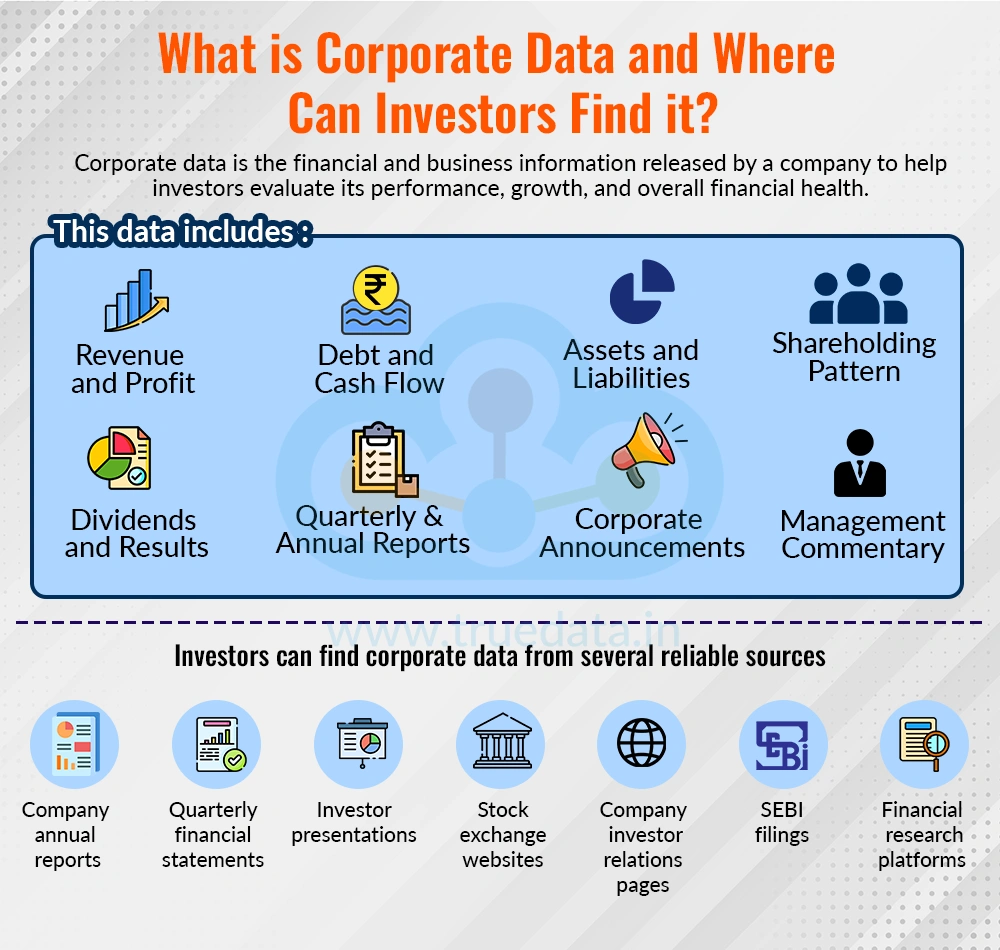
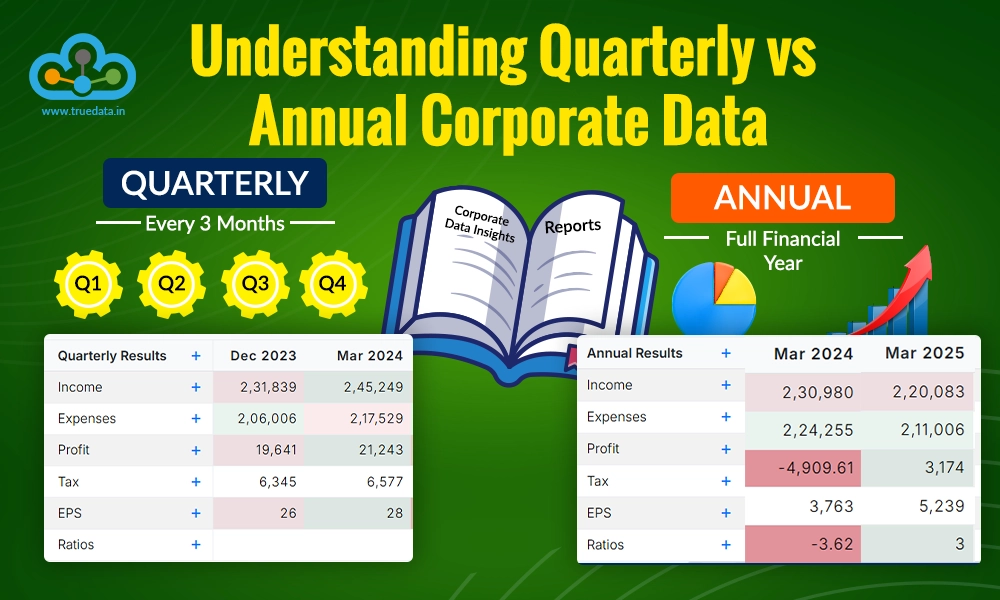
Corporate data refers to the financial and non-financial information released by a company that helps investors understand its business performance, financial health, risks, growth potential, and management quality. This data includes important details such as revenue, profit, debt, cash flow, assets, liabilities, shareholding pattern, dividends, quarterly results, annual reports, corporate announcements, and management commentary. Investors use this information to evaluate whether a company is financially strong, efficiently managed, and suitable for long-term investment.
Investors can find corporate data from several reliable sources, such as company annual reports, quarterly financial statements, investor presentations, stock exchange websites NSE India and BSE India, company investor relations pages, SEBI filings, and financial research platforms. It is crucial to regularly track corporate data as it helps investors make informed decisions based on facts and financial performance instead of relying only on market rumours or emotions.

Analysing corporate data is the basis of shaping an investment portfolio. The importance of using corporate data for analysis is explained below.
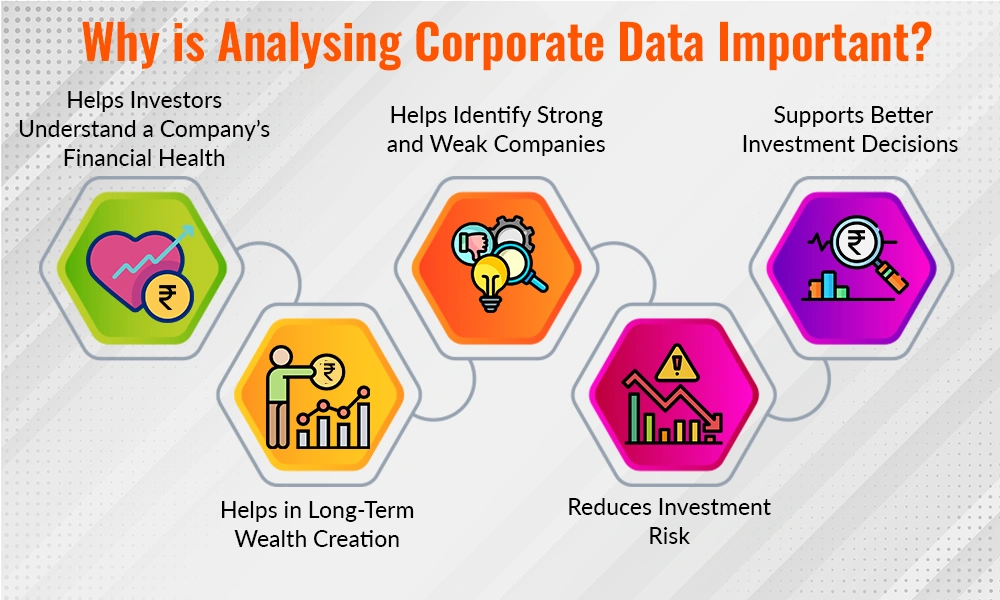
Helps Investors Understand a Company’s Financial Health - Corporate data gives investors a clear picture of how a company is performing financially. By analysing metrics like revenue, profit, debt, and cash flow, investors can understand whether the business is stable, growing, or facing challenges. This helps in avoiding investments based only on market hype or rumours.
Helps Identify Strong and Weak Companies - Not all companies in the market are equally strong. Analysing corporate data helps investors compare companies within the same sector and identify businesses with better profitability, efficient management, and healthy growth potential. It also highlights warning signs like falling profits or rising debt.
Supports Better Investment Decisions - Investing without proper analysis can increase risk. Corporate data helps investors make informed decisions based on facts instead of emotions. It allows investors to judge whether a stock is fairly valued, overvalued, or undervalued before investing their hard-earned money.
Helps in Long-Term Wealth Creation - Companies with strong fundamentals often have a better chance of delivering stable long-term growth. Tracking corporate data regularly helps investors stay invested in quality businesses and build wealth steadily over time.
Reduces Investment Risk - Analysing financial and business data can help investors spot potential problems early, such as declining sales, poor cash flow, or excessive borrowing. This can reduce the chances of investing in financially weak companies and protect investors from major losses.
Before investing in a company, investors should look beyond stock price movements and analyse important corporate data metrics. These metrics help in understanding a company’s financial strength, profitability, growth potential, valuation, and overall business quality. By tracking the right data points, investors can make informed investment decisions instead of relying only on market sentiment or tips. Here are some of the most important corporate data metrics every investor should consider before investing.

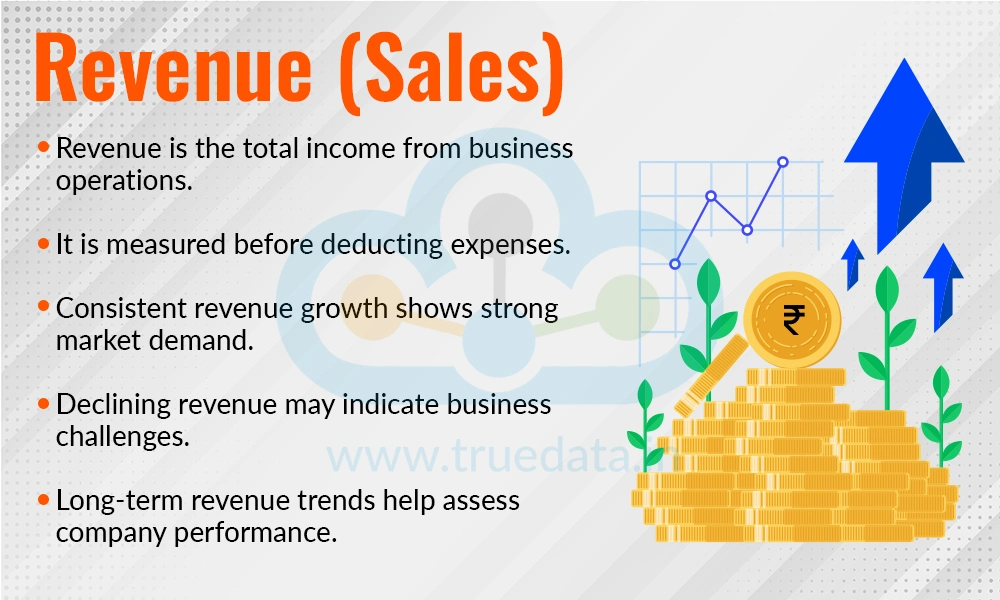
Revenue is the total income generated by a company from its business operations before expenses are deducted. It is one of the first indicators investors should track because consistent revenue growth often reflects rising demand for the company’s products or services. A company with steadily growing revenue may have strong market demand, good customer reach, and expansion potential. On the other hand, stagnant or declining revenue can indicate slowing business growth or increased competition. Investors should not just look at a single year’s revenue. Analysing revenue growth over multiple quarters or years gives a better picture of the company’s long-term performance.

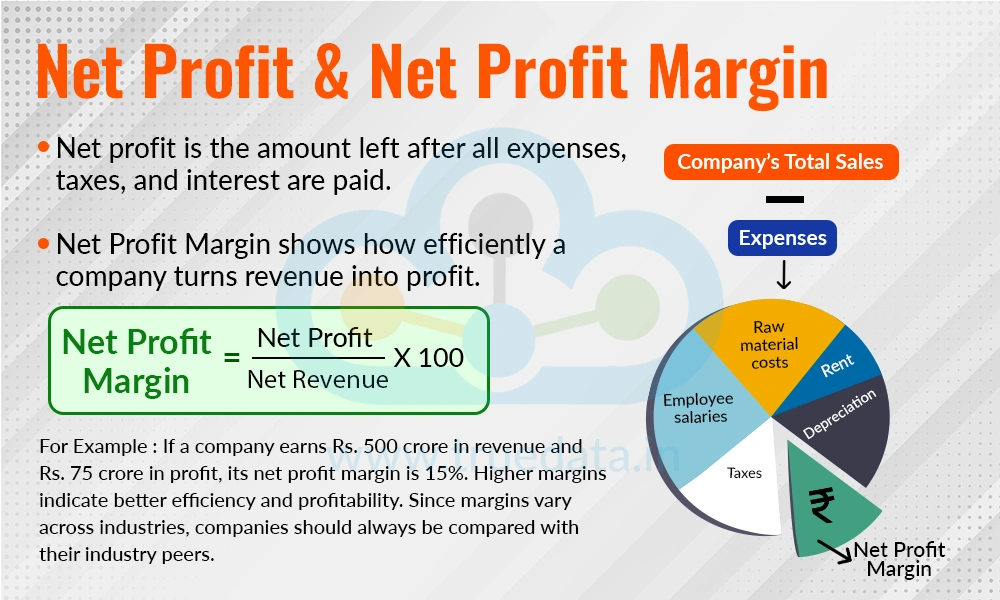
If revenue is the top line, net profit is the bottom line, i.e., what is actually left for the company after paying all its expenses, taxes, and interest. However, more than just the profit number, savvy investors look at the Net Profit Margin, which indicates how efficiently a company converts its revenue into profit.
Net Profit Margin = Net Profit / Net Revenue * 100
For example, if a company earns Rs. 500 crore in revenue and has a net profit of Rs. 75 crore, its net profit margin is 15%. This means for every Rs. 100 earned, it keeps Rs. 15 as profit. A higher and improving margin over time is a sign of strong operational efficiency and pricing power. In India, margins vary significantly by sector. Technology and pharma companies tend to enjoy higher margins (15 - 25%), while retail and infrastructure companies may operate on thinner margins (3 - 8%). Thus, it is important to always compare a company's margin against its industry peers, not in isolation.

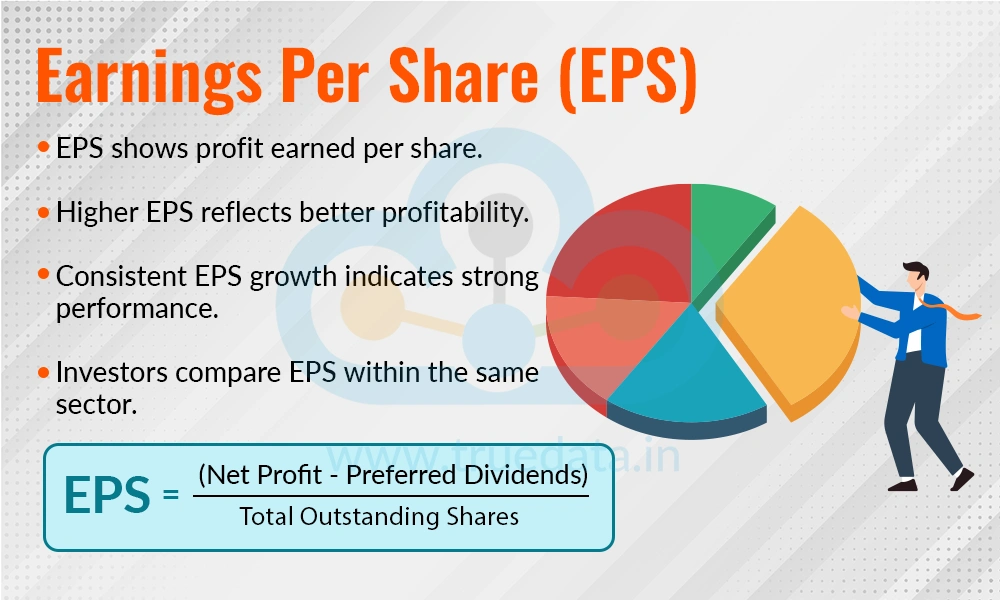
Earnings Per Share (EPS) measures how much profit a company earns for each outstanding share. It is one of the most widely used metrics for evaluating a company’s profitability from a shareholder’s perspective. A higher and consistently growing EPS often reflects improving company performance. Investors usually compare EPS growth over time rather than focusing only on the current number, and it is also commonly used to compare the performance of companies in the same sector.
The formula for EPS is,
EPS = (Net Profit - Preferred Dividends) / Total Outstanding Shares

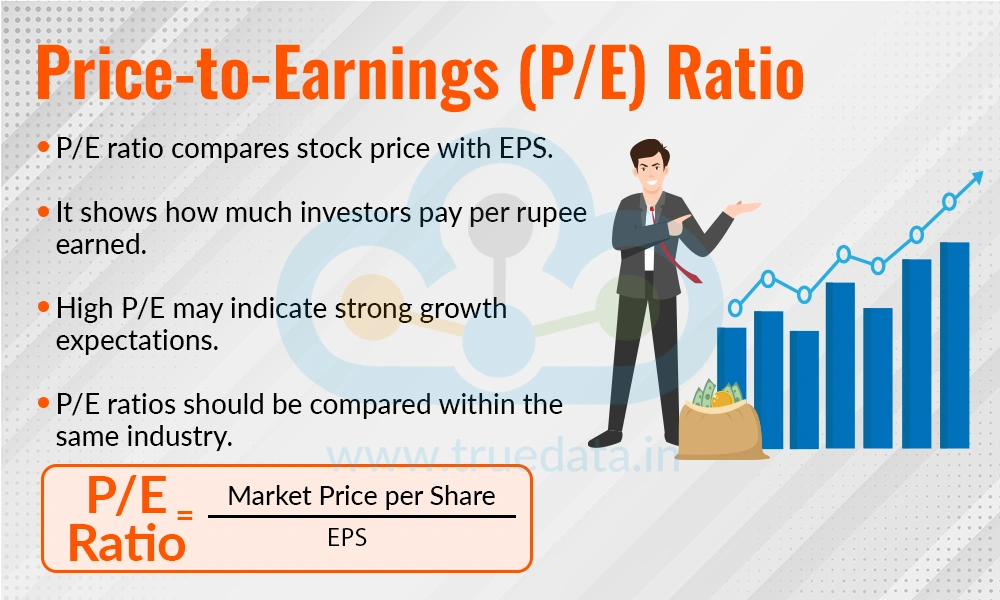
The Price-to-Earnings Ratio (P/E Ratio) compares a company’s stock price with its earnings per share. It helps investors understand how much they are paying for every rupee of earnings generated by the company. A high P/E ratio may indicate that investors expect strong future growth. A low P/E ratio may suggest undervaluation or weak growth expectations. However, P/E ratios should always be compared with industry averages because different sectors trade at different valuation levels.
The formula to calculate the P/E ratio is,
P/E Ratio = Market Price per Share / Earnings Per Share

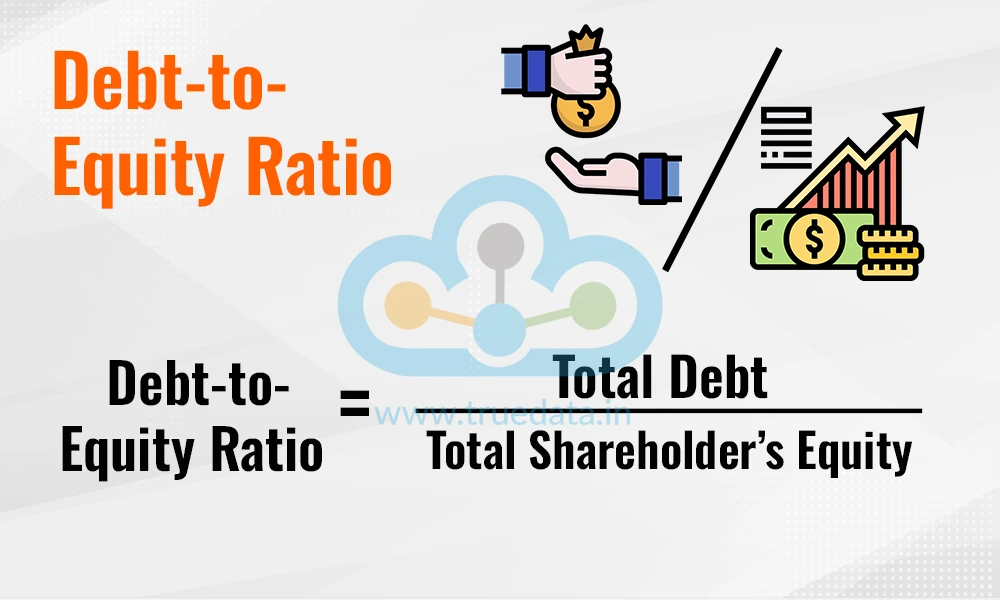
The Debt-to-Equity Ratio measures how much debt a company uses compared to shareholders’ equity. Companies often borrow money for expansion, but excessive debt can increase financial risk, especially during economic slowdowns or periods of high interest rates. A moderate level of debt may be manageable, but consistently high debt can reduce profitability and strain cash flows. Capital-intensive industries like infrastructure or telecom may naturally have higher debt levels, so it is important to consider the industry when evaluating.
The formula to calculate Debt-to-Equity Ratio is,
Debt-to-Equity Ratio = Total Debt / Shareholders’ Equity

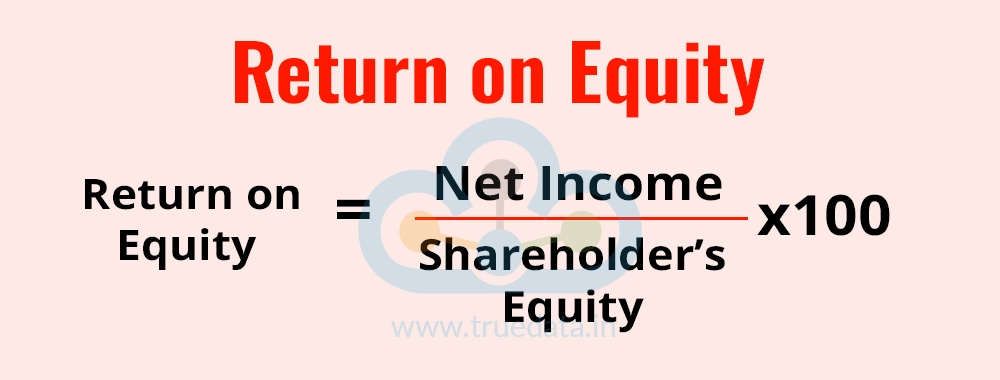
Return on Equity (ROE) is one of the favourite metrics of legendary investors like Warren Buffett, and Indian investors would do well to adopt it too. It measures how efficiently a company uses shareholders' money to generate profits.
The formula to calculate ROE is,
ROE = Net Profit / Shareholders’ Equity * 100
If a company has a net profit of Rs. 100 crore and shareholders’ equity of Rs. 500 crore, its ROE is 20%, meaning it generates Rs. 20 of profit for every Rs. 100 of shareholder investment. An ROE consistently above 15 - 20% over several years is a strong indicator of a well-run company with a competitive advantage. In India, companies like Asian Paints, HDFC Bank, and Pidilite have been celebrated for maintaining high ROEs over decades, which is a major reason they are considered quality businesses.

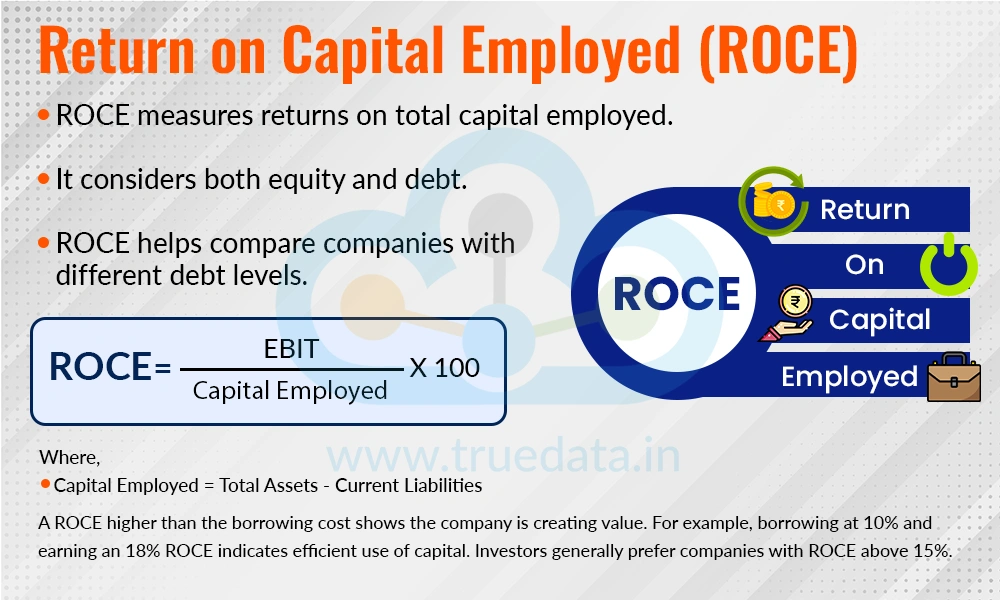
While ROE looks at returns on equity alone, ROCE gives a broader picture by considering the returns generated on all capital employed, i.e., both equity and debt. This makes it especially useful when comparing companies that have different debt structures.
The formula to calculate the ROCE is,
ROCE = EBIT / Capital Employed * 100
Where,
Capital Employed = Total Assets - Current Liabilities
A ROCE higher than the company's cost of borrowing (interest rate) means the company is creating value. If a company borrows at 10% but generates a ROCE of 18%, it is effectively making money on borrowed money, which is a very positive sign. Investors should look for companies with an ROCE above 15% as a general benchmark.

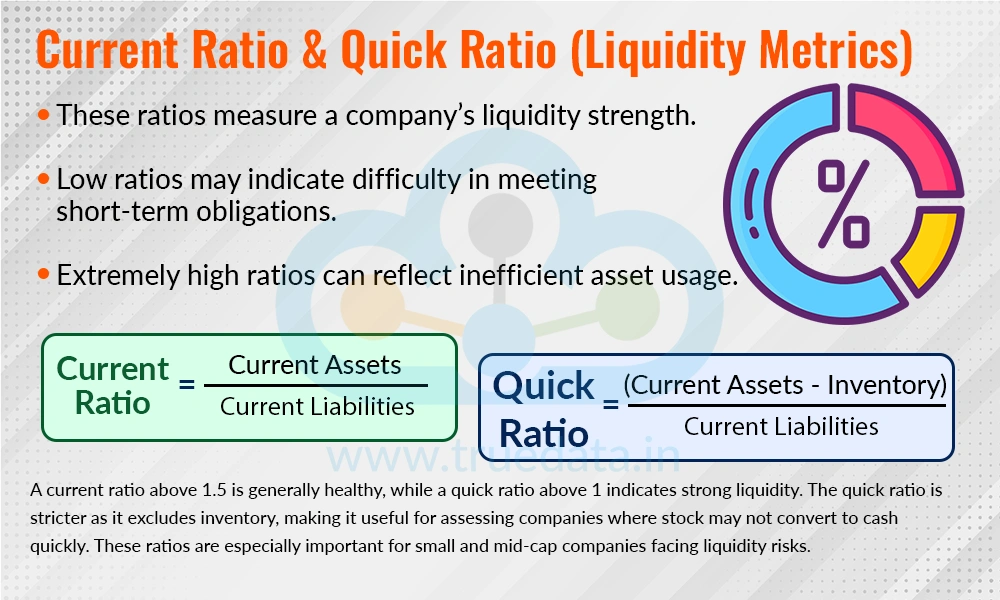
These two ratios indicate whether a company can comfortably pay its short-term obligations. Thus, it helps assess the liquidity strength of a company. A very low ratio may indicate liquidity problems, while an extremely high ratio may suggest inefficient use of assets.
The formulas to calculate the Current Ratio and Quick Ratio are,
Current Ratio = Current Assets / Current Liabilities
Quick Ratio = (Current Assets - Inventory) / Current Liabilities
A current ratio above 1.5 is considered healthy, while a quick ratio above 1 is reassuring. The quick ratio is stricter because it excludes inventory, which may not always be easy to convert to cash quickly, especially for manufacturing or retail companies sitting on large inventory piles. These ratios are particularly important when investing in small and mid-cap companies, where liquidity crunches can hit hard and fast.

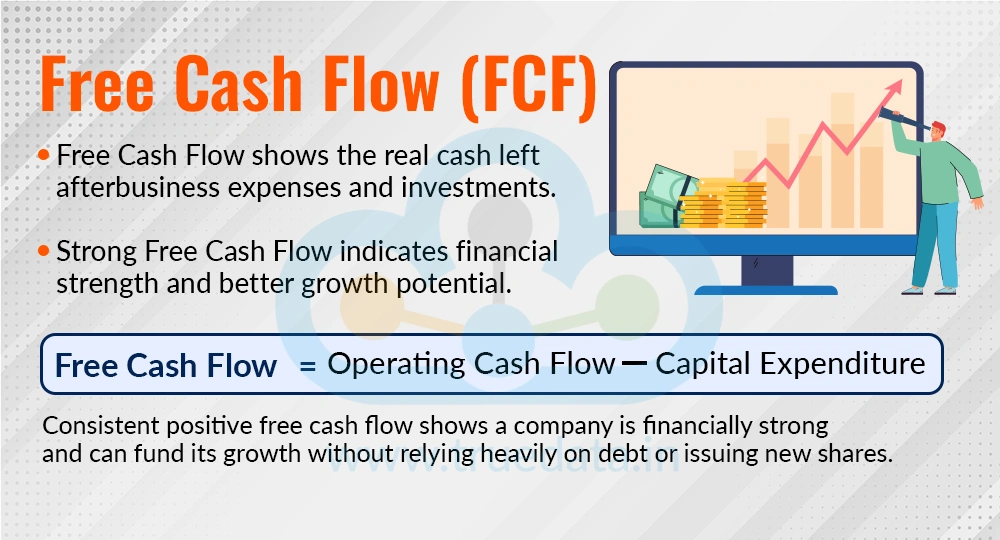
Profits can be dressed up; cash flow cannot. Free Cash Flow is the actual cash a company generates after spending on maintaining and growing its business (capital expenditure). It's often called the ‘real profit’ of a business.
The formula to calculate the Free Cash Flow is,
Free Cash Flow = Operating Cash Flow - Capital Expenditure
A company that consistently generates positive free cash flow is self-sufficient, and it does not always need to raise money from the market or banks to fund its operations. This is a key quality indicator, particularly as many companies dilute shareholders by repeatedly issuing new shares or taking on more debt.

This is a uniquely important metric for Indian stock market investors that often goes overlooked in global investing literature. In India, promoter holding (the stake held by the company's founders or controlling family) is publicly disclosed every quarter and is a powerful signal of confidence. A high and stable promoter holding (above 50 - 60%) generally indicates that the founders believe in the company's future. More importantly, investors should watch out for pledged shares, as when promoters pledge their shares as collateral to take loans, it signals financial stress and can lead to forced selling if stock prices fall, causing sharp crashes (as seen in the IL&FS and Zee Entertainment crises).

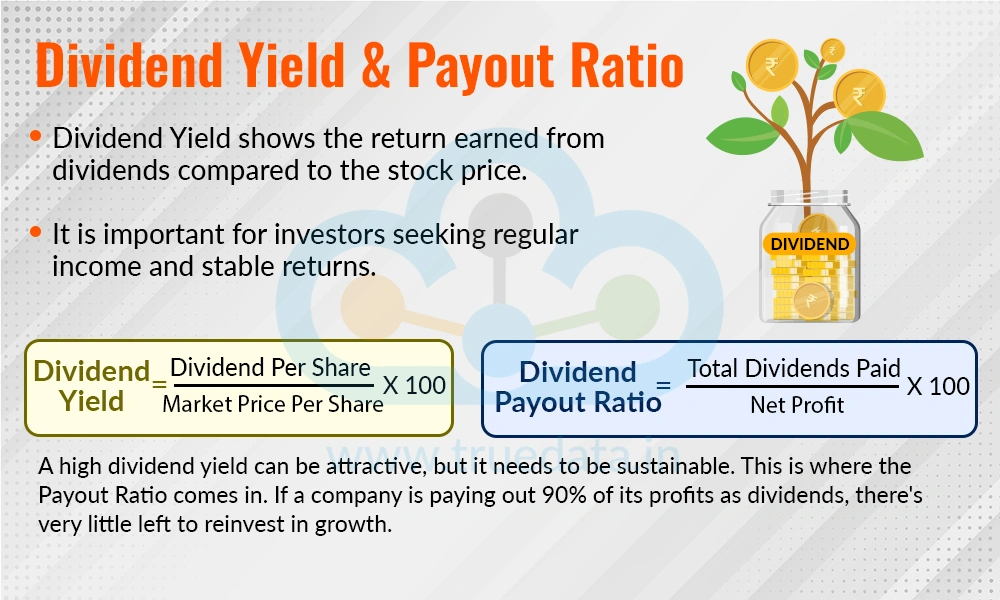
Dividends are a key consideration for many retail investors, particularly those investing for regular income or retirement. The Dividend Yield indicates how much return investors get purely from dividends relative to the stock price.
The key dividend formulas investors should consider are,
Dividend Yield = Dividend Per Share / Market Price Per Share * 100
Dividend Payout Ratio = Total Dividends Paid / Net Profit * 100
A high dividend yield can be attractive, but it needs to be sustainable. This is where the Payout Ratio comes in. If a company is paying out 90% of its profits as dividends, there's very little left to reinvest in growth. That may be fine for a mature, slow-growing company (like many PSUs or established FMCG brands), but it could be a concern for a growth company that needs capital to expand.

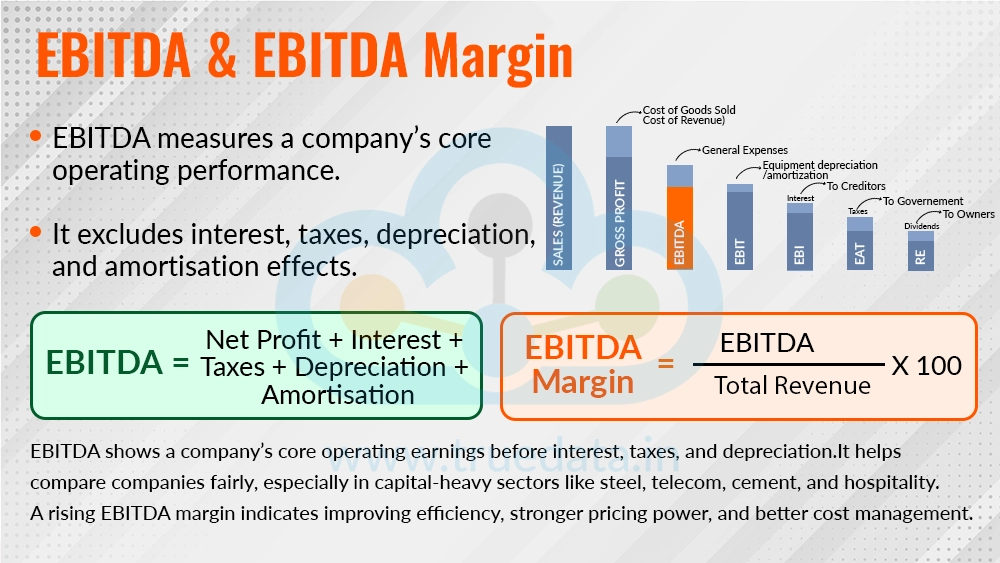
EBITDA stands for Earnings Before Interest, Taxes, Depreciation, and Amortisation. It is actually one of the most honest ways to measure a company's core operating performance by stripping away the effects of financing decisions, tax environments, and accounting adjustments.
The formula for EBITDA and EBITDA Margin is,
EBITDA = Net Profit + Interest + Taxes + Depreciation + Amortisation
EBITDA Margin = EBITDA / Total Revenue * 100
EBITDA represents the earnings a business generates purely from its operations, before the accountants and tax authorities get involved. This makes it extremely useful when comparing companies across different capital structures. For example, comparing a debt-heavy Tata Steel with a relatively debt-free company like Infosys on a level playing field.
EBITDA margin is widely used by analysts to track profitability trends in sectors like telecom, cement, steel, and hospitality. These are industries where depreciation and interest costs can be enormous and can distort net profit figures significantly. A consistently expanding EBITDA margin over the years is a strong sign that the company is becoming more operationally efficient, gaining pricing power, or successfully managing its input costs.

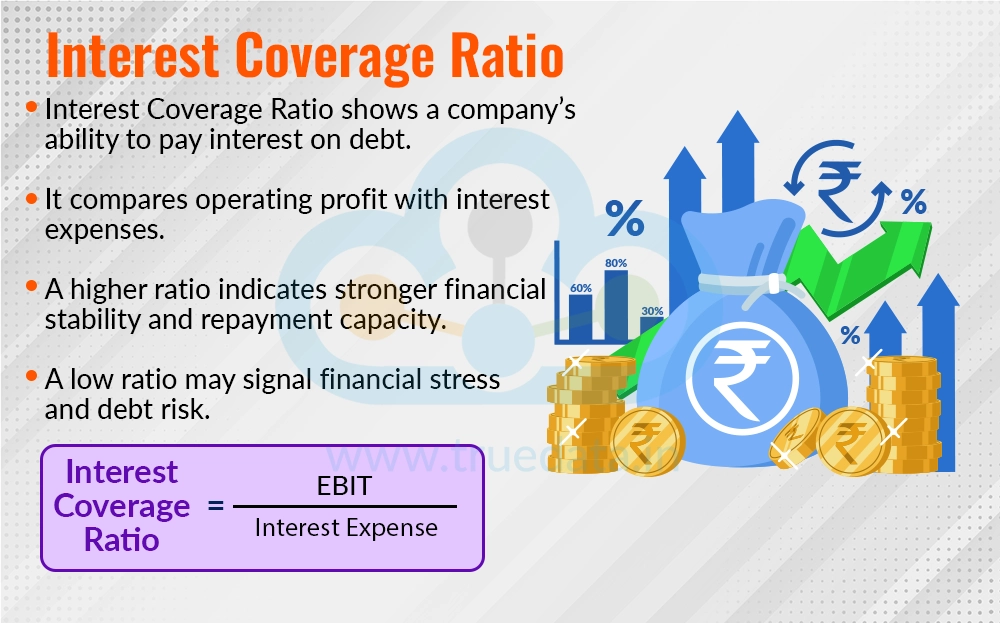
The Interest Coverage Ratio measures how easily a company can pay interest on its outstanding debt using its operating profits. It is an important metric for understanding the company’s financial safety and debt repayment capacity. A higher ratio generally indicates that the company is comfortably generating enough earnings to meet its interest obligations. A very low ratio may suggest financial stress, especially during periods of slow business growth or rising interest rates.
The formula to calculate the Interest Coverage Ratio is
Interest Coverage Ratio = EBIT / Interest Expense

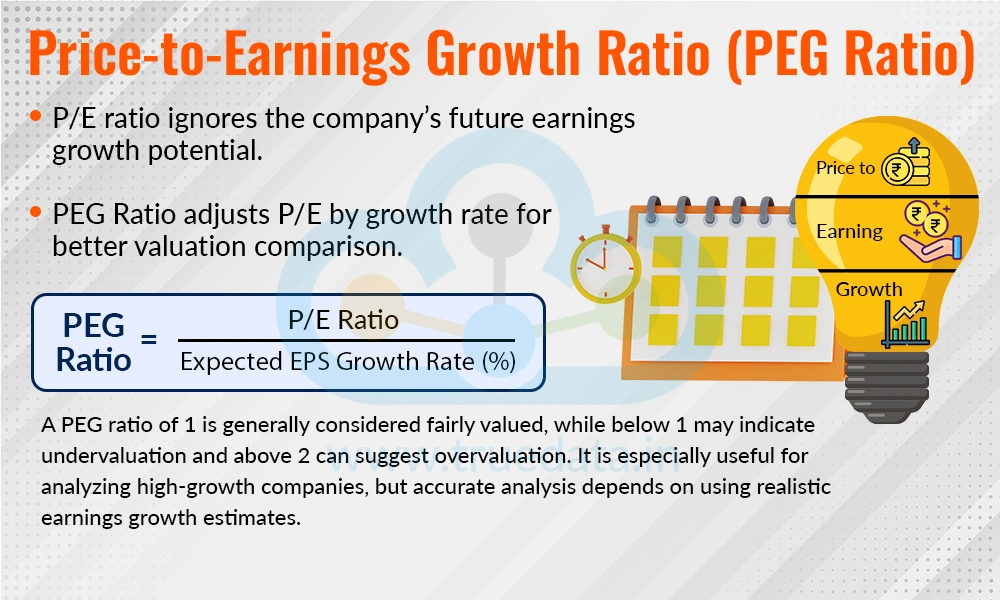
The P/E ratio is a powerful and commonly used metric, but it has a blind spot. It does not account for how fast the company is growing. A company with a P/E of 40x might actually be cheaper than one at 20x if it is growing earnings twice as fast. This is exactly what the PEG Ratio corrects for.
The formula for calculating the PEG Ratio is,
PEG Ratio = P/E Ratio / Expected EPS Growth Rate (%)
If a company has a P/E of 30x and is growing its EPS at 30% annually, its PEG ratio is 1, which is generally considered fairly valued. A PEG below 1 suggests the stock may be undervalued relative to its growth, while a PEG above 2 suggests it may be overvalued.
This metric is especially useful for investors evaluating high-growth sectors like speciality chemicals, consumer tech, or new-age financial services, where P/E ratios can look stretched at first glance but are justified by rapid earnings growth. However, it is also important to note that optimistic growth estimates should be used for accurate analysis with realistic, conservative projections rather than best-case scenarios.

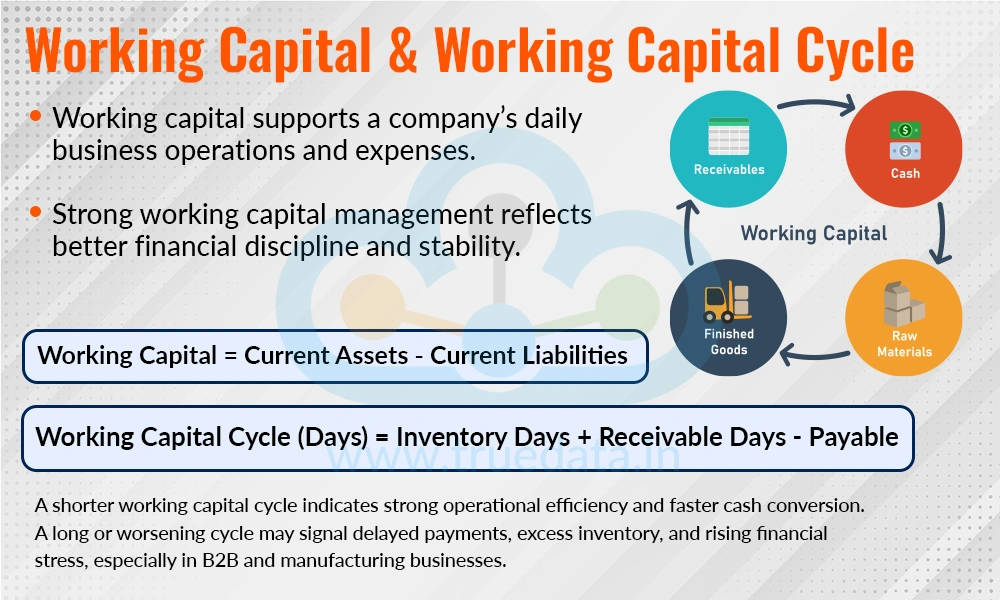
Working capital is the money a company needs to run its day-to-day operations, i.e., paying suppliers, managing inventory, and collecting payments from customers. It is a behind-the-scenes metric that often separates financially disciplined companies from struggling ones.
The formula to calculate Working Capital & Working Capital Cycle is,
Working Capital = Current Assets - Current Liabilities
Working Capital Cycle (Days) = Inventory Days + Receivable Days - Payable Days
A shorter working capital cycle means the company converts its investments in inventory and receivables into cash quickly, which is a sign of strong operational efficiency and bargaining power. DMart, for instance, is famous for its negative working capital cycle; it collects cash from customers before it even pays its suppliers, which is an extraordinary business advantage. On the other hand, a company with a long or worsening working capital cycle may be struggling to collect payments (high receivable days) or sitting on too much inventory, both of which drain cash and signal operational stress. This metric is especially worth watching in B2B businesses, infrastructure companies, and mid-cap manufacturers where payment delays and working capital stress are common pain points.

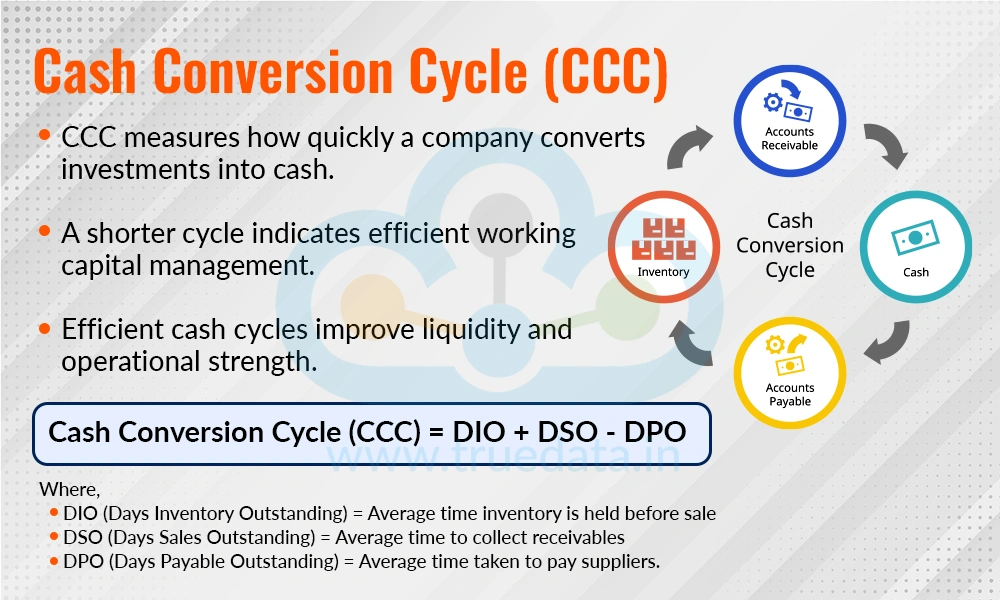
The Cash Conversion Cycle measures the time a company takes to convert its investments in inventory and other resources into cash from sales. A shorter cycle generally indicates efficient working capital management and strong cash flow management quality. Companies with efficient cash cycles may have better liquidity and operational strength.
The formula to calculate Cash Conversion Cycle (CCC) is,
Cash Conversion Cycle (CCC) = DIO + DSO - DPO
Where,
DIO (Days Inventory Outstanding) = Average time inventory is held before sale
DSO (Days Sales Outstanding) = Average time to collect receivables
DPO (Days Payable Outstanding) = Average time taken to pay suppliers.
Tracking key corporate data metrics is an important step before investing in any company. Metrics like revenue, profit, debt, cash flow, valuation ratios, and return ratios help investors understand a company’s financial health, growth potential, and overall business quality. Instead of making decisions based only on market trends or emotions, investors should use corporate data to make informed and confident investment choices. A disciplined approach to analysing these metrics can help investors reduce risk, identify strong companies, and build long-term wealth more effectively.
This article highlights the key markers used in analysing a company. Watch out for part 2 of this blog, where we analyse real corporate data to evaluate the financial health of an organisation, bridging the gap between theoretical understanding and practical application.
Till then, Happy Reading!
Read More: Return on Assets - How to Calculate it and Use it
Thestock market never stands still, and prices swing constantly with every new h...
Corporate financial data is the backbone ofsmart investing. It helps investors d...