Debt and equity together form the total capital of a company. However, when analysed separately, they can reveal a lot about the company’s financial strength, growth strategy and risk levels. While we discussed the debt-to-equity ratio in our earlier blog, there are several other ratios that examine debt and equity individually and provide deeper insights into a company’s financial structure. Dive into this blog to explore these debt and equity ratios and understand why they are important tools in the fundamental analysis of stocks.

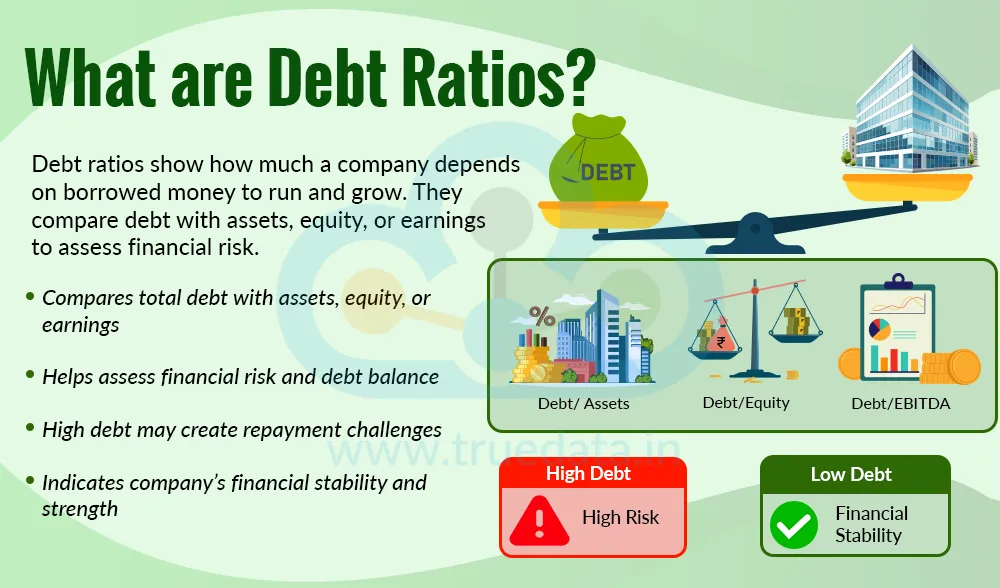
Debt ratios are financial metrics that help investors understand how much a company relies on borrowed money to run and grow its business. These ratios compare a company’s total debt with different parts of its financial structure, such as its assets, equity, or earnings. By analysing debt ratios, investors can assess whether a company is using debt in a balanced way or if it is taking on too much financial risk. A company with very high debt may face difficulty in repaying loans or interest during slow business periods, while a company with manageable debt is usually seen as financially more stable. Therefore, debt ratios are an important part of fundamental analysis because they help investors judge a company’s financial strength, risk level, and ability to meet its long-term obligations.
Debt ratios are calculated by comparing a company’s total debt with different financial measures, such as assets or total capital employed. These ratios help investors understand how much the company relies on borrowed funds and whether it can comfortably repay its obligations. By looking at multiple debt ratios together, investors get a clearer picture of the company’s financial risk, stability, and long-term sustainability. The common debt ratios include,

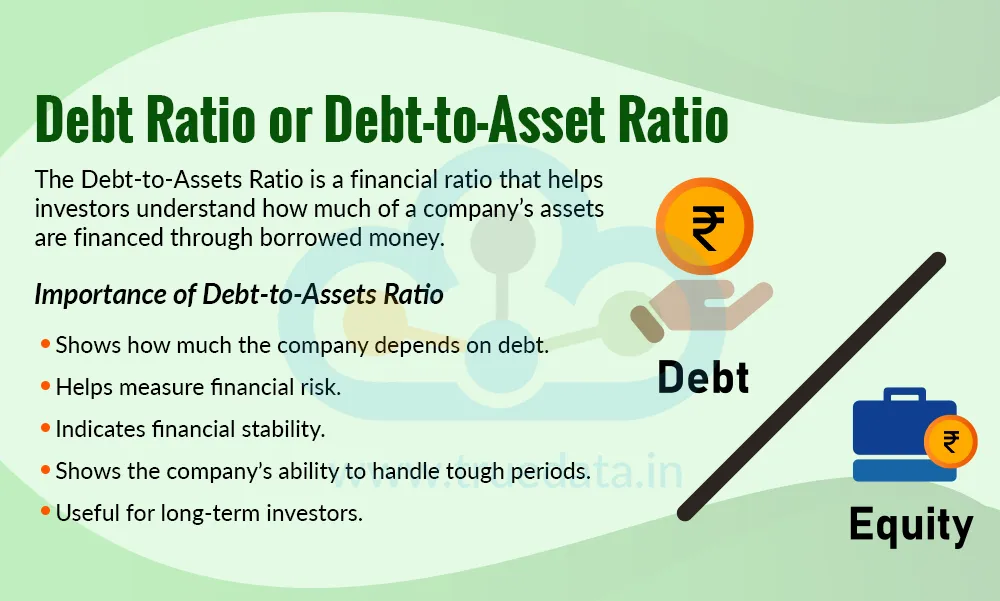
The Debt-to-Assets Ratio is a financial ratio that helps investors understand how much of a company’s assets are financed through borrowed money. It shows the proportion of a company’s total assets that come from debt rather than the company’s own funds. Companies usually use a mix of equity (owners’ funds) and debt (borrowed funds) to run and grow their business. This ratio tells investors how large the debt portion is compared to the company’s total assets.
Importance of Debt-to-Assets Ratio
Shows how much the company depends on debt - It helps investors see how much of the company’s assets are financed through borrowing.
Helps measure financial risk - A higher ratio may indicate higher risk because the company has to pay interest and repay debt regularly.
Indicates financial stability - Companies with lower debt levels are usually more financially stable and less burdened by fixed payments.
Shows the company’s ability to handle tough periods - Businesses with lower debt are often better able to manage slow economic conditions or weak sales.
Useful for long-term investors - It helps investors identify companies that manage debt carefully and maintain a healthy financial structure.
Calculation of Debt-to-Assets Ratio

The debt-to-assets ratio shows what portion of a company’s assets is financed through debt. The formula to calculate the debt-to-assets ratio is,
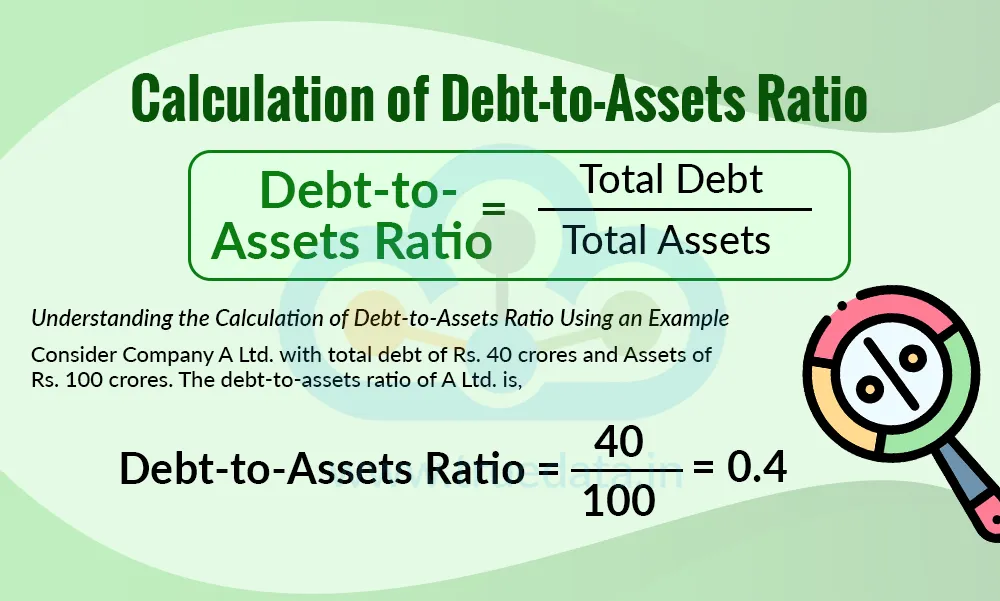
Debt-to-Assets Ratio = Total Debt / Total Assets
Understanding the Calculation of Debt-to-Assets Ratio Using an Example
Consider Company A Ltd. with total debt of Rs. 40 crores and Assets of Rs. 100 crores. The debt-to-assets ratio of A Ltd. is,
Debt-to-Assets Ratio = Total Debt / Total Assets
Debt-to-Assets Ratio = 40/100 = 0.4
Thus, 40% of the company’s assets are financed by debt.
Interpretation of Debt-to-Assets Ratio
Higher ratio indicates higher financial risk - A higher ratio means a larger portion of the company’s assets is financed through debt, which increases repayment and interest obligations. Sectors like infrastructure, telecom, and utilities often use more debt because they require large investments in assets.
Too much debt can create financial pressure - If the ratio becomes very high, the company may find it difficult to repay its debt during economic slowdowns or when profits fall.
Lower ratio indicates stronger financial position - A lower ratio means the company relies more on its own funds, which usually reduces financial risk.
A very low ratio may limit growth - If a company avoids debt completely, it may miss opportunities to expand or invest in new projects.
It is important to note that the debt-to-assets ratio should be used for comparing companies in the same industry to understand whether the debt level is reasonable.

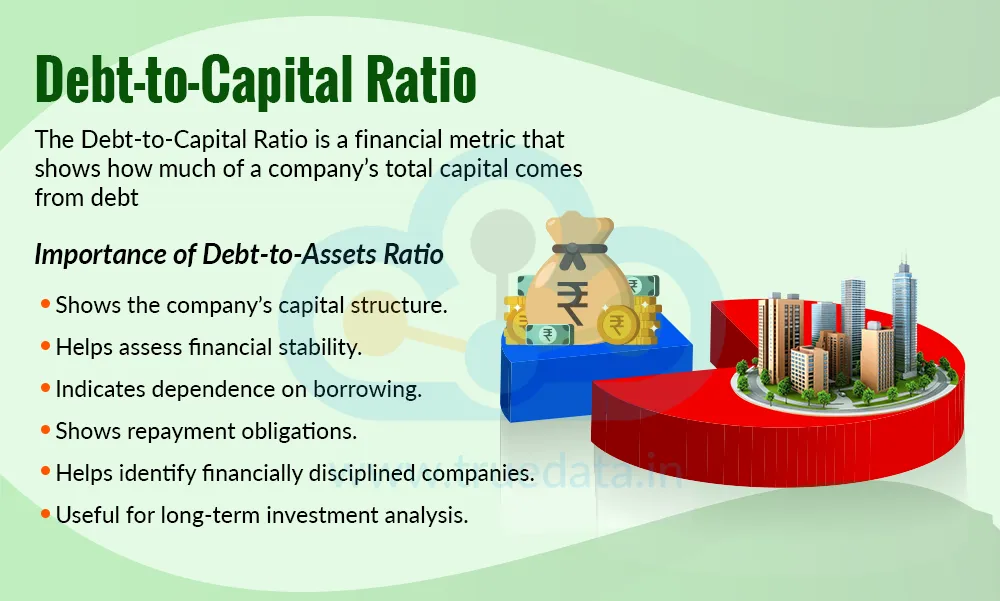
The Debt-to-Capital Ratio is a financial metric that shows how much of a company’s total capital comes from debt. It tells investors what portion of the company’s overall funding is borrowed money compared to the owner’s funds. This ratio helps investors understand the balance between these two sources of funding.
Importance of the Debt-to-Capital Ratio
Shows the company’s capital structure - It helps investors understand how much of the company’s funding comes from debt compared to shareholders’ equity.
Helps assess financial stability - Companies with balanced debt and equity are usually considered more financially stable.
Indicates dependence on borrowing - A higher ratio shows the company relies more on borrowed funds to finance its operations and growth.
Shows repayment obligations - Companies with higher debt must regularly pay interest and repay loans, which can create financial pressure if profits decline.
Helps identify financially disciplined companies - Investors can use this ratio to find businesses that maintain a healthy balance between debt and equity.
Useful for long-term investment analysis - It helps investors evaluate whether a company’s financing structure is sustainable over time.
Calculation of Debt-to-Capital Ratio

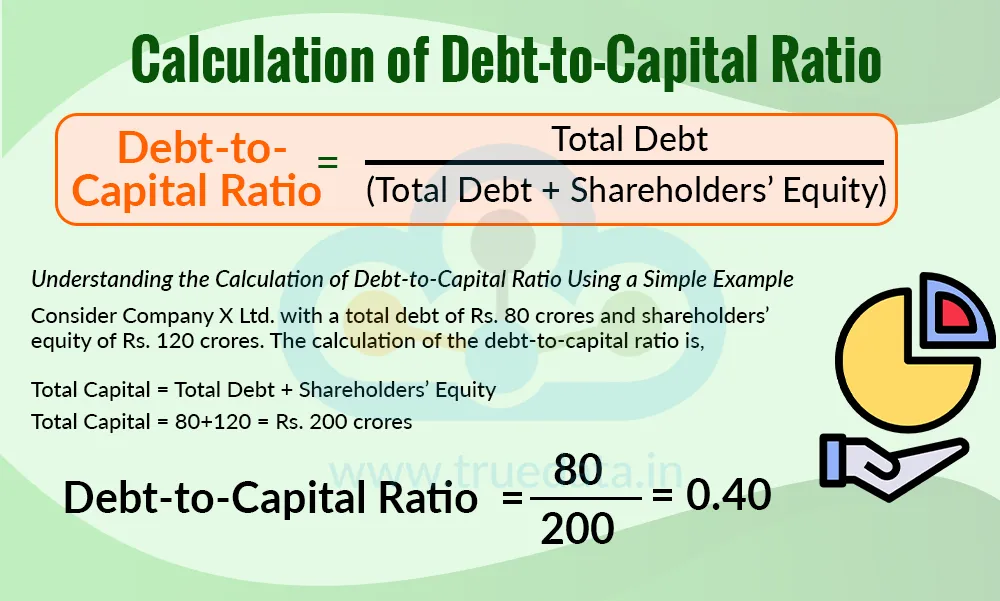
The debt-to-capital ratio indicates the proportion of debt used in the company’s total capital structure. The formula to calculate the debt-to-capital ratio is,
Debt-to-Capital Ratio = Total Debt / (Total Debt + Shareholders’ Equity)
Where,
The Total Debt includes all short-term and long-term borrowings of the company.
Shareholders’ Equity represents the owners’ funds invested in the company, including share capital and retained earnings.
Understanding the Calculation of Debt-to-Capital Ratio Using a Simple Example
Consider Company X Ltd. with a total debt of Rs. 80 crores and shareholders’ equity of Rs. 120 crores. The calculation of the debt-to-capital ratio is,
Total Capital = Total Debt + Shareholders’ Equity
Total Capital = 80+120 = Rs. 200 crores
Debt-to-Capital Ratio = Total Debt / (Total Debt + Shareholders’ Equity)
Debt-to-Capital Ratio = 80/200 = 0.40
Thus, 40% of the company’s total capital comes from debt, while the remaining 60% comes from shareholders’ equity, indicating a moderate level of borrowing in its capital structure.
Interpretation of Debt-to-Capital Ratio
A higher ratio indicates greater use of debt - A higher ratio means a larger portion of the company’s capital comes from borrowed funds. Companies with more debt have higher repayment and interest obligations.
Moderate debt can support growth - Many companies use debt to fund expansion, invest in new projects, or grow their business.
A lower ratio indicates more equity funding - A lower ratio means the company relies more on shareholders’ funds rather than borrowing. Companies with less debt typically have fewer fixed payment obligations.
A very low ratio may limit growth opportunities - If a company uses very little debt, it may miss opportunities to expand or invest.

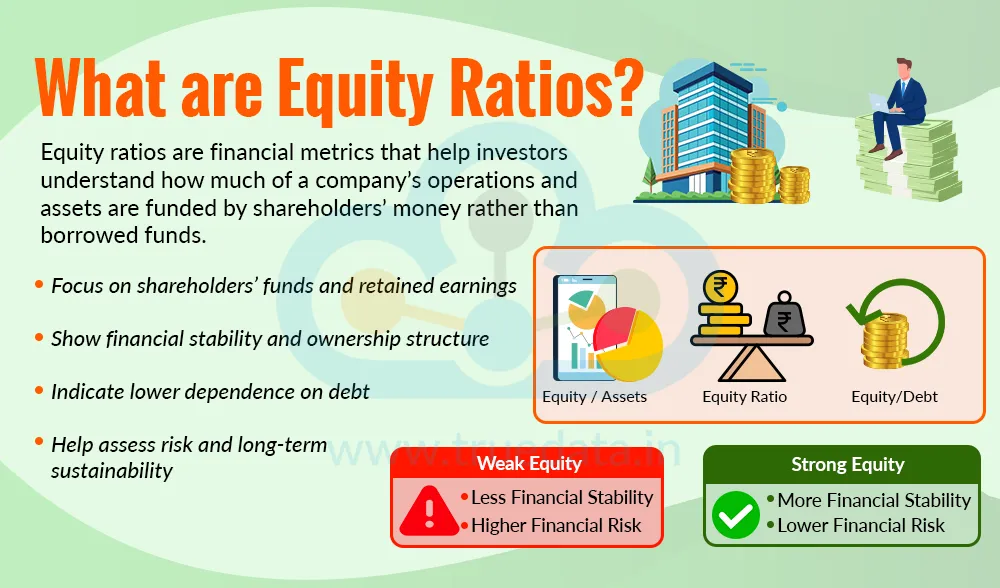
Equity ratios are financial metrics that help investors understand how much of a company’s operations and assets are funded by shareholders’ money rather than borrowed funds. These ratios focus on the equity portion of a company’s capital structure, which includes funds invested by shareholders and retained earnings kept in the business. Equity ratios help investors evaluate the company’s financial stability, ownership structure, and reliance on internal funds for growth. A company with stronger equity support is generally considered more financially stable because it depends less on debt and has a greater cushion to absorb losses during difficult periods. Therefore, equity ratios are useful tools in fundamental analysis as they help investors assess the company’s financial strength, risk level, and long-term sustainability.
Equity ratios are calculated by comparing shareholders’ equity with different financial elements such as total assets, total capital, or company earnings. These ratios help investors understand how much of the company is funded by the owners and how efficiently that capital is being used. By analysing equity ratios, investors can assess a company’s financial stability, ownership strength, and ability to generate returns for shareholders. The common equity ratios include,

The Equity Ratio is a financial metric that shows how much of a company’s total assets are financed by shareholders’ funds. It helps investors understand how much the company depends on its own funds rather than borrowing.
Importance of the Equity Ratio
Shows the company’s financial strength - It helps investors understand how much of the company’s assets are supported by shareholders’ funds.
Indicates long-term financial stability - Companies with higher equity support usually have a stronger financial foundation.
Reduces financial obligations - Companies with higher equity generally have fewer interest and loan repayment commitments.
Helps manage difficult business conditions - Businesses with strong equity funding are often better able to handle economic slowdowns or financial challenges.
Useful for identifying financially stable companies - Investors can use this ratio to find companies with lower financial risk and a solid financial base.
Calculation of Equity Ratio

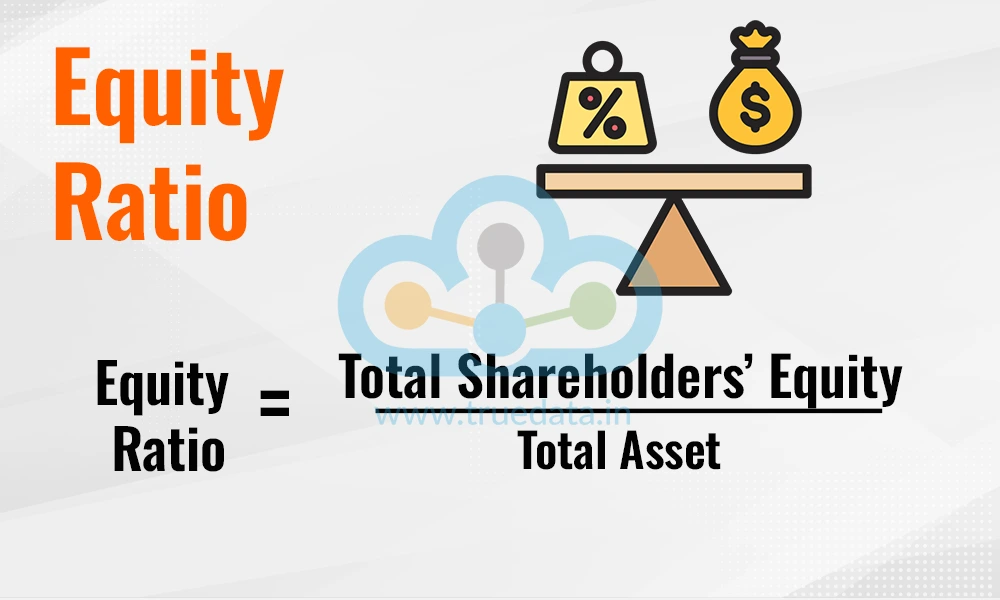
The equity ratio helps determine the portion of assets that are financed by shareholders rather than creditors. The formula to calculate the equity ratio is,
Equity Ratio = Shareholders’ Equity / Total Assets
Where,
Shareholders’ Equity represents the owners’ funds invested in the company, including share capital and retained earnings.
Total Assets include everything the company owns, such as cash, property, equipment, inventory, and investments.
Understanding the Calculation of the Equity Ratio Using an Example
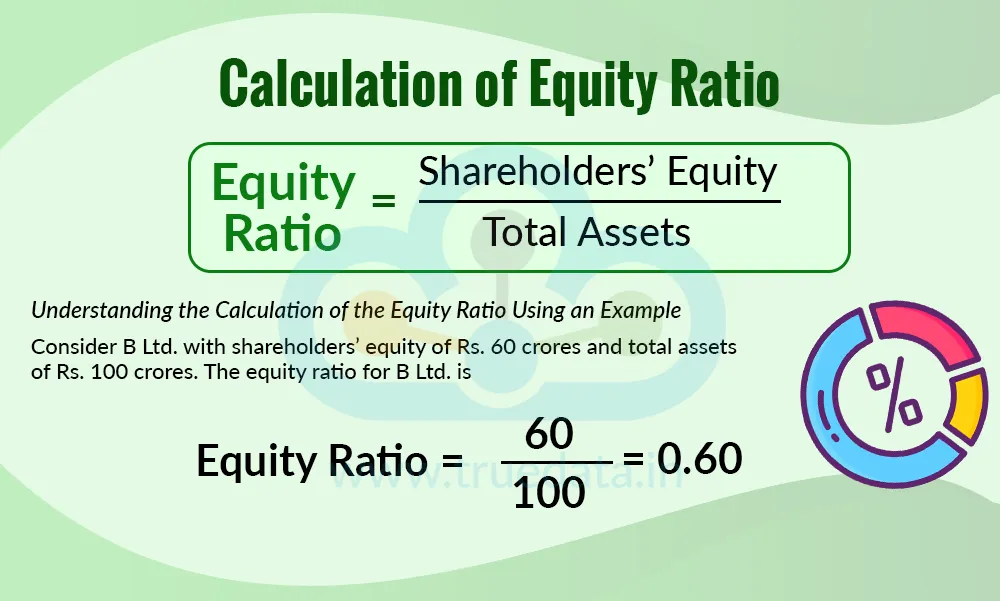
Consider B Ltd. with shareholders’ equity of Rs. 60 crores and total assets of Rs. 100 crores. The equity ratio for B Ltd. is
Equity Ratio = Shareholders’ Equity / Total Assets
Equity ratio = 60/100 = 0.60
Thus, 60% of the company’s assets are financed by shareholders’ funds, while the remaining 40% is financed through debt or other liabilities.
Interpretation of Equity Ratio
Higher ratio indicates stronger financial stability - A higher equity ratio implies a larger portion of the company’s assets is financed by shareholders’ funds.
Lower financial risk - Companies with higher equity usually have fewer loan obligations and lower financial pressure.
A lower ratio indicates higher use of debt - A lower equity ratio means the company relies more on borrowed funds to finance its assets.
Higher debt can increase financial pressure - Companies with lower equity may face higher interest and repayment obligations. However, debt can also support growth, and companies may use debt strategically to expand and invest in new opportunities.

The Equity Multiplier is a financial ratio that measures how much of a company’s assets are financed through shareholders’ equity. It is also known as the financial leverage ratio and shows how many rupees of assets a company controls for every rupee of equity invested by shareholders. This ratio helps investors understand how much financial leverage the company is using.
Importance of Equity Multiplier
Shows the level of financial leverage - It helps investors understand how much the company is using borrowed money along with equity to finance its assets, or how many assets the company controls for every rupee invested by shareholders.
Helps assess financial risk - A higher equity multiplier means the company is using more debt, which increases financial obligations like interest and loan repayments.
Can indicate growth strategy - Companies may use leverage to expand operations and increase potential returns.
Useful for analysing financial structure - Investors often compare this ratio with others such as the debt-to-equity ratio and return on equity (ROE).
Calculating Equity Multiplier

The equity multiplier shows the quantum of company assets supported by its equity. The formula to calculate the equity multiplier is,
Equity Multiplier = Total Assets / Shareholders’ Equity
Where,
Total Assets represent everything the company owns, such as cash, buildings, machinery, inventory, and investments.
Shareholders’ Equity represents the owners’ funds invested in the company, including share capital and retained earnings.
Understanding the Calculation of Equity Multiplier Using an Example
Consider C Ltd. with total assets of Rs. 150 crores and shareholders’ equity of Rs. 75 crores. The equity multiplier for C Ltd. is,
Equity Multiplier = Total Assets / Shareholders’ Equity
Equity Multiplier = 150/75 = 2
Thus, the company has Rs. 2 worth of assets for every Rs. 1 of shareholders’ equity. This suggests that the company is using a mix of equity and borrowed funds to finance its assets. Investors can track this ratio over time and compare it with similar companies in the same industry to understand whether the company’s level of financial leverage is reasonable or excessive.
Interpretation of Equity Multiplier
A higher ratio indicates greater use of debt - A higher equity multiplier means the company is using more borrowed money along with equity to finance its assets. However, more debt means higher interest and repayment obligations for the company. This can also result in a potential increase in returns if the debt is used efficiently.
A lower ratio indicates more equity funding - A lower equity multiplier means the company relies more on shareholders’ funds. Companies with less debt usually face fewer financial obligations. On the other hand, if a company avoids debt completely, it may grow more slowly due to limited funds.

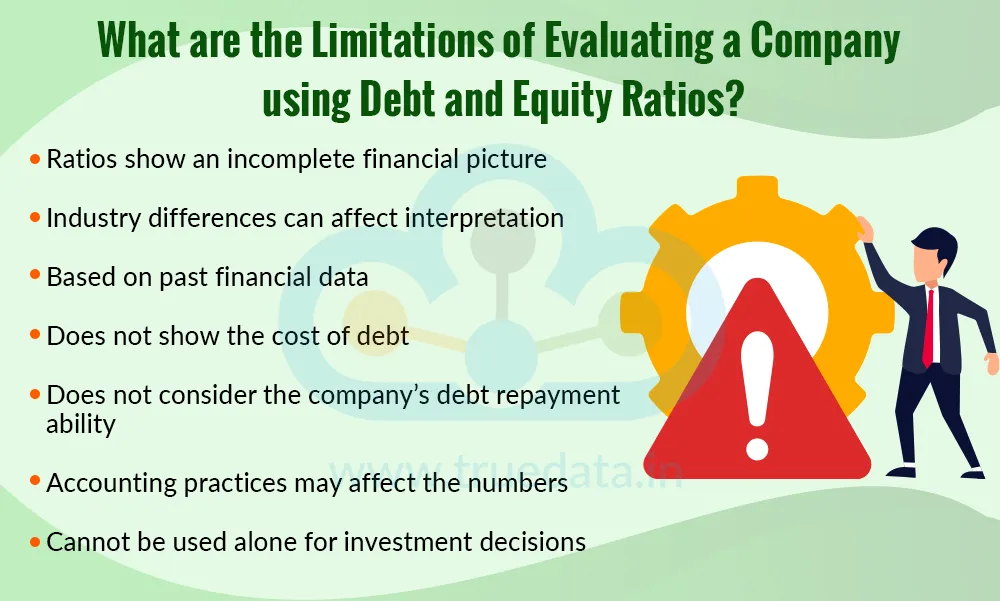
While the debt and equity ratios help evaluate the capital structure of a company, they do come with a set of limitations. These limitations include,
Ratios show an incomplete financial picture - Debt and equity ratios only focus on the capital structure of a company and do not reflect other important factors such as profitability, cash flow, or business performance.
Industry differences can affect interpretation - Some industries, like infrastructure or telecom, naturally operate with higher debt levels, so comparing ratios across different sectors may lead to incorrect conclusions.
Based on past financial data - These ratios are calculated using information from financial statements, which represent past performance and may not fully reflect the company’s future financial position.
Does not show the cost of debt - A company may have high debt, but if the borrowing cost is low and manageable, the financial risk may not be as high as the ratios suggest.
Does not consider the company’s debt repayment ability - Ratios do not directly show whether the company generates enough cash flow to meet its debt obligations.
Accounting practices may affect the numbers - Differences in accounting policies or financial reporting methods can influence the values used in ratio calculations.
Cannot be used alone for investment decisions - Investors should analyse debt and equity ratios along with other financial ratios, business fundamentals, and industry trends before making investment decisions.
Debt and equity ratios are useful tools that help investors understand how a company finances its assets and operations. These ratios provide insights into the company’s capital structure, level of financial leverage, and dependence on borrowed funds. By analysing these ratios, investors can assess the company’s financial stability, risk level, and ability to sustain long-term growth. However, these ratios should not be used in isolation as they do not provide a complete picture of a company’s financial health.
This post is another part of our series on exploring financial ratios. Let us know your thoughts on this article or if you need any further information on the same and we will address it soon.
Till then, Happy Reading!
Read More: Valuation Ratios - PEG Ratio
Thestock market never stands still, and prices swing constantly with every new h...
Corporate data is more than just the numbers of a company. They can show what is...
Solvency and leverage ratios play a vital role in understanding a company’...