In our journey of breaking down financial ratios, we now move a step further into the world of cash flow analysis. In our previous blog, we explored operating cash flow ratios and what they reveal about a company’s day-to-day financial strength. In this instalment, we shift our focus to free cash flow ratios, which are an essential measure of a business’s ability to generate real cash after meeting its expenses. Understanding free cash flow is crucial as it tells us whether a company has the flexibility to grow, reduce debt or simply stay resilient during tough times. Read on to learn about different free cash flow ratios and what they reveal about a business and its viability.

Free Cash Flow (FCF) is the cash a company actually has left after running its business and spending money on maintaining or expanding its assets, such as plants, machinery, or equipment. To put it simply, it is the ‘extra’ cash available in the business after considering the regular operations and necessary investments. Understanding FCF is important for investors as this leftover cash can be used to repay loans, pay dividends, buy back shares, expand the business, or build a safety cushion for tough times.
Free Cash Flow is calculated using the formula,
FCF = Operating Cash Flow - Capital Expenditure (CapEx)
Where,
Operating Cash Flow (OCF) is the cash generated from the company’s core business activities.
Capital Expenditure is the money spent on long-term assets such as buildings or machinery.
These numbers are available in the company’s cash flow statement in its annual report.
If FCF is positive, it means the company is generating more cash than it needs to maintain its business. If it is negative, the company may be investing heavily for growth or may be struggling to generate enough cash. Free Cash Flow is a powerful measure as it shows a company’s real cash strength, beyond just reported profits.
Understanding the Calculation of FCF Using an Example
Consider A Ltd., a manufacturing company, with operating cash flows of Rs. 500 crores and capital expenditure (money spent on new machines and factory upgrades) of Rs. 200 crores. The FCF for A Ltd. is shown below.
FCF = Operating Cash Flow - Capital Expenditure (CapEx)
FCF = 500-200 = Rs. 300 crores

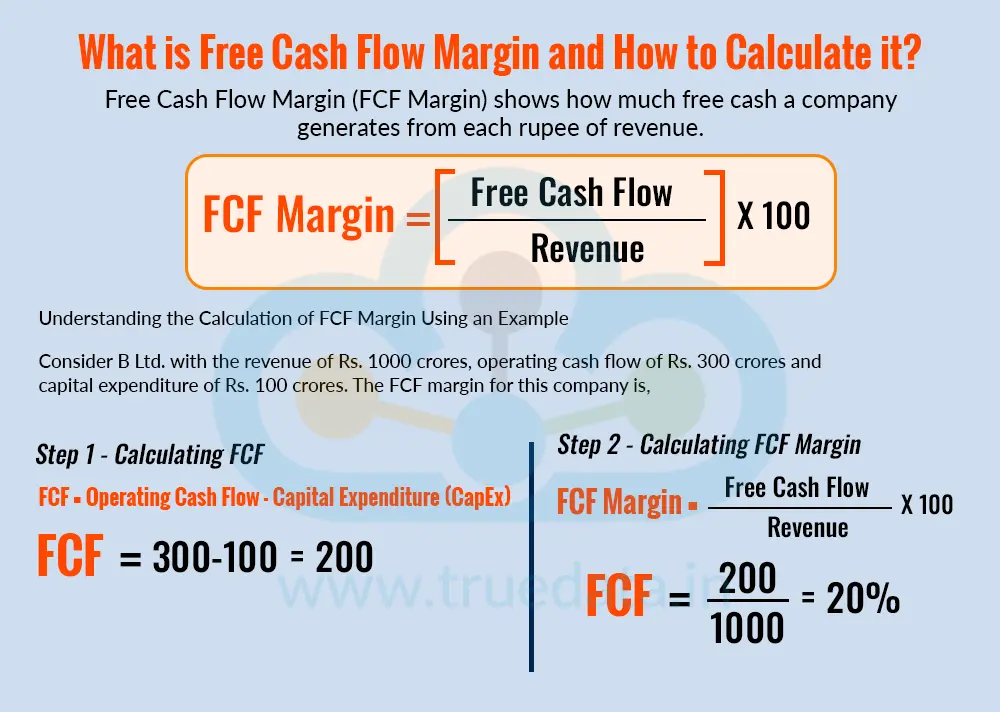
Free Cash Flow Margin (FCF Margin) indicates the amount of free cash a company generates from every rupee of revenue. It tells investors how efficiently a company converts its sales into actual cash after paying for operating expenses and capital investments. While profit margins highlight the accounting profit, FCF margin shows the real cash strength of the business. Cash Cow Companies are usually seen with higher and more stable FCF margins. A higher FCF margin usually means the company has a better financial flexibility to repay debt, pay dividends, reinvest in growth, or handle difficult business conditions.
The formula to calculate the FCF Margin is,
FCF Margin = (Free Cash Flow / Revenue) * 100
Understanding the Calculation of FCF Margin Using an Example
Consider B Ltd. with the revenue of Rs. 1000 crores, operating cash flow of Rs. 300 crores and capital expenditure of Rs. 100 crores. The FCF margin for this company is
Step 1 - Calculating FCF
FCF = Operating Cash Flow - Capital Expenditure (CapEx)
FCF = 300-100 = 200
Step 2 - Calculating FCF Margin
FCF Margin = (Free Cash Flow / Revenue) * 100
FCF Margin = 200/1000 = 20%
Thus, A 20% FCF margin means that for every Rs. 100 of sales, the company generates Rs. 20 in free cash after covering operating costs and investments.
Interpretation of FCF Margin -
A ‘good’ FCF Margin varies from industry to industry.
A high margin of around 10%-15% or more is usually seen in asset-light businesses like software or consulting, where companies do not need heavy investment in factories or machinery to grow.
A low margin of below 5% is common in capital-intensive sectors such as airlines, manufacturing, or retail. In these industries, most of the cash is regularly reinvested into equipment, inventory, or infrastructure.
Similarly, a rising FCF Margin generally shows that the company is becoming more efficient and that revenue is growing faster than costs. This is a positive sign of improving operational strength.
Conversely, a negative FCF Margin is not always a warning sign, especially for young or expanding companies. It may simply mean the business is investing heavily today to grow faster in the future.
Thus, investors should look at the FCF Margin over at least 3-5 years. A single year’s high number may not be reliable, as it could be due to temporary factors like delayed capital spending.
FCFE Margin (Free Cash Flow to Equity Margin) and Free Cash Flow to Firm are extensions of the FCF margin and provide deeper insights for investors and other stakeholders. These ratios are explained hereunder.

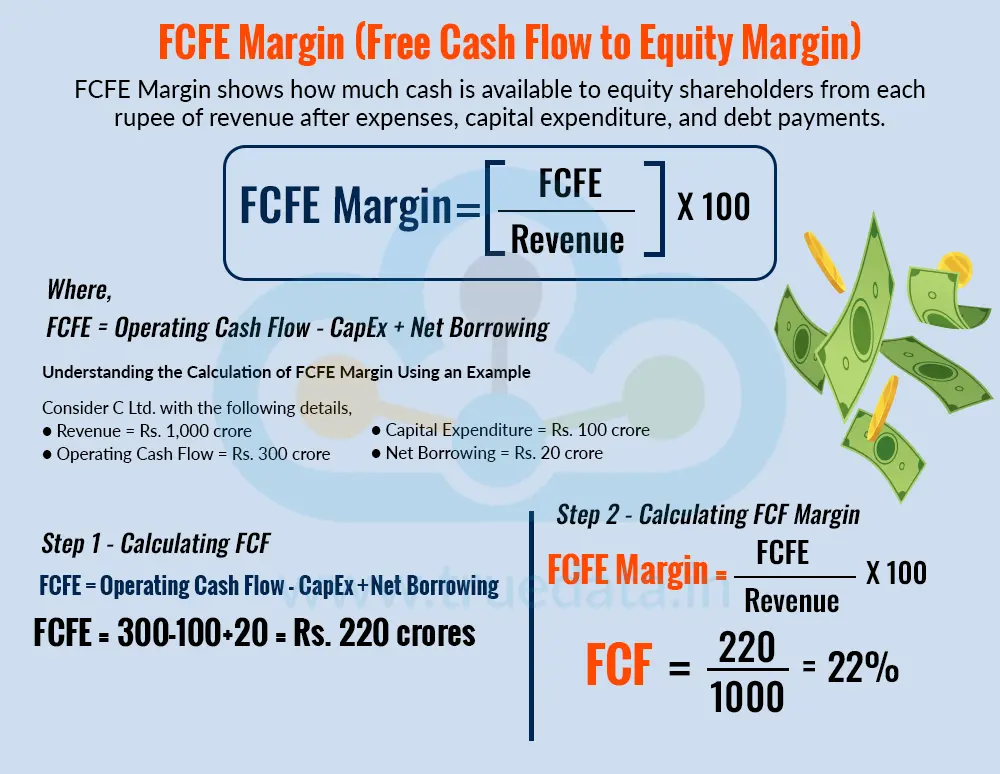
FCFE Margin (Free Cash Flow to Equity Margin) shows how much cash is available for equity shareholders from every rupee of revenue, after the company has paid for operating expenses, capital expenditure, and debt obligations. Thus, it tells investors how much actual cash shareholders have after taking care of lenders. This is a crucial measure, as even if a company reports good profits, shareholders benefit only when there is real cash left after all commitments.
The formula to calculate FCFE is,
FCFE Margin = (FCFE / Revenue) * 100
Where,
FCFE = Operating Cash Flow - CapEx + Net Borrowing
Understanding the Calculation of FCFE Margin Using an Example
Consider C Ltd. with the following details,
Revenue = Rs. 1,000 crore
Operating Cash Flow = Rs. 300 crore
Capital Expenditure = Rs. 100 crore
Net Borrowing = Rs. 20 crore
The FCFE for C Ltd. is,
Step 1 - Calculating FCFE
FCFE = Operating Cash Flow - CapEx + Net Borrowing
FCFE = 300-100+20 = Rs. 220 crores
Step 2 - Calculating FCFE Margin
FCFE Margin = FCFE / Revenue * 100
FCFE = 220 / 1000 * 100 = 22%
Thus, for every Rs. 100 of sales, Rs. 22 is available for shareholders after expenses and debt adjustments. A higher FCFE margin usually indicates better cash availability for dividends, share buybacks, or reinvestment.

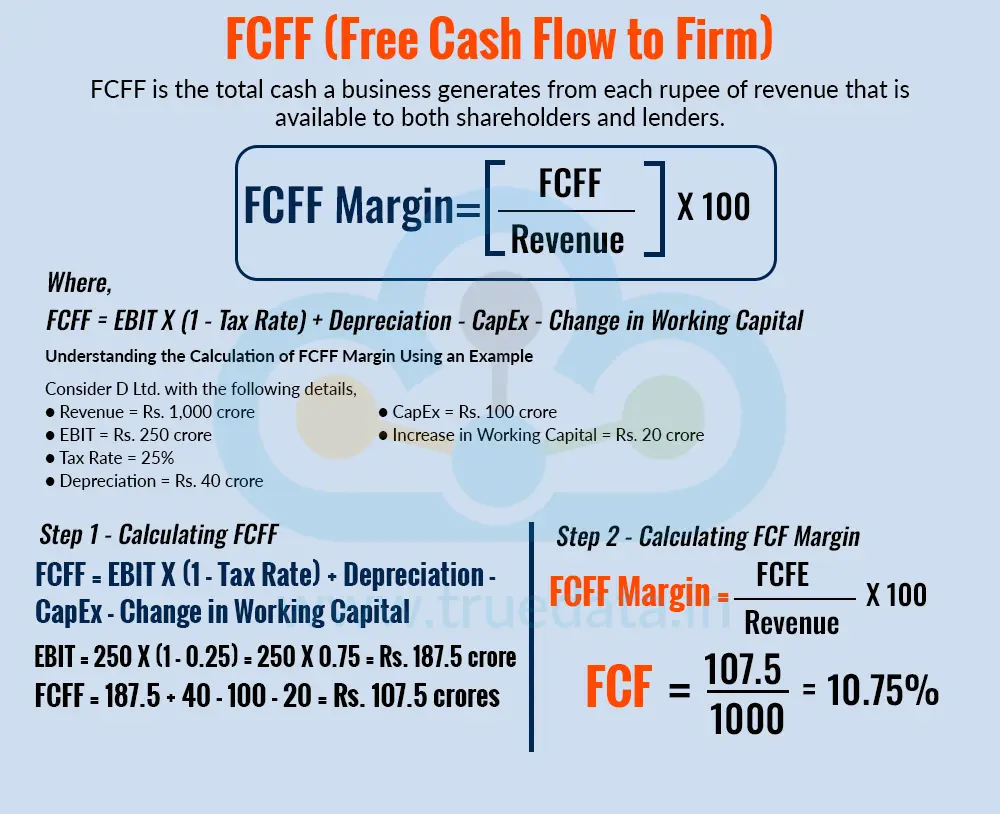
FCFF is the total cash a business generates that is available to both shareholders and lenders from every rupee of revenue. It measures the total cash-generating strength of the business, before considering how it is financed (debt or equity). This ratio is useful when analysing the overall financial strength of a company, especially for valuation purposes.
The formula to calculate the FCFF is,
FCFF Margin = (FCFF / Revenue) * 100
Where,
FCFF = EBIT * (1 - Tax Rate) + Depreciation - CapEx - Change in Working Capital
Understanding the Calculation of FCFF Margin Using an Example
Consider D Ltd. with the following details,
Revenue = Rs. 1,000 crore
EBIT = Rs. 250 crore
Tax Rate = 25%
Depreciation = Rs. 40 crore
CapEx = Rs. 100 crore
Increase in Working Capital = Rs. 20 crore
The FCFF for D Ltd. is shown below.
Step 1 - Calculating FCFF
FCFF = EBIT * (1 - Tax Rate) + Depreciation - CapEx - Change in Working Capital
EBIT = 250 * (1 - 0.25) = 250 * 0.75 = Rs. 187.5 crore
FCFF = 187.5 + 40 - 100 - 20 = Rs. 107.5 crores
Step 2 - Calculating FCFF Margin
FCFF Margin = (FCFF / Revenue) * 100
FCFF = 107.5 / 1000 * 100 = 10.75%
Thus, for every Rs. 100 of sales, the business generates about Rs. 10.75, which is available for both lenders and shareholders.
The FCFE Margin measures the actual cash available to shareholders after paying taxes, interest to lenders and reinvesting in the business. Since equity holders are paid last, this margin reflects how efficiently a company converts its revenue into real distributable wealth. A strong and growing FCFE Margin suggests the company can fund dividends, share buybacks, or expansion plans without raising fresh equity or taking on excessive debt, which is an important sign of financial strength, especially in capital-intensive sectors.
On the other hand, the FCFF Margin looks at the total cash generated by the business before any payments to lenders or shareholders. This makes it a better tool for valuation experts and fund managers who want to compare companies with different debt levels on a fair basis. Thus, FCFE shows what shareholders ultimately receive, while FCFF shows the total cash-generating power of the business itself.
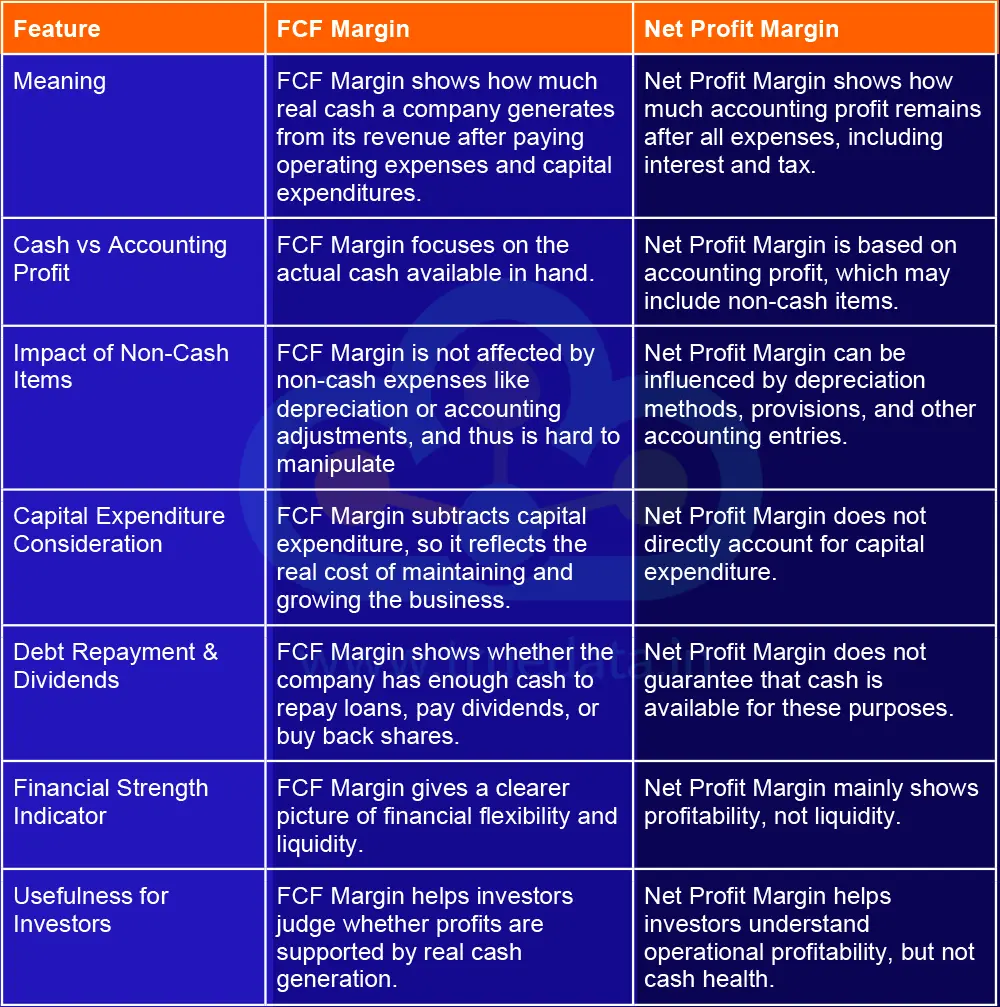
Seasoned investors often prefer the FCF margin over the traditional net profit margin for strategic analysis and investment decision-making. This is mainly due to the possibilities of manipulation in the net profit numbers due to non-cash items like depreciation, tax adjustments, etc. However, cash flows are hard to manipulate and give a clearer picture of the business’s financial health.
The differences between the FCF margin and net profit margin are highlighted below.


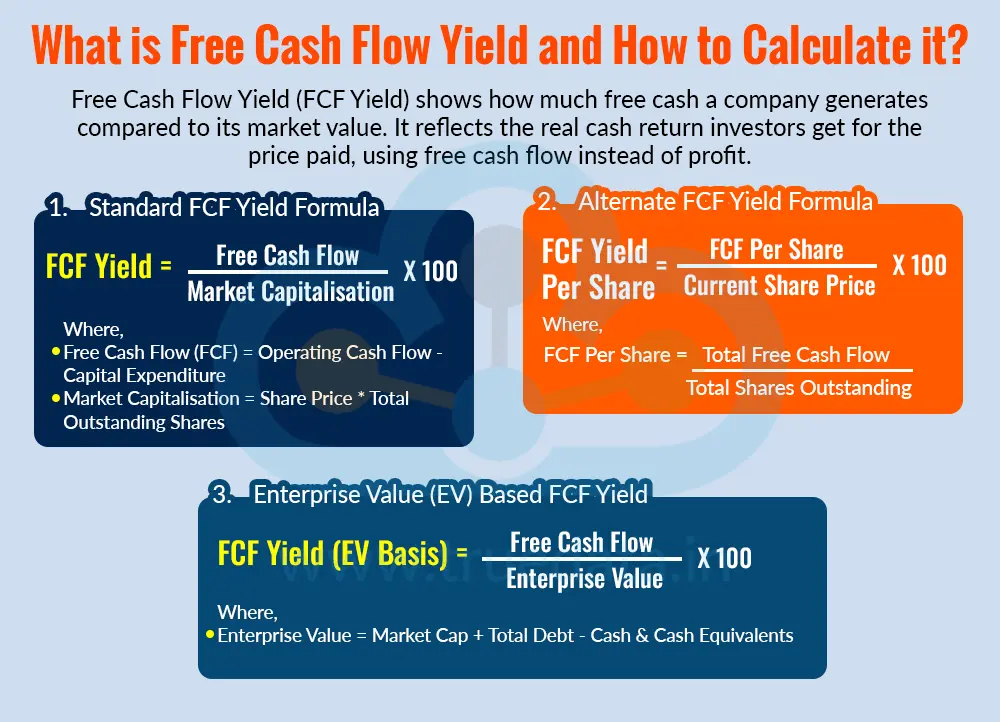
Free Cash Flow Yield (FCF Yield) indicates the free cash a company generates compared to its market value. It tells investors the actual cash return they get for the price they paid for the stock. The concept is similar to earnings yield. However, instead of profit, it uses free cash flow, thus reflecting the real cash available after capital expenditure. FCF Yield helps in understanding whether a stock is reasonably valued and whether the company is generating strong cash relative to its share price. A higher FCF Yield generally means the stock may be undervalued or generating strong cash flows. A lower yield may suggest the stock is expensive or that cash generation is weak.
The formulas to calculate FCF Yield are,
The standard or the common FCF Yield formula is
FCF Yield = (Free Cash Flow / Market Capitalisation) * 100
Where,
Free Cash Flow (FCF) = Operating Cash Flow - Capital Expenditure
Market Capitalisation = Share Price * Total Outstanding Shares
The alternate FCF Yield formula focuses on the per share version of the above formula.
FCF Yield Per Share = (FCF Per Share / Current Share Price) * 100
Where,
FCF Per Share = Total Free Cash Flow / Total Shares Outstanding
Seasoned investors often focus on the Enterprise Value (EV) instead of Market Capitalisation to calculate the FCF Yield, as EV includes the company's debt, giving a more ‘holistic’ view of the yield. This version is more rigorous as it considers the fact that a company with massive debt is ‘riskier’, even if its FCF looks high relative to the stock price alone.
The formula to calculate the EV baked FCF Yield is,
FCF Yield (EV Basis) = (Free Cash Flow / Enterprise Value) * 100
Where,
Enterprise Value = Market Capitalisation + Total Debt - Cash & Cash Equivalents
Understanding the Calculation of FCF Yield Using an Example
Consider E Ltd. with the following details
Operating Cash Flow = Rs. 500 crore
Capital Expenditure = Rs. 200 crore
Number of Outstanding Shares = 10 crore shares
Current Share Price = Rs. 500
Total Debt = Rs. 1,000 crore
Cash & Cash Equivalents = Rs. 300 crore
The FCF Yield for this company is shown below.
Step 1 - Calculating FCF
FCF = Operating Cash Flow - Capital Expenditure
FCF = 500 - 200 = Rs. 300 crores
Step 2 - Calculate Market Capitalisation
Market Capitalisation = Share Price * Outstanding Shares
Market Capitalisation = 500*10 = Rs. 5000 crores
Step 3 - Calculate Standard FCF Yield
FCF Yield = (Free Cash Flow / Market Capitalisation) * 100
FCF Yield = 300 / 5000 * 100 = 6%
Step 4 - Calculate Alternate FCF Yield
FCF Per Share = 300 / 10 = Rs. 30 per share
FCF Yield Per Share = (FCF Per Share / Current Share Price) * 100
FCF Yield Per Share = 30 / 500 * 100 = 6%
Step 5 = Calculate EV-Based FCF Yield
Enterprise Value = Market Cap + Total Debt - Cash & Cash Equivalents
Enterprise Value = 5000+1000-300 = Rs. 5700 crores
FCF Yield (EV Basis) = (Free Cash Flow / Enterprise Value) * 100
FCF Yield (EV Basis) = 300 / 5700 * 100 ≈ 5.26%
Interpretation of FCF Yield -
FCF Yield is often compared with the risk-free rate, such as the yield on a 10-year Government of India bond. This helps investors judge whether the return from a stock is attractive compared to a safer investment.
A high FCF Yield (around 7%-10% or more) usually suggests a value stock. The company is generating strong cash compared to its share prices, but sometimes the market may have concerns about its future growth.
A low FCF Yield (around 1%-3%) is common in growth stocks. Investors are willing to pay a higher price today because they expect the company’s cash flows to increase significantly in the future.
A negative FCF Yield means the company is burning cash instead of generating it. This is common in early-stage or fast-growing companies that are investing heavily and have not yet become profitable.
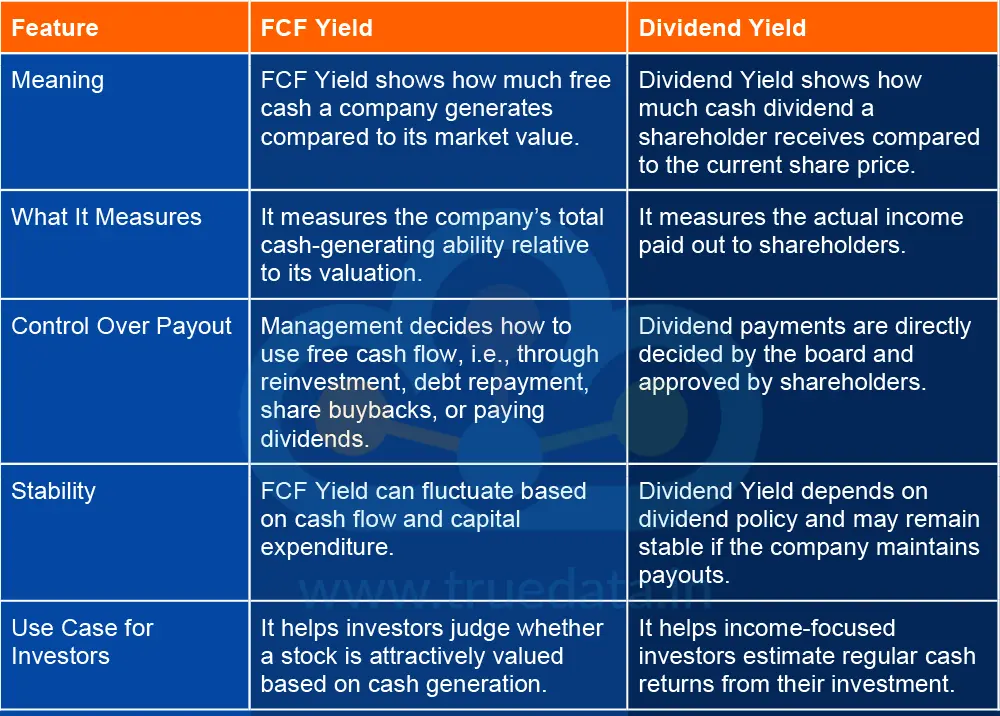
FCF Yield shows the cash the company generates or can pay its shareholders, while Dividend Yield shows the cash shareholders actually receive. Thus, FCF Yield is useful for valuation analysis, whereas Dividend Yield is important for those seeking regular income. Both ratios together give a more complete picture of a company’s financial strength and shareholder returns.
The key differences between the two are highlighted below.

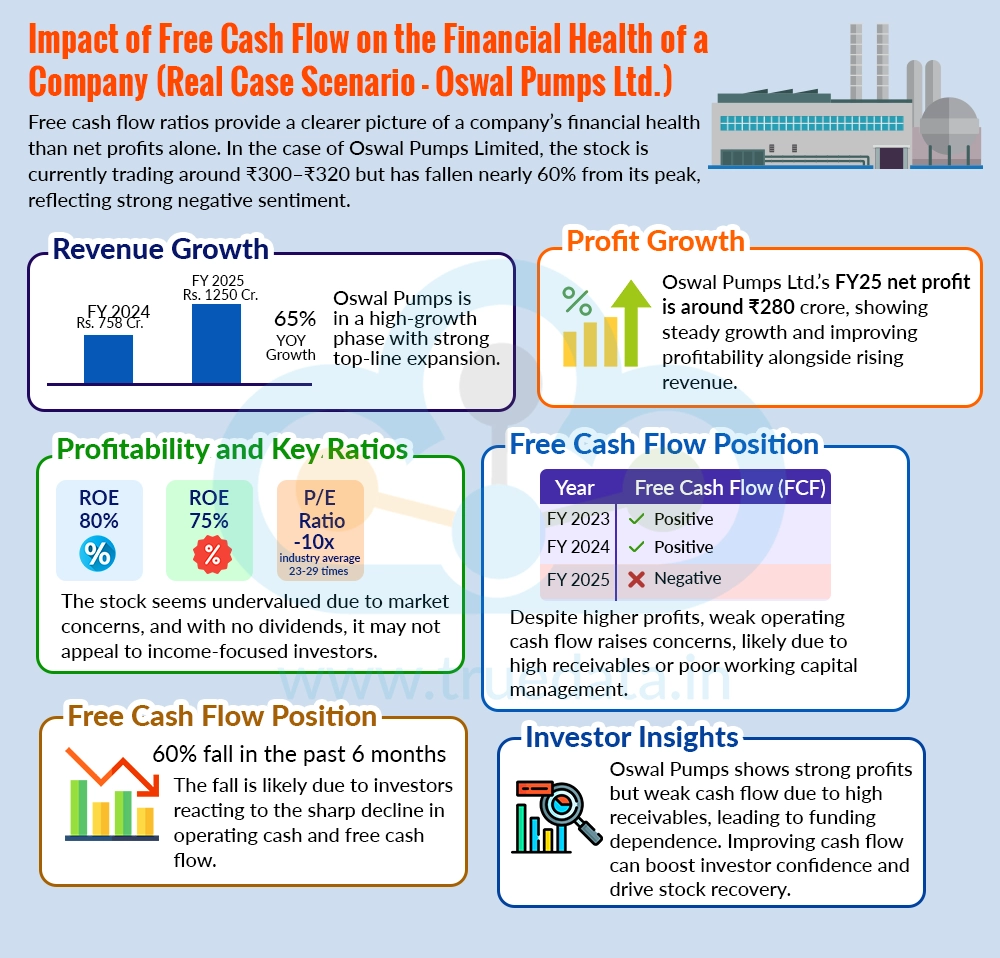
We have seen above the calculation of various free cash flow ratios and how they are significant in accurate financial analysis, rather than relying on net profits alone. Let us now understand the impact of decreasing free cash flows on a company and its market price. Consider the case of Oswal Pumps Limited. The company has a current market price in the range of Rs. 300 to Rs. 320. However, the stock has corrected approximately 60% from its peak, which indicates recent strong negative sentiment. After reviewing the financial statements for the past years (FY 23, FY 24 and FY 25 in particular), these are the following insights,

The other key parameters include,
Revenue Growth
Revenue in FY 25 is approximately Rs. 1250 crores, and for FY 2024 was Rs. 758 crores. This indicates approximately 65% YoY growth.
Profit Growth
The net profit of Oswal Pump Ltd. for FY 25 is approximately Rs. 280 crores and has been steadily increasing over the past few years. When considered alongside the rise in revenues (above), this suggests that the company is in a high-growth phase and that profitability is improving.
Profitability and Key Ratios
ROE is approximately 80%, and ROCE is approximately 75%. The P/E ratio is approximately 10 times, and the industry average is in the range of 23-29 times. This indicates that the stock is undervalued, even though the revenue has increased. Thus, it seems that the stock is severely undervalued, or the market has accounted for certain risks and is currently not considering it as an attractive investment opportunity. The company also does not pay any dividends. Thus, income-oriented investors may not consider investing in this company.
Free Cash Flow Position
The company had positive free cash flows for the year FY 23 and FY 24, however, for FY 25, the free cash flows turned negative. This, coupled with a deep negative in the operating cash flows despite an increase in profits, raises a few red flags. The primary reason for such a decline in operating profits and free cash flows can be the high receivables (funds stuck with customers) or working capital mismanagement.
Fall in the Current Price
The stock price of Oswal Pumps has seen major reductions in recent times, i.e., approximately 60% in the past 6 months. This reduction can be attributed to the market, especially institutional investors, accounting for the sudden drop in operating cash and free cash flow levels.
Investor Insights
The current free cash flow (FCF) situation of Oswal Pumps Ltd. clearly shows a gap between strong profits and weak cash generation. While the company is growing fast and reporting high earnings, much of this profit is not turning into actual cash because money is stuck in receivables and working capital. This means the business is currently dependent on external funding to support its growth. If the company improves collections, reduces receivable days, and starts generating positive operating cash, then FCF will turn positive. This can lead to a re-rating of the stock, as investors gain confidence in the quality of earnings, and the share price may see a strong recovery since valuations are currently low.
On the other hand, if free cash flow continues to remain weak, it creates risks such as higher borrowing, possible dilution, and lower investor confidence, which can keep the stock under pressure or moving sideways. Right now, the company is in a ‘growth-heavy but cash-poor’ phase, which explains the recent fall in stock price. The market has already started factoring in this risk, showing that investors are cautious and not fully trusting the reported profits until they are backed by consistent cash flows. In simple terms, the business looks good on paper, but future returns will largely depend on how well it improves its cash flow situation.
Free cash flow ratios give investors a clearer picture of a company’s real financial strength because they focus on actual cash, not just accounting profits. The different versions of free cash flow ratios indicate the business efficiency at different levels and help in strategic decision-making. Thus, tracking these ratios over several years and comparing them with industry peers can lead to smarter, more confident investment portfolios.
This article is an extension of our series on cash flow ratios and their significance in fundamental analysis. We have also included a real-world example to highlight that even if all the other parameters show a positive signal for investors, a decline in free cash flows and operating cash flows can raise significant red flags, and the market accounts for such negative data. We hope this analysis helps in a better understanding of the ratios. Let us know your thoughts on the topic or if you need further information, and we will address it soon.
Till then, Happy Reading!
Read More: Understanding Cash Flow Statements With an Example
Thestock market never stands still, and prices swing constantly with every new h...
Net profits in the P&L statement are usually a sign of a healthy company. Ho...
Liquidity ratios tell us how comfortably a company can meet its short-term oblig...