Understanding financial statements is the foundation of investing in quality stocks. After breaking down the balance sheet and income statement, we now move to the final and most practical piece of the puzzle, i.e., the cash flow statement. In this section, we explain its key components and walk through a real-world example to show how investors can draw meaningful insights from the numbers.

A cash flow statement shows where cash comes from and where it goes during a year. It is divided into three parts, i.e, Operating activities, Investing activities, and Financing activities.

This section starts with Profit Before Tax and adjusts it for non-cash items and working capital changes.
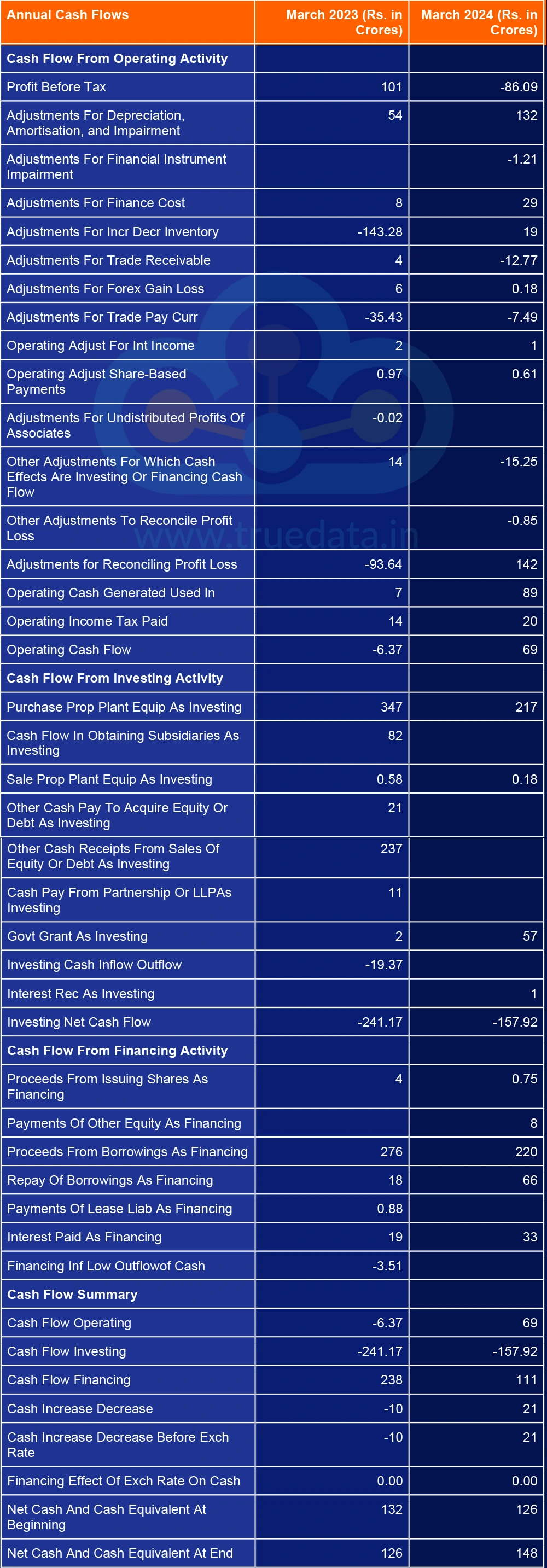
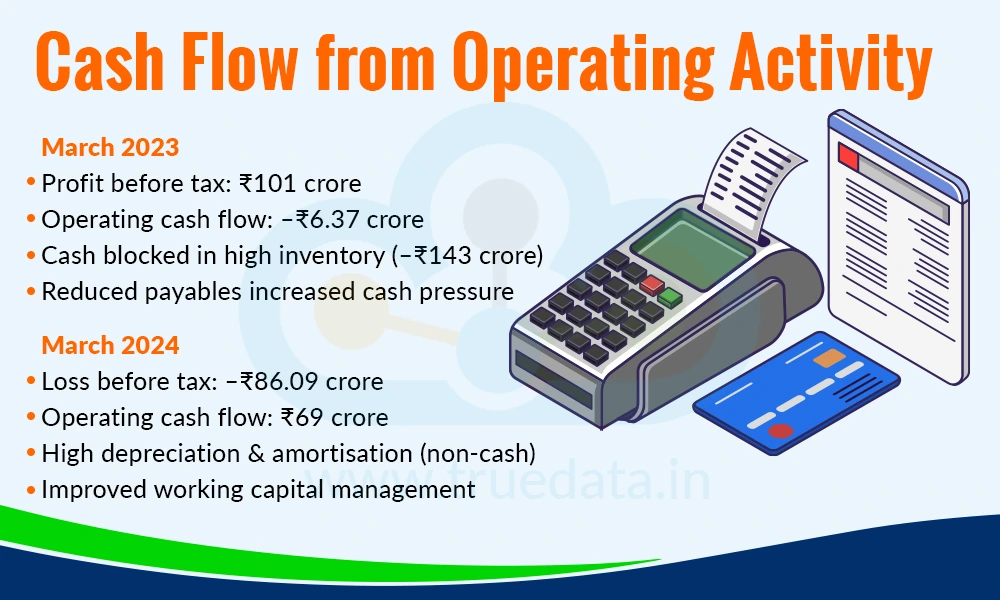
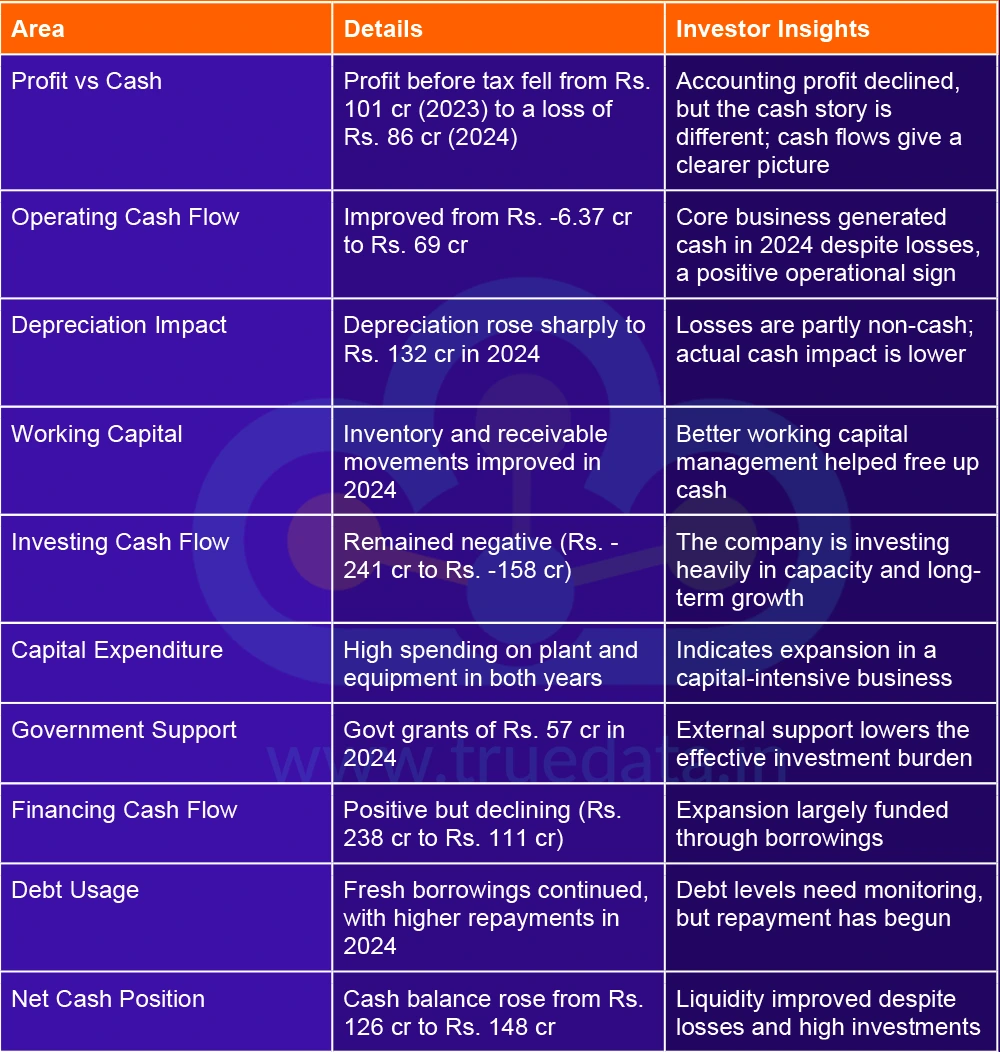
In March 2023, the company reported a profit before tax of Rs. 101 crore, but operating cash flow was negative at Rs. -6.37 crore. This happened mainly because,
A large increase in inventory (Rs. -143 crore) blocked cash.
Payables were reduced, and cash was tied up in day-to-day operations.
In March 2024, despite a loss before tax of Rs. -86.09 crore, operating cash flow turned positive at Rs. 69 crore. Key reasons include,
High depreciation and amortisation (Rs. 132 crore), which reduces profit but does not use cash.
Better control over working capital, like inventory and receivables.
Thus, positive operating cash flow in 2024 shows the core business generated cash even in a loss year, which is a healthy sign.

This section reflects money spent on or received from assets like plants, equipment, and subsidiaries.
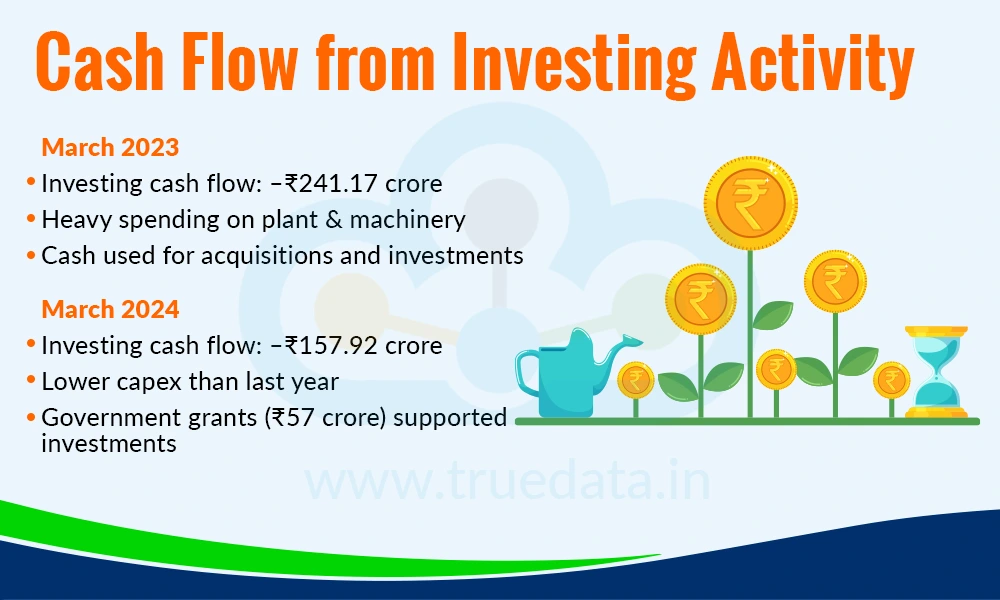
In March 2023, investing cash flow was Rs. -241.17 crore, mainly due to,
Heavy spending on property, plant, and equipment.
Cash is used for acquiring subsidiaries and investments.
In March 2024, the investing cash outflow reduced to Rs. -157.92 crore.
Capital expenditure was still high but lower than the previous year.
The company also received government grants (Rs. 57 crore), supporting investments.
Thus, consistent negative cash flow from investing activities suggests the company is expanding capacity and investing for future growth.

This section shows how the company funds its operations and investments.
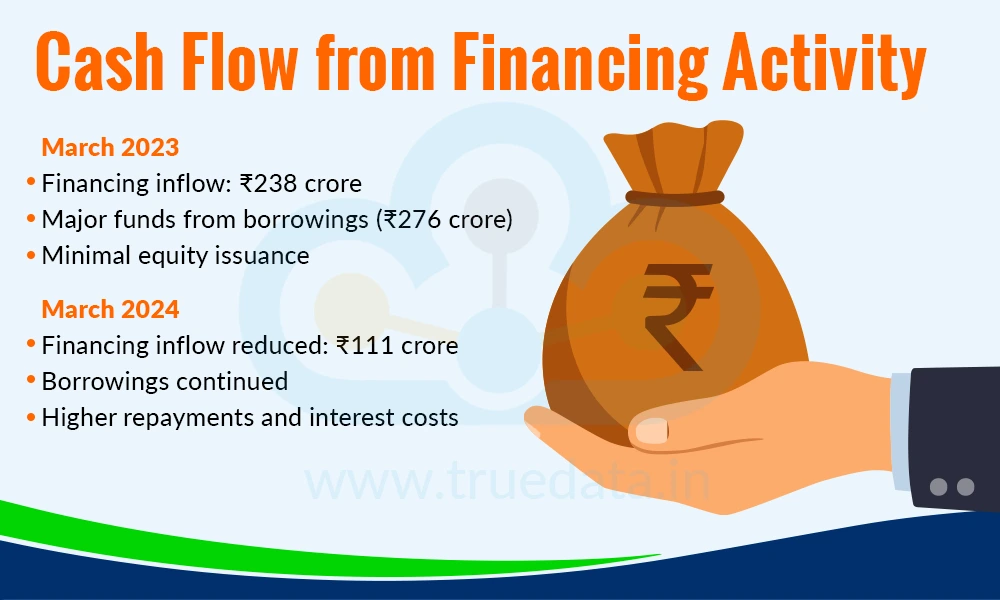
In March 2023, financing activities provided Rs. 238 crore, mainly from
Borrowings (Rs. 276 crore).
Limited equity issuance.
In March 2024, financing inflow reduced to Rs. 111 crore.
Borrowings were still raised, but repayments and interest payments increased.
Thus, the company relied on debt to fund expansion, which is common in capital-intensive industries but should be watched closely.

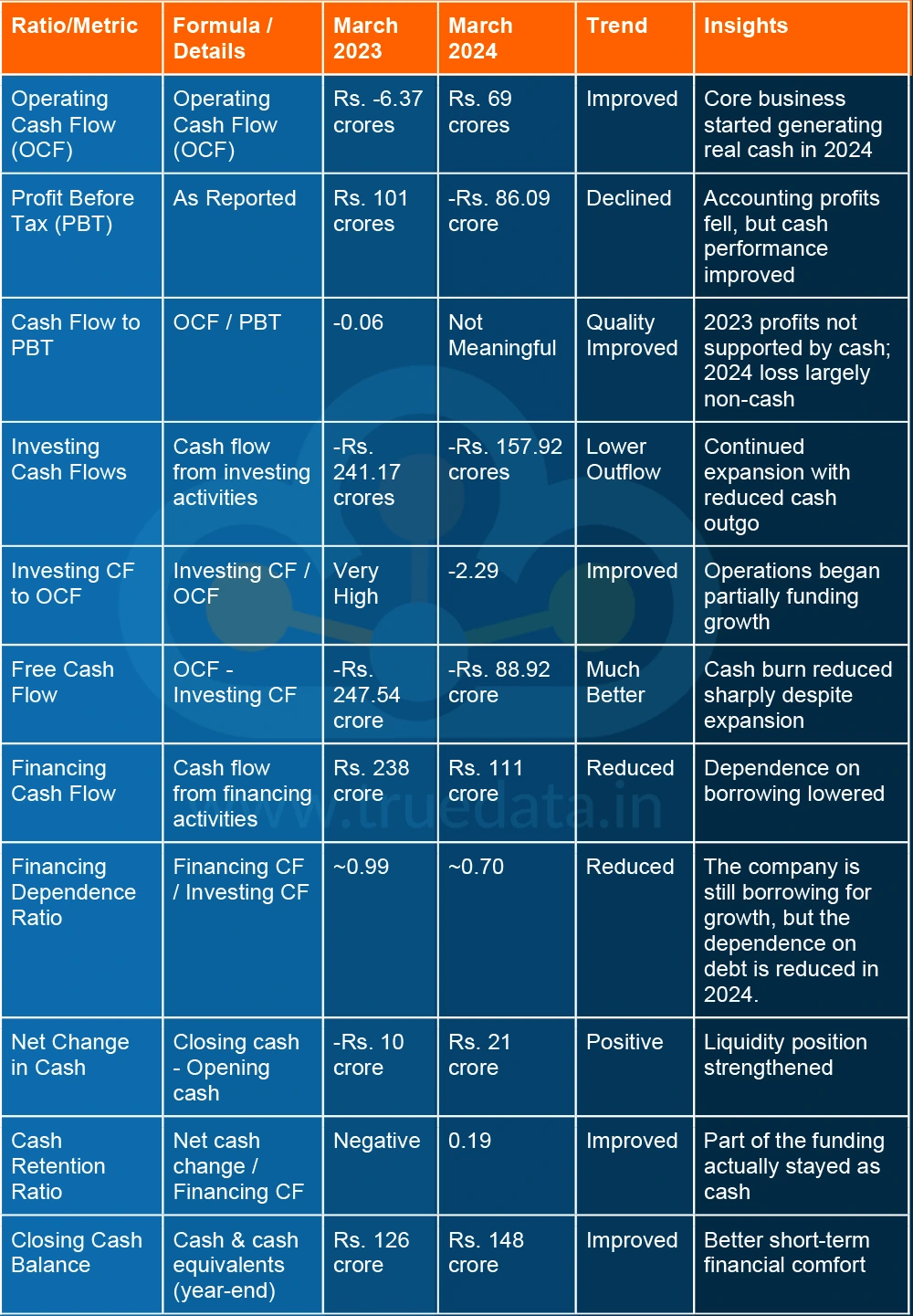
The key ratios and their interpretation from the given cash flow statement are shown below.


The cash flow statement shows Borosil Renewables moving toward stronger operational cash discipline, which is a positive signal if sustained in future years.
Cash generation improved sharply in 2024, even during a loss year.
The company remains in growth and expansion mode, but with lower cash burn.
Debt dependence reduced, though borrowings are still important.
Liquidity improved, giving near-term financial stability.
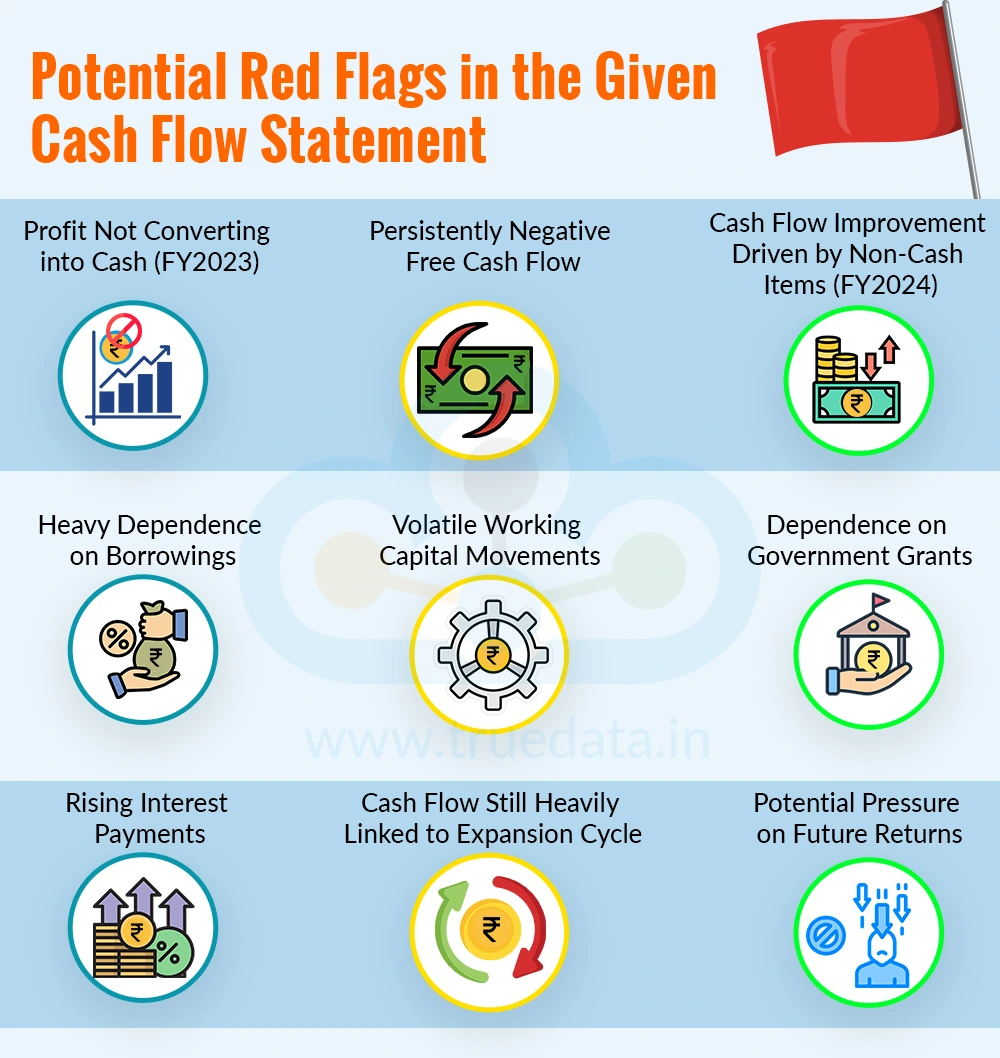
The potential red flags that can be interpreted from the cash flow statement are explained below.

In March 2023, the company reported a healthy profit before tax, but its operating cash flow was negative. This indicates that profits were locked up in inventory or working capital instead of coming in as cash. For investors, this is a classic warning sign because profits that do not convert into cash cannot be used to repay debt, invest further, or reward shareholders. If such a pattern continues for many years, it may suggest aggressive accounting or weak operational discipline.
Strategic insight -
Investors should track whether future profits consistently translate into operating cash flow. One bad year is manageable; repeated mismatches are not.
Free cash flow remained negative in both years due to heavy capital expenditure. This shows that the business is not yet able to fund its expansion using internally generated cash. While negative free cash flow is common during expansion phases, it increases financial risk if growth does not deliver expected returns.
Strategic insight -
Investors should look for a clear roadmap toward positive free cash flow. If expansion keeps consuming cash without visible payback, shareholder returns may suffer.
In March 2024, operating cash flow turned positive even though the company reported a loss. This improvement was largely supported by high depreciation, which reduces profit but does not require cash outflow. While this helps liquidity in the short term, it does not mean the business has become structurally more profitable.
Strategic insight -
Investors should check whether operating cash flow stays positive once profits return. Sustainable cash generation should ideally come from higher sales and margins, not only accounting adjustments.
A large part of the investment spending has been funded through borrowings, especially in March 2023. Although reliance on financing reduced in March 2024, debt remains a key source of funds. Debt-funded growth works well only when future cash flows are predictable and strong.
Strategic insight -
Investors should closely monitor debt levels and operating cash flow together. Rising debt without matching cash generation can pressure valuations and increase downside risk.
Large swings in inventory, receivables, and payables across the two years indicate working capital volatility. This can make cash flows unpredictable and may point to demand uncertainty or execution challenges in managing growth.
Strategic insight -
Stable working capital trends usually indicate operational maturity. Investors should watch whether volatility reduces as the company scales.
The receipt of government grants in March 2024 supported investing cash flows. While helpful, such grants are often policy-driven and may not recur. Treating them as a regular source of funding can create unrealistic expectations about future cash flows.
Strategic insight -
Investors should focus on cash flows generated by the business itself and treat grants as a bonus, not a core strength.
Interest paid increased in March 2024, reflecting a higher debt burden. As interest costs rise, a larger portion of operating cash flow gets locked into servicing debt rather than supporting growth or strengthening the balance sheet.
Strategic insight -
In a rising interest rate environment, investors should be cautious with companies where interest costs are growing faster than operating cash flow
A large portion of cash movements is driven by expansion-related spending rather than steady business operations. This makes cash flows highly sensitive to project execution timelines, cost overruns, and delays in capacity utilisation. If expansion projects take longer to stabilise, cash pressure can remain for extended periods.
Strategic insight -
Investors should track whether new capacities start contributing meaningfully to operating cash flow within the expected timeframe.
High capital expenditure combined with rising debt means future returns must be strong enough to justify the capital invested. If return on capital remains weak, shareholders may see limited value creation despite revenue growth.
Strategic insight -
Investors should track return ratios alongside cash flow, as cash-heavy expansion without improving returns can dilute long-term shareholder value.

The cash flow statement shows a company that is clearly in an expansion and transition phase. While profits weakened in FY2024, cash flows, especially operating cash flow, improved meaningfully, offering deeper insight than the profit and loss statement alone.
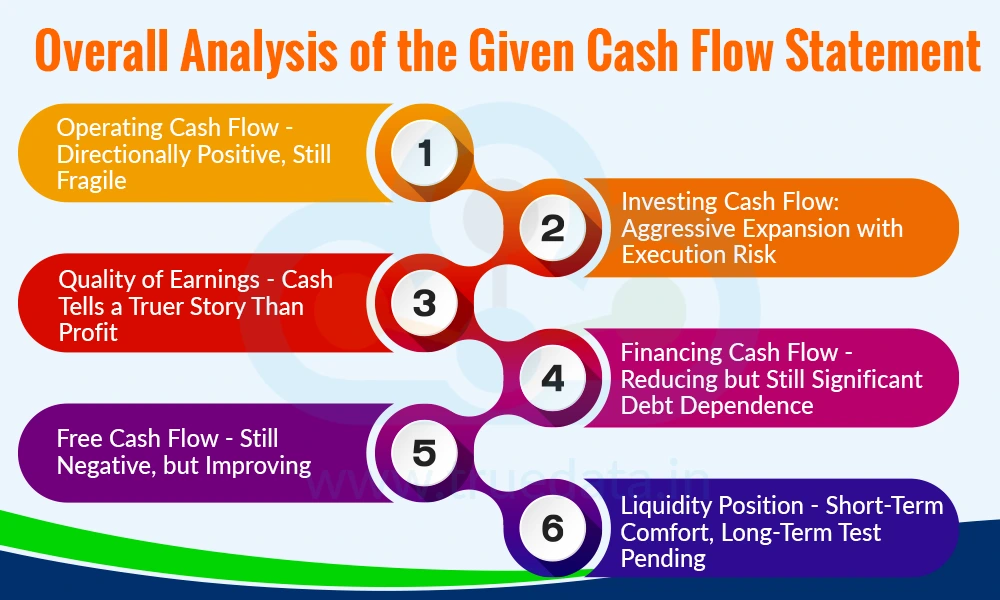
Here is the overall analysis of the cash flow statement of Borosil Renewables for the given period.
The most important positive development is the sharp improvement in operating cash flow, from a small negative in FY2023 to a healthy positive figure in FY2024. This suggests better working capital management and stronger cash discipline in day-to-day operations.
However, ratio analysis shows that this improvement was partly driven by non-cash items like depreciation rather than pure operating strength. This means cash generation is improving, but it is not yet robust enough to be considered structurally strong. The direction is encouraging, but investors should look for consistency over multiple years, especially when profits recover.
FY2023 raised a red flag when reported profits did not convert into cash. FY2024, on the other hand, showed cash generation despite accounting losses. Together, these years highlight why cash flow is more reliable than profit numbers. The cash flow-to-profit ratios confirm that earnings quality has been uneven, improving recently but still requiring validation. Thus, it is vital to treat profit numbers with caution and prioritise operating cash flow trends when assessing business quality.
Free cash flow remained negative in both years due to heavy capital expenditure. However, ratio analysis shows that cash burn reduced sharply in FY2024, which is an important improvement. Negative free cash flow is not a deal-breaker in a growth phase, but it becomes a risk if it continues without clear payback. The key milestone to watch is when operating cash flow can comfortably fund regular capital expenditure, signalling self-sustaining growth.
Consistently large investing outflows indicate capacity expansion and long-term growth ambition. Government grants in FY2024 helped reduce the net cash burden, but these are non-recurring by nature, thus, the scale of investment increases execution risk. Any delay in ramp-up or lower-than-expected demand may lead to strained cash flows. Hence, expansion is positive only if it leads to higher and stable operating cash flows within a reasonable timeframe.
The financing ratios clearly show that borrowings funded most of the expansion, especially in FY2023. FY2024 showed improvement, with lower dependence on external funding and better cash retention. However, interest payments increased, which signals a rising fixed obligation on future cash flows. A company's debt is manageable only if operating cash flow grows faster than interest costs. Thus, this balance needs close monitoring.
Despite losses and heavy investments, the company ended FY2024 with higher cash and cash equivalents. This reflects improved liquidity management and provides short-term comfort. However, liquidity strength is still closely tied to financing access and cash timing, which introduces risk during adverse market conditions. Thus, investors should watch quarterly cash balances and avoid relying solely on year-end numbers.
The cash flow statement is the final piece of the puzzle to understand the financial health and stability of a company. The data presented here enables readers to see beyond the mere profits of the company and focus on its true financial position. However, the financial statements have to be seen comprehensively to gain a clear picture and understand what the numbers are trying to tell in totality.
We have covered the financial statements of Borosil Renewables Limited for the years 2023 and 2024 in our examples to understand the balance sheet, profit and loss statement and cash flow statement. We hope this helps our readers understand the nuances of the financial statements and the data presented in a better manner. Let us know your thoughts on the topic, or if you need further information on the same, and we will address it soon.
Till then, Happy Reading!
Read More: Impact of Accounting Policy Changes on Financial Ratios
Thestock market never stands still, and prices swing constantly with every new h...
Net profits in the P&L statement are usually a sign of a healthy company. Ho...
Analysing the financial statements is the first step in the fundamental analysis...