Corporate Data

Understanding Profit and Loss Statement with an Example

Marisha Bhatt · 20 Nov 2025 · 9 mins read · 10 Comments

understanding-profit-and-loss-statement-with-an-example

We have previously covered various financial statements and their analysis in our blog. Now, let us implement this understanding in a practical scenario. The next step in our fundamental analysis of financial statement series is understanding the profit and loss statement in detail with an example. Check out this blog, which extracts details from the profit and loss statement of a company, along with our practical example on understanding the balance sheet, to have a comprehensive understanding of the two financial statements.

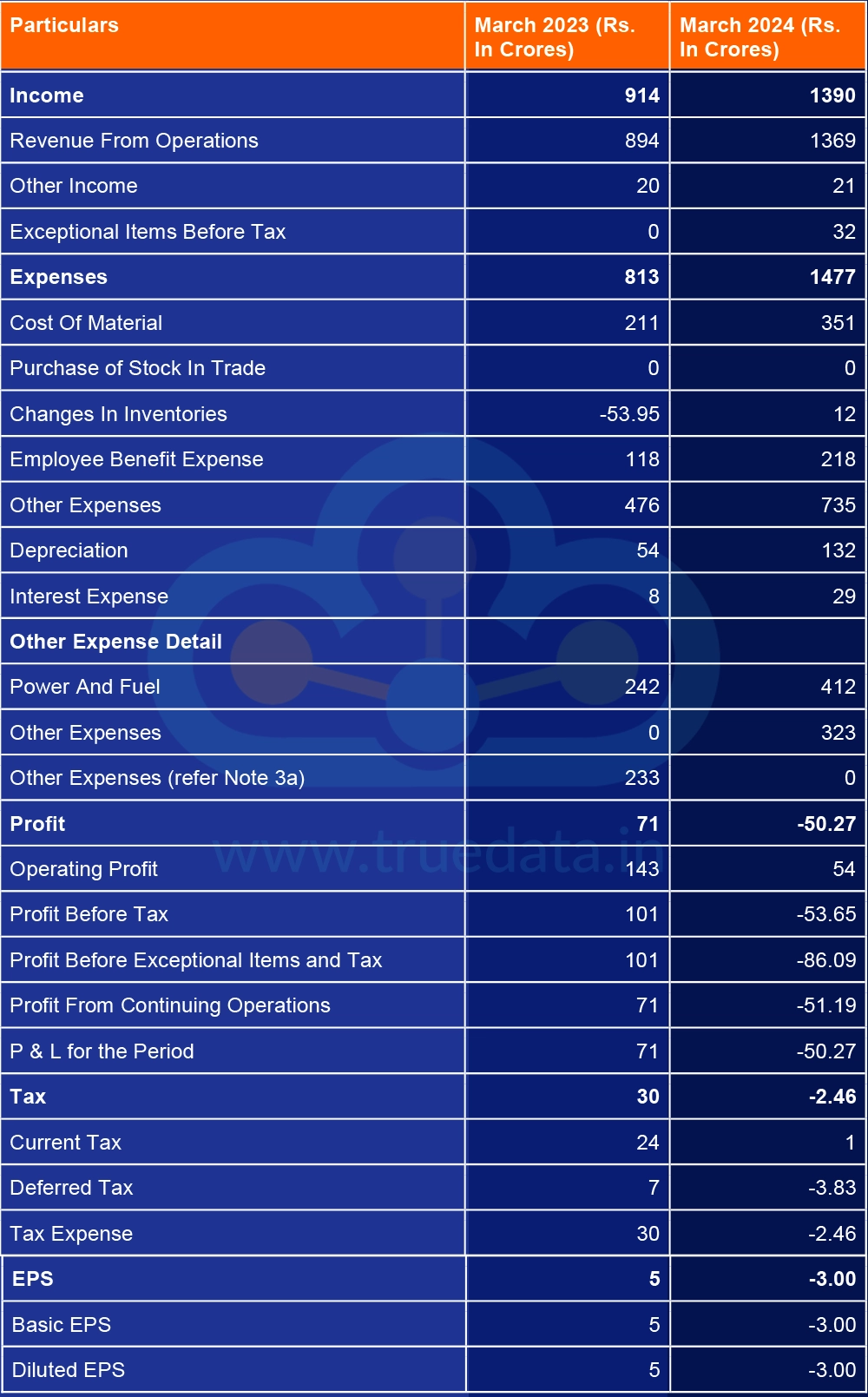
Profit and Loss Statement of Borosil Renewables Limited for March 2023 and March 2024

Profit and Loss Statement of Borosil Renewables Limited for March 2023 and March 2024

Particulars

March 2023 (Rs. In Crores)

March 2024 (Rs. In Crores)

Income

914

1390

Revenue From Operations

894

1369

Other Income

20

21

Exceptional Items Before Tax

0

32

Expenses

813

1477

Cost Of Material

211

351

Purchase of Stock In Trade

0

0

Changes In Inventories

-53.95

12

Employee Benefit Expense

118

218

Other Expenses

476

735

Depreciation

54

132

Interest Expense

8

29

Other Expense Detail

Power And Fuel

242

412

Other Expenses

0

323

Other Expenses (refer Note 3a)

233

0

Profit

71

-50.27

Operating Profit

143

54

Profit Before Tax

101

-53.65

Profit Before Exceptional Items and Tax

101

-86.09

Profit From Continuing Operations 

71

-51.19

P & L for the Period

71

-50.27

Tax

30

-2.46

Current Tax

24

1

Deferred Tax

7

-3.83

Tax Expense

30

-2.46

EPS

5

-3.00

Basic EPS

5

-3.00

Diluted EPS

5

-3.00

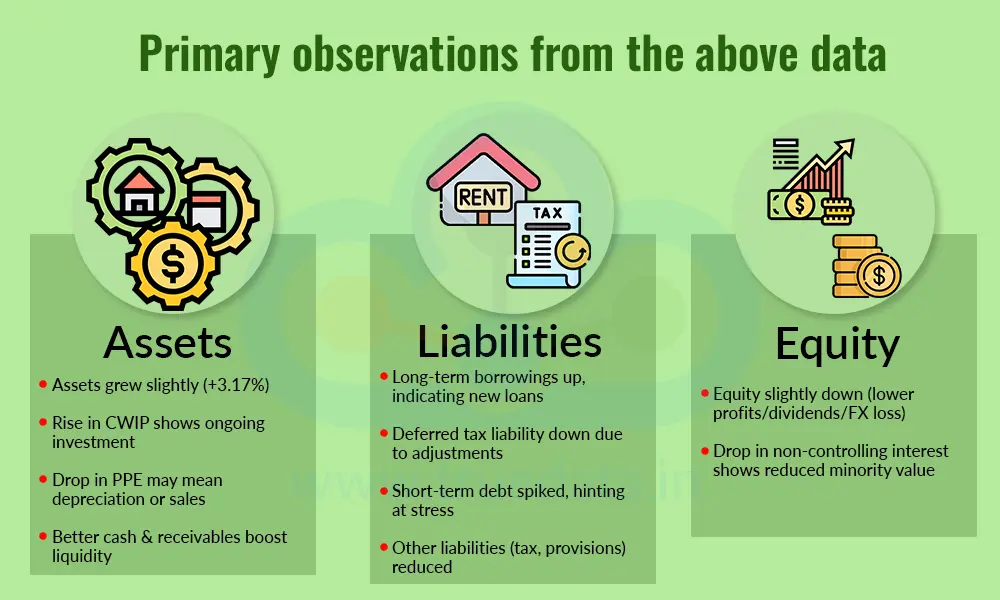
Primary observations from the above data

Primary observations from the above data

Particulars

2023

2024

Analysis

Revenue

894

1369

+53% growth (significant increase)

Total Expenses

813

1477

+82% Increase (Major Cost Surge)

Operating Profit

143

54

-62% (Significant Decline)

PAT (Profit After Tax)

71

-50

Shift from Profit to Loss

EPS

5/-

-3/-

Indicates Loss Per Share

Interpretation for Investors

Positive Signals - 

  • Strong revenue growth

  • Continued expansion of operations.

Negative Signals - 

  • Costs (materials, power, and employees) grew disproportionately.

  • High depreciation and interest show capital-intensive expansion.

  • Resulted in a net loss in 2024 despite higher sales.

Thus, Borosil Renewables Limited expanded its scale, but profitability declined due to higher operating and financing costs. Investors should watch if these costs stabilise or if the company can improve margins in the next year.

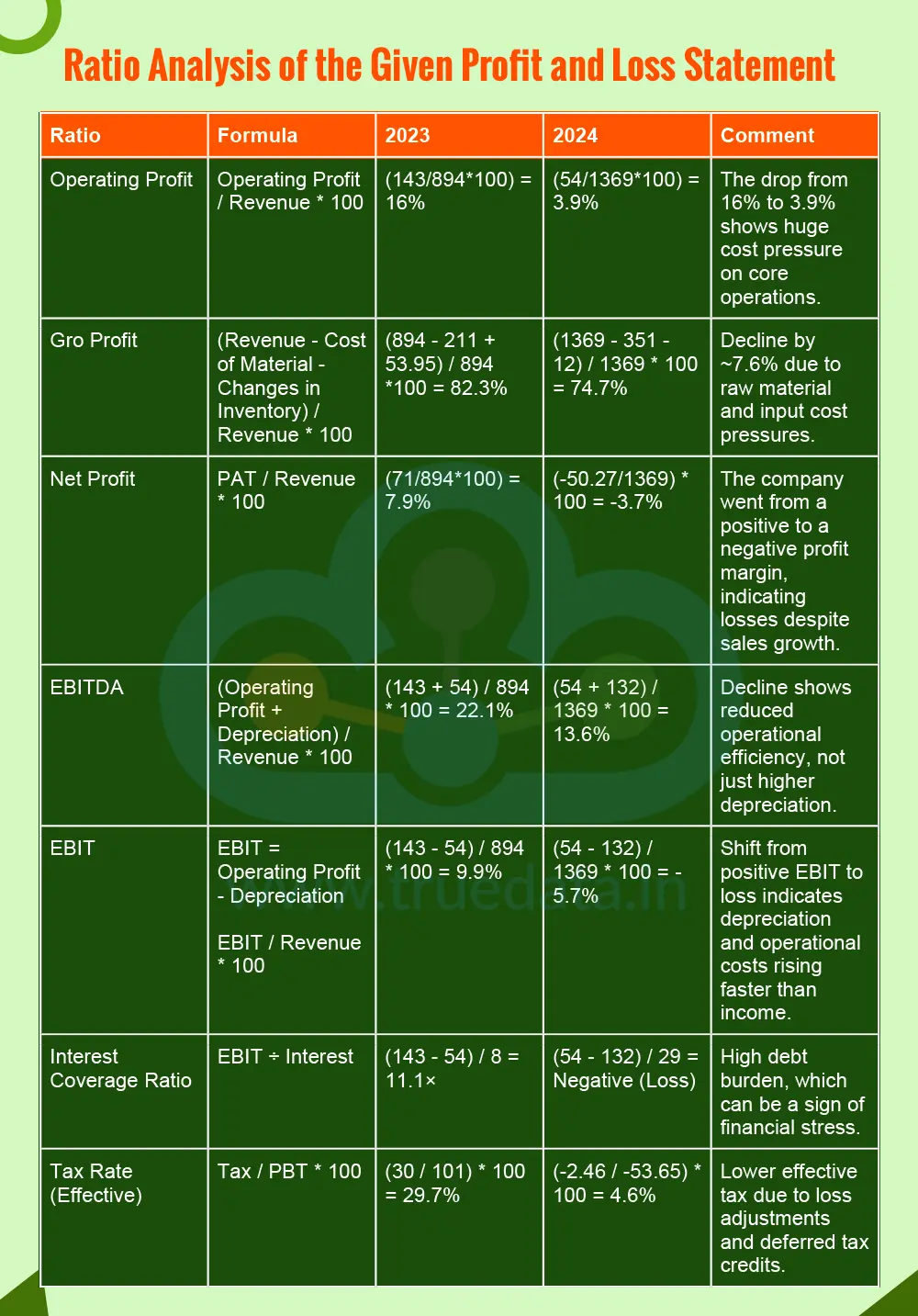
Ratio Analysis of the Given Profit and Loss Statement

Ratio analysis of the profit and loss statement helps in understanding the profitability, operational efficiency and cost management trend of the company.

Ratio Analysis of the Given Profit and Loss Statement

Ratio

Formula 

2023

2024

Comment 

Operating Profit

Operating Profit / Revenue * 100

(143/894*100) = 16%

(54/1369*100) = 3.9%

The drop from 16% to 3.9% shows huge cost pressure on core operations.

Gro Profit

(Revenue - Cost of Material - Changes in Inventory) / Revenue * 100

(894 - 211 + 53.95) / 894 *100 = 82.3%

(1369 - 351 - 12) / 1369 * 100 = 74.7%

Decline by ~7.6% due to raw material and input cost pressures.

Net Profit 

PAT / Revenue * 100

(71/894*100) = 7.9%

(-50.27/1369) * 100 = -3.7%

The company went from a positive to a negative profit margin, indicating losses despite sales growth.

EBITDA

(Operating Profit + Depreciation) / Revenue * 100

(143 + 54) / 894 * 100 = 22.1%

(54 + 132) / 1369 * 100 = 13.6%

Decline shows reduced operational efficiency, not just higher depreciation.

EBIT

EBIT = Operating Profit - Depreciation


EBIT / Revenue * 100

(143 - 54) / 894 * 100 = 9.9%

(54 - 132) / 1369 * 100 = -5.7%

Shift from positive EBIT to loss indicates depreciation and operational costs rising faster than income.

Interest Coverage Ratio

EBIT ÷ Interest

(143 - 54) / 8 = 11.1×

(54 - 132) / 29 = Negative (Loss)

High debt burden, which can be a sign of financial stress.

Tax Rate (Effective)

Tax / PBT * 100

(30 / 101) * 100 = 29.7%

(-2.46 / -53.65) * 100 = 4.6%

Lower effective tax due to loss adjustments and deferred tax credits.

Interpretation for Investors

  • Strong Top-Line, Weak Bottom-Line - Revenue grew 53%, but profits fell due to a sharp 82% increase in expenses.

  • Cost inflation and Inefficiency - Power & fuel and employee expenses surged. Depreciation doubled, possibly due to new capacity expansion, but returns are not yet visible.

  • Financial Pressure - Interest tripled (Rs. 8 Cr to Rs. 29 Cr), implying higher debt, i.e., expansion financed through borrowings.

  • Margins Under Pressure - All profitability ratios fell sharply, and the company is operating on thin or negative margins.

  • Future Outlook - Expansion may pay off in the long term if capacity utilisation rises. Short-term liquidity and debt management will be key risks.


Borosil Renewables in FY2024 shows a classic case of expansion-phase strain. Revenues are up, but the profitability is down. This indicates the company is investing heavily for future growth, but bearing short-term financial pain. In short, it can be translated into a healthy top line but a hurting bottom line. 

Potential Red Flags in the Given Profit and Loss Statement

potential-red-flags-in-the-given-profit-and-loss-statement

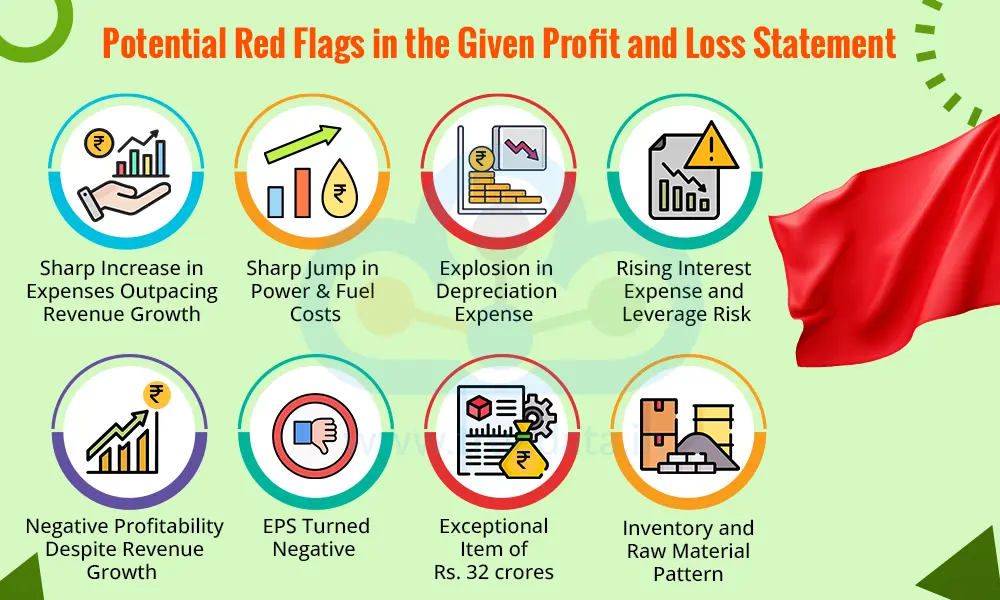
Profit and Loss Statement talks about the income and expenses for the period and the overall profitability of the organisation at the various levels. However, if you read the profit and loss statement with a keen eye, you can also spot potential red flags that can be a concern for various stakeholders. The potential red flag that can be seen in the above data and its interpretation is explained below.

  • Sharp Increase in Expenses Outpacing Revenue Growth - Costs are rising much faster than revenue, which can indicate cost inefficiency, poor control, or input price inflation. This can be especially worrying for a manufacturing company where profit margins are under pressure.

  • Sharp Jump in Power & Fuel Costs - A steep rise in energy costs (as % of revenue) implies either inefficient energy usage, higher input prices not passed to customers, or overcapacity / idle plant operation.

  • Explosion in Depreciation Expense - This increase can be concerning as it suggests heavy new capital investment or revaluation of assets. This is normally good for growth, but revenues have not scaled enough to justify this jump. Depreciation, being a non-cash expense, does not affect liquidity but reduces accounting profits sharply. This may also signal underutilised new capacity (invested but not yet producing output).

  • Rising Interest Expense and Leverage Risk - This increase indicates the company has taken on significant new debt. Further, the interest coverage ratio turns negative in 2024. Thus, operating profit no longer covers interest payments. This could point to liquidity risk or strain on cash flow.

  • Negative Profitability Despite Revenue Growth - The company turned from profitable to loss-making in one year. The significant boost in sales did not translate to profits, which can signal inefficiency or cost absorption issues.

  • EPS Turned Negative - The EPS of the company turned from a nominal Rs. 5 per share to negative in a span of a year, and the loss per share erodes shareholder value. This signals poor return on capital and potential stock price weakness if the trend continues.

  • Exceptional Item of Rs. 32 crores - The company has recorded a one-time gain of Rs. 32 crore, which reduced the reported loss. Without it, PBT would have been Rs. -86 Cr instead of Rs. -54 Cr. This means core operations performed worse than the reported headline loss. This can be a red flag if the company starts depending on such one-off items to offset recurring losses.

  • Inventory and Raw Material Pattern - FY23 had an inventory drawdown (negative figure), boosting profit. FY24 had an inventory buildup (positive figure), reducing profit. This may indicate slow-moving or unsold stock due to a demand slowdown or overproduction. 


Overall, the company appears to be in a capital-intensive expansion phase, but cost overruns and financing burdens have turned profits into losses. Unless future capacity utilisation improves and costs stabilise, these trends could lead to liquidity strain or profit erosion in the coming years. 

Overall Analysis of the Given Profit and Loss Statement

Overall Analysis of the Given Profit and Loss Statement

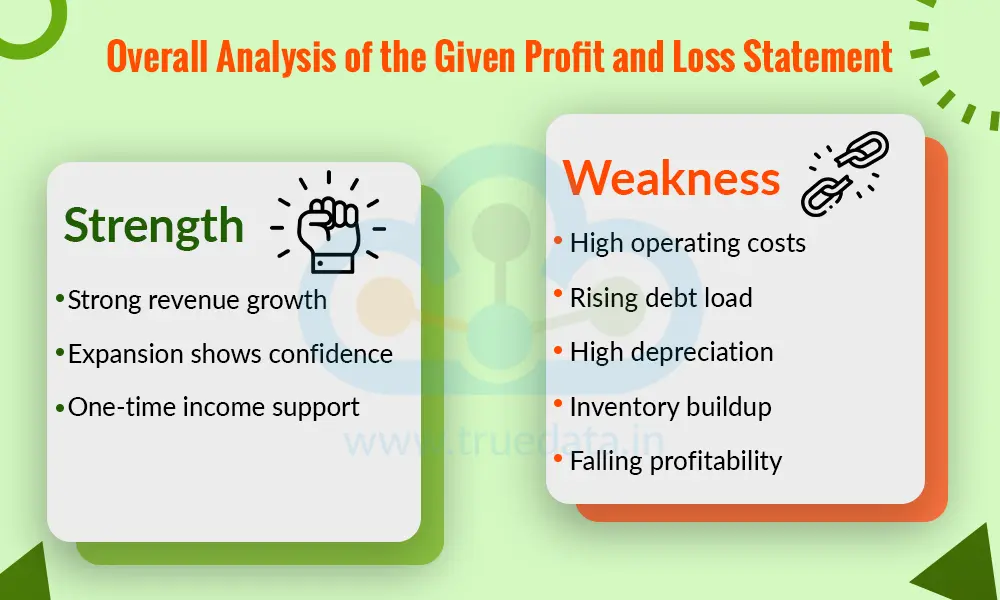
Borosil Renewables Limited (FY2024) shows a revenue growth story overshadowed by cost and leverage pressures. The core points indicating the overall analysis of the data are highlighted below.

Strengths

  • Strong revenue growth - Sales increased sharply, showing steady demand for the company’s products.

  • Expansion shows confidence - Heavy investment in new plants reflects management’s belief in long-term market growth.

  • One-time income support - Exceptional income helped reduce losses in FY2024, giving short-term financial relief.

 Weaknesses / Risks

  • High operating costs - Rising expenses in power, materials, and staff have reduced profit margins.

  • Rising debt load - Increased borrowings have pushed up interest costs, putting pressure on profits.

  • High depreciation - Large new investments have increased fixed costs, limiting financial flexibility.

  • Inventory buildup - Unsold stock has tied up funds, possibly straining working capital.

  • Falling profitability - The company shifted from profit to loss, lowering shareholder returns and market confidence.

Strategic Insights from the Profit and Loss Statement

Strategic Insights from the Profit and Loss Statement

Borosil Renewables Limited’s FY2024 results show a company that is growing in size but struggling with profits. It is clearly in a phase of heavy investment and expansion, which has increased costs and financial pressure in the short term. However, if it can control expenses, manage its debt, and make better use of its new production capacity, the company can recover and improve its profitability in the coming years. For now, the focus should be on stabilising operations and improving efficiency to avoid long-term margin and liquidity problems.

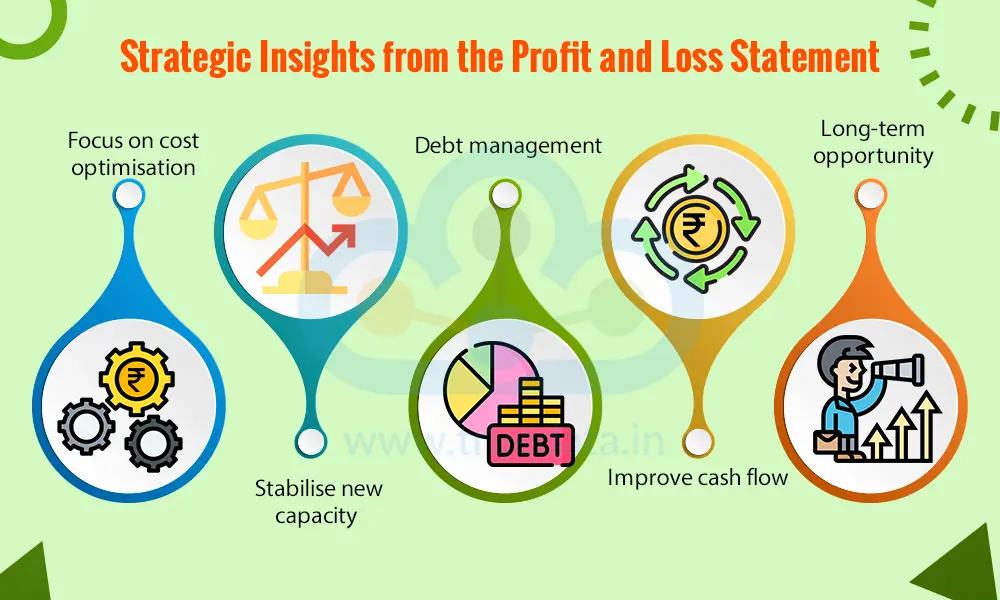
A few strategic insights from the above data are explained below.

  • Focus on cost optimisation - The company needs to improve efficiency by cutting down on unnecessary costs. Areas like power consumption, material usage, and manpower productivity can be managed better so that profits can improve even if sales growth slows.

  • Stabilise new capacity - Since Borosil has expanded its manufacturing facilities, the next step can be to ensure that these plants are fully utilised. Higher utilisation will spread fixed costs over more units, improving margins and justifying the heavy investment made.

  • Debt management - To reduce financial risk, the company can control future borrowings. It can look for cheaper financing options, refinance high-interest loans, or use internal funds more effectively to manage debt levels.

  • Improve cash flow - The company could focus on generating cash from its main business operations rather than depending on one-time exceptional income. Better control over working capital, especially inventory and receivables, will help improve liquidity.

  • Long-term opportunity - If the company successfully manages costs and starts using its expanded capacity efficiently, profitability can improve over time. Once the initial phase of expansion is absorbed, Borosil Renewables has the potential to grow strongly in the long run.

Conclusion

The profit and loss statement is a vital part of a company’s financial reporting, showing how effectively it generates income, manages expenses, and creates profits over time. When read alongside the balance sheet, it helps investors and readers understand not just the company’s current financial position, but also its profitability, operational efficiency, and potential for sustained growth. Together, these statements offer a clearer picture of how well the company is performing today and how prepared it is for future expansion.

This article provides a practical insight into reading the profit and loss statement and the inferences that can be drawn from the same. Let us know your thoughts on the topic or if you need further information on the same, and we will address it. 

Till then, Happy Reading!


Read More: Dividend Policy-What are the Different Types of Dividends?

Frequently Asked Questions

Yes, the Profit and Loss Statement and the Income Statement are the same. Both show a company’s income, expenses, and profit or loss over a period of time.

In an accrual basis P&L, income and expenses are recorded when they are earned or incurred, even if the money hasn’t been received or paid yet. In a cash basis P&L, they are recorded only when cash actually changes hands.

Yes, non-cash items like depreciation or amortisation are shown on the P&L. They reduce profit on paper but do not involve any actual cash outflow.

A quick analysis of the P&L statement can be done by looking at revenue earned by the company, its spending, and the profit that is generated and retained. Readers should also compare these numbers with previous periods to see if the company’s performance is improving or declining.

EBITDA means Earnings Before Interest, Taxes, Depreciation, and Amortisation. It shows a company’s profit from its main operations before accounting for financing costs, taxes, and non-cash expenses, and it is calculated using figures from the P&L statement.
Marisha Bhatt

Marisha Bhatt is a financial content writer @TrueData.
She writes with the sole aim of simplifying complex financial concepts and jargon while attempting to clarify technical and fundamental analysis concepts of the stock markets. The ultimate goal is to spread vital knowledge and benefit the maximum audience. Her Chartered Accountant background acts as the knowledge base to help clarify crucial concepts and create a sound investment portfolio.

10 Comments
S
Suhail G
· November 21, 2025

I loved your posts about P and L . and it is very helpful

·
Marisha Bhatt Author
Suhail G · November 21, 2025

Thank you so much for your valuable feedback. Your support means a lot! We are delighted to know the P&L posts were helpful for you. Watch this space for more quality content on diverse topics!

·
S
Saran
· November 21, 2025

Excellent topic mam

·
Marisha Bhatt Author
Saran · November 24, 2025

Thank you for appreciating our work! Stay tuned for more quality content on TrueData!

·
K
Krish
· November 24, 2025

I like your blogs and efforts

·
Marisha Bhatt Author
Krish · November 25, 2025

Thank you so much for your encouraging words! Keep reading and engaging with TrueData for more informative and interesting content!

·
L
Lenin
· November 25, 2025

Good post

·
Meyhar Singh
Lenin · November 27, 2025

Thank you! Glad you found the post helpful.

·
B
Bawas
· November 25, 2025

Good Article

·
Meyhar Singh
Bawas · November 27, 2025

Thank you! Glad you found the article useful.

·