Corporate Data

Cash Flow Ratios - Operating Cash Flow Margin, Earnings Quality and Cash Conversion Ratio

Marisha Bhatt · 28 Feb 2026 · 13 mins read · 0 Comments

cash-flow-ratios-operating-cash-flow-margin-earnings-quality-and-cash-conversion-ratios

Cash flows are one of the most reliable measures of a company’s financial health, often revealing insights that profits alone cannot. When cash flows are used in ratio analysis, they help investors understand operational efficiency, financial stability, and the quality of earnings more clearly. In this piece, we take the next step in ratio analysis by exploring key cash flow ratios, such as the Operating Cash Flow Margin, and see how they add depth to fundamental analysis and practical investment decision-making.

What is Operating Cash Flow Margin?

What is Operating Cash Flow Margin

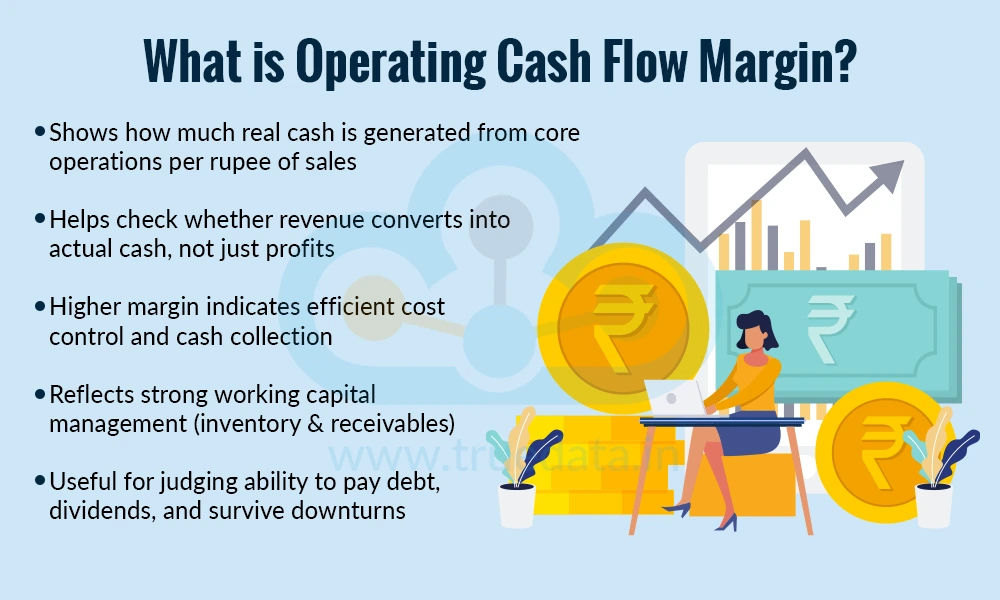
Operating Cash Flow Margin is a financial ratio that shows how much cash a company actually generates from its core business operations for every rupee of sales it makes. In simple terms, it tells investors whether the company’s revenues are converting into real cash, not just accounting profits. The ratio is calculated by dividing operating cash flow by revenue, and it is expressed as a percentage. A higher Operating Cash Flow Margin means the company is efficient at collecting cash from customers, controlling operating costs, and managing working capital such as inventory and receivables. This ratio is especially useful for investors as it helps identify businesses with strong cash-generating ability, which can support debt repayment, dividends, expansion plans, and resilience during economic slowdowns, even if reported profits fluctuate.

How to Calculate Operating Cash Flow Margin?

How to Calculate Operating Cash Flow Margin

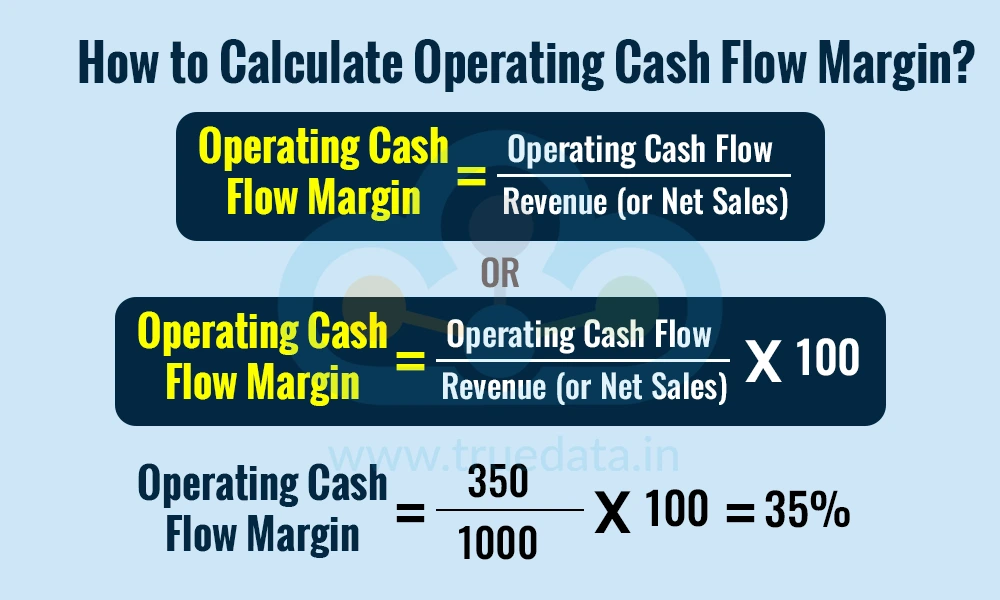
Operating Cash Flow Margin is calculated using two basic components from the cash flow statement and the profit and loss statement. The formula to calculate the operating cash flow margin is explained below.

Operating Cash Flow Margin = Operating Cash Flow / Revenue (or Net Sales)

Or 

Operating Cash Flow Margin = Operating Cash Flow / Revenue (or Net Sales) * 100

Understanding Operating Cash Flow Margin Using a Simple Example - 

Consider XYZ Ltd. with a revenue of Rs. 1,000 crore and an operating cash flow of Rs. 350 crores. The operating cash flow margin is calculated as follows,

Operating Cash Flow Margin = Operating Cash Flow / Revenue (or Net Sales) * 100

Operating Cash Flow Margin = 350 / 1000) * 100 = 35%

This means that for every Rs. 100 of sales, the company is generating Rs. 35 as actual cash from its core operations. A consistently healthy Operating Cash Flow Margin indicates good cash collection, efficient operations, and better ability to fund growth, repay loans, or handle tough market conditions, without depending heavily on external borrowing.

Why is Operating Cash Flow Margin Important?

Why is Operating Cash Flow Margin Important

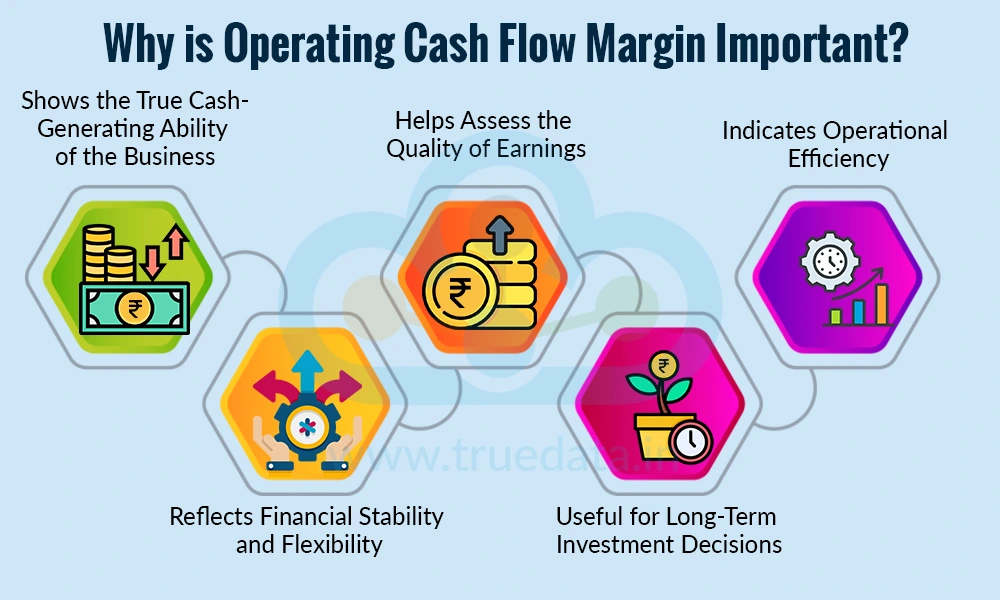
Operating cash flow margin showcases the ability of the company to generate actual cash from its core operations to keep the wheels running. This is a crucial parameter for a business to understand its ability to survive and eventually thrive. The importance of operating cash flow margin for a company, as well as investors and other stakeholders, is explained below.

Shows the True Cash-Generating Ability of the Business

Operating Cash Flow Margin tells investors how much real cash a company generates from its day-to-day operations compared to its sales. Unlike profits, which can be influenced by accounting policies or one-time adjustments, this ratio focuses on actual cash coming in. This is an important parameter to evaluate, as companies with strong cash generation are better placed to survive slowdowns, price pressure, or temporary declines in demand.

Helps Assess the Quality of Earnings

A company may report rising profits, but if its Operating Cash Flow Margin is weak or falling, it can be a red flag. This ratio helps investors check whether reported profits are supported by real cash or are mainly on paper due to credit sales or aggressive accounting. A healthy margin indicates that earnings are of good quality and more reliable in the long run.

Indicates Operational Efficiency

A higher Operating Cash Flow Margin suggests that the company is managing its costs, inventory, and receivables efficiently. It shows the business is converting sales into cash without excessive delays or wastage. This is especially useful for investors when comparing companies within the same industry, as it highlights which players run their operations more efficiently.

Reflects Financial Stability and Flexibility

Companies with strong operating cash flows have more financial flexibility. They can repay debt, invest in expansion, pay dividends, or handle unexpected expenses without relying heavily on borrowings. In an environment where interest rates and credit conditions can change quickly, a good Operating Cash Flow Margin adds a layer of safety to an investment.

Useful for Long-Term Investment Decisions

Over time, consistently strong Operating Cash Flow Margins indicate a sustainable business model. Such companies are less dependent on external funding and better positioned to grow steadily. Thus, this ratio helps investors in identifying businesses that can compound wealth while managing risks effectively.

What is Earnings Quality?

What is Earnings Quality

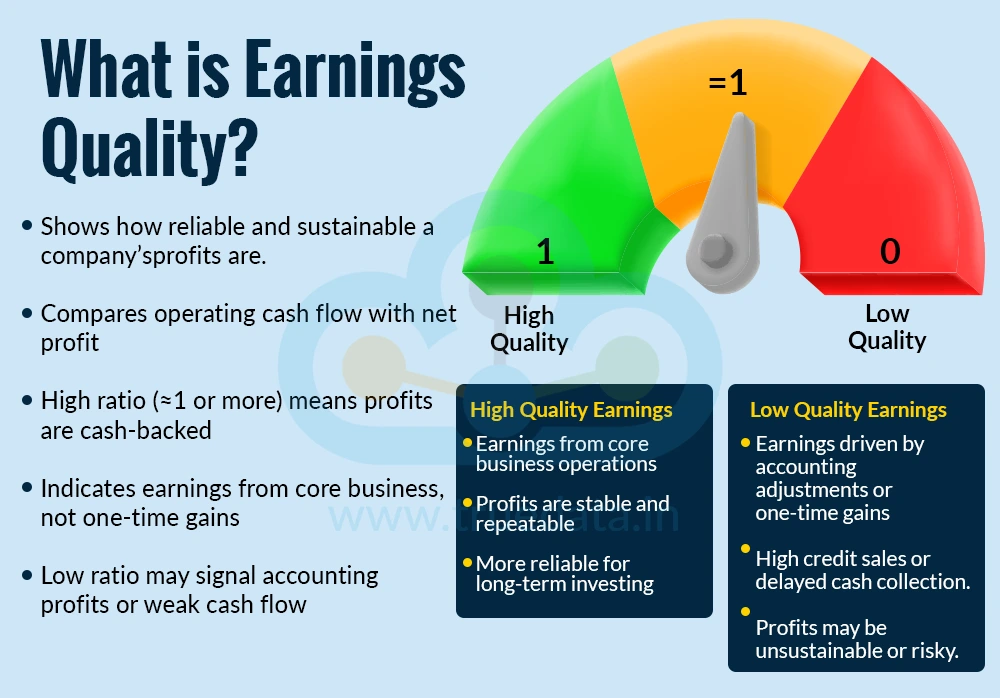
Earnings quality refers to how reliable, sustainable, and cash-backed a company’s reported profits are. Earnings quality is calculated by comparing the cash a business actually generates from its core operations with the net profit shown in the profit and loss statement. High-quality earnings originate from the company’s core business operations and are underpinned by robust operating cash flows, rather than accounting adjustments or one-time gains. If this ratio is close to 1 or higher, it means the company’s profits are well supported by real cash inflows, which is a healthy sign. In such cases, profits tend to be consistent and repeatable, making them more trustworthy for long-term analysis. If the ratio is consistently much lower than 1, it may indicate that profits are driven by accounting entries, high credit sales, or temporary factors rather than actual cash generation.

How is Earnings Quality Calculated?

How is Earnings Quality Calculated

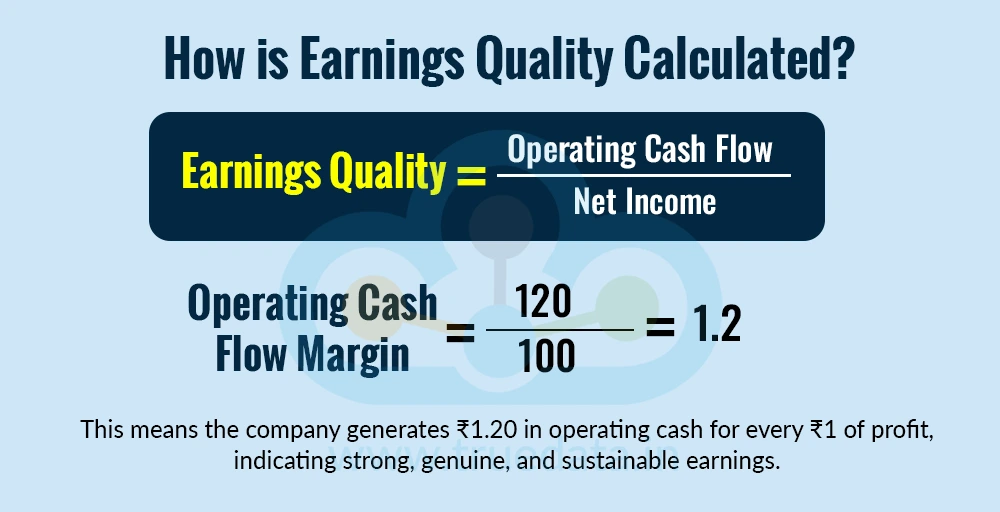
Earnings quality is not calculated as a profit number by itself, but it is measured using ratios that compare reported earnings with actual cash generation. The formula to calculate the earnings quality is explained below.

Earnings Quality = Operating Cash Flow / Net Income.

Interpretation of the Ratio - 

  • Earnings Quality > 1 = Profits are strongly supported by cash (high quality)

  • Earnings Quality ≈ 1 = Profits and cash flows are aligned (healthy)

  • Earnings Quality < 1 = Profits may not be fully cash-backed (needs caution)

Understanding Earnings Quality Using a Simple Example - 

Consider ABC Ltd. with a net income of Rs. 100 crore and an operating cash flow of Rs. 120 crore. The calculation of earnings quality is shown below, 

Earnings Quality = 120 / 100 = 1.2

This means the company is generating Rs. 1.20 in operating cash for every Re. 1 of reported profit. This is a strong sign that earnings are genuine, sustainable, and not inflated by accounting entries.

Now consider another company, PQR Ltd., with a net income of Rs. 100 crore operating cash flow of Rs. 60 crore. The calculation of earnings quality is shown below, 

Earnings Quality = 60 / 100 = 0.6

Here, profits are not fully supported by cash, which may indicate high credit sales, delayed collections, or aggressive accounting. Thus, comparing earnings quality across years and peers helps identify companies with real financial strength rather than just attractive profit numbers.

What Does Earnings Quality Tell About the Company?

The importance of earnings quality is calculated below.

What Does Earnings Quality Tell About the Company

Reveals Profit Reliability

Earnings quality helps investors understand whether a company’s reported profits can be trusted. When earnings are supported by strong operating cash flows, it means profits are real and not just accounting numbers. High earnings quality indicates that the company is genuinely earning money from its core business, which makes its financial performance more dependable for long-term investors.

Highlights the Sustainability of Earnings

Good earnings quality suggests that profits are likely to continue in the future. These earnings usually come from regular business activities rather than one-time gains, asset sales, or accounting adjustments. This helps in identifying businesses with stable and repeatable income streams for investors looking to hold stocks for the long term.

Helps Detect Red Flags Early

Low earnings quality can be an early warning sign. If profits are rising but cash flows are weak, it may point to issues such as aggressive revenue recognition, growing unpaid customer dues, or heavy dependence on credit sales. Tracking earnings quality helps investors spot such problems before they reflect in falling profits or share prices.

Indicates Financial Strength and Flexibility

Companies with high earnings quality generally have better financial strength. Strong cash-backed earnings allow them to repay loans, fund expansion, invest in new projects, and pay dividends without stress. In changing economic conditions, such companies are also better equipped to handle downturns, which adds comfort for investors.

Improves Better Investment Decision-Making

By focusing on earnings quality, investors move beyond headline profit numbers and gain deeper insight into a company’s true performance. It allows for more meaningful comparison between companies in the same sector and helps investors choose businesses with genuine value creation rather than short-term profit spikes.

What is the Cash Conversion Ratio?

What is the Cash Conversion Ratio

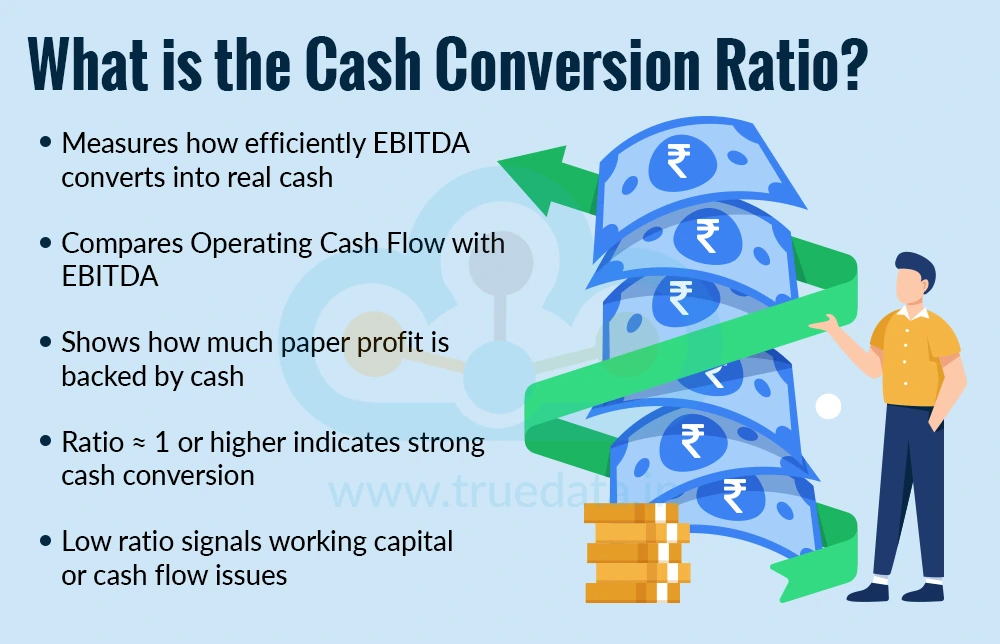
The Cash Conversion Ratio or Cash EBITDA Ratio is used to measure the efficiency of a company to convert its operating earnings into actual cash. EBITDA shows profits from core business activities before non-cash charges like depreciation and amortisation, but it does not reflect real cash movement. Comparing Operating Cash Flow with EBITDA tells investors how much of the company’s operating profit is being realised as cash after accounting for working capital changes such as receivables, inventory, and payables, i.e., how much of ‘paper profits’ are backed by real cash. A ratio close to or above 1 indicates strong cash conversion and disciplined operations, while a consistently lower ratio may point to delayed customer payments, inventory build-up, or cash getting stuck in daily operations.  Thus, the Cash Conversion Ratio is a reality check as it tells whether the profits seen in the financial statements are truly flowing into the company’s bank account. This is a powerful tool to judge the quality of earnings for long-term investors, especially in India, where cash management is critical.

How to Calculate Cash Conversion Ratio?

How to Calculate Cash Conversion Ratio

The Cash Conversion Ratio also shows how efficiently a company converts its operating profits (EBITDA) into actual cash from its core business. Cash Conversion Ratio does not have just one fixed formula. In practice, analysts use a few closely related formulas, depending on what they want to compare cash flows with. The formulas to calculate the cash conversion ratio are,

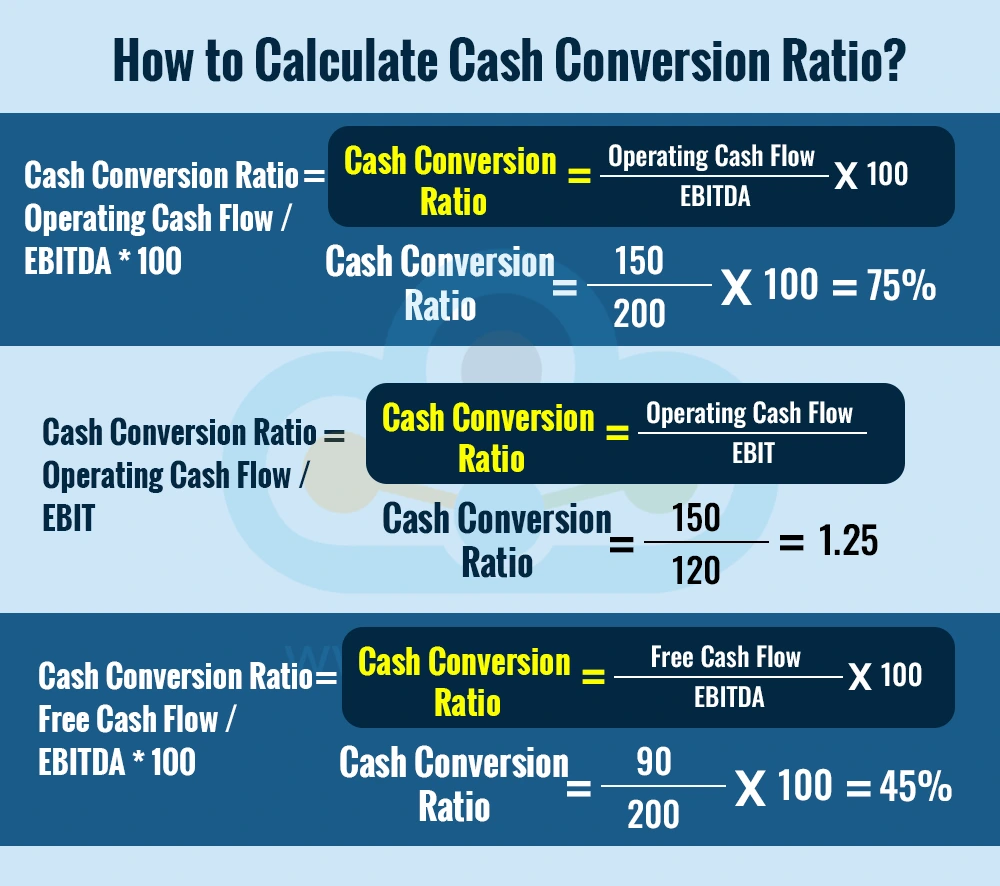
  1. Cash Conversion Ratio = Operating Cash Flow / EBITDA * 100

This is the most commonly used formula for calculating the cash conversion ratio. It shows how efficiently a company converts its operating profits into real cash after working capital changes.

Understanding the calculation of Cash Conversion Ratio Using a Simple Example - 

Consider a company with an operating cash flow of Rs. 150 crores and EBITDA of Rs. 200 crores. The calculation of the cash conversion ratio is shown below, 

Calculating the Cash Conversion Ratio using the formula - 

Cash Conversion Ratio = Operating Cash Flow / EBITDA * 100

Cash Conversion Ratio = 150 / 200 = 0.75 (75%)

This means the company converts 75% of its operating profits into cash, which is generally healthy if it is consistent across periods.

  1. Cash Conversion Ratio = Operating Cash Flow / EBIT 

This formula to calculate the CCR is used with caution as it compares cash with operating profit after depreciation and amortisation. It is sometimes used in analysis, but it can be misleading for asset-heavy companies because EBIT includes non-cash depreciation expenses.

Understanding the calculation of Cash Conversion Ratio Using a Simple Example - 

Consider a company with an operating cash flow of Rs. 150 crores and EBIT of Rs. 120 crores. The calculation of the cash conversion ratio is shown below, 

Calculating the Cash Conversion Ratio using the formula - 

Cash Conversion Ratio = Operating Cash Flow / EBIT

Cash Conversion Ratio = 150 / 120 = 1.25

A ratio above 1 suggests strong cash flow, but this can be distorted in asset-heavy businesses due to high depreciation.

  1. Cash Conversion Ratio = Free Cash Flow / EBITDA * 100 

Some analysts use this stricter version of the cash conversion ratio to analyse how much cash is left after capital expenditure. It is a stricter measure of cash conversion and is useful for mature companies. However, it is less common for a general cash conversion analysis.

Understanding the calculation of Cash Conversion Ratio Using a Simple Example - 

Consider a company with a free cash flow of Rs. 90 crores and EBITDA of Rs. 200 crores. The calculation of the cash conversion ratio is shown below, 

Calculating the Cash Conversion Ratio using the formula - 

Cash Conversion Ratio = Free Cash Flow / EBITDA

Cash Conversion Ratio = 90 / 200 = 0.45 (or 45%)

This suggests that while the company may generate operating cash, a large part is used for capital spending.

What are the differences between Operating Cash Flow Margin, Earnings Quality and Cash Conversion Ratio?

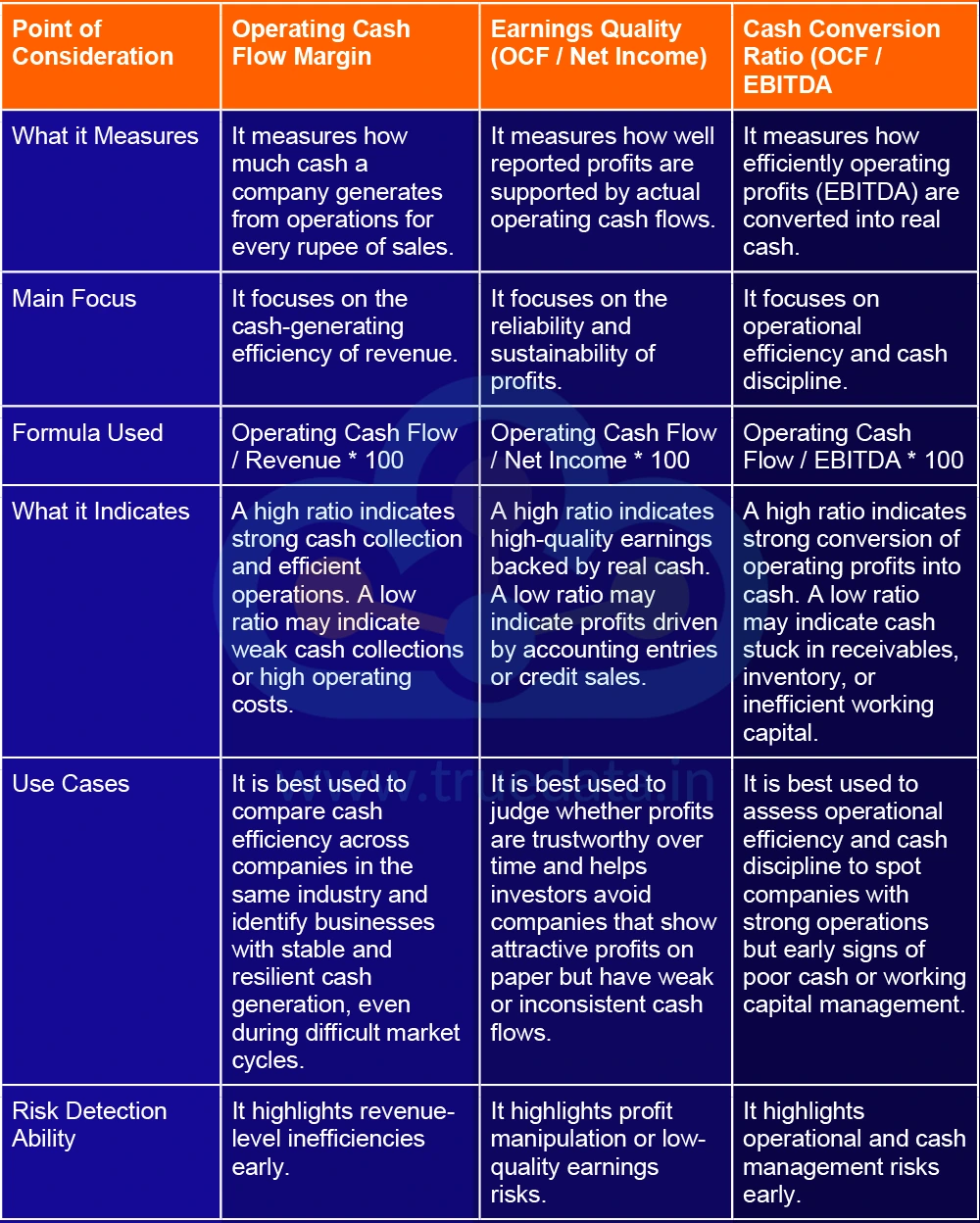
The Operating Cash Flow Margin, Earnings Quality and Cash Conversion Ratio address deeper cash flow analysis and answer different questions. The key differences between the three are highlighted below.

What are the differences between Operating Cash Flow Margin, Earnings Quality and Cash Conversion Ratio

Point of Consideration 

Operating Cash Flow Margin

Earnings Quality (OCF / Net Income)

Cash Conversion Ratio (OCF / EBITDA

What it Measures

It measures how much cash a company generates from operations for every rupee of sales.

It measures how well reported profits are supported by actual operating cash flows.

It measures how efficiently operating profits (EBITDA) are converted into real cash.

Main Focus

It focuses on the cash-generating efficiency of revenue.

It focuses on the reliability and sustainability of profits.

It focuses on operational efficiency and cash discipline.

Formula Used

Operating Cash Flow / Revenue * 100

Operating Cash Flow / Net Income * 100

Operating Cash Flow / EBITDA * 100

What it Indicates

A high ratio indicates strong cash collection and efficient operations. A low ratio may indicate weak cash collections or high operating costs.

A high ratio indicates high-quality earnings backed by real cash. A low ratio may indicate profits driven by accounting entries or credit sales.

A high ratio indicates strong conversion of operating profits into cash. A low ratio may indicate cash stuck in receivables, inventory, or inefficient working capital.

Use Cases

It is best used to compare cash efficiency across companies in the same industry and identify businesses with stable and resilient cash generation, even during difficult market cycles.

It is best used to judge whether profits are trustworthy over time and helps investors avoid companies that show attractive profits on paper but have weak or inconsistent cash flows.

It is best used to assess operational efficiency and cash discipline to spot companies with strong operations but early signs of poor cash or working capital management.

Risk Detection Ability

It highlights revenue-level inefficiencies early.

It highlights profit manipulation or low-quality earnings risks.

It highlights operational and cash management risks early.

Conclusion

The cash flow ratios explained here work best as a combined toolkit. Operating Cash Flow Margin explains how strong sales cash flows are, Earnings Quality explains how real the profits are, and Cash Conversion Ratio explains how efficiently operations turn profits into cash. Using all three together gives a deeper and more reliable picture of a company’s true financial health than relying on profit numbers alone. Thus, it leads to more confident and informed long-term investment decisions. 

Cash flow ratios are an integral part of the fundamental analysis of stocks and evaluating optimum investment opportunities. We hope this explanation could help you understand these ratios in a better light. Let us know your thoughts on the topic or if you need further information on the same, and stay tuned for the next part, where we break down the remaining cash flow ratios.

Till then, Happy Reading!


Read More: How Mutual Fund Managers Use Corporate Financial Data?

Frequently Asked Questions

A high Operating Cash Flow (OCF) margin indicates that the company is efficiently converting its sales into real cash from its core operations. It shows strong cash collection, good cost control, and a financially stable business model.

Operating Cash Flow Margin shows how much real cash a company generates from its sales, while Net Profit Margin shows accounting profit after expenses and taxes. Thus, OCF Margin is often more reliable as it reflects actual cash strength, not just reported profits.

OCF/EBITDA is used as a liquidity or quality measure because it shows how much of a company’s operating profit actually turns into real cash. It helps judge whether profits are supported by cash and whether the business has good cash discipline.

Yes, a company can have positive operating cash flow but negative net income if non-cash expenses like depreciation or one-time charges reduce profits. This often means the business is generating cash but is temporarily impacted by accounting or exceptional items.

A widening gap between net income and operating cash flow over time can be a warning sign that profits are not turning into cash. It may indicate rising credit sales, poor working capital management, or aggressive accounting practices.
Marisha Bhatt

Marisha Bhatt is a financial content writer @TrueData.

She writes with the sole aim of simplifying complex financial concepts and jargon while attempting to clarify technical and fundamental analysis concepts of the stock markets. The ultimate goal is to spread vital knowledge and benefit the maximum audience. Her Chartered Accountant background acts as the knowledge base to help clarify crucial concepts and create a sound investment portfolio.

0 Comments