Corporate Data

What is the Dividend per share? How to calculate it?

Marisha Bhatt · 26 Mar 2026 · 8 mins read · 0 Comments

what-is-dividend-per-share-how-to-calculate-it

When choosing long-term stocks, dividends often play an important role for investors. After all, dividends represent the real income you earn from your investment. But how do you know exactly how much dividend you receive for each share you hold? This is where Dividend Per Share (DPS) becomes important. Read on to understand what DPS means, how to calculate it using simple formulas, and how it is different from Earnings Per Share (EPS).

What is Dividend Per Share?

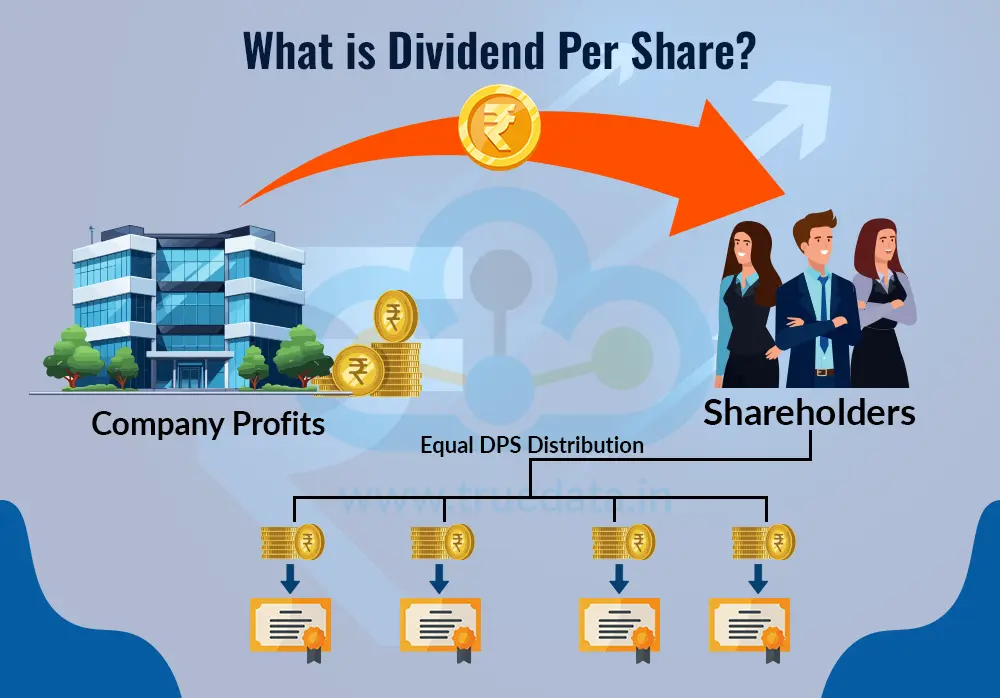
What is Dividend Per Share

Dividend Per Share (DPS) is a financial measure that shows how much dividend a company pays to its equity shareholders for each share they own. It tells investors the amount of income they earn per share from the company’s profits. While a company is not obligated to declare and distribute dividends each year, when a company makes profits, it may choose to distribute a part of those profits to shareholders in the form of dividends. DPS helps investors clearly understand the exact amount paid on each share, instead of just looking at the total dividend announced by the company. DPS is useful because it helps compare dividend-paying companies and understand which stocks provide better regular income, along with potential price growth.

How to Calculate the Dividend Per Share?

Dividend per share can be calculated using several formulas. These formulas are explained hereunder. 

  1. Basic Formula for Calculating Dividend Per Share

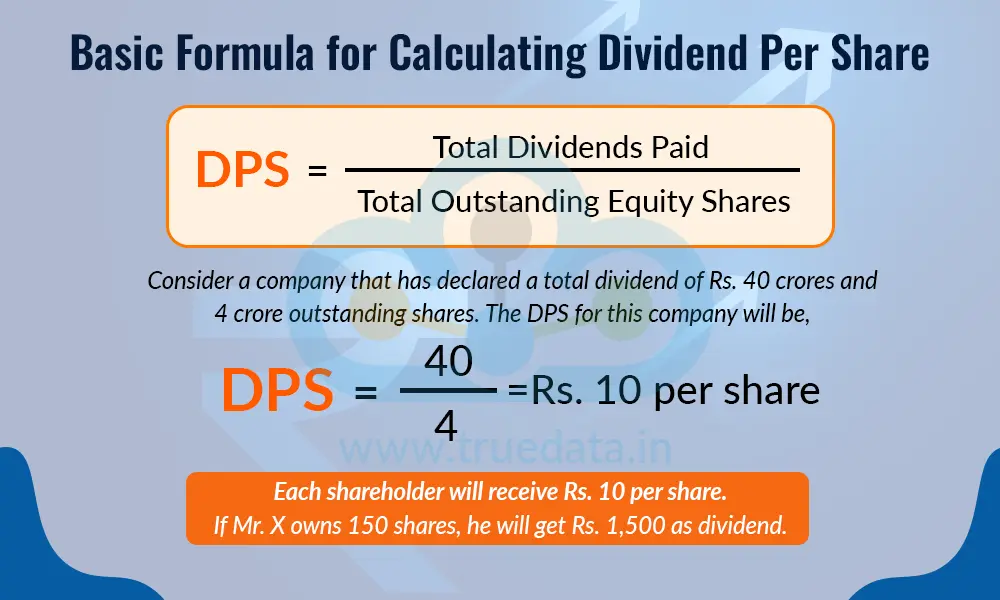
Basic Formula for Calculating Dividend Per Share

The basic formula to calculate the dividend per share includes comparing the total dividend paid by the company and the total outstanding shares of the company. The formula to calculate the DPS is,

DPS = Total Dividends Paid / Total Outstanding Equity Shares

Understanding the Calculation of DPS using an Example

Consider a company that has declared a total dividend of Rs. 40 crores and 4 crore outstanding shares. The DPS for this company will be,

DPS = Total Dividends Paid / Total Outstanding Equity Shares

DPS = 40/4 = Rs. 10 per share

Thus, every shareholder will receive Rs. 10 for each share they hold.

If Mr. X owns 150 shares, his total dividend income will be Rs. 1500 (150*10). 

  1. Alternate Formula for Calculating Dividend Per Share

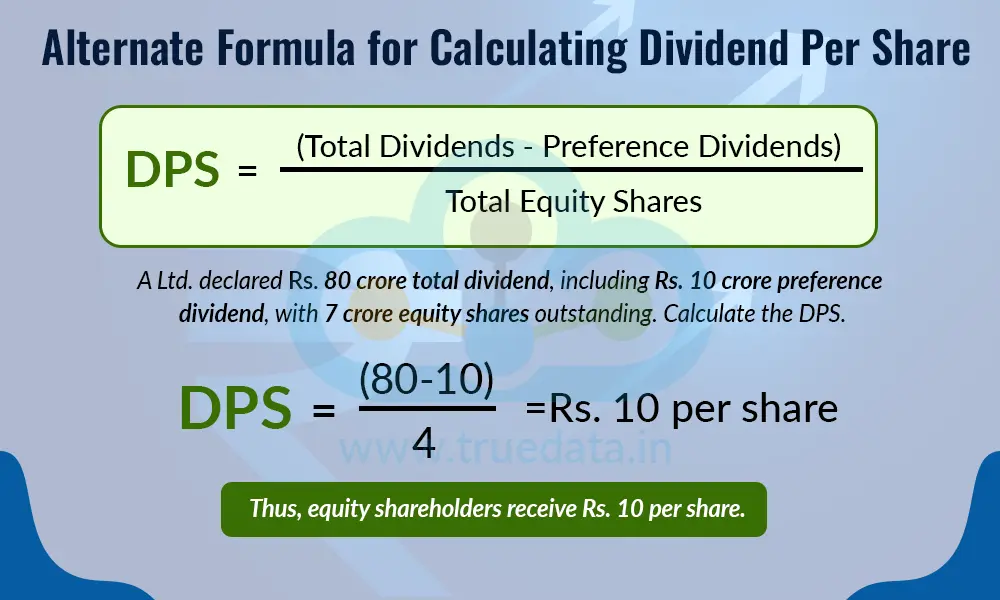
Alternate Formula for Calculating Dividend Per Share

If the company has preference shares, the preference dividend has to be deducted while calculating the final DPS for equity shareholders. The formula to calculate the DPS in this case will be,

DPS = (Total Dividends - Preference Dividends) / Total Equity Shares

Understanding the Calculation of DPS using an Example

Consider A Ltd. with a total dividend declared of Rs. 80 crores, preference dividend of Rs. 10 crores and 7 crore outstanding equity shares. Calculating DPS in this case,

DPS = (Total Dividends - Preference Dividends) / Total Equity Shares

DPS = (80-10) / 7 = Rs. 10 per share

Thus, equity shareholders receive Rs. 10 per share.

  1. Dividend Using the Payout Ratio

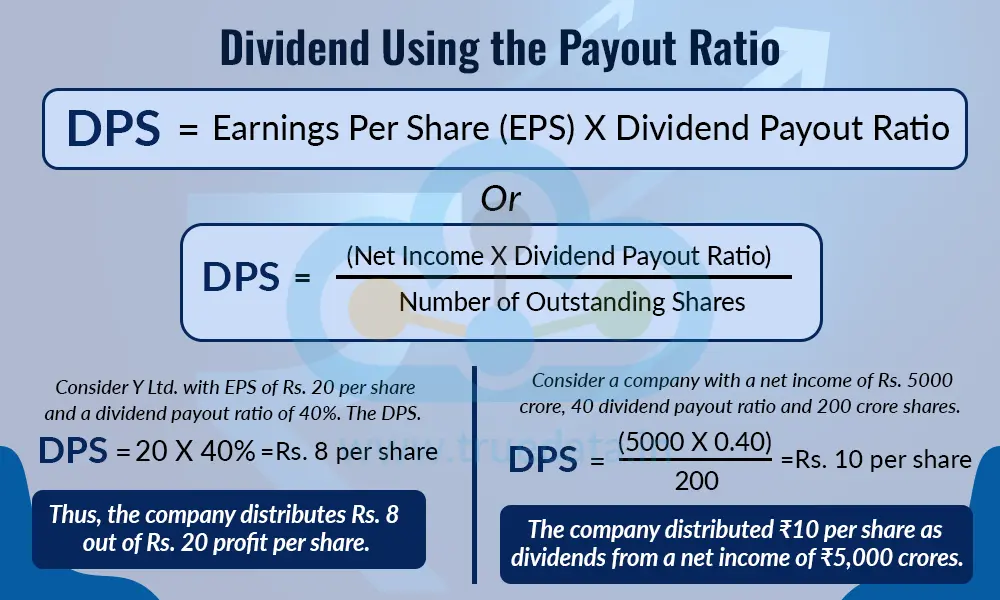
Dividend Using the Payout Ratio

DPS can also be calculated using the company’s earnings and payout ratio. The formula to calculate DPS in this case is,

DPS = Earnings Per Share (EPS) × Dividend Payout Ratio

Or 

DPS = (Net Income * Dividend Payout Ratio) / Number of Outstanding Shares

Understanding the Calculation of DPS using an Example

  • Consider Y Ltd. with EPS of Rs. 20 per share and a dividend payout ratio of 40%. The DPS. Calculating DPS in this case,

DPS = Earnings Per Share (EPS) × Dividend Payout Ratio

DPS = 20*40% = Rs. 8 per share

Thus, the company distributes Rs. 8 out of Rs. 20 profit per share.

  • Consider a company with a net income of Rs. 5000 crore, 40 dividend payout ratio and 200 crore shares. 

DPS = (Net Income * Dividend Payout Ratio) / Number of Outstanding Shares

DPS = (5000 * 0.40) / 200 = Rs. 10 per share

Thus, the company distributes Rs. 10 per share as dividends out of the net income of Rs. 5000 crores. 

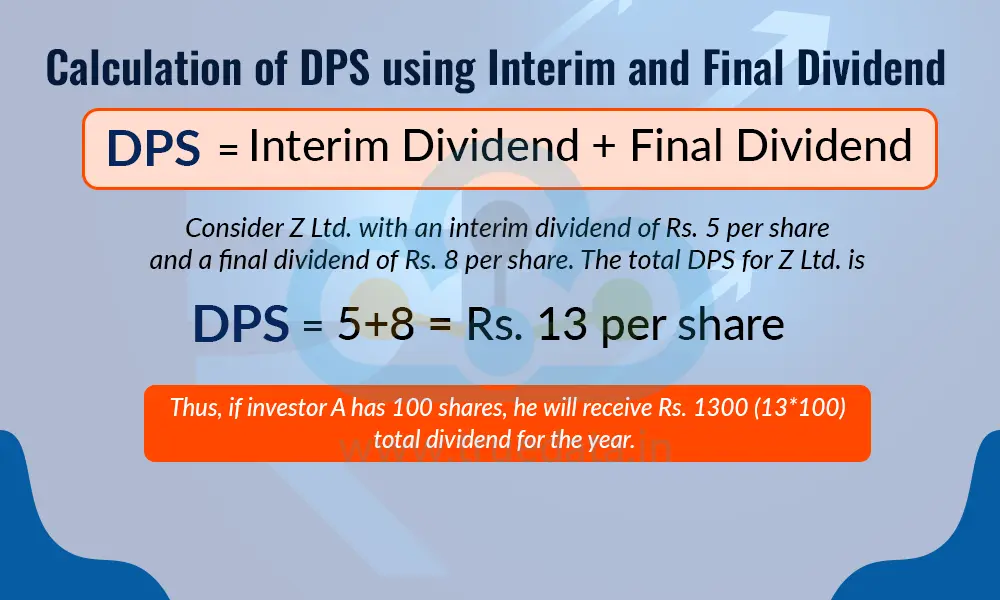
  1. Calculation of DPS using Interim and Final Dividend

Calculation of DPS using Interim and Final Dividend

Companies in India can declare dividends more than once during a year. This dividend is known as an interim dividend and a final dividend. The formula to calculate DPS in this case is,

DPS = Interim Dividend + Final Dividend

Understanding the Calculation of DPS using an Example

Consider Z Ltd. with an interim dividend of Rs. 5 per share and a final dividend of Rs. 8 per share. The total DPS for Z Ltd. is

DPS = Interim Dividend + Final Dividend

DPS = 5+8 = Rs. 13 per share

Thus, if investor A has 100 shares, he will receive Rs. 1300 (13*100) total dividend for the year.  

What are the Rules for Declaring and Distributing Dividends?

The Companies Act 2013 and SEBi have specific rules for declaring and distributing dividends. These rules ensure that dividends are declared only when companies have genuine profits and financial strength. The Companies Act, 2013, protects the legal process, while SEBI ensures transparency and timely information for listed companies. Together, these regulations help build trust and protect shareholder interests. Some of these provisions and the rules in this regard are explained hereunder. 

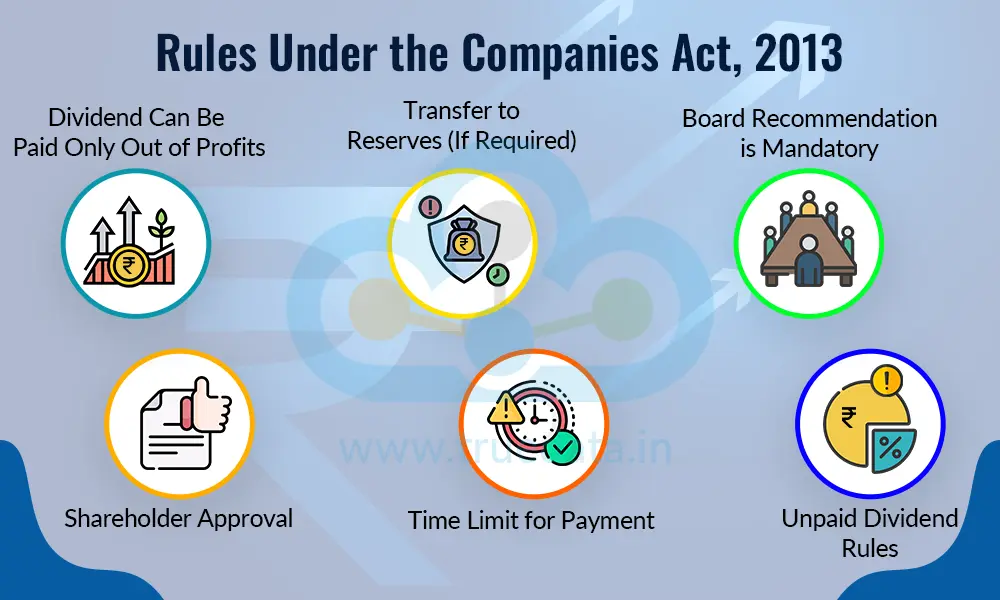
Rules Under the Companies Act, 2013

Rules Under the Companies Act, 2013

  • Dividend Can Be Paid Only Out of Profits - As per the Companies Act, 2013, a company can declare dividends only out of, 

    • Current year profits, or

    • Past accumulated profits (free reserves), or

    • Money provided by the government (in certain cases)

A company cannot declare dividends out of borrowed money. Also, depreciation must be properly adjusted before calculating profits available for dividends.

  • Transfer to Reserves (If Required) - Earlier, companies were required to transfer a portion of profits to reserves before declaring dividends. Under the Companies Act, 2013, this is now optional. However, companies may still transfer some amount to reserves for financial stability before declaring dividends.

  • Board Recommendation is Mandatory - Dividend declaration starts with the Board of Directors. The Board must recommend the dividend amount. Shareholders cannot declare a dividend higher than what the Board recommends. They can approve it or reduce it at the Annual General Meeting (AGM).

  • Shareholder Approval - An approval of shareholders is required for final dividends at the AGM. Once approved, it becomes a liability of the company and must be paid. However, interim dividends can be declared by the Board during the financial year without shareholder approval.

  • Time Limit for Payment - Once a dividend is declared, it must be paid within 30 days from the date of declaration. If not paid within this time, the company may face penalties.

  • Unpaid Dividend Rules - If a dividend remains unpaid or unclaimed for 30 days, it must be transferred to a special bank account called the ‘Unpaid Dividend Account’. If it remains unclaimed for 7 years, the amount must be transferred to the Investor Education and Protection Fund (IEPF).

SEBI Rules for Listed Companies

SEBI Rules for Listed Companies

For companies listed on stock exchanges like NSE or BSE, additional SEBI regulations apply.

  • Disclosure Requirements - Listed companies must promptly inform stock exchanges about the following details to ensure transparency for investors.

    • Dividend decision by the Board

    • Record date or book closure date

    • Dividend amount per share

  • Record Date - The company must announce a ‘record date’. Only shareholders whose names appear in the company’s records on that date are eligible to receive the dividend.

  • Electronic Payment - SEBI encourages dividend payments through electronic modes like NEFT, RTGS, or direct bank transfer to ensure faster and safer payments to investors.

  • Corporate Governance Compliance - Listed companies must follow SEBI’s Listing Obligations and Disclosure Requirements (LODR) and also update on the trading closure window as per the SEBI regulations as part of the LODR requirements. This ensures proper approval processes, fair treatment of shareholders, and timely communication.

What is the Difference Between Dividend Per Share and Earnings Per Share?

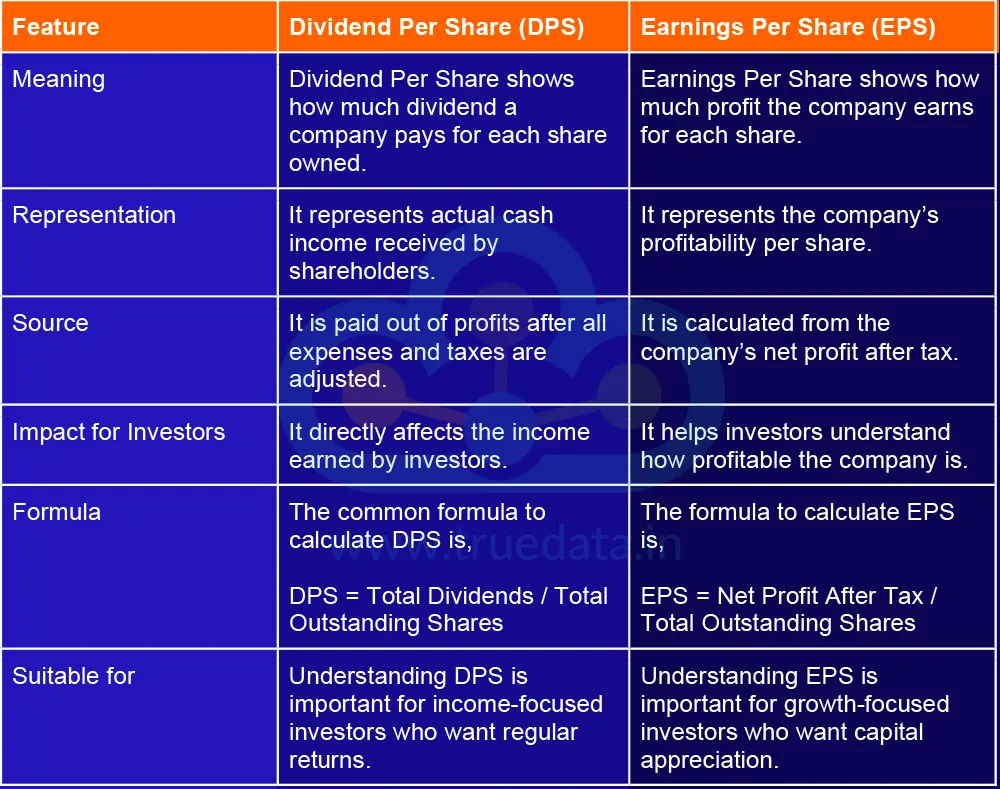
Dividend Per Share (DPS) and Earnings Per Share (EPS) are both important financial measures, but they serve different purposes. EPS shows how much profit a company earns for each share, while DPS shows how much of that profit is actually paid to shareholders as a dividend. The differences between the two are highlighted below.

What is the Difference Between Dividend Per Share and Earnings Per Share

Feature

Dividend Per Share (DPS)

Earnings Per Share (EPS)

Meaning

Dividend Per Share shows how much dividend a company pays for each share owned.

Earnings Per Share shows how much profit the company earns for each share.

Representation

It represents actual cash income received by shareholders.

It represents the company’s profitability per share.

Source

It is paid out of profits after all expenses and taxes are adjusted.

It is calculated from the company’s net profit after tax.

Impact for Investors

It directly affects the income earned by investors.

It helps investors understand how profitable the company is.

Formula

The common formula to calculate DPS is,


DPS = Total Dividends / Total Outstanding Shares

The formula to calculate EPS is,


EPS = Net Profit After Tax / Total Outstanding Shares

Suitable for 

Understanding DPS is important for income-focused investors who want regular returns.

Understanding EPS is important for growth-focused investors who want capital appreciation.

Conclusion

Dividend Per Share (DPS) is an important measure for investors who want to understand the actual income they earn from their shares. It shows how much dividend is paid per share and can be calculated using different methods. It can be used as an effective tool to compare companies across sectors if the focus is on selecting stocks based on their dividend potential, thus helping in planning regular income and making better long-term investment decisions.

This article breaks down the calculation of dividends and is an extension of our series on understanding dividends. Let us know your thoughts on the topic or if you need further information on the same, and we will address it soon. 

Till then, Happy Reading!


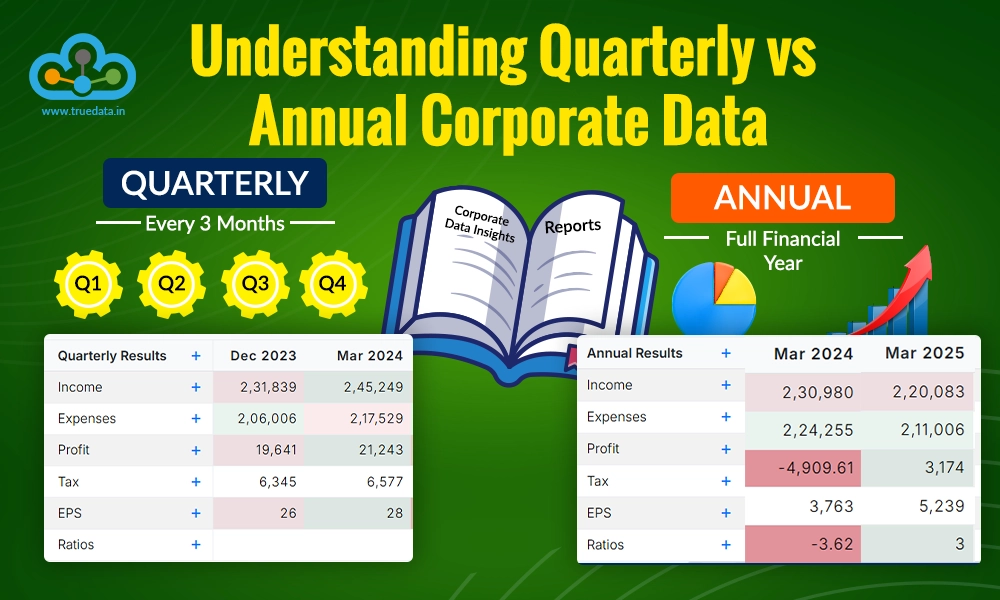
Read More: Understanding Quarterly vs Annual Corporate Data 

Frequently Asked Questions

Trailing DPS refers to the total dividend per share that a company has paid over the past 12 months. It helps investors understand the recent actual dividend income received per share, based on past payments rather than future estimates.

Forward DPS refers to the expected dividend per share that a company is likely to pay in the coming year. It is based on company guidance or analyst estimates and helps investors understand the possible future dividend income.

Dividend Per Share (DPS) shows the actual amount of dividend paid per share, while dividend yield shows the dividend as a percentage of the current share price. Thus, DPS tells you how much you earn per share, and dividend yield tells you how good that income is compared to the share price.

A stock buyback reduces the total number of shares in the market. If the total dividend amount stays the same, fewer shares mean Dividend Per Share (DPS) can increase for remaining investors.

Stock split increases the number of shares, and the dividend per share reduces in the same proportion. So, investors should divide the old DPS by the split ratio to compare it correctly with the new DPS.

No, DPS cannot be negative because dividend is paid only when a company has profits and decides to distribute them. If a company has losses or chooses not to pay dividends, the DPS will simply be zero, not negative.

DPS is useful because it shows the exact dividend income an investor earns for each share held. It helps investors compare dividend-paying companies and plan regular income from their investments.
Marisha Bhatt

Marisha Bhatt is a financial content writer @TrueData.

She writes with the sole aim of simplifying complex financial concepts and jargon while attempting to clarify technical and fundamental analysis concepts of the stock markets. The ultimate goal is to spread vital knowledge and benefit the maximum audience. Her Chartered Accountant background acts as the knowledge base to help clarify crucial concepts and create a sound investment portfolio.

0 Comments