Corporate Data

Valuation Ratios - PEG Ratio

Marisha Bhatt · 21 Feb 2026 · 8 mins read · 0 Comments

valuation-peg-ratio

Valuation plays a central role in almost every investment decision, whether you are a retail investor building a long-term portfolio or a large stakeholder assessing business worth. Valuation ratios, therefore, form one of the strongest pillars of fundamental analysis. While we have already covered the basics of valuation ratios in our earlier blog, it is time to go a step deeper, starting with the PEG Ratio, i.e., the price/earnings to growth ratio. Check out this blog to learn about the PEG Ratio in detail and its core differences from the traditional PE Ratio. 

What is the PEG Ratio?

What is the PEG Ratio

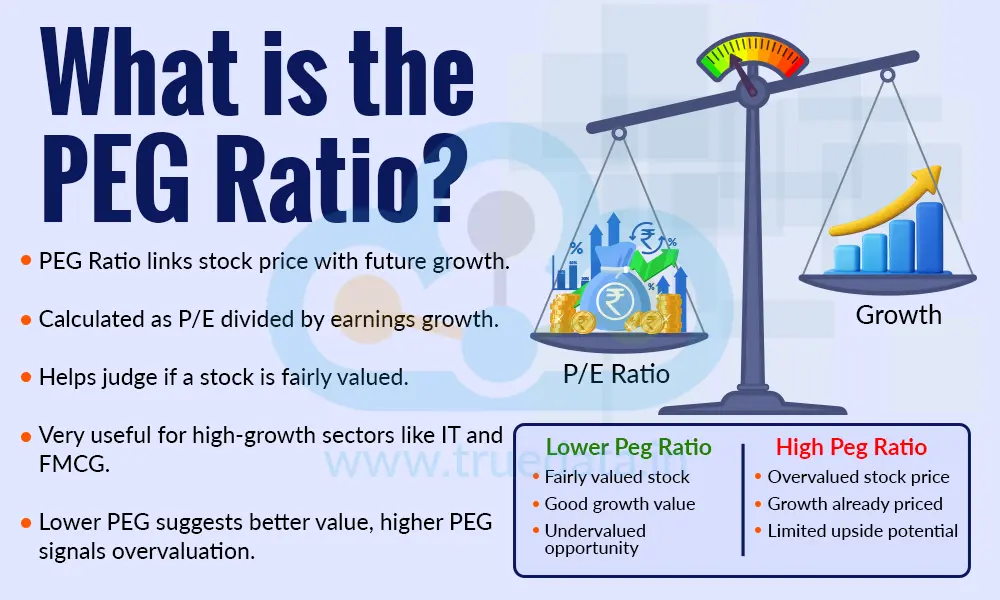
The PEG Ratio, or Price/Earnings to Growth Ratio, is a valuation metric that helps investors understand whether a stock’s price is reasonable when its future growth is taken into account. It builds on the popular P/E ratio by dividing the P/E ratio by the company’s expected earnings growth rate. In simple terms, while the PE Ratio tells you how expensive a stock looks today, the PEG Ratio shows whether that price is justified by how fast the company is expected to grow.

This is especially useful in analysing growing companies, such as those in IT, FMCG, or emerging sectors, where earnings growth plays a big role in long-term returns. A lower PEG Ratio generally suggests the stock may be fairly valued or undervalued compared to its growth potential, while a higher PEG Ratio can indicate that the stock price may already be too optimistic about future growth.

How to Calculate the PEG Ratio?

The PEG ratio is calculated by dividing a company’s Price-to-Earnings (P/E) ratio by its earnings growth rate. It adjusts the P/E ratio for growth, making it a more balanced valuation metric. The formulas to calculate the PEG Ratio are explained below.

Standard PEG Ratio

Standard PEG Ratio

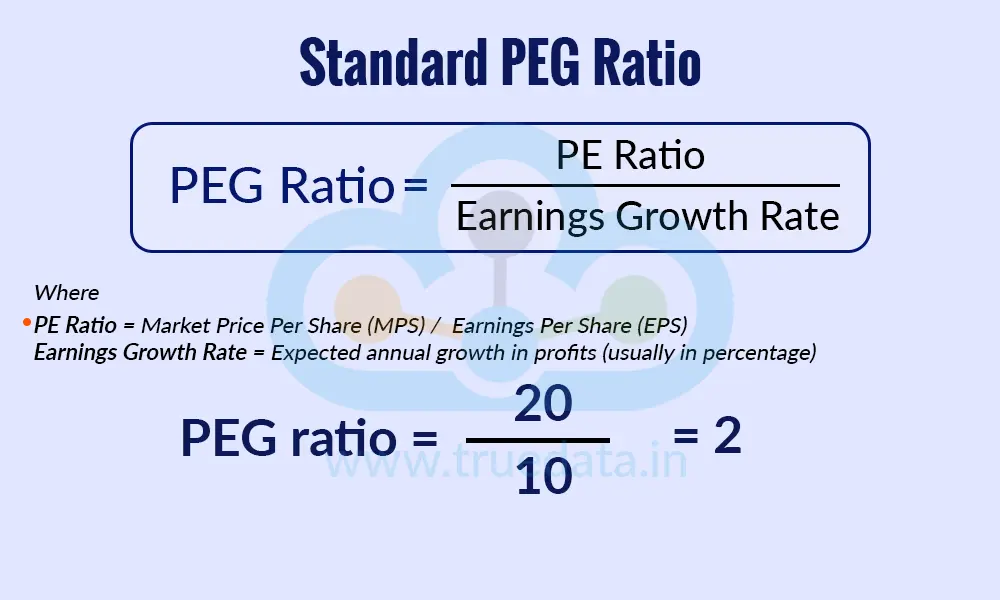
PEG Ratio = PE Ratio / Earnings Growth Rate

Where,

  • PE Ratio = Market Price Per Share (MPS) /  Earnings Per Share (EPS)

  • Earnings Growth Rate = Expected annual growth in profits (usually in percentage)

Understanding the Calculation of the Standard PEG Ratio with an Example 

Consider company X Ltd. with a P/E ratio of 20 and the expected growth rate of 10% per annum. The PEG ratio for Company X Ltd. is calculated as follows.

PEG Ratio = PE Ratio / Earnings Growth Rate

PEG ratio = 20/10 = 2

Thus, A PEG Ratio of 2 suggests the stock may be expensive compared to its growth. Generally, a PEG close to 1 is considered fairly valued. 

Forward PEG ratio

Forward PEG ratio

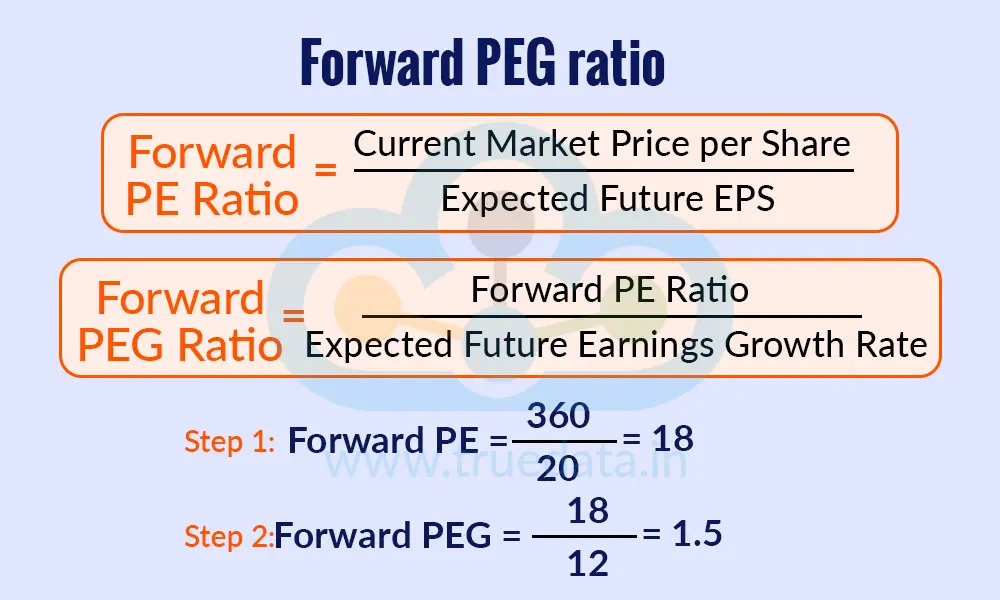
The Forward PEG Ratio is a valuation metric that looks ahead instead of backwards. Unlike the regular PEG Ratio, which may use past earnings growth, the Forward PEG Ratio uses expected future earnings growth to judge whether a stock’s current price is justified. The Forward PEG Ratio focuses on future growth by using the Forward PE Ratio, which is calculated using expected earnings instead of past profits. This helps investors judge whether today’s stock price is reasonable based on how the company is likely to perform in the coming years. The formula to calculate the Forward PEG Ratio is shown below. 

Formula to Calculate Forward PE Ratio -

Forward PE Ratio = Current Market Price per Share / Expected Future EPS

Formula to Calculate Forward PEG Ratio - 

Forward PEG Ratio = Forward PE Ratio / Expected Future Earnings Growth Rate

Understanding the Calculation of the Forward PEG Ratio with an Example 

Consider a company Y Ltd. with the current share price of RS. 360 and expected EPS for the next year of Rs. 20, along with an expected growth earnings of 12% per annum. The calculation of the forward PEG ratio is shown below.

Step 1 - Calculating the Forward PE Ratio

Forward PE = 360 / 20 = 18

Step 2 - Calculating the Forward PEG Ratio

Forward PEG = 18 / 12 = 1.5

A Forward PEG Ratio of 1.5 suggests that the stock may be slightly expensive compared to its expected future growth. This combined approach is helpful because it links today’s price, tomorrow’s earnings, and long-term growth into one simple valuation measure.

How is the PEG Ratio Interpreted?

How is the PEG Ratio Interpreted

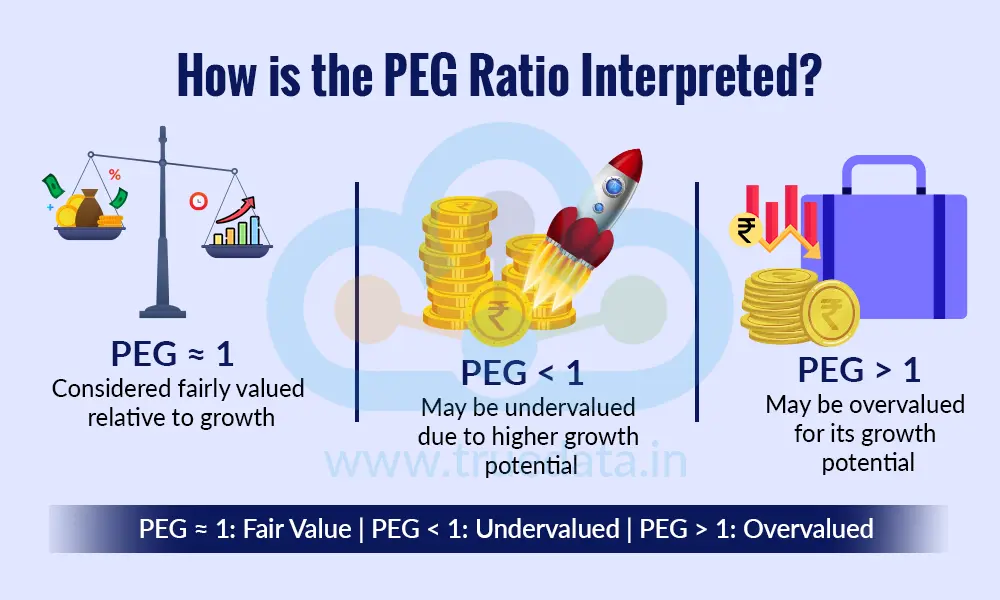
The PEG Ratio compares a company’s valuation with its expected earnings growth, helping investors understand whether a stock is reasonably priced for its future potential. In simple terms, it answers one key question, i.e., is the price you are paying justified by how fast the company is expected to grow? The PEG Ratio is especially useful when analysing growing companies, where a high P/E Ratio alone may look expensive but could still be reasonable if growth is strong. A lower PEG Ratio generally means better value for money, while a higher PEG Ratio suggests that the stock price may already be factoring in very optimistic growth expectations. The PEG Ratio works best among companies in the same industry and is more meaningful when based on reliable and consistent earnings growth.

The key points to remember while interpreting the PEG Ratio are,

  • PEG ≈ 1 - The stock is usually considered fairly valued in relation to its growth.

  • PEG < 1 - The stock may be undervalued, as growth could be higher than what the price suggests.

  • PEG > 1 - The stock may be overvalued, meaning investors might be paying too much for expected growth.

Why is the PEG Ratio Important for Companies and Investors?

Why is the PEG Ratio Important for Companies and Investors

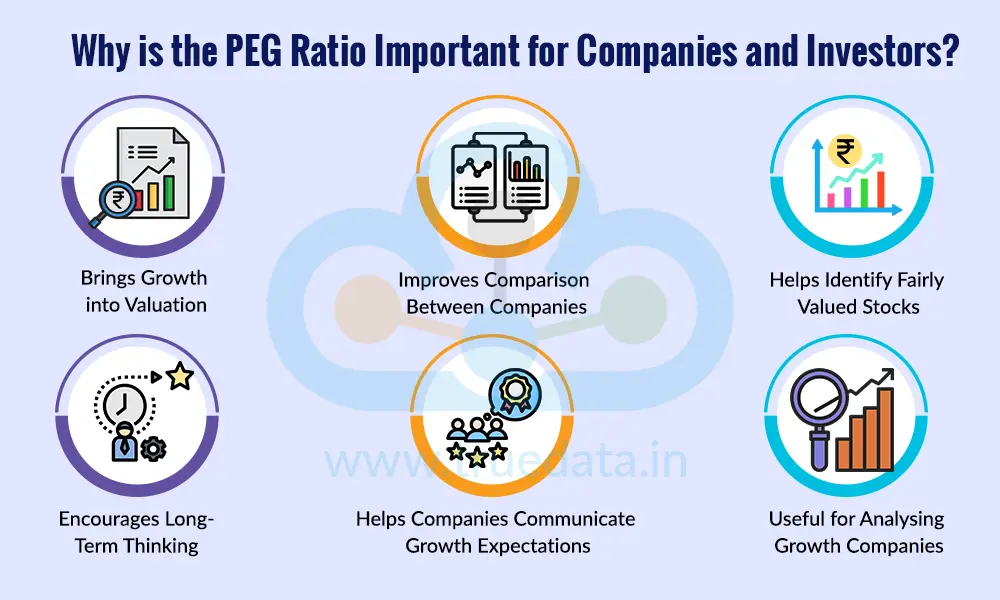
PEG Ratio offers a balanced and realistic view of company valuations. It acts as a bridge between traditional valuation (PE Ratio) and future growth expectations, making it a powerful tool for smarter, growth-aware investment decisions. The importance of the PEG Ratio for companies and investors is explained below. 

Brings Growth into Valuation

Many good companies trade at high P/E ratios simply because they are expected to grow faster in the future. The PEG Ratio adjusts the PE Ratio by adding earnings growth into the picture. This makes it easier for investors to judge whether a high-priced stock is genuinely expensive or just reflecting strong future potential.

Improves Comparison Between Companies

The PEG Ratio allows investors to compare companies within the same sector more fairly. Two companies may have similar P/E ratios, but if one is growing faster, its PEG Ratio will be lower and more attractive. This helps investors choose better opportunities without relying only on headline valuation numbers.

Helps Identify Fairly Valued Stocks

A PEG Ratio close to 1 often indicates that the stock price is fairly matched with its growth rate. This makes the PEG Ratio a useful shortcut for investors who want to quickly filter stocks that may be undervalued or overvalued based on growth expectations.

Encourages Long-Term Thinking

The PEG Ratio pushes investors to think beyond short-term price movements and look at sustainable earnings growth. This aligns well with long-term investing, where consistent growth matters more than temporary market fluctuations.

Helps Companies Communicate Growth Expectations

From a company’s point of view, growth guidance directly influences how investors value the stock using metrics like the PEG Ratio. Clear and realistic growth projections can help investors better understand the company’s long-term strategy and value it more accurately.

Useful for Analysing Growth Companies

The PEG Ratio is especially helpful for fast-growing businesses, such as technology, consumer brands, or emerging sectors. It shifts the focus from past performance to future earnings potential, which is often what drives long-term returns for investors.

What are the Differences Between PEG Ratio and the PE Ratio?

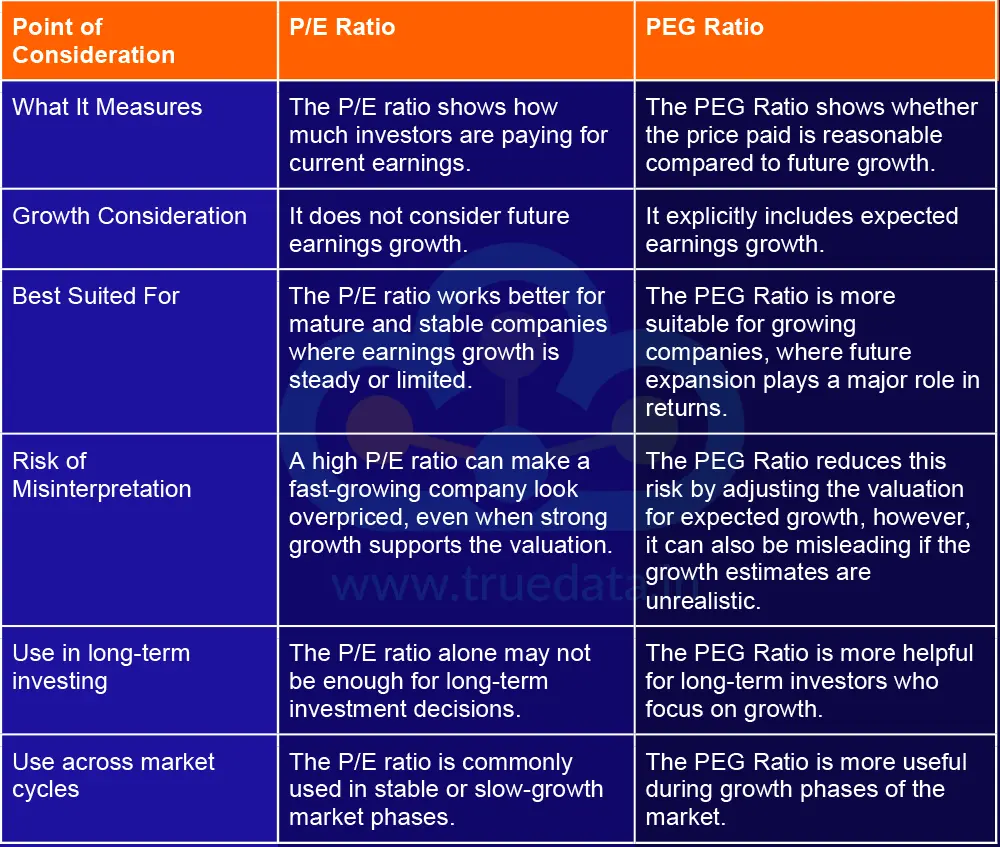
The PE Ratio and the PEG Ratio are both widely used valuation tools, but they serve different purposes in investment analysis. While the P/E ratio focuses only on current earnings, the PEG Ratio adds the important element of future growth. The key differences between the P/E Ratio and the PEG ratio are highlighted below.

What are the Differences Between PEG Ratio and the PE Ratio

Point of Consideration

P/E Ratio

PEG Ratio

What It Measures

The P/E ratio shows how much investors are paying for current earnings.

The PEG Ratio shows whether the price paid is reasonable compared to future growth.

Growth Consideration 

It does not consider future earnings growth.

It explicitly includes expected earnings growth.

Best Suited For

The P/E ratio works better for mature and stable companies where earnings growth is steady or limited.

The PEG Ratio is more suitable for growing companies, where future expansion plays a major role in returns.

Risk of Misinterpretation 

A high P/E ratio can make a fast-growing company look overpriced, even when strong growth supports the valuation.

The PEG Ratio reduces this risk by adjusting the valuation for expected growth, however, it can also be misleading if the growth estimates are unrealistic.

Use in long-term investing

The P/E ratio alone may not be enough for long-term investment decisions.

The PEG Ratio is more helpful for long-term investors who focus on growth.

Use across market cycles

The P/E ratio is commonly used in stable or slow-growth market phases.

The PEG Ratio is more useful during growth phases of the market.

What are the Common Limitations of the PEG Ratio?

Although the PEG ratio is a step up from using the traditional P/E ratio and is a valuable tool for investors and companies alike in fundamental analysis, it is not without limitations. These limitations are highlighted below.

What are the Common Limitations of the PEG Ratio

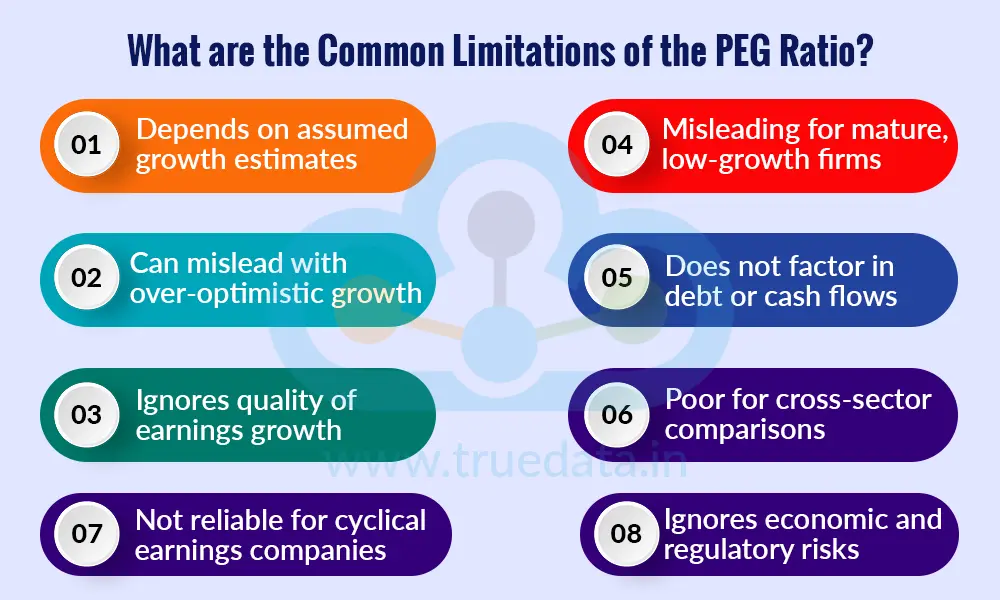
  • The PEG Ratio depends heavily on earnings growth estimates, which are based on assumptions and may not always turn out to be accurate.

  • The ratio can be misleading if the expected growth rate is unrealistically high or overly optimistic.

  • The PEG Ratio does not consider the quality or sustainability of growth, such as whether growth is driven by one-time factors or long-term business strength.

  • It is less useful for companies with unstable or cyclical earnings, where growth rates fluctuate widely.

  • The PEG Ratio may not work well for mature companies with low or declining growth, as the ratio can appear very high even if the company is fundamentally strong.

  • It does not take into account important factors like debt levels, cash flows, or return on capital.

  • Comparing PEG Ratios across different sectors can be misleading, as growth rates and business models vary widely between industries.

  • The ratio ignores external risks such as economic slowdowns, regulatory changes, or competitive pressures that can affect future growth.

Conclusion

The PEG Ratio is a practical and insightful valuation tool that helps investors look beyond price and current earnings by bringing future growth into the analysis. By linking the P/E Ratio with expected earnings growth, it offers a more balanced view of whether a stock is fairly valued, undervalued, or overvalued. The PEG Ratio is especially useful for analysing growing companies and for making long-term investment decisions, but it should not be used in isolation.

This article is an extension of our series on breaking down financial ratios in detail. Let us know your thoughts on the topic or if you need further information on ratios, and we will address them soon. 

TIll then, Happy Reading!


Read More: Gross Profit Margin and Net Profit Margin 

Frequently Asked Questions

A PEG Ratio of 1 means the stock price is generally fairly valued in relation to its expected earnings growth. In simple terms, investors are paying a reasonable price for the growth the company is expected to deliver.

The trailing PEG Ratio is calculated using past earnings growth, while the forward PEG Ratio is calculated using expected future earnings growth. Thus, trailing PEG considers what the company has already achieved, while forward PEG focuses on what the company is expected to deliver in the future.

It is better to use annualised CAGR over 3-5 years for the PEG Ratio, as it smoothens ups and downs in earnings. Single-year growth can be misleading because profits may jump or fall due to one-time events.

PEG Ratio should not ideally be used while comparing companies across different industries, because growth rates and business models vary widely. PEG works best when comparing companies within the same sector, where growth expectations are more similar.

PEG is considered better than the PE Ratio alone because it factors in earnings growth, not just current profits. This helps investors judge whether a stock’s price is reasonable for the growth it is expected to deliver.
Marisha Bhatt

Marisha Bhatt is a financial content writer @TrueData.

She writes with the sole aim of simplifying complex financial concepts and jargon while attempting to clarify technical and fundamental analysis concepts of the stock markets. The ultimate goal is to spread vital knowledge and benefit the maximum audience. Her Chartered Accountant background acts as the knowledge base to help clarify crucial concepts and create a sound investment portfolio.

0 Comments

Related Articles

SEE ALL
Corporate Data
Corporate Data
Investing Smarter: The Power of Corporate Data and Market Sentiment Analysis

Thestock market never stands still, and prices swing constantly with every new h...

Corporate Data
Corporate Data
How to Read Cash Flow Statements?

Net profits in the P&amp;L statement are usually a sign of a healthy company. Ho...

Corporate Data
Corporate Data
Balance Sheet Assets (Current + non-current) - How to Report and Analyse

Analysing the financial statements is the first step in the fundamental analysis...

Relevant Tags