Corporate Data

Interest Coverage Ratio (EBIT / Interest) - What is it and How to Calculate it?

Marisha Bhatt · 07 May 2026 · 9 mins read · 0 Comments

interest-coverage-ratio-what-is-it-and-how-to-calculate-it

Understanding a company’s financial health is not just about profits. It is also about how comfortably it can handle its debt. A company can have high profitability, but if it is unable to repay its debt, it can be a severe challenge for its long-term solvency. This is where the interest coverage ratio comes in. It helps investors see whether a company earns enough to pay its interest obligations without stress. Curious to know how it works? Dive into this blog where we explore the meaning and calculation of the interest coverage ratio and its significance in company fundamental analysis.

What is the Interest Coverage Ratio?

What is the Interest Coverage Ratio

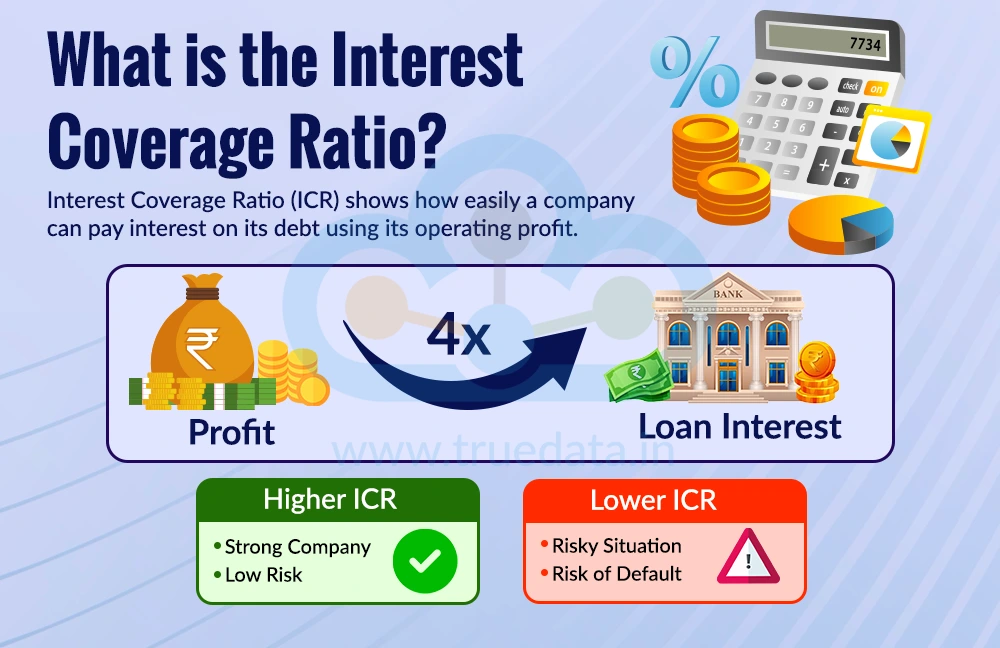
The Interest Coverage Ratio (ICR) is a financial metric that helps investors understand how easily a company can pay the interest on its debt using its earnings. It shows how many times a company’s operating profit can cover its interest expenses. For example, if a company has an interest coverage ratio of 4, it implies that the company is earning four times more than what is needed to pay its interest, thus indicating a comfortable position. A higher ratio generally suggests that the company is financially stable and has a lower risk of default, while a lower ratio may signal stress in meeting debt obligations. This ratio is especially useful when analysing companies with high borrowings, as it gives a clear picture of their ability to manage debt and maintain long-term financial health.

Why is the Interest Coverage Ratio Important?

Why is the Interest Coverage Ratio Important

Interest coverage ratio is one of the most critical solvency ratios to determine the long-term financial and investment viability. The importance of the interest coverage ratio can be explained as follows,

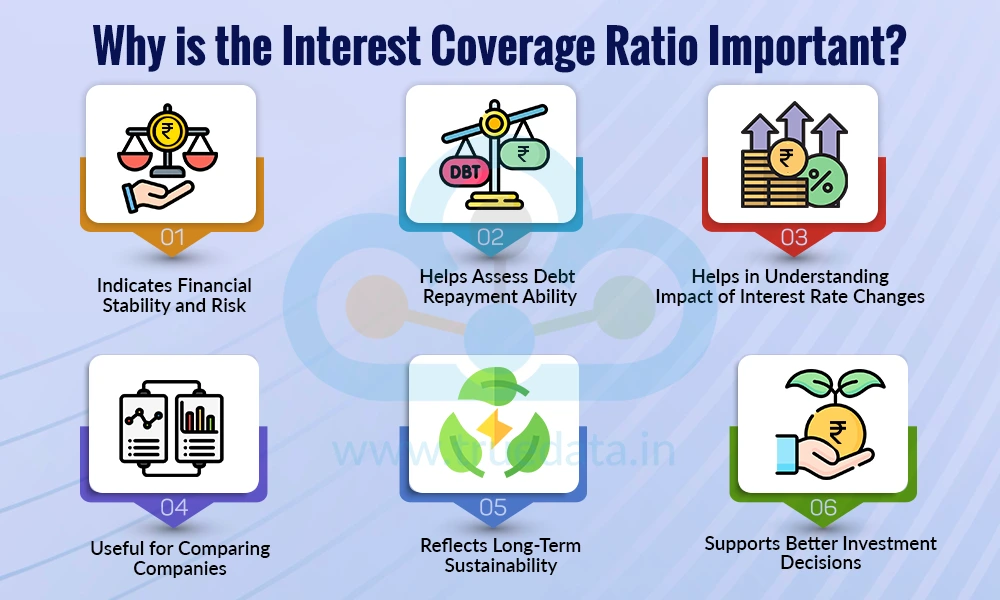
  • Indicates Financial Stability and Risk - This ratio gives a quick idea of how risky a company is from a debt perspective. A high interest coverage ratio means the company has a safety cushion and is less likely to default on its payments. A low ratio, however, signals higher financial risk. This helps investors avoid companies that may face solvency issues, especially during economic slowdowns or rising interest rates.

  • Helps Assess Debt Repayment Ability - The interest coverage ratio indicates whether a company can comfortably pay the interest on its loans using its current earnings. This is crucial information for investors, as many companies rely on borrowed money to grow. If a company earns much more than its interest cost, it indicates financial strength and stability. On the other hand, if earnings are barely enough to cover interest, the company may struggle during tough times.

  • Helps in Understanding Impact of Interest Rate Changes - Interest rates in India can change based on decisions by the Reserve Bank of India. When interest rates rise, companies with high debt may see their interest costs increase. A company with a strong interest coverage ratio is better prepared to handle such changes, while a weak ratio can become a warning sign for investors.

  • Useful for Comparing Companies - The interest coverage ratio helps investors compare companies within the same industry. For example, in sectors like infrastructure, real estate, or telecom (where borrowing is common), this ratio can highlight which companies are managing their debt better. A company with a higher ratio is generally in a stronger position compared to its peers.

  • Reflects Long-Term Sustainability - A company that consistently maintains a healthy interest coverage ratio is more likely to sustain its operations and growth over the long term. It shows that the business is not overly dependent on debt and can manage its financial obligations efficiently. This is especially important for long-term investors seeking stable and reliable companies.

  • Supports Better Investment Decisions - This ratio acts as an early warning signal for investors. It helps in identifying companies that may look profitable on the surface but are actually under pressure due to high debt. By using the interest coverage ratio along with other financial metrics, investors can make more informed and safer investment decisions.

How to Calculate the Interest Coverage Ratio?

How to Calculate the Interest Coverage Ratio

The standard formula to calculate the interest coverage ratio is,

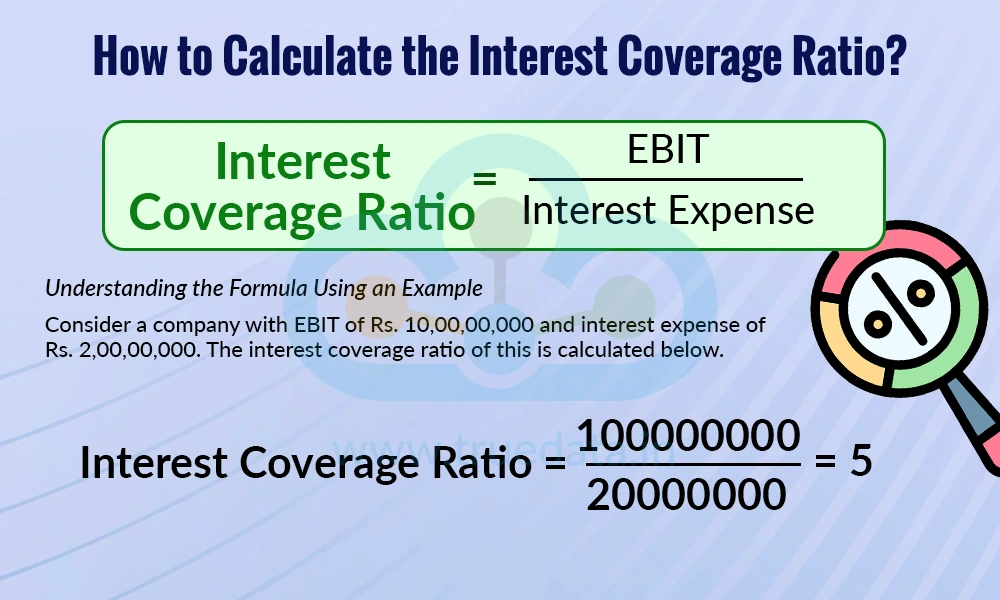
Interest Coverage Ratio = EBIT / Interest Expense

Where,

  • EBIT (Earnings Before Interest and Taxes) = The company’s operating profit

  • Interest Expense = The total interest the company has to pay on its loans

This formula tells us how many times a company’s operating profit can cover its interest payments.

Understanding the Formula Using an Example

Consider a company with EBIT of Rs. 10,00,00,000 and interest expense of Rs. 2,00,00,000. The interest coverage ratio of this is calculated below.

Interest Coverage Ratio = EBIT / Interest Expense

Interest Coverage Ratio = 100000000/20000000 = 5

Thus, the company earns 5 times the amount needed to pay its interest.

What are the Types of Interest Coverage Ratio?

Apart from the standard formula for calculating the interest coverage ratio, there are a few other variations. These different formulas provide deeper analysis to investors and other stakeholders. 

EBITDA-Based Interest Coverage Ratio

EBITDA-Based Interest Coverage Ratio

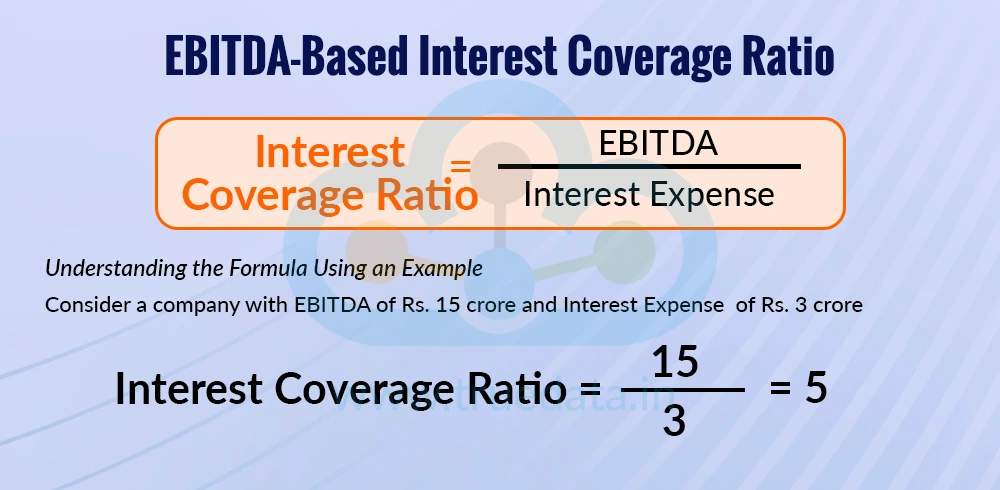
This version uses EBITDA (Earnings Before Interest, Taxes, Depreciation, and Amortisation). It gives a slightly more relaxed view by adding back non-cash expenses like depreciation. The formula using EBITDA is,

Interest Coverage Ratio = EBITDA / Interest Expense

Understanding the Formula Using an Example

Consider a company with EBITDA of Rs. 15 crore and Interest Expense  of Rs. 3 crore

Interest Coverage Ratio = EBITDA / Interest Expense

Interest Coverage Ratio = 15 / 3 = 5

This shows a stronger ability to pay interest compared to EBIT, as EBITDA is higher. This version can also be used by companies that have higher non-cash expenses. 

Fixed Charge Coverage Ratio (FCCR)

Fixed Charge Coverage Ratio (FCCR)

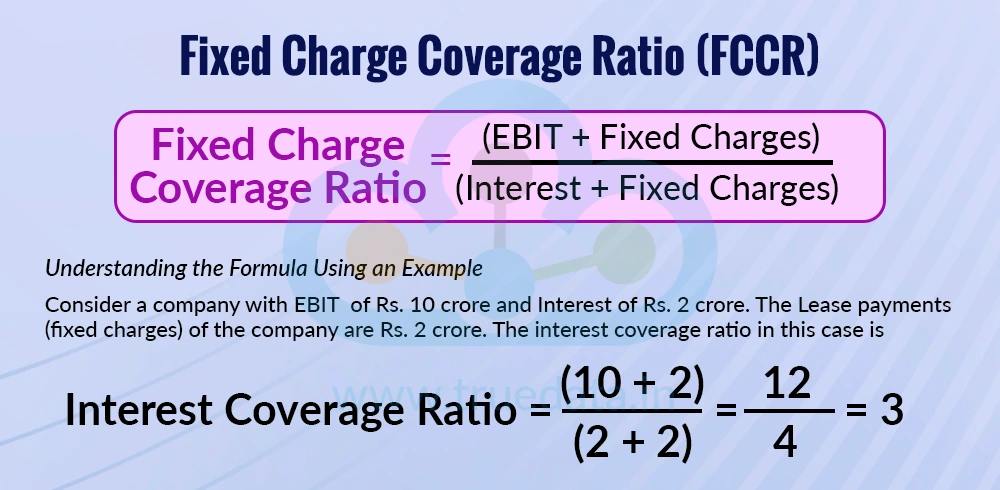
This is a broader version that includes not just interest, but also other fixed financial obligations like lease payments.

Fixed Charge Coverage Ratio = (EBIT + Fixed Charges) / (Interest + Fixed Charges)

Understanding the Formula Using an Example

Consider a company with EBIT  of Rs. 10 crore and Interest of Rs. 2 crore. The Lease payments (fixed charges) of the company are Rs. 2 crore. The interest coverage ratio in this case is,

Fixed Charge Coverage Ratio = (EBIT + Fixed Charges) / (Interest + Fixed Charges)

Fixed Charge Coverage Ratio = (10 + 2) / (2 + 2) = 12 / 4 = 3

Thus, the company can cover all fixed obligations 3 times, giving a more complete picture of financial strength.

EBITDA Less Capex Interest Coverage Ratio

EBITDA Less Capex Interest Coverage Ratio

This version of the interest coverage ratio takes a more practical and conservative approach. Instead of just using EBITDA, it subtracts capital expenditure (Capex), i.e., the money a company spends on maintaining or expanding its business. This helps investors understand how much real usable cash is left to pay interest after essential investments.

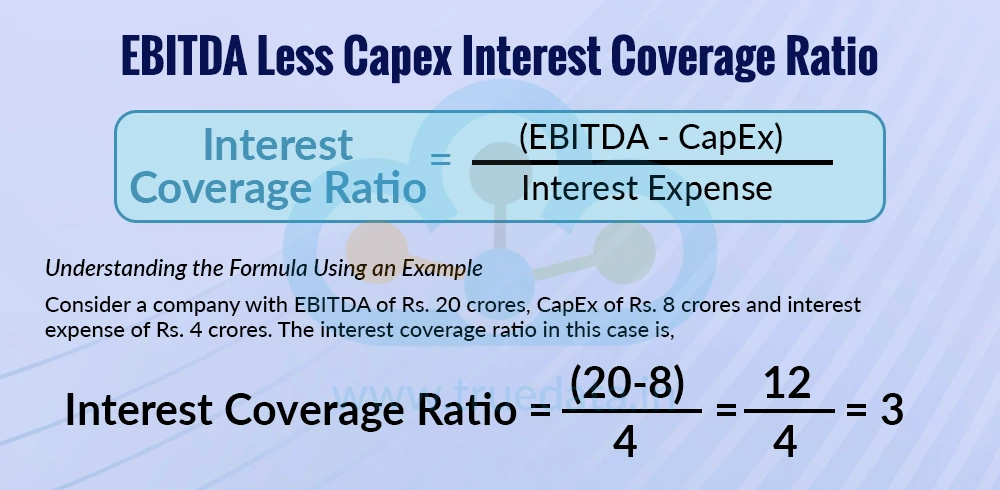
The formula to calculate the Interest Coverage Ratio in this case is,

Interest Coverage Ratio = (EBITDA - CapEx) / Interest Expense

Where,

  • EBITDA shows operating earnings before non-cash expenses

  • Capex represents necessary spending on assets like machinery, equipment, or infrastructure

Understanding the Formula Using an Example

Consider a company with EBITDA of Rs. 20 crores, CapEx of Rs. 8 crores and interest expense of Rs. 4 crores. The interest coverage ratio in this case is,

Interest Coverage Ratio = (EBITDA - CapEx) / Interest Expense

Interest Coverage Ratio = (20 - 8) / 4 = 3

A ratio of 3 means the company has 3 times the cash needed to pay its interest after spending on essential investments. 

This is a more cautious and realistic measure compared to EBITDA-based ratios. If this ratio is low, it may indicate that even though profits look strong, actual cash available is limited.

How to Interpret the Interest Coverage Ratio?

How to Interpret the Interest Coverage Ratio

The interpretation of the interest coverage ratio is explained below.

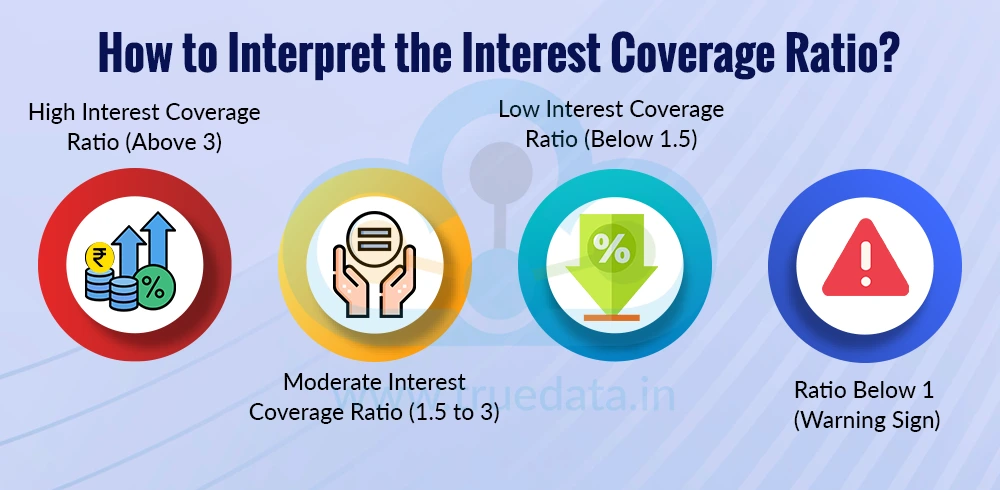
  • High Interest Coverage Ratio (Above 3) - A high interest coverage ratio indicates that a company earns significantly more than its interest obligations. This suggests strong financial health and a comfortable ability to service debt. Such companies are generally considered safer, as they have a good cushion even if profits decline.

  • Moderate Interest Coverage Ratio (1.5 to 3) - A moderate ratio shows that the company can meet its interest payments, but the margin of safety is limited. It indicates that the company is stable for now, but investors should monitor its earnings and debt levels closely. Any drop in profits or rise in interest costs could create pressure.

  • Low Interest Coverage Ratio (Below 1.5) - A low ratio signals that the company may be under financial stress. It earns just enough, or sometimes not enough, to cover its interest expenses. This increases the risk of default, especially during economic downturns. Investors should be cautious while analysing such companies.

  • Ratio Below 1 (Warning Sign) - An interest coverage ratio below 1 implies that the company’s earnings are not sufficient to cover its interest payments. This is a serious red flag, indicating potential solvency issues. The company may need to borrow more, sell assets, or raise funds to meet its obligations.

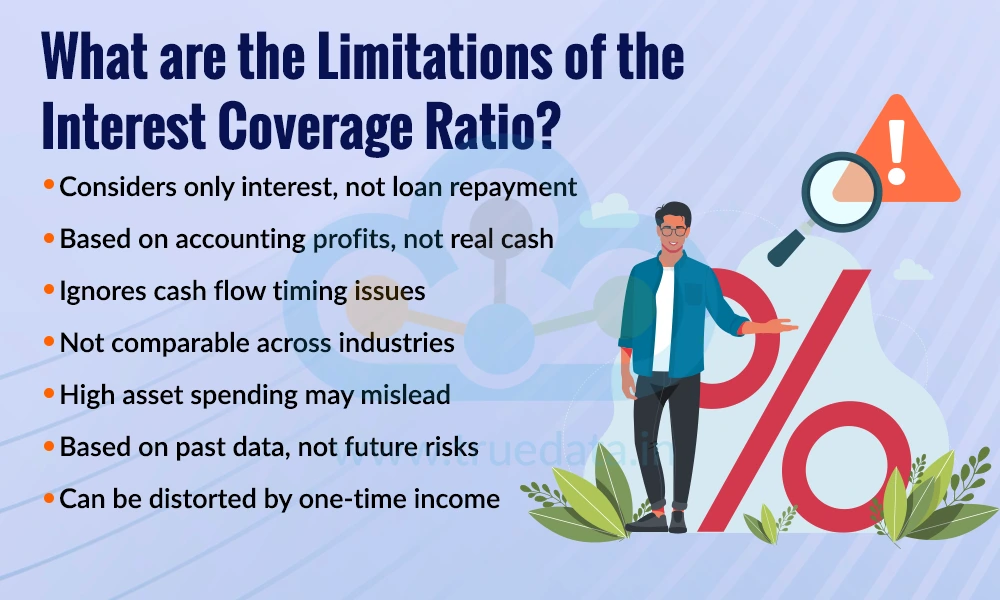
What are the Limitations of the Interest Coverage Ratio?

What are the Limitations of the Interest Coverage Ratio

The limitations of using the interest coverage ratio are,

  • Does not include loan repayment, considers only interest, not the actual repayment of the borrowed amount.

  • Relies on accounting profits (EBIT and EBITDA), which may not reflect actual cash available.

  • Ignores cash flow timing issues

  • Not comparable across all industries, as different sectors have different debt levels.

  • Companies spending heavily on assets may appear strong, but have less free cash.

  • It is based on past data and does not show future risks.

  • This ratio can be distorted using one-time income and should not be used in isolation. 

Conclusion

The interest coverage ratio is a useful tool that helps investors understand how comfortably a company can meet its interest obligations using its earnings. It highlights the company’s financial strength, risk level, and ability to handle debt, especially in sectors where borrowing is common. While a higher ratio generally indicates stability and a lower ratio signals caution, it is important to look at different types of this ratio and analyse trends over time. Therefore, understanding the interest coverage ratio is a crucial step in the fundamental analysis of stocks and in having a robust investment portfolio. 

This article focuses on a critical ratio of fundamental analysis and its importance in shaping a portfolio. Let us know your thoughts on the topic or if you need any further information, and we will address it soon. 

Till then, Happy Reading!


Read More: Solvency and Leverage Ratios - Debt and Equity Ratios

Frequently Asked Questions

Yes, the interest coverage ratio (ICR) can be negative if a company has negative operating profit (EBIT). This means the company is not earning enough to cover its interest payments, which is a strong warning sign for investors.

Lenders use the interest coverage ratio to check if a company can safely pay its interest on time. A higher ratio gives them confidence that their money is secure, while a low ratio signals higher risk of default.

A company can improve its interest coverage ratio by increasing its profits (EBIT) through higher sales or better cost control. It can also reduce interest costs by lowering debt or refinancing loans at lower interest rates.

The interest coverage ratio (ICR) shows how easily a company can pay only its interest using its earnings, while the debt service coverage ratio (DSCR) checks if it can pay both interest and loan repayments. Thus, DSCR gives a more complete picture of a company’s ability to handle total debt obligations.

A consistently declining interest coverage ratio is a key warning sign, as it shows profits are falling or debt costs are rising. A sudden drop or ratio going close to 1 (or below) also signals increasing financial stress and higher risk for investors.
Marisha Bhatt

Marisha Bhatt is a financial content writer @TrueData.
She writes with the sole aim of simplifying complex financial concepts and jargon while attempting to clarify technical and fundamental analysis concepts of the stock markets. The ultimate goal is to spread vital knowledge and benefit the maximum audience. Her Chartered Accountant background acts as the knowledge base to help clarify crucial concepts and create a sound investment portfolio.

0 Comments

Related Articles

SEE ALL
Corporate Data
Corporate Data
Investing Smarter: The Power of Corporate Data and Market Sentiment Analysis

Thestock market never stands still, and prices swing constantly with every new h...

Corporate Data
Corporate Data
Solvency and Leverage Ratios - Debt and Equity Ratios

Debt and equity together form the total capital of a company. However, when anal...

Mutual Funds
Mutual Funds
PE Ratio in Mutual Funds

Every investor knows that the stepping stones to a good investment in thestock m...