Corporate Data

How do Interest Rates Impact Stock Valuations?

Marisha Bhatt · 05 May 2026 · 10 mins read · 0 Comments

how-do-interest-rates-impact-stock-valuations

The current world scenario has the global markets on edge, and the investors are struggling to hold on to their portfolio valuations. Add changing interest rates to the mix, and stock valuations can shift quickly, driven by borrowing costs, company profits, and investor behaviour. But how do interest rates have such a broad impact on stock valuations? And more importantly, what should investors do in such times? Get answers to these questions and more in this blog and make informed portfolio decisions. 

What is the Link Between Interest Rates and Stock Valuations?

What is the Link Between Interest Rates and Stock Valuations

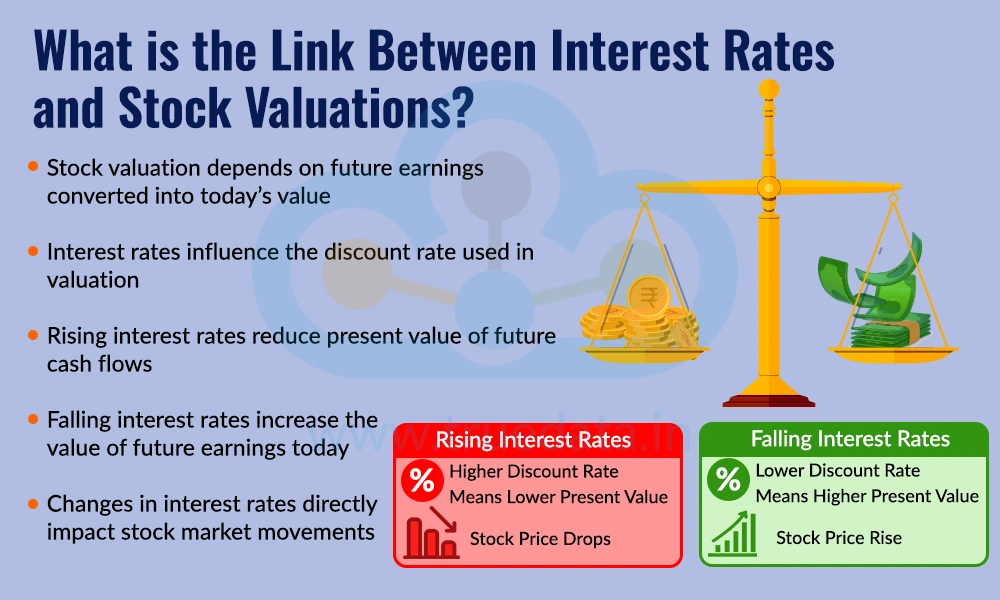
The relationship between interest rates and stock valuations is primarily driven by how investors assess the present value of a company’s future earnings. Effective evaluation of a stock is essentially estimating the profits a company is expected to generate in the future and then converting those future earnings into today’s value. This process involves using a discounting rate closely linked to prevailing interest rates in the economy. An increase in the interest rates also leads to an increase in the discount rate, which reduces the present value of future cash flows. As a result, even if a company’s future prospects remain strong, its valuation may decline. On the other hand, a decrease in interest rates translates into a reduced discounting rate, making future earnings more valuable in today’s terms. This scenario is often supported by higher stock prices. This is why equity markets tend to react strongly to changes in interest rate expectations.

What is the Impact on Corporate Earnings?

What is the Impact on Corporate Earnings

We have analysed briefly the impact of interest rates on corporate earnings and, ultimately, corporate valuations. This impact is explained in detail hereunder.

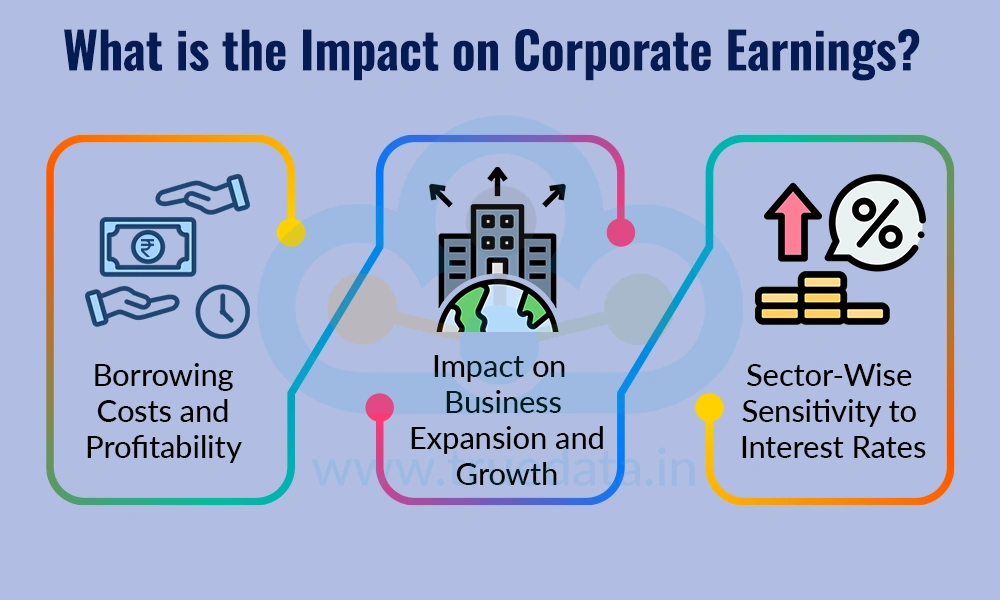
Borrowing Costs and Profitability

Interest rates play a key role in determining the cost of borrowing for companies. An increase in interest rates leads to loans becoming more expensive for the business. Therefore, companies have to pay higher interest on their existing and new borrowings, resulting in an increase in their overall expenses and reduced net profit. Such an impact can be quite significant for businesses such as infrastructure and real estate that depend heavily on debt, as a large portion of their earnings may go towards servicing loans instead of growing the business. 

On the other hand, a fall in interest rates results in a lowering of borrowing costs. Companies can, thus, raise funds at lower costs and meet other objectives like investing in expansion, improving operations, and managing cash flows better. Lower interest expenses directly support higher profitability and stronger balance sheets. This means that a low-interest-rate environment generally creates a favourable situation for corporate earnings growth.

Impact on Business Expansion and Growth

Interest rates also influence how confidently companies invest in future growth. When borrowing costs are high, companies may delay expansion plans, reduce capital expenditure, or avoid taking new loans. This can slow down revenue growth over time and affect long-term earnings potential. Even strong companies may become cautious during such periods, leading to slower overall economic activity.

On the other hand, when interest rates are low, companies are more willing to invest in new projects, expand capacity, and enter new markets. This supports revenue growth and improves future earnings visibility. As businesses grow, it can lead to better stock performance, making such periods attractive for equity investors.

Sector-Wise Sensitivity to Interest Rates

Different sectors respond differently to interest rate changes, with banking, real estate, and automobiles being more sensitive due to their dependence on borrowing and loan demand. When interest rates are on the higher side, it can reduce demand and impact business growth in such sectors. On the other hand, sectors like FMCG and IT are relatively less affected as they rely more on steady consumption or global revenues. Thus, understanding these differences helps investors adjust their portfolios based on the interest rate cycle.

What is the impact of Interest Rates on Market Sentiment?

What is the impact of Interest Rates on Market Sentiment

Changes in interest rates and market sentiment are strongly interlinked and this relationship is explored below.

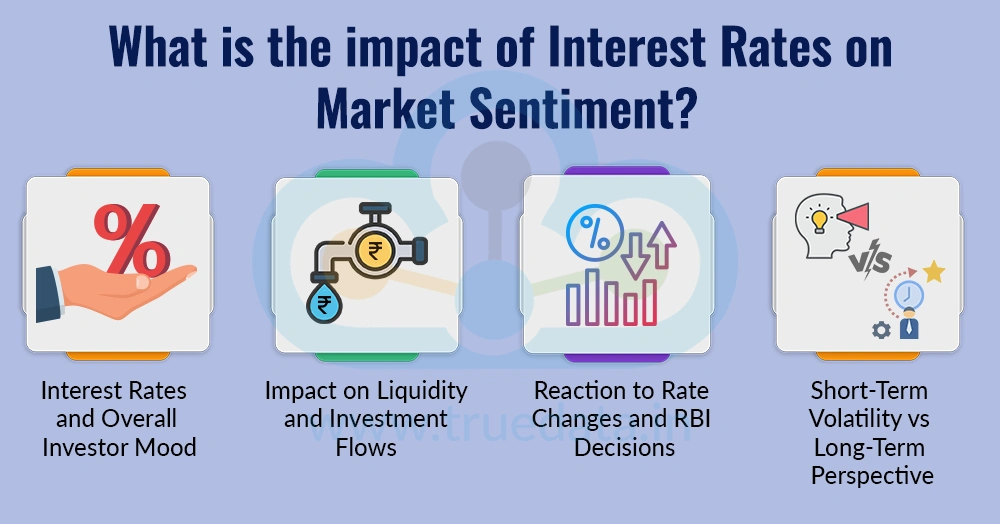
Interest Rates and Overall Investor Mood

Interest rates strongly influence how investors feel about the stock market. When interest rates are rising, it often creates a cautious or negative sentiment in the market. Investors worry about higher borrowing costs, lower company profits, and slower economic growth. As a result, many investors may reduce their exposure to equities, leading to market volatility or even declines. In contrast, when interest rates are falling, the overall mood in the market tends to become more positive. Lower rates signal easier financial conditions, which support business growth and profitability. This boosts investor confidence and often leads to increased participation in the stock market, pushing valuations higher.

Impact on Liquidity and Investment Flows

Interest rates also affect how money flows between different asset classes. When rates are high, safer investment options like fixed deposits, bonds, and other debt instruments become more attractive because they offer better returns with lower risk. This can lead to a shift of funds away from equities, reducing liquidity in the stock market and putting pressure on stock prices. On the other hand, when interest rates are low, returns from fixed-income investments decrease. Investors then look for higher returns in equities, mutual funds, and other growth assets. This increased flow of money into the stock market improves liquidity and supports a positive sentiment, often leading to rising stock prices.

Reaction to Rate Changes and RBI Decisions

Market sentiment in India is highly sensitive to policy decisions by the Reserve Bank of India. Even before actual rate changes happen, markets react to expectations. For example, if investors expect a rate hike, markets may start correcting in advance due to cautious sentiment. Similarly, expectations of rate cuts can lead to a rally even before the official announcement. After the RBI announces its decision, markets often react quickly, i.e., sometimes positively, sometimes negatively, depending on whether the decision matches expectations. This shows that not just the rate change, but also investor expectations and surprises play a major role in shaping market sentiment.

Short-Term Volatility vs Long-Term Perspective

Interest rate changes can cause short-term ups and downs in the market, as investors react quickly to news and policy updates. Sectors like banking, real estate, and automobiles may see sharp movements during such times due to their sensitivity to interest rates. This can make the market appear unstable in the short run. However, over the long term, markets tend to stabilise as businesses adjust to the new interest rate environment. It is important for investors to avoid reacting emotionally to short-term movements and instead focus on long-term fundamentals. Understanding how interest rates influence sentiment can help investors stay calm and make better decisions during market fluctuations.

Explain the Sector-Wise Impact of Interest Rate Change?

Understanding sector-wise impact of interest rate changes is crucial. Interest rate cycles can create opportunities in some sectors while putting pressure on others. Thus, by identifying which sectors benefit from rising or falling rates, investors can make smarter allocation decisions and manage risk more effectively. 

Banking and Financial Services

Banking and Financial Services

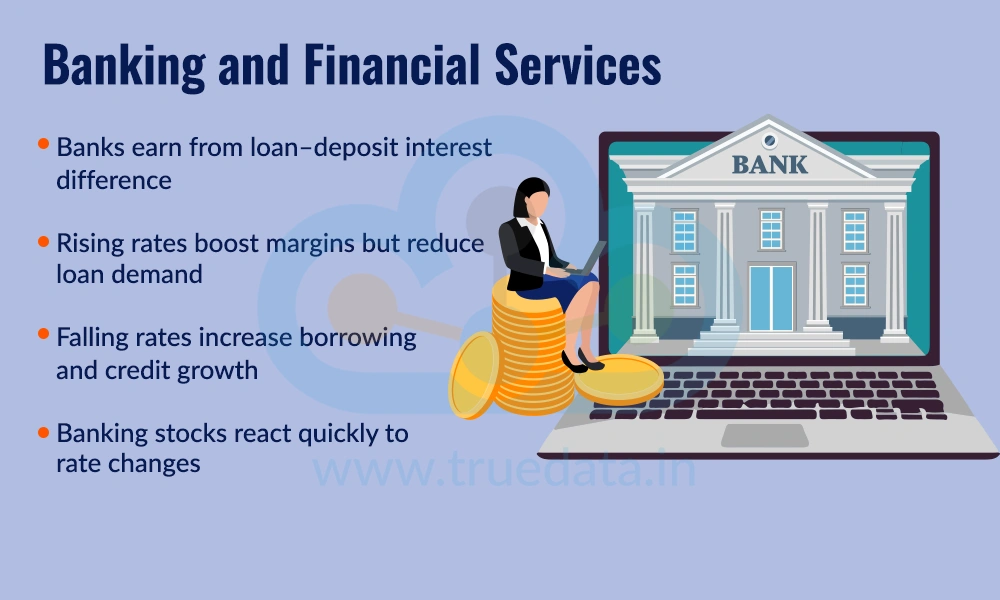
The banking and financial sector is directly linked to interest rates. Banks earn money from the difference between the interest they charge on loans and the interest they pay on deposits. When interest rates rise, banks may initially benefit because lending rates increase faster than deposit rates, improving margins. However, over time, higher rates can reduce loan demand and increase the risk of loan defaults, which can hurt profitability. When interest rates fall, loan demand usually improves as borrowing becomes cheaper for individuals and businesses. This can support credit growth and boost bank earnings. However, margins may come under slight pressure if deposit rates do not fall as quickly. Overall, banking stocks tend to react quickly to changes in interest rate expectations.

Automobile Sector

Automobile Sector

The automobile sector is also highly sensitive to interest rates, as many vehicle purchases in India are financed through loans. When interest rates increase, EMIs for car and two-wheeler loans also see an upside, making purchases more expensive for consumers. This can reduce demand and slow down sales growth for auto companies. In contrast, lower interest rates make vehicle loans more affordable, encouraging more consumers to buy vehicles. This boosts sales volumes and supports revenue growth for automobile companies, which can positively impact their stock valuations.

Real Estate and Infrastructure

Real Estate and Infrastructure

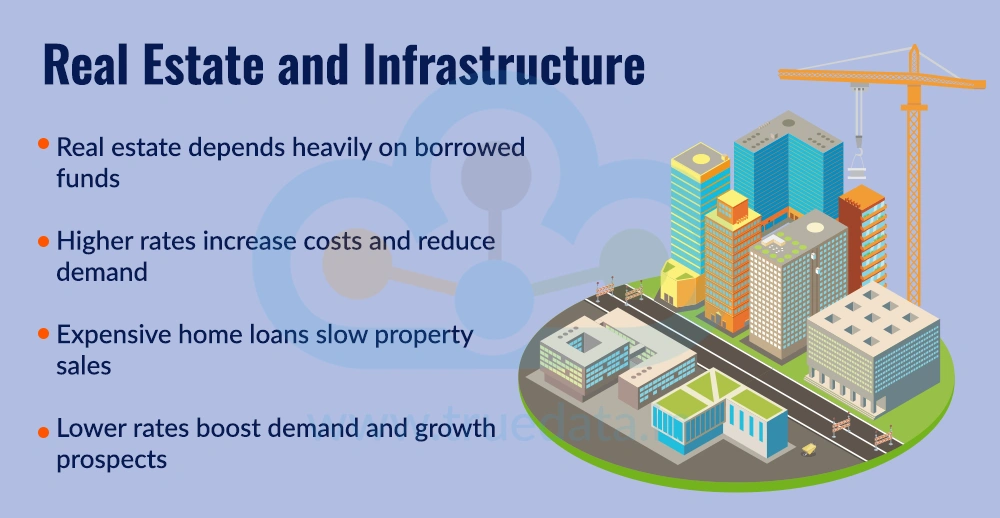
Real estate and infrastructure are among the most interest rate-sensitive sectors. These sectors depend heavily on borrowed funds for projects and expansion. A rise in interest rates results in expensive borrowing for developers, thereby increasing project costs and reducing profitability. At the same time, higher home loan interest rates increase EMIs for buyers, which can reduce demand for property. This combination can slow down sales and negatively impact the stock prices of real estate companies. On the other hand, when interest rates fall, home loans become more affordable, demand improves, and developers benefit from lower financing costs, leading to better growth prospects.

FMCG and Defensive Sectors

FMCG and Defensive Sectors

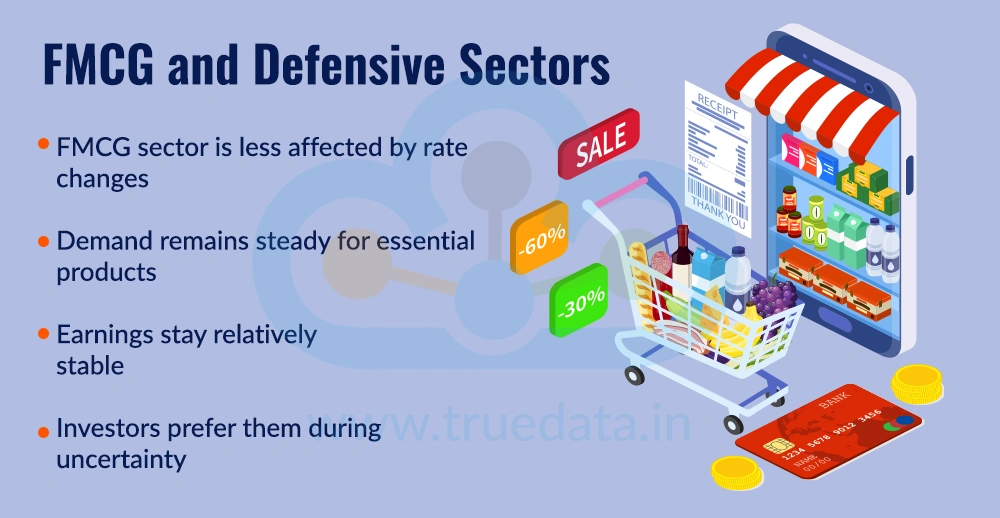
Fast-moving consumer goods (FMCG) and other defensive sectors are generally less affected by interest rate changes. These companies sell essential products like food, personal care, and household items, which people continue to buy regardless of interest rate movements. While these companies may still face some indirect impact (like changes in input costs or consumer spending), their earnings remain relatively stable. As a result, during periods of rising interest rates and market uncertainty, investors often shift towards these defensive stocks for stability.

Capital-Intensive Industries

Capital-Intensive Industries

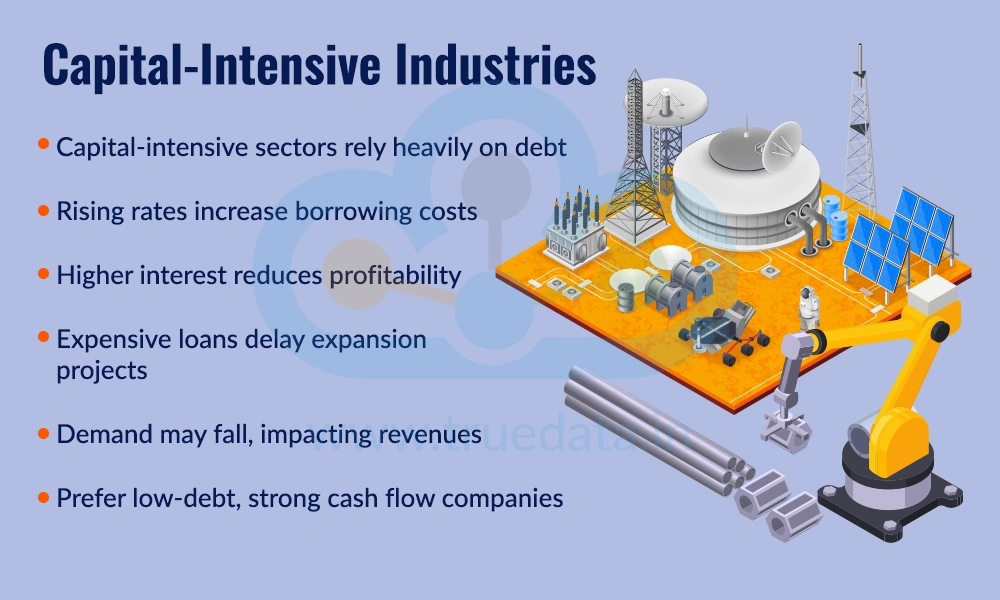
Capital-intensive industries such as metals, power, telecom, and manufacturing require large investments in infrastructure and therefore rely heavily on debt financing, making them highly sensitive to interest rate changes. When interest rates rise, their borrowing costs increase, leading to higher interest expenses and reduced profitability, especially given the large size of their debt. This can limit their ability to invest, pay dividends, or expand operations. Expensive financing may also delay or cancel long-term projects, slowing future growth. At the same time, higher interest rates can reduce overall economic demand, impacting sectors like metals and manufacturing that depend on construction, infrastructure, and consumer spending. This creates a double pressure of rising costs and weaker revenues. As a result, these sectors often underperform in high-interest-rate environments, and investors should focus on companies with lower debt, strong cash flows, and better ability to manage interest costs.

IT and Export-Oriented Sectors

IT and Export-Oriented Sectors

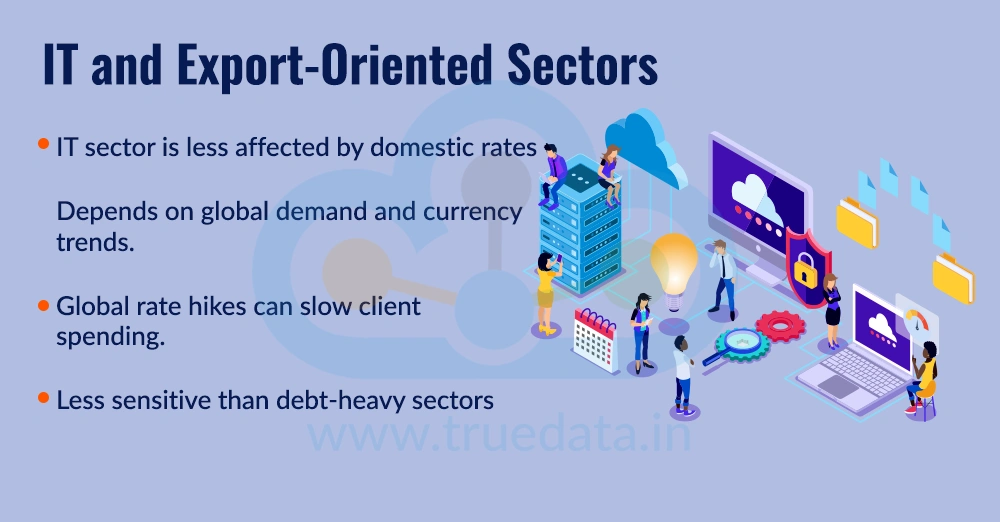
Domestic interest rates relatively less directly impact the IT sector and other export-oriented businesses. Their performance depends more on global demand, currency movements, and economic conditions in countries like the US and Europe. However, global interest rate trends can still play a role. For example, if global interest rates rise, it may slow down spending by international clients, which can affect revenue growth for Indian IT companies. Despite this, the sector is generally considered less sensitive compared to domestic, debt-heavy industries.

What Should Investors Do? 

What Should Investors Do

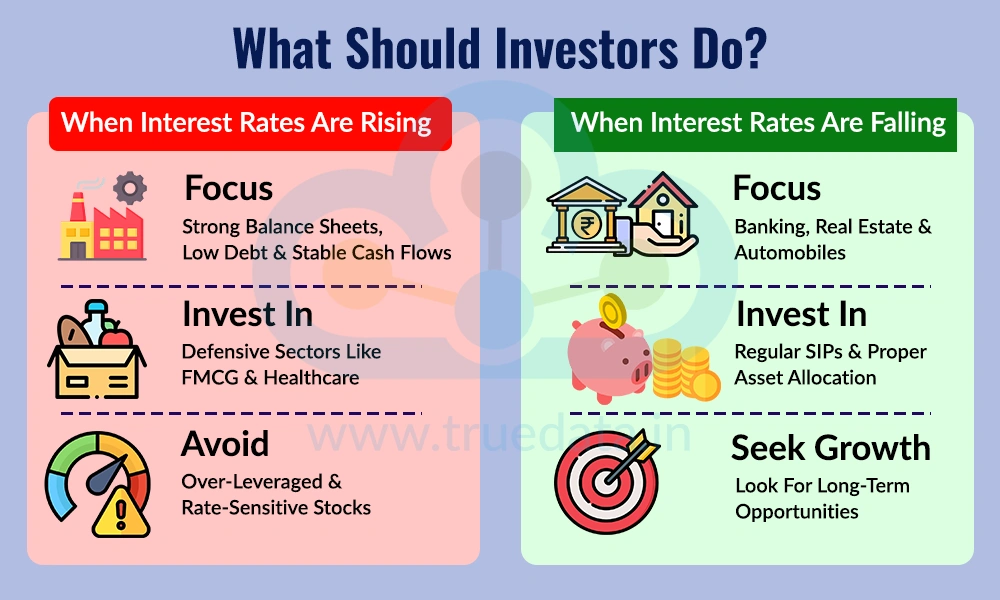
Interest rate changes are more or less a routine phenomenon and are triggered by multiple factors. The key for investors is not to react emotionally to every interest rate change but to understand the broader trend and adjust their strategy accordingly. When interest rates are rising, it is wise to be slightly cautious, i.e., focus on companies with strong balance sheets, low debt, and stable cash flows, as they are better positioned to handle higher borrowing costs. During such times, investors can also consider increasing exposure to defensive sectors like FMCG or healthcare, which tend to perform relatively steadily. At the same time, avoiding over-leveraged or highly interest rate-sensitive sectors can help reduce risk.

On the other hand, when interest rates are falling, it often creates opportunities for growth. Investors can gradually increase exposure to sectors like banking, real estate, and automobiles, which benefit from lower borrowing costs and improved demand. However, instead of trying to time the market perfectly, a disciplined approach such as regular investing through SIPs and maintaining proper asset allocation between equity and debt remains crucial. Most importantly, investors should stay focused on long-term goals, diversify their portfolio, and avoid making sudden decisions based only on short-term interest rate movements.

What are the Common Mistakes to Avoid?

What are the Common Mistakes to Avoid

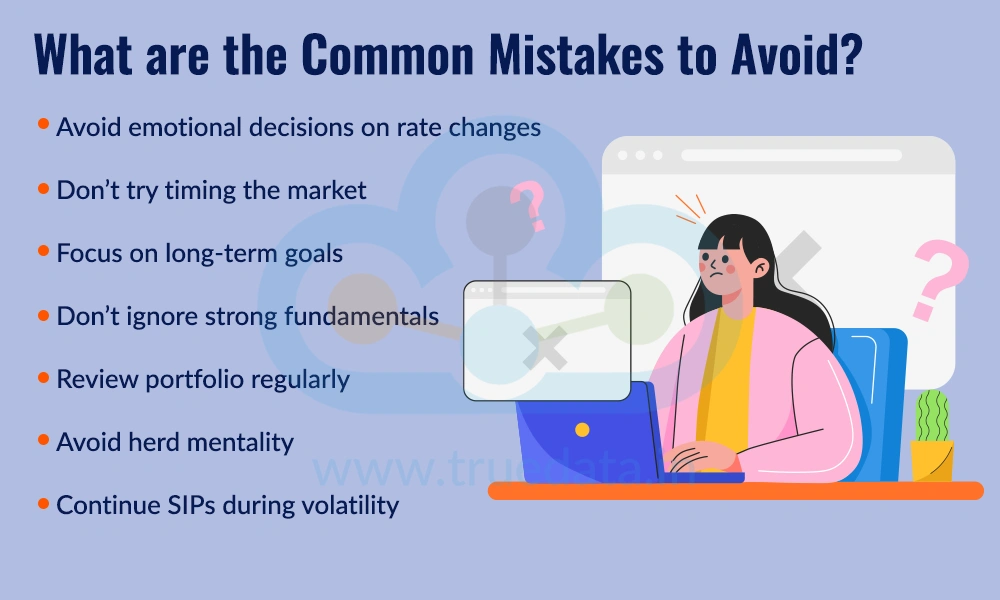
Common mistakes to avoid in investments of high market volatility due to interest rate changes include,

  • Avoiding emotional reaction to interest rate changes, as sudden decisions can lead to losses.

  • Not trying to time the market interest rate changes, as sudden decisions can lead to losses.

  • Ignoring long-term financial goals while focusing only on short-term rate changes.

  • Ignoring company fundamentals, as strong businesses can perform well even in changing rate cycles.

  • Not reviewing the portfolio regularly to make gradual adjustments instead of sudden changes.

  • Getting influenced by herd behaviour can lead to poor investment decisions.

  • Stopping or paying SIPs during market volatility can affect long-term wealth creation. 

Conclusion

Interest rates play a powerful role in shaping stock valuations by influencing the valuation of future earnings, company borrowings, and portfolio allocation. Interest rate changes can trigger negative market sentiment and impact sector performance, which can further trigger portfolio rebalancing. Thus, it is important to stay informed and act with a long-term perspective rather than making portfolio changes based on an emotional reaction. 

This article explains the relationship between interest rates and stock valuations, helping investors make informed decisions. Let us know your thoughts on the topic or if you need further information on the same, and we will address it soon. 

Till then, Happy Reading!


Read More: What is Share Dilution? How Does it Affect Shareholders and Valuations?

Frequently Asked Questions

Yes, growth stocks usually suffer more during interest rate hikes because their valuations depend heavily on future earnings, which get discounted more when rates rise. In comparison, value stocks are less affected as they have more stable and current earnings.

Markets often react more to expectations than actual rate changes. If a rate hike is already expected, the impact may be limited. However, if the actual move is different from expectations, it can cause sharp market reactions.

Higher interest rates increase borrowing costs, so companies may reduce stock buybacks and be more cautious with dividends to conserve cash. This can limit returns for investors and put some pressure on stock prices.

Yes, stock valuations can stay high even when interest rates rise if companies continue to deliver strong earnings growth and a positive outlook. However, it becomes harder to sustain high valuations for long as higher rates put pressure on future growth expectations.

No, the impact rate changes in booms and recessions are not the same. During economic booms, markets can handle higher interest rates better because growth and earnings are strong. However, during recessions, even small rate increases can hurt markets more as companies and investors are already under pressure.
Marisha Bhatt

Marisha Bhatt is a financial content writer @TrueData.
She writes with the sole aim of simplifying complex financial concepts and jargon while attempting to clarify technical and fundamental analysis concepts of the stock markets. The ultimate goal is to spread vital knowledge and benefit the maximum audience. Her Chartered Accountant background acts as the knowledge base to help clarify crucial concepts and create a sound investment portfolio.

0 Comments

Related Articles

SEE ALL
Corporate Data
Corporate Data
Investing Smarter: The Power of Corporate Data and Market Sentiment Analysis

Thestock market never stands still, and prices swing constantly with every new h...

Corporate Data
Corporate Data
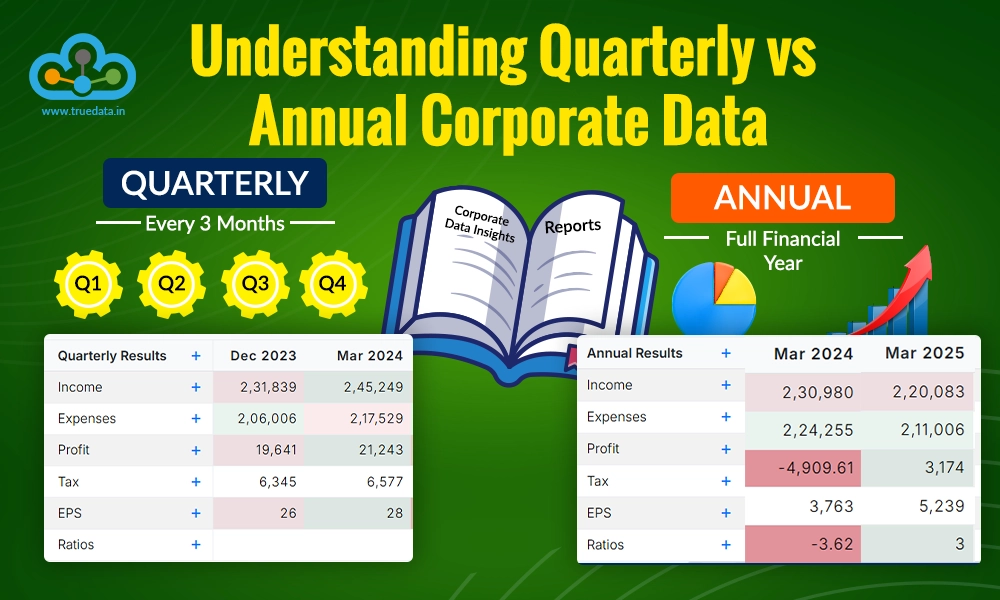
Understanding Quarterly vs Annual Corporate Data

Corporate data is more than just the numbers of a company. They can show what is...

Corporate Data
Corporate Data
Solvency and Leverage Ratios - Debt and Equity Ratios

Debt and equity together form the total capital of a company. However, when anal...

Relevant Tags