Corporate Data

What is Share Dilution? How does it affect shareholders and valuations?

Marisha Bhatt · 28 Mar 2026 · 9 mins read · 0 Comments

what-is-share-dilution-how-does-it-affect-shareholders-and-valuations

When companies announce a share buyback, investors often see it as good news. It signals confidence, reduces the number of shares in the market, and can even help prevent hostile takeovers. But what happens when the opposite takes place? Instead of reducing shares, a company may issue more shares through a process known as share dilution. This increases the total number of shares and can change how much of the company each investor actually owns. So, is share dilution a red flag, or can it sometimes work in your favour? Let us break down what share dilution really means and how it can impact both companies and investors.

What is Share Dilution?

What is Share Dilution

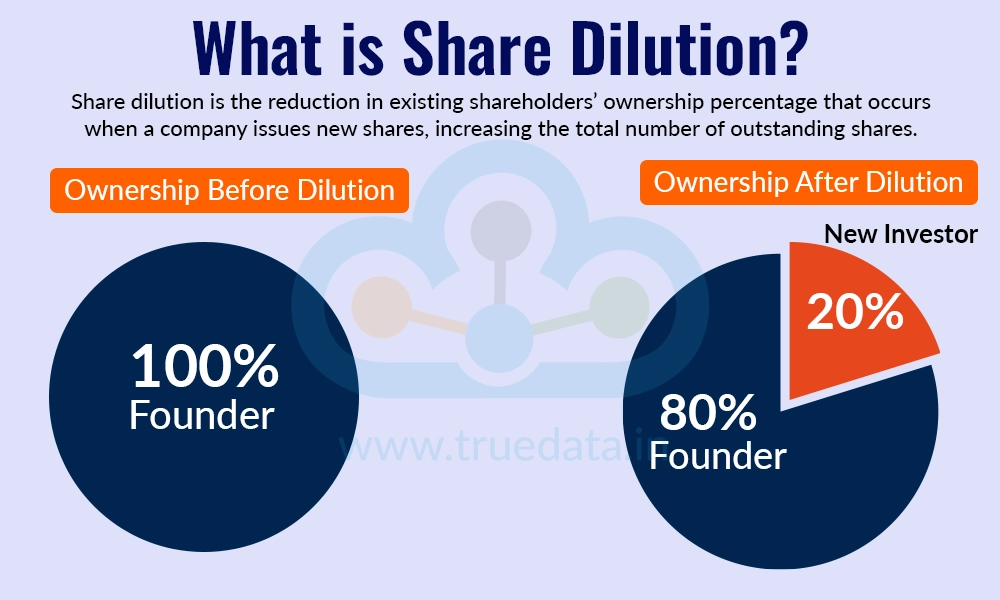
Share dilution is the increase in the shareholder base through the issue of new shares, which effectively results in a reduction of the ownership percentage of existing shareholders because the company is now divided into more shares. Let us put it simply, share dilution is like cutting a birthday cake into smaller and smaller slices because more people unexpectedly joined the party. So you still have a slice, but it is now a much smaller percentage of the whole cake. The company’s profits are spread across a larger number of shares post dilution. This can reduce Earnings Per Share (EPS), which may also affect the stock price. Companies usually dilute shares to raise money for expansion, repay debt, fund new projects, or offer stock options to employees. It is important to understand that dilution does not always mean something negative. Its impact depends on the company‘s reason for issuing new shares and its effective use of the funds raised.

What are the Reasons for Share Dilution?

What are the Reasons for Share Dilution

Share dilution is a corporate action that directly results in an increase in the shareholder base and can be triggered by various reasons. The reasons or causes of share dilution are explained hereunder.

Raising Capital for Business Growth

One of the most common reasons for share dilution is to raise money. A company may issue new shares to investors and collect funds instead of taking a loan from a bank. This money can be used to expand operations, enter new markets, build factories, invest in technology, or launch new products. This method is often easier than borrowing large amounts for growing companies, especially startups and mid-sized firms. Share dilution can actually benefit long-term investors if the funds are used wisely and help increase profits over time.

Employee Stock Options (ESOPs)

Many companies, especially listed companies and startups, offer Employee Stock Option Plans (ESOPs) to their employees as part of the retention or recruitment process. When employees exercise these options, new shares are issued, increasing the total share count, leading to dilution. While this may reduce existing shareholders’ ownership percentage, it can help the company grow faster if skilled employees contribute to better performance.

Reducing Debt

Sometimes companies may issue new shares to repay existing loans. If a company has high debt and large interest payments, it may decide to raise equity rather than continuing with heavy borrowing. This debt reduction helps the company to lower its financial risk and improve its balance sheet. This can be a positive move for investors if it strengthens the company’s financial position, even though their ownership percentage reduces slightly.

Mergers and Acquisitions

A company may also issue shares to acquire another business rather than paying in cash. In such cases, the acquiring company gives its own shares to the shareholders of the target company. This increases the total number of shares and causes share dilution. However, if the acquisition improves revenue and profits, it can create long-term value for shareholders.

Converting Convertible Securities

Some companies may issue instruments such as convertible debentures or warrants, which can later be converted into shares. When investors or promoters convert them into equity shares, new shares are created, leading to dilution. This is a common practice in fundraising rounds or strategic investments. Investors should check the company’s disclosures to understand how many such securities are outstanding.

What is the impact of Share Dilution on Share Prices and Shareholders’ Value?

Share dilution has a direct and lasting impact on the shareholders’ value as well as share prices. It should not be judged as purely negative or positive impact. The real impact on shareholder value and share prices depends on the company’s ability to use the additional capital effectively. If the dilution leads to stronger growth and higher profits in the future, it can create wealth. However, if it does not improve performance, it may reduce returns over time. The impact of share dilution is explained below.

Impact on Shareholders’ Value

Impact on Shareholders’ Value

  • Reduction in Ownership Percentage - When a company issues new shares, the total number of shares increases. Even though a shareholder continues to hold the same number of shares, their percentage ownership in the company is reduced. For example, if Mr. A owned 2% of the company earlier, after dilution, he may own 1.5%. Thus, the claim on the company’s future profits and assets reduces proportionally.

  • Impact on Earnings Per Share (EPS) - Earnings Per Share (EPS) is calculated by dividing the company’s profit by the total number of outstanding shares. When new shares are issued, profits are divided among more shares. If the company’s profit does not increase immediately, EPS may fall. A lower EPS can sometimes lead to a decline in the stock price, especially if investors feel the dilution is not justified.

  • Effect on Voting Power - As the ownership percentage decreases, the shareholders’ voting power in the company's decisions also reduces slightly. This may not have a major practical impact for retail investors, but for large shareholders or promoters, dilution can significantly change control and decision-making power.

  • Dividend Impact - If the company pays dividends, dilution can directly affect Dividend Per Share (DPS). When profits are spread over more shares, the dividend per share may reduce unless total profits increase. This can impact income-focused investors and make the investment less attractive to them.

Impact on Share Prices

Impact on Share Prices

  • Immediate Market Reaction - When a company announces share dilution, the stock price often reacts quickly. In many cases, prices may fall in the short term because investors worry that their ownership percentage will reduce and profits will be spread over more shares. This reaction is common in markets as well, especially if the reason for dilution is not clearly explained.

  • Valuation May Adjust - Many investors value stocks using ratios like the Price-to-Earnings (P/E) ratio. If EPS falls due to dilution, the valuation metrics may change. The market may adjust the share price to reflect the new earnings level. However, if investors believe the dilution will lead to higher future profits, the stock may recover over time.

  • Positive Impact in Growth Cases - Dilution is not always negative for share prices. If the company issues shares to fund expansion, reduce debt, or acquire a strong business, investors may see it as a growth opportunity. In such cases, the share price may remain stable or even rise because the market expects higher future profits.

  • Long-Term Effect Depends on Performance - In the long run, share prices depend more on business performance than on dilution alone. If the funds raised through new shares help the company increase revenue and profitability, the stock price can grow despite initial dilution. However, if profits do not improve, the share price may struggle.

What is the Difference Between Share Dilution and a Stock Split?

Share dilution and stock split are both corporate actions that bring a change in the total number of shares. However, these corporate actions significantly differ in purpose and impact. These differences are highlighted hereunder. 

What is the Difference Between Share Dilution and a Stock Split

Feature

Share Dilution

Stock Split

Meaning

Share dilution is the result of a company issuing new shares, which increases the total number of shares in the market.

A stock split is when a company divides its existing shares into more shares without issuing new capital.

Purpose

Companies usually dilute shares to raise money, reduce debt, fund expansion, or issue shares under ESOPs.

Companies usually split shares to make the stock price more affordable and improve trading activity.

Impact on Total Company Value

The company’s total value may change if new funds are raised and used for growth.

The total value of the company remains exactly the same after a stock split.

Ownership Percentage

Existing shareholders’ ownership percentage reduces if they do not participate in the new share issue.

Shareholders’ ownership percentage remains exactly the same after a stock split.

Impact on EPS

Earnings per share may decrease because profits are divided among a larger number of shares.

Earnings per share reduce proportionally, but there is no real impact on overall value.

Effect on Investors’ Wealth

Investors’ wealth may be impacted depending on how the company uses the raised funds.

Investors’ total wealth does not change because only the number of shares increases.

Conclusion

Share dilution is the reduction in the ownership percentage of existing shareholders after an increase in the overall number of shares. It can have a multi-faceted impact on EPS, voting rights, and stock prices, making it crucial for companies to explain the reasons for such dilution and ensure that the funds generated are used constructively to achieve long-term growth. Thus, investors should analyse share dilution without having a knee-jerk reaction to the dilution itself, but to understand the reason behind it and whether it strengthens the company’s future prospects.

This article explains a critical corporate action and its overall impact, thereby enabling informed decision-making for investors and shareholders alike. Let us know your thoughts on the topic or if you need further information on the same, and we will address it soon.

Till then, Happy Reading!


Read More: How Realtime Corporate Announcements Can Enhance Transparency and Trust in Organisations?

Frequently Asked Questions

Dilution usually happens when a company issues new shares to raise money for expansion, reduce debt, fund acquisitions, or offer shares to employees under ESOPs. It can also occur when convertible securities like warrants or debentures are converted into equity shares.

Fully diluted share count is the total number of shares a company would have if all convertible securities, warrants, and employee stock options were converted into equity shares. It shows the maximum possible number of shares that could exist and helps investors understand the true potential dilution.

Anti-dilution protection is a clause that protects certain investors (usually early or institutional investors) from losing value if a company issues new shares at a lower price in the future. It adjusts their share price or gives them additional shares so their investment value is not unfairly reduced.

Equity dilution reduces your ownership percentage in the company when new shares are issued. Voting dilution reduces your voting power, which can happen if new shares with voting rights are issued or if special shares with higher voting rights are created.

Diluted Earnings Per Share (Diluted EPS) is calculated by dividing the company’s net profit by the total number of shares outstanding plus all potential shares that could be created from stock options, warrants, or convertible securities. Thus, it shows how much profit each share would earn if all possible shares were issued.

Investors should check how many total shares are outstanding and how many additional shares could be created from ESOPs, warrants, or convertible securities. It is also important to see whether promoters’ ownership is decreasing significantly, as that may signal future dilution risk.
Marisha Bhatt

Marisha Bhatt is a financial content writer @TrueData.

She writes with the sole aim of simplifying complex financial concepts and jargon while attempting to clarify technical and fundamental analysis concepts of the stock markets. The ultimate goal is to spread vital knowledge and benefit the maximum audience. Her Chartered Accountant background acts as the knowledge base to help clarify crucial concepts and create a sound investment portfolio.

0 Comments

Related Articles

SEE ALL
Corporate Data
Corporate Data
Investing Smarter: The Power of Corporate Data and Market Sentiment Analysis

Thestock market never stands still, and prices swing constantly with every new h...

Corporate Data
Corporate Data
Understanding Quarterly vs Annual Corporate Data

Corporate data is more than just the numbers of a company. They can show what is...

Corporate Data
Corporate Data
Share Buyback and Its Impact on Share Prices

The stock market is abuzz with excitement as Infosys announces a massive share b...