Net profit indicates the company’s earnings, but it does not tell the full story. Investors also want to know how efficiently a company is using its resources to generate those profits. This is where Return on Assets (ROA) comes into the picture. It measures the ability of a company to turn its assets into earnings, which further indicates its operational efficiency. Dive into this blog where we break down what ROA means, why it matters, and how it can help you make smarter investment decisions as you explore the world of ratio analysis.

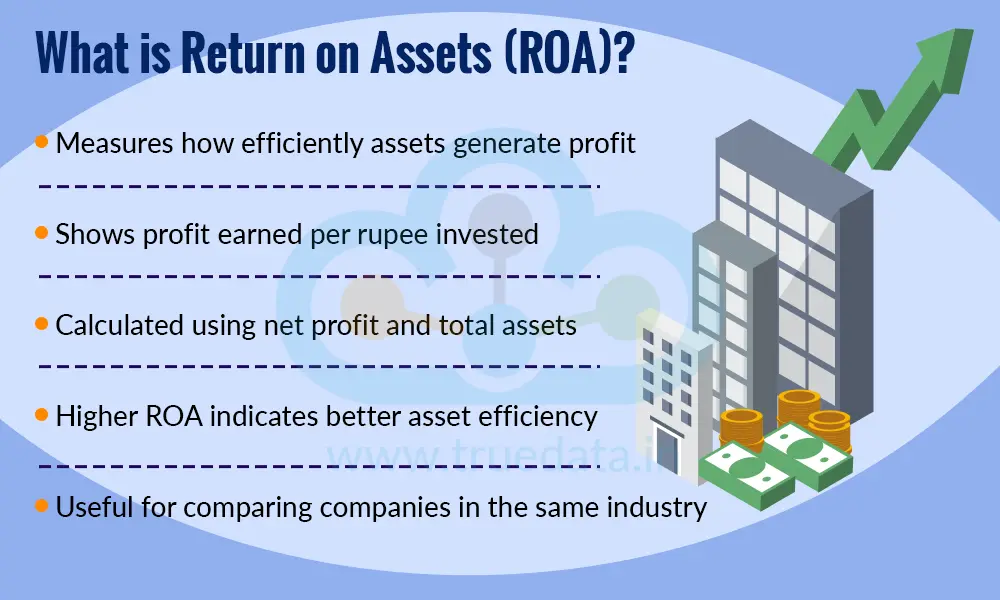
Return on Assets (ROA) is a financial ratio that shows how efficiently a company uses its total assets to generate profit. It indicates the level of profit a company earns for every rupee invested in its assets, such as machinery, buildings, inventory, and cash. ROA is calculated by comparing net profit and total assets. A higher ROA means the company is using its assets well to generate earnings, while a lower ROA may indicate inefficiency or underutilised resources. ROA is useful in comparing companies within the same industry, as it helps identify businesses that are better at turning their investments into profits.
Return on Assets (ROA) is a financial ratio that is calculated using two important components from the financial statements, i.e., net profit and total assets.
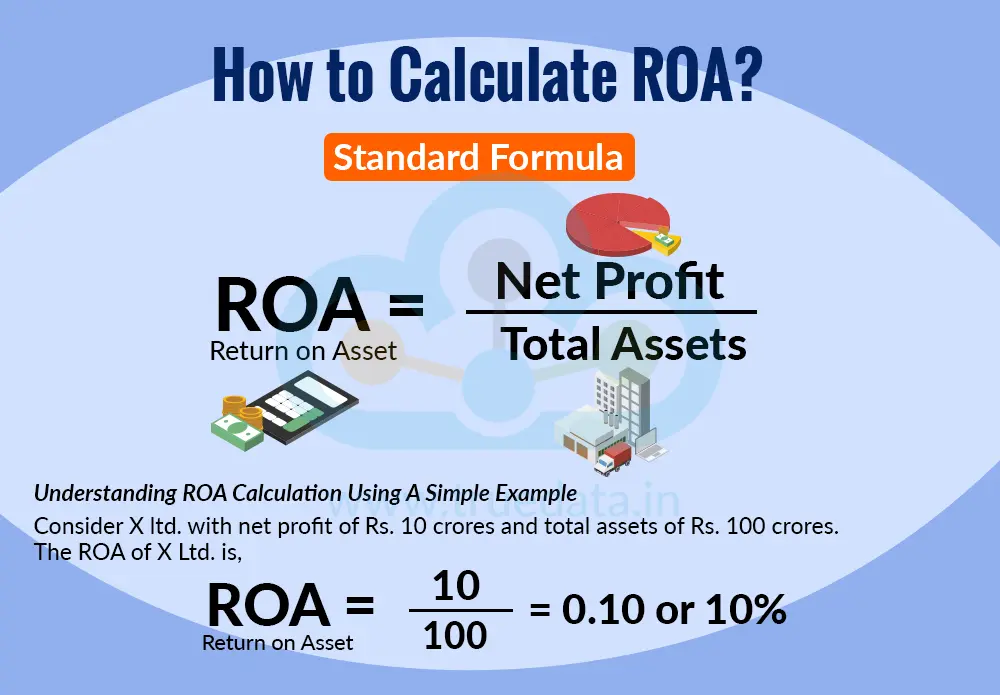
The formula to calculate ROA is,
Standard Formula

ROA = Net Profit / Total Assets
This ratio shows how much profit a company earns for every rupee invested in its assets.
Understanding ROA Calculation Using A Simple Example
Consider X Ltd. with a net profit of Rs. 10 crores and total assets of Rs. 100 crores. The ROA of X Ltd. is,
ROA = Net Profit / Total Assets
ROA = 10/100 = 0.10 or 10%
Thus, X Ltd. is generating 10% return on its assets or what it owns.
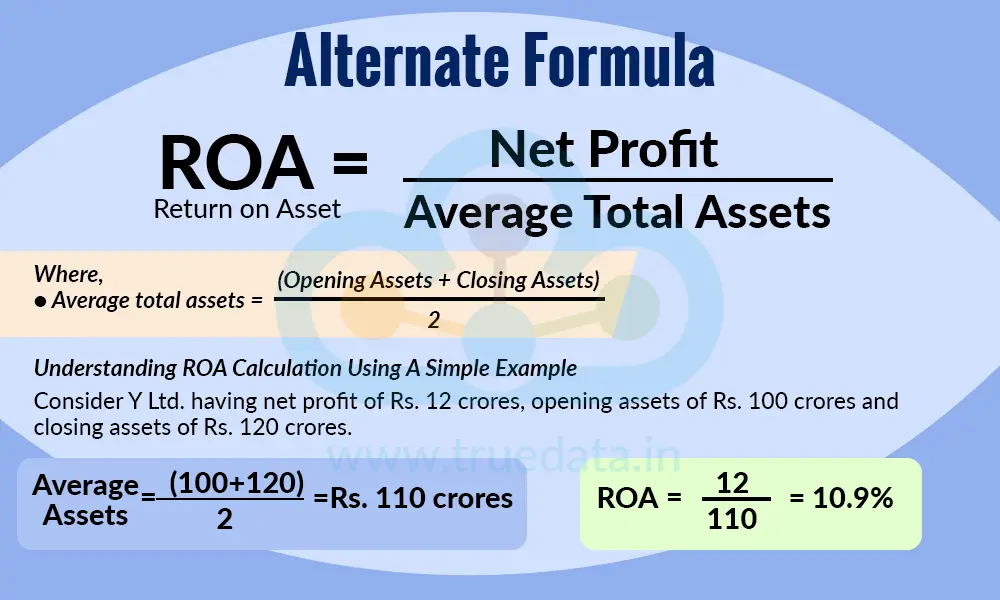
Alternate Formula

ROA = Net Profit / Average Total Assets
Where,
Average total assets = (Opening Assets + Closing Assets) / 2.
The use of average assets makes the analysis more accurate for investors and other stakeholders in the company.
Understanding ROA Calculation Using A Simple Example
Consider Y Ltd. having a net profit of Rs. 12 crores, opening assets of Rs. 100 crores and closing assets of Rs. 120 crores.
Average Assets = (100+120) / 2 = Rs. 110 crores
ROA = Net Profit / Average Total Assets
ROA = 12/110 = 0.109 = 10.9%
Thus, Y Ltd. earns 10.9% return on its assets or what it owns.

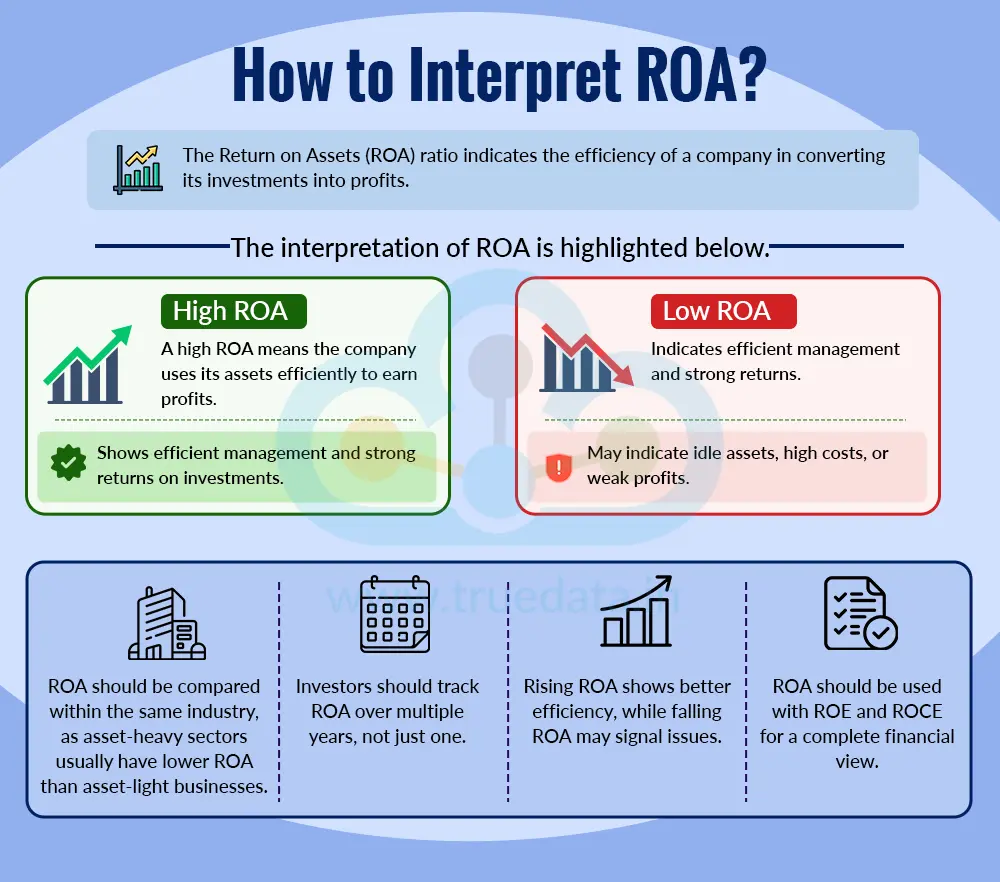
The Return on Assets ratio indicates the efficiency of a company in converting its investments into profits. The interpretation of ROA is highlighted below.
High ROA - A high ROA shows that the company is using its assets efficiently to generate profits. This usually indicates a well-managed business that is getting good returns from its investments.
Low ROA - A low ROA suggests that the company is not using its assets effectively. It may have idle resources, high costs, or lower profits, which can be a concern for investors.
ROA should always be compared with companies in the same sector. For example, asset-heavy industries like manufacturing or telecom usually have lower ROA, while asset-light businesses like IT services tend to have higher ROA. Furthermore, investors should track it over multiple years rather than focusing on a single year. A rising ROA shows improving efficiency, while a falling ROA may signal problems in the business. ROA should not be used alone, and investors should consider other ratios like Return on Equity (ROE) and Return on Capital Employed (ROCE) to get a complete picture of the company’s financial health.

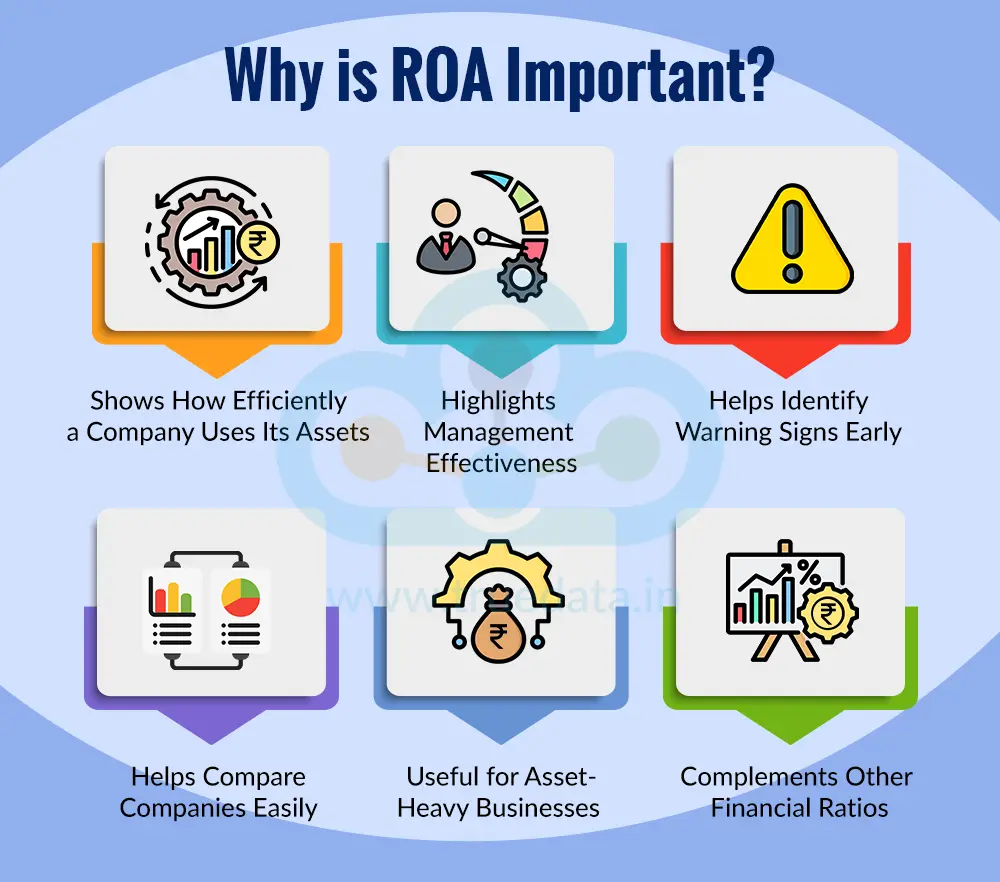
The importance of ROA is explained hereunder.
Shows How Efficiently a Company Uses Its Assets - ROA helps investors understand how well a company is using everything it owns, like machines, buildings, and cash, to generate profit. A higher ROA indicates an efficient use of resources by the company, which is a positive sign for investors looking for efficient businesses.
Highlights Management Effectiveness - ROA also reflects how capable the management is in running the business. Good management will use assets wisely to generate higher profits, which improves ROA over time. A consistently strong ROA often indicates disciplined and effective decision-making.
Helps Identify Warning Signs Early - A declining ROA over time can signal potential problems such as falling profits, inefficient use of assets, or unnecessary expansion. This gives investors an early warning to review the company more carefully before making decisions.
Helps Compare Companies Easily - ROA makes it easier to compare companies within the same industry, even if their sizes are different. For example, two companies may have similar profits, but the one with fewer assets and a higher ROA is usually more efficient and may be a better investment option.
Useful for Asset-Heavy Businesses - For industries like manufacturing, telecom, or infrastructure, where large investments in assets are required, ROA becomes especially important. It helps investors judge whether those heavy investments are actually generating good returns.
Complements Other Financial Ratios - ROA works best when used along with other ratios like ROE and ROCE. While ROE focuses on returns to shareholders and ROCE looks at overall capital efficiency, ROA adds another layer by showing how well total assets are being utilised, giving investors a more complete picture.
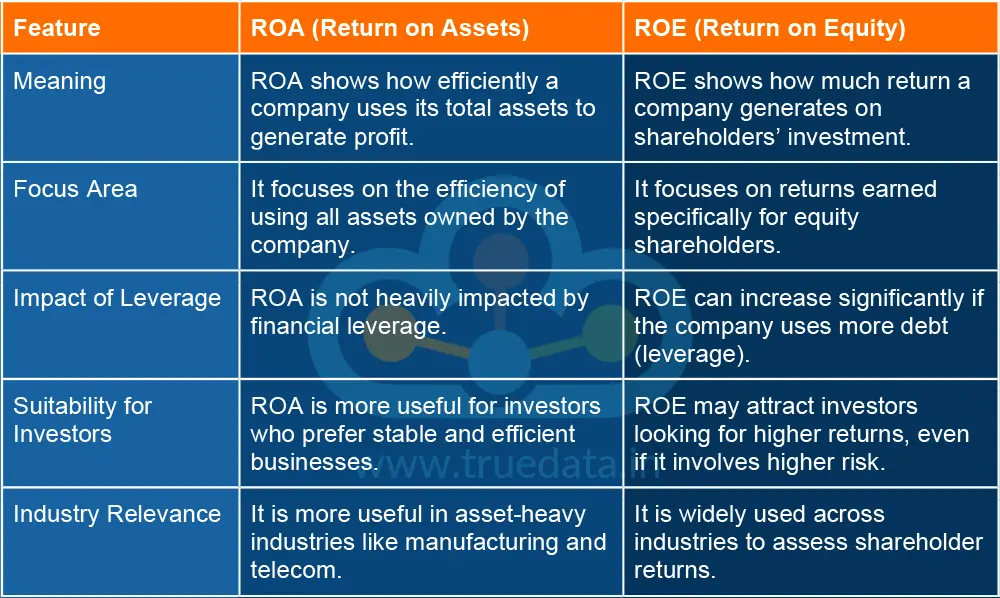
ROA (Return on Assets) and ROE (Return on Equity) are two important metrics that indicate the profitability and efficiency of a business. The key differences between these financial ratios are tabled below.


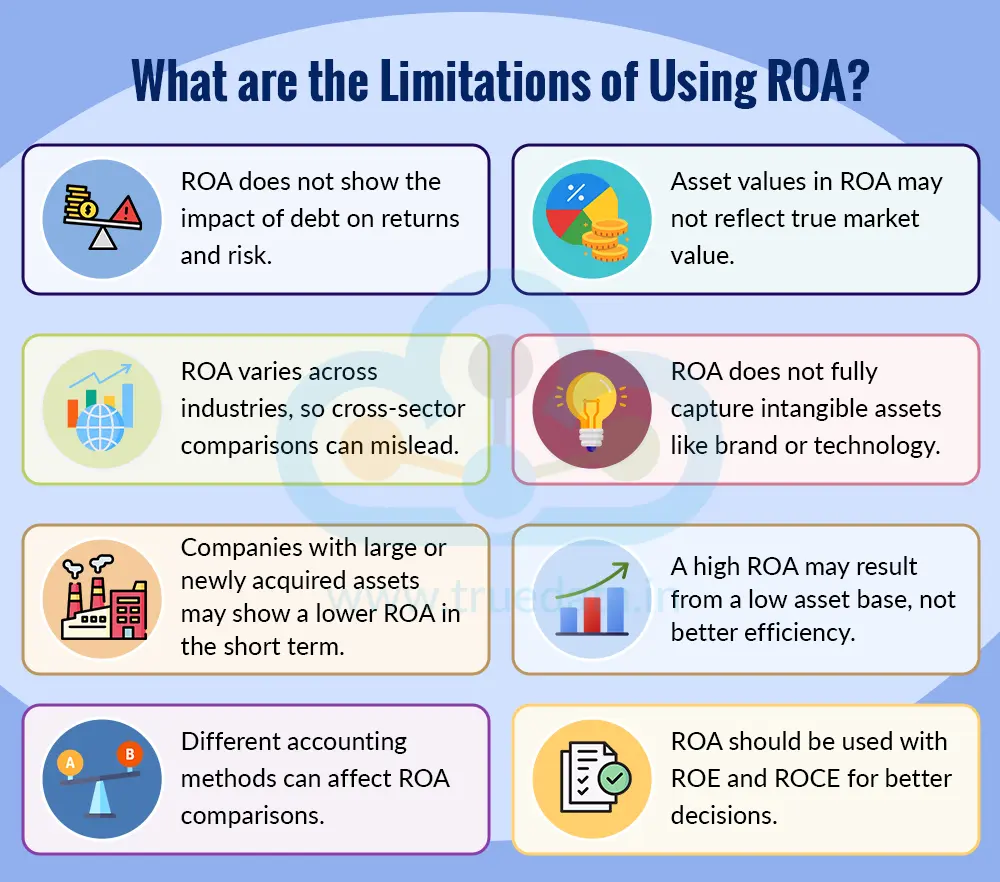
Return on Assets is a widely used metric in financial analysis, especially in asset-heavy sectors. However, it comes with a few limitations that should be considered for optimum analysis. These limitations include,
ROA does not consider how the company is financed, so it may not show the impact of debt on overall returns and risk.
It can vary widely across industries, so comparing companies from different sectors using ROA can give misleading conclusions.
Companies with large or newly acquired assets may show a lower ROA in the short term, even if the investments are good for future growth.
Different accounting policies (like depreciation methods) can affect asset values and profits, making ROA less comparable across companies.
ROA depends on accounting values of assets, which may not reflect their true market value, especially in older companies.
ROA does not capture intangible assets like brand value or technology properly, which can be important for modern businesses.
A high ROA does not always mean strong performance, as it could be due to a lower asset base rather than higher efficiency.
ROA does not give a complete picture on its own, so investors should use it along with other ratios like ROE and ROCE before making decisions.
Return on Assets (ROA) is a useful ratio that helps investors understand how efficiently a company uses its assets to generate profit. It goes beyond just looking at the absolute net profit figures and shows the efficiency in utilising resources like machines, buildings, and cash. While this ratio is an integral part of the fundamental analysis of companies, it should not be used in isolation to avoid misinterpretation.
This article explains yet another important ratio in our series on ratio analysis. Let us know your thoughts on the topic or if you need further information on the same, and we will address it soon.
Till then, Happy Reading!
Thestock market never stands still, and prices swing constantly with every new h...
Corporate data is more than just the numbers of a company. They can show what is...
Debt and equity together form the total capital of a company. However, when anal...