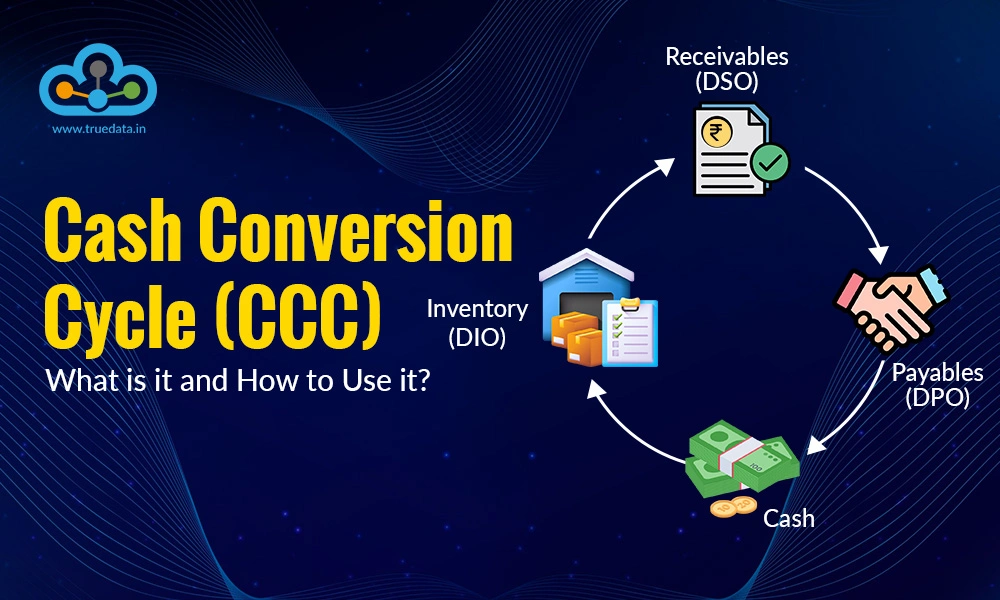
What is the one thing common between most successful businesses? They have cracked the code for a smooth-sailing business that runs like a perfectly oiled machine. A key component of this system is the seamless conversion of inventory into cash. Enter the Cash Conversion Cycle, which helps in understanding the inventory management, working capital efficiency, and the overall operational strength of a company. Check out this blog to understand the cash conversion cycle and its importance in the fundamental analysis of companies.

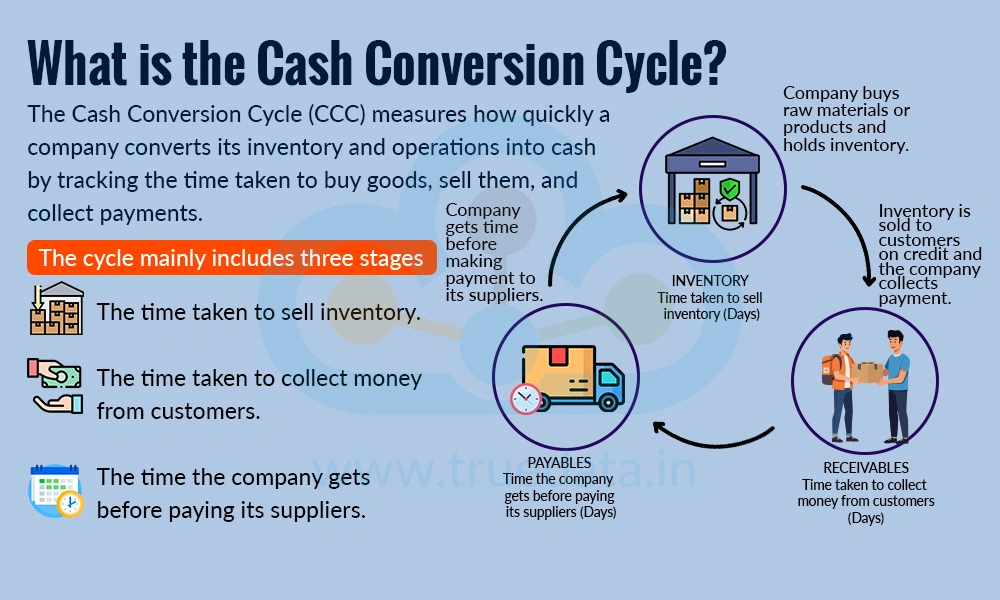
The Cash Conversion Cycle (CCC) is a financial metric that measures how quickly a company can convert its investments in inventory and business operations into actual cash. It shows the number of days a business takes to buy raw materials or products, sell them to customers, and finally receive payments. The cycle mainly includes three stages, i.e.,
The time taken to sell inventory.
The time taken to collect money from customers.
The time the company gets before paying its suppliers.
A shorter cash conversion cycle usually indicates that the business is managing its inventory and cash flow efficiently, while a longer cycle may suggest delays in sales or collections. Cash Conversion Cycle helps assess the operational efficiency and liquidity of a business. Businesses with efficient cash conversion cycles often have better cash management, lower dependence on borrowing, and stronger financial stability over the long term.

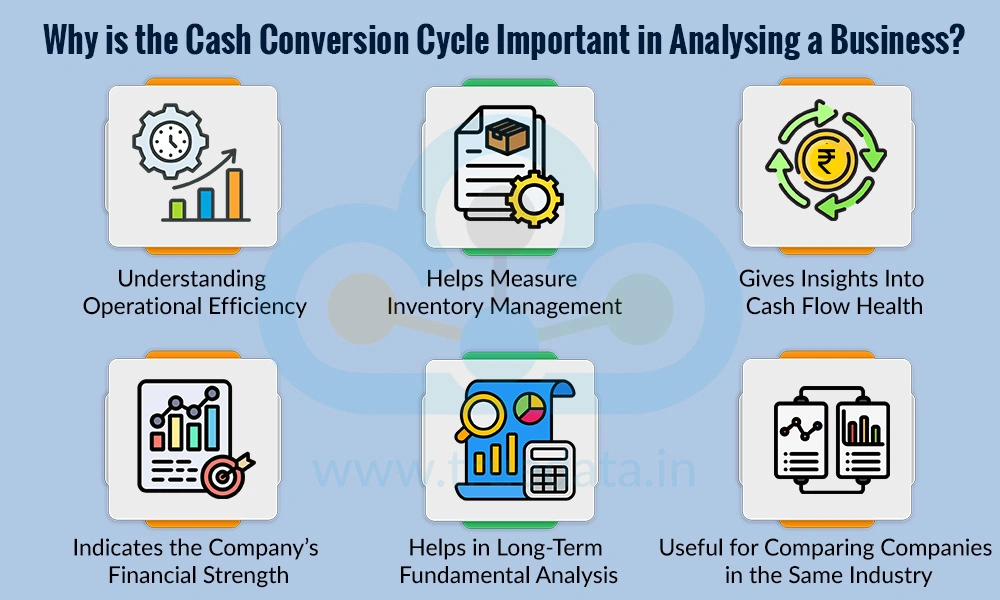
Cash Conversion is a combination of three components that help in understanding the day-to-day liquidity position of a business through its routine operations. Thus, it is an important metric to evaluate the long-term sustainability of a business. The importance of the Cash Conversion Cycle for a business is explained hereunder.
The Cash Conversion Cycle (CCC) helps investors understand how efficiently a company manages its day-to-day business operations. It shows how quickly the company can convert its inventory and other operational investments into actual cash. A business with a shorter cash conversion cycle is usually able to sell products faster, collect payments on time, and manage expenses efficiently. This reflects strong operational discipline and smoother business functioning. On the other hand, a very long cash conversion cycle may indicate slow-moving inventory, delayed customer payments, or weak working capital management.
The cash conversion cycle also sheds insight into how effectively a company manages its inventory. If products remain unsold for a long time, it increases storage costs and blocks the company’s cash. Efficient businesses usually maintain an optimal level of inventory and avoid unnecessary stock build-up. Sectors like FMCG, retail, automobiles, and manufacturing are hugely impacted by inventory management, which plays a major role in profitability and operational efficiency.
Profit alone does not always tell the full story about a company’s financial health. A company may report strong profits but still struggle with cash shortages if money is stuck in inventory or unpaid customer bills. The cash conversion cycle helps investors analyse the business's actual cash flow position. Companies that convert their inventory into cash quickly generally have healthier cash flows, which allows them to meet expenses, pay salaries, repay debt, and invest in future growth more comfortably.
A company with a strong and efficient cash conversion cycle often depends less on external borrowing for daily operations. Since cash comes back into the business quickly, the company may not need to rely heavily on loans or short-term debt to manage working capital requirements. This can improve financial stability and reduce interest costs over time. Investors often prefer companies with efficient cash cycles because they are generally better prepared to handle economic slowdowns or market uncertainties.
The cash conversion cycle is an important part of fundamental analysis for long-term investors as it provides deeper insights beyond revenue and profit figures. A consistently improving CCC may indicate that management is becoming more efficient in handling operations and working capital. Over time, businesses with strong cash flow management often have better growth potential, stronger balance sheets, and higher resilience during difficult market conditions.
The cash conversion cycle becomes even more useful when comparing companies within the same sector. For example, two companies may report similar profits, but the one with the shorter cash conversion cycle may actually be operationally stronger and financially healthier. Comparing the cash conversion cycle of companies in industries such as retail, FMCG, pharmaceuticals, or consumer durables can help investors identify businesses with better management efficiency and stronger cash flow generation capabilities.

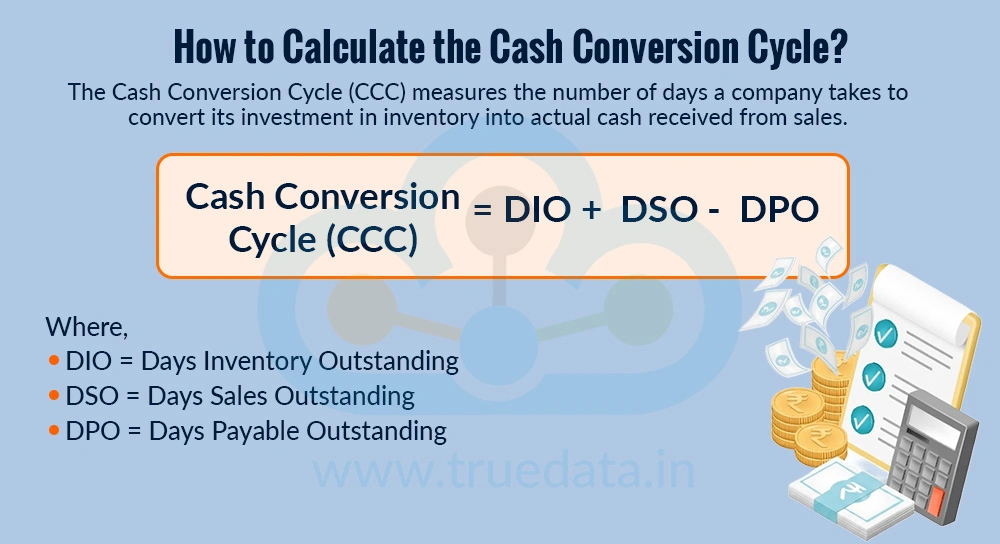
The Cash Conversion Cycle (CCC) measures the number of days a company takes to convert its investment in inventory into actual cash received from sales. Thus, it tracks how efficiently money moves through the business cycle. The formula to calculate the Cash Conversion Cycle uses three important components and is shown below.
Cash Conversion Cycle (CCC) = DIO + DSO - DPO
Where,
DIO = Days Inventory Outstanding
DSO = Days Sales Outstanding
DPO = Days Payable Outstanding
Days Inventory Outstanding (DIO) - Days Inventory Outstanding measures how many days a company takes to sell its inventory. It shows how long products remain in stock before being sold.
The formula to calculate the Days Inventory Outstanding (DIO) is,
DIO = Average Inventory / Cost of Goods Sold * 365
Interpretation -
A lower DIO generally indicates faster inventory movement.
A higher DIO may suggest slow sales or excess inventory.
Days Sales Outstanding (DSO) - Days Sales Outstanding measures how many days a company takes to collect payment from customers after making sales. Companies with strong customer relationships and efficient billing systems usually maintain a lower DSO.
The formula to calculate the Days Sales Outstanding (DSO) is,
DSO = Average Accounts Receivable / Net Credit Sales * 365
Interpretation -
A lower DSO means the company collects payments quickly.
A higher DSO may indicate delayed customer payments or weak collection efficiency.
Days Payable Outstanding (DPO) - Days Payable Outstanding measures how many days a company takes to pay its suppliers.
The formula to calculate the Days Payable Outstanding (DPO) is,
DPO = Average Accounts Payable / Cost of Goods Sold * 365
Interpretation -
A higher DPO can help conserve cash because the company gets more time to pay suppliers.
However, an extremely high DPO may sometimes indicate financial stress or delayed payments.
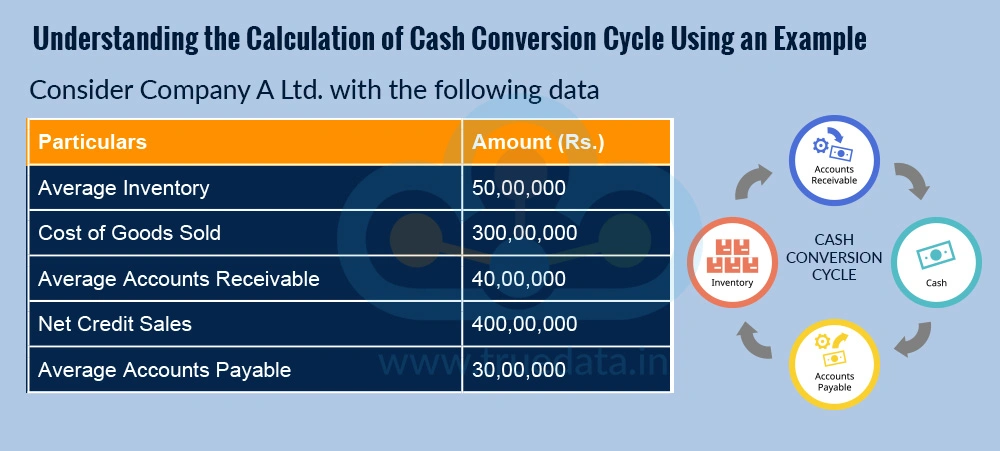
Understanding the Calculation of Cash Conversion Cycle Using an Example
Consider Company A Ltd. with the following data.

The Cash Conversion Cycle for Company A Ltd. is calculated as follows.
Step 1 - Calculate Days Inventory Outstanding (DIO)
DIO = Average Inventory / Cost of Goods Sold * 365
DIO = 50,00,000 / 300,00,000 * 365 = 60.833 ≈ 61 days
Thus, the company takes approximately 61 days to sell its inventory.
Step 2 - Calculate Days Sales Outstanding (DSO)
DSO = Average Accounts Receivable / Net Credit Sales * 365
DSO = 40,00,000 / 400,00,000 * 365 = 36.5 ≈ 37 days
Thus, the company takes approximately 37 days to collect money from customers after sales.
Step 3 - Calculate Days Payable Outstanding (DPO)
DPO = Average Accounts Payable / Cost of Goods Sold * 365
DPO = 30,00,000 / 300,00,000 * 365 = 36.5 ≈ 37 days
Thus, the company takes approximately 37 days to pay its suppliers.
Step 4 - Calculate the Cash Conversion Cycle
Cash Conversion Cycle (CCC) = DIO + DSO - DPO
Cash Conversion Cycle (CCC) = 61+37-37 = 61 days
The company’s Cash Conversion Cycle is 61 days. Thus, the business takes around 61 days to convert its investment in inventory and operations back into actual cash.

Businesses with shorter CCCs generally have better liquidity and may depend less on loans for working capital needs. However, it is important to note that Cash Conversion Cycle should always be compared with companies in the same industry, as different sectors naturally have different operating cycles.
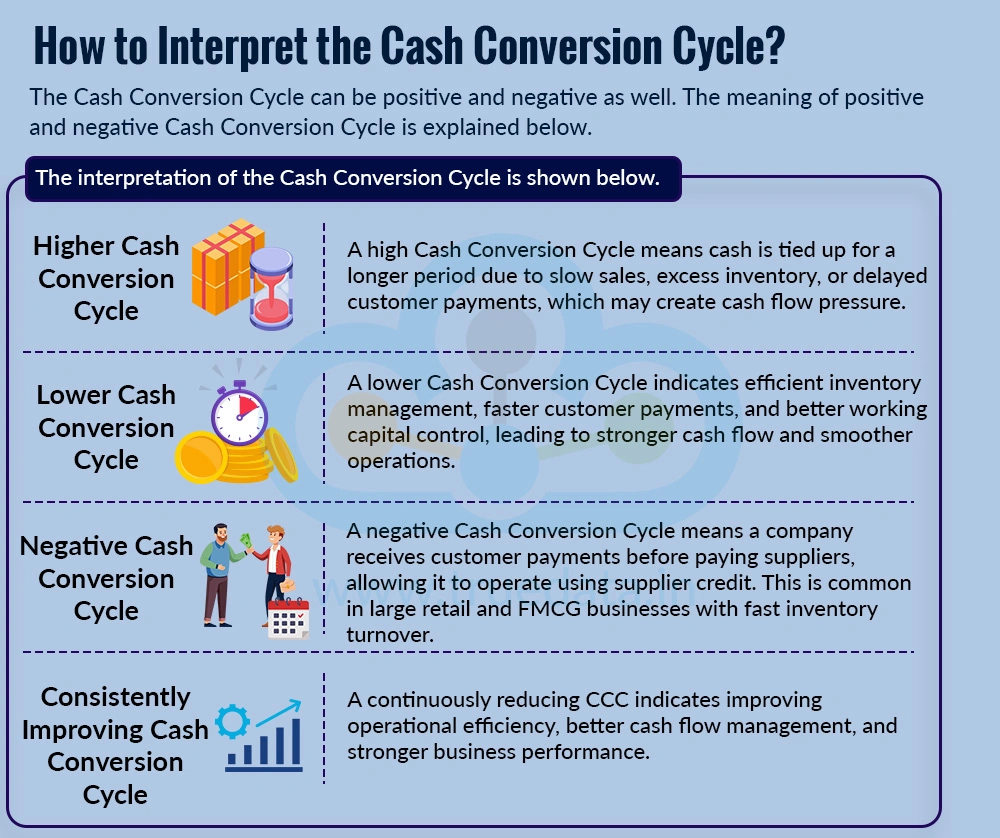
The interpretation of the Cash Conversion Cycle is shown below.
Higher Cash Conversion Cycle - A high Cash Conversion Cycle means cash remains tied up in inventory or receivables for a longer time. This may indicate slow sales, excess inventory, delayed customer payments, or weak working capital management. Companies with very high CCCs may sometimes face cash flow pressure.
Lower Cash Conversion Cycle - A lower Cash Conversion Cycle generally means the company is able to quickly convert its inventory into cash. This shows efficient inventory management, faster customer collections, and better working capital control. Businesses with lower CCCs often enjoy stronger cash flows and smoother operations.
Negative Cash Conversion Cycle - Some businesses operate with a negative Cash Conversion Cycle. This means they receive money from customers before paying suppliers. Such companies can run operations using supplier credit instead of their own cash. Large retail and FMCG businesses often achieve this due to strong bargaining power and fast inventory turnover.
Consistently Improving Cash Conversion Cycle - If a company’s CCC keeps reducing over time, it may indicate improving operational efficiency and stronger management practices. It shows the business is becoming better at selling products, collecting payments, and managing cash flow.
The Cash Conversion Cycle can be positive and negative as well. The meaning of positive and negative Cash Conversion Cycle is explained below.

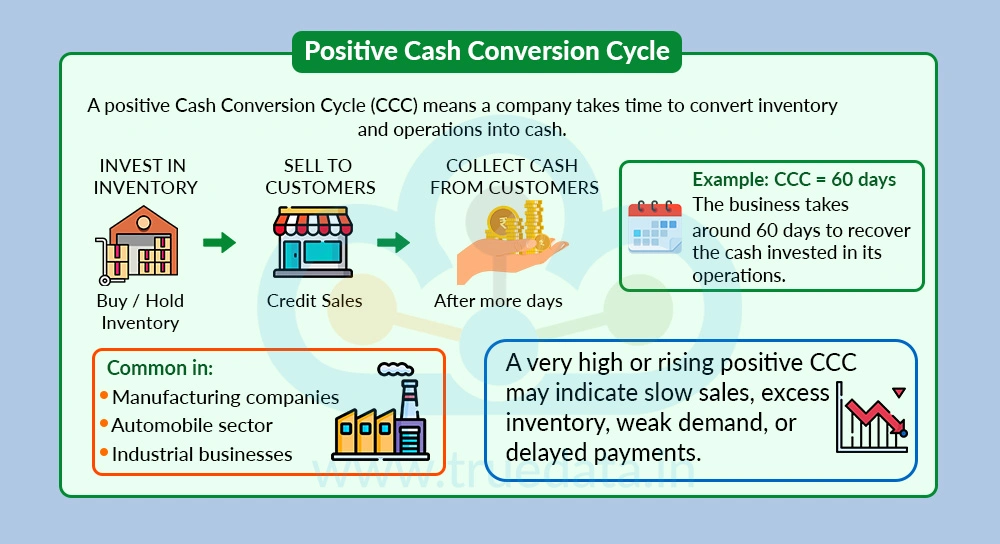
A positive Cash Conversion Cycle (CCC) means a company takes time to convert its investment in inventory and operations back into actual cash. During this period, the company’s cash remains tied up in inventory and receivables. For example, if a company has a CCC of 60 days, it means the business takes around 60 days to recover the cash invested in its operations. Most manufacturing, automobile, and industrial companies usually operate with a positive cash conversion cycle because production, inventory management, and customer collections naturally take time.
A positive CCC is not necessarily bad. In many industries, it is completely normal. However, investors generally prefer companies with a lower positive CCC because it indicates faster inventory turnover, quicker customer collections, and better working capital efficiency. If the positive CCC becomes very high or keeps increasing continuously, it may indicate slow sales, excess inventory, weak demand, or delayed customer payments.

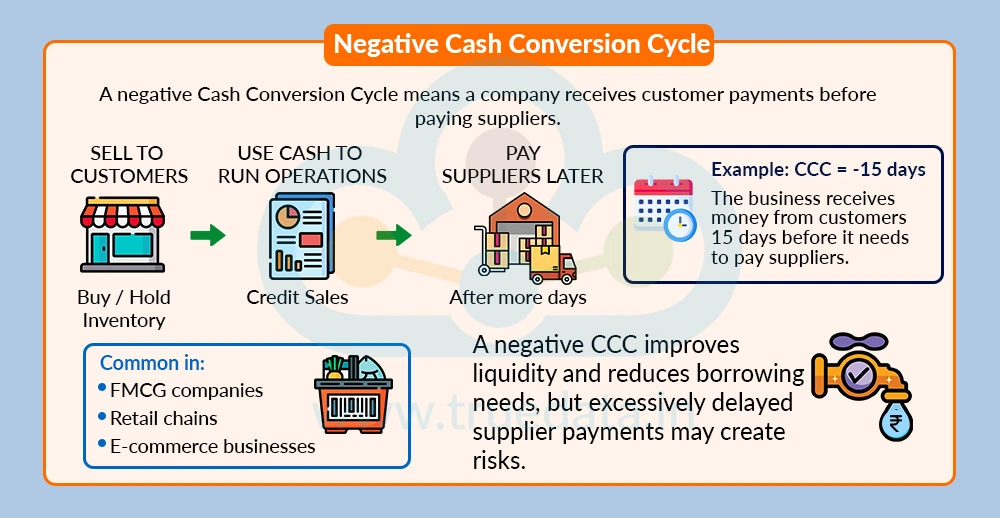
A negative Cash Conversion Cycle occurs when a company receives cash from customers before it has to pay its suppliers. This creates a situation where the company can run operations using supplier credit instead of its own cash. For example, if a company has a CCC of -15 days, it means the business receives money from customers 15 days before it needs to pay suppliers. This is often considered a very strong sign of operational efficiency and cash flow management.
Large FMCG companies, supermarkets, e-commerce businesses, and retail chains sometimes achieve negative CCCs because products sell quickly and customers usually pay immediately, while suppliers are paid later. Businesses with strong brand power and bargaining strength are more likely to maintain negative cash conversion cycles. A negative CCC can improve liquidity, reduce dependence on short-term borrowing, and strengthen overall financial stability. However, investors should still analyse the business carefully because an extremely stretched payment cycle to suppliers may sometimes affect supplier relationships or indicate aggressive working capital practices.

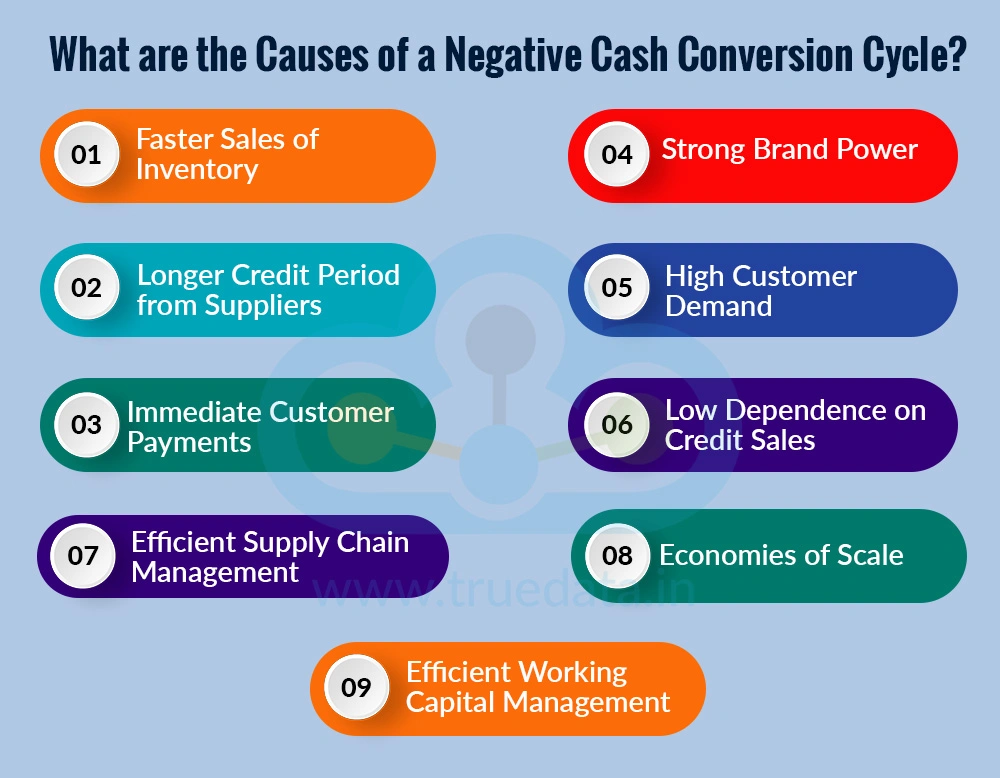
A negative cash conversion cycle may be rare, but it is the ideal scenario for a business. The reasons or causes of a negative CCC are explained below.
Faster Sales of Inventory - One of the biggest reasons for a negative Cash Conversion Cycle is rapid inventory turnover. When products are sold very quickly, cash enters the business faster. Companies dealing in daily-use products such as FMCG items, groceries, etc. often experience this advantage because demand remains steady and products do not stay in warehouses for long.
Longer Credit Period from Suppliers - Some companies have strong bargaining power and can negotiate longer payment periods with suppliers. This allows the business to delay payments for raw materials or inventory while continuing to generate sales and collect cash from customers. Large and established companies often enjoy better supplier credit terms because of their market position and scale.
Immediate Customer Payments - Businesses that receive payments instantly or within a very short period can achieve a negative CCC more easily. Retail stores, supermarkets, restaurants, and e-commerce companies usually collect money immediately through cash, UPI, cards, or online payments. Since customers pay upfront, the company receives cash before supplier payments become due.
Efficient Supply Chain Management - Companies with highly efficient logistics, inventory management, and distribution systems can reduce the time products spend in storage. Faster movement of goods from production to customers helps improve cash flow and shortens the operating cycle.
Strong Brand Power - Well-known brands usually experience higher customer demand and faster sales. Their strong market presence also gives them better negotiating power with suppliers. As a result, these companies can collect cash quickly while delaying supplier payments, contributing to a negative cash conversion cycle.
High Customer Demand - When demand for products remains consistently strong, inventory gets sold quickly, and cash collections improve. Companies selling essential products or popular consumer brands often benefit from continuous sales, helping them maintain negative CCCs.
Low Dependence on Credit Sales - Businesses that mainly operate on cash sales or advance payments are more likely to maintain a negative CCC. Since they do not have to wait long for customer payments, cash enters the business much faster. This is common in sectors such as retail, hospitality, and online commerce.
Economies of Scale - Large companies often benefit from economies of scale, which improve operational efficiency and bargaining power. Their ability to buy in bulk, negotiate better supplier terms, and maintain faster sales cycles can contribute to a sustainable negative CCC.
Efficient Working Capital Management - Strong financial discipline and proper management of receivables, inventory, and payables play a major role in achieving a negative CCC. Companies that closely monitor their working capital requirements can optimise cash flow and reduce unnecessary cash blockage.

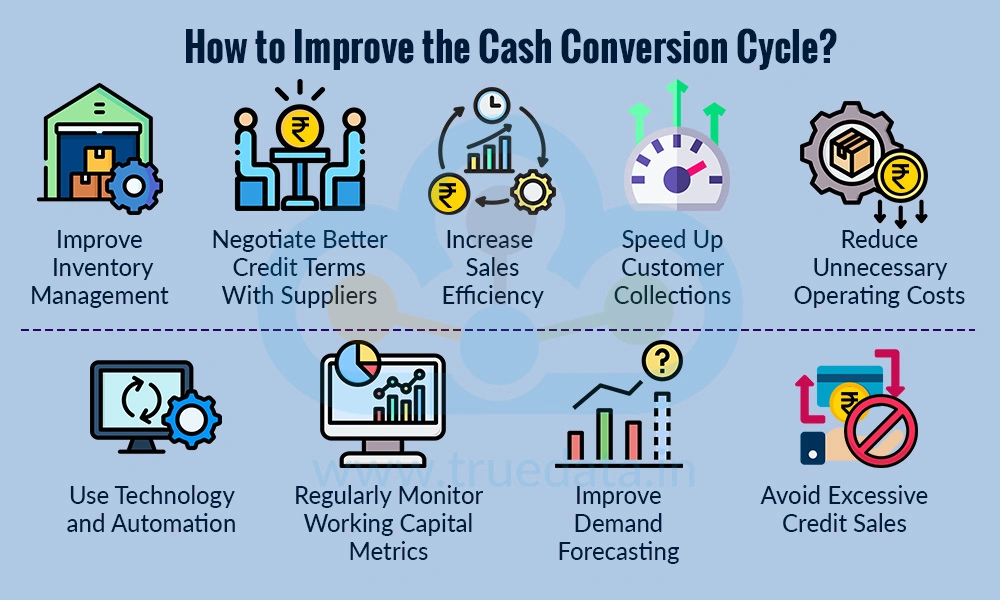
A lengthy Cash Conversion Cycle (CCC) can be detrimental to a business. Therefore, it is important to take measures to improve it and shorten the cycle to improve business efficiency. The steps to improve the Cash Conversion Cycle are mentioned below.
Improve Inventory Management - One of the most effective ways to improve the Cash Conversion Cycle (CCC) is by managing inventory efficiently. Companies should avoid holding excess stock for long periods because unsold inventory blocks cash and increases storage costs. Businesses can improve inventory turnover by better demand forecasting, efficient production planning, and maintaining optimal stock levels. Faster inventory movement helps the company recover cash more quickly and improves operational efficiency.
Negotiate Better Credit Terms With Suppliers - Companies can improve their cash conversion cycle by negotiating longer payment periods with suppliers. This gives the business more time to use its cash before making payments. Large and financially strong companies often have better bargaining power to secure favourable supplier credit terms. However, businesses must maintain healthy supplier relationships and avoid excessive delays that may affect trust or future supply arrangements.
Increase Sales Efficiency - Improving sales efficiency can also help reduce the cash conversion cycle. Businesses that sell products faster can convert inventory into cash more quickly. Companies can achieve this through better marketing strategies, stronger distribution networks, attractive pricing, and improved customer service. Strong product demand usually supports faster inventory turnover and healthier cash flow.
Speed Up Customer Collections - Reducing the time taken to collect payments from customers can significantly improve the CCC. Companies can encourage faster collections by offering digital payment options, sending timely invoices, and following up regularly on outstanding payments. Some businesses also provide small discounts for early payments. Faster receivable collections improve cash flow and reduce the risk of bad debts.
Reduce Unnecessary Operating Costs - Controlling unnecessary expenses can help businesses preserve cash and improve liquidity. Efficient cost management allows companies to maintain smoother operations without putting excessive pressure on working capital. Lower operational inefficiencies also reduce the need for short-term borrowing to fund daily business activities.
Use Technology and Automation - Modern technology can greatly improve working capital management. Businesses can use inventory management software, automated billing systems, digital payment tracking, and data analytics to monitor inventory and receivables more efficiently. Automation reduces delays, improves accuracy, and helps management make quicker business decisions. Many companies are increasingly adopting digital systems to strengthen operational efficiency and cash flow management.
Regularly Monitor Working Capital Metrics - Businesses should continuously monitor important working capital indicators such as inventory days, receivable days, and payable days. Regular tracking helps management identify inefficiencies early and take corrective action before problems become serious. Investors often prefer companies that consistently improve their working capital efficiency over time.
Improve Demand Forecasting - Accurate forecasting helps companies plan production and inventory levels more efficiently. Poor forecasting can lead to overproduction, excess inventory, or stock shortages. Better demand prediction allows businesses to maintain balanced inventory levels and improve cash flow management over the long term.
Avoid Excessive Credit Sales - While offering credit to customers can help increase sales, excessive credit periods may delay cash inflows. Companies should maintain a balanced credit policy and carefully evaluate customer payment behaviour before extending long credit terms. Efficient credit management reduces delayed collections and improves cash availability.
The Cash Conversion Cycle (CCC) is an important metric that helps investors understand how efficiently a company manages its inventory, receivables, and cash flow. It goes beyond just profits and provides deeper insights into the operational strength and financial health of a business. A shorter or improving CCC often indicates efficient working capital management, stronger liquidity, and better business efficiency, while a consistently high CCC may point to operational challenges. However, the ideal cash conversion cycle can vary across industries. Therefore, investors should always compare companies within the same sector. Analysing the CCC along with other financial metrics helps investors gain a clearer picture of a company’s ability to generate cash, manage operations smoothly, and sustain long-term growth.
This article is yet another addition to our series on understanding fundamental analysis ratios. Let us know your thoughts on the topic or if you need further information on the same, and we will address it soon.
TIll then, Happy Reading!
Read More: Working Capital Cycle - All you need to know
Thestock market never stands still, and prices swing constantly with every new h...
When analysing companies, investors often focus on metrics such as profits, valu...
Corporate data is more than just the numbers of a company. They can show what is...