Corporate Data

Understanding Inventory Turnover and Inventory Days

Marisha Bhatt · 30 Apr 2026 · 18 mins read · 0 Comments

understanding-inventory-turnover-and-inventory-days

Think of company financial analysis like exploring a deep ocean where there is always more beneath the surface. While financial statements and key ratios often get all the attention, one critical factor that can quietly shape a company’s profitability is often overlooked, i.e., inventory management. The ability of a company to efficiently manage its inventory can directly impact its cash flow, costs, and ultimately, its profits. This is where the inventory turnover ratio and inventory days come into play. These simple yet powerful metrics reveal a business’s efficiency in managing its stock and how quickly it turns inventory into sales. Dive into this blog to learn all about these ratios and their importance in financial analysis. 

What is Inventory Turnover?

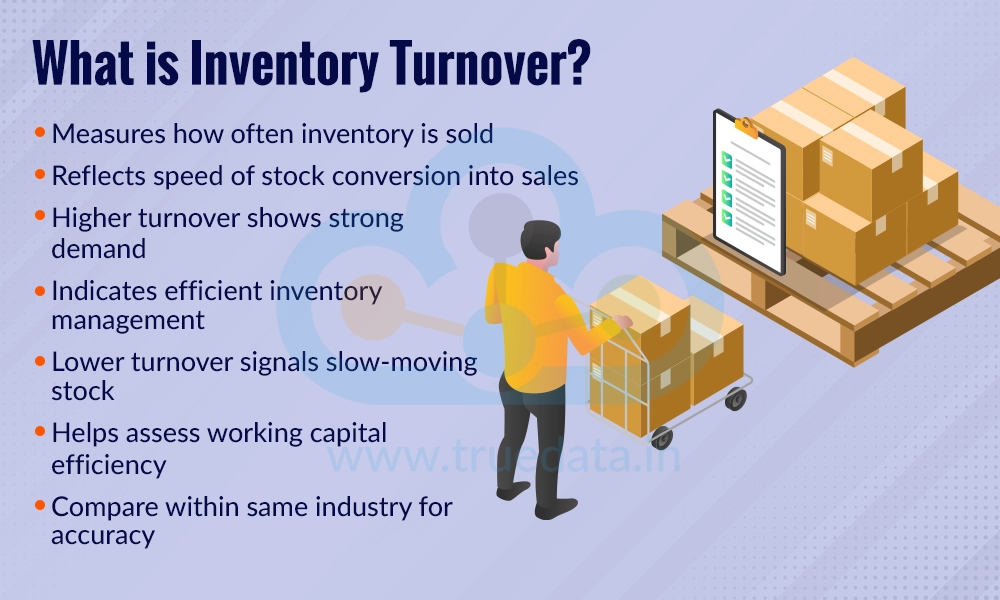
What is Inventory Turnover

Inventory turnover is a financial ratio that shows how many times a company sells and replaces its stock (inventory) over a certain period, usually a year. It tells how quickly a business is able to convert its inventory into sales. A higher inventory turnover means the company is selling its products fast, which is generally a good sign of strong demand and efficient operations. On the other hand, a lower turnover may indicate slow sales, excess stock, or poor inventory management. This ratio helps assess how well a company is managing its working capital and whether its products are in demand. However, it should always be compared with other companies in the same industry, as ideal turnover levels can vary across sectors like FMCG, retail, or automobiles.

How to Calculate Inventory Turnover?

The inventory turnover ratio can be calculated using more than one formula (depending on the data available) to gain insights into inventory management. These ratios and their calculations are explained below.

  1. Inventory Turnover Using Cost of Goods Sold (COGS)

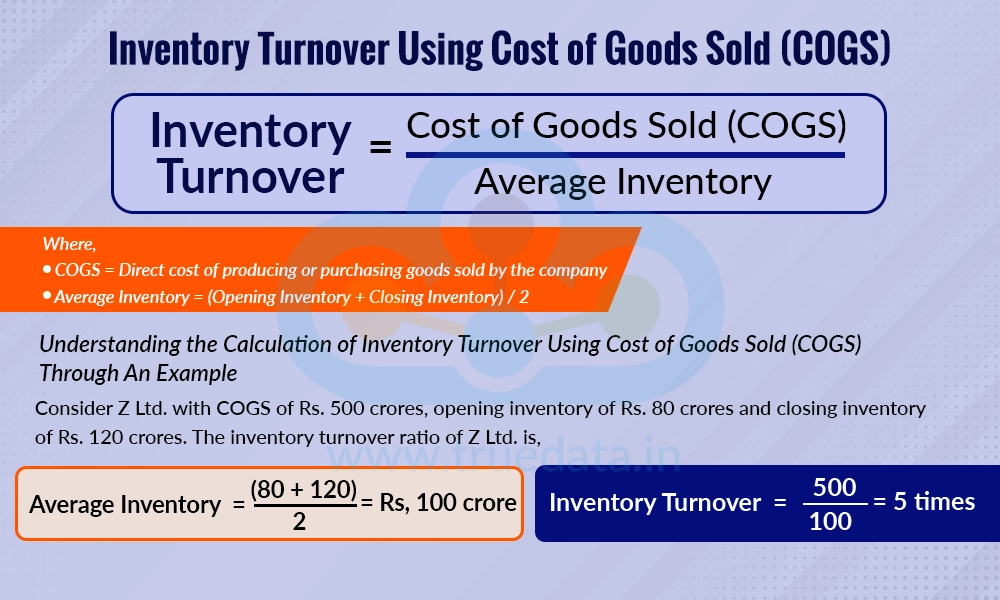
Inventory Turnover Using Cost of Goods Sold (COGS)

This is the most accurate and widely used formula as it considers the actual cost of products sold, not the selling price. The formula to calculate the Inventory Turnover Ratio using COGS is,

Inventory Turnover = Cost of Goods Sold (COGS) / Average Inventory

Where,

  • COGS = Direct cost of producing or purchasing goods sold by the company

  • Average Inventory = (Opening Inventory + Closing Inventory) / 2

Understanding the Calculation of Inventory Turnover Using Cost of Goods Sold (COGS) Through An Example

Consider Z Ltd. with COGS of Rs. 500 crores, opening inventory of Rs. 80 crores and closing inventory of Rs. 120 crores. The inventory turnover ratio of Z Ltd. is,

Average Inventory = (80 + 120) / 2 = Rs, 100 crore

Inventory Turnover = Cost of Goods Sold (COGS) / Average Inventory

Inventory Turnover = 500 / 100 = 5 times

Thus, the company sold and replaced its inventory 5 times in a year.

  1. Inventory Turnover Using Sales 

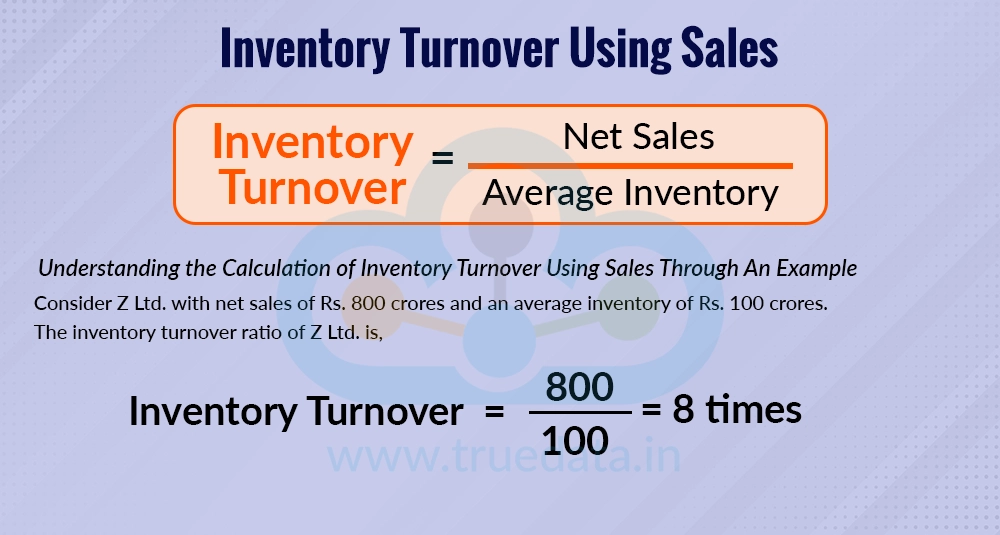
Inventory Turnover Using Sales 

This method uses sales instead of cost, which is easier to calculate (especially for beginners). However, it is slightly less accurate as sales include profit margins too. The formula to calculate the inventory turnover ratio in this case is,

Inventory Turnover = Net Sales / Average Inventory 

Understanding the Calculation of Inventory Turnover Using Sales Through An Example

Consider Z Ltd. with net sales of Rs. 800 crores and an average inventory of Rs. 100 crores. The inventory turnover ratio of Z Ltd. is,

Inventory Turnover = Net Sales / Average Inventory 

Inventory Turnover = 800 / 100 = 8 times

This looks higher than the COGS method, as sales include profit. Hence, it is prudent to usually prefer the COGS-based formula.

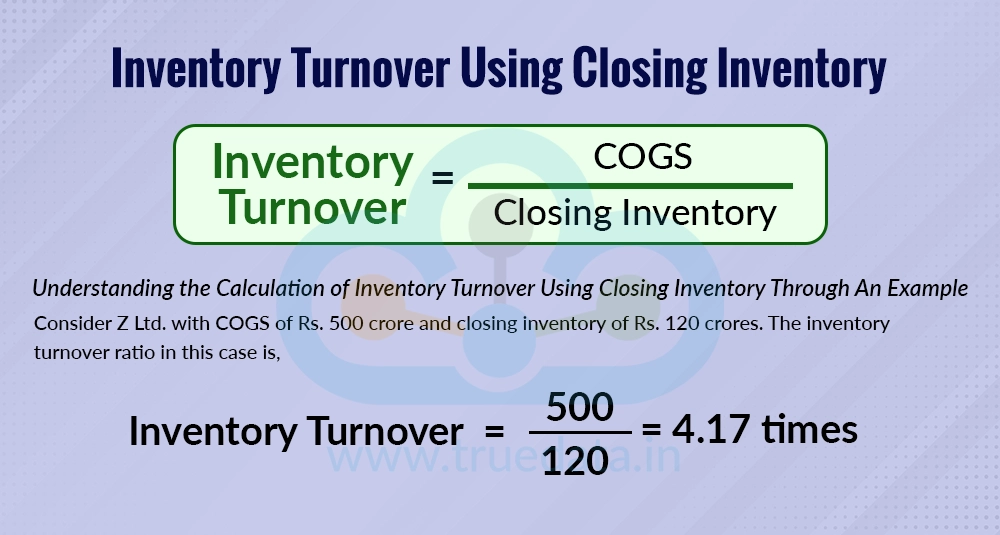
  1. Inventory Turnover Using Closing Inventory 

Inventory Turnover Using Closing Inventory 

This is a quick or shortcut version for calculating the inventory turnover ratio when opening inventory is not available. However, it may not be as reliable. The formula to calculate the inventory turnover ratio using the closing inventory is,

Inventory Turnover = COGS / Closing Inventory

Understanding the Calculation of Inventory Turnover Using Closing Inventory Through An Example

Consider Z Ltd. with COGS of Rs. 500 crore and closing inventory of Rs. 120 crores. The inventory turnover ratio in this case is, 

Inventory Turnover = COGS / Closing Inventory

Inventory Turnover = 500/120 = 4.17 times

This gives investors a rough idea of the inventory management, however, it may be slightly misleading if inventory levels changed a lot during the year.

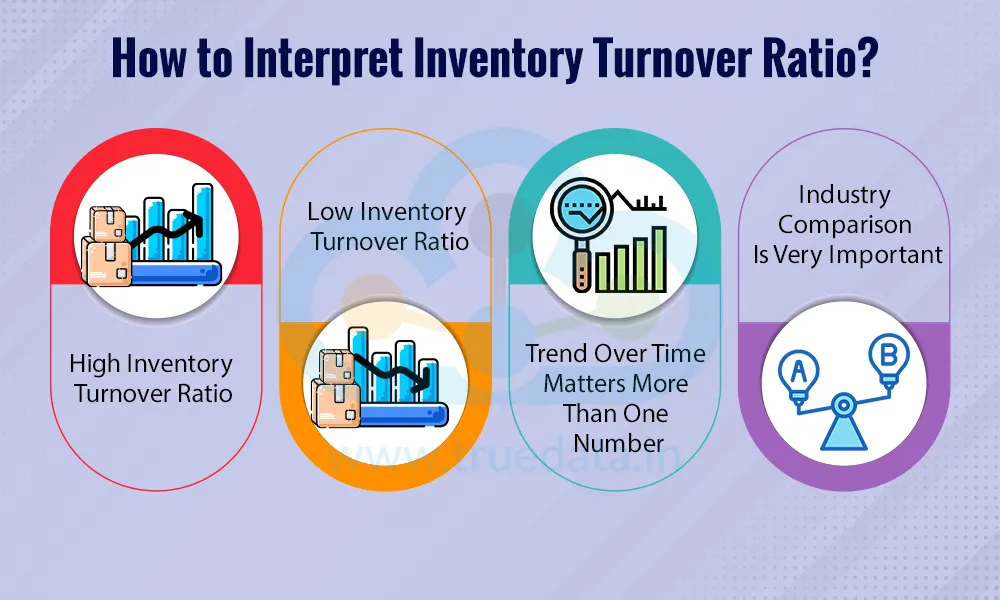
How to Interpret Inventory Turnover Ratio?

How to Interpret Inventory Turnover Ratio

Understanding the inventory turnover ratio is not just about knowing the number. It is more about knowing what that number says about a company’s business performance. The inventory turnover ratio shows how many times a company sells and replaces its stock in a given period. It tells investors how fast the company is able to sell its products. A higher number generally means the company is selling quickly, while a lower number suggests that products are moving slowly. This makes it an important indicator of business efficiency and demand.

High Inventory Turnover Ratio

A high inventory turnover usually indicates that the company is selling its goods quickly. This can be a positive sign as, 

  • It shows strong customer demand

  • The company is managing inventory efficiently

  • Less money is stuck in unsold stock

For example, FMCG companies often have high inventory turnover as their goods sell quickly.

On the other hand, a very high turnover can sometimes also indicate the following,

  • The company is not keeping enough stock

  • It may lose sales due to stock shortages

Therefore, while a high inventory turnover ratio is good, an extremely high ratio may also need attention.

Low Inventory Turnover Ratio

A low inventory turnover indicates that the company is taking longer to sell its inventory. This could be due to the following factors,

  • Weak demand for products

  • Excess or outdated stock

  • Poor inventory management

This can also be a warning sign of the following,

  • Funds are stuck in inventory

  • There may be higher storage and holding costs

  • Risk of losses if products become obsolete

However, in some industries like automobiles or heavy machinery, lower turnover is normal as products are expensive and take longer to sell.

Trend Over Time Matters More Than One Number

Looking at inventory turnover for just one year does not give the full picture. It is better to track the trend over several years to understand how a company is performing. If the turnover is increasing, it usually means better sales and improved efficiency, while a decreasing trend may signal slowing demand or excess inventory. A consistent improvement over time is, therefore, usually considered a positive sign for long-term investment decisions.

Industry Comparison Is Very Important

Inventory turnover differs across industries, so comparing companies from different sectors can give wrong conclusions. For example, FMCG and retail businesses usually have high turnover because they sell goods quickly, while automobile and capital goods companies have lower turnover due to slower sales cycles. As an investor, it is important to compare a company’s inventory turnover only with similar companies in the same industry to get a clear and fair understanding of its performance.

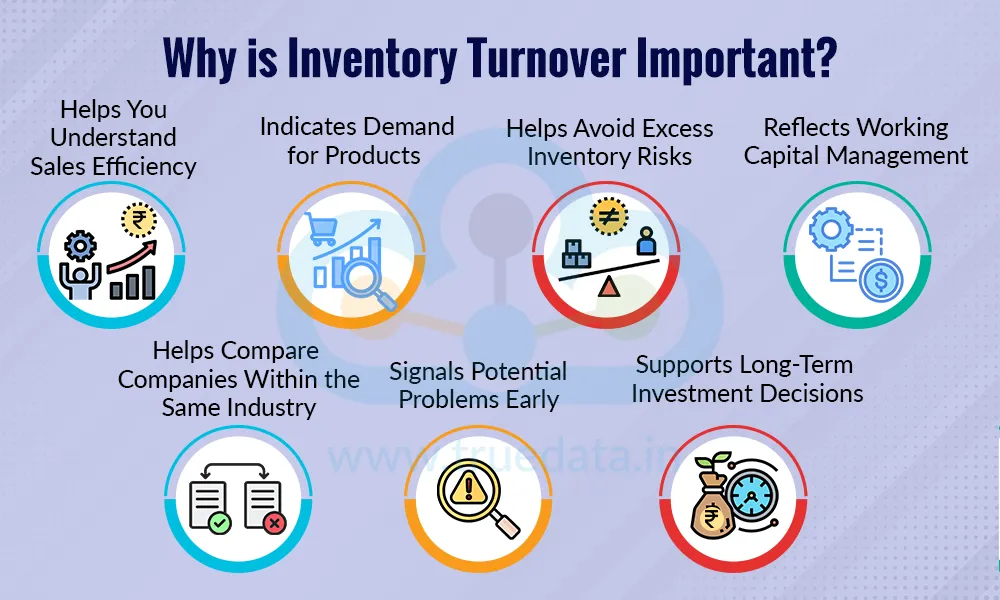
Why is Inventory Turnover Important?

Why is Inventory Turnover Important

The importance of the inventory turnover ratio is explained hereunder. 

  • Helps Understand Sales Efficiency - Inventory turnover shows how quickly a company is able to sell its products. A higher turnover means the company is selling goods faster, which usually indicates strong demand and efficient operations. This helps investors in identifying companies that are good at converting their inventory into sales without unnecessary delays.

  • Indicates Demand for Products - This ratio gives a clear idea about how well a company’s products are performing in the market. If inventory turnover is high, it often means customers are buying regularly. On the other hand, a low turnover may suggest weak demand or outdated products. This insight is important for investors to judge whether the business has a strong market presence.

  • Helps Avoid Excess Inventory Risks - Holding too much inventory can be risky for companies. It can lead to higher storage costs, damage, or even obsolescence (especially in industries like electronics or fashion). A healthy inventory turnover shows that the company is managing its stock efficiently and not overstocking, which is a positive sign for investors.

  • Reflects Working Capital Management - Inventory is a major part of a company’s working capital. If inventory moves quickly, cash is not stuck in unsold goods and can be used for other business needs. Efficient inventory turnover indicates better cash flow management, which is crucial for the financial health of any company.

  • Helps Compare Companies Within the Same Industry - Inventory turnover is very useful when comparing companies in the same sector. It helps investors identify which company is operating more efficiently. For example, among FMCG companies, a higher turnover can signal better supply chain management and stronger sales.

  • Signals Potential Problems Early - A declining inventory turnover over time can be an early warning sign. It may indicate slowing sales, poor demand, or inefficient inventory management. By tracking this ratio regularly, investors can spot issues early and make better investment decisions.

  • Supports Long-Term Investment Decisions - A consistent and stable inventory turnover is a positive sign for long-term investors. It shows that the company has steady demand, good management practices, and efficient operations. Such companies are often better positioned for sustainable growth over time.

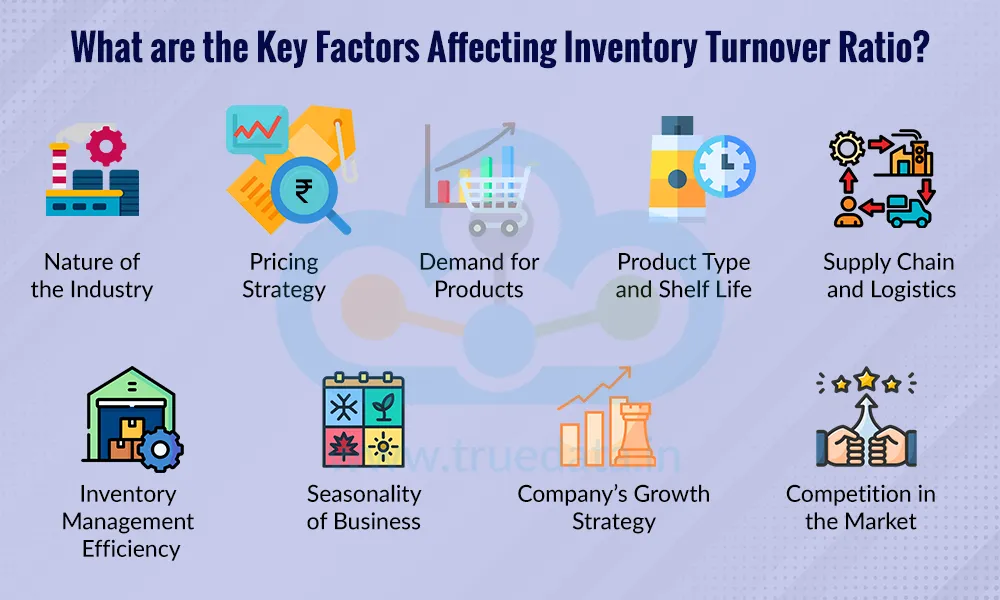
What are the Key Factors Affecting Inventory Turnover Ratio?

What are the Key Factors Affecting Inventory Turnover Ratio

Inventory management can be influenced by a number of factors that can contribute to an improving or declining ratio. These factors include,

  • Nature of the Industry - Inventory turnover varies a lot depending on the type of business. Companies in FMCG or retail sell products quickly, so they usually have high turnover. On the other hand, industries like automobiles or capital goods have longer production and sales cycles, leading to lower turnover. It is important to judge inventory turnover based on the industry the company operates in.

  • Pricing Strategy - The pricing strategy of a company for its products also affects inventory turnover. Competitive pricing can boost sales and increase turnover, while very high prices may slow down sales. Discounts, offers, and seasonal pricing strategies can also impact how quickly inventory is cleared. Investors should check whether sales growth is coming from healthy pricing or heavy discounting.

  • Demand for Products - Customer demand plays a major role in how fast inventory is sold. If a company’s products are popular and in high demand, inventory moves quickly, resulting in a higher turnover ratio. However, if demand is weak or declining, goods remain unsold for longer, reducing the turnover. This factor helps investors understand how well a company’s products are accepted in the market.

  • Product Type and Shelf Life - Products with a short shelf life, like food or pharmaceuticals, need to be sold quickly, leading to higher turnover. In contrast, durable goods like machinery or furniture take longer to sell, resulting in lower turnover. Understanding the type of products a company deals in helps investors interpret the ratio correctly.

  • Supply Chain and Logistics - A strong supply chain helps companies restock quickly and deliver products on time. If logistics are smooth, companies can operate with lower inventory levels and still meet demand, improving turnover. Poor supply chain systems can lead to delays, excess stock, or stock shortages, negatively affecting the ratio.

  • Inventory Management Efficiency - Efficient inventory management ensures that the company maintains the right level of stock. Companies that use better planning, forecasting, and supply chain systems can avoid overstocking or understocking. Good inventory control leads to faster movement of goods and higher turnover, which is a positive signal for investors.

  • Seasonality of Business - Some businesses experience seasonal demand. For example, companies selling festive items, air conditioners, or agricultural products may see higher sales during specific periods. This can cause fluctuations in inventory turnover throughout the year. Investors should look at yearly trends instead of short-term changes to get a clear picture.

  • Company’s Growth Strategy - A company planning for expansion may increase inventory levels in advance to meet future demand. This can temporarily reduce inventory turnover even if the business is growing well. Similarly, entering new markets or launching new products can impact inventory levels. Investors should consider the company’s strategy before drawing suitable conclusions.

  • Competition in the Market - High competition can affect how quickly a company sells its products. If many competitors offer similar products, companies may face slower sales or may need to reduce prices to clear inventory. Strong competitive positioning, brand value, and customer loyalty can help maintain a healthy inventory turnover.

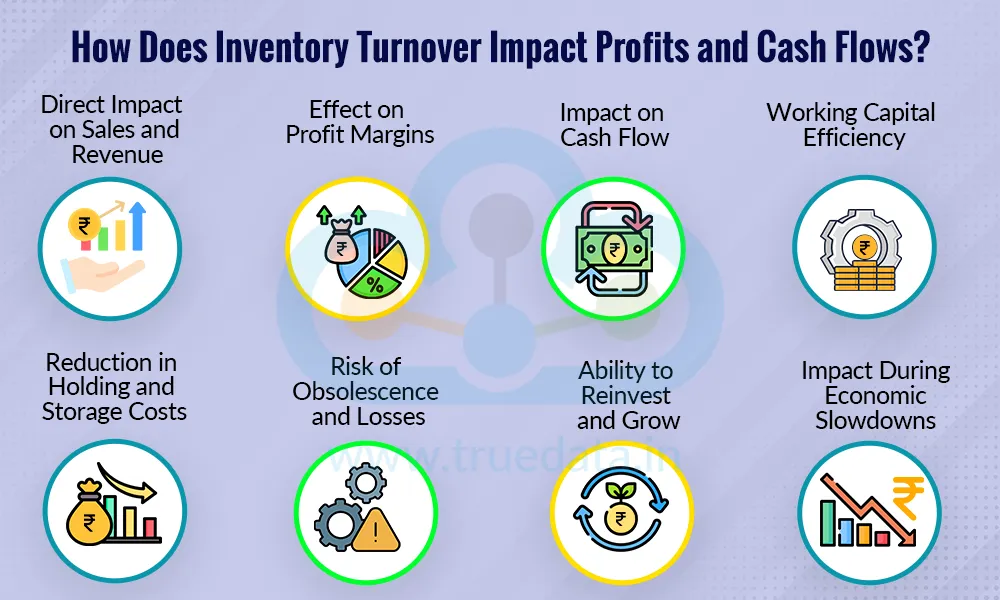
How Does Inventory Turnover Impact Profits and Cash Flows?

How Does Inventory Turnover Impact Profits and Cash Flows

At the beginning of this article, we highlighted that a company’s inventory management can have a direct impact on its profits and cash flows. This impact is explained hereunder.

Direct Impact on Sales and Revenue

Inventory turnover has a strong connection with a company’s sales. When inventory moves quickly, it means products are being sold regularly, leading to higher revenue. Faster sales cycles allow the company to sell more within the same period, which can improve overall income. A healthy turnover ratio often indicates that the business can generate steady and growing sales.

Effect on Profit Margins

Efficient inventory turnover can help improve profit margins. When goods are sold quickly, companies avoid heavy discounting, storage costs, and losses from outdated stock. This helps in maintaining better pricing power and profitability. On the other hand, slow-moving inventory may force companies to offer discounts or write off unsold goods, which reduces profits.

Impact on Cash Flow

Inventory directly affects cash flow because money is tied up in stock. When inventory turnover is high, goods are sold faster, and cash comes back into the business quickly. This improves liquidity and allows the company to use cash for operations, expansion, or debt repayment. Low turnover means cash is stuck in unsold inventory, which can create cash flow problems even if the company shows paper profits.

Working Capital Efficiency

Inventory is a key part of working capital. Companies with higher inventory turnover need less working capital because they do not have to hold large amounts of stock. This improves efficiency and reduces the need for borrowing. For investors, this is a positive sign as it shows the company is using its resources wisely and managing its operations efficiently.

Reduction in Holding and Storage Costs

Holding inventory comes with costs such as warehousing, insurance, maintenance, and risk of damage. When inventory turnover is high, products spend less time in storage, reducing these costs. Lower expenses directly support higher profitability. In contrast, slow-moving inventory increases these costs and puts pressure on margins.

Risk of Obsolescence and Losses

Certain industries, like electronics, fashion, or technology, face the risk of products becoming outdated quickly. A higher inventory turnover reduces this risk because goods are sold before they lose value. However, low turnover increases the chances of obsolete stock, leading to write-offs and losses that negatively impact profits.

Ability to Reinvest and Grow

When a company generates cash quickly through fast inventory turnover, it can reinvest that cash into the business. This could include expanding operations, launching new products, or improving infrastructure. Strong cash flow supports long-term growth and creates value for investors.

Impact During Economic Slowdowns

During periods of weak demand, companies with low inventory turnover may struggle more. Unsold inventory piles up, cash flow tightens, and profits decline due to discounting or write-offs. In contrast, companies with efficient inventory management are better positioned to handle such situations, as they maintain healthier cash flows and lower inventory risks.

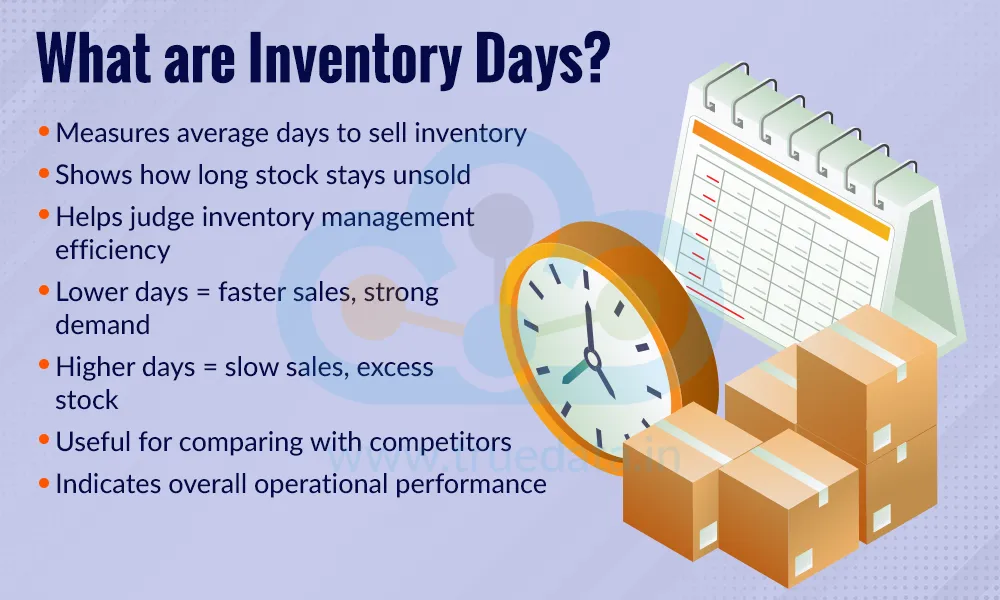
What are Inventory Days?

What are Inventory Days

Inventory Days, also known as Days Inventory Outstanding (DIO), is a measure that tells how many days a company takes, on average, to sell its entire inventory. It, thus, shows how long goods remain in stock before being sold. This helps investors understand how efficiently a company is managing its inventory. A lower number of inventory days means the company is selling its products quickly, which usually indicates strong demand and good inventory management. On the other hand, a higher number of inventory days suggests that products are staying in the warehouse for longer, which may point to slow sales, excess stock, or weak demand. This metric is especially useful when compared over time or with similar companies in the same industry, as it gives a clearer picture of a company’s operational efficiency and sales performance.

How to Calculate Inventory Days?

The calculation of inventory days can have various versions. These different formulas and relevant details are explained below. 

  1. Basic Formula

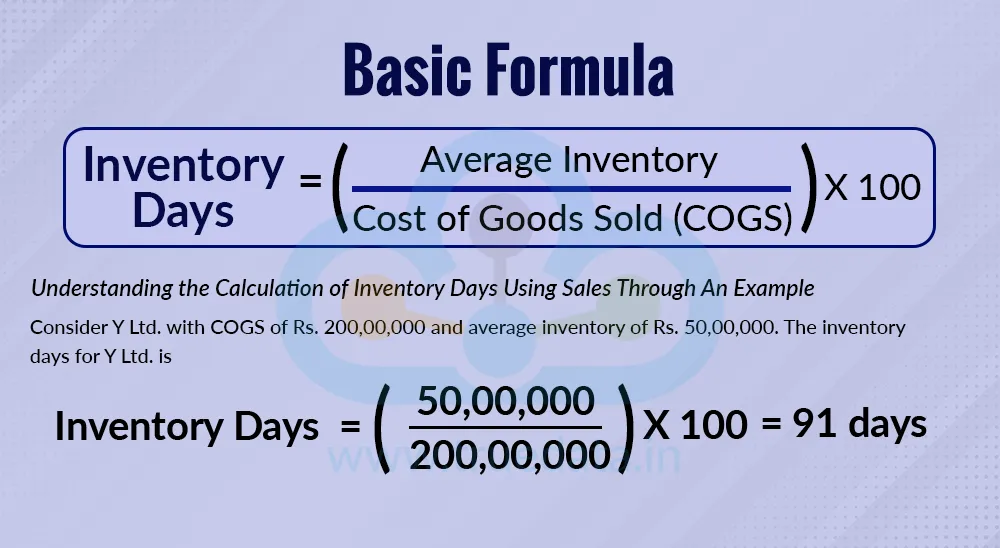
how-to-calculate-inventory-days-basic-formula

The basic formula to calculate inventory days includes two factors, i.e., average inventory and COGS. The formula to calculate inventory days using the basic formula is,

Inventory Days = (Average Inventory / Cost of Goods Sold) * 365

Understanding the Calculation of Inventory Days Using Sales Through An Example

Consider Y Ltd. with COGS of Rs. 200,00,000 and average inventory of Rs. 50,00,000. The inventory days for Y Ltd. is 

Inventory Days = (Average Inventory / Cost of Goods Sold) * 365

Inventory Days = (50,00,000 / 200,00,000) * 365 = 91 days

Thus, the company takes 91 days to sell the inventory. 

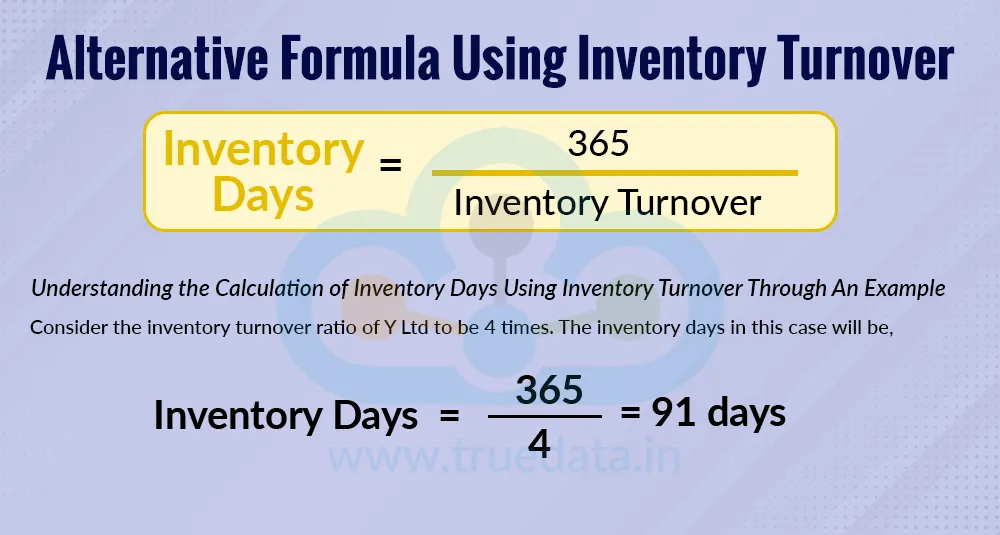
  1. Alternative Formula Using Inventory Turnover

Alternative Formula Using Inventory Turnover

An alternative formula to calculate inventory days is using the inventory turnover ratio. The formula to calculate inventory days in this case is,

Inventory Days = 365 / Inventory Turnover

Understanding the Calculation of Inventory Days Using Inventory Turnover Through An Example

Consider the inventory turnover ratio of Y Ltd to be 4 times. The inventory days in this case will be,

Inventory Days = 365 / Inventory Turnover

Inventory Days = 365 / 4 = 91 days

Thus, the result is the same even with a different approach.

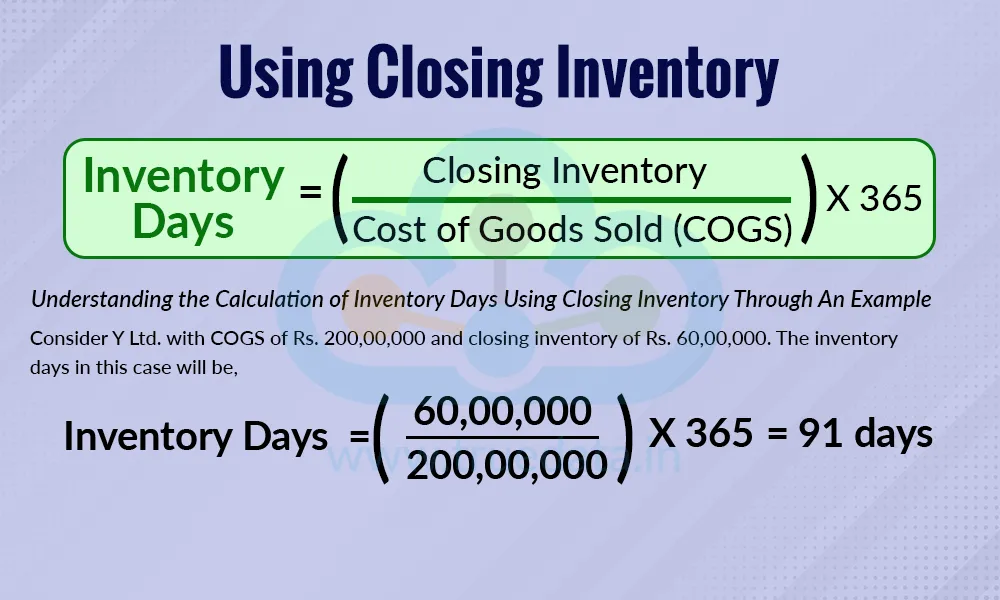
  1. Using Closing Inventory

Using Closing Inventory

Similar to calculating the inventory turnover ratio using the closing inventory, inventory days can also be calculated using the same parameter. The formula for the same is,

Inventory Days = (Closing Inventory / COGS) * 365

Understanding the Calculation of Inventory Days Using Closing Inventory Through An Example

Consider Y Ltd. with COGS of Rs. 200,00,000 and closing inventory of Rs. 60,00,000. The inventory days in this case will be,

Inventory Days = (Closing Inventory / COGS) * 365

Inventory Days = (60,00,000 / 200,00,000) * 365 = 109.5 days

This gives a different scenario and may be slightly inaccurate, as only the closing inventory is used. This may lead to a different interpretation, which may be misleading. Hence, it is prudent to use the average inventory rather than the closing inventory. 

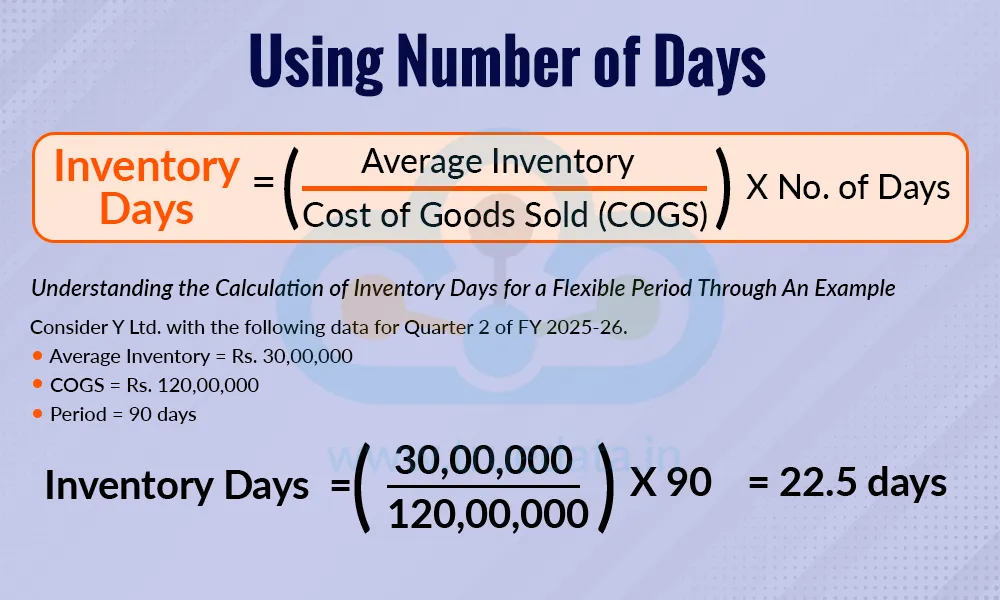
  1. Using Number of Days 

Using Number of Days 

The calculation of inventory days can also be done for a specified period (for example, a quarter or semi-annually). The period or the number of days considered in the formula will be adjusted in such cases according to the specified period. 

Inventory Days = (Average Inventory / COGS) * Number of Days

Understanding the Calculation of Inventory Days for a Flexible Period Through An Example

Consider Y Ltd. with the following data for Quarter 2 of FY 2025-26. 

  • Average Inventory = Rs. 30,00,000

  • COGS = Rs. 120,00,000

  • Period = 90 days

Inventory Days = (Average Inventory / COGS) * Number of Days

Inventory Days = (30,00,000 / 120,00,000) * 90 = 22.5 day

Thus, this formula allows investors and other stakeholders to analyse the data on a periodic basis for effective comparison and analysis. 

How to Interpret Inventory Days?

How to Interpret Inventory Days

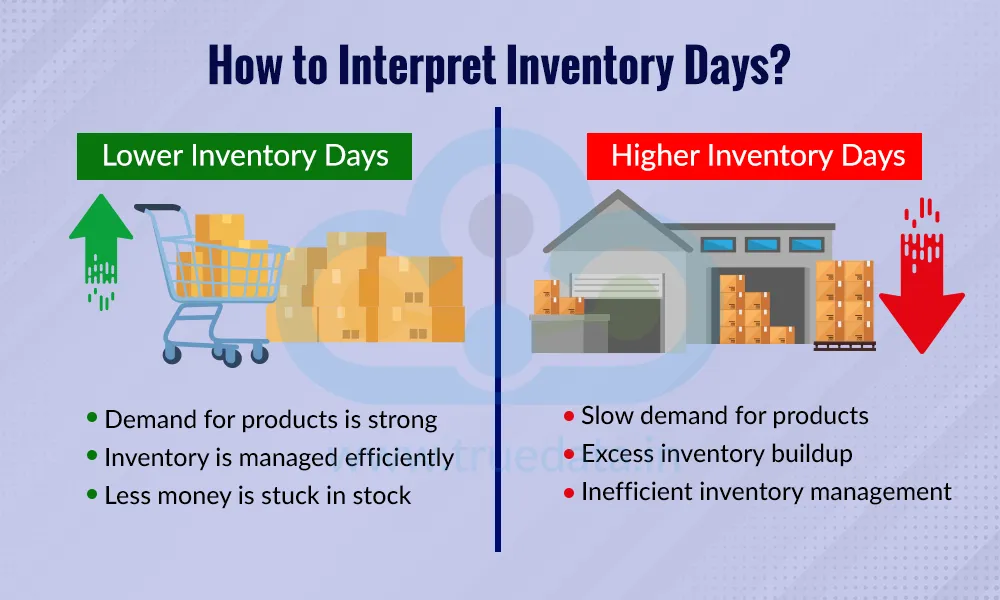
Inventory days (also called Days Inventory Outstanding or DIO) tell how many days a company takes to sell its inventory. It converts the inventory turnover ratio into a time-based measure, making it easier for investors to understand how quickly stock is moving. Interpreting inventory days correctly can give deep insights into a company’s efficiency, demand, and cash flow position.

Lower Inventory Days

When a company has low inventory days, it indicates that it is selling its products quickly. This is generally a positive sign as,

  • Demand for products is strong

  • Inventory is managed efficiently

  • Less money is stuck in stock

For example, FMCG companies usually have low inventory days because their products (like food or daily-use items) sell quickly. 

However, very low inventory days can sometimes also indicate,

  • The company is maintaining very low stock levels

  • It may face stock shortages and miss sales opportunities

Higher Inventory Days 

Higher inventory days indicate that the company is taking more time to sell its inventory. This may suggest, 

  • Slow demand for products

  • Excess inventory buildup

  • Inefficient inventory management

This can be concerning as,

  • Cash is blocked in unsold stock

  • Storage and holding costs increase

  • Risk of damage or obsolescence rises

In sectors like automobiles or heavy machinery, higher inventory days are normal because products are expensive and take longer to sell.

What are the Differences between the Inventory Turnover Ratio and the Inventory Days?

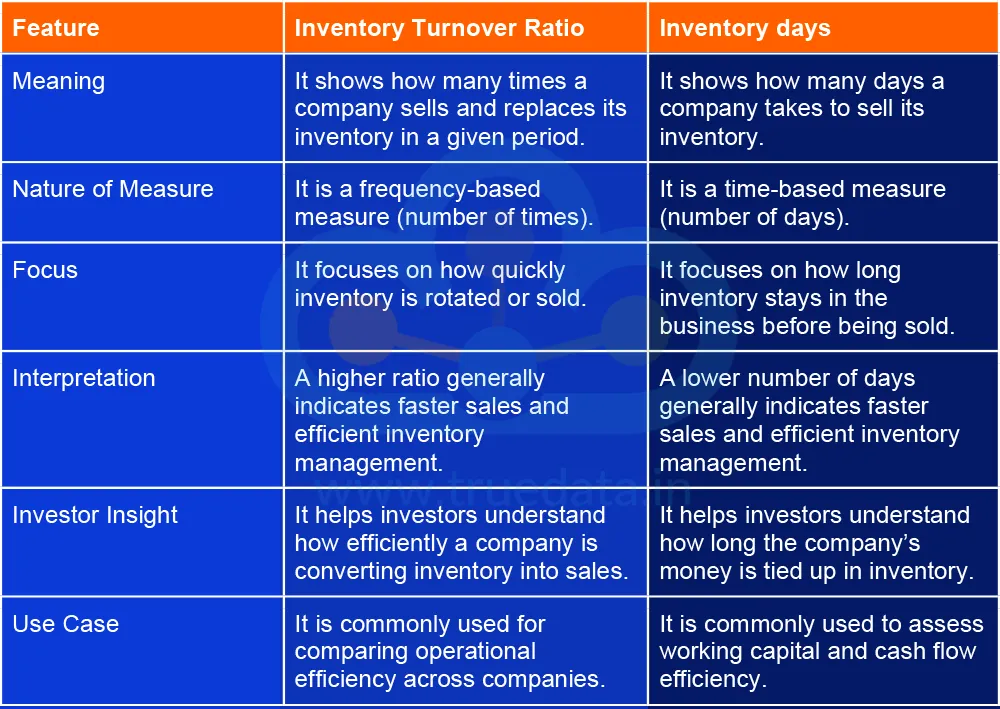
Inventory turnover ratio and inventory days use the same components, COGS and average inventory, for calculation. However, they are significantly different and provide different interpretations. The key differences between these ratios are tabled below. 

What are the Differences between the Inventory Turnover Ratio and the Inventory Days

Feature

Inventory Turnover Ratio 

Inventory days

Meaning

It shows how many times a company sells and replaces its inventory in a given period.

It shows how many days a company takes to sell its inventory.

Nature of Measure

It is a frequency-based measure (number of times).

It is a time-based measure (number of days).

Focus

It focuses on how quickly inventory is rotated or sold.

It focuses on how long inventory stays in the business before being sold.

Interpretation

A higher ratio generally indicates faster sales and efficient inventory management.

A lower number of days generally indicates faster sales and efficient inventory management.

Investor Insight

It helps investors understand how efficiently a company is converting inventory into sales.

It helps investors understand how long the company’s money is tied up in inventory.

Use Case

It is commonly used for comparing operational efficiency across companies.

It is commonly used to assess working capital and cash flow efficiency.

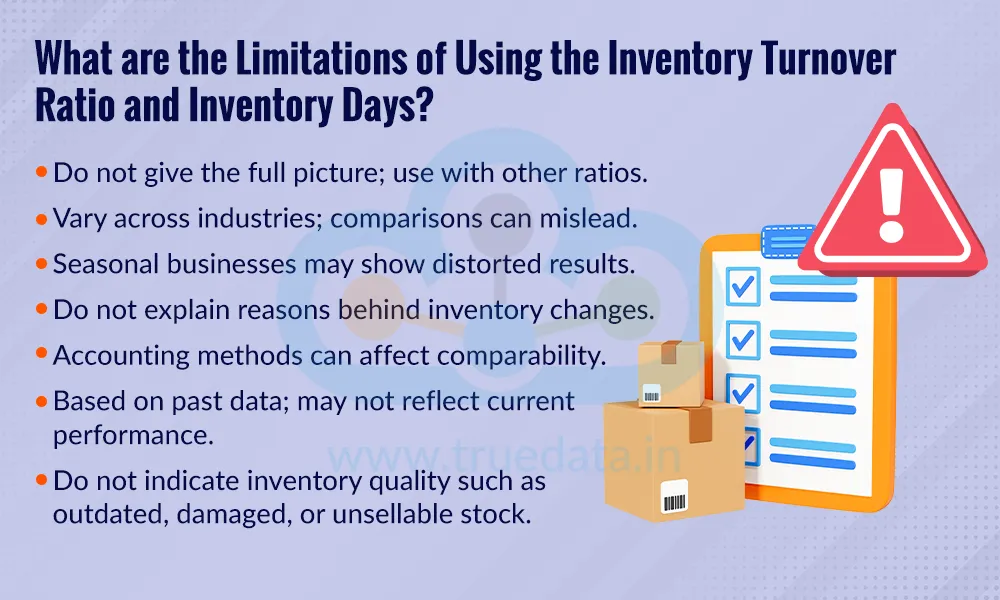
What are the Limitations of Using the Inventory Turnover Ratio and Inventory Days?

What are the Limitations of Using the Inventory Turnover Ratio and Inventory Days

While these ratios are used for inventory analysis and effective inventory management, they are not free from limitations. These limitations include,

  • They do not give the full picture on their own, so they should always be used along with other financial ratios.

  • These ratios can vary a lot across industries, so comparing companies from different sectors can give wrong conclusions.

  • Seasonal businesses (like festive or agricultural companies) may show misleading numbers at certain times of the year.

  • These ratios do not explain why inventory is high or low. Hence, the reason behind the numbers is not always clear.

  • Changes in accounting methods for inventory (like FIFO or weighted average) can affect the ratio and make comparisons difficult. 

  • They are based on past data, so they may not always reflect the current or future performance of the company.

  • These ratios do not show the quality of inventory, such as outdated, damaged, or unsellable stock.

Conclusion

The inventory turnover ratio and inventory days are simple yet powerful tools that help investors understand how efficiently a company manages and sells its stock. They give insights into demand, operational efficiency, cash flow, and profitability by showing how quickly inventory is converted into sales and how long it stays in the business. However, these ratios cannot be used in isolation and should be used as part of the overall fundamental analysis of an organisation. 

This article breaks down inventory ratios in detail and helps in understanding this crucial piece of the puzzle in financial analysis. Let us know your thoughts on the topic or if you need further information on the same, and we will address it soon. 

Till Then, Happy Reading!


Read More: Free Cash Flow Ratios Explained

Frequently Asked Questions

A good inventory turnover rate depends on the industry, but generally, a higher ratio than peers indicates better efficiency and strong demand. Investors should compare it with similar companies and look for a stable or improving trend over time.

Companies improve inventory turnover by better demand planning, reducing excess stock, and improving sales through pricing or marketing. They also manage supply chains efficiently to ensure the right products are available at the right time.

Inventory turnover and inventory days are inversely related, i.e., when turnover is high, inventory days are low, and vice versa. Thus, faster sales mean fewer days to sell stock.

Yes, low inventory turnover can be a red flag as it may indicate weak demand, excess stock, or poor management. However, investors should check the industry, as some sectors naturally have lower turnover.

Average inventory is used because it gives a more accurate picture of stock levels over the whole year, not just at one point in time. Ending inventory alone can be misleading if stock levels fluctuate during the year.

Inventory turnover helps companies understand how fast products are selling, so they can order the right quantity at the right time. This avoids overstocking and stock shortages, improving efficiency and sales.
Marisha Bhatt

Marisha Bhatt is a financial content writer @TrueData.
She writes with the sole aim of simplifying complex financial concepts and jargon while attempting to clarify technical and fundamental analysis concepts of the stock markets. The ultimate goal is to spread vital knowledge and benefit the maximum audience. Her Chartered Accountant background acts as the knowledge base to help clarify crucial concepts and create a sound investment portfolio.

0 Comments

Related Articles

SEE ALL
Corporate Data
Corporate Data
Investing Smarter: The Power of Corporate Data and Market Sentiment Analysis

Thestock market never stands still, and prices swing constantly with every new h...

Corporate Data
Corporate Data
Solvency and Leverage Ratios - Debt and Equity Ratios

Debt and equity together form the total capital of a company. However, when anal...

Corporate Data
Corporate Data
Liquidity Ratios - Quick Ratio and Cash Ratio

Liquidity ratios tell us how comfortably a company can meet its short-term oblig...