Corporate Data

Working Capital Turnover Ratio - What is it and How to Use it?

Marisha Bhatt · 14 May 2026 · 7 mins read · 2 Comments

working-capital-turnover-ratio-what-is-it-and-how-to-use-it

Ratio analysis is a key part of fundamental analysis, helping investors understand how efficiently a company is performing. While most investors focus on popular metrics like profitability and solvency ratios, efficiency ratios often do not get the attention they deserve. However, these ratios play a crucial role in evaluating how well a business uses its resources to generate revenue. One such important metric is the working capital turnover ratio. Think of working capital as the wheels that keep a business moving smoothly. If it is not managed well, even a profitable company can face challenges. This ratio helps investors understand how effectively a company is using its working capital to drive sales. Curious to know how it works and why it matters? Let’s break it down and take your fundamental analysis skills a step further.

What is the Working Capital Turnover Ratio?

What is the Working Capital Turnover Ratio

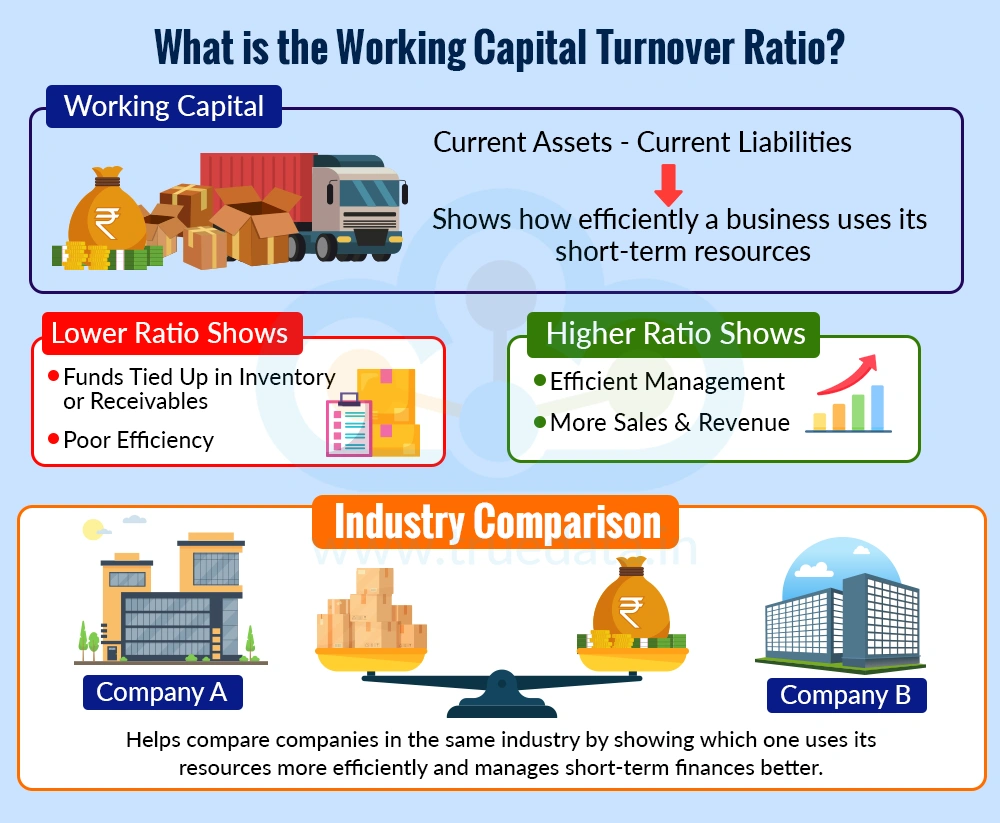
The Working Capital Turnover Ratio is an efficiency ratio that indicates the business’s efficiency in using its short-term resources, like cash, inventory, and receivables, to run the day-to-day operations and generate revenue. Thus, it shows how well a company is using its working capital (current assets minus current liabilities) to generate sales. While there is no standard working capital turnover ratio, and it can vary across industries, a higher ratio generally means the company is using its working capital efficiently to generate more sales. On the other hand, a lower ratio may indicate that funds are tied up in inventory or receivables and not being used effectively. This ratio is especially useful when comparing companies within the same industry, as it helps assess operational efficiency and how smoothly the business is managing its short-term finances.

How to Calculate the Working Capital Turnover Ratio?

How to Calculate the Working Capital Turnover Ratio

The working capital turnover ratio is calculated using two key components, i.e., the net assets and the average working capital. Using the average working capital provides a more rational and balanced view compared to relying on a single metric like the closing working capital, which can present a distorted or incomplete picture. 

The formula to calculate the working capital turnover ratio is, 

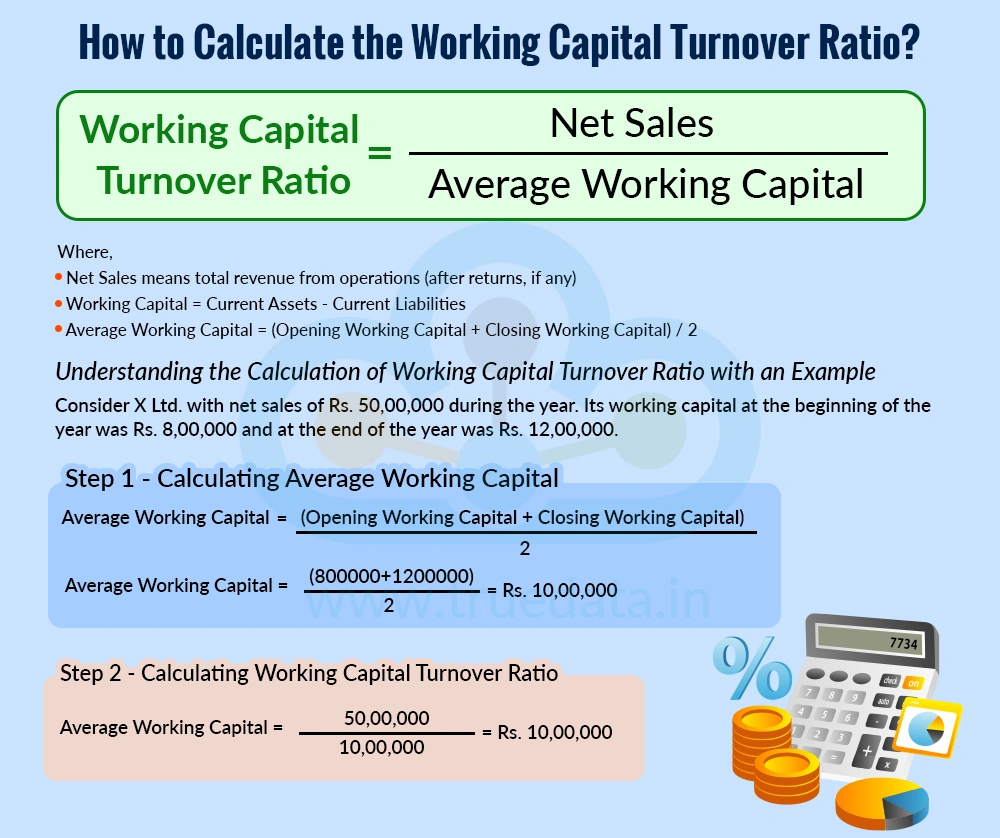
Working Capital Turnover Ratio = Net Sales / Average Working Capital

Where,

  • Net Sales means total revenue from operations (after returns, if any)

  • Working Capital = Current Assets - Current Liabilities 

  • Average Working Capital = (Opening Working Capital + Closing Working Capital) / 2

Understanding the Calculation of Working Capital Turnover Ratio with an Example

Consider X Ltd. with net sales of Rs. 50,00,000 during the year. Its working capital at the beginning of the year was Rs. 8,00,000 and at the end of the year was Rs. 12,00,000. 


Step 1 - Calculating Average Working Capital

Average Working Capital = (Opening Working Capital + Closing Working Capital) / 2

Average Working Capital = (800000+1200000) / 2 = Rs. 10,00,000

Step 2 - Calculating Working Capital Turnover Ratio 

Working Capital Turnover Ratio = Net Sales / Average Working Capital

Working Capital Turnover Ratio = 50,00,000 / 10,00,000 = 5 times

This indicates that the company generated sales equal to 5 times its working capital during the year, indicating how effectively it is using its short-term funds to drive business operations.

How to Interpret the Working Capital Turnover Ratio?

How to Interpret the Working Capital Turnover Ratio

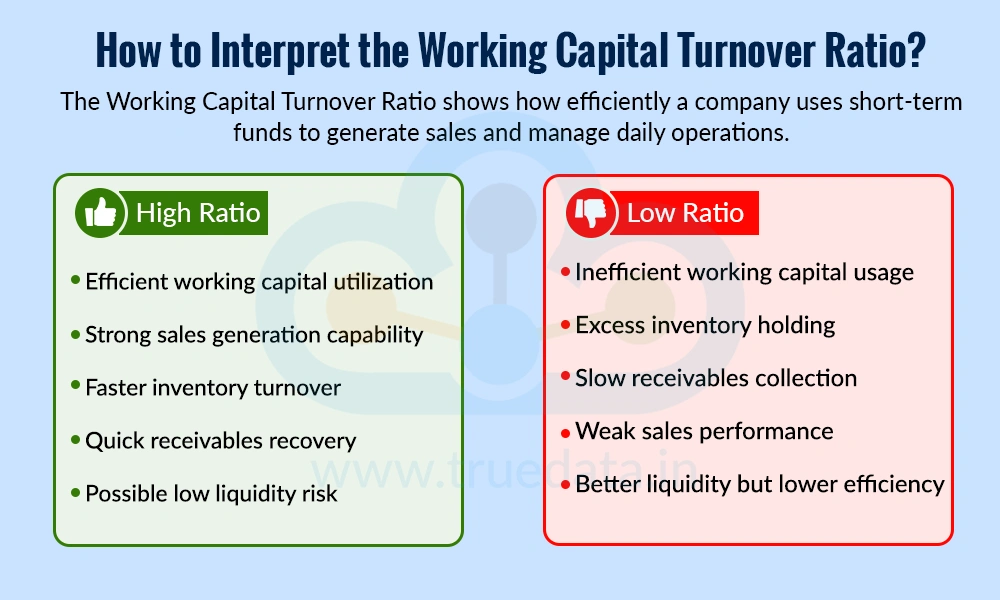
The Working Capital Turnover Ratio shows how efficiently a company is using its short-term funds to generate sales. Thus, it gives a quick view of how smoothly a company’s day-to-day operations are functioning. The interpretation of this ratio is explained below.

  • High Ratio - A high working capital turnover ratio generally means the company is using its working capital very efficiently to generate sales. It indicates strong operational efficiency, faster inventory movement, and effective collection of receivables. However, an extremely high ratio may also signal that the company has very low working capital, which could lead to liquidity issues. In such cases, the business might struggle to meet short-term obligations during tough times.

  • Low Ratio - A low ratio may suggest that the company is not using its working capital efficiently. This could happen if too much money is stuck in inventory or if customers are taking longer to pay. It may point to weak sales, poor inventory management, or inefficient operations. However, in some cases, a lower ratio could also mean the company is maintaining higher liquidity as a safety measure, which is not always negative.

Why is Working Capital Turnover Ratio Important?

Why is Working Capital Turnover Ratio Important

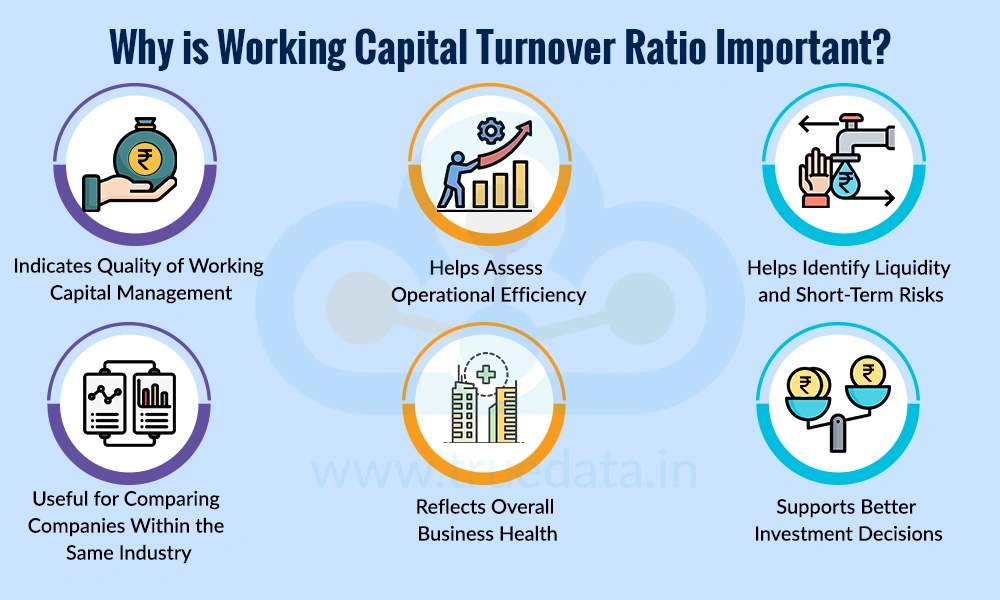
Working capital turnover ratio is an efficiency ratio that is used to evaluate the business efficiency in working capital management and thereby its operational efficiency. The importance of this ratio and its uses can be explained below.

Indicates Quality of Working Capital Management

This ratio gives insight into how well a company is managing its day-to-day finances. Efficient management of inventory, timely collection from customers, and proper control over short-term liabilities all reflect in this ratio. A good working capital turnover suggests that the company is not keeping excess funds idle and is using them productively to run the business.

Helps Assess Operational Efficiency

The Working Capital Turnover Ratio is important because it shows how efficiently a company is using its short-term resources to generate sales. This means understanding whether the business is making the most of its cash, inventory, and receivables. A company that uses its working capital efficiently can generate higher sales without needing additional funds, which is a positive sign of strong operations.

Helps Identify Liquidity and Short-Term Risks

While profitability is important, a company must also maintain enough liquidity to meet its short-term obligations. This ratio helps investors understand whether the company has too much or too little working capital. Very low working capital (leading to a very high ratio) may indicate potential liquidity risks, while excess working capital (leading to a low ratio) may point to inefficiency.

Useful for Comparing Companies Within the Same Industry

This ratio becomes especially useful when comparing companies in the same sector. It helps identify which company is better at converting its working capital into sales. For example, in sectors like retail or FMCG, companies with higher turnover ratios are often more efficient in managing inventory and receivables compared to their peers.

Reflects Overall Business Health

Working capital is the backbone of daily business activities. This ratio indirectly reflects how smoothly the business is running. Efficient use of working capital often leads to better cash flows, improved profitability, and stronger financial stability, which are important for long-term investors.

Supports Better Investment Decisions

Analysing this ratio, investors can make more informed decisions. A company that consistently shows a healthy working capital turnover is likely managing its operations well, which can support steady growth. On the other hand, a declining ratio may be an early warning sign of operational issues, helping investors take timely action.

What are the Pros and Cons of Using the Working Capital Ratio?

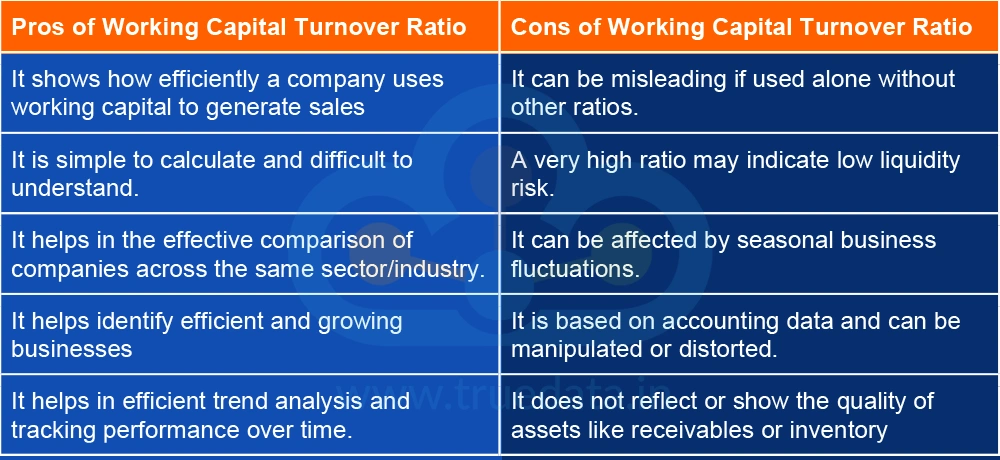
The pros and cons of using the working capital turnover ratio are tabled below.

What are the Pros and Cons of Using the Working Capital Ratio

Pros of Working Capital Turnover Ratio

Cons of Working Capital Turnover Ratio

It shows how efficiently a company uses working capital to generate sales

It can be misleading if used alone without other ratios.

It is simple to calculate and difficult to understand. 

A very high ratio may indicate low liquidity risk.

It helps in the effective comparison of companies across the same sector/industry. 

It can be affected by seasonal business fluctuations. 

It helps identify efficient and growing businesses

It is based on accounting data and can be manipulated or distorted.  

It helps in efficient trend analysis and tracking performance over time.  

It does not reflect or show the quality of assets like receivables or inventory

Conclusion

The Working Capital Turnover Ratio is a useful tool that helps investors understand how efficiently a company is using its short-term funds to generate sales and run its day-to-day operations. It highlights the importance of strong working capital management and gives insights into operational efficiency, liquidity, and overall business health. However, like any financial ratio, it should not be used in isolation and should be used along with other ratios for a complete analysis.

This is yet another addition to our series on exploring financial ratios in detail. Let us know your thoughts on the topic or if you need further information on the same and we will address it soon. 

Till then, Happy Reading!


Read More: Interest Coverage Ratio (EBIT / Interest) - What is it and How to Calculate it?

Frequently Asked Questions

Net Revenue is used instead of Gross Revenue as it shows the actual income a company earns after deducting returns, discounts, and allowances. This gives investors a more accurate picture of real sales and efficiency.

Current assets for this ratio include short-term items like cash, bank balance, inventory, accounts receivable (debtors), and other assets expected to be converted into cash within a year. These are the resources a company uses for its day-to-day operations.

Current liabilities for this ratio include short-term obligations like trade payables (creditors), short-term loans, outstanding expenses, taxes payable, and other dues payable within one year. These are the immediate payments a company must manage as part of its daily operations.

There is no fixed ideal target for the Working Capital Turnover Ratio, as it varies across industries. Therefore, it is best to compare the ratio with similar companies and track its trend over time to judge efficiency.

You can improve the Working Capital Turnover Ratio by increasing sales without significantly increasing working capital, and by managing inventory and receivables more efficiently (faster stock turnover and quicker collections).
Marisha Bhatt

Marisha Bhatt is a financial content writer @TrueData.

She writes with the sole aim of simplifying complex financial concepts and jargon while attempting to clarify technical and fundamental analysis concepts of the stock markets. The ultimate goal is to spread vital knowledge and benefit the maximum audience. Her Chartered Accountant background acts as the knowledge base to help clarify crucial concepts and create a sound investment portfolio.

2 Comments
D
Dhiva Shree
· May 14, 2026

Good

·
Meyhar Singh
Dhiva Shree · May 14, 2026

Thank you so much!

·

Related Articles

SEE ALL
Corporate Data
Corporate Data
Investing Smarter: The Power of Corporate Data and Market Sentiment Analysis

Thestock market never stands still, and prices swing constantly with every new h...

Corporate Data
Corporate Data
Solvency and Leverage Ratios - Debt and Equity Ratios

Debt and equity together form the total capital of a company. However, when anal...

Corporate Data
Corporate Data
Liquidity Ratios - Quick Ratio and Cash Ratio

Liquidity ratios tell us how comfortably a company can meet its short-term oblig...