15-MIN DELAYED
NIFTY 24,370.00 +35.45 (+0.15%) | BANKNIFTY 57,928.75 +414.55 (+0.72%) | SENSEX 77,961.97 +305.88 (+0.39%) | CRUDEOIL-I 7,665.00 -169.00 (-2.16%) | GOLD-I 1,62,957.00 -72.00 (-0.04%) | NIFTY 24,370.00 +35.45 (+0.15%) | BANKNIFTY 57,928.75 +414.55 (+0.72%) | SENSEX 77,961.97 +305.88 (+0.39%) | CRUDEOIL-I 7,665.00 -169.00 (-2.16%) | GOLD-I 1,62,957.00 -72.00 (-0.04%) |
TrueData
Helpline / Support +91 7304-22-44-66
Get started

WORKSPACE

Workspace overview Workspace overview Our flagship product SignalX SignalX web charting for indian market Sheets Sheets streaming spreadsheet Wealth Wealth corporate data and news


Built for India's markets.

Real-time charts, streaming spreadsheets, live corporate announcements — all in one workspace.

Get started free
Corporate Data

How to Analyse Capital-Intensive Businesses Using Fundamentals?

Marisha Bhatt · 25 Aug 2026 · 17 mins read · 0 Comments

how-to-analyse-capital-intensive-businesses-using-fundamentals

We have taken a deep dive into analysing asset-light and intangible businesses. But what about businesses that require huge investments in plants, machinery, infrastructure, or other assets just to operate? How can you tell whether such a business is financially strong and sustainable, or whether it may struggle under the constant need for large capital investments? In this blog, we will answer these questions and explore the key fundamental factors that can help you analyse capital-intensive businesses with confidence.

What are Capital-Intensive Businesses?

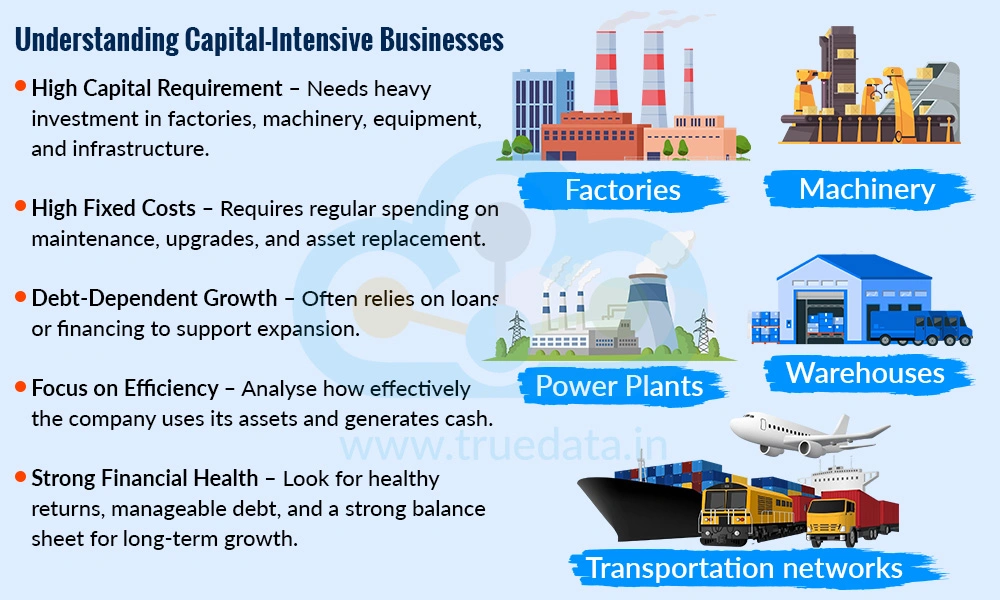
What are Capital-Intensive Businesses

Capital-intensive businesses are companies that need a large amount of money to buy, build, and maintain physical assets such as factories, machinery, equipment, power plants, warehouses, or transportation networks. These businesses usually require significant investment before they can produce goods or provide services, and they also need regular spending to upgrade or replace their assets over time. As a result, they often have high fixed costs and may have to rely on loans or other forms of financing to support their operations and expansion. Industries such as manufacturing, steel, cement, oil and gas, power generation, telecom, airlines, railways, and infrastructure are common examples of capital-intensive businesses.


Analysing capital-intensive businesses requires looking beyond just revenue and profits. It is important to understand how efficiently the company uses its assets, whether it generates enough cash to fund its operations, and the amount of debt it has taken on to finance growth. A business that manages its capital wisely, earns healthy returns on its investments, and maintains a strong balance sheet is generally better positioned to create long-term value for its shareholders.

What are the Key Characteristics of Capital-Intensive Companies?

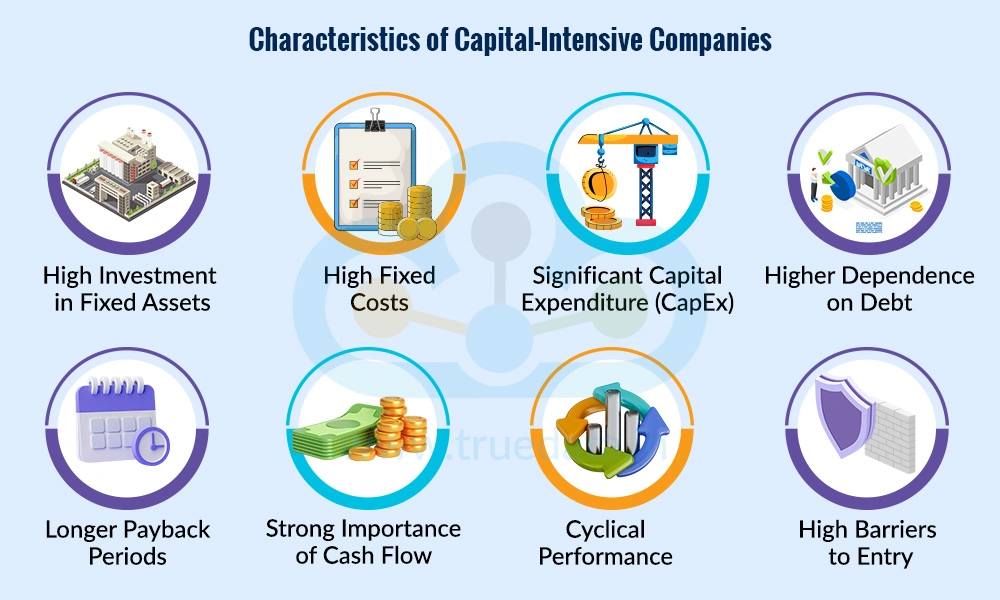
What are the Key Characteristics of Capital-Intensive Companies

Capital-intensive businesses, as the name suggests, require huge investments at every stage of the business. The key characteristics of such businesses that define and shape them are explained below.

  • High Investment in Fixed Assets - One of the biggest characteristics of capital-intensive companies is that they require a large investment in fixed assets such as factories, machinery, equipment, power plants, warehouses, or transport infrastructure. These assets are essential for producing goods or delivering services, but they also involve high upfront costs. As the business grows, it often needs to invest even more in expanding or upgrading these assets.

  • High Fixed Costs - Capital-intensive businesses usually have high fixed costs that must be paid regardless of how much they produce or sell. Expenses such as equipment maintenance, factory operations, insurance, depreciation, and employee salaries continue even during periods of weak demand. This means these businesses need to maintain a certain level of production and sales to remain profitable.

  • Significant Capital Expenditure (CapEx) - These companies regularly spend money on Capital Expenditure (CapEx) to purchase new assets, replace old equipment, or expand production capacity. Unlike day-to-day operating expenses, CapEx is a long-term investment that helps the business grow. Investors should compare a company's CapEx with its cash flow to understand whether the spending is sustainable.

  • Higher Dependence on Debt - Since setting up and expanding operations requires substantial capital, many capital-intensive businesses borrow money through loans or issue bonds to raise funds. While borrowing can support growth, excessive debt also increases interest costs and financial risk. Investors should therefore pay close attention to debt levels and the company's ability to repay its borrowings.

  • Longer Payback Periods - Large investments in factories, plants, or infrastructure usually do not generate returns immediately. It often takes several years before these projects start contributing significantly to profits. As a result, investors need to be patient and focus on the company's long-term earnings potential rather than expecting quick returns.

  • Strong Importance of Cash Flow - For capital-intensive businesses, generating healthy cash flow is just as important as earning profits. A company may report good profits on paper, but if it does not generate enough cash, it may struggle to pay interest, maintain its assets, or fund future expansion. This is why investors should analyse operating cash flow and free cash flow alongside the income statement .

  • Cyclical Performance - Many capital-intensive industries, such as steel, cement, automobiles, aviation, and infrastructure, are influenced by economic cycles. During periods of strong economic growth, demand and profits generally increase. However, during slowdowns or recessions recessions, sales may fall while fixed costs remain high, putting pressure on profitability. Investors should consider where the industry is in its business cycle before making investment decisions.

  • High Barriers to Entry - Capital-intensive industries often have high barriers to entry because starting a new business requires enormous financial investment, technical expertise, regulatory approvals, and years of planning. This limits competition and can benefit established companies by protecting their market position. However, investors should still assess whether the company is using this advantage efficiently and generating attractive long-term returns.

What are the Important Financial Ratios to Analyse Capital-Intensive Businesses?

Capital-intensive businesses require huge investments in factories, machinery, equipment, power plants, and other long-term assets. Therefore, simply looking at sales or net profit is not enough to understand whether such a company is a good investment. Investors should analyse financial ratios that measure profitability, efficiency, debt levels, cash flow, and returns on invested capital. These ratios provide a clearer picture of whether the company is making the best use of its expensive assets and whether it can sustain its growth over the long term.

Here are some of the most important financial ratios every investor should consider.

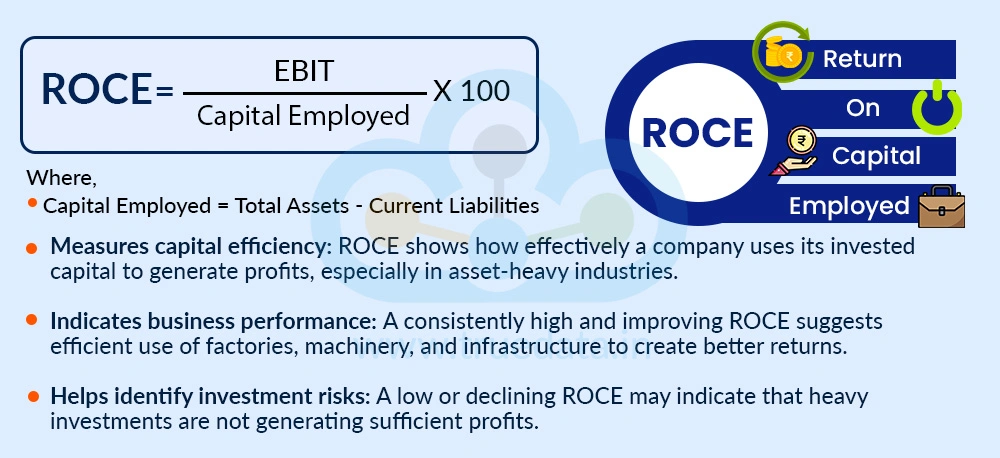
Return on Capital Employed (ROCE)

Return on Capital Employed (ROCE)

ROCE = Earnings Before Interest and Taxes (EBIT) / Capital Employed * 100

Where,

  • Capital Employed = Total Assets - Current Liabilities

ROCE is one of the most important ratios for analysing capital-intensive businesses because it measures how efficiently a company generates profits from the capital invested in the business. Since these companies invest heavily in factories, plants, machinery, and infrastructure, investors should know whether these expensive assets are producing adequate returns. A consistently high and improving ROCE generally indicates that the company is using its capital efficiently. On the other hand, a low or declining ROCE may suggest that the company is investing heavily but not generating enough profits from those investments.

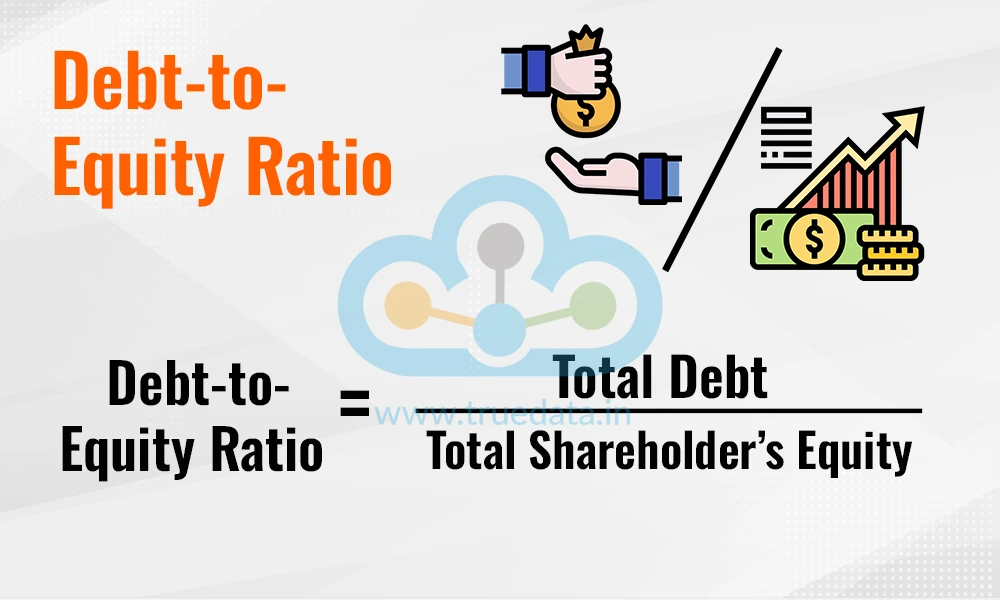
Debt-to-Equity Ratio (D/E Ratio)

Debt-to-Equity Ratio (D/E Ratio)

Debt-to-Equity Ratio = Total Debt / Shareholders' Equity

Capital-intensive companies often borrow money to finance expansion projects, as building factories or infrastructure requires huge amounts of capital. The Debt-to-Equity Ratio shows how much debt the company is using compared to the money invested by shareholders. A moderate level of debt can support growth, but excessive borrowing increases financial risk, especially during periods of weak demand or rising interest rates. Investors should compare this ratio with industry averages rather than using a single benchmark for every sector.

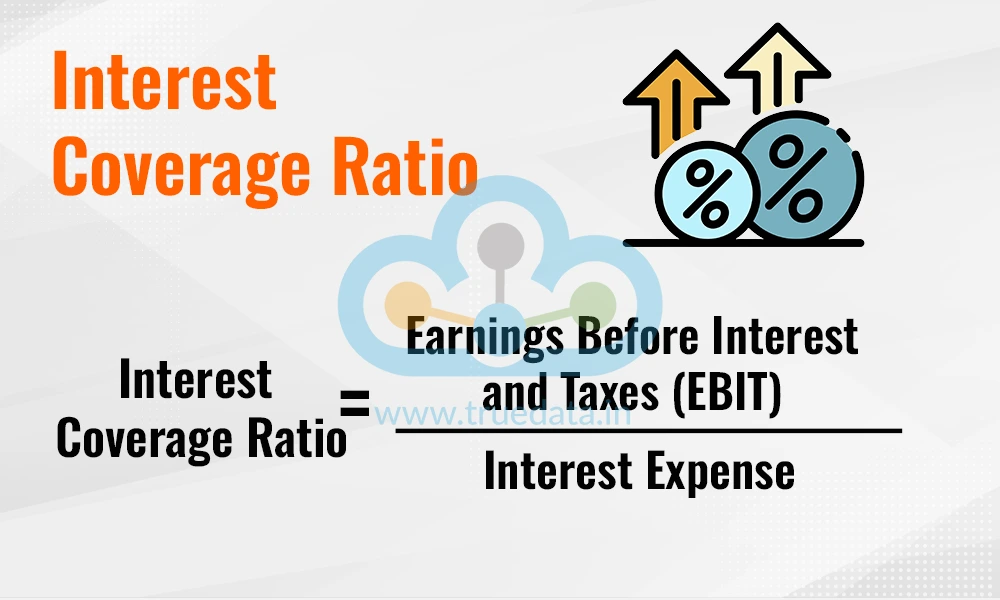
Interest Coverage Ratio

Interest Coverage Ratio

Interest Coverage Ratio = EBIT / Interest Expense

Borrowing money comes with interest payments. The Interest Coverage Ratio shows whether a company earns enough operating profit to comfortably pay those interest expenses. This ratio is especially important for capital-intensive businesses, as many of them carry significant debt. A high Interest Coverage Ratio indicates that the company can easily meet its interest obligations. A low ratio suggests that even a small fall in profits could make debt repayment difficult, increasing financial risk.

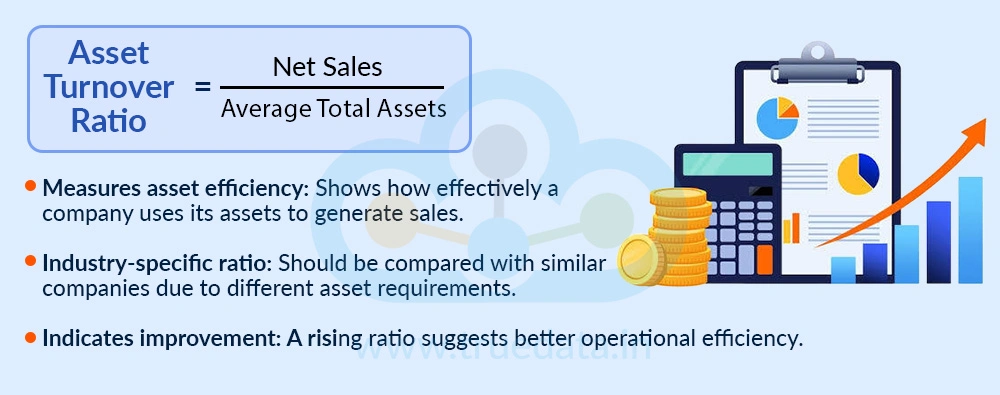
Asset Turnover Ratio

Asset Turnover Ratio

Asset Turnover Ratio = Net Sales / Average Total Assets

Capital-intensive companies own expensive assets that should generate sufficient revenue over time. The Assets Turnover Ratio measures how efficiently the company uses all of its assets to generate sales. This ratio is naturally lower for industries such as steel, power, telecom, and cement compared to software or consulting companies because their asset base is much larger. Therefore, investors should compare this ratio only with companies operating in the same industry. A rising Asset Turnover Ratio generally indicates improving operational efficiency.

Fixed Asset Turnover Ratio

Fixed Asset Turnover Ratio

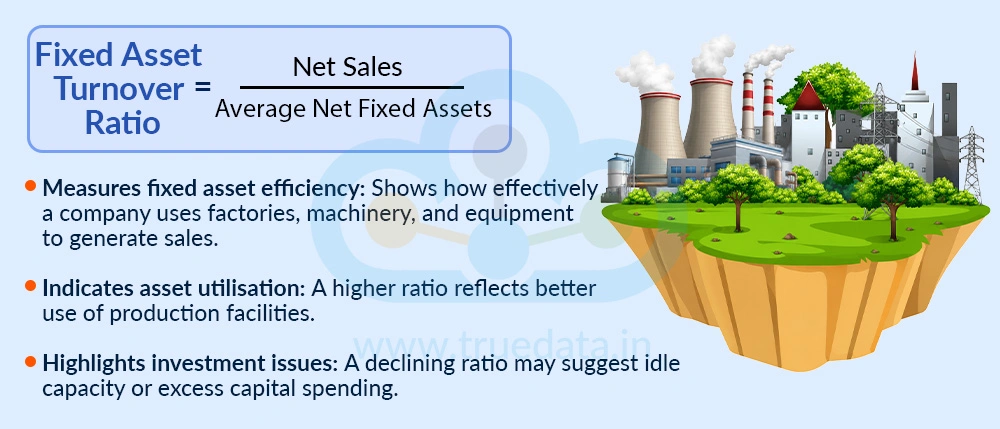
Fixed Asset Turnover Ratio = Net Sales / Average Net Fixed Assets


While the Asset Turnover Ratio considers all assets, the Fixed Asset Turnover Ratio focuses specifically on long-term physical assets such as factories, machinery, buildings, and equipment. This ratio helps investors understand whether the company's investments in production facilities are generating adequate sales. A higher ratio indicates efficient use of production assets, whereas a declining ratio could suggest underutilised factories, idle capacity, or excessive capital expenditure that has not yet started generating returns.

Operating Cash Flow Ratio

Operating Cash Flow Ratio

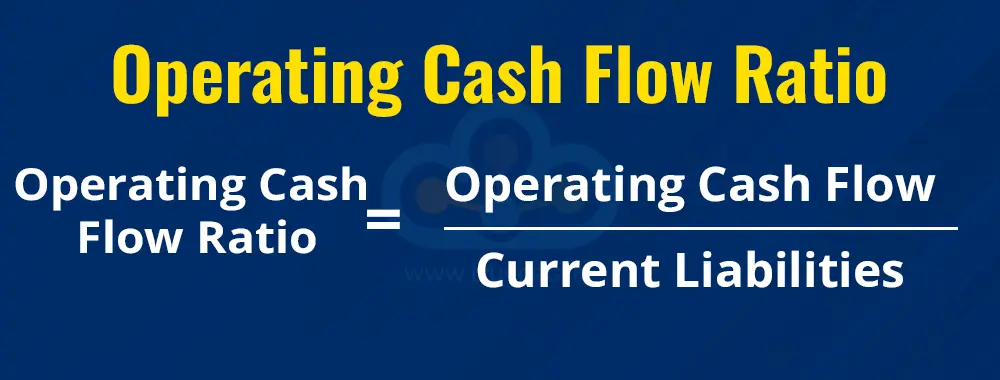
Operating Cash Flow Ratio = Operating Cash Flow / Current Liabilities


A company may report healthy profits but still struggle if it does not generate enough cash from its core business. Capital-intensive companies require continuous cash to maintain machinery, repay debt, purchase raw materials, and fund expansion projects. The Operating Cash Flow Ratio measures whether the company's operating cash flow is sufficient to meet its short-term financial obligations. A consistently strong ratio indicates better financial stability and reduces dependence on additional borrowing.

Free Cash Flow (FCF)

Free Cash Flow (FCF)

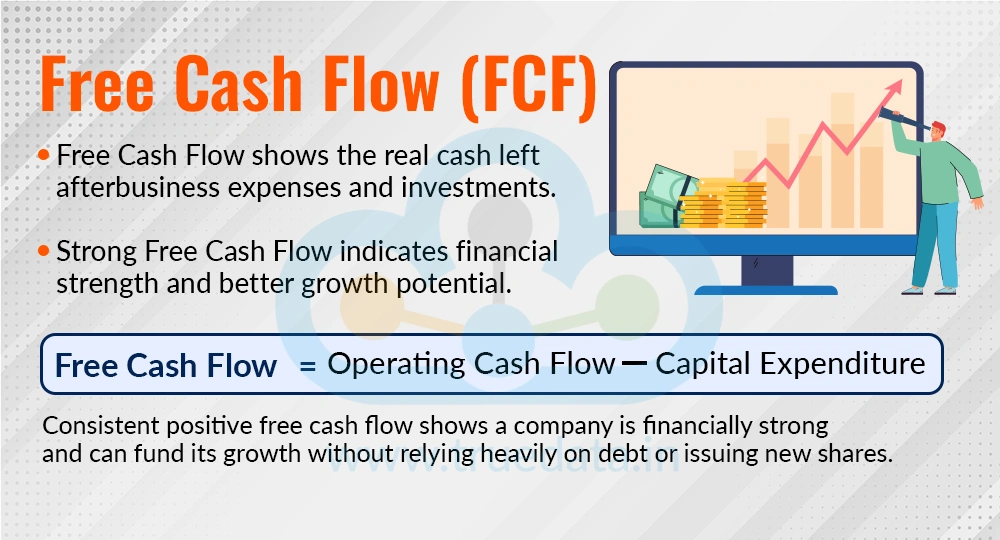
Free Cash Flow = Operating Cash Flow - Capital Expenditure (CapEx)

Capital-intensive businesses spend large amounts on Capital Expenditure every year. Free Cash Flow shows how much cash remains after these investments. A company with healthy Free Cash Flow has greater financial flexibility. It can repay debt, pay dividends, buy back shares, or invest in future growth without relying heavily on external financing. Consistently negative Free Cash Flow may not always be bad, especially if the company is expanding, but investors should ensure that these investments are expected to generate higher future returns.

Return on Assets (ROA)

Return on Assets (ROA)

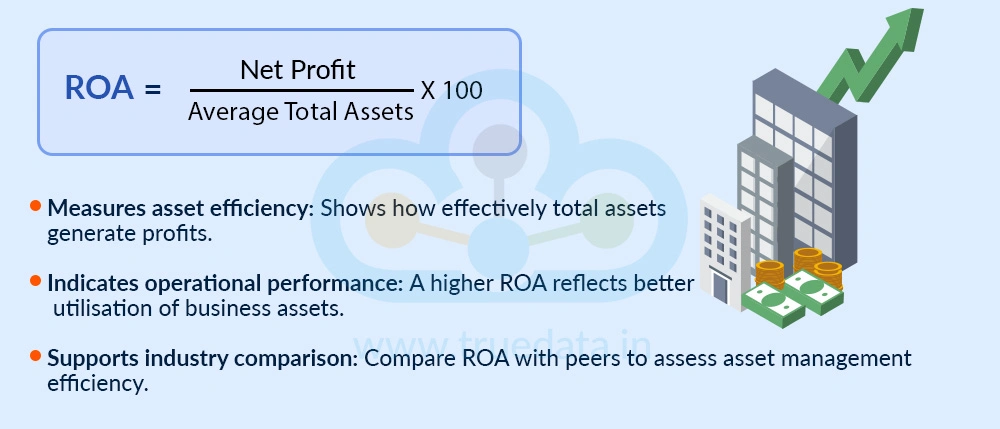
ROA = Net Profit / Average Total Assets * 100

Return on Assets measures how effectively a company converts its total assets into profits. Since capital-intensive businesses own very large asset bases, this ratio helps investors judge whether those assets are generating sufficient earnings. Although ROA is generally lower for capital-intensive companies than for asset-light businesses, investors should compare it with industry peers. A company with a consistently higher ROA than its competitors is usually managing its assets more efficiently.

Capital Expenditure (CapEx) to Sales Ratio

Capital Expenditure (CapEx) to Sales Ratio

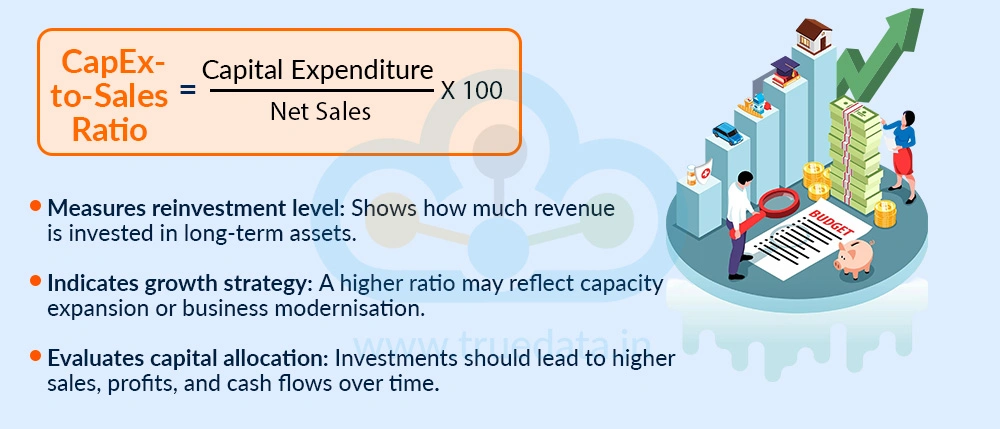
CapEx-to-Sales Ratio = Capital Expenditure / Net Sales * 100

This ratio indicates how much of the company's revenue is being reinvested into purchasing or upgrading long-term assets. A high CapEx-to-Sales Ratio may indicate that the company is expanding capacity or modernising operations. While this can support future growth, investors should check whether these investments eventually translate into higher sales, better profitability, and stronger cash flows. Continuous heavy spending without corresponding growth may indicate poor capital allocation.

EBITDA Margin

EBITDA Margin

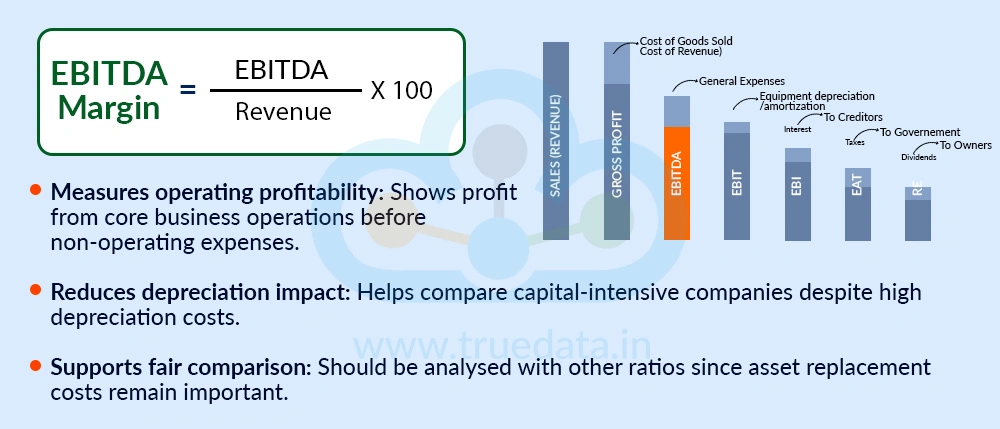
EBITDA Margin = EBITDA / Revenue * 100

EBITDA Margin measures the profitability of a company's core operations before deducting interest, taxes, depreciation, and amortisation. This ratio is particularly useful for capital-intensive businesses because depreciation expenses are often very high due to costly factories and machinery. EBITDA Margin allows investors to compare operating performance across companies without the impact of accounting depreciation. However, it should never be analysed in isolation because depreciation reflects the actual wear and tear of assets that will eventually require replacement.

Debt Service Coverage Ratio (DSCR)

Debt Service Coverage Ratio (DSCR)

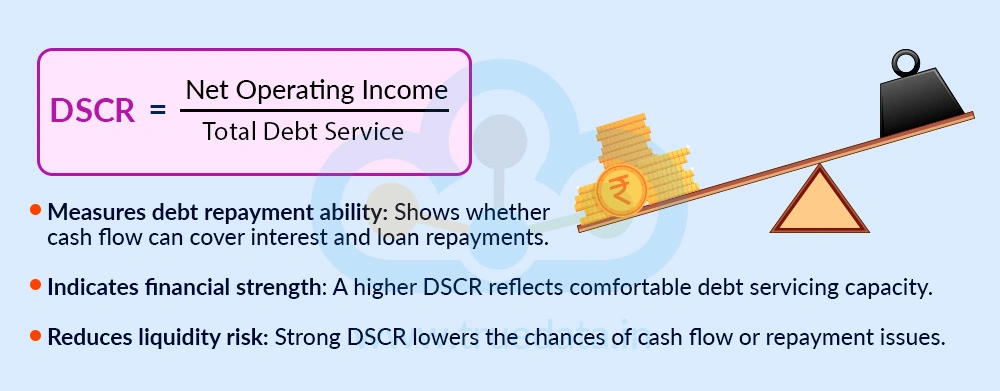
DSCR = Net Operating Income / Total Debt Service

(Total Debt Service includes both interest and principal repayments.)

Unlike the Interest Coverage Ratio, which considers only interest payments, the Debt Service Coverage Ratio measures whether the company generates enough cash to meet both its interest and loan repayment obligations. This ratio provides additional confidence for businesses with large borrowings about their financial strength. A higher DSCR indicates that the company is comfortably servicing its debt and is less likely to face liquidity issues.

How to Evaluate Cash Flow and Debt Levels?

How to Evaluate Cash Flow and Debt Levels

Cash flow and debt are two of the most important factors to analyse before investing in a capital-intensive business. Companies in sectors such as steel, cement, power, telecom, infrastructure, and aviation require continuous spending on factories, machinery, maintenance, and expansion. As a result, many of these businesses also rely on borrowed money to finance their operations. A company may report strong profits, but if it does not generate enough cash or carries excessive debt, it may struggle to sustain its business over the long term. Therefore, investors should evaluate both cash flow and debt together rather than looking at them separately.

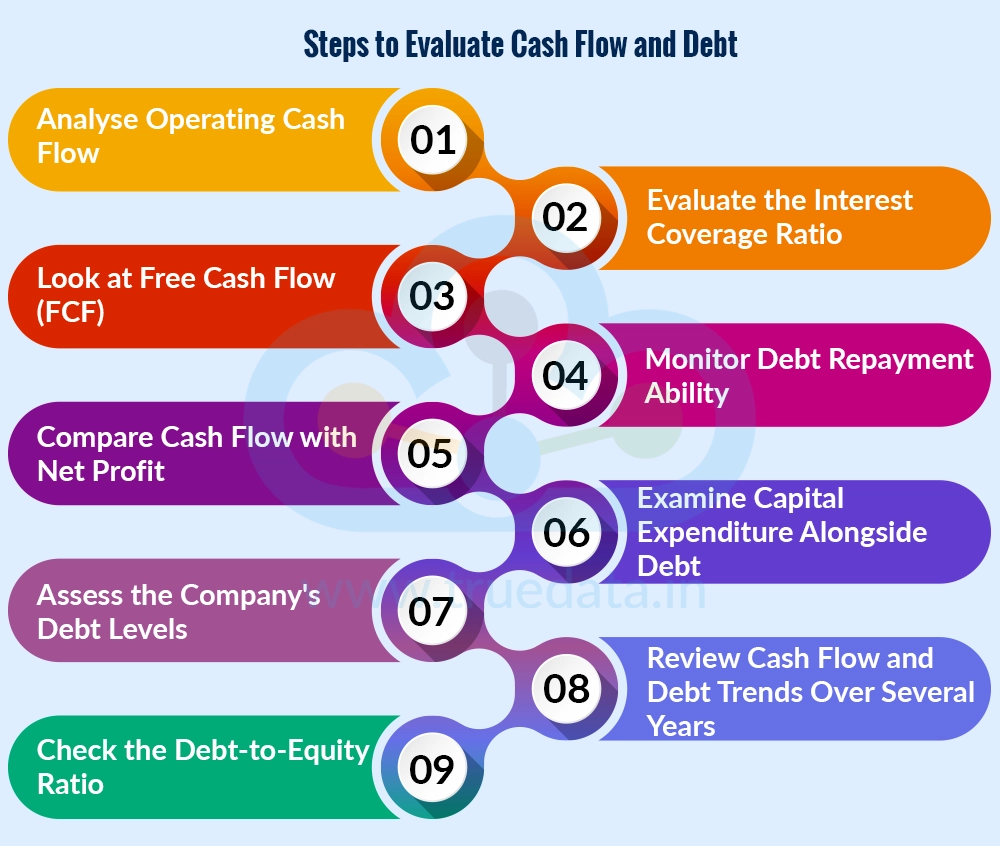
Analyse Operating Cash Flow

Operating Cash Flow (OCF) represents the cash generated from the company's core business activities. Unlike net profit, which includes accounting adjustments, Operating Cash Flow shows the actual cash flowing into the business. A strong Operating Cash Flow is essential for capital-intensive businesses because it helps fund day-to-day operations, pay suppliers and employees, maintain machinery, service debt, and support future investments. A company with consistently positive and growing Operating Cash Flow is generally in a stronger financial position than one that depends heavily on external borrowing. As an investor, compare the company's Operating Cash Flow over several years. Consistent growth is usually a positive sign, while falling or highly volatile cash flows may require further investigation.

Look at Free Cash Flow (FCF)

Free Cash Flow is the cash left after the company spends money on Capital Expenditure (CapEx), such as buying new machinery, upgrading equipment, or expanding production capacity. This is an important measure because capital-intensive businesses regularly spend large amounts on maintaining and expanding their assets. A company that generates healthy Free Cash Flow has greater financial flexibility. It can repay debt, pay dividends, invest in new projects, or build cash reserves without relying too much on additional borrowing. However, investors should not immediately worry if Free Cash Flow is negative. It is important to understand why. Negative Free Cash Flow may simply indicate that the company is investing heavily in expansion, which could generate higher profits in the future. The key is to check whether these investments are improving revenue, profitability, and cash generation over time.

Compare Cash Flow with Net Profit

A profitable company should generally generate healthy cash from its operations. If a business consistently reports rising profits but weak Operating Cash Flow, it may indicate issues such as delayed customer payments, excessive inventory, or aggressive accounting practices. For capital-intensive businesses, this comparison is particularly important because large depreciation expenses may affect reported profits. Looking at both profit and cash flow helps investors understand the company's actual financial strength. Ideally, Operating Cash Flow should remain stable or grow alongside profits over the long term.

Assess the Company's Debt Levels

Most capital-intensive companies borrow money to build factories, purchase machinery, or finance expansion projects. Borrowing itself is not a problem, provided the company can comfortably repay its obligations. Investors should evaluate whether debt is increasing faster than the company's earnings and cash flow. If debt rises continuously while profits remain stagnant or cash generation weakens, the company may face financial pressure during economic slowdowns. Comparing debt levels with industry peers can also provide useful insights into whether the company is borrowing responsibly.

Check the Debt-to-Equity Ratio

The Debt-to-Equity Ratio compares the company's total debt with shareholders’ equity. This ratio helps investors understand how much of the business is financed through borrowing. While some debt is normal for capital-intensive industries, an excessively high ratio may indicate greater financial risk. Instead of looking at the number in isolation, compare it with competitors operating in the same sector, as acceptable debt levels vary across industries.

Evaluate the Interest Coverage Ratio

Companies that borrow money must regularly pay interest on their loans. The Interest Coverage Ratio measures whether the company earns enough operating profit to comfortably meet these interest payments. A higher ratio suggests that the business can easily service its interest obligations, while a low ratio may indicate that even a temporary decline in earnings could make debt repayment difficult. For capital-intensive companies with significant borrowings, this ratio is an important indicator of financial stability.

Monitor Debt Repayment Ability

Besides paying interest, companies must also repay the principal amount of their loans. Investors should check whether the company generates enough cash to meet these repayments without constantly taking on new debt. One useful measure is the Debt Service Coverage Ratio (DSCR). A higher DSCR indicates that the company has sufficient cash flow to comfortably meet its debt obligations, reducing the risk of financial stress.

Examine Capital Expenditure Alongside Debt

Capital-intensive businesses regularly invest in expanding production capacity or upgrading technology. While such investments can support long-term growth, they should ideally be funded through a healthy combination of operating cash flow and manageable debt. If a company finances every new project through borrowing while cash flow remains weak, its debt burden may become difficult to manage over time. Investors should therefore assess whether Capital Expenditure is leading to higher revenue, better profits, and stronger cash flows.

Review Cash Flow and Debt Trends Over Several Years

Analysing one year's financial statements rarely tells the complete story. Instead, investors should study cash flow and debt trends over at least the last five to ten years. A few considerations that can help investors better understand the financial position of the company are,

  • A steady growth of the operating cash flow

  • Over time improvement of the free cash flow

  • Increase in debt levels at a reasonable pace

  • Reduction in debt levels after completion of major expansion projects

  • Checking if the interest payments are becoming easier to manage

Studying long-term trends provides a much better understanding of the company's financial discipline and sustainability than looking at a single year's numbers.

What are the Red Flags to Watch Out for Before Investing?

What are the Red Flags to Watch Out for Before Investing

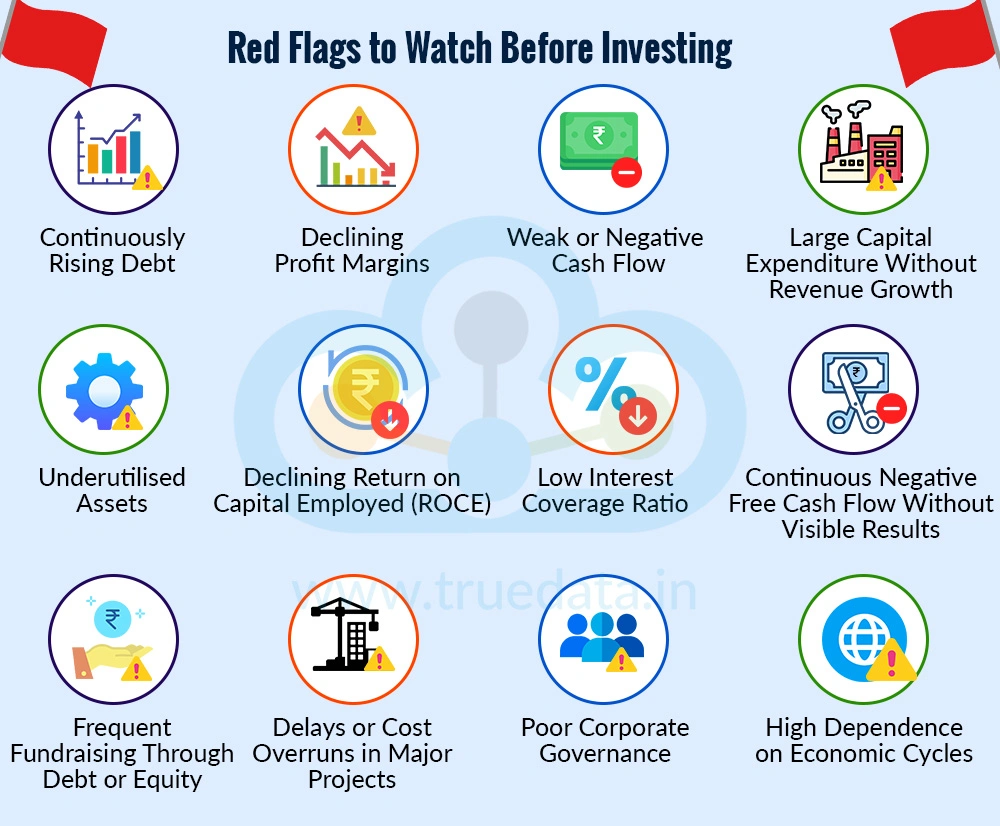
Capital-intensive businesses can generate attractive long-term returns, but they also carry unique risks due to their high investment requirements and dependence on physical assets. Before investing, it is important to identify warning signs that may indicate financial weakness or poor management decisions. Here are some key red flags every investor should watch out for.

  • Continuously Rising Debt - Capital-intensive companies often borrow money to finance expansion, but debt should remain manageable. If a company's debt keeps increasing year after year without a corresponding rise in revenue, profits, or cash flow, it may indicate that the business is relying too heavily on borrowing. High debt also increases interest costs and makes the company more vulnerable during economic slowdowns or periods of rising interest rates.

  • Declining Profit Margins - A steady decline in operating or net profit margins may indicate rising costs, lower pricing power, inefficient operations, or increasing competition. Since capital-intensive businesses already have high fixed costs, shrinking margins can put additional pressure on profitability and cash flow.

  • Weak or Negative Cash Flow - A company may report healthy profits but still face financial difficulties if it does not generate enough cash from its core operations. Consistently weak or negative operating cash flow suggests that the business may struggle to pay suppliers, maintain assets, repay debt, or fund future expansion. Investors should always compare profits with cash flow to get a complete picture of the company's financial health.

  • Large Capital Expenditure Without Revenue Growth - Heavy spending on new plants, machinery, or expansion projects should eventually result in higher production, increased sales, or improved profits. If the company continues to invest heavily but revenue remains stagnant over several years, it may suggest poor investment decisions or inefficient project execution.

  • Underutilised Assets - Capital-intensive businesses invest heavily in factories, machinery, and equipment. If these assets are not operating efficiently or production capacity remains low for an extended period, the company continues to incur maintenance and depreciation costs without generating adequate revenue. Poor asset utilisation can significantly reduce profitability.

  • Declining Return on Capital Employed (ROCE) - A falling ROCE over several years may indicate that the company is investing more capital but generating lower returns from those investments. This could mean that new projects are not performing well, capital is being allocated inefficiently, or assets are not being fully utilised. A consistently declining ROCE is a warning sign that deserves closer attention.

  • Low Interest Coverage Ratio - Companies with large borrowings must generate enough operating profits to pay interest on their loans. A low Interest Coverage Ratio means the company has less room to meet these obligations if earnings decline. If interest payments consume a significant portion of profits, the business may face financial stress during difficult market conditions.

  • Continuous Negative Free Cash Flow Without Visible Results - Negative Free Cash Flow is not always a bad sign, especially if the company is investing in expansion. However, if Free Cash Flow remains negative for many years and there is little improvement in sales, profitability, or production capacity, it may indicate that management is spending heavily without creating value for shareholders.

  • Frequent Fundraising Through Debt or Equity - If a company repeatedly raises money by taking on new loans or issuing additional shares, it may indicate that its existing operations are not generating sufficient cash to support growth. While occasional fundraising is normal, continuous dependence on external funding can increase financial risk or dilute existing shareholders' ownership.

  • Delays or Cost Overruns in Major Projects - Many capital-intensive companies undertake large infrastructure or manufacturing projects that take several years to complete. Frequent delays, budget overruns, or repeated changes in project timelines can increase costs, delay revenue generation, and weaken the company's financial position. Investors should monitor whether management has a strong track record of completing projects on time and within budget.

  • Poor Corporate Governance - Strong financial performance alone is not enough if management lacks transparency or accountability. Warning signs include frequent changes in auditors, delays in publishing financial results, related-party transactions that are not well explained, or poor communication with shareholders. Weak corporate governance can increase the risk of financial mismanagement and negatively impact long-term investor returns.

  • High Dependence on Economic Cycles - Many capital-intensive industries, such as steel, cement, automobiles, aviation, and infrastructure, are highly sensitive to economic conditions. If a company has weak finances and operates in a cyclical industry, even a temporary slowdown can significantly affect its earnings and ability to repay debt. Investors should assess whether the company has sufficient financial strength to withstand periods of lower demand.

What Should Investors Do?

What Should Investors Do

Before investing in a capital-intensive business, take the time to understand how the company earns money and whether its large investments are creating long-term value. Instead of focusing only on revenue or profit growth, investors should analyse key factors such as Return on Capital Employed (ROCE), debt levels, cash flow, capital expenditure (CapEx), and asset utilisation. These ratios have to be compared with those of similar companies in the same industry, as financial ratios can vary significantly across sectors. Looking at the company's financial performance over the last five to ten years can help investors identify consistent trends rather than making decisions based on short-term results.

Most importantly, investors should invest with a long-term perspective. Capital-intensive businesses often take years to recover their investments and may experience temporary setbacks due to economic cycles or large expansion projects. Hence, it is important to choose companies that have strong cash flows, manageable debt, efficient use of capital, and a proven track record of disciplined management. By combining thorough fundamental analysis with patience and regular portfolio reviews, investors can make more informed investment decisions and improve their chances of building long-term wealth.

Conclusion

Analysing capital-intensive businesses requires looking beyond just revenue and profits. Since these companies invest heavily in factories, machinery, and infrastructure, it is important to evaluate how efficiently they use their capital, manage debt, and generate cash flow. By studying key financial ratios, understanding the company's long-term growth strategy, and watching out for potential red flags, investors can make more informed investment decisions. A disciplined approach to fundamental analysis can help you identify financially strong companies that have the potential to create sustainable wealth over the long term.

This article is a detailed take on analysing capital-intensive businesses. Let us know your thoughts on the topic or if you need further information, and we will address it soon. 

Till then, Happy Reading!


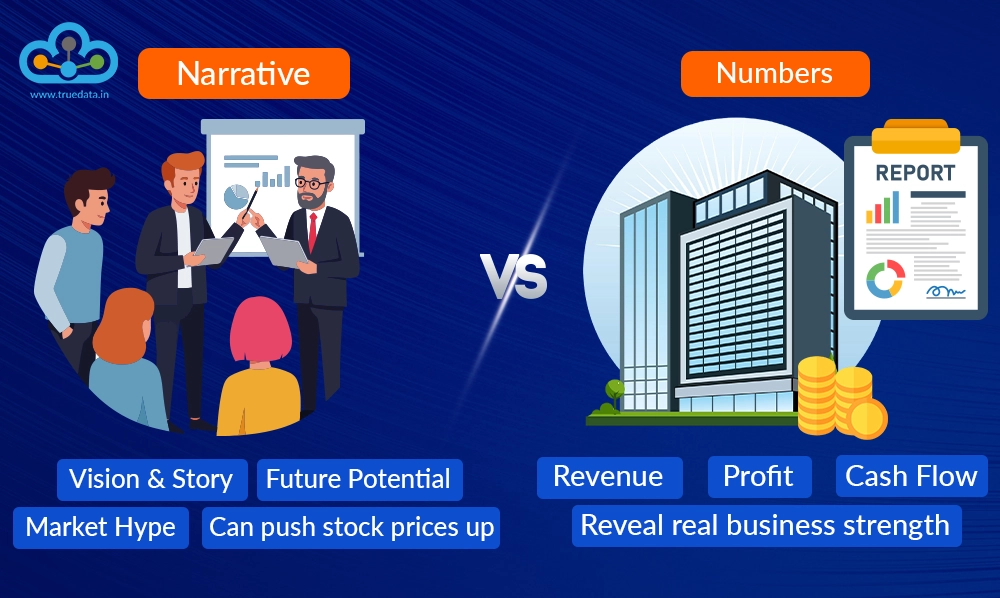
Read More: Narrative vs Numbers - When Stories Drive Stock Prices More Than Fundamentals

Frequently Asked Questions

Investors should evaluate asset efficiency by analysing ratios such as the Asset Turnover Ratio and Fixed Asset Turnover Ratio, which show how effectively a company uses its assets to generate sales. These ratios should be compared with industry peers, as capital-intensive businesses naturally have larger asset bases than asset-light companies.

Depreciation shows the gradual reduction in the value of a company's fixed assets due to regular use, while impairment reflects a sudden decline in an asset's value when it can no longer generate the expected benefits. Investors should monitor both, as high depreciation or frequent impairment charges may indicate ageing assets or poor investment decisions.

Investors should evaluate Return on Invested Capital (ROIC) to understand how efficiently a company generates profits from the money invested in its business. A consistently high or improving ROIC compared to industry peers generally indicates efficient use of capital and strong long-term performance.

Investors should consider external factors such as economic growth, interest rates, government policies, raw material prices, and changes in demand, as these can significantly affect capital-intensive businesses. These factors influence production costs, profitability, borrowing costs, and future growth prospects.

Investors should assess pricing power by checking whether the company can increase prices without significantly reducing customer demand, while volume drivers can be evaluated by analysing growth in sales volumes, production capacity, and market demand. Consistent growth in both pricing and sales volumes generally indicates a stronger and more competitive business.

Investors should focus on Operating Cash Flow (OCF) and Free Cash Flow (FCF), as these show whether a company generates enough cash from its core business and has sufficient funds left after capital expenditure. Strong and consistent cash flows generally indicate better financial health and long-term sustainability.
Marisha Bhatt

Marisha Bhatt is a financial content writer @TrueData.
She writes with the sole aim of simplifying complex financial concepts and jargon while attempting to clarify technical and fundamental analysis concepts of the stock markets. The ultimate goal is to spread vital knowledge and benefit the maximum audience. Her Chartered Accountant background acts as the knowledge base to help clarify crucial concepts and create a sound investment portfolio.

0 Comments

Related Articles

SEE ALL
Corporate Data
Corporate Data
Investing Smarter: The Power of Corporate Data and Market Sentiment Analysis

Thestock market never stands still, and prices swing constantly with every new h...

Corporate Data
Corporate Data
Understanding Quarterly vs Annual Corporate Data

Corporate data is more than just the numbers of a company. They can show what is...

Corporate Data
Corporate Data
Key Corporate Data Every Investor Must Track Before Investing

Investing is not just about numbers on a screen. It is about understanding the s...

Relevant Tags