15-MIN DELAYED
NIFTY 50 24,366.00 -29.85 (-0.12%) | BANKNIFTY 57,491.10 -144.15 (-0.25%) | SENSEX 78,009.25 -70.71 (-0.09%) | CRUDEOIL-I 7,878.00 +66.00 (+0.84%) | GOLD-I 1,54,590.00 +1,190.00 (+0.78%) | NIFTY 50 24,366.00 -29.85 (-0.12%) | BANKNIFTY 57,491.10 -144.15 (-0.25%) | SENSEX 78,009.25 -70.71 (-0.09%) | CRUDEOIL-I 7,878.00 +66.00 (+0.84%) | GOLD-I 1,54,590.00 +1,190.00 (+0.78%) |
TrueData
Helpline / Support +91 7304-22-44-66
Get started

WORKSPACE

Workspace overview Workspace overview Our flagship product signalx signalx web charting for indian market Sheets Sheets streaming spreadsheet wealth wealth corporate data and news

Built for India's markets.

Real-time charts, streaming spreadsheets, live corporate announcements — all in one workspace.

Get started free
Corporate Data

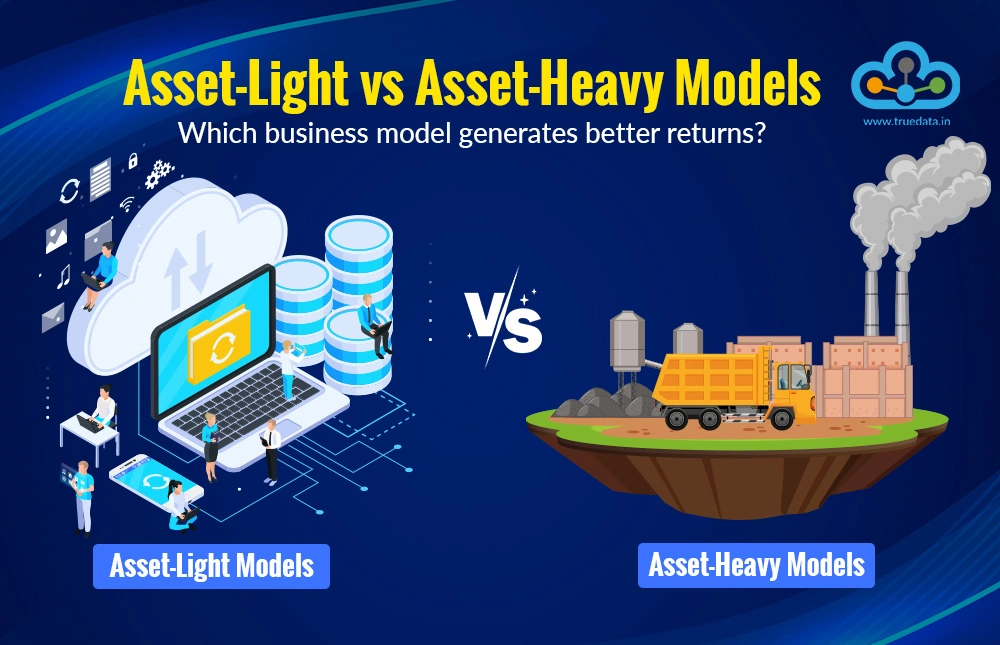
Asset-Light vs Asset-Heavy Models - Which business model generates better returns?

Marisha Bhatt · 16 Jul 2026 · 12 mins read · 40 Comments

asset-light-vs-asset-heavy-models-which-business-model-generates-better-returns

In today's digital-first world, many of the most valuable companies own very few physical assets. Businesses built around software, data, and technology are growing rapidly, while traditional asset-heavy industries continue to play a crucial role in the economy. Does this mean asset-light businesses are the way to go? Or can asset-heavy companies still generate strong returns for investors? The answer is not as straightforward as it may seem. Both business models come with their own strengths, risks, and opportunities. Dive into this blog, where we compare asset-light and asset-heavy businesses, understand how they create value, and explore which model has the potential to generate better returns for investors.

What Are Asset-Light and Asset-Heavy Business Models?

What Are Asset-Light and Asset-Heavy Business Models

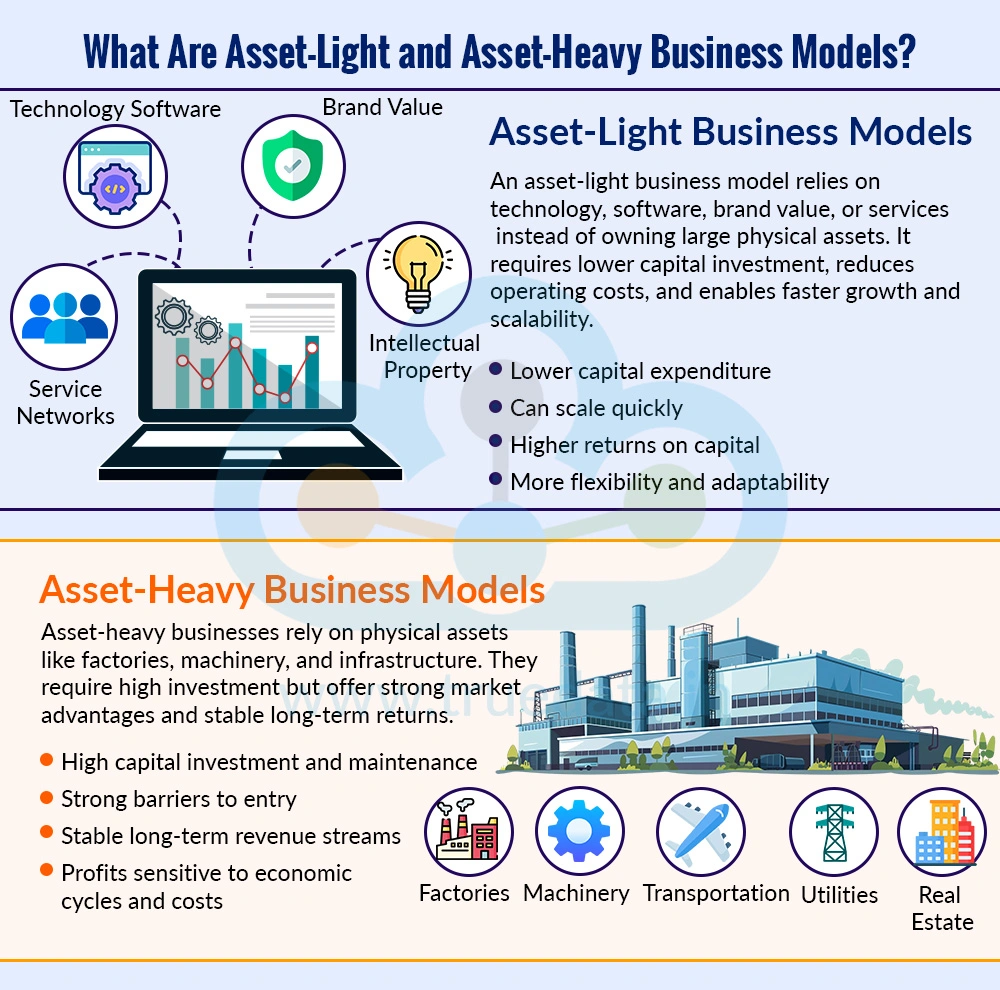
An asset-light business model is a type of business that operates with relatively few physical assets, such as factories, warehouses, machinery, or large equipment. Instead, these companies focus on assets like technology, software, intellectual property, brand value, or service networks to generate revenue. Since they do not need to invest heavily in physical infrastructure, asset-light businesses often require lower capital expenditure and can scale their operations more quickly. Examples include software companies, online marketplaces, digital payment providers, and many service-based businesses. Asset-light companies can be attractive for investors as they often generate higher returns on capital and have greater flexibility to adapt to changing market conditions.

An asset-heavy business model, on the other hand, relies heavily on physical assets to operate and generate revenue. These businesses typically invest significant amounts of money in factories, machinery, transportation networks, power plants, real estate, or other large infrastructure. Industries such as manufacturing, airlines, telecom, utilities, and steel production are common examples of asset-heavy businesses. While these companies usually require substantial capital investments and ongoing maintenance expenses, their physical assets can create strong barriers to entry and provide stable long-term revenue streams. Asset-heavy companies may offer steady growth and competitive advantages, but their profitability can be more sensitive to economic cycles and high operating costs.

Examples of Asset-Light and Asset-Heavy Companies in India

Examples of Asset-Light and Asset-Heavy Companies in India

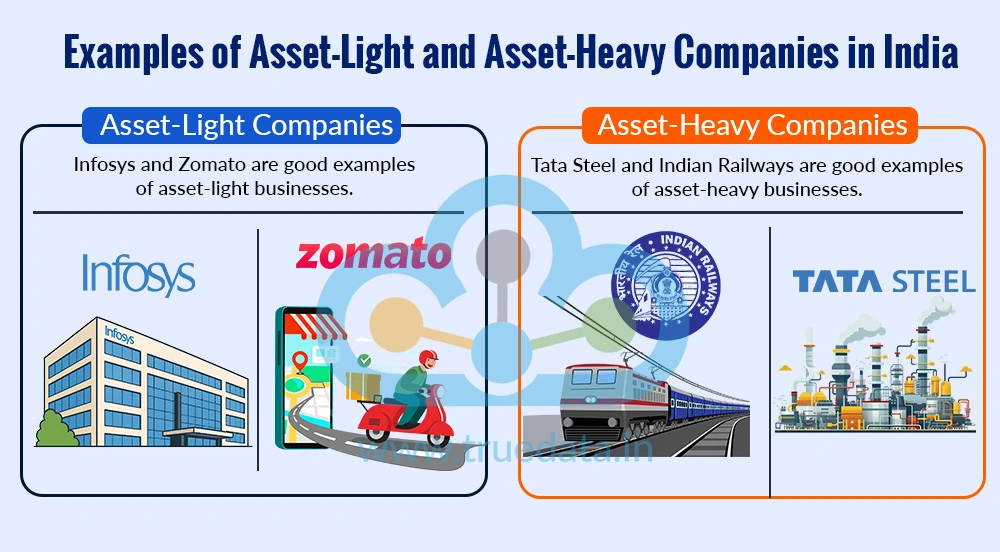
A good example of an asset-light business is Infosys. The company generates revenue mainly by providing software development, consulting, and digital transformation services to clients worldwide. It does not need to invest heavily in factories, large machinery, or physical infrastructure to grow its business. Another example is Zomato, which primarily acts as a platform connecting customers, restaurants, and delivery partners. Such businesses rely more on technology, brand value, and networks than on owning large physical assets. As a result, they can often expand their operations with relatively lower capital investments.

On the other hand, Tata Steel is a classic asset-heavy business. The company requires massive investments in steel plants, machinery, mining operations, and transportation infrastructure to produce and distribute steel. Similarly, Indian Railways operates one of the world's largest railway networks and depends on extensive physical assets such as tracks, stations, trains, and maintenance facilities. These businesses need significant capital to build and maintain their assets, but those assets can also create strong competitive advantages and long-term revenue opportunities. Understanding the nature of these business models can help investors evaluate their growth potential, profitability, and risk profile.

How Investors Can Evaluate Asset-Light and Asset-Heavy Stocks?

How Investors Can Evaluate Asset-Light and Asset-Heavy Stocks

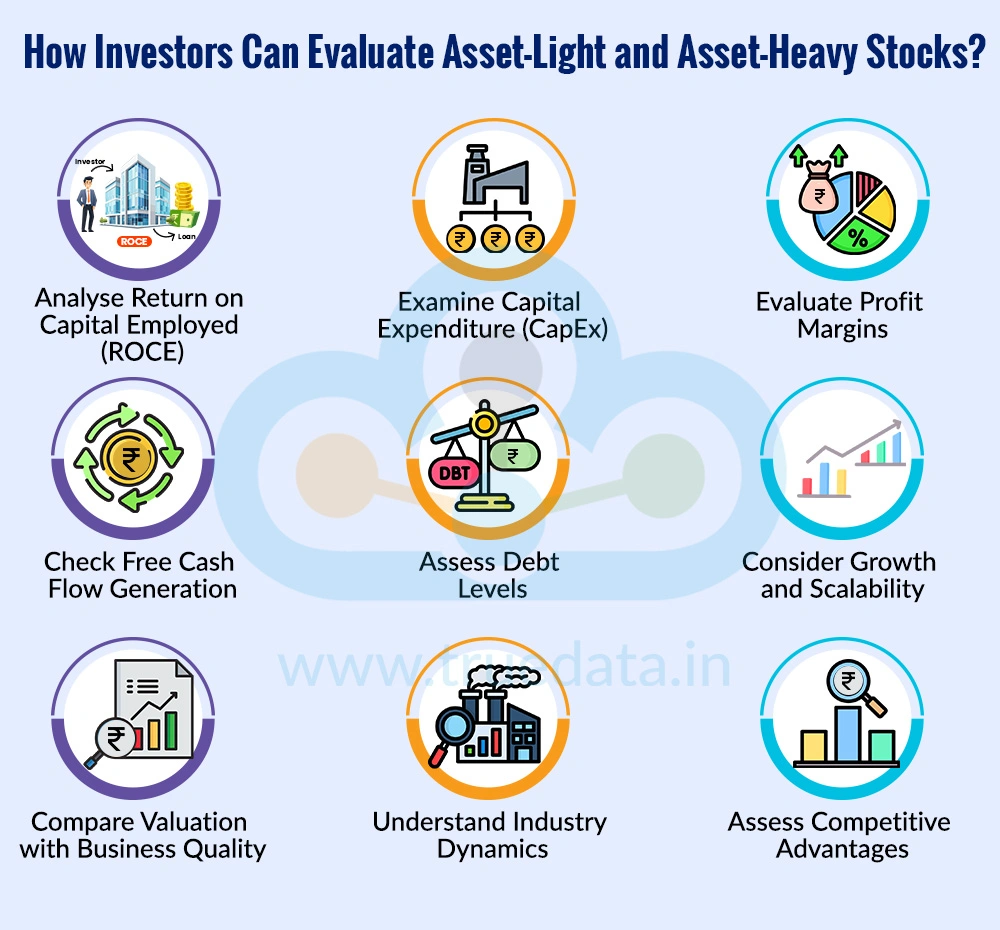
Choosing between asset-light and asset-heavy stocks is not about deciding which model is universally better. Instead, investors should understand how each business generates profits, uses capital, and creates value for shareholders. Here are some key factors to consider when evaluating these companies.

Analyse Return on Capital Employed (ROCE)

ROCE measures how efficiently a company uses its capital to generate profits. This ratio is particularly useful when comparing companies from the same industry. Asset-light businesses often have higher ROCE because they require less investment in physical assets. For example, a software company may generate significant profits without owning factories or large infrastructure. Asset-heavy companies usually have lower ROCE due to their large investments in plants, machinery, and equipment. As an investor, look for companies that consistently maintain strong ROCE over several years.

Examine Capital Expenditure (CapEx)

Capital expenditure refers to the money a company spends on acquiring or maintaining long-term assets. Asset-heavy businesses generally require regular and substantial CapEx to expand operations and keep assets in good condition. In contrast, asset-light companies often need lower capital investments, allowing them to retain more cash. Investors should assess whether a company's spending on assets is generating adequate growth and profitability.

Evaluate Profit Margins

Profit margins indicate how much profit a company retains from its revenue after covering expenses. Asset-light businesses often enjoy higher operating margins due to lower maintenance and infrastructure costs. Asset-heavy companies may face higher operating expenses due to asset upkeep, energy costs, and depreciation. Comparing profit margins over time can help investors understand the company's operational efficiency.

Check Free Cash Flow Generation

Free Cash Flow represents the cash left after a company has met its operating and capital expenditure requirements. Since asset-light businesses generally spend less on physical assets, they often generate stronger free cash flows. This cash can be used for business expansion, debt reduction,  dividends, or share buybacks. Asset-heavy companies can also generate healthy cash flows, but investors should ensure that large capital requirements are not putting pressure on the company's finances.

Assess Debt Levels

Debt is an important factor when analysing any stock, especially asset-heavy businesses. Many asset-heavy companies borrow funds to build factories, infrastructure, or production facilities. While this can support growth, excessive debt can increase financial risk during economic slowdowns. Investors should examine debt-to-equity ratios and interest coverage ratios to determine whether the company can comfortably manage its obligations.

Consider Growth and Scalability

One of the major advantages of asset-light businesses is their ability to scale quickly. They can often enter new markets and increase revenues without making massive investments in physical infrastructure. Asset-heavy companies usually expand more slowly because growth often requires significant capital investments. However, once their assets are established, they may benefit from strong market positions and stable cash flows. Investors should evaluate whether the company's growth strategy aligns with its business model.

Compare Valuation with Business Quality

A great business is not always a great investment if its stock is overpriced. Asset-light companies often trade at higher valuations as investors expect faster growth and stronger profitability. Asset-heavy companies may trade at lower valuations due to slower growth or cyclical risks. Investors should compare valuation metrics such as P/E ratio, P/B ratio, EV/EBITDA, and ROCE to determine whether the stock offers a reasonable balance between price and quality.

Understand Industry Dynamics

The effectiveness of a business model depends heavily on the industry in which the company operates. For example, IT services, digital platforms, and financial services are naturally suited to asset-light models. On the other hand, industries such as steel, power generation, railways, and telecom require substantial physical assets and are inherently asset-heavy. Therefore, investors should compare companies within the same sector rather than across completely different industries.

Assess Competitive Advantages

A company's competitive advantage plays a major role in its long-term success. Asset-heavy companies can create strong barriers to entry as building factories, power plants, or transportation networks requires significant capital and expertise. Asset-light businesses may rely on technology, brand value, customer loyalty, or network effects to stay ahead of competitors. Investors should evaluate whether the company has sustainable advantages that can support future growth.

What Are the Key Differences Between Asset-Light and Asset-Heavy Companies?

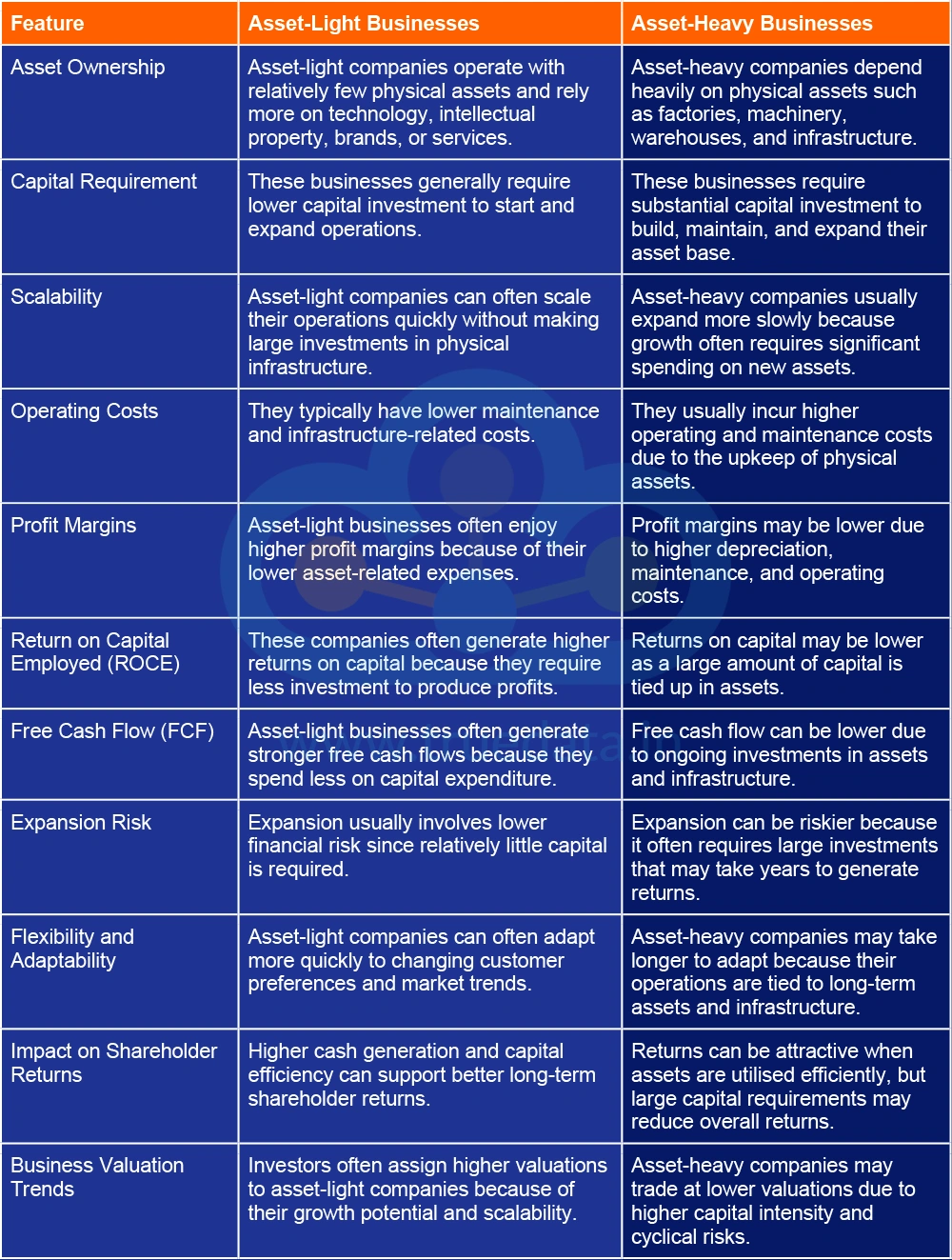
While asset-light companies are generally known for higher efficiency, scalability, and capital-light growth, asset-heavy companies can create lasting competitive advantages through their infrastructure and physical assets. The key differences between the two models are explained below. 

What Are the Key Differences Between Asset-Light and Asset-Heavy Companies

Feature

Asset-Light Businesses

Asset-Heavy Businesses

Asset Ownership

Asset-light companies operate with relatively few physical assets and rely more on technology, intellectual property, brands, or services.

Asset-heavy companies depend heavily on physical assets such as factories, machinery, warehouses, and infrastructure.

Capital Requirement

These businesses generally require lower capital investment to start and expand operations.

These businesses require substantial capital investment to build, maintain, and expand their asset base.

Scalability

Asset-light companies can often scale their operations quickly without making large investments in physical infrastructure.

Asset-heavy companies usually expand more slowly because growth often requires significant spending on new assets.

Operating Costs

They typically have lower maintenance and infrastructure-related costs. 

They usually incur higher operating and maintenance costs due to the upkeep of physical assets.

Profit Margins

Asset-light businesses often enjoy higher profit margins because of their lower asset-related expenses.

Profit margins may be lower due to higher depreciation, maintenance, and operating costs.

Return on Capital Employed (ROCE)

These companies often generate higher returns on capital because they require less investment to produce profits.

Returns on capital may be lower as a large amount of capital is tied up in assets.

Free Cash Flow (FCF)

Asset-light businesses often generate stronger free cash flows because they spend less on capital expenditure.

Free cash flow can be lower due to ongoing investments in assets and infrastructure.

Expansion Risk

Expansion usually involves lower financial risk since relatively little capital is required.

Expansion can be riskier because it often requires large investments that may take years to generate returns.

Flexibility and Adaptability

Asset-light companies can often adapt more quickly to changing customer preferences and market trends.

Asset-heavy companies may take longer to adapt because their operations are tied to long-term assets and infrastructure.

Impact on Shareholder Returns

Higher cash generation and capital efficiency can support better long-term shareholder returns.

Returns can be attractive when assets are utilised efficiently, but large capital requirements may reduce overall returns.

Business Valuation Trends

Investors often assign higher valuations to asset-light companies because of their growth potential and scalability.

Asset-heavy companies may trade at lower valuations due to higher capital intensity and cyclical risks.

Asset-Light vs Asset-Heavy - Which Model Delivers Better Returns?

Asset-Light vs Asset-Heavy - Which Model Delivers Better Returns

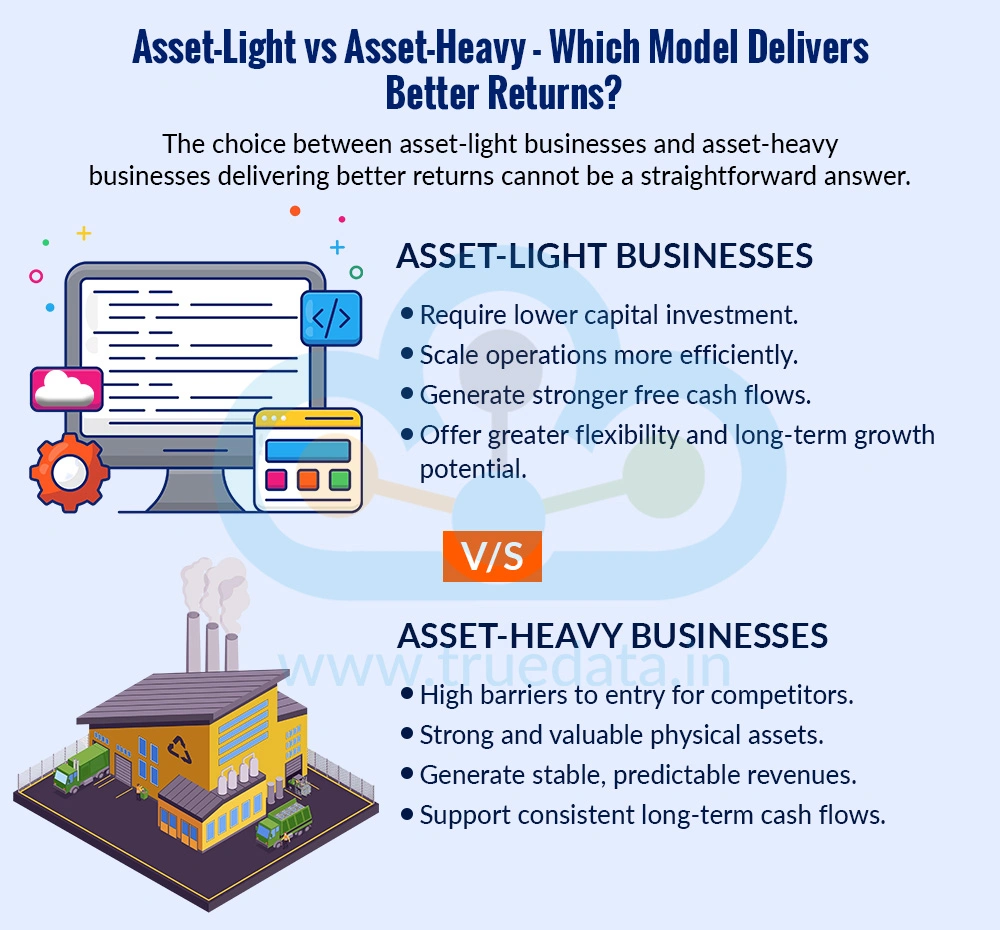
The choice between asset-light businesses and asset-heavy businesses delivering better returns cannot be a straightforward answer. The outcome in this scenario depends on factors such as industry, management quality, and market conditions. 

Asset-light companies often generate higher returns on capital as they require less investment in physical assets and can scale their operations more efficiently. They also tend to have stronger free cash flows and greater flexibility to adapt to changing customer needs. As a result, many successful technology, software, and service-based companies have delivered impressive long-term returns to investors.

However, asset-heavy businesses should not be overlooked. Companies operating in sectors such as infrastructure, utilities, manufacturing, and telecom often benefit from strong barriers to entry, as competitors need significant capital to enter these industries. Once established, these businesses can generate stable revenues and long-term cash flows. 

Thus, the better model is not necessarily the one with fewer or more assets, but rather the one that uses its assets efficiently, maintains strong profitability, and creates sustainable value for shareholders over time. 

What Are the Advantages and Risks of Each Business Model?

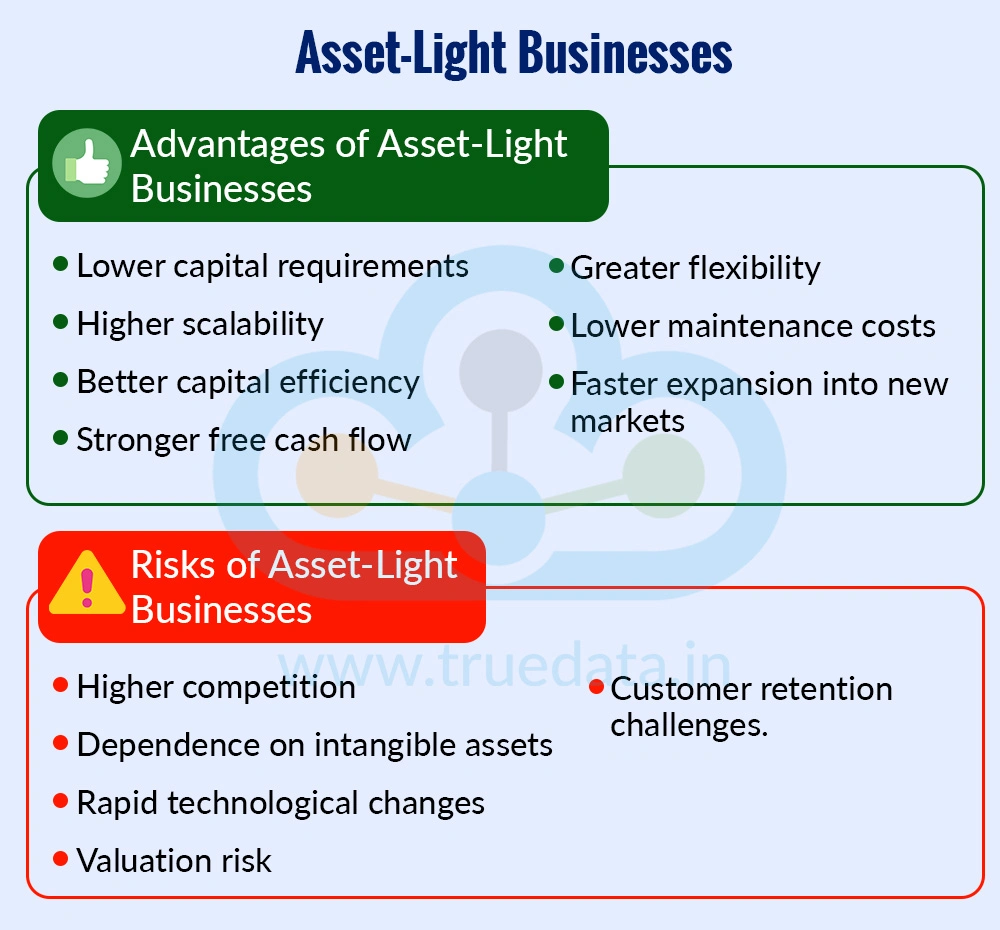
Both asset-light and asset-heavy business models have their own advantages and risks. Investors should focus on how effectively a company uses its resources rather than assuming one business model is always superior to the other. The key advantages and risks of each business model are explained below.

Asset-Light Businesses

Asset-Light Businesses

  • Advantages of Asset-Light Businesses

    • Lower capital requirements - These businesses need less money to start, operate, and expand.

    • Higher scalability - They can often grow quickly without investing heavily in new infrastructure.

    • Better capital efficiency - Less capital is tied up in physical assets, which can lead to higher returns on capital.

    • Stronger free cash flow - Lower spending on assets often leaves more cash available for growth, dividends, or share buybacks.

    • Greater flexibility - Asset-light companies can usually adapt more quickly to changing market conditions and customer preferences.

    • Lower maintenance costs - They spend less on maintaining factories, machinery, and other physical assets.

    • Faster expansion into new markets - Growth can often be achieved without building large facilities or infrastructure.

  • Risks of Asset-Light Businesses

    • Higher competition - Lower entry barriers can make it easier for new competitors to enter the market.

    • Dependence on intangible assets - Brand value, technology, or customer relationships can be difficult to maintain over time.

    • Rapid technological changes - Businesses may need to continuously innovate to stay relevant.

    • Valuation risk - Many asset-light companies trade at high valuations, which can increase downside risk if growth slows.

    • Customer retention challenges - Losing customers can have a significant impact on revenue and profitability.

Asset-Heavy Businesses

Asset-Heavy Businesses

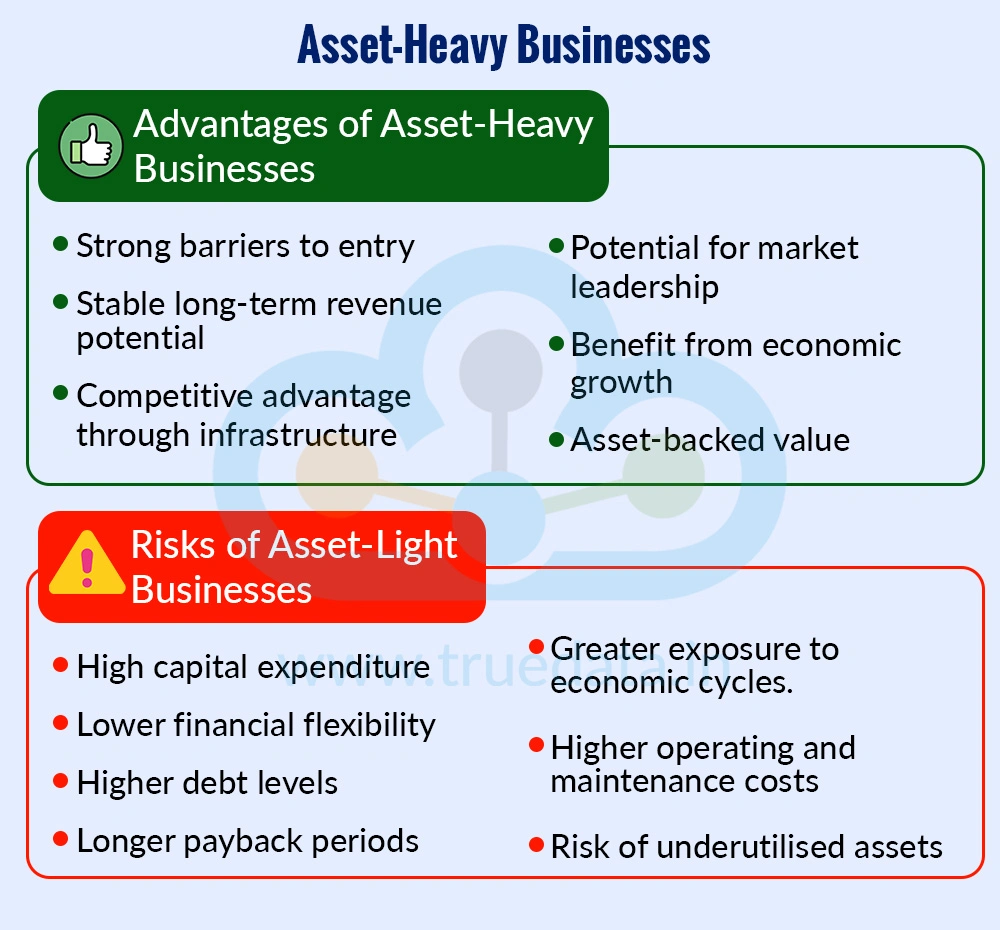
  • Advantages of Asset-Heavy Businesses

    • Strong barriers to entry - High capital requirements make it difficult for new competitors to enter the industry.

    • Stable long-term revenue potential - Physical assets can support revenue generation for many years.

    • Competitive advantage through infrastructure - Large facilities, production capacity, or networks can create lasting business strengths.

    • Potential for market leadership - Companies with significant assets often hold strong positions within their industries.

    • Benefit from economic growth - Rising demand for infrastructure, manufacturing, and industrial products can support long-term growth.

    • Asset-backed value - Physical assets can provide a degree of financial stability and business resilience.

  • Risks of Asset-Heavy Businesses

    • High capital expenditure - Large investments are required to build, upgrade, and maintain assets.

    • Lower financial flexibility - A significant portion of capital remains tied up in long-term assets.

    • Higher debt levels - Many asset-heavy companies rely on borrowing to fund expansion projects.

    • Greater exposure to economic cycles - Demand for their products and services may decline during economic slowdowns.

    • Higher operating and maintenance costs - Running and maintaining physical infrastructure can be expensive.

    • Longer payback periods - It may take years for large investments to generate meaningful returns.

    • Risk of underutilised assets - If demand weakens, expensive assets may not be used efficiently, reducing profitability.

Conclusion

Asset-light and asset-heavy businesses each have their own strengths, and neither model is inherently better than the other. While asset-light companies often benefit from higher capital efficiency, faster growth, and stronger returns on capital, asset-heavy businesses can enjoy strong competitive advantages, stable cash flows, and high barriers to entry. Thus, the key is not to focus solely on the business model but to evaluate how effectively a company uses its assets, manages its finances, and creates long-term value. By understanding these factors, investors can make more informed decisions and build a stronger portfolio for long-term wealth creation.

This article explains the two polar-opposite business approaches and their nuances. Let us know your thoughts on the topic or if you need further information on the same, and we will address it soon. 

Till then, happy Reading!


Read More: Family-Owned vs Professionally Managed Firms - Does management style impact financial performance?

Frequently Asked Questions

Asset-light businesses typically scale faster because they do not need to invest heavily in factories, machinery, or other physical assets to grow. This allows them to expand operations, enter new markets, and increase revenue more quickly than most asset-heavy businesses.

Asset-light businesses often generate higher returns on capital because they require less investment to grow and operate. Asset-heavy businesses may deliver steadier returns over the long term, but their large capital requirements can sometimes limit overall profitability.

Asset-light businesses are often preferable when investors are looking for companies with high growth potential, strong capital efficiency, and the ability to scale quickly. They can also be attractive in rapidly changing industries where flexibility and innovation are important for long-term success.

Asset-heavy businesses may be preferable when investors are seeking stable cash flows, strong barriers to entry, and exposure to sectors such as infrastructure, utilities, or manufacturing. They can also benefit during periods of economic growth when demand for physical assets and industrial output increases.

Yes, many companies operate using a hybrid model that combines elements of both asset-light and asset-heavy businesses. For example, a company may own some key assets while outsourcing other operations, allowing it to balance growth, efficiency, and control.

Both models can attract external funding, but asset-light businesses often attract more interest from investors because they can scale quickly and usually require less capital to grow. However, asset-heavy companies may also secure significant funding when they operate in sectors with strong long-term demand, such as infrastructure, energy, or manufacturing.

Capital efficiency is commonly measured using ratios such as Return on Capital Employed (ROCE) and Return on Invested Capital (ROIC), which show how effectively a company generates profits from the capital invested in the business. A higher ratio generally indicates that the company is using its capital more efficiently.

Yes, companies can shift from an asset-light to an asset-heavy model, or vice versa, depending on their growth strategy and market conditions. For example, a company may start by outsourcing operations to remain asset-light and later invest in its own facilities to gain greater control and improve profitability.
Marisha Bhatt

Marisha Bhatt is a financial content writer @TrueData.
She writes with the sole aim of simplifying complex financial concepts and jargon while attempting to clarify technical and fundamental analysis concepts of the stock markets. The ultimate goal is to spread vital knowledge and benefit the maximum audience. Her Chartered Accountant background acts as the knowledge base to help clarify crucial concepts and create a sound investment portfolio.

40 Comments
K
Kanish Kumar
· July 17, 2026

A very informative blog. I especially liked how you explained the impact of capital investment, scalability, and profitability when comparing these two business models.

·
Marisha Bhatt Author
Kanish Kumar · July 19, 2026

Thank you for your thoughtful feedback! We are delighted you found the comparison useful. Understanding how capital investment, scalability, and profitability shape different business models can help investors evaluate companies more effectively and make well-informed long-term investment decisions.

·
V
Vaibhav
· July 17, 2026

Great read! Investors often focus only on profits, but understanding a company's business model is equally important.

·
Marisha Bhatt Author
Vaibhav · July 19, 2026

Thank you for your thoughtful feedback! We are glad you enjoyed the article. Yes, a company's profits are important, but understanding its business model helps investors assess how sustainable those profits are and whether the business can create long-term value.

·
S
Santhosh
· July 17, 2026

It would be great if you could also include a few listed Indian companies that follow each model.

·
Marisha Bhatt Author
Santhosh · July 19, 2026

Thank you for the great suggestion! We are glad you found the article helpful. Adding real-world examples can certainly make the concepts easier to understand. For instance, companies like Infosys, TCS, and Naukri (Info Edge) are often considered asset-light businesses, while UltraTech Cement, Tata Steel, and NTPC are examples of asset-heavy businesses.

·
K
Keshwick
· July 17, 2026

Excellent blog and this is a useful guide for anyone learning fundamental analysis

·
Marisha Bhatt Author
Keshwick · July 19, 2026

Thank you for your kind words! We are delighted you found the article useful. Understanding whether a company follows an asset-light or asset-heavy business model is an important part of fundamental analysis, as it provides valuable insight into its growth potential, capital requirements, and long-term profitability. Happy investing!

·
S
Sanam
· July 17, 2026

A comparison table summarizing the key differences would make the article even more useful for quick reference.

·
Marisha Bhatt Author
Sanam · July 19, 2026

Thank you for the valuable suggestion! A comparison table highlighting factors such as capital investment, scalability, profitability, and risk would make it much easier for readers to quickly compare asset-light and asset-heavy business models. We will certainly consider adding one in a future update to make the article even more useful for investors.

·
T
Tom
· July 17, 2026

Very insightful blog. It helped me understand why asset-light businesses often scale faster, while asset-heavy companies can have stronger operational control.

·
Marisha Bhatt Author
Tom · July 19, 2026

Thank you for your thoughtful feedback! We are glad the article helped clarify the strengths of both business models. Yes, asset-light businesses can often scale more quickly with lower capital requirements, while asset-heavy companies may benefit from greater operational control and higher entry barriers. Understanding these differences can help investors evaluate businesses more effectively based on their long-term goals.

·
A
Abinav Kumar
· July 17, 2026

Thanks for sharing this. A great addition to your fundamental analysis series.

·
Marisha Bhatt Author
Abinav Kumar · July 19, 2026

Thank you for your encouraging words! We are glad you found this article valuable. Our goal with the fundamental analysis series is to simplify important concepts so investors can make more informed long-term investment decisions. Happy reading and investing!

·
S
Sanju Reddy
· July 17, 2026

Good. This is a useful guide for anyone learning fundamental analysis.

·
Marisha Bhatt Author
Sanju Reddy · July 19, 2026

Thank you for your kind feedback! We are happy to know you found the article useful. Stay tuned for more informative content on TrueData!

·
S
Shruthi
· July 18, 2026

Good blog

·
Marisha Bhatt Author
Shruthi · July 19, 2026

Thank you for your valuable feedback! Watch this space for more informative content on TrueData!

·
D
Deivik
· July 20, 2026

Great explanation of the differences between asset-light and asset-heavy business models. The examples make the topic easy to understand.

·
Marisha Bhatt Author
Deivik · July 22, 2026

Thank you for your kind words! We are delighted that the explanation and examples made the differences between asset-light and asset-heavy business models easy to understand. Our goal is to simplify fundamental concepts so investors can better evaluate businesses and make more informed long-term investment decisions. Happy investing!

·
A
Aravind
· July 20, 2026

This is a helpful post for anyone trying to understand how different business models impact profitability and long-term growth.

·
Marisha Bhatt Author
Aravind · July 22, 2026

Thank you for your thoughtful feedback! We are glad you found the post useful. Understanding how asset-light and asset-heavy business models influence profitability, growth, and capital requirements can help investors make more informed long-term investment decisions. Happy investing!

·
S
Sunil
· July 20, 2026

I liked how the blog compares both models without suggesting that one is always better.

·
Marisha Bhatt Author
Sunil · July 22, 2026

Thank you for your thoughtful feedback! We are glad you appreciated the balanced approach. Every business model has its own strengths and challenges, and understanding them in the right context helps investors make better decisions based on a company's industry, strategy, and long-term goals. Happy investing!

·
R
Ravichandar
· July 20, 2026

Well-written and informative.

·
Marisha Bhatt Author
Ravichandar · July 22, 2026

Thank you for your kind words! We are delighted that you found the article informative. Our goal is to make important investing concepts easy to understand so investors can evaluate businesses with greater confidence and make well-informed long-term decisions. Happy investing!

·
V
Vivek Osla
· July 20, 2026

One suggestion, Adding financial ratio examples like ROCE or ROA could enhance the analysis.

·
Marisha Bhatt Author
Vivek Osla · July 22, 2026

Thank you for the thoughtful suggestion! We will consider adding it as a future update to make the article even more useful for investors. Stay tuned!

·
K
Karan Singh
· July 20, 2026

Easy to read and understand.

·
Marisha Bhatt Author
Karan Singh · July 22, 2026

Thank you for your kind feedback! We are glad you found the article easy to read and understand. Our aim is to simplify important investing concepts so readers can confidently evaluate different business models and make better-informed investment decisions. Happy investing!

·
S
Sudharsan
· July 21, 2026

Great Blog

·
Marisha Bhatt Author
Sudharsan · July 22, 2026

Thank you, glad you like our post! Stay tuned for more informative posts on TrueData!

·
C
chowthri
· July 27, 2026

I enjoyed reading this. Understanding the differences between these models helps investors set more realistic expectations about growth, margins, and capital requirements.

·
Marisha Bhatt Author
chowthri · July 27, 2026

Thank you so much for your thoughtful feedback! We are delighted to hear that you enjoyed the article. Understanding the differences between asset-light and asset-heavy business models helps investors set realistic expectations about growth potential, profitability, capital requirements, and long-term returns. We truly appreciate your support and look forward to sharing more insightful investment content. Happy investing!

·
Y
Yuvan
· July 30, 2026

Good Post

·
Meyhar Singh
Yuvan · July 30, 2026

Thank you so much ! Glad you liked it

·
S
Saran Kumar
· August 02, 2026

Nice Blog

·
Marisha Bhatt Author
Saran Kumar · August 03, 2026

Thank you for your valuable feedback! Stay tuned for more informative content on TrueData!

·
R
Rahul
· August 07, 2026

Excellent blog

·
Marisha Bhatt Author
Rahul · August 10, 2026

Thank you for appreciating our work! Watch this space for more interesting content on TrueData!

·

Related Articles

SEE ALL
Corporate Data
Corporate Data
Investing Smarter: The Power of Corporate Data and Market Sentiment Analysis

Thestock market never stands still, and prices swing constantly with every new h...

Corporate Data
Corporate Data
Understanding Quarterly vs Annual Corporate Data

Corporate data is more than just the numbers of a company. They can show what is...

Corporate Data
Corporate Data
Key Corporate Data Every Investor Must Track Before Investing

Investing is not just about numbers on a screen. It is about understanding the s...