Corporate Data

How to Analyse Businesses with High Intangible Assets?

Marisha Bhatt · 26 May 2026 · 20 mins read · 11 Comments

how-to-analyse-business-with-high-intangible-assets

A few decades ago, asset-heavy businesses were considered to be the golden goose with a good probability of success. Then came the tech-driven business models, not asset-light, particularly, but their assets were intangible, like brand value, technology, data and intellectual property. Today, the top 15 firms in India have an intangible asset intensity of around 81%, i.e., these companies are largely driven by knowledge, brand power, and digital assets. The trend continues with our unicorn startups, too, like Zomato, Nykaa, etc. So how do you analyse these businesses? What are the key points to focus on? Get answers to these questions and more in this blog and enrich your investment journey. 

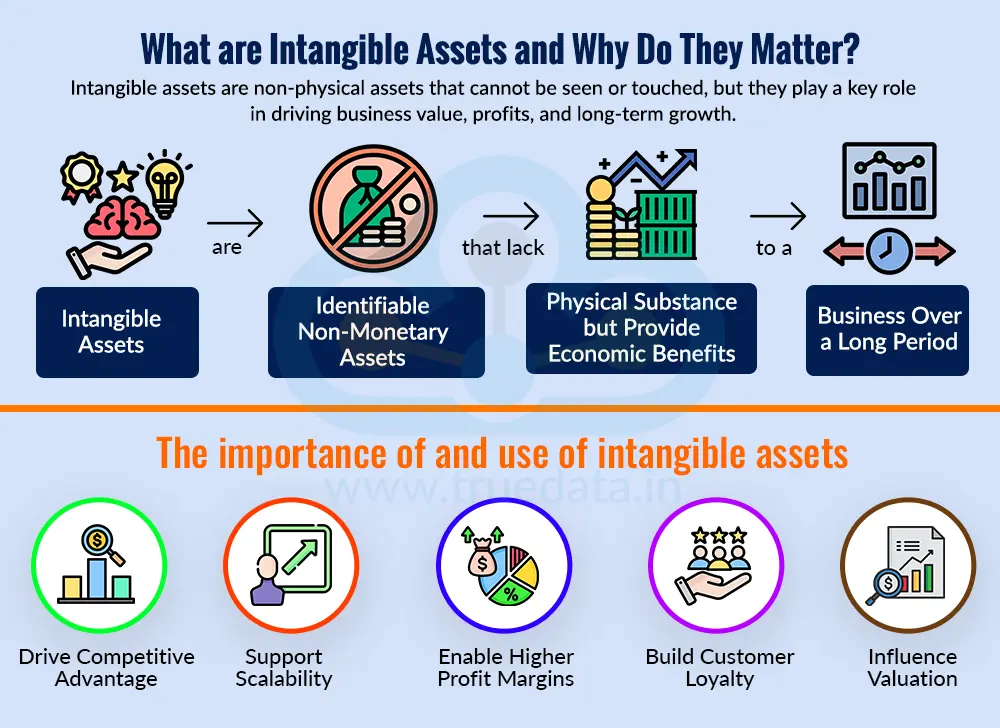
What are Intangible Assets and Why Do They Matter?

What are Intangible Assets and Why Do They Matter

Intangible assets are assets that do not have a physical form, but still create significant value for a business. Unlike factories, machines, or land, these assets cannot be seen or touched. However, they often play a much bigger role in driving profits and long-term growth. Intangible assets include things like brand reputation, patents, trademarks, software, data, customer relationships, and intellectual property. For example, a company’s strong brand can allow it to charge higher prices, while proprietary technology or software can give it a competitive edge. In today’s digital and knowledge-driven economy, many companies, especially in sectors like IT, pharma, and consumer brands, derive most of their value from these invisible assets rather than physical ones.

The importance and use of intangible assets in a business can be explained below.

  • Drive Competitive Advantage - Intangible assets help companies stand out from competitors. A strong brand or unique technology creates a moat, making it difficult for others to replicate the business.

  • Support Scalability - Unlike physical assets, intangible assets like software or platforms can be scaled quickly with low additional cost, helping businesses grow faster.

  • Enable Higher Profit Margins - Companies with strong intangible assets can often charge premium prices or operate more efficiently, leading to better margins and profitability.

  • Build Customer Loyalty - Brands, user experience, and trust play a big role in retaining customers, especially in sectors like FMCG, e-commerce, and fintech.

  • Influence Valuation - Modern businesses with strong intangible assets often trade at higher valuations, as investors expect sustained growth and long-term earnings power.

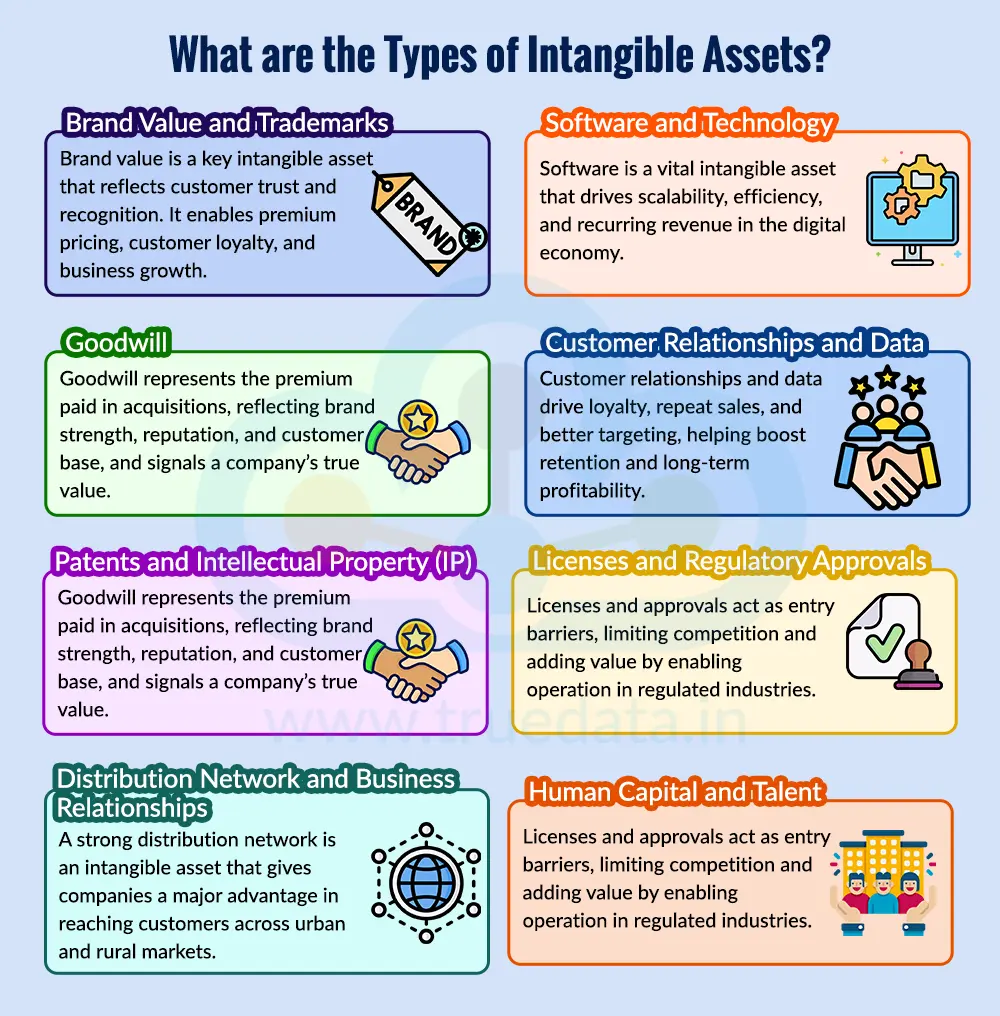
What are the Types of Intangible Assets?

What are the Types of Intangible Assets

Intangible assets come in different forms, and each type contributes differently to a company’s growth, profitability, and competitive advantage. Understanding these types helps investors in identifying where the real value of a business lies. 

Brand Value and Trademarks

Brand value is one of the most powerful intangible assets a company can have. It represents how well customers recognise and trust a brand. Trademarks protect brand elements like logos, names, and taglines. A strong brand allows companies to charge premium prices, retain customers, and expand easily into new products. For example, well-known consumer companies benefit hugely from brand recall, which directly impacts their sales and margins.

Software and Technology

In today’s digital economy, software is a key intangible asset. This includes internally developed platforms, applications, algorithms, and IT systems. For IT companies, SaaS businesses, and digital platforms, software enables scalability, efficiency, and recurring revenue models, making it a core value driver.

Goodwill

Goodwill arises when one company acquires another at a price higher than its net tangible assets. It reflects factors like brand strength, customer base, and reputation. While goodwill is not a directly usable asset, it signals the premium value of a business, and investors should track whether it is justified and sustainable.

Customer Relationships and Data

Customer relationships include loyalty, repeat purchases, and long-term engagement with users. Along with this, customer data, such as buying behaviour and preferences, is a valuable asset. Companies that understand their customers well can target better, sell more, and improve retention, which directly boosts profitability over time.

Patents and Intellectual Property (IP)

Patents give a company exclusive rights to use or sell an invention for a certain period. Intellectual property also includes copyrights and proprietary technology. This type of asset is especially important in sectors like pharma, biotech, and technology, where innovation drives growth. Companies with strong IP can protect their products from competition and earn high returns over time.

Licenses and Regulatory Approvals

Some businesses require licenses or approvals to operate, such as in telecom, banking, or pharmaceuticals. These permissions can act as entry barriers, limiting competition. Such assets are valuable because they allow companies to operate in regulated industries where not everyone can easily enter.

Distribution Network and Business Relationships

A strong distribution network, like dealer networks, supplier relationships, or partnerships, is also considered to be an intangible asset. In India, companies with deep distribution reach, especially in FMCG and retail, gain a significant advantage in reaching customers across urban and rural markets.

Human Capital and Talent

Employees, skills, and management expertise are often overlooked but are critical intangible assets. A strong team can drive innovation, execute strategy effectively, and build long-term value. In sectors like IT and startups, talent is often the biggest asset.

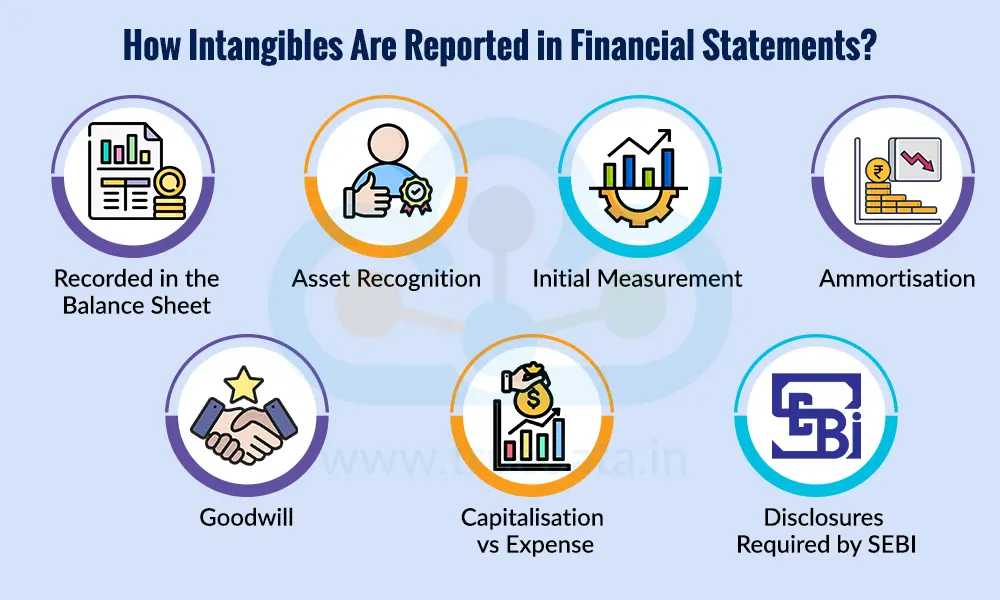
How Intangibles Are Reported in Financial Statements?

How Intangibles Are Reported in Financial Statements

SEBI and the Companies Act 2013, along with the prescribed Indian Accounting Standards, provide specific provisions and rules that govern and direct the reporting of intangible assets in the financial statements. These provisions ensure that the value of intangible assets is correctly and accurately reflected in the books of accounts, thereby enabling efficient business valuation and analysis. These provisions and rules include,

Recorded in the Balance Sheet

Intangible assets are part of a company’s long-term assets and are recorded in the company's balance sheet under the head non-current assets. These assets have to be grouped under a separate head, ‘Intangible Assets, and have to be recorded at the net value. However, it is not sufficient to look at the block of intangible assets in the balance sheet. Investors should also look at the ‘Notes to Account’ to get further details on the company’s Intangible assets. The details included in the Notes to Accounts include, 

  • Types of intangible assets

  • Opening and closing values

  • Additions, deletions, and amortisation

This section is crucial for investors because it gives clarity on what exactly the company owns and how those values are changing over time.

Asset Recognition

As per Indian Accounting Standards (Ind AS), a company can record an intangible asset only when it is clearly identifiable (either separable or legally protected) and when it is expected to generate measurable future economic benefits. Due to these stringent rules, many valuable internally created assets like brand reputation, customer loyalty, or strong management are not shown in financial statements since they are difficult to separate and reliably value. Hence, the company’s true value may often be higher than what appears on its balance sheet. Thus, investors should not rely only on reported numbers but also consider qualitative strengths that drive long-term growth. 

Initial Measurement

Under Indian Accounting Standards (Ind AS), when an intangible asset is first recognised, it is measured at its cost, i.e., the total amount the company actually spends to acquire or create it. This includes not just the purchase price but also directly related expenses like legal fees, registration charges, and development costs (only if strict conditions are met, such as technical feasibility and future benefits being reasonably certain). For example, if a company buys software, a patent, or a license, it records the asset at the exact amount paid, making the valuation reliable and objective. However, if a company builds something internally, like a strong brand, customer trust, or market reputation, these are usually not capitalised. This can be attributed to their cost and future value not being accurately measured, even though they may be extremely valuable. As a result, the reported asset value can be lower than the actual economic value of the business, which is an important gap investors should keep in mind while analysing financial statements.

Ammortisation

Most intangible assets (except goodwill) are amortised as per the provisions under the Indian Accounting Standards (Ind AS). Their cost is gradually charged as an expense over a period of a few years of their useful life to the business rather than showing the full cost in one year. This practice is essentially similar to depreciation in the case of fixed assets to match the expenses with the benefits the asset provides over time. This amortisation amount appears in the Profit and Loss Statement and reduces reported profits each year. It is a non-cash expense and more of an accounting adjustment, so investors should understand that no actual cash is going out at the time of recording it, as it was already spent earlier when the asset was purchased. Therefore, while amortisation lowers accounting profits, it does not directly affect cash flows, making it important for investors to analyse both profit and cash flow metrics together to get a clearer picture of a company’s real financial performance.

Goodwill

Goodwill is created when a company buys another business for a price higher than the value of its identifiable net assets (assets minus liabilities). This extra amount represents things that are not easily measurable, such as brand reputation, customer relationships, or expected future growth. Under Indian Accounting Standards (Ind AS), goodwill is treated differently from other intangible assets. It is not amortised every year, meaning it is not gradually reduced like software or licenses. Instead, companies are required to check their value at least once a year through an impairment test. If the acquired business is not performing as expected, and its value has fallen, the company must reduce (impair) the goodwill and record this loss in the Profit & Loss statement.

This is important because a continuously rising goodwill balance may indicate that the company is overpaying for acquisitions, especially if profits and cash flows are not growing accordingly. A sudden impairment can significantly reduce reported profits and signal that past acquisitions have not delivered the expected value. Therefore, it is essential to track whether goodwill is supported by actual business performance, rather than just accounting entries.

Capitalisation vs Expense

One of the most important and sometimes confusing areas in accounting for intangible assets is whether a company should capitalise a cost (show it as an asset on the balance sheet) or expense it immediately (record it in the Profit & Loss statement). This decision depends on whether the spending is expected to create future economic benefits as per the provisions under the Indian Accounting Standards. For example, research costs (where the outcome is uncertain) are usually expensed right away. However, development costs (where the product or technology is likely to succeed) can be capitalised if certain conditions are met, such as technical feasibility and the ability to generate future revenue. This distinction is crucial as it directly affects reported profits. A company capitalising more costs will have higher current profits, since those expenses are not immediately charged to the P&L. Instead, they are spread over future years through amortisation. On the other hand, expensing costs immediately reduces profits today but can make future earnings look stronger.

This creates room for management judgement and potential manipulation. Companies may be tempted to capitalise more costs to show better short-term performance. Therefore, investors should carefully read the accounting policies in annual reports, check whether the company is consistent over time, and watch for sudden increases in capitalised expenses. A sharp rise without a clear business justification can be a warning sign that profits are being overstated rather than genuinely earned.

Disclosures Required by SEBI

SEBI mandates listed companies to provide detailed disclosures on intangible assets in annual reports and periodic financial results to ensure transparency for investors. Companies must provide the following, 

  • Break-up of intangible assets (such as software, patents, goodwill, etc.)

  • Changes during the year (like additions, disposals, or amortisation). 

  • Disclose any impairment losses (which indicate a decline in the value of these assets) 

  • Explain the accounting policies they follow (especially around capitalisation, amortisation, and impairment testing).

These disclosures are extremely valuable because they go beyond just headline numbers. They help investors understand what is driving the company’s value, whether intangible assets are genuinely creating returns, and if there are any warning signs. For example, frequent impairment losses or large, unexplained increases in intangible assets could indicate over-optimistic assumptions or aggressive accounting. Similarly, consistent and transparent disclosures signal better governance.  

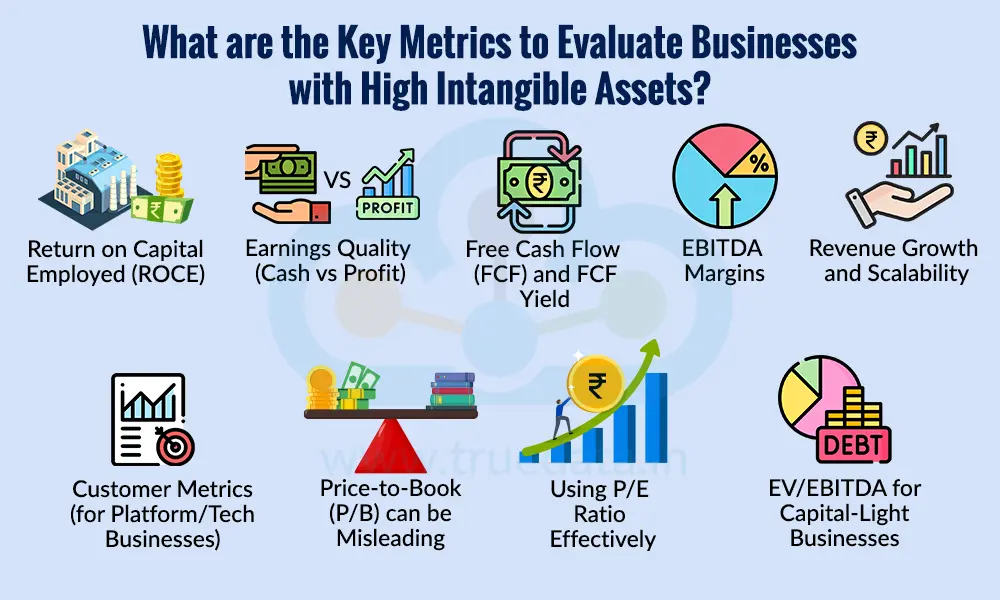
What are the Key Metrics to Evaluate Businesses with High Intangible Assets? 

What are the Key Metrics to Evaluate Businesses with High Intangible Assets

Businesses with high intangible assets (like brands, software, patents, or customer relationships) require a slightly different lens for evaluation. Traditional metrics alone can be misleading, so investors need to focus on a mix of profitability, cash flow, and growth quality.

Return on Capital Employed (ROCE)

Return on Capital Employed (ROCE) tells you how efficiently a company is using its total capital (both equity and debt) to generate profits, i.e., the profit earned by the business for every rupee invested in it. In intangible-heavy businesses like IT, pharma, or digital platforms, the need for physical assets is relatively low. Instead, value comes from things like software, patents, or brand strength. Such companies often report higher ROCE compared to traditional asset-heavy businesses. A consistently high ROCE is a strong signal that the company has a competitive advantage, such as strong intellectual property or brand power, which allows it to generate more profits without needing large investments in physical assets.

Earnings Quality (Cash vs Profit)

Earnings quality refers to the level of a company’s reported profits being supported by actual cash flows. A simple way to check this is by comparing net profit with operating cash flow. If both move in the same direction and are broadly similar over time, it indicates good earnings quality. However, if profits are high but cash flows are weak, it could mean that the company is using aggressive accounting methods or that it is heavily reinvesting in areas like marketing or product development. This is quite common in intangible-driven businesses. In such businesses, profits can fluctuate due to accounting treatments like amortisation, but cash flows reveal the true financial strength and sustainability of the company.

Free Cash Flow (FCF) and FCF Yield

Free Cash Flow (FCF) represents the actual cash a company generates after covering all its expenses and necessary investments. FCF Yield goes a step further and compares this cash flow to the company’s market value, helping investors understand how much cash return they are getting on their investment. In intangible-heavy businesses, many important investments, like research, branding, or customer acquisition, are often recorded as expenses in the Profit & Loss statement. This reduces reported profits, even though the business may still be generating strong cash flows. FCF gives a clearer and more reliable picture of a company’s real earning power than accounting profits, making it a key metric for investors analysing such businesses.

EBITDA Margins

EBITDA (Earnings Before Interest, Taxes, Depreciation, and Amortisation) focuses on a company’s core operating performance by excluding non-cash expenses like depreciation and amortisation. In businesses with significant intangible assets, amortisation can reduce reported profits even though it does not involve any actual cash outflow. EBITDA removes this distortion and gives a clearer view of how well the core business is performing. EBITDA margins help investors understand the underlying profitability of the business, especially when accounting charges related to intangible assets make net profits look lower.

Revenue Growth and Scalability

Revenue growth shows how fast a company is expanding its business. However, more important than just growth is business scalability. In intangible-heavy businesses, once the initial investment in technology, platform, or brand is made, the cost of serving additional customers is often very low. Thus, as revenue grows, profits can increase at a faster rate, leading to improved margins over time. For example, a software company can sell the same product to thousands of customers without significantly increasing costs. Strong and consistent growth combined with improving margins indicates that the business has scalable economics, which is a key advantage of intangible-driven models.

Customer Metrics (for Platform/Tech Businesses) 

Traditional financial metrics alone are not enough for platform-based and tech-driven companies. Customer-related metrics provide deeper insights into business performance. These metrics include, 

  • Customer Acquisition Cost (CAC) is the amount a company spends to acquire a new customer.

  • Lifetime Value (LTV) estimates the total revenue a company can earn from a customer over time.

  • Retention rate indicates the percentage of customers who continue using the product or service.

These metrics help investors understand how strong the company’s brand, customer loyalty, and network effects are. For example, a company with high retention and strong LTV compared to CAC is likely building a sustainable business. These metrics reflect the strength of intangible assets like user trust, brand value, and ecosystem stickiness, which are often the real drivers of long-term success in such businesses.

Price-to-Book (P/B) can be Misleading

The Price-to-Book (P/B) Ratio compares a company’s market value with its book value (the value of assets shown in the balance sheet). This works well for traditional businesses with factories and machinery, but not for companies driven by intangible assets. In intangible-heavy businesses, key assets like brand value, software, data, or customer relationships are often not fully recorded in the books, especially if they are built internally. As a result, the book value appears lower than the true economic value of the business. A company may look ‘expensive’ based on P/B, but in reality, it may be fairly valued or even undervalued because its most valuable assets are not visible in accounting numbers.

Using P/E Ratio Effectively

The Price-to-Earnings (P/E) Ratio compares a company’s stock price with its earnings. It is one of the most commonly used valuation metrics, but it needs careful interpretation for intangible-driven businesses.

Investors should not look at P/E in isolation; it should be used as follows - 

  • Compared with industry peers

  • Evaluated along with the company’s growth rate

  • Checked for consistency and quality of earnings over time

High P/E ratios are common in such businesses as investors expect strong future growth. However, this premium is justified only if the company’s earnings are scalable, predictable, and sustainable.

EV/EBITDA for Capital-Light Businesses

EV/EBITDA compares a company’s total value (including debt and equity) with its operating earnings before non-cash expenses. This metric is particularly useful for intangible-heavy and capital-light businesses because it removes the impact of,

  • Different capital structures (debt vs equity)

  • Accounting differences like depreciation and amortisation

EV/EBITDA allows investors to compare companies on a more equal basis, even when their accounting policies or capital structures differ. It gives a clearer picture of the company’s core operating performance.

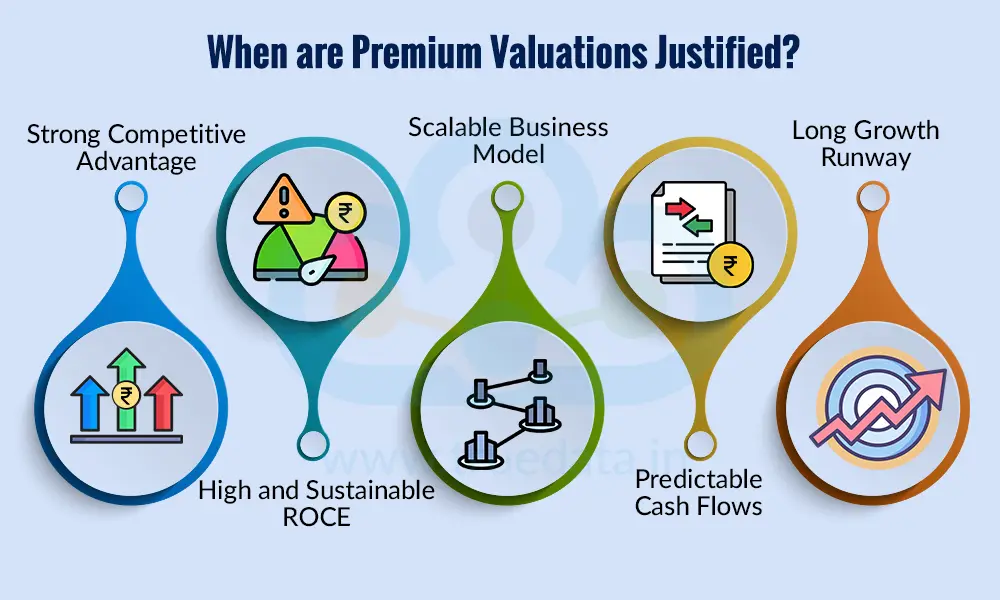
When are Premium Valuations Justified?

when-are-premium-valuations-justified

A business with high intangible assets and a premium valuation can often raise alarms. However, high valuations are not always a red flag. They can be justified if,

  • Strong Competitive Advantage - If the company has a strong brand, patents, or network effects, competitors cannot easily replicate it.

  • High and Sustainable ROCE - Consistently high returns indicate efficient use of capital and durable business quality.

  • Scalable Business Model - Digital, platform, or IP-driven businesses can grow revenue faster than costs.

  • Predictable Cash Flows - Stable and growing cash flows reduce risk and justify higher multiples.

  • Long Growth Runway - If the company operates in a large, underpenetrated market, future growth can support current valuations.

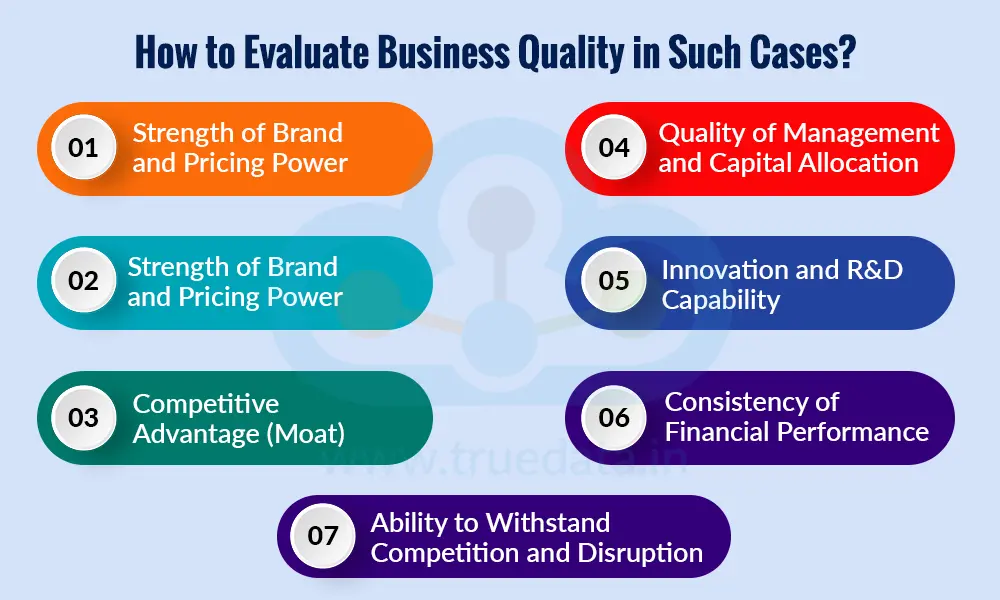
How to Evaluate Business Quality in Such Cases?

How to Evaluate Business Quality in Such Cases

When a company’s value comes largely from intangible assets, evaluating business quality requires going beyond financial numbers. Investors need to focus on qualitative factors that indicate whether the business can sustain growth and profits over the long term. Some factors to consider in such cases are highlighted below. 

  • Strength of Brand and Pricing Power - A strong brand is one of the most valuable intangible assets. It reflects how much customers trust and prefer a company’s products or services. Companies with strong brands can often charge higher prices without losing customers, which directly improves profitability. For example, in sectors like FMCG, retail, or digital platforms, brand recall plays a huge role in driving repeat purchases. Strong pricing power indicates that the company has customer trust and differentiation, making its earnings more stable and resilient.

  • Scalability of the Business Model - Scalability means the ability of a business to grow revenue without a proportional increase in costs. Many intangible-driven businesses, like software or platform companies, can serve more customers at very low additional cost once the initial investment is made. This leads to improving margins as the business grows. High scalability allows companies to grow faster and become more profitable over time, making them attractive investments.

  • Competitive Advantage (Moat) - A competitive advantage, or ‘moat’, refers to what makes a business difficult to replicate. In intangible-heavy companies, this could come from,

    • Technology or proprietary platforms

    • Network effects (more users increase value)

    • Strong distribution or ecosystem

Such advantages help the company maintain its position even when competition increases. A strong moat ensures that the company can protect its profits and market share over time, which is critical for long-term investors.

  • Quality of Management and Capital Allocation - Management plays a critical role in businesses driven by intangible assets. Since many decisions, like branding, R&D, or acquisitions, involve judgement, the quality and integrity of management become very important. Good management allocates capital wisely, avoids overpaying for acquisitions, and focuses on long-term value creation rather than short-term gains. Strong management ensures that intangible investments translate into real business value and shareholder returns.

  • Innovation and R&D Capability - For many intangible-heavy businesses, continuous innovation is essential. This includes investment in research and development (R&D), new product launches, and technological improvements. Companies that consistently innovate are better positioned to stay relevant and ahead of competitors. Strong innovation capability ensures the business can adapt to changes and sustain its competitive edge in dynamic industries.

  • Consistency of Financial Performance - Even though intangible businesses may have fluctuating profits due to accounting treatments, strong companies show consistent growth in revenue, cash flows, and margins over time. Sudden spikes or drops without clear reasons can be a warning sign. Consistency indicates that the business model is stable, scalable, and well-managed.

  • Ability to Withstand Competition and Disruption - Intangible-heavy businesses often operate in fast-changing industries. New technologies or competitors can disrupt even strong companies. Investors should assess how well the company is prepared to handle such risks, whether through innovation, diversification, or strong customer relationships. The ability to adapt ensures the company can survive and grow even in a competitive and evolving environment.

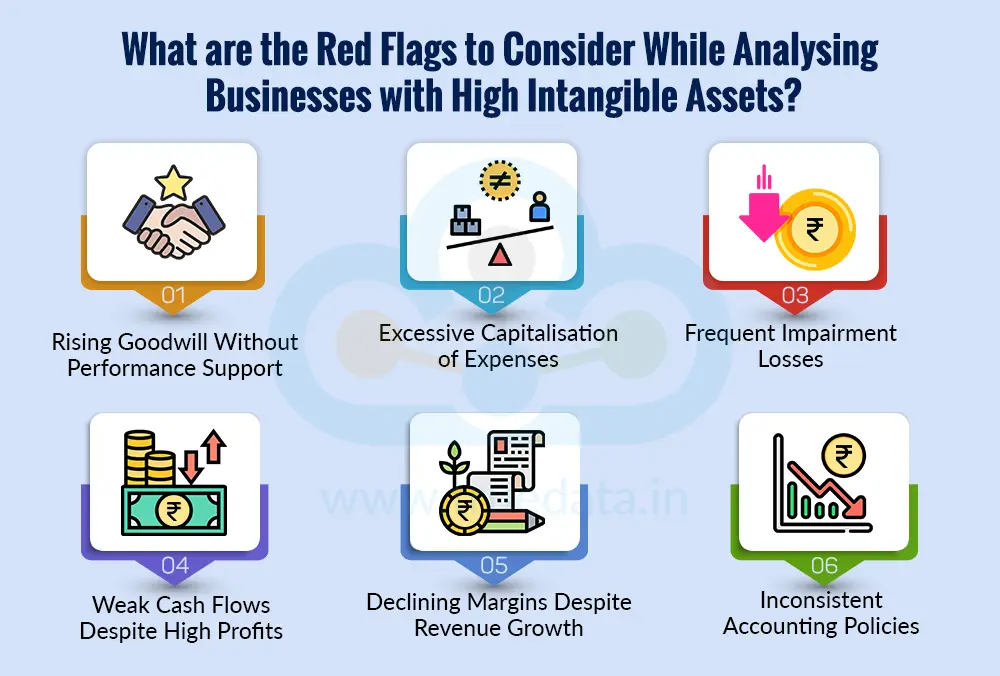
What are the Red Flags to Consider While Analysing Businesses with High Intangible Assets?

What are the Red Flags to Consider While Analysing Businesses with High Intangible Assets

Analysing businesses with high intangible assets can be tricky because many risks are not clearly visible in financial statements. Here are some important red flags investors should watch out for. 

  • Rising Goodwill Without Performance Support - If a company’s goodwill keeps increasing due to acquisitions, but its profits and cash flows are not improving, it may indicate that the company is overpaying for acquisitions. This can later lead to large impairment losses, which can suddenly reduce profits.

  • Excessive Capitalisation of Expenses - If a company starts capitalising more costs (like development or marketing expenses) instead of expensing them, its profits may look artificially higher. A sudden increase in capitalised costs without clear justification can signal earnings manipulation.

  • Frequent Impairment Losses - Regular impairment of goodwill or other intangible assets suggests that earlier assumptions about growth or acquisitions were too optimistic. This indicates poor capital allocation and weak management judgement.

  • Weak Cash Flows Despite High Profits - If a company reports strong profits but consistently shows weak or negative operating cash flows, it is a warning sign. This may indicate aggressive accounting, high receivables, or heavy spending that is not generating real cash returns.

  • Declining Margins Despite Revenue Growth - If revenue is growing but margins are shrinking, it may mean the company is spending too much on marketing, discounts, or operations to sustain growth. This can signal weak pricing power or increasing competition.

  • Inconsistent Accounting Policies - Frequent changes in accounting policies, especially related to amortisation or capitalisation, can make financials difficult to compare over time. This reduces transparency and may hide the true performance of the business.

What Should Investors Do?

What Should Investors Do

The key to analysing businesses with high intangible assets is to look beyond traditional metrics and focus on the real drivers of value. Instead of relying only on ratios like P/B, investors should pay close attention to cash flows, return ratios like ROCE, and consistency in earnings and growth. It is also important to understand what truly gives the company its strength, whether it is brand power, technology, customer loyalty, or innovation. Reading annual reports carefully, especially the notes on intangible assets and management commentary, can provide deeper insights into how sustainable these advantages really are.

At the same time, investors should remain disciplined and cautious about valuations and risks. Just because a business is driven by strong intangible assets does not automatically make it a good investment. One should check whether growth is supported by real performance, avoid companies with aggressive accounting or weak cash flows, and prefer businesses with strong management, clear strategy, and consistent execution. Thus, by combining financial analysis with qualitative understanding and taking a long-term view, investors can make better decisions in this evolving landscape.

Conclusion

In today’s evolving business arena, where data and technology are the king, the techniques and approaches to analysing such businesses have to evolve beyond traditional methods. This includes having a balanced approach that combines cash flow analysis, return ratios like ROCE, and valuation tools such as P/E, FCF yield, and EV/EBITDA, along with a deep understanding of business quality. It is also important to stay alert to the red flags in the financial statements and focus on sustainable growth, strong competitive advantages, and disciplined valuation to make informed long-term decisions.

This article explores the fundamentals of analysing a business with intangible assets in detail. Let us know your thoughts on the topic or if you need further information on the same, and we will address it soon. 

Till then, Happy Reading!


Read More: How to Evaluate Newly Listed Companies?

Frequently Asked Questions

A business is considered to have high intangible assets when a large part of its value comes from non-physical assets like brand, technology, patents, or customer relationships rather than factories or machinery.

The quality of intangible assets in the balance sheets can be assessed by checking whether they are supported by strong cash flows, consistent profits, and clear disclosures in the financial statements. Investors should also look for signs like frequent impairments or sudden increases, which may indicate poor quality or overvaluation of those assets.

Investors can assess sustainability by checking whether the company shows consistent revenue growth, strong cash flows, and high return ratios over time. They should also evaluate if the company has a durable competitive advantage, like a strong brand, technology, or customer loyalty that is hard for competitors to replicate.

Investors should compare such companies using metrics like P/E, EV/EBITDA, ROCE, and FCF yield, rather than relying on P/B alone. They should also assess growth consistency, margins, and the strength of competitive advantages to identify which business is truly better positioned.

The most important qualitative signals are strong brand power, clear competitive advantage (moat), quality of management, and customer loyalty. These factors show whether the business can sustain growth and stay ahead of competitors over the long term.
Marisha Bhatt

Marisha Bhatt is a financial content writer @TrueData.
She writes with the sole aim of simplifying complex financial concepts and jargon while attempting to clarify technical and fundamental analysis concepts of the stock markets. The ultimate goal is to spread vital knowledge and benefit the maximum audience. Her Chartered Accountant background acts as the knowledge base to help clarify crucial concepts and create a sound investment portfolio.

11 Comments
H
Harinath
· May 27, 2026

Excellent explanation of how intangible assets impact business valuation and long-term growth. Very useful for investors analysing modern asset-light companies.

·
S
Samar
· May 27, 2026

Excellent Post. The examples of patents, brand value, and goodwill made it easier to understand.

·
A
Amanbir
· May 27, 2026

One of the most practical articles on fundamental analysis I’ve read recently. The section on competitive advantage was especially helpful.

·
E
Ekjot
· May 27, 2026

Very informative post. Many investors ignore intangible assets while analysing businesses, but this article explains why they matter so much.

·
A
Amandeep
· May 27, 2026

Helpful blog of how brands, intellectual property, and software contribute to company value. Nicely written.

·
V
Varun
· May 27, 2026

Really useful for stock market beginners like me

·
T
Thamimun Ansari
· May 27, 2026

Can high intangible assets sometimes make a company overvalued? Would love to know how investors can identify that risk

·
A
Amritvar
· May 27, 2026

It would also be interesting to compare intangible-heavy businesses with manufacturing companies having large physical assets.

·
D
Darshan
· May 27, 2026

Thanks for explaining the difference between goodwill and other intangible assets so clearly. That part removed a lot of confusion.

·
C
Charanjeet
· May 27, 2026

Very detailed and beginner-friendly content. Articles like this make financial analysis much easier to understand.

·
A
Aken Pri
· May 27, 2026

Hi i follow your pinterest blog. This is an underrated topic in investing. Most people focus only on revenue and profit without understanding the value of intangible assets.

·