Trading Strategies / Indicators

What is the Flag And Pole Pattern In Technical Analysis?

Marisha Bhatt · 21 Apr 2026 · 10 mins read · 0 Comments

what-is-flag-and-pole-pattern-in-technical-analysis

Global uncertainty often spills over into financial markets. In times when geopolitical tensions rise and markets turn volatile, stock prices can move sharply in both directions. For traders, this makes it even more important to identify clear entry and exit points, whether the goal is capturing opportunities or protecting capital. One chart pattern that can help during such conditions is the flag and pole pattern. This pattern appears in both bullish and bearish markets and can signal potential continuation of a trend. Curious about how it works and how traders use it? Check out this blog to understand the flag and pole pattern in detail and how it can be applied in trading.

What is the Flag and Pole Pattern?

what-is-flag-and-pole-pattern

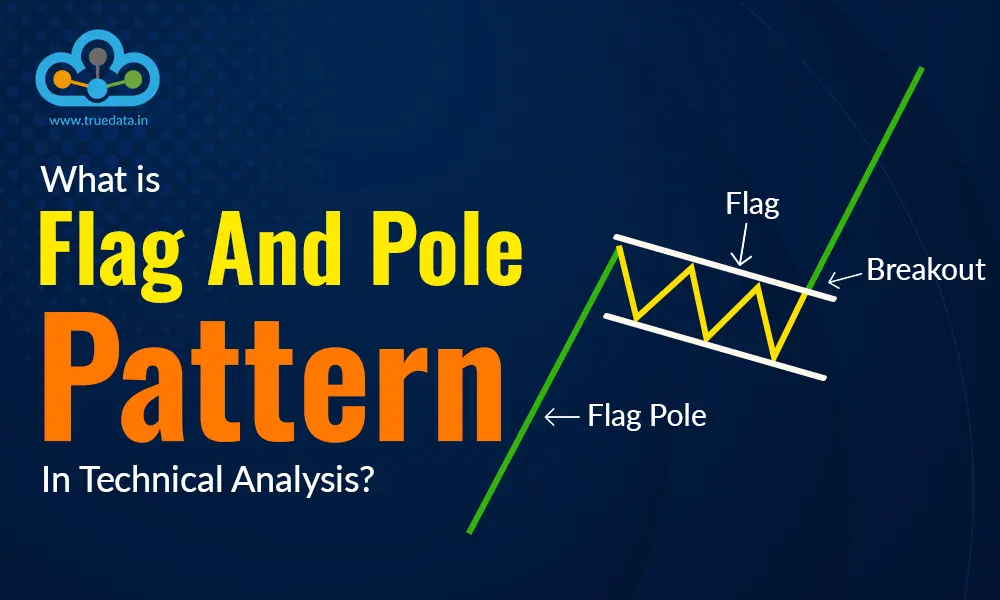
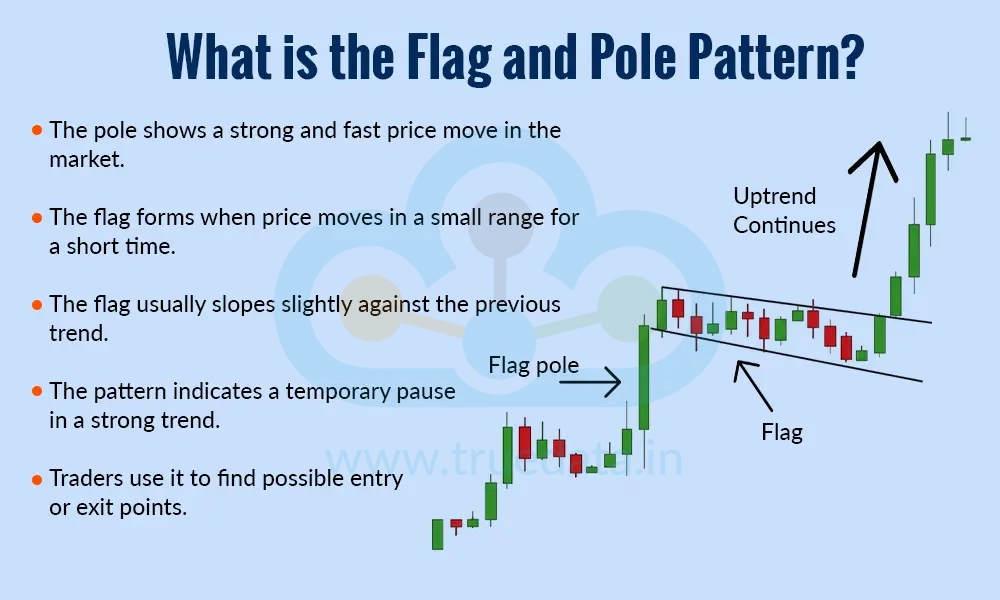
The flag and pole pattern is a chart pattern used in technical analysis to describe a short pause in a strong price trend before the trend continues. The name comes from the way the pattern looks on a price chart. The pole represents a sharp and fast price movement, either upward or downward, caused by strong buying or selling in the market. After this sudden move, the price usually slows down and moves in a narrow range for a short period. This part forms the flag, which looks like a small rectangle or channel that slightly slopes against the earlier trend. The pattern suggests that the market is temporarily consolidating before continuing in the same direction as the initial move. Thus, it shows a strong move, a brief pause, and then a possible continuation of the trend. Traders often watch the flag and pole pattern to identify potential opportunities to enter or exit trades in trending markets.

How to identify the Flag and Pole Pattern?

How to identify the Flag and Pole Pattern

Identifying the flag and pole pattern requires observing how the price moves during a strong trend and the brief pause that follows. Traders usually look for the following key elements on a price chart.

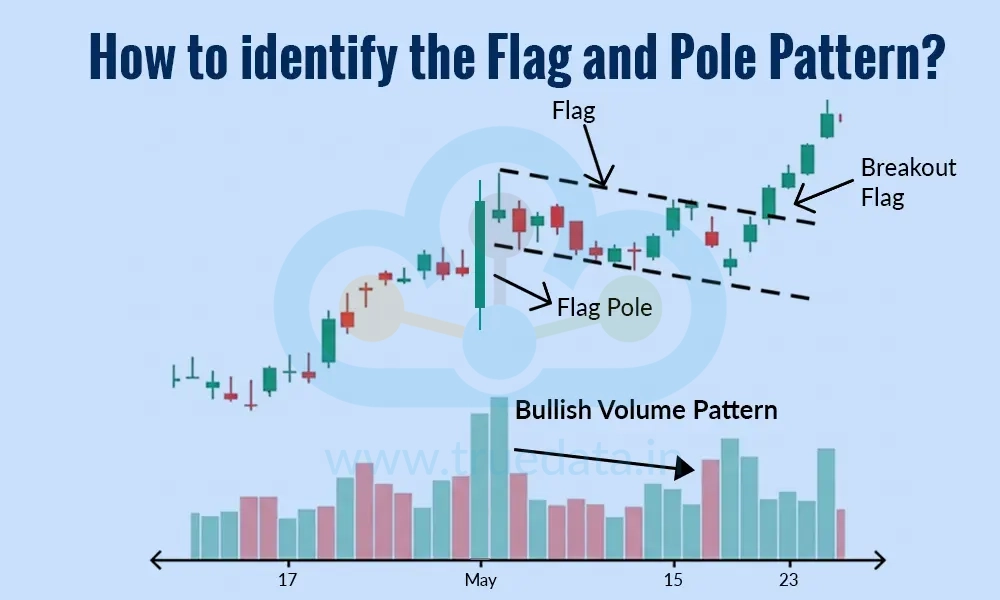
  • Look for a Strong and Sharp Price Move (The Pole) - The first step is to spot a quick and significant price change over a short period. This movement can be either upward or downward and is usually driven by strong buying or selling pressure. The move should be nearly straight and steeper than typical price fluctuations. This sharp movement forms the pole of the pattern.

  • Observe a Short Period of Consolidation (The Flag) - After the strong move, the price typically pauses and trades within a narrow range for a brief time. Instead of continuing sharply in the same direction, the price begins moving sideways or slightly against the previous trend. This small consolidation forms the flag part of the pattern.

  • Check the Shape of the Flag - The flag typically appears as a small rectangular or channel-like pattern that slopes slightly in the opposite direction of the prior trend. For example, in a bullish trend, the flag may slope slightly downward, while in a bearish trend, it may slope slightly upward. The movements within the flag tend to be smaller and more controlled compared to the pole.

  • Look for Lower Trading Volume During the Flag - In many cases, trading volume decreases during the flag's formation. This suggests the market is taking a brief pause after the strong move. Reduced activity during this stage often indicates temporary consolidation rather than a trend reversal.

  • Watch for a Breakout from the Flag - The pattern gains significance when the price breaks out of the flag formation in the same direction as the prior trend. A breakout above the flag in an upward trend or below the flag in a downward trend may signal the continuation of the previous trend.

  • Confirm the Pattern with Volume or Momentum - Traders often seek higher trading volume or stronger momentum indicators during the breakout. Such confirmation helps to increase confidence that the trend may persist after the consolidation.

How to Trade Using the Flag and Pole Pattern?

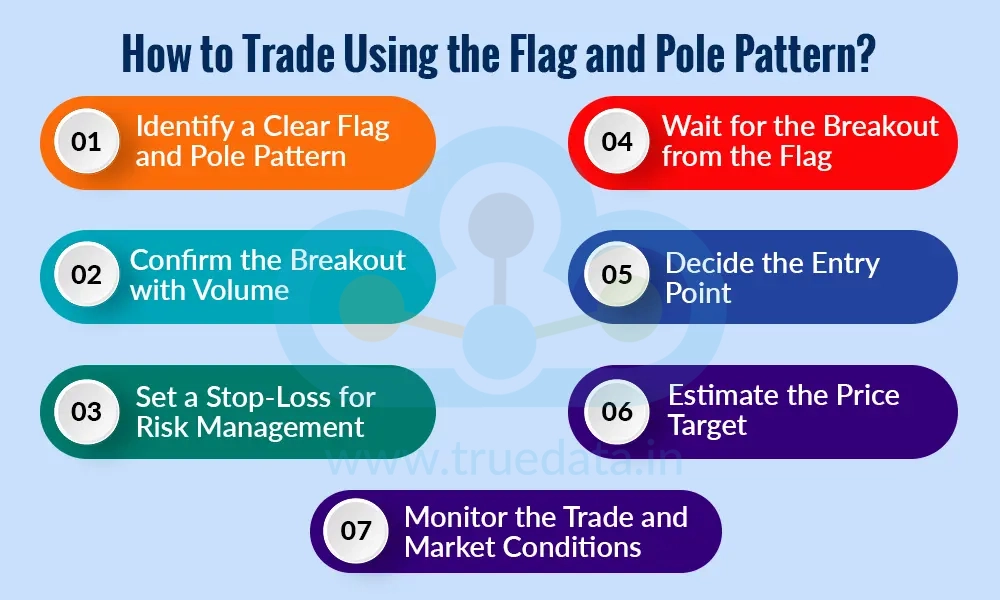
How to Trade Using the Flag and Pole Pattern

Traders often use the flag and pole pattern to trade in the direction of an existing trend. Since the pattern usually signals a continuation of the earlier move, traders focus on entering trades when the price breaks out of the flag formation. The steps to approach trades using this pattern are explained below.

  • Identify a Clear Flag and Pole Pattern - The first step to trade this pattern is to confirm that the chart shows a strong price move (the pole) followed by a short consolidation period (the flag). The pole should show a sharp upward or downward movement, while the flag should appear as a small channel or rectangle where the price moves sideways or slightly against the earlier trend.

  • Wait for the Breakout from the Flag - Instead of entering a trade immediately, traders usually wait for the price to break out of the flag pattern.

    • In a bullish flag, traders usually watch for the price to break above the upper boundary of the flag.

    • In a bearish flag, traders usually look for the price to break below the lower boundary of the flag.

This breakout often signals that the earlier trend may continue.

  • Confirm the Breakout with Volume - It is also important to check whether trading volume increases during the breakout. A rise in volume suggests stronger buying or selling interest and can provide additional confidence that the breakout may be genuine rather than a false signal.

  • Decide the Entry Point - A common trading approach is to enter the trade soon after the breakout is confirmed. Some traders enter immediately when the price crosses the flag boundary, while others wait for the price to close above or below the flag to reduce the risk of false breakouts.

  • Set a Stop-Loss for Risk Management - Risk management is an important part of trading this pattern. It is common to place a stop-loss slightly below the flag in a bullish trade or above the flag in a bearish trade. This helps limit potential losses if the pattern fails or if the market moves in the opposite direction.

  • Estimate the Price Target - A common way to estimate a potential price target is to measure the length of the pole and project that distance from the breakout point. This gives traders a rough idea of how far the price may move if the trend continues.

  • Monitor the Trade and Market Conditions - Even after entering a trade, traders usually monitor price movement, volume, and overall market conditions. If the market shows signs of weakening momentum or reversal, traders may adjust their stop-loss or exit the trade to protect profits.

What are the Different Types of Flag and Pole Patterns? 

The flag and pole pattern can be seen in the bullish market as well as the bearish market. These different types of flag and pole patterns are explained below. 

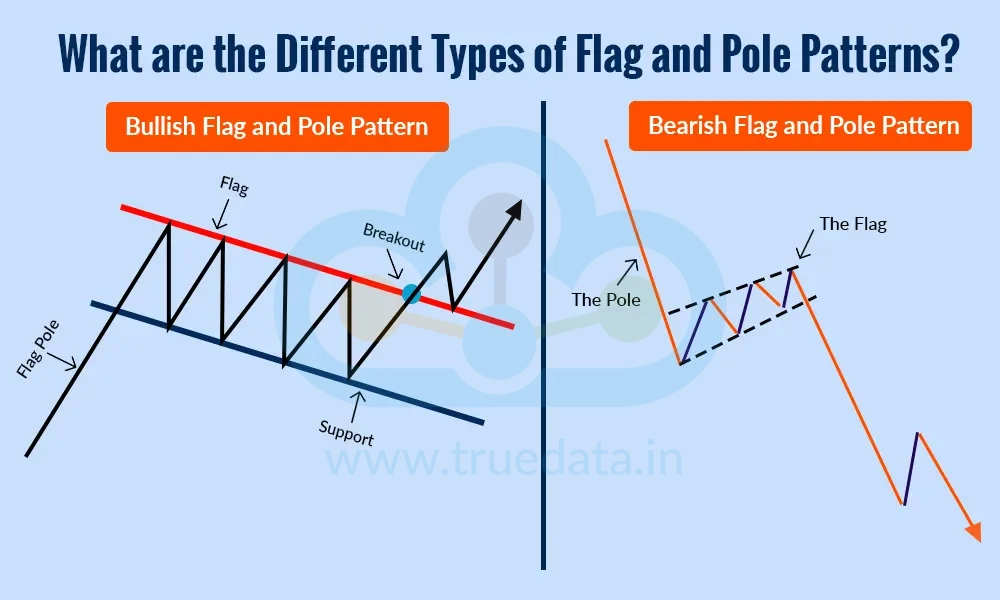
What are the Different Types of Flag and Pole Patterns

Bullish Flag and Pole Pattern

The bullish flag and pole pattern appears during an upward trend and suggests that the price may continue rising after a short pause. In this pattern, the pole forms when a stock’s price rises sharply due to strong buying interest. After this rapid increase, the price usually enters a short consolidation phase where it moves slightly downward or sideways within a narrow range. This part forms the flag, which often slopes gently downward against the earlier upward move. The consolidation shows that the market is taking a brief pause as traders book some profits. If the price later breaks above the upper boundary of the flag, it may indicate that buying momentum is returning and the upward trend could continue. Traders often watch this breakout as a potential signal to enter a trade in the direction of the trend.

Bearish Flag and Pole Pattern

The bearish flag and pole pattern forms during a downward trend and indicates that the price may continue falling after a short consolidation. In this case, the pole appears when the price drops sharply due to strong selling pressure. After this fall, the price typically moves slightly upward or sideways for a short period, creating the flag portion of the pattern. The flag usually slopes gently upward, which is opposite to the earlier downward move. This phase represents a temporary pause in selling as the market stabilises briefly. When the price eventually breaks below the lower boundary of the flag, it may signal that the selling pressure has resumed, and the downward trend could continue. Traders often look for this breakout as a possible opportunity to trade in the direction of the falling trend.

What is the Typical Risk-Reward ratio for the Flag and Pole Pattern?

The flag and pole pattern is popular among traders because it often offers a favourable risk-reward ratio, especially in trending markets. In most cases, traders look for a risk-reward ratio of 1:2 or 1:3 in this pattern. This means risking Re. 1 to potentially earn Rs. 2 or Rs. 3, which makes the trade worthwhile. 

  • Stop loss placement - The pattern has a small consolidation area (flag) and a large prior move (pole). Since the stop-loss is placed near the flag and the target is based on the larger pole, the potential reward is usually higher than the risk. The risk remains limited because traders place the stop-loss just outside the flag (below in bullish and above in bearish patterns). This keeps the possible loss small compared to the expected gain.

  • Target Based on Pole Length - The reward is estimated using the pole height, which is generally much larger than the flag. This is why the pattern naturally supports higher reward compared to risk.

  • Scenario for change in Risk-Reward Ratio - The risk-reward ratio may be lower in the following scenarios,

    • The flag is too large or unclear

    • The breakout is weak

    • Market conditions are highly volatile 

In such cases, traders may avoid the trade or wait for better confirmation.

What are the Limitations of Using the Flag and Pole Pattern?

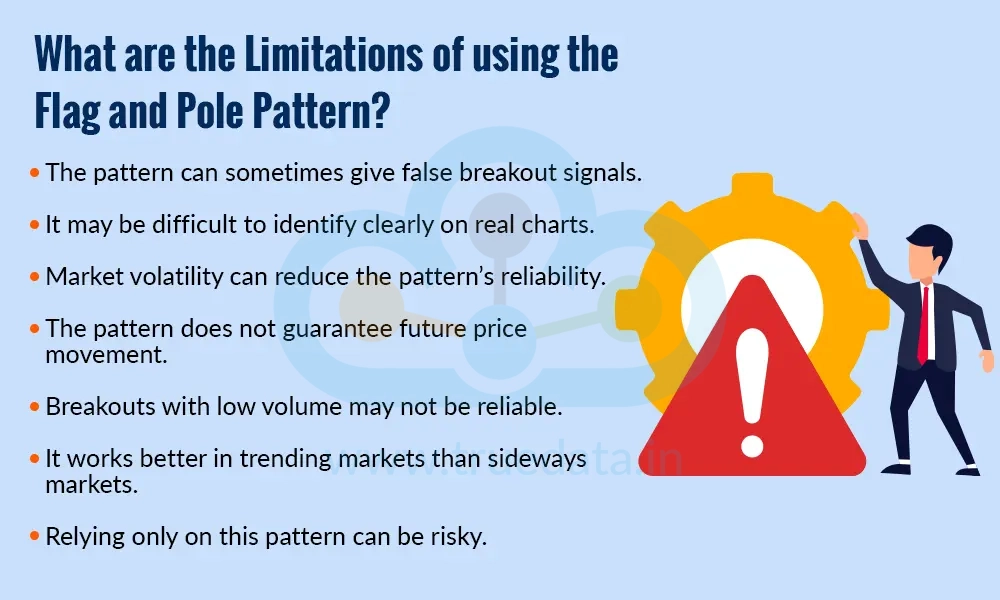
What are the Limitations of Using the Flag and Pole Pattern

Like any other pattern, the flag and pole pattern is not foolproof and is not free from limitations. These limitations include,

  • The pattern can sometimes give false signals. A breakout from the flag does not always lead to a continuation of the trend, and the price may quickly reverse, leading to losses.

  • It can be difficult to identify the pattern clearly. In real market conditions, price movements are not always neat, so traders may interpret the pattern differently on the same chart.

  • Market conditions can affect the reliability of the pattern. During highly volatile or uncertain markets, price movements may not follow technical patterns as expected.

  • The pattern does not guarantee future price movement. Like all technical analysis tools, the flag and pole pattern only suggests a possible trend continuation and does not provide certainty.

  • Breakouts may occur with low volume. If a breakout happens without strong trading volume, it may not be reliable and could lead to a false trading signal.

  • It may not work well in sideways markets. The pattern is most useful in strong trending markets, but it can be less effective when the market is moving within a range.

  • Relying on the pattern alone can be risky. Traders often need to combine it with other indicators, such as volume analysis or support and resistance levels, to make better trading decisions.

Conclusion

The flag and pole pattern is a useful chart pattern that helps traders understand how a strong trend may pause briefly before continuing in the same direction. It consists of a sharp price move called the pole, followed by a short consolidation phase known as the flag. This pattern can appear in both bullish and bearish markets and may help traders identify possible entry and exit points when the price breaks out of the flag, making it versatile and easy to understand for traders, including beginners. However, it is important to note that traders should use this pattern along with other indicators, volume analysis and optimum risk management for making informed trading decisions and having a robust trading plan. 

This article talks about another important pattern that decodes market movements and helps traders make informed trading decisions. Let us know your thoughts on the topic or if you need further information on the same, and we will address it soon. 

Till then, Happy Reading!


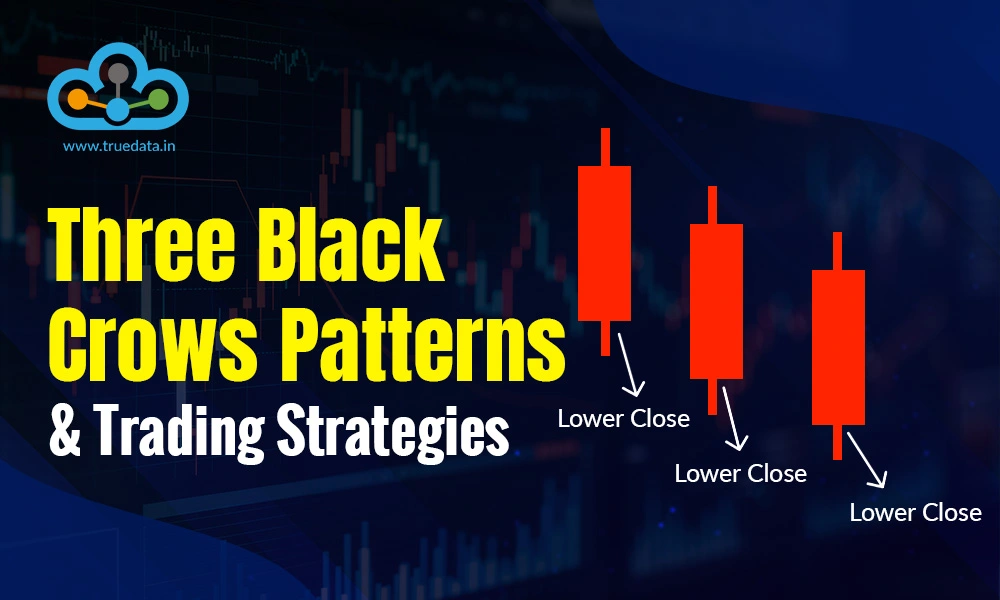
Read More: Three Black Crows Patterns and Trading Strategies 

Frequently Asked Questions

To determine the flag-to-pole height ratio, measure the length of the strong price move that forms the pole and compare it with the height or the size of the flag consolidation. Ideally, the flag should be much smaller than the pole, usually around one-third to one-half of the pole’s height, showing that it is only a brief pause in the trend.

A pole clearance pattern refers to a situation where the price moves strongly beyond the previous flag or consolidation area after forming the pole. It suggests that the market has enough momentum to continue the trend after clearing the resistance or support formed during consolidation.

Flag patterns should be reviewed and updated whenever new price data appears on the chart, such as with each new candle or trading session. Since market conditions change quickly, traders need to re-evaluate the pattern regularly to confirm whether it is still valid or if a breakout has already occurred.

The flag pattern usually forms a small parallel channel or rectangular consolidation where prices move slightly against the previous trend. The finish of the pattern occurs when the price breaks out of this channel with strong momentum, indicating that the earlier trend may continue.
Marisha Bhatt

Marisha Bhatt is a financial content writer @TrueData.

She writes with the sole aim of simplifying complex financial concepts and jargon while attempting to clarify technical and fundamental analysis concepts of the stock markets. The ultimate goal is to spread vital knowledge and benefit the maximum audience. Her Chartered Accountant background acts as the knowledge base to help clarify crucial concepts and create a sound investment portfolio.

0 Comments

Related Articles

SEE ALL
Trading Strategies / Indicators
Three Black Crows Patterns and Trading Strategies

The red and green candlesticks on a chart may look like chaos at first glance. B...

Trading Strategies / Indicators
Engulfing Candlestick Patterns

Candlestick patterns are among the most basic and common tools traders use to cr...

Trading Strategies / Indicators
What are candlestick patterns? - Part 2

Stock markets have been under a lot of pressure in the past week and investors ...