Have you ever watched the popular show Shark Tank? One thing that often stands out is how entrepreneurs pitch their businesses. While the numbers are important, it is usually the story behind the business, its vision, purpose, and future potential that captures investors' attention. This highlights the power of ‘narrative’, which can often set the stage for success, but it can also be the trigger for downfall. The stock market often works the same way. A compelling story about a company's future can drive its share price higher, sometimes even more than its current financial performance. So what matters more in the end, narrative or numbers? And how can you judge whether a company's story is supported by solid fundamentals or simply creating market hype? Dive in to explore the role of narratives and numbers in investing and how to strike the right balance before making investment decisions.

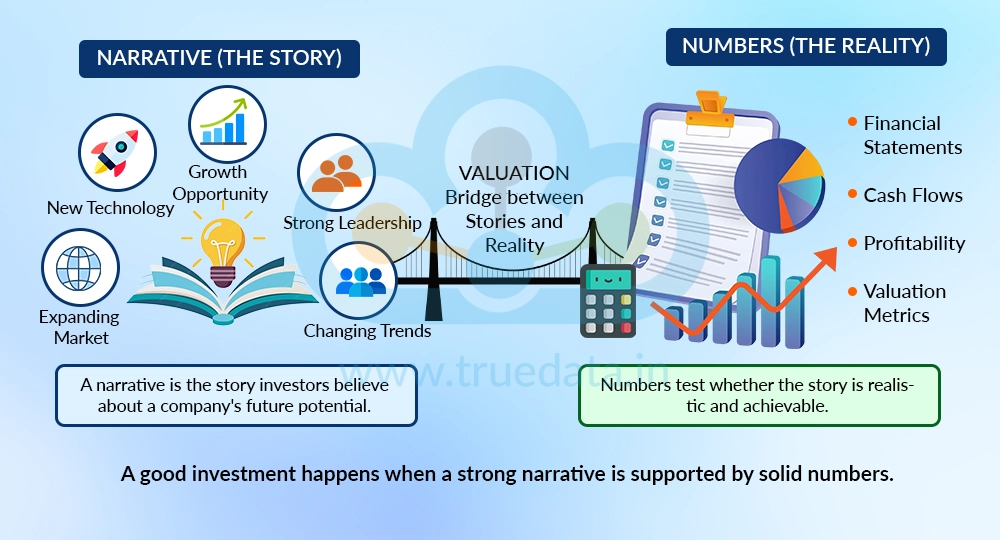
In the stock market, a narrative is the story investors believe about a company's future. It goes beyond the company's current profits, sales, or financial statements and focuses on what the company could become. This story may be based on factors such as a new technology, an innovative business model, expansion into a fast-growing industry, a visionary management team, or changing consumer trends. When investors believe that a company has strong long-term potential, they may be willing to buy its shares even if its current financial performance is not very strong. As a result, the company's share price may rise due to optimism and expectations rather than its present-day fundamentals. On the other hand, if confidence in the story weakens, the stock price can fall quickly, even if the company's financial results remain stable.
This idea was popularised by Mr. Aswath Damodaran, the renowned Professor of Finance at New York University Stern School of Business, in his book Narrative and Numbers. Mr. Damodaran explains that every successful valuation begins with a story but must ultimately be supported by numbers. According to him, a good narrative helps investors understand how a company plans to grow, while financial analysis tests whether that story is realistic and achievable. He describes valuation as a bridge between stories and numbers, where the narrative explains the business, and the numbers determine whether the expectations are justified. Investors who rely only on a compelling story may overestimate a company's potential, while those who look only at financial statements may overlook future growth opportunities.

A company's share price is not influenced only by its profits, revenue, or other financial numbers. It is also affected by what investors believe about the company's future. This belief, or narrative, shapes market sentiment and can cause stock prices to rise or fall, sometimes even before any real financial improvement takes place. Understanding how narratives influence stock prices can help investors make better investment decisions and avoid getting carried away by market excitement.
The stock market is forward-looking. Investors buy shares not only because of how a company is performing today but also based on what they expect it to achieve in the future. A strong narrative gives investors confidence that the company can grow faster, earn higher profits, or become a market leader over time. For example, if a company announces plans to expand into an upcoming or trending sector, investors may become optimistic about its future growth. Even if the company's current earnings remain unchanged, the expectation of higher future profits can increase demand for its shares and push the stock price higher.
Stock prices are largely driven by demand and supply. When a company's narrative excites investors, more people want to buy its shares. As buying demand increases, the share price usually rises. This is why companies with compelling growth stories often receive higher valuations than companies with similar financial performance but less exciting prospects. Investors are willing to pay a premium as they believe the company's future will justify today's higher price.
Investor sentiment plays an important role in the short term. A positive narrative creates confidence, optimism, and enthusiasm, encouraging more investors to participate. As more people buy the stock, the rising price attracts even more investors who fear missing out on potential gains. This creates a cycle where the narrative strengthens market sentiment, and strong sentiment further supports higher stock prices. In some cases, the excitement becomes so strong that prices rise much faster than the company's actual business performance.
In today's digital world, narratives spread quickly through business news channels, financial websites, social media platforms, investment forums, and influencer content. Positive headlines about a company's expansion plans, new product launches, strategic partnerships, or technological innovations can attract widespread attention. When the same story is repeated across multiple platforms, more investors begin believing in the company's future potential. This increased visibility often leads to higher trading activity and greater demand for the stock, especially among retail investors.
A company with a convincing growth story often trades at a higher valuation than its current financial performance alone would suggest. Investors may accept a high Price-to-Earnings (P/E) Ratio or other valuation multiples as they expect future earnings to grow significantly. This explains why many young or fast-growing companies sometimes command higher valuations than mature businesses. Investors are paying not just for today's earnings but also for tomorrow's possibilities.
While narratives can create genuine investment opportunities, they can also fuel excessive optimism. Sometimes investors become so focused on future promises that they ignore weak earnings, high debt, poor cash flows, or execution risks. If the company fails to deliver on its promises, investor confidence can quickly disappear. As expectations fall, the share price may decline sharply because the market starts valuing the company based on its actual financial performance rather than its future story. This is why many stocks experience sharp corrections after periods of excessive hype.
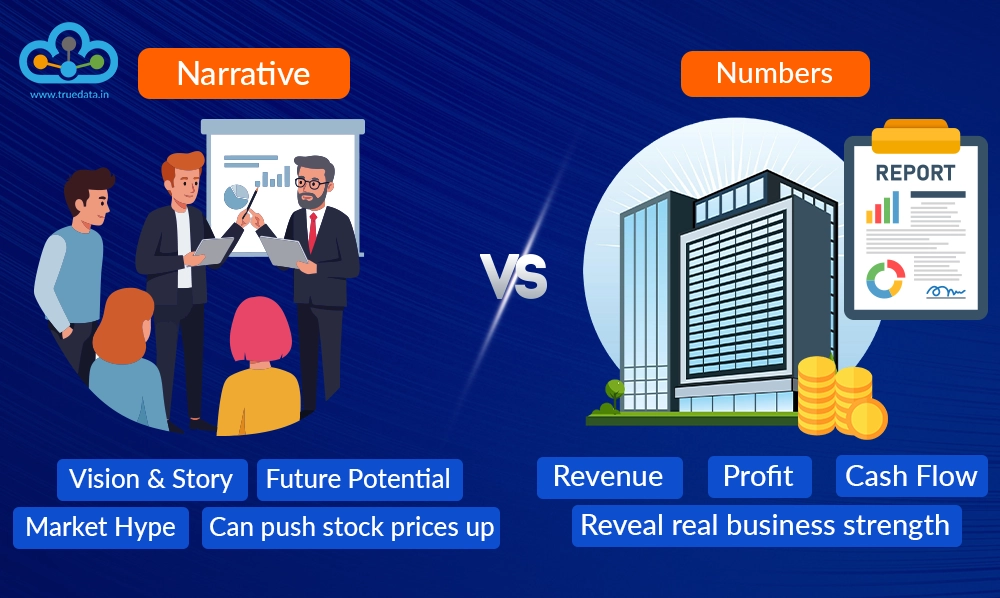
While both narratives and numbers play an important role in investing, they represent different aspects of a company. A narrative explains the company's future potential and growth story, while numbers reveal its actual financial performance. Successful investors learn to evaluate both instead of relying on just one. The table below highlights the key differences between the two.

Human beings are wired for stories. We remember them, believe them, and emotionally connect with them far more easily than we connect with spreadsheets and balance sheet. This is as true in investing as it is in life. When a founder speaks passionately about disrupting an industry, when an analyst predicts a sector will grow 10x in a decade, or when a company's product becomes part of everyday conversation, it creates a powerful emotional pull that can cloud rational judgement. This is what behavioural economists call narrative bias, i.e., the tendency to give disproportionate weight to a compelling story while underweighting hard evidence.
Consider the following examples to understand the pull between narratives and numbers and how they can ultimately influence your portfolio.

When Paytm launched its IPO in November 2021, it was backed by one of the strongest growth stories in India. As one of the country's leading digital payments companies, Paytm benefited from India's rapid shift towards digital transactions and the growing popularity of UPI. Investors believed the company was well-positioned to benefit from this long-term trend. The IPO raised around Rs. 18,300 crore at a valuation of nearly Rs. 1.34 lakh crore, making it the largest IPO in India at that time.
However, the company's financial performance did not match the excitement surrounding its story. In FY2021, Paytm reported a loss of around Rs. 1,701 crore, and there was no clear timeline for achieving profitability. It also faced intense competition from other digital payment platforms. As investors shifted their focus from future expectations to actual financial performance, the stock price fell sharply. After listing below its IPO price of Rs. 2,150, the share price dropped by nearly 75% within the following year.
Key Lesson - Paytm showed that a strong industry trend and a compelling business story are not enough to justify a high valuation. Investors should always check whether the company's revenue growth, profitability, and business model support the narrative before investing.

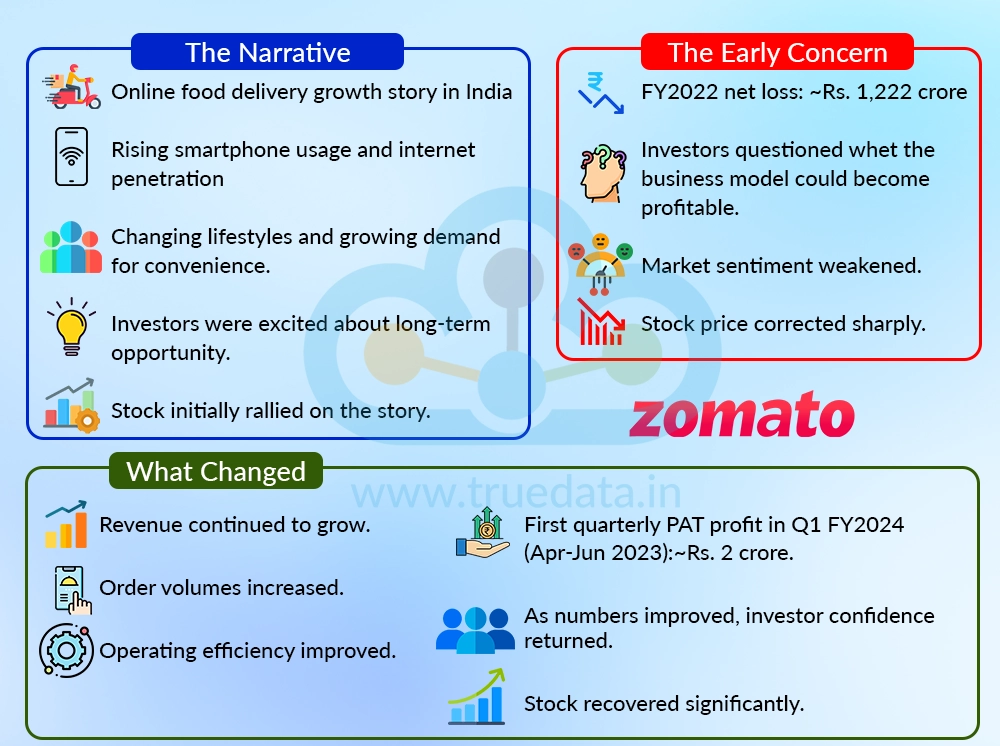
Zomato is an excellent example of how a strong narrative can eventually be validated by strong numbers. When the company went public in 2021, investors were excited about the future of online food delivery in India. Rising smartphone usage, increasing internet penetration, changing consumer lifestyles, and growing demand for convenience created a powerful long-term growth story. The stock initially rallied as investors focused on this opportunity.
Despite the attractive narrative, Zomato was still making losses. In FY2022, the company reported a net loss of around Rs. 1,222 crore, leading many investors to question whether its business model could ever become profitable. The stock price corrected sharply as market sentiment weakened. However, unlike many companies that fail to deliver, Zomato gradually improved its financial performance. Revenue continued to grow, order volumes increased, operating efficiency improved, and the company reported its first quarterly PAT profit in Q1 FY2024 (April-June 2023) of about Rs. 2 crore. As the financial numbers began supporting the original narrative, investor confidence returned, and the stock recovered significantly.
Key Lesson - Zomato teaches investors that a strong narrative can create long-term value only if the company eventually delivers better financial results. Instead of investing purely on future promises, investors should wait for signs that revenue, profitability, and cash flows are moving in the right direction.

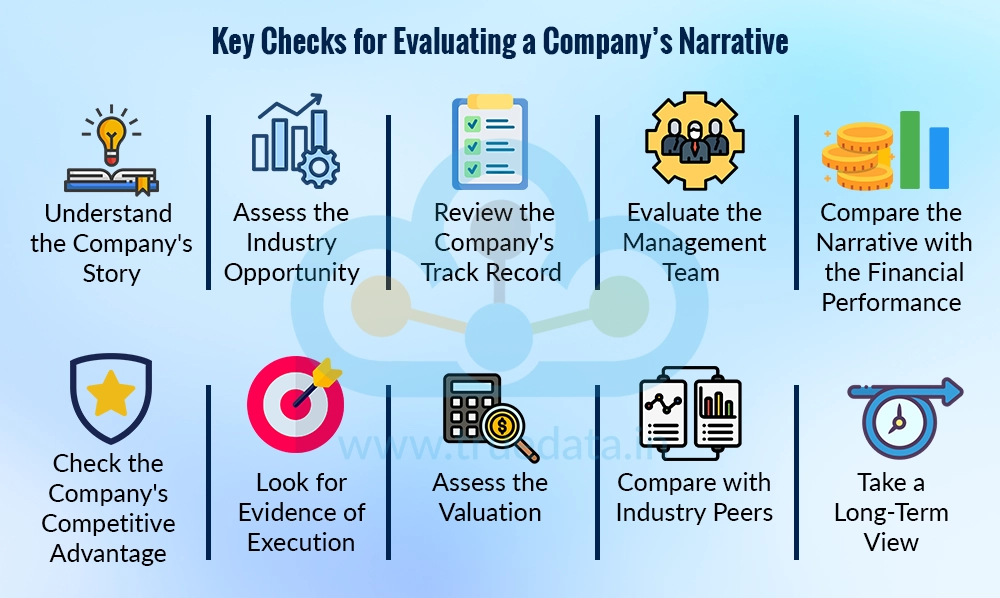
A compelling story can make a company look like an attractive investment. However, investors should evaluate whether the narrative is realistic and supported by facts before investing. The following points can help investors assess the strength of a company's narrative.
Understand the Company's Story - Investors should first understand what the company is trying to achieve and why it believes it can grow in the future. The narrative may revolve around launching new products, entering a fast-growing industry, expanding into new markets, or adopting new technologies. A clear and logical story is easier to evaluate than one based on vague promises or ambitious claims.
Assess the Industry Opportunity - Investors should determine whether the industry itself has strong long-term growth potential. A company may have an exciting story, but if the industry is shrinking or highly competitive, achieving its goals could become difficult. Understanding industry trends helps investors judge whether the company's growth plans are realistic.
Review the Company's Track Record - Past performance can provide valuable insights into a company's ability to execute its plans. Investors should check whether the company has fulfilled its earlier commitments, achieved its business targets, and delivered consistent growth. Companies with a strong execution history are generally more likely to deliver on future promises.
Evaluate the Management Team - A company’s management plays a key role in turning its vision into reality. Investors should assess whether the leadership team has relevant industry experience, a good reputation, and a history of making sound business decisions. Transparent communication and consistent execution often indicate capable management.
Compare the Narrative with the Financial Performance - A company's story should gradually be reflected in its financial results. An investor should check whether revenue, profits, operating margins, and cash flows are improving over time. If the financial performance continues to remain weak despite an exciting narrative, it may indicate that the company is struggling to execute its plans.
Check the Company's Competitive Advantage - Investors should identify what makes the company different from its competitors. This could include a strong brand, unique technology, cost advantages, loyal customers, a wide distribution network, or superior products. A sustainable competitive advantage increases the likelihood that the company's narrative can translate into long-term growth.
Look for Evidence of Execution - Instead of relying only on management presentations or media headlines, investors should look for tangible progress. Evidence such as successful product launches, increasing customer adoption, higher sales, expansion into new markets, completed projects, or strategic partnerships provides confidence that the company is turning its narrative into reality.
Assess the Valuation - Even an excellent company may not be a good investment if its share price is excessively high. Investors should compare the company's valuation with its earnings, growth prospects, and industry peers. Paying too much for a compelling story can reduce future investment returns, even if the business performs well.
Compare with Industry Peers - Comparing a company with its competitors provides useful perspective. Investors should evaluate how the company's growth, profitability, market share, debt levels, and valuation compare with other businesses in the same industry. This helps determine whether the company's narrative is genuinely stronger or simply being marketed more effectively.
Take a Long-Term View - A strong narrative should remain relevant for many years rather than depend on short-term market excitement. Investors should consider whether the company's strategy can generate sustainable growth over the next five to ten years. Businesses that consistently execute their plans and improve their financial performance are more likely to create long-term shareholder value.

While market narratives can influence stock prices for a short period, fundamentals determine whether a company can create lasting value for its shareholders. Over time, investors and markets pay greater attention to the company's actual financial performance rather than its future promises. The following points explain why fundamentals matter in the long run.
Reflect the Company's Financial Health - Fundamentals provide a clear picture of a company's financial position. Factors such as revenue, profits, cash flows, debt levels, and profitability help investors understand whether the business is financially strong and capable of sustaining long-term growth.
Help Identify Sustainable Businesses - Companies with strong fundamentals are generally better equipped to handle competition, economic slowdowns, and changing market conditions. Consistent growth in sales, profits, and cash flows often indicates that the business has a solid foundation for long-term success.
Reduce the Impact of Market Hype - Stock prices can rise sharply due to positive news or popular market themes. However, if the company's fundamentals remain weak, the excitement is unlikely to last. Strong financial performance helps investors separate genuine opportunities from temporary market hype.
Support Long-Term Wealth Creation - Many of the stock market's biggest wealth creators have consistently delivered strong financial performance over several years. Companies that regularly increase their revenue, profits, and shareholder value are more likely to generate sustainable returns for long-term investors.
Help Investors Make Better Decisions - Analysing a company's fundamentals can help investors make decisions based on facts rather than emotions or market rumours. This reduces the chances of investing in companies whose valuations are driven mainly by expectations instead of business performance.

Successful investing is not about choosing either the narrative or the numbers. It is about understanding how both work together. A company's narrative helps an investor understand its future vision, growth opportunities, and long-term potential, while its financial numbers reveal whether that vision is actually being translated into business performance. Instead of getting carried away by an exciting story or relying only on historical financial data, an investor should evaluate both together. A strong narrative can identify promising investment opportunities, but it becomes truly valuable only when it is supported by growing revenue, improving profitability, healthy cash flows, and a strong balance sheet.
Before making an investment decision, investors should review whether the company's financial performance supports its growth story and whether its valuation is reasonable for the expected growth. If the narrative is compelling but the numbers remain weak for a prolonged period, caution may be necessary. Similarly, if a company has strong financials but no clear strategy for future growth, its long-term potential may be limited. The most rewarding investments are often found in companies where the narrative and the numbers reinforce each other. Balancing future possibilities with present-day financial performance can help investors make more informed decisions, avoid market hype, and build a stronger long-term investment portfolio.
We are currently living in a world of narratives where a strong narrative can often reshape or distort the real picture. However, when it comes to evaluating a business, nothing can replace the merit in numbers. The key lies in striking the right balance to find a strong narrative that has the potential to disrupt the market and is also backed by secure fundamentals to achieve the vision. This balance will help investors make more informed investment decisions and build a portfolio that is better positioned to create sustainable wealth over the long run.
This article focuses on two important aspects of investing and finding te right balance between them. Let us know your thoughts on the topic, or if you need further information, and we will address them soon.
Till then, Happy Reading!
Read More: High ROCE Companies: Why Asian Paints Delivers Consistent Returns
Thestock market never stands still, and prices swing constantly with every new h...
Corporate data is more than just the numbers of a company. They can show what is...
Investing is not just about numbers on a screen. It is about understanding the s...