Before investing in a stock, it is important to understand how efficiently a business uses its capital to generate profits and cash flows. While many investors focus on popular ratios like ROE and ROCE, another powerful metric that often goes unnoticed is Return on Invested Capital (ROIC) and its cash-based version, Cash ROIC (CROIC). These ratios help investors identify businesses that can generate strong returns from the money invested in their operations. Check out this blog to know the meaning and importance of this ratio and how to use it for making informed investment decisions.

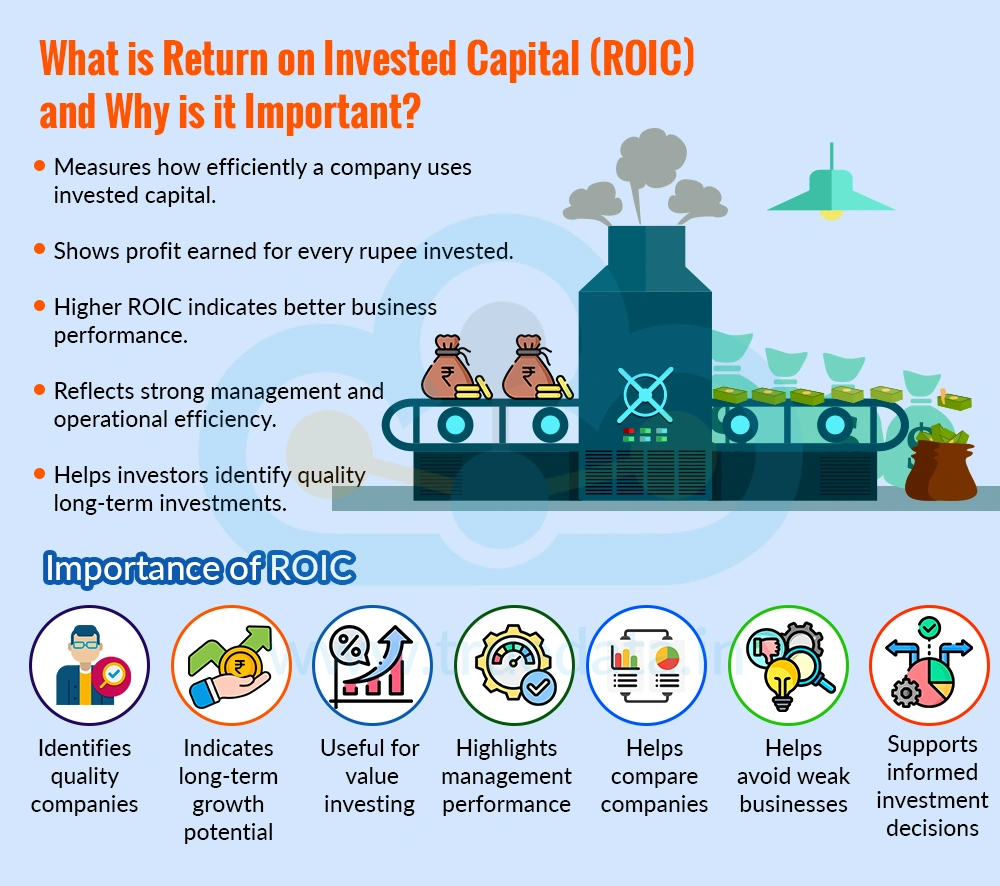
Return on Invested Capital (ROIC) is a financial ratio that shows how efficiently a company uses the money invested in its business to generate profits. This invested capital includes money raised from shareholders, loans, retained earnings, and other long-term funds used to run and grow the company. ROIC helps investors understand how much profit a company earns for every rupee invested in the business. For example, if a company has an ROIC of 20%, it means the business generates Rs. 20 of profit for every Rs. 100 invested in it. A consistently high ROIC usually indicates that the company has strong management, efficient operations, and a profitable business model. Investors often use this ratio to identify quality companies that can create long-term wealth while using capital wisely.
Importance of ROIC
Identifies quality companies - Companies with consistently high ROIC are often financially strong and well-managed businesses.
Indicates long-term growth potential - A high ROIC may suggest that the company can reinvest profits successfully and grow over time.
Useful for value investing - Many long-term investors use ROIC to identify companies that can create sustainable wealth.
Highlights management performance - Efficient use of shareholder and borrowed funds reflects good decision-making by the management.
Helps compare companies - Investors can compare companies within the same industry to find which business uses capital more efficiently.
Helps avoid weak businesses - Low or declining ROIC may indicate poor profitability, inefficient operations, or excessive capital usage.
Supports informed investment decisions - Understanding ROIC can help investors choose fundamentally strong companies instead of relying only on stock price movements.

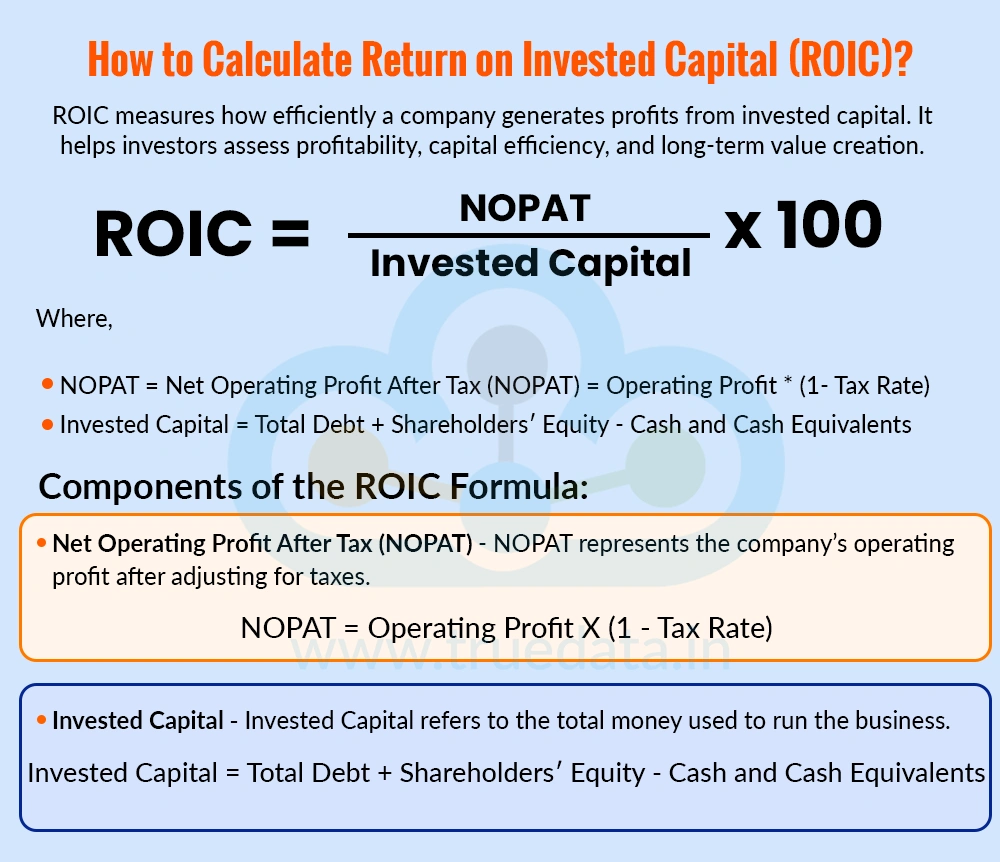
Return on Invested Capital (ROIC) measures how efficiently a company generates profits from the total capital invested in the business. It helps investors understand whether the company is creating enough returns from the money provided by shareholders and lenders. Long-term investors can use ROIC to identify businesses with strong profitability and efficient capital allocation. The formula to calculate ROIC is explained below.
ROIC = NOPAT / Invested Capital * 100
Where,
NOPAT = Net Operating Profit After Tax (NOPAT) = Operating Profit * (1- Tax Rate)
Invested Capital = Total Debt + Shareholders′ Equity - Cash and Cash Equivalents
Components of the ROIC Formula
Net Operating Profit After Tax (NOPAT) - NOPAT represents the company’s operating profit after adjusting for taxes. It shows the profit generated from core business operations without considering interest costs and non-operating income.
The formula for NOPAT is,
NOPAT = Operating Profit * (1 - Tax Rate)
Where,
Operating Profit (EBIT) = Profit earned from the company’s main business activities before interest and taxes.
Tax Rate - The percentage of tax paid by the company on its operating income.
Invested Capital - Invested Capital refers to the total money used to run the business. It includes funds invested by shareholders and lenders.
The formula for Invested Capital is,
Invested Capital = Total Debt + Shareholders′ Equity - Cash and Cash Equivalents
Where,
Total Debt = Includes long-term and short-term borrowings taken by the company.
Shareholders’ Equity = The capital invested by shareholders, along with retained earnings.
Cash and Cash Equivalents = Excess cash is usually subtracted because it may not be actively used in business operations.
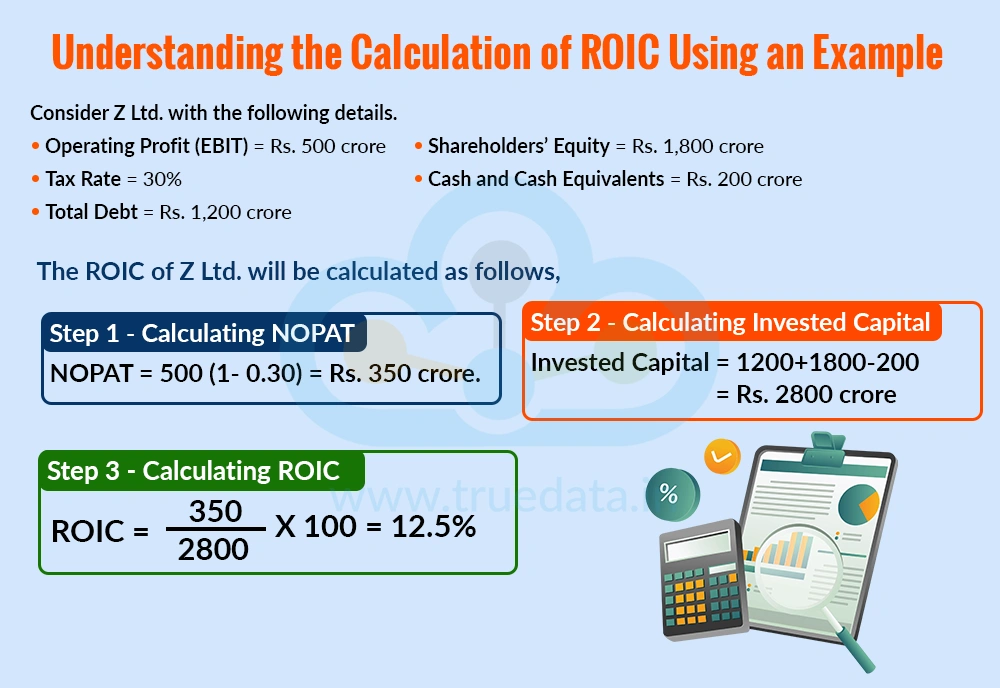
Understanding the Calculation of ROIC Using an Example

Consider Z Ltd. with the following details.
Operating Profit (EBIT) = Rs. 500 crore
Tax Rate = 30%
Total Debt = Rs. 1,200 crore
Shareholders’ Equity = Rs. 1,800 crore
Cash and Cash Equivalents = Rs. 200 crore
The ROIC of Z Ltd. will be calculated as follows,
Step 1 - Calculating NOPAT
NOPAT = Operating Profit * (1- Tax Rate)
NOPAT = 500 (1- 0.30) = Rs. 350 crore.
Step 2 - Calculating Invested Capital
Invested Capital = Total Debt + Shareholders′ Equity - Cash and Cash Equivalents
Invested Capital = 1200+1800-200 = Rs. 2800 crore
Step 3 - Calculating ROIC
ROIC = NOPAT / Invested Capital * 100
ROIC = 350 / 2800 * 100 = 12.5%

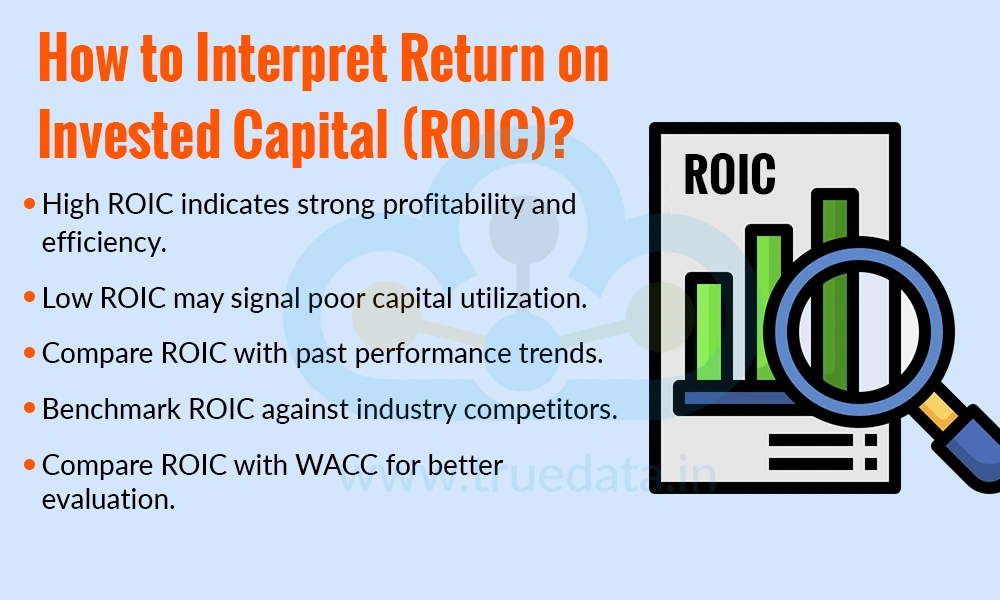
Simply calculating ROIC is not enough, investors must also know how to interpret the number correctly. A company with a high ROIC is generally considered financially strong because it is able to generate more profit from the capital used in the business. On the other hand, a low ROIC may indicate weak profitability, inefficient operations, or poor capital allocation. It has to be compared with previous ROIC performance and also with competitors within the same industry. Another crucial point of reference to interpret ROIC is the WACC.

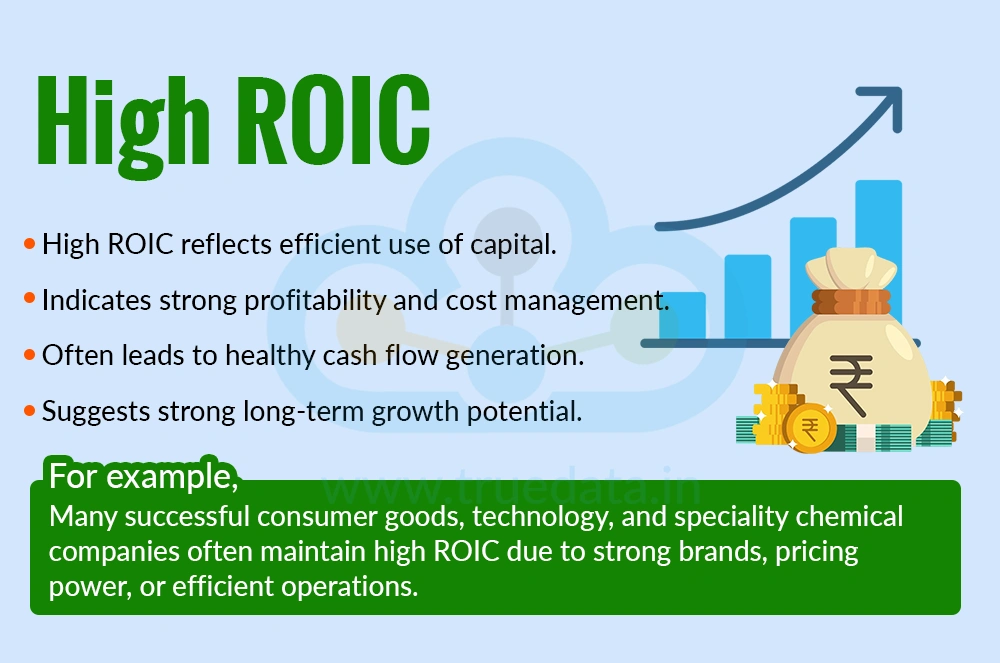
A high ROIC usually indicates that the company uses capital efficiently and has strong profit margins. Further, it also indicates that the company manages costs well and may possess competitive advantages. Companies with high ROIC often generate strong cash flows and may have better long-term growth potential. Such businesses are generally preferred by long-term investors as they can reinvest profits at attractive returns. For example, many successful consumer goods, technology, and speciality chemical companies often maintain high ROIC due to strong brands, pricing power, or efficient operations.

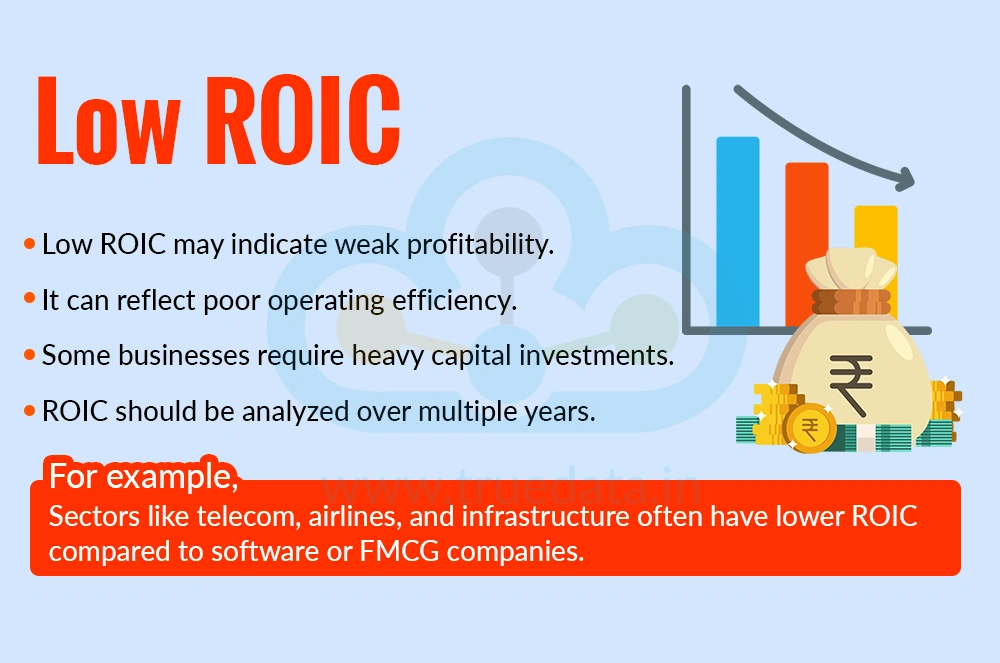
A low ROIC may suggest that the company is not generating sufficient profits from invested capital and has a weak operating efficiency. Alternatively, it can also indicate that the business requires excessive capital to grow. However, investors should not judge a company only based on one year’s ROIC. Some industries naturally operate with lower ROIC because they require heavy investments in factories, machinery, infrastructure, or assets. For example, sectors like telecom, airlines, and infrastructure often have lower ROIC compared to software or FMCG companies.
One of the most important ways to interpret ROIC is by comparing it with the company’s Weighted Average Cost of Capital (WACC). Long-term investors generally prefer companies that consistently maintain ROIC above their cost of capital. This interpretation is explained below.
If ROIC is Higher Than WACC
The company is creating shareholder value.
Management is using capital efficiently.
Growth investments are likely profitable.
If ROIC is Lower Than WACC
The company may be destroying shareholder value.
Capital allocation may be inefficient.
Future growth may not benefit investors.

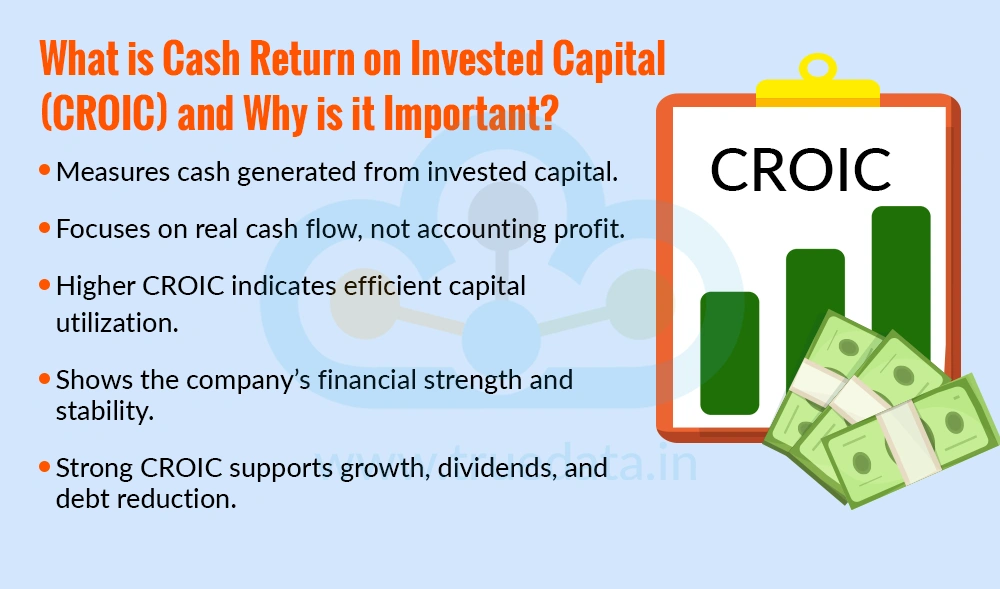
Cash Return on Invested Capital (CROIC) is a financial ratio that measures how efficiently a company generates cash flow from the capital invested in its business. While ROIC focuses on accounting profits, CROIC focuses on actual cash generated by the company’s operations. Since cash flow is harder to manipulate than accounting profits, many investors consider CROIC an important indicator of the true financial strength of a company. A high CROIC usually shows that the business is generating strong cash flows, managing its operations efficiently, and using capital wisely. Companies with consistently strong CROIC are often financially healthy and may have a better ability to reinvest in growth, pay dividends, reduce debt, or survive economic downturns.
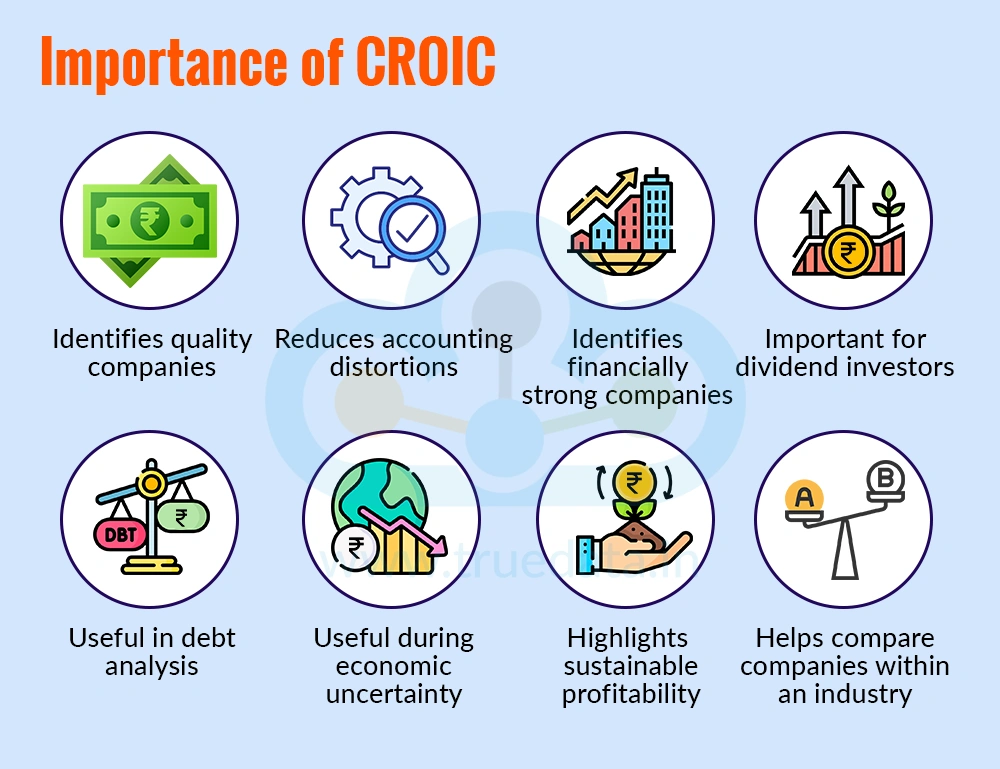
Importance of CROIC

Focuses on real cash generation - CROIC measures actual cash flow instead of accounting profits, giving a clearer picture of business performance.
Reduces accounting distortions - Since cash flow is less affected by accounting adjustments, CROIC can provide more reliable insights than profit-based ratios alone.
Identifies financially strong companies - Companies with consistently high CROIC often have stable business models and efficient operations.
Important for dividend investors - Companies with strong CROIC may have a better ability to pay stable dividends and reward shareholders.
Useful in debt analysis - Strong operating cash flow helps companies repay loans and manage debt more comfortably.
Useful during economic uncertainty - Businesses generating strong cash flows are generally better prepared to handle market slowdowns and financial stress.
Highlights sustainable profitability - A company showing strong profits but weak cash flow may face financial problems in the future. CROIC helps identify such risks.
Helps compare companies within an industry - Investors can compare CROIC among similar businesses to identify companies with superior cash-generating ability.

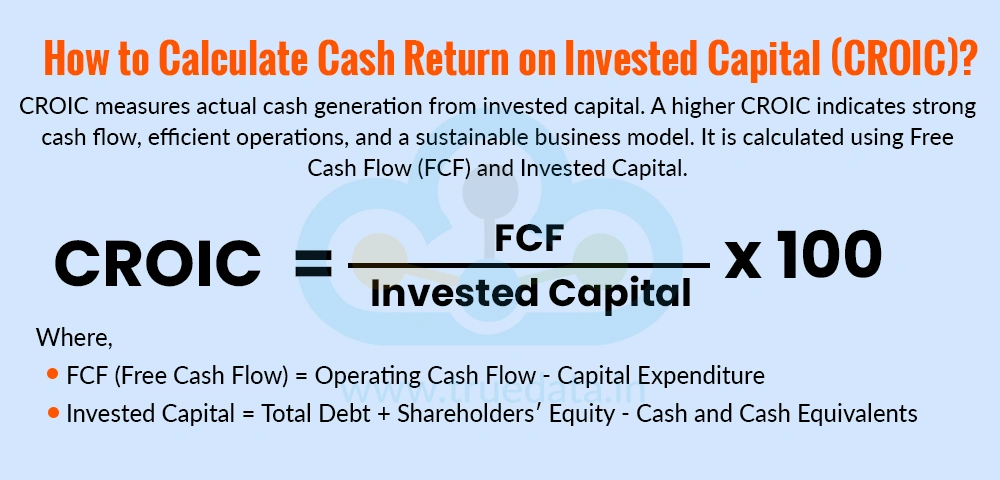
Unlike profit-based ratios, CROIC focuses on actual cash generation, which helps investors understand the company’s real financial strength and operational efficiency. A higher CROIC generally indicates that the company is generating strong cash flows from the money invested in the business. Investors often use this ratio to identify companies with sustainable business models, efficient operations, and healthy cash generation ability. CROIC calculation is based on two components, namely, Free Cash Flow (FCF) and Invested Capital. The formula for calculating CROIC is explained below.
CROIC = FCF / Invested Capital * 100
Where,
FCF (Free Cash Flow) = Operating Cash Flow - Capital Expenditure
Invested Capital = Total Debt + Shareholders′ Equity - Cash and Cash Equivalents
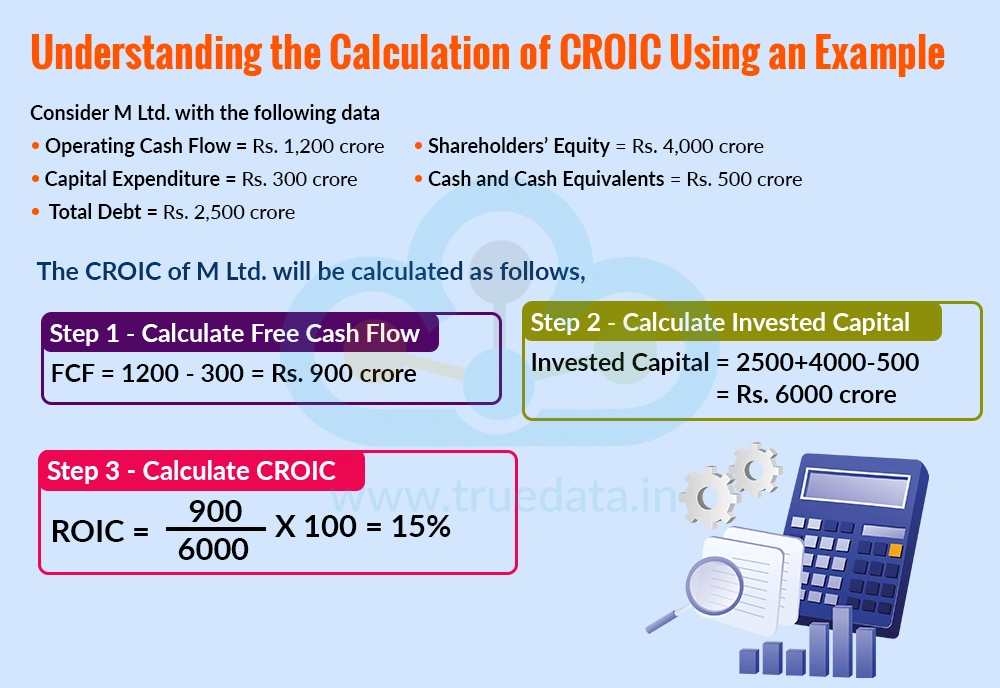
Understanding the Calculation of CROIC Using an Example

Consider M Ltd. with the following data
Operating Cash Flow = Rs. 1,200 crore
Capital Expenditure = Rs. 300 crore
Total Debt = Rs. 2,500 crore
Shareholders’ Equity = Rs. 4,000 crore
Cash and Cash Equivalents = Rs. 500 crore
Step 1 - Calculate Free Cash Flow
FCF = Operating Cash Flow - Capital Expenditure
FCF = 1200 - 300 = Rs. 900 crore
Step 2 - Calculate Invested Capital
Invested Capital = Total Debt + Shareholders′ Equity - Cash and Cash Equivalents
Invested Capital = 2500+4000-500 = Rs. 6000 crore
Step 3 - Calculate CROIC
CROIC = FCF / Invested Capital * 100
CROIC = 900 / 6000 * 100 = 15%
A CROIC of 15% means the company generates Rs. 15 of free cash flow for every Rs. 100 invested in the business. This indicates that the business is efficiently converting invested capital into usable cash.
A consistently high CROIC generally suggests the following strength for a company.
Strong cash-generating ability,
Disciplined capital spending,
Efficient management,
Healthy long-term financial performance.
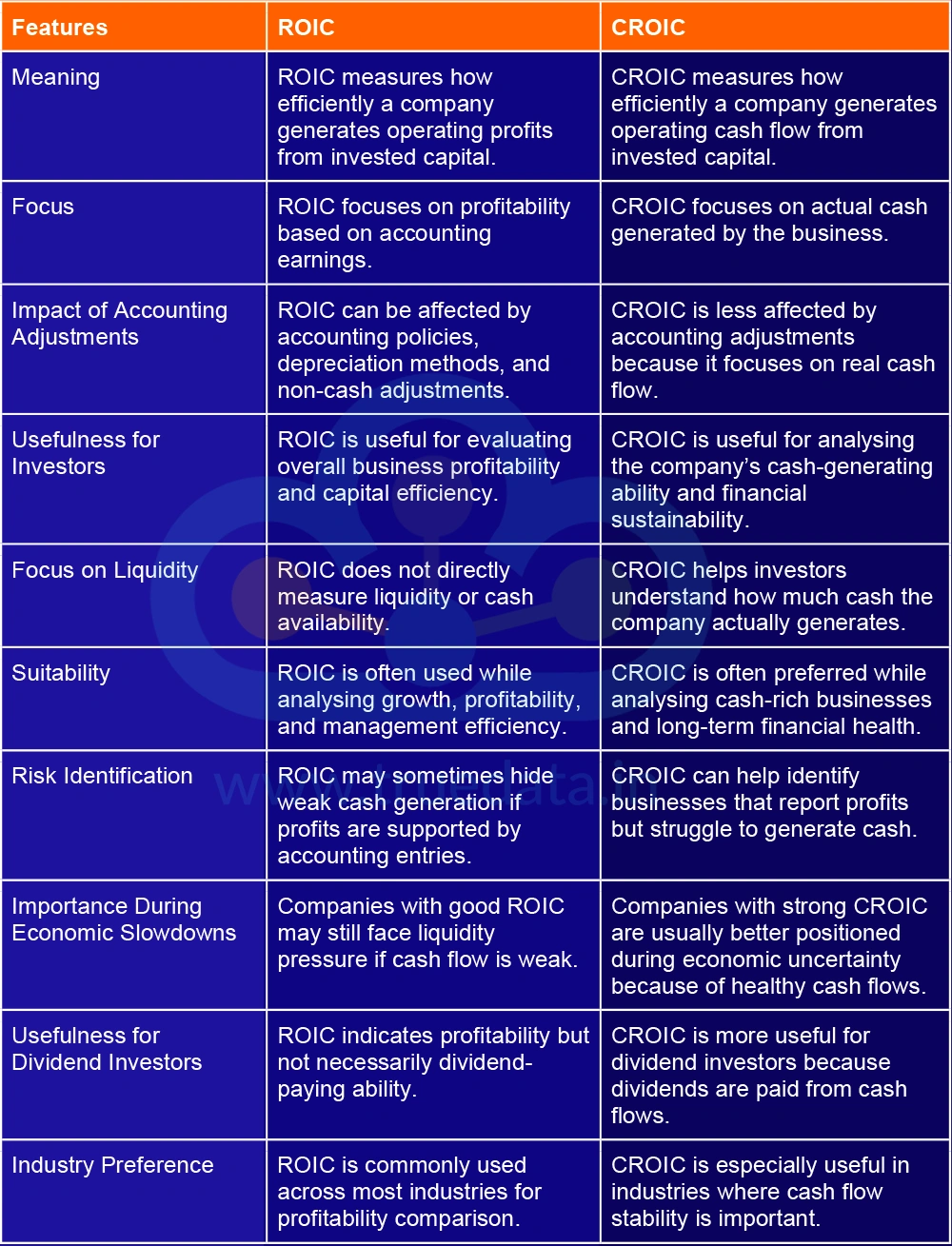
Both Return on Invested Capital (ROIC) and Cash Return on Invested Capital (CROIC) are important financial ratios used to measure how efficiently a company uses its invested capital. However, the main difference lies in what they measure. ROIC focuses on accounting profits, while CROIC focuses on actual cash generation. Understanding the difference between these two ratios can help investors analyse companies more effectively and make better long-term investment decisions.

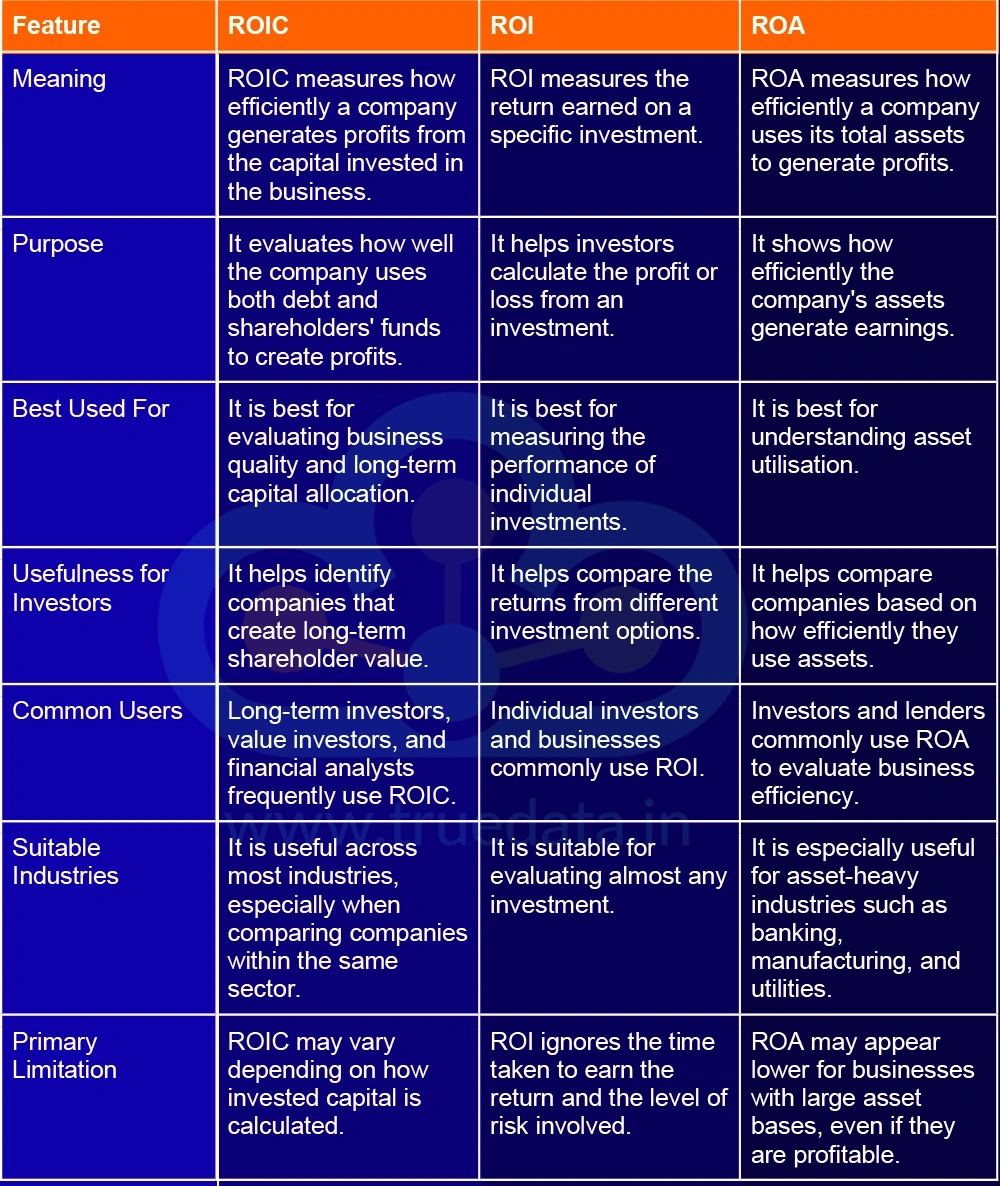
ROIC, ROI, and ROA are all financial ratios that measure returns, but they do so in different ways and for different purposes. While they may sound similar, each ratio answers a different question about a company or an investment. Understanding these differences can help investors choose the right ratio when analysing a business or making investment decisions.

Return on Invested Capital (ROIC) and Cash Return on Invested Capital (CROIC) are two important financial ratios that help investors understand how efficiently a company uses its capital to generate profits and cash flows. While ROIC focuses on operating profitability, CROIC highlights the company’s actual cash-generating ability, making both ratios valuable for evaluating business quality and long-term financial strength. Investors should analyse these ratios together, along with other financial indicators such as ROE, ROCE, debt levels, and free cash flow to gain a complete understanding of a company’s performance.
This article is yet another addition to our series on understanding financial ratios. Let us know your thoughts on the topic or if you need further information on the same, and we will address it soon.
Till then, Happy Reading!
Read More: Key Corporate Data Every Investor Must Track Before Investing
Thestock market never stands still, and prices swing constantly with every new h...
Corporate data is more than just the numbers of a company. They can show what is...
Investing is not just about numbers on a screen. It is about understanding the s...