When we talk of the costs for a company, we often focus on the direct costs like inventory, labour, etc. However, these are variable costs and depend upon production levels. A business also has fixed financial commitments like rent, lease payments, and interest expenses that must be paid even during slow periods or when production falls. A company's ability to comfortably meet these fixed obligations says a lot about its financial strength and stability. This is where the Fixed-Charge Coverage Ratio (FCCR) becomes useful. Have you heard about it? Read on to learn all about this important solvency ratio and why it deserves a place in your fundamental analysis toolkit.

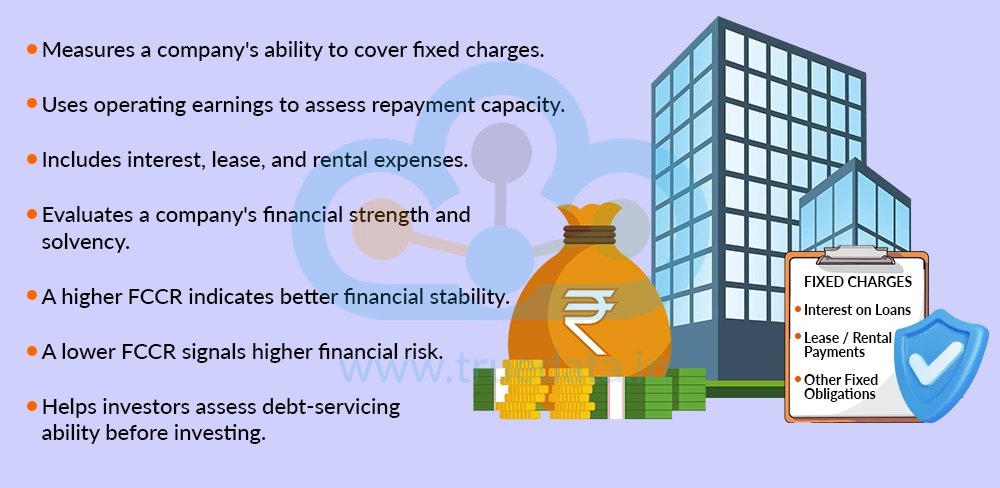
The Fixed-Charge Coverage Ratio (FCCR) is a solvency ratio that measures how well a company can pay its fixed financial obligations using its operating earnings. These fixed charges include expenses such as interest on loans, lease or rental payments, and other costs that the company must pay regardless of whether sales are high or low. Unlike variable costs, which rise or fall with production, fixed charges remain largely unchanged and have to be paid on time. A higher FCCR indicates that the company generates enough earnings to comfortably meet these obligations, making it financially stronger and more resilient during difficult business conditions. On the other hand, a low FCCR may indicate that the company could struggle to meet its fixed commitments if profits decline. Thus, the FCCR is a useful ratio for assessing a company's financial stability, debt-servicing ability, and overall solvency before making an investment decision.

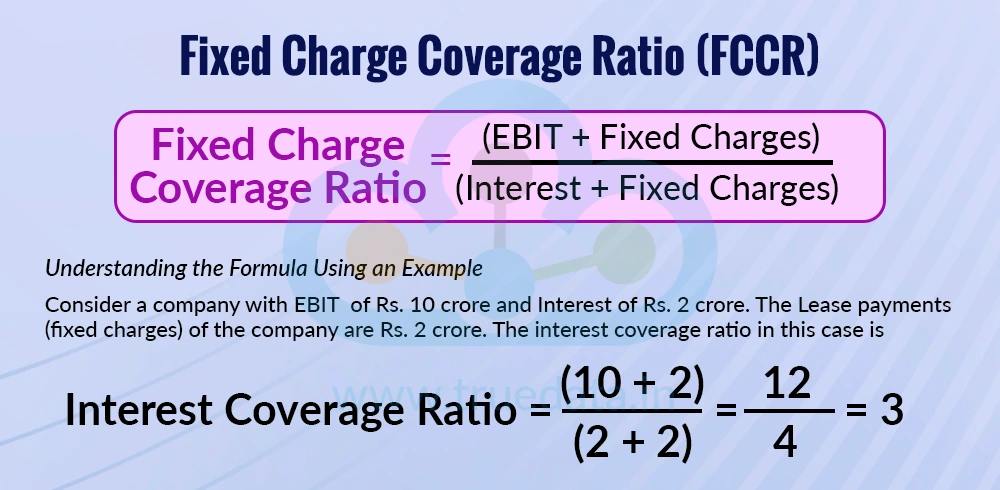
The Fixed-Charge Coverage Ratio (FCCR) measures how many times a company can cover its fixed financial obligations with its operating earnings. It compares the earnings available to pay fixed charges with the total fixed charges that the company has to meet.
The formula for calculating the Fixed-Charge Coverage Ratio is,
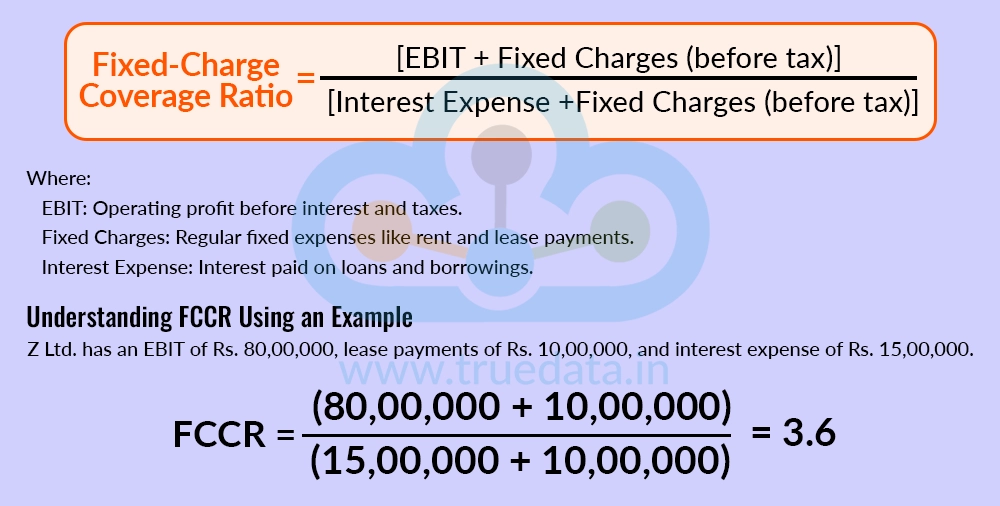
Fixed-Charge Coverage Ratio = [EBIT + Fixed Charges (before tax)] / [Interest Expense +
Fixed Charges (before tax)]
Where,
EBIT (Earnings Before Interest and Taxes) is the company's operating profit before deducting interest and taxes.
Fixed Charges include expenses such as lease rentals, rent, and other fixed contractual payments that the company must make regularly.
Interest Expense is the interest paid on loans and borrowings.
Understanding FCCR Using an Example
Consider Z Ltd. having an EBIT of Rs. 80,00,000 and annual lease payments of Rs. 10,00,000. The company also has an interest expense of Rs. 15,00,000. The FCCR for this company is calculated below.
Fixed-Charge Coverage Ratio = [EBIT + Fixed Charges (before tax)] / [Interest Expense +
Fixed Charges (before tax)]
FCCR = (80,00,000 + 10,00,000) / (15,00,000 + 10,00,000) = 3.6
Thus, Z Ltd. generates operating earnings that are 3.6 times its fixed financial obligations. In other words, the company has a comfortable margin to pay its interest and lease commitments, which indicates good financial stability. As an investor, a consistently high FCCR is generally a positive sign as it suggests that the company is less likely to face financial stress in meeting its fixed obligations, even if business conditions become challenging.

While there is no single ideal Fixed-Charge Coverage Ratio for every company, the following ranges can serve as general guidelines. Investors should always compare the ratio with companies in the same industry and review its trend over several years.
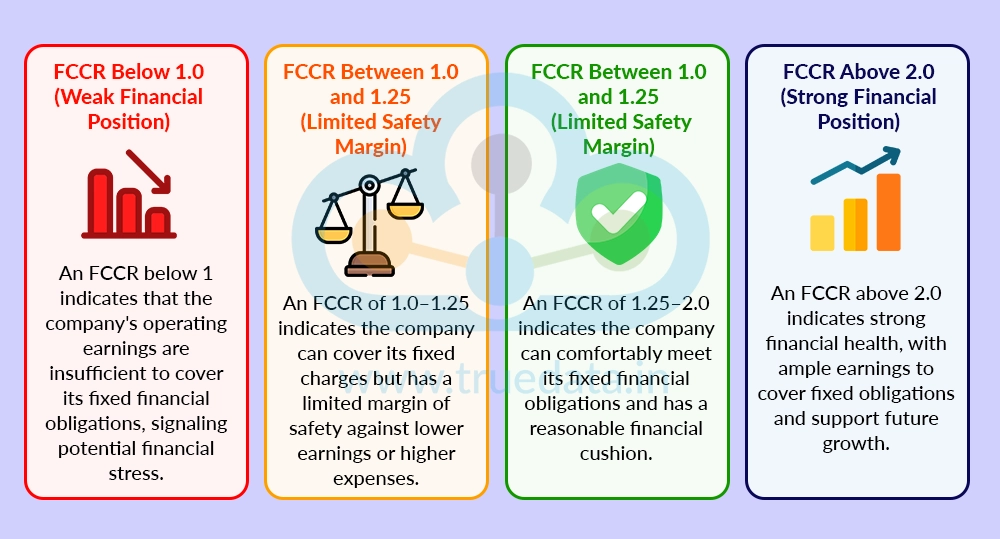
FCCR Below 1.0 (Weak Financial Position) - An FCCR below 1 means the company's operating earnings are not enough to cover its fixed financial obligations. This may indicate financial stress, and the company could be relying on cash reserves or additional borrowings to meet its commitments.
FCCR Between 1.0 and 1.25 (Limited Safety Margin) - An FCCR between 1.0 and 1.25 indicates that the company can meet its fixed charges, but it has only a small margin of safety. A decline in earnings or an increase in expenses could make it difficult for the company to meet its obligations comfortably.
FCCR Between 1.25 and 2.0 (Healthy Financial Position) - An FCCR in this range generally indicates that the company has a comfortable ability to meet its fixed financial commitments. It suggests that the business has a reasonable financial cushion to handle temporary business slowdowns or unexpected expenses.
FCCR Above 2.0 (Strong Financial Position) - An FCCR above 2.0 generally indicates a financially strong company with ample earnings to cover its fixed obligations. Such companies are often better positioned to manage economic downturns, invest in growth opportunities, and raise additional funds if required.
It is important to note that the FCCR should never be evaluated in isolation. It should always be compared with industry peers and analysed over a period of 3-5 years for effective trend identification. Also, it should be used along with other solvency ratios, such as the Interest Coverage Ratio and Debt-to-Equity Ratio, for decision-making.

The importance of FCCR and how it can be used in fundamental analysis is explained below.
Assesses Financial Strength and Solvency - The Fixed-Charge Coverage Ratio helps investors evaluate a company's financial strength by measuring whether its operating earnings are sufficient to cover fixed financial obligations such as interest and lease payments. A consistently healthy FCCR indicates that the company can comfortably meet its long-term commitments, making it more financially stable and less likely to face financial stress during difficult business conditions.
Assesses Debt-Servicing Ability - A company with significant borrowings must generate sufficient earnings to pay its interest and other fixed charges. The FCCR helps investors determine whether the company's debt level is manageable or whether it may become a financial burden.
Identifies Financial Risk - A declining or consistently low FCCR may indicate rising financial risk. It suggests that the company has a smaller earnings cushion to cover its fixed obligations, making it more vulnerable during periods of lower profits or economic slowdown.
Helps Compare Companies Within the Same Industry - Investors can use the FCCR to compare companies operating in the same sector. A company with a consistently higher FCCR than its peers generally has stronger financial stability and greater flexibility to meet its fixed commitments.
Shows Business Resilience - Companies with a healthy FCCR are usually better equipped to handle temporary declines in sales, higher costs, or economic uncertainty. They are more likely to continue meeting their fixed obligations without relying heavily on additional borrowings.
Indicates Capacity for Future Growth - A strong FCCR suggests that the company has room to raise additional funds for expansion if required. Since it can comfortably service its existing obligations, lenders and investors may view the company as financially reliable.
Helps Assess Long-Term Financial Trends - Investors should analyse the FCCR over the last three to five years rather than looking at a single year's ratio. A consistently improving ratio indicates strengthening financial health, while a declining trend may require further investigation.
Supports Better Investment Decisions - The FCCR is a useful tool in fundamental analysis as it highlights a company's ability to manage its fixed financial obligations. When used along with other financial metrics, it helps investors identify financially sound companies and avoid businesses with excessive financial risk.

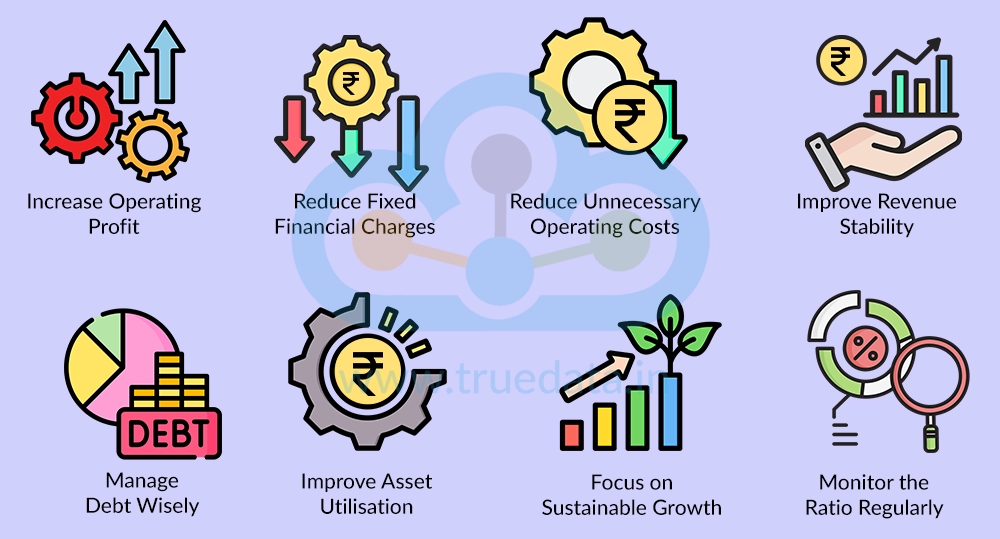
A poor FCCR ratio is a red flag for investors and analysts as it can indicate a struggle for the long-term financial sustainability of the company. This warrants the company to take necessary measures to improve the FCCR ratio that can eventually give confidence to its investors and shareholders about its financial stability. These measures include,
Increase Operating Profit - A company can improve its FCCR by increasing its operating earnings (EBIT). This can be achieved by growing sales, improving pricing, launching new products, or increasing operational efficiency.
Reduce Fixed Financial Charges - Lowering fixed expenses such as interest and lease payments can improve the FCCR. Companies can achieve this by repaying debt, renegotiating lease agreements, or refinancing loans at lower interest rates.
Reduce Unnecessary Operating Costs - Cutting avoidable expenses and improving cost efficiency can increase operating profit. Higher earnings make it easier for the company to meet its fixed financial obligations.
Improve Revenue Stability - Companies with steady and predictable revenue are better able to generate consistent earnings. Stable income helps maintain a healthy FCCR even during periods of slower business activity.
Manage Debt Wisely - Avoiding excessive borrowing and maintaining a balanced capital structure can prevent interest costs from rising too quickly. This helps keep the FCCR at a comfortable level.
Improve Asset Utilisation - Using existing assets more efficiently can increase productivity and profitability without significantly increasing fixed costs. This can strengthen the company's ability to cover its fixed obligations.
Focus on Sustainable Growth - Expanding the business gradually while keeping fixed financial commitments under control can improve the FCCR over time. Sustainable growth reduces the risk of financial strain from excessive debt or fixed expenses.
Monitor the Ratio Regularly - Regularly tracking the FCCR allows management to identify potential financial pressure early and take corrective action before fixed obligations become difficult to manage.

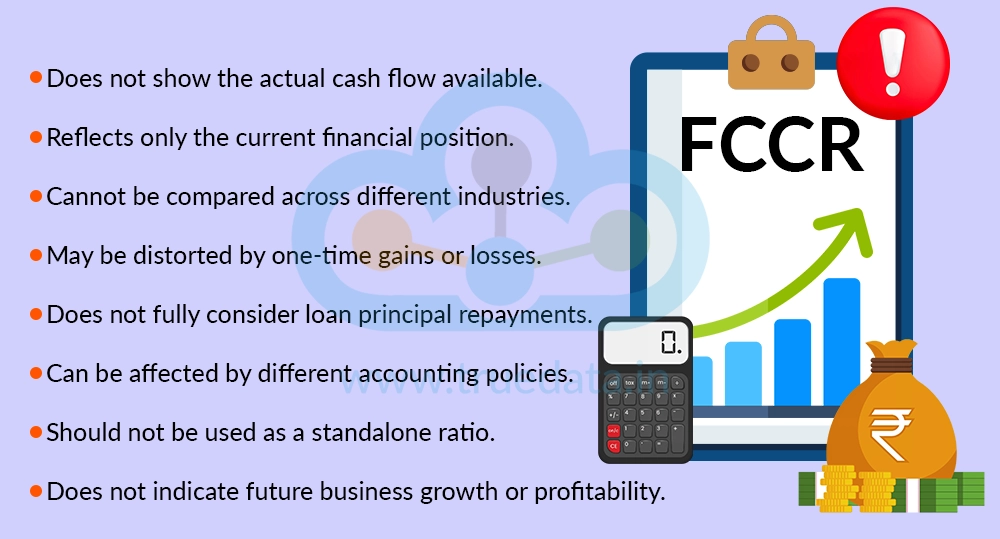
The FCCR ratio, like any other ratio, comes with a few limitations. These limitations include,
Does not show the actual cash flow available.
Reflects only the current financial position.
Cannot be compared across different industries.
May be distorted by one-time gains or losses.
Does not fully consider loan principal repayments.
Can be affected by different accounting policies.
Should not be used as a standalone ratio.
Does not indicate future business growth or profitability.
The Fixed-Charge Coverage Ratio (FCCR) is a valuable solvency ratio that helps investors understand whether a company can comfortably meet its fixed financial obligations using its operating earnings. A consistently healthy FCCR can generally reflect stronger financial stability and lower financial risk. However, no single ratio can provide a complete picture of a company's financial health. Thus, investors should analyse the FCCR alongside other financial ratios, compare it with industry peers, and track its trend over several years to make well-informed investment decisions.
This article explains a crucial financial ratio and its importance in fundamental analysis. Let us know your thoughts on this topic or if you need further information on the same, and we will address it soon.
Till then, Happy Reading!
Read More: Key Corporate Data Every Investor Must Track Before Investing
Thestock market never stands still, and prices swing constantly with every new h...
Debt and equity together form the total capital of a company. However, when anal...
Every investor knows that the stepping stones to a good investment in thestock m...