15-MIN DELAYED
NIFTY 22,711.90 -41.30 (-0.18%) | BANKNIFTY 54,034.10 -332.60 (-0.61%) | SENSEX 73,416.34 -190.41 (-0.26%) | CRUDEOIL-I 9,702.00 -13.00 (-0.13%) | GOLD-I 1,42,283.00 -867.00 (-0.61%) | NIFTY 22,711.90 -41.30 (-0.18%) | BANKNIFTY 54,034.10 -332.60 (-0.61%) | SENSEX 73,416.34 -190.41 (-0.26%) | CRUDEOIL-I 9,702.00 -13.00 (-0.13%) | GOLD-I 1,42,283.00 -867.00 (-0.61%) |
TrueData
Helpline / Support +91 7304-22-44-66
Get started

WORKSPACE

Workspace overview Workspace overview Our flagship product SignalX SignalX web charting for indian market Sheets Sheets streaming spreadsheet Wealth Wealth corporate data and news


Built for India's markets.

Real-time charts, streaming spreadsheets, live corporate announcements — all in one workspace.

Get started free

10 Corporate Filings Every Stock Investor Should Track in India

Marisha Bhatt · 27 Oct 2026 · 13 mins read · 0 Comments

10-corporate-filings-every-stock-investor-should-track-in-india

Quarterly and annual reports are among the most common ways companies keep shareholders and other stakeholders informed about their performance. But a company’s story does not begin and end with its financial results. Listed companies also make several other important filings and disclosures about major business developments, ownership changes, management decisions, corporate actions and more. For investors, these filings can offer valuable clues about what is happening inside a company between its regular financial updates. So, which corporate filings deserve your attention? Read on to understand 10 important corporate filings every stock investor in India should track and what they can tell you about a company.

What are Corporate Filings and Why are they Important?

What are Corporate Filings and Why are they Important

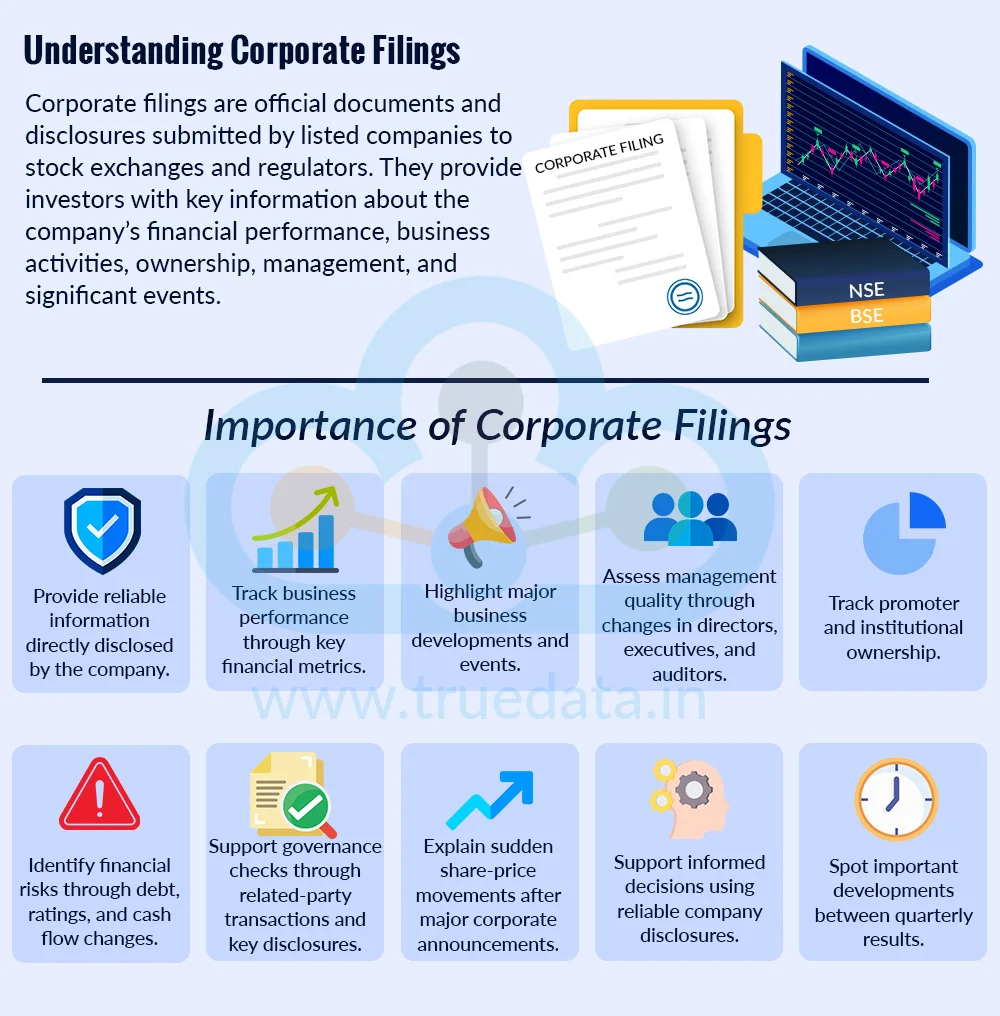
Corporate filings are official documents and disclosures that a listed company submits to stock exchanges such as the NSE and BSE, and in some cases to regulators such as SEBI and the Ministry of Corporate Affairs (MCA). These filings tell investors about important developments in the company, such as its quarterly financial results, annual performance, shareholding pattern, dividends, acquisitions, major orders, changes in directors or auditors, related-party transactions and other events that may affect the business or its shareholders. Corporate filings are the company's official way of telling the market what is happening inside the business. Unlike news reports, analyst opinions, or social media discussions, these disclosures come directly from the company and are an important source of information for investors researching an Indian-listed company. 

Importance of Corporate Filings

  • Provide reliable information directly disclosed by the company.

  • Help track business performance by showing whether revenue, profits, margins and other key numbers are improving or weakening.

  • Reveal important developments by alerting investors to acquisitions, large orders, mergers, fund raising, regulatory actions and other major events.

  • Help assess management quality by providing clues on corporate governance through any changes in directors, senior executives or auditors. 

  • Show who owns the company by tracking promoter and institutional ownership.

  • Help identify financial risks like debt-related disclosures, credit-rating changes and declining cash flows, highlighting potential problems.

  • Improve corporate governance checks through related-party transactions and other disclosures and help investors assess whether the company's decisions appear to protect minority shareholders.

  • Explain sudden share-price movements in the event of a major corporate announcement.

  • Help investors make informed decisions instead of relying only on market rumours or recommendations.

  • Help spot changes early by disclosing important events between quarterly results, allowing investors to stay updated on developments as they happen.

What are the Top 10 Corporate Filings Investors Should Check?

Under SEBI's Listing Obligations and Disclosure Requirements (LODR) framework, listed companies have periodic as well as event-based disclosure requirements. NSE's current compliance calendar, for example, covers financial results, shareholding patterns, governance filings, annual reports and material-event disclosures. Here are the 10 corporate filings that individual stock investors should focus on most closely.

Quarterly and Annual Financial Results

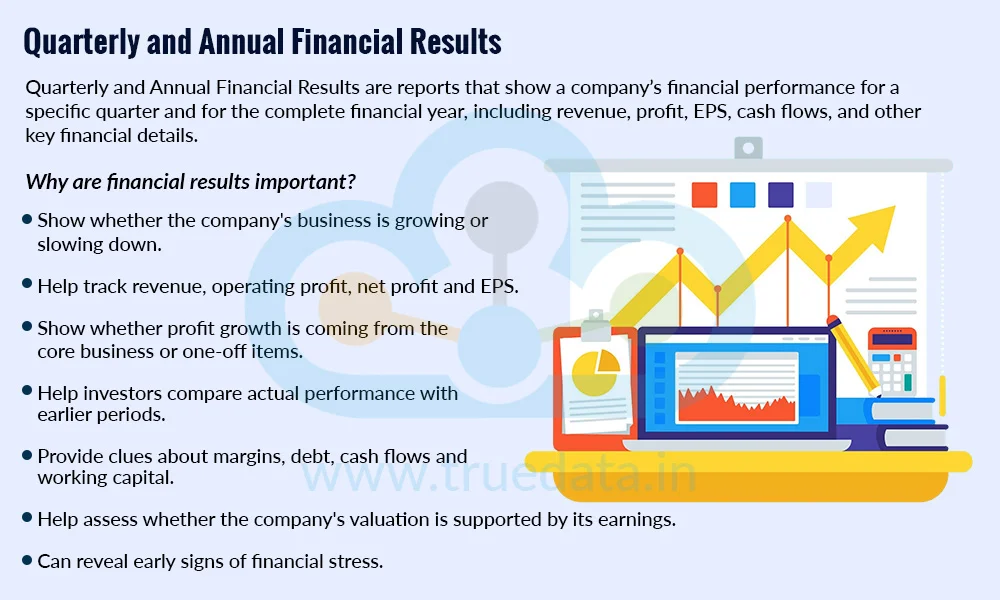
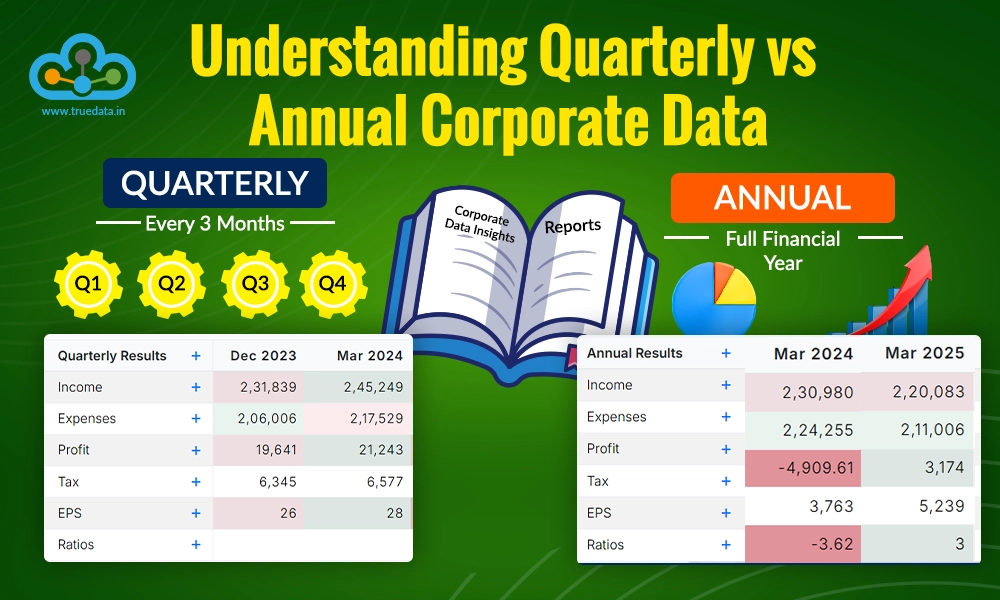
Financial results are among the most important filings for any stock investor because they show how the company has performed during a particular period. Listed companies generally report their results every quarter, along with the annual results for the full financial year. The filing can include revenue, operating profit, profit after tax (PAT), earnings per share (EPS), balance sheet information, cash flows and other financial details. It is also accompanied by the limited review or audit report, as applicable. Under Regulation 33 of SEBI LODR, quarterly results are generally required within 45 days of the quarter-end, while the audited annual results are required within 60 days of the financial year-end.

The important point is not simply whether profit has increased or decreased. Investors should compare the latest results with the same quarter of the previous year, look at revenue and margin trends, check whether cash flows support reported profits, and understand what management says about the future. A company may report higher profits due to a one-time gain, while its core business may actually be weakening. Similarly, strong sales growth accompanied by falling margins or rising debt may deserve closer attention.

Why are financial results important?

  • Show whether the company's business is growing or slowing down.

  • Help track revenue, operating profit, net profit and EPS.

  • Show whether profit growth is coming from the core business or one-off items.

  • Help investors compare actual performance with earlier periods.

  • Provide clues about margins, debt, cash flows and working capital.

  • Help assess whether the company's valuation is supported by its earnings.

  • Can reveal early signs of financial stress.

Annual Report

Annual Report

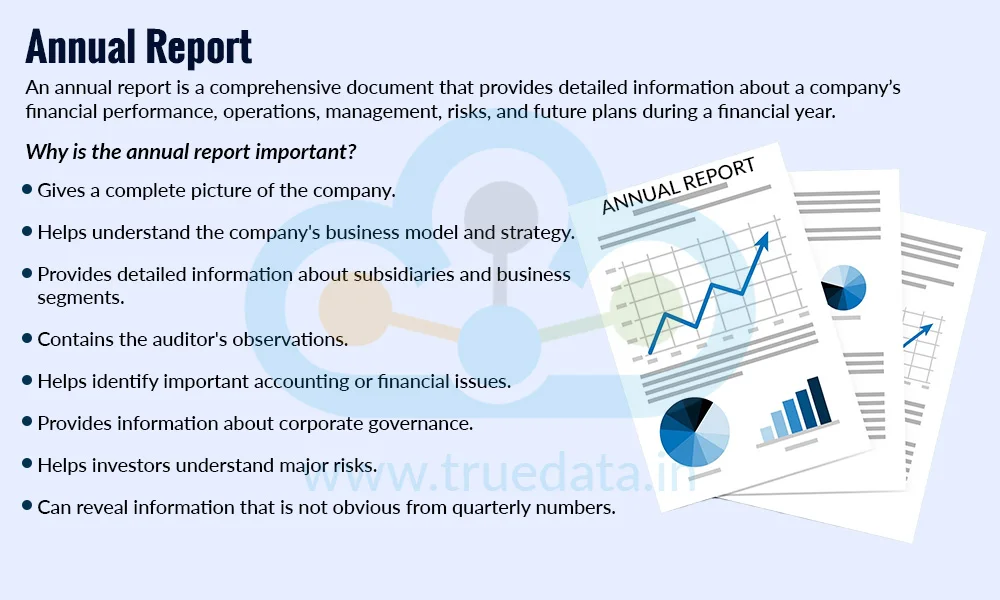
The annual report is a comprehensive document that provides a much broader picture of the company than quarterly results. It generally contains the company's financial statements, auditor's report, directors’ report, management discussion and analysis, corporate governance information and other statutory disclosures. Under Regulation 34 of SEBI LODR, listed entities are required to submit their annual report to the stock exchanges within the prescribed framework.

The annual report is particularly useful as it allows investors to move beyond headline numbers. They can understand the company's business segments, subsidiaries, risks, strategy, capital allocation, related-party transactions, accounting policies and management's explanation of the year's performance. For larger listed companies, the annual report can also include the Business Responsibility and Sustainability Report (BRSR), which provides information on sustainability and responsible business matters.

Why is the annual report important?

  • Gives a complete picture of the company.

  • Helps understand the company's business model and strategy.

  • Provides detailed information about subsidiaries and business segments.

  • Contains the auditor's observations.

  • Helps identify important accounting or financial issues.

  • Provides information about corporate governance.

  • Helps investors understand major risks.

  • Can reveal information that is not obvious from quarterly numbers.

Shareholding Pattern

Shareholding Pattern

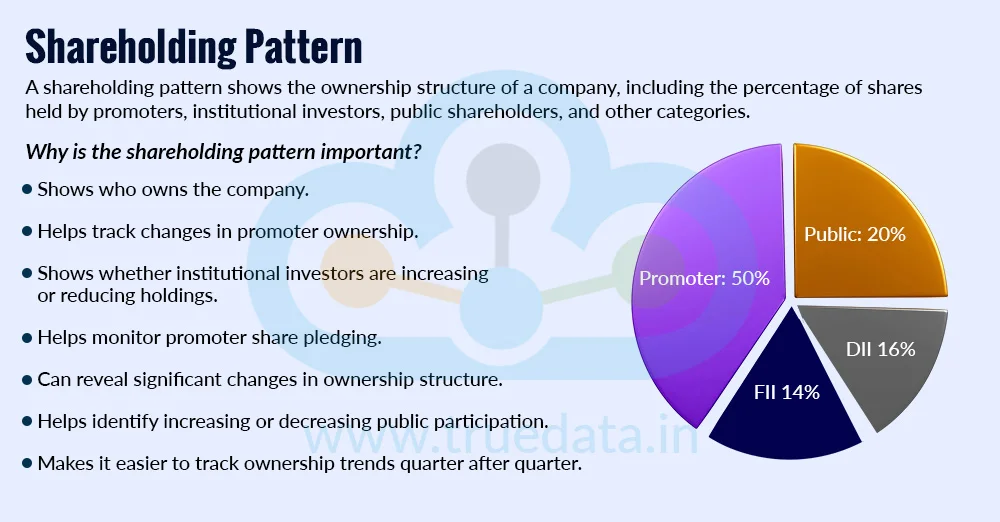
The shareholding pattern shows who owns the company's shares and how ownership is distributed. It generally separates holdings into categories such as promoters and promoter group, foreign institutional investors (FPIs), domestic institutional investors, public shareholders and other categories. Listed entities are required to file the shareholding pattern under Regulation 31, generally within 21 days from the end of each quarter.

The real value comes from comparing the pattern over several quarters. A rising promoter holding can sometimes indicate increasing promoter commitment, although it should not automatically be considered bullish. On the other hand, a declining promoter stake may deserve investigation, particularly if the reduction is large or repeated. Investors should also examine promoter pledging because a significant increase in pledged shares can indicate higher financial pressure or borrowing against promoter holdings. Institutional ownership changes can also provide useful information, but they should not be treated as a buy or sell signal on their own.

Why is the shareholding pattern important?

  • Shows who owns the company.

  • Helps track changes in promoter ownership.

  • Shows whether institutional investors are increasing or reducing holdings.

  • Helps monitor promoter share pledging.

  • Can reveal significant changes in ownership structure.

  • Helps identify increasing or decreasing public participation.

  • Makes it easier to track ownership trends quarter after quarter.

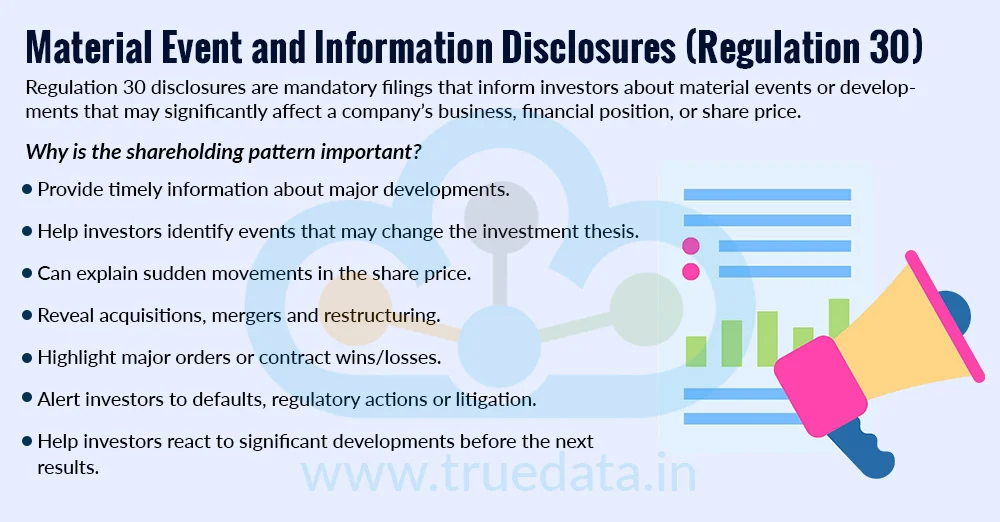
Material Event and Information Disclosures (Regulation 30)

Material Event and Information Disclosures (Regulation 30)

Regulation 30 disclosures inform investors about important events or developments that could affect the company's business, financial position or share price. These can include acquisitions, mergers, demergers, major orders, major contracts, changes in management, defaults, restructuring, fraud-related developments, regulatory actions, litigation, business disruptions and other material events. NSE's current filing categories specifically include acquisitions, restructuring, management changes, defaults, corporate insolvency proceedings, orders/contracts and several other Regulation 30 events.

These filings can sometimes be more important than quarterly results because they can provide information about a major change before it appears in the company’s financial statements. For example, a large acquisition may change the company's growth prospects and debt position, while the resignation of a key executive or auditor may warrant further investigation. Similarly, the cancellation of a major order could affect future revenue expectations.

Why are Regulation 30 disclosures important?

  • Provide timely information about major developments.

  • Help investors identify events that may change the investment thesis.

  • Can explain sudden movements in the share price.

  • Reveal acquisitions, mergers and restructuring.

  • Highlight major orders or contract wins/losses.

  • Alert investors to defaults, regulatory actions or litigation.

  • Help investors react to significant developments before the next results.

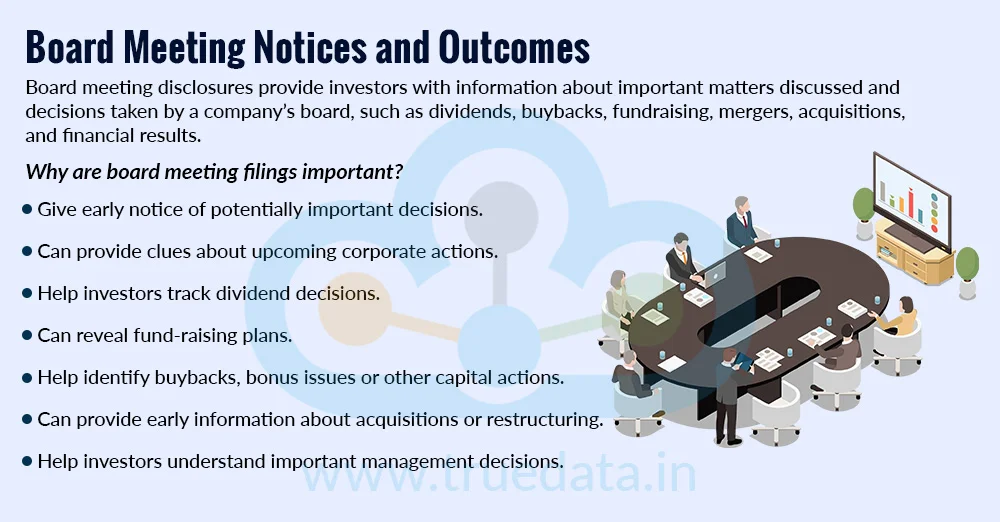
Board Meeting Notices and Outcomes

Board Meeting Notices and Outcomes

Listed companies disclose information about important board meetings and subsequently communicate the decisions taken at those meetings. Board meetings can deal with financial results, dividends, buybacks, bonus issues, fundraising, preferential issues, rights issues, mergers, acquisitions and other important matters. Under the current NSE compliance framework, prior intimation of board meetings under Regulation 29 is generally required at least two working days in advance, subject to the applicable requirements.

The board-meeting outcome can be particularly important because it tells investors what the directors actually decided. For example, a company may announce a dividend, approve a fund-raising proposal, decide on a buyback, approve an acquisition or take another major corporate decision. Investors should pay attention to both the meeting notice and the final outcome, as the notice tells investors what is being considered, while the outcome tells them what was actually approved.

Why are board meeting filings important?

  • Give early notice of potentially important decisions.

  • Can provide clues about upcoming corporate actions.

  • Help investors track dividend decisions.

  • Can reveal fund-raising plans.

  • Help identify buybacks, bonus issues or other capital actions.

  • Can provide early information about acquisitions or restructuring.

  • Help investors understand important management decisions.

Promoter, Insider and Significant Shareholder Transaction Disclosures

Promoter, Insider and Significant Shareholder Transaction Disclosures

These disclosures provide information about certain purchases or sales of shares by promoters, directors, key managerial personnel and other persons covered by SEBI's insider-trading framework or substantial-acquisition rules. They can help investors see whether important insiders are buying or selling shares. Significant shareholder acquisitions or disposals are also subject to disclosure requirements under the SEBI Takeover Regulations. For example, the SAST framework contains disclosure requirements around acquisition/disposal by shareholders at or above specified ownership thresholds.

These filings can be useful because insiders may have a closer understanding of the company's operations. However, investors should be careful about interpreting them. An insider selling shares does not automatically mean that the company is weak; the person may need money for personal reasons, taxation or diversification. Similarly, an insider purchase can be encouraging but does not guarantee future share price appreciation. The size, frequency, price and context of the transaction matter.

Why are these disclosures important?

  • Show whether certain insiders are buying or selling shares.

  • Can provide additional information about management confidence.

  • Help identify substantial ownership changes.

  • Can reveal repeated selling or buying patterns.

  • Help investors monitor changes in control or influence.

  • Provide useful context when combined with the shareholding pattern.

  • Can strengthen or challenge an existing investment thesis.

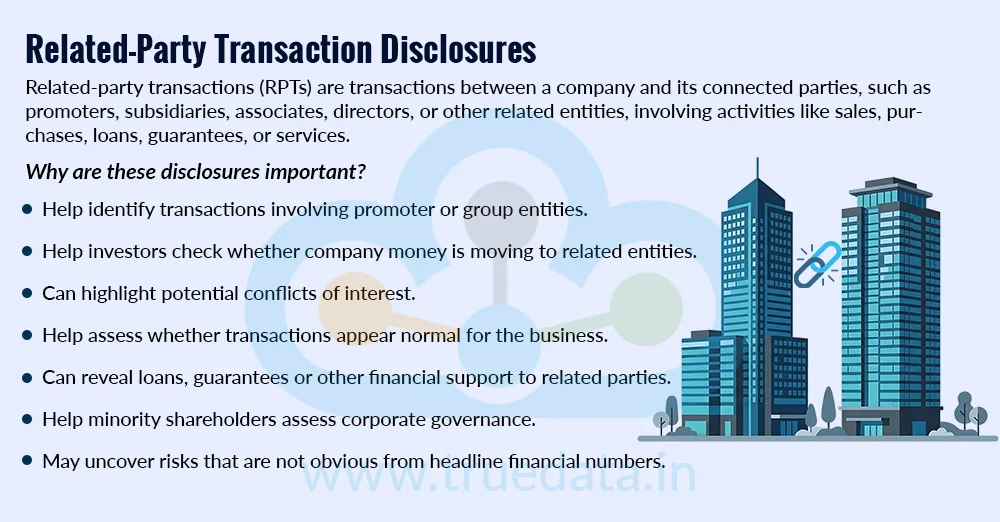
Related-Party Transaction Disclosures

Related-Party Transaction Disclosures

Related-party transactions (RPTs) involve transactions between the listed company and parties connected to it, such as promoter group entities, subsidiaries, associates, directors or other related parties. These transactions may include purchases, sales, loans, guarantees, leases, services or other arrangements. Under the current integrated filing framework, related-party transaction disclosures form part of the Integrated Filing Financials and are made on a half-yearly basis alongside the relevant financial results.

Related-party transactions are not automatically bad. A large business group may routinely transact with its subsidiaries or group companies as part of normal business. The important question is whether the transactions appear reasonable, transparent and beneficial to the listed company and its minority shareholders. Investors should pay particular attention to large loans, guarantees, unusual purchases or sales, transactions with promoter-linked entities and arrangements that appear disproportionate to the company's size.

Why are RPT disclosures important?

  • Help identify transactions involving promoter or group entities.

  • Help investors check whether company money is moving to related entities.

  • Can highlight potential conflicts of interest.

  • Help assess whether transactions appear normal for the business.

  • Can reveal loans, guarantees or other financial support to related parties.

  • Help minority shareholders assess corporate governance.

  • May uncover risks that are not obvious from headline financial numbers.

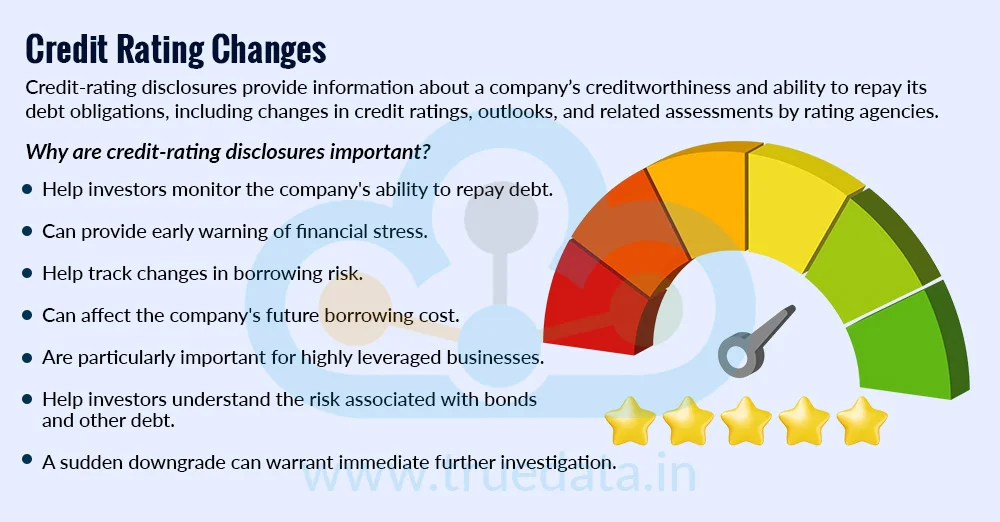
Credit Rating Changes

Credit Rating Changes

Credit rating disclosures relate mainly to the company's debt instruments and borrowings. Rating agencies assess the ability of a company to meet its financial obligations and assign ratings based on factors such as financial strength, debt levels, cash flows and repayment capacity. A rating upgrade may indicate improving credit quality, while a downgrade or negative outlook may signal increasing financial risk.

Credit rating information can be especially important for companies with substantial debt, banks, NBFCs and businesses that frequently raise money through bonds or other debt instruments. NSE's filing framework includes credit-rating-related disclosures, and SEBI's reforms have also moved certain rating disclosures toward system-driven processes.

Why are credit-rating disclosures important?

  • Help investors monitor the company's ability to repay debt.

  • Can provide early warning of financial stress.

  • Help track changes in borrowing risk.

  • Can affect the company's future borrowing cost.

  • Are particularly important for highly leveraged businesses.

  • Help investors understand the risk associated with bonds and other debt.

  • A sudden downgrade can warrant immediate further investigation.

Corporate Action Filings

Corporate Action Filings

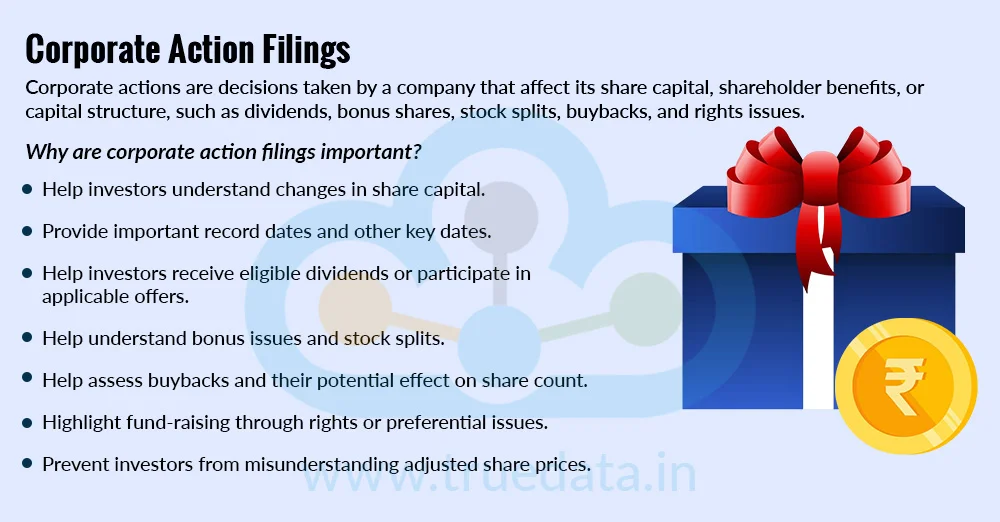
Corporate actions are decisions that change the company's share capital, shareholder benefits or capital structure. They can include dividends, bonus shares, stock splits, buybacks, rights issues, preferential issues and other securities-related actions. Listed companies disclose relevant information about these actions through the stock exchanges, including important dates such as record dates where applicable. NSE's current filing categories specifically include dividend, bonus, buyback, securities issuance, split/consolidation and related corporate actions.

Corporate actions can affect how investors calculate returns and interpret share prices. For example, a stock split reduces the face value and increases the number of shares while keeping the overall economic value broadly unchanged at the time of the adjustment. A bonus issue similarly increases the number of shares without directly creating equivalent economic wealth for shareholders. A buyback, on the other hand, can reduce the number of outstanding shares and potentially affect EPS and ownership percentages.

Why are corporate action filings important?

  • Help investors understand changes in share capital.

  • Provide important record dates and other key dates.

  • Help investors receive eligible dividends or participate in applicable offers.

  • Help understand bonus issues and stock splits.

  • Help assess buybacks and their potential effect on share count.

  • Highlight fund-raising through rights or preferential issues.

  • Prevent investors from misunderstanding adjusted share prices.

Corporate Governance, Director and Auditor Filings

Corporate Governance, Director and Auditor Filings

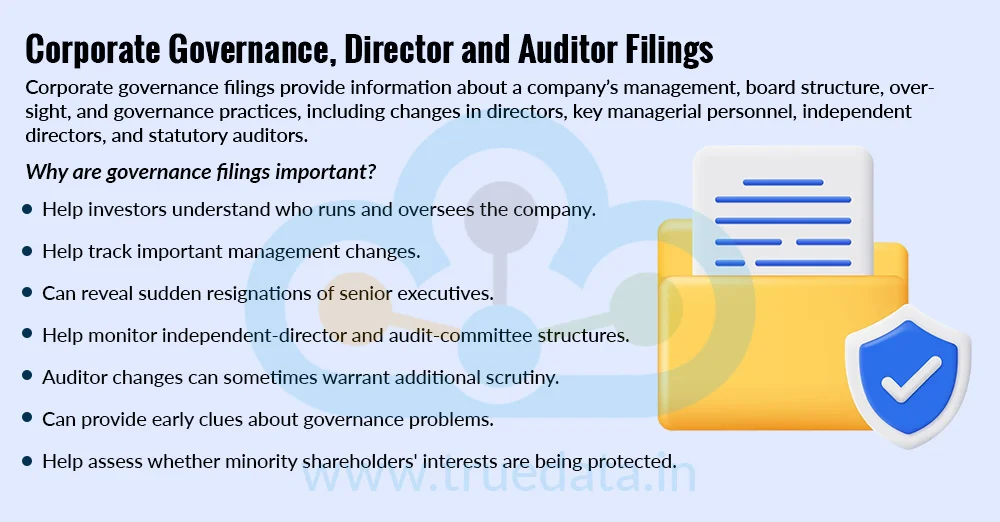
Corporate governance filings provide information about how the company is being managed and overseen. They can cover board composition, independent directors, audit committees, investor grievances and other governance matters. Companies also make event-based disclosures when directors, key managerial personnel, senior management, compliance officers or statutory auditors are appointed or resign. NSE's current filing categories specifically include changes in directors and key managerial personnel, as well as resignation of statutory auditors.

These filings are important because financial statements tell investors what happened financially, while governance disclosures can provide clues about who is making decisions and how the company is being controlled. A normal change in management may not be concerning, but the sudden resignation of a CFO, independent director or statutory auditor, particularly when several senior people leave around the same time, may require deeper investigation. Investors should read the stated reasons and check whether other filings or financial developments provide additional context.

Why are governance filings important?

  • Help investors understand who runs and oversees the company.

  • Help track important management changes.

  • Can reveal sudden resignations of senior executives.

  • Help monitor independent-director and audit-committee structures.

  • Auditor changes can sometimes warrant additional scrutiny.

  • Can provide early clues about governance problems.

  • Help assess whether minority shareholders' interests are being protected.

Conclusion

Corporate filings can help investors look beyond daily share-price movements and understand what is really happening inside a company. From financial results and shareholding patterns to major business updates, related-party transactions and management changes, these disclosures provide useful information for making informed investment decisions. By regularly tracking the key corporate filings and looking at them together, investors can better assess a company's financial health, growth prospects, risks and corporate governance before making investment decisions. 

This article highlights the important details that investors can focus on from the abundance of available corporate data and information. Let us know your thoughts on the topic or if you need further information, and we will address it soon. 

Till then, Happy Reading! 


Read More: Key Corporate Data Every Investor Must Track Before Investing 

Frequently Asked Questions

Corporate filings can affect stock prices when they contain news that changes investors’ expectations about a company’s profits, growth, risks or future plans. Positive developments may support the share price, while weak results, rising debt, management changes or other negative disclosures may put pressure on it.

Investors can find corporate filings on the official websites of the NSE and BSE, as well as on the respective company’s investor-relations website. These platforms provide filings such as financial results, shareholding patterns, corporate announcements, annual reports and other important disclosures.

Investors can use corporate filings to spot risks such as falling profits, rising debt, promoter share pledging, management changes, related-party transactions and credit-rating downgrades. Comparing these disclosures over time can help investors identify warning signs and assess a company's financial and governance risks before making an investment decision.

Financial corporate filings provide information about a company’s financial performance, such as revenue, profits, cash flows and debt, while non-financial filings cover important business, management, ownership, governance and corporate events. Both are important for investors as they together give a clearer picture of the company’s financial health, risks and future prospects.

Listed companies in India make corporate filings at different intervals depending on the type of disclosure, as some are quarterly or annually, while others are made whenever a major event or corporate action occurs. It is useful to check these filings regularly, as important updates can come between financial results.
Marisha Bhatt

Marisha Bhatt is a financial content writer @TrueData.

She writes with the sole aim of simplifying complex financial concepts and jargon while attempting to clarify technical and fundamental analysis concepts of the stock markets. The ultimate goal is to spread vital knowledge and benefit the maximum audience. Her Chartered Accountant background acts as the knowledge base to help clarify crucial concepts and create a sound investment portfolio.

0 Comments