15-MIN DELAYED
NIFTY 22,776.10 +220.35 (+0.98%) | BANKNIFTY 55,128.40 +414.30 (+0.76%) | SENSEX 73,067.81 +685.34 (+0.95%) | CRUDEOIL-I 8,636.00 -45.00 (-0.52%) | GOLD-I 1,50,130.00 +3,590.00 (+2.45%) | NIFTY 22,776.10 +220.35 (+0.98%) | BANKNIFTY 55,128.40 +414.30 (+0.76%) | SENSEX 73,067.81 +685.34 (+0.95%) | CRUDEOIL-I 8,636.00 -45.00 (-0.52%) | GOLD-I 1,50,130.00 +3,590.00 (+2.45%) |
TrueData
Helpline / Support +91 7304-22-44-66
Get started

WORKSPACE

Workspace overview Workspace overview Our flagship product SignalX SignalX web charting for indian market Sheets Sheets streaming spreadsheet Wealth Wealth corporate data and news


Built for India's markets.

Real-time charts, streaming spreadsheets, live corporate announcements — all in one workspace.

Get started free

Bonus Issues and Stock Splits

Marisha Bhatt · 06 Oct 2026 · 14 mins read · 0 Comments

bonus-issues-and-stock-splits

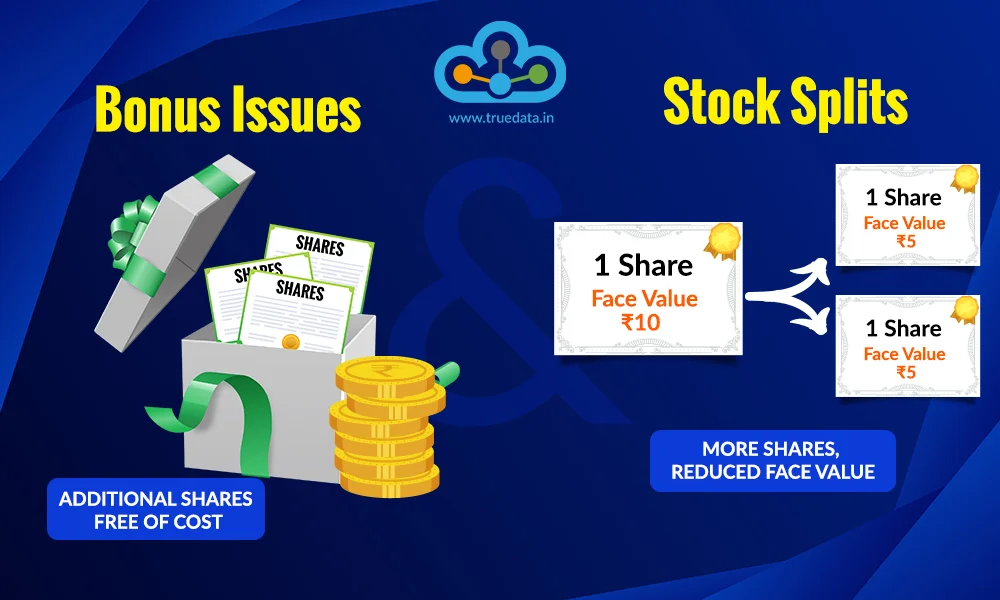
Have you ever noticed that a company’s share price suddenly drops while the value of your investment remains broadly unchanged? Or found that the number of shares in your demat account has increased without you buying any additional shares? These changes can sometimes be linked to corporate actions such as bonus issues and stock splits. While both can result in investors holding more shares, the way they work, the reason companies announce them, and their impact on the share price and face value can be quite different. Understanding these differences can help investors avoid common misconceptions and better interpret such announcements. So dive into this blog to explore the key differences between bonus issues and stock splits and why companies opt for them.

What is a Bonus Issue?

What is a Bonus Issue

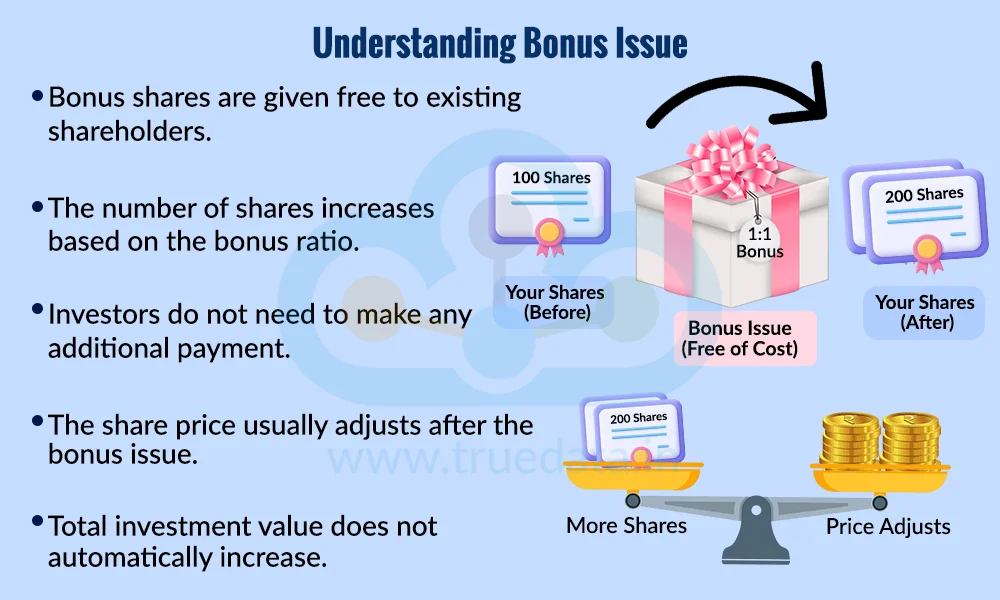
A bonus issue is a corporate action in which a company gives additional shares to its existing shareholders free of cost, based on the number of shares they already own. Therefore, instead of paying shareholders cash, the company rewards them with extra shares. For example, if a company announces a 1:1 bonus issue, an investor holding 100 shares will receive 100 additional shares, taking the total holding to 200 shares. A bonus issue does not require the investor to make any additional payment. However, receiving extra shares does not automatically increase the total value of the investment, because the share price generally adjusts downward in proportion to the bonus ratio. Companies may issue bonus shares when they have accumulated reserves and want to reward existing shareholders, improve the affordability or liquidity of their shares, or signal confidence in the business. It is therefore important to look beyond the higher number of shares and understand how the bonus issue affects the share price, earnings per share (EPS), and overall investment value.

Why Do Companies Opt for a Bonus Issue?

Why Do Companies Opt for a Bonus Issue

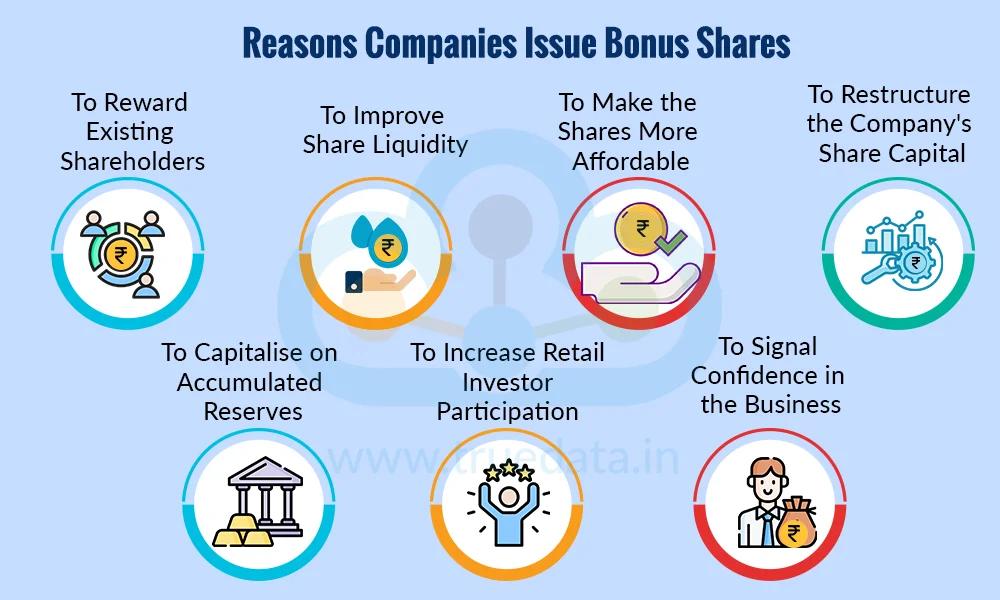
Companies may announce a bonus issue for several reasons. While it gives existing shareholders additional shares without requiring them to pay anything, the decision is usually linked to the company’s capital structure, accumulated reserves, share price and broader shareholder strategy. Here are some common reasons why companies opt for a bonus issue.

To Reward Existing Shareholders

A bonus issue can be a way for a company to reward its existing shareholders for their continued support, where, in place of an additional cash dividend, the company can distribute free shares to eligible shareholders. For example, in a 1:2 bonus issue, an investor holding 100 shares receives another 50 shares. This can make shareholders feel more connected to the company’s growth, although the bonus itself does not create additional wealth immediately because the share price adjusts accordingly.

To Improve Share Liquidity

Companies may also use bonus issues to encourage greater trading activity in their shares. When the price per share falls after a bonus issue, more investors may be able to buy smaller quantities of shares. This can potentially increase the number of shares traded in the market and improve liquidity. However, a bonus issue does not guarantee that trading volume or liquidity will increase.

To Make the Shares More Affordable

When a company's share price becomes very high, some retail investors may find it difficult to buy its shares. A bonus issue increases the number of shares while the market price generally adjusts downward in proportion to the bonus ratio. This can bring the per-share price to a more accessible level. A lower share price may make the stock appear more affordable to smaller investors and can potentially improve participation in the market.

To Restructure the Company's Share Capital

A bonus issue can also help a company reorganise its share capital without raising fresh funds from shareholders. Since the additional shares are issued from eligible reserves, the company's total number of outstanding shares increases while the underlying business and total shareholder ownership percentage generally remain unchanged. This makes a bonus issue more of a capital restructuring exercise than a way of raising new money.

To Capitalise on Accumulated Reserves

A bonus issue allows a company to convert certain accumulated reserves into share capital. Thus, instead of keeping some eligible reserves only as reserves on the balance sheet, the company can use them to issue additional shares to existing shareholders. This can increase the company’s paid-up share capital without bringing in fresh cash from investors.

To Increase Retail Investor Participation

A high-priced share may be less accessible to smaller investors, even when the underlying business is attractive. By increasing the number of shares and reducing the market price per share proportionately, a bonus issue can make the stock easier to access for retail investors. This may broaden the investor base over time, although the actual impact depends on market conditions and investor interest.

To Signal Confidence in the Business

A bonus issue can sometimes be viewed as a sign that the company has built up sufficient reserves and has confidence in its financial position. It may also indicate that the management believes the company has reached a stage where its share structure can be broadened. However, investors should not treat a bonus announcement on its own as proof that a company is financially strong. It is important to also examine its revenue growth, profitability, cash flows, debt levels and overall financial performance.

What are the Key Rules for a Bonus Issue?

What are the Key Rules for a Bonus Issue

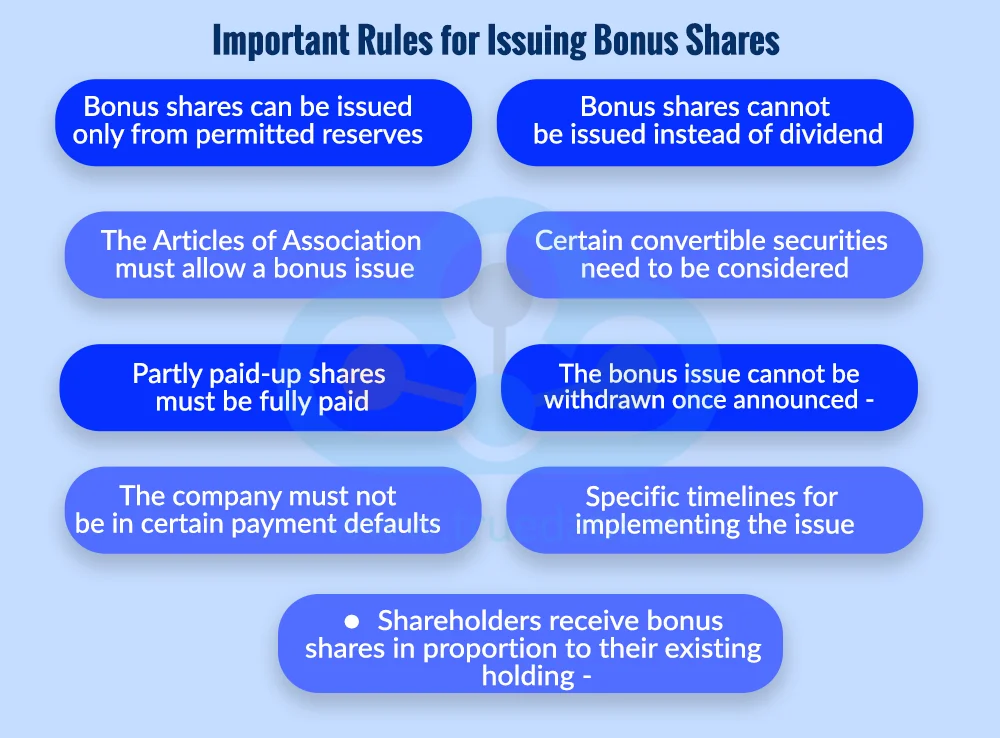
The main provisions governing the bonus issue come from Section 63 of the Companies Act, 2013 and, for listed companies, the SEBI (Issue of Capital and Disclosure Requirements) Regulations, 2018 (ICDR Regulations). These rules cover matters such as eligibility, approvals, disclosures and implementation of the bonus issue and have to be adhered to by companies for a successful bonus issue.

  • Bonus shares can be issued only from permitted reserves - Under Section 63 of the Companies Act, 2013, a company can issue bonus shares out of its free reserves, securities premium account, or capital redemption reserve account. However, reserves created through the revaluation of assets cannot be used for issuing bonus shares.

  • The Articles of Association must allow a bonus issue - The company's Articles of Association (AoA) should authorise the issue of bonus shares and capitalisation of reserves. If they do not, the company needs to make the required changes to its AoA through the appropriate shareholder approval process. SEBI's ICDR framework also contains this requirement for listed companies.

  • Partly paid-up shares must be fully paid - If the company has partly paid-up shares, these must be made fully paid-up before the bonus shares are allotted. This prevents a company from issuing bonus shares while existing shares still have an unpaid amount.

  • The company must not be in certain payment defaults - SEBI rules for a listed company require that the company should not have defaulted on the payment of interest or principal on fixed deposits or debt securities. It should also have sufficient reason to believe that it has not defaulted on certain statutory employee dues, such as provident fund, gratuity and bonus payments.

  • Bonus shares cannot be issued instead of dividend - A company cannot use a bonus issue simply as a substitute for paying a dividend that is due to shareholders. The bonus issue is a capitalisation of eligible reserves, not a cash dividend.

  • Certain convertible securities need to be considered - If a company has outstanding compulsorily convertible debt instruments, it must make appropriate provision for the holders of those instruments when issuing bonus shares. The reserved shares are to be issued when the convertible instruments are converted, on the same terms or proportion as the bonus issue.

  • The bonus issue cannot be withdrawn once announced - Once a company announces a bonus issue after the required approval, it cannot simply withdraw the decision. This gives investors greater certainty after the company has formally announced the corporate action.

  • Specific timelines for implementing the issue - SEBI has prescribed timelines for implementing a bonus issue after the necessary approvals. The current regulatory framework also includes operational measures intended to speed up the credit and trading of bonus shares. SEBI's February 2026 framework provides for a T+1 deemed date of allotment and aims to enable T+2 trading of bonus shares, subject to the prescribed process.

  • Shareholders receive bonus shares in proportion to their existing holding - A bonus issue is made to existing shareholders based on the announced ratio and their eligibility on the record date. 

What are Stock Splits?

What are Stock Splits

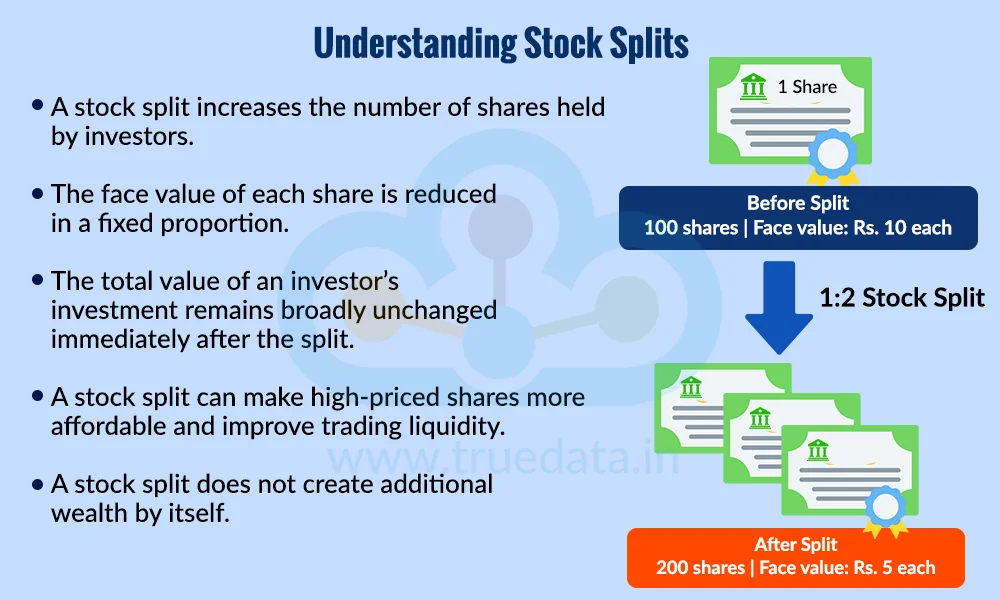
A stock split is a corporate action in which a company divides its existing shares into a larger number of shares by reducing the face value of each share in a fixed proportion. For example, in a 1:2 stock split, one existing share with a face value of Rs. 10 is split into two shares with a face value of Rs. 5 each. An investor holding 100 shares before the split would therefore hold 200 shares after the split. However, the total value of the investment does not automatically increase because the market price of the share generally adjusts downward in the same proportion. The company’s overall market capitalisation also remains broadly unchanged immediately after the split, assuming other market factors remain constant. Companies may opt for a stock split when their share price has risen significantly, and they want to make the shares more affordable and potentially improve trading liquidity. It is important to understand that a stock split increases the number of shares but does not, by itself, create additional wealth.

Why do Companies Opt for Stock Splits?

Why do Companies Opt for Stock Splits

A stock split is more than just a mathematical change in the number of shares. Companies may choose to split their shares for several practical reasons, particularly when the market price has risen significantly. Here are some of the key reasons why companies opt for stock splits.

To Make Shares More Affordable

One of the most common reasons for a stock split is to bring down the price per share. When a company's share price becomes very high, smaller investors may find it difficult to buy the stock in convenient quantities. A stock split reduces the market price per share while increasing the number of shares held by investors in the same proportion.

To Encourage Retail Investor Participation

A high share price can sometimes make a stock less accessible to retail investors. By lowering the price per share through a split, a company may make its shares easier for smaller investors to purchase. This can potentially broaden participation in the stock.

To Improve Share Liquidity

Companies may also opt for a stock split to improve the liquidity of their shares. When the price per share becomes lower, more investors may be able to participate in buying and selling the stock. This can potentially increase trading activity and make it easier for investors to transact in the shares. 

To Make the Share Price More Accessible for Smaller Transactions

A lower-priced share gives investors greater flexibility when deciding how many shares to buy. For example, purchasing 5 shares of a Rs. 2,000 stock requires Rs. 10,000, while purchasing 5 shares of a Rs. 500 stock requires Rs. 2,500. This can make it easier for investors with smaller amounts of capital to participate. This can be particularly relevant when building a diversified portfolio with limited investment amounts.

To Align the Share Structure With the Company's Growth

As a company grows over time, its share price and market capitalisation may increase significantly. A stock split can help the company adjust its share structure to suit its larger scale and broader investor base.

To Improve Market Perception and Accessibility

A stock split may also be used to make a company's shares appear more accessible to a wider group of investors. Companies with strong share-price performance sometimes use splits after a sustained rise in their stock price. However, investors should not view a stock split as proof that a company is fundamentally strong or that its share price will rise in the future. A split changes the number and price of shares, not the underlying business value.

What are the Key Rules for a Stock Split?

What are the Key Rules for a Stock Split

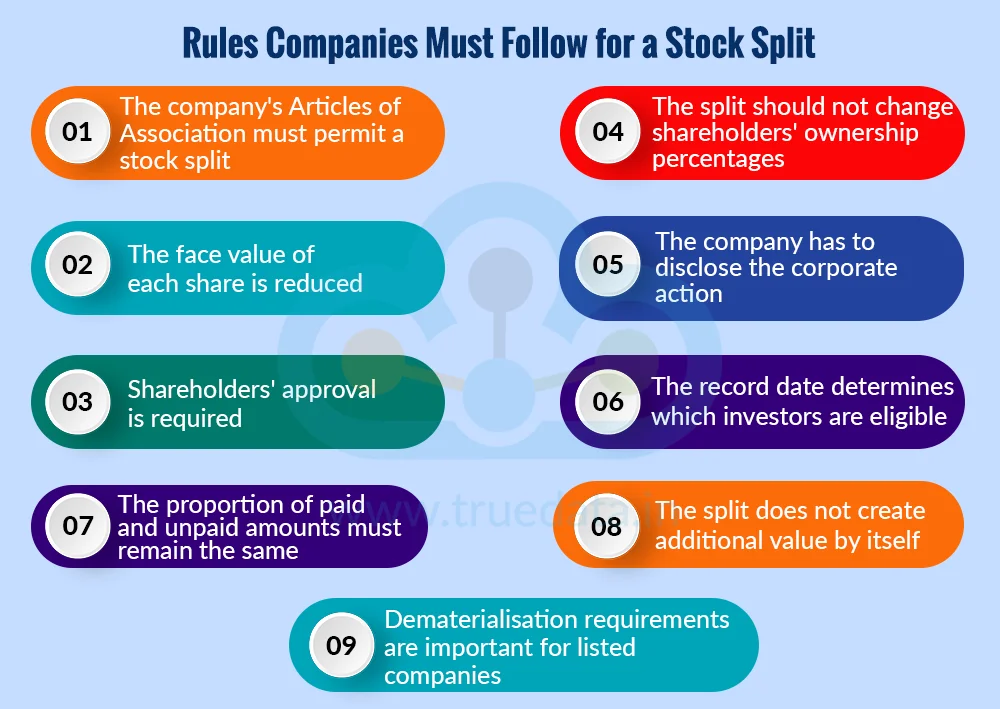
A stock split is mainly governed by Section 61 of the Companies Act, 2013, along with applicable SEBI regulations and stock-exchange requirements for listed companies. Section 61 specifically allows a company, if authorised by its Articles of Association, to subdivide its shares into shares of a smaller denomination. The key rules can be understood as follows.

  • The company's Articles of Association must permit a stock split - A company can split its shares only if its Articles of Association (AoA) allow it to do so. If the AoA does not provide for this, the company has to make the necessary changes before carrying out the split.

  • The face value of each share is reduced - A stock split involves dividing shares into smaller denominations. For example, if a company splits a Rs. 10 face-value share into two Rs. 5 shares, an investor holding 100 shares will hold 200 shares after the split. The total face value represented by the holding remains Rs. 1,000.

  • Shareholders' approval is required - The decision to subdivide the shares is generally approved by shareholders through a resolution in a general meeting. This gives shareholders a say before the company's share structure is changed.

  • The proportion of paid and unpaid amounts must remain the same - Under Section 61, when shares are subdivided, the proportion between the amount already paid and any amount still unpaid on each share must remain the same as it was before the split. A stock split cannot be used to change the proportion of the amount paid or unpaid on the original shares.

  • The split should not change shareholders' ownership percentages - A stock split increases the number of shares but does not, by itself, change an investor's percentage ownership in the company. For example, if you own 1% of a company before the split, you would generally continue to own 1% after the split, assuming there are no other changes to the shareholding.

  • The company has to disclose the corporate action - Listed companies are required to make the relevant disclosures to the stock exchanges when undertaking corporate actions such as a stock split. This allows investors to know about the proposed change and important dates associated with it.

  • The record date determines which investors are eligible - A company announces a record date to determine which shareholders are eligible for the stock split. Investors whose names or holdings qualify according to the applicable record-date process will receive the additional shares resulting from the split.

  • The split does not create additional value by itself - Regulations govern how the split is carried out, but investors should remember the economic effect, i.e., a stock split does not automatically increase the value of the company or an investor's holding. The number of shares increases while the market price generally adjusts downward in the same proportion, all else being equal.

  • Dematerialisation requirements are important for listed companies - SEBI has been moving towards greater dematerialisation of securities. SEBI has specifically identified subdivision or split of the face value of securities as one of the corporate actions where listed companies should avoid creating fresh physical securities. 

What are the Key Differences Between Bonus Issues and Stock Splits?

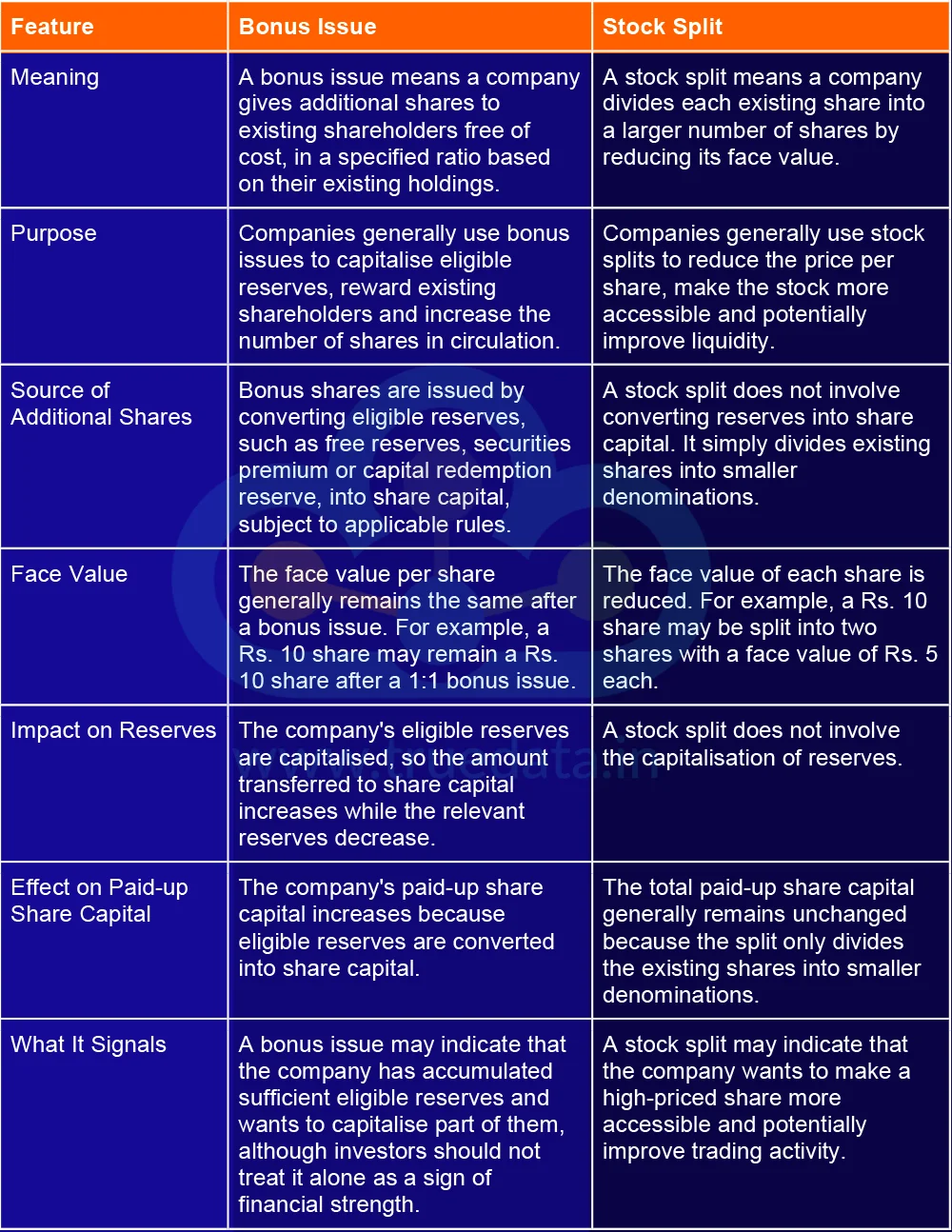
Bonus issues and stock splits can look similar because both increase the number of shares held by existing shareholders. However, they differ in how they are carried out, why companies use them, and what happens to the reserves and face value of the shares. The key differences between the two are explained below.

What are the Key Differences Between Bonus Issues and Stock Splits

Feature

Bonus Issue

Stock Split

Meaning

A bonus issue means a company gives additional shares to existing shareholders free of cost, in a specified ratio based on their existing holdings.

A stock split means a company divides each existing share into a larger number of shares by reducing its face value.

Purpose

Companies generally use bonus issues to capitalise eligible reserves, reward existing shareholders and increase the number of shares in circulation.

Companies generally use stock splits to reduce the price per share, make the stock more accessible and potentially improve liquidity.

Source of Additional Shares

Bonus shares are issued by converting eligible reserves, such as free reserves, securities premium or capital redemption reserve, into share capital, subject to applicable rules.

A stock split does not involve converting reserves into share capital. It simply divides existing shares into smaller denominations.

Face Value

The face value per share generally remains the same after a bonus issue. For example, a Rs. 10 share may remain a Rs. 10 share after a 1:1 bonus issue.

The face value of each share is reduced. For example, a Rs. 10 share may be split into two shares with a face value of Rs. 5 each.

Impact on Reserves

The company's eligible reserves are capitalised, so the amount transferred to share capital increases while the relevant reserves decrease.

A stock split does not involve the capitalisation of reserves.

Effect on Paid-up Share Capital

The company's paid-up share capital increases because eligible reserves are converted into share capital.

The total paid-up share capital generally remains unchanged because the split only divides the existing shares into smaller denominations.

What It Signals

A bonus issue may indicate that the company has accumulated sufficient eligible reserves and wants to capitalise part of them, although investors should not treat it alone as a sign of financial strength.

A stock split may indicate that the company wants to make a high-priced share more accessible and potentially improve trading activity.

What is a Reverse Stock Split?

What is a Reverse Stock Split

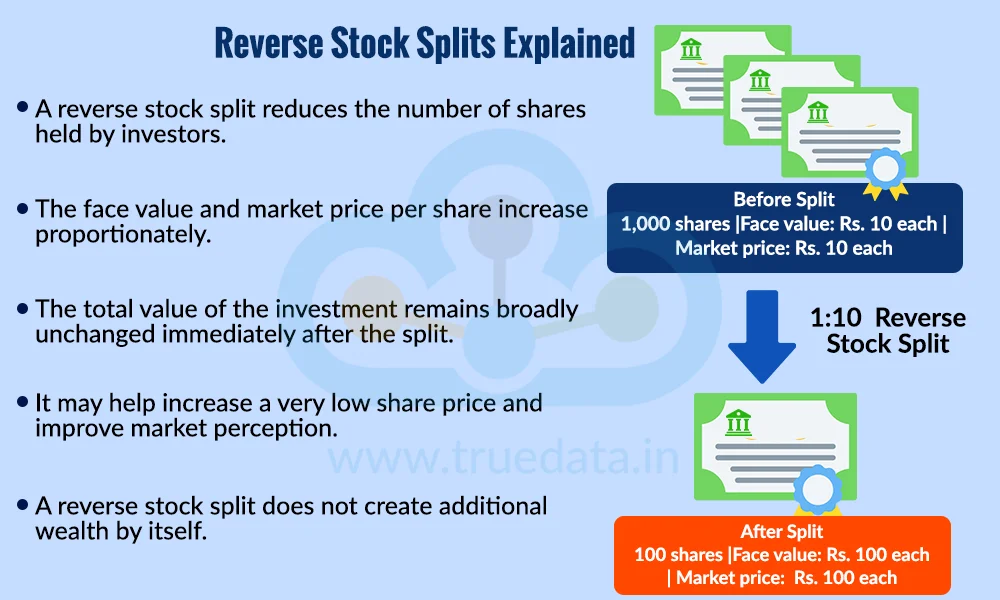
A reverse stock split is a corporate action in which a company combines multiple existing shares into a smaller number of shares, while increasing the face value and market price per share in the same proportion. In simple words, it is the opposite of a normal stock split. For example, in a 1:10 reverse stock split, every 10 existing shares are consolidated into 1 share. So, an investor holding 1,000 shares would hold 100 shares after the reverse split. If the market price was Rs. 10 per share before the split, it could theoretically adjust to around Rs. 100 per share after the split, assuming other market factors remain unchanged. Therefore, the total value of the investment does not automatically increase just because the number of shares falls. Companies may consider a reverse stock split when their share price has become very low, and they want to increase the per-share price, simplify their share structure or improve the stock's market perception. It is important to understand that a reverse stock split changes the number and price of shares but does not, by itself, create additional value.

Conclusion

A bonus issue and a stock split may both leave investors with more shares, but they work in different ways. A bonus issue uses eligible company reserves to issue additional shares, while a stock split divides existing shares into smaller denominations. In both cases, the share price generally adjusts, so receiving more shares does not automatically mean a higher investment value. The key is to look beyond the increase in share count and understand the company’s financial health, business performance, valuation and the reason behind the corporate action before making an investment decision.

This article addresses two important corporate actions and their key differences. We hope it helps aour readers understand the corporate restructuring under these and make informed investment decisions. Let us know your thoughts on the topic or if you need further information, and we will address it soon. 

Till then, Happy Reading!


Read More: What Is a Rights Issue and Should You Participate?

Frequently Asked Questions

No. Bonus issues and stock splits do not change a company’s market capitalisation by themselves because the share price generally adjusts in proportion to the increase in the number of shares. Market capitalisation can change later due to normal market movements and investor demand.

No, voting rights generally remain the same because the investor’s ownership percentage does not change, although the number of shares and votes per share may be adjusted proportionately. Dividend per share may change because there are more shares after a bonus issue or split, but the total dividend received can remain broadly similar if the company maintains the same overall dividend payout.

A bonus issue or stock split increases the number of shares, so EPS generally falls in proportion to the increase in shares, while the P/E ratio usually remains broadly unchanged immediately after the adjustment, assuming the market price and earnings adjust proportionately.

Yes, there can be tax implications when you eventually sell the shares, but receiving bonus shares or a stock split itself generally does not trigger an immediate capital gains tax. The cost and holding period rules differ depending on whether the shares came from a bonus issue or stock split.

Yes, investors should be aware of market reactions around bonus issues and stock splits, as share prices can move before or after the corporate action based on investor sentiment and expectations. However, investors should avoid making decisions based only on the announcement or short-term price movements and instead focus on the company’s fundamentals, valuation and long-term prospects.
Marisha Bhatt

Marisha Bhatt is a financial content writer @TrueData.
She writes with the sole aim of simplifying complex financial concepts and jargon while attempting to clarify technical and fundamental analysis concepts of the stock markets. The ultimate goal is to spread vital knowledge and benefit the maximum audience. Her Chartered Accountant background acts as the knowledge base to help clarify crucial concepts and create a sound investment portfolio.

0 Comments

Related Articles

SEE ALL
Corporate Data
Corporate Data
Investing Smarter: The Power of Corporate Data and Market Sentiment Analysis

Thestock market never stands still, and prices swing constantly with every new h...

Corporate Data
Corporate Data
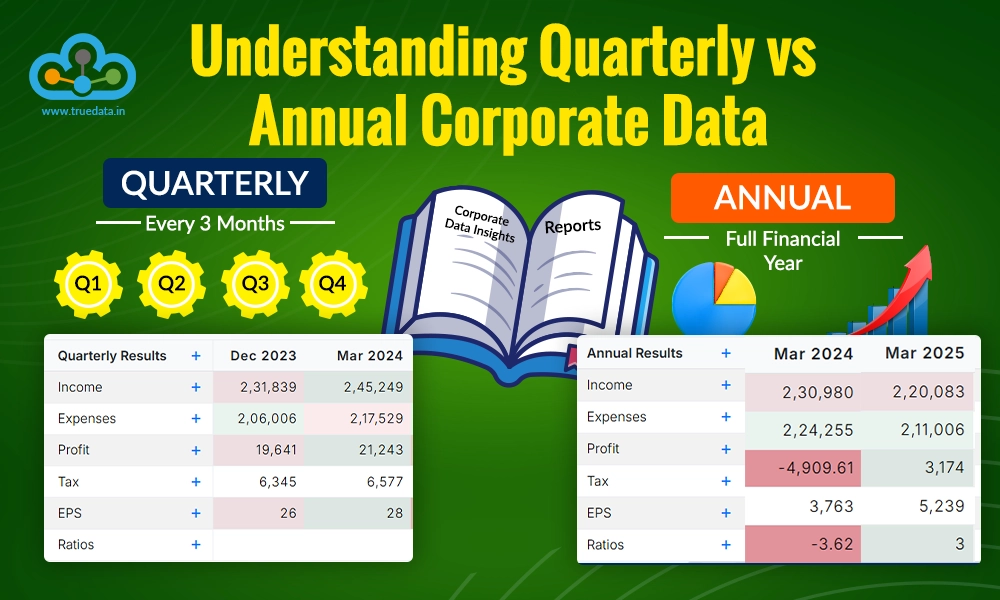
Understanding Quarterly vs Annual Corporate Data

Corporate data is more than just the numbers of a company. They can show what is...

Corporate Data
Corporate Data
Key Corporate Data Every Investor Must Track Before Investing

Investing is not just about numbers on a screen. It is about understanding the s...

Relevant Tags