In today's digital-first world, many of the most valuable companies own very few physical assets. Businesses built around software, data, and technology are growing rapidly, while traditional asset-heavy industries continue to play a crucial role in the economy. Does this mean asset-light businesses are the way to go? Or can asset-heavy companies still generate strong returns for investors? The answer is not as straightforward as it may seem. Both business models come with their own strengths, risks, and opportunities. Dive into this blog, where we compare asset-light and asset-heavy businesses, understand how they create value, and explore which model has the potential to generate better returns for investors.
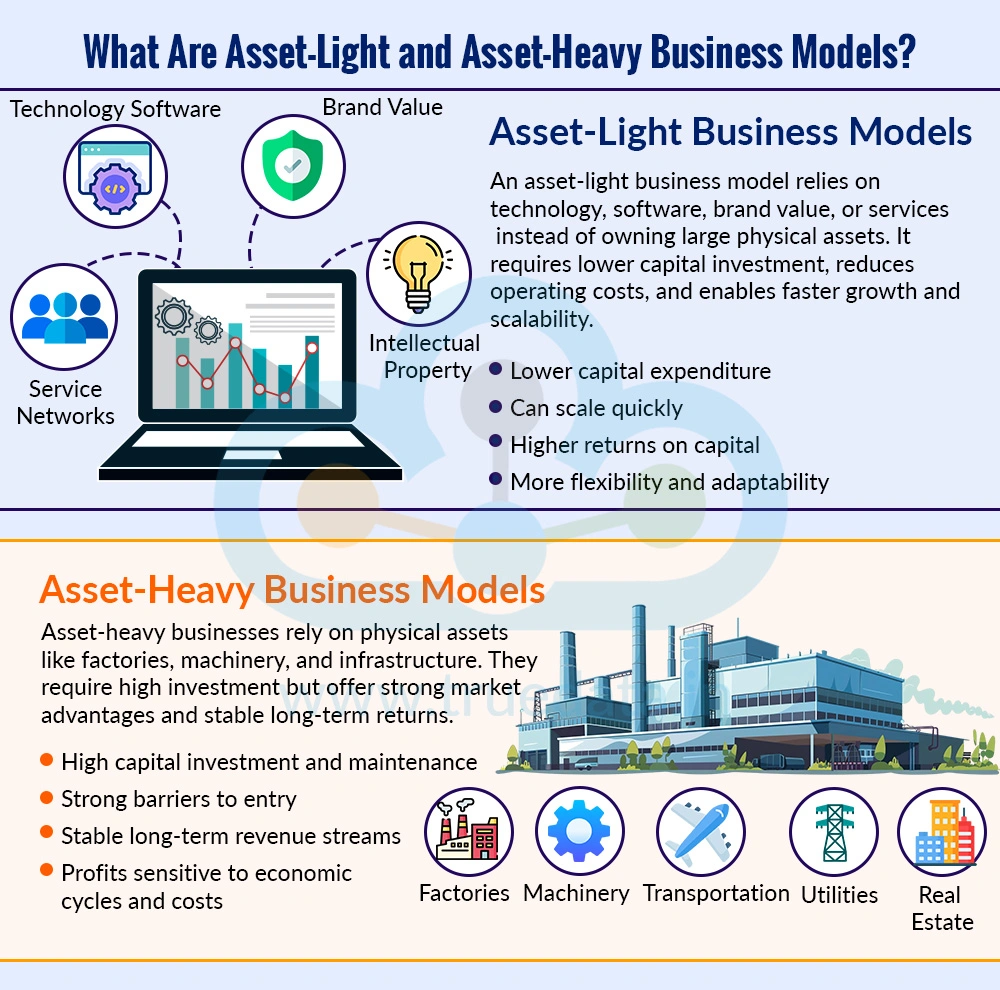
An asset-light business model is a type of business that operates with relatively few physical assets, such as factories, warehouses, machinery, or large equipment. Instead, these companies focus on assets like technology, software, intellectual property, brand value, or service networks to generate revenue. Since they do not need to invest heavily in physical infrastructure, asset-light businesses often require lower capital expenditure and can scale their operations more quickly. Examples include software companies, online marketplaces, digital payment providers, and many service-based businesses. Asset-light companies can be attractive for investors as they often generate higher returns on capital and have greater flexibility to adapt to changing market conditions.
An asset-heavy business model, on the other hand, relies heavily on physical assets to operate and generate revenue. These businesses typically invest significant amounts of money in factories, machinery, transportation networks, power plants, real estate, or other large infrastructure. Industries such as manufacturing, airlines, telecom, utilities, and steel production are common examples of asset-heavy businesses. While these companies usually require substantial capital investments and ongoing maintenance expenses, their physical assets can create strong barriers to entry and provide stable long-term revenue streams. Asset-heavy companies may offer steady growth and competitive advantages, but their profitability can be more sensitive to economic cycles and high operating costs.
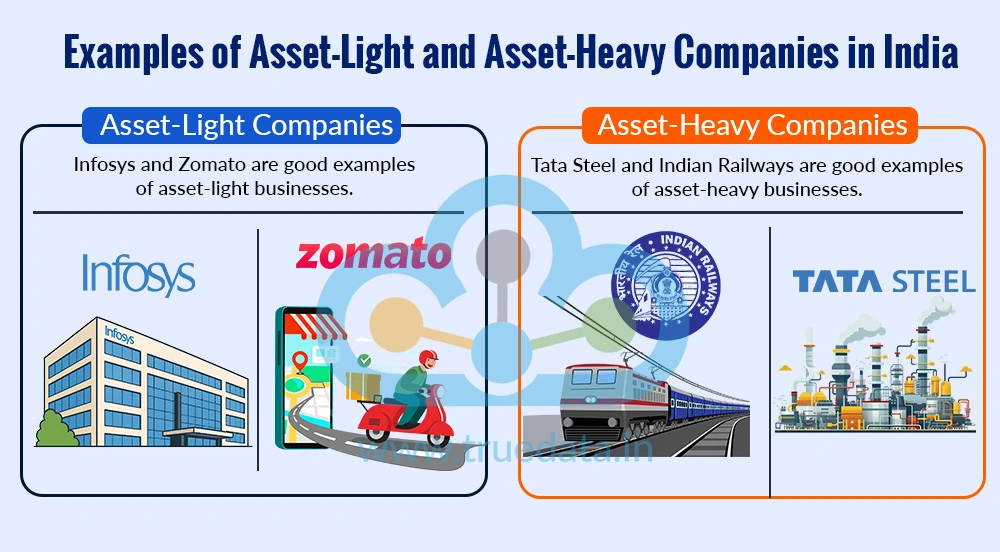
A good example of an asset-light business is Infosys. The company generates revenue mainly by providing software development, consulting, and digital transformation services to clients worldwide. It does not need to invest heavily in factories, large machinery, or physical infrastructure to grow its business. Another example is Zomato, which primarily acts as a platform connecting customers, restaurants, and delivery partners. Such businesses rely more on technology, brand value, and networks than on owning large physical assets. As a result, they can often expand their operations with relatively lower capital investments.
On the other hand, Tata Steel is a classic asset-heavy business. The company requires massive investments in steel plants, machinery, mining operations, and transportation infrastructure to produce and distribute steel. Similarly, Indian Railways operates one of the world's largest railway networks and depends on extensive physical assets such as tracks, stations, trains, and maintenance facilities. These businesses need significant capital to build and maintain their assets, but those assets can also create strong competitive advantages and long-term revenue opportunities. Understanding the nature of these business models can help investors evaluate their growth potential, profitability, and risk profile.
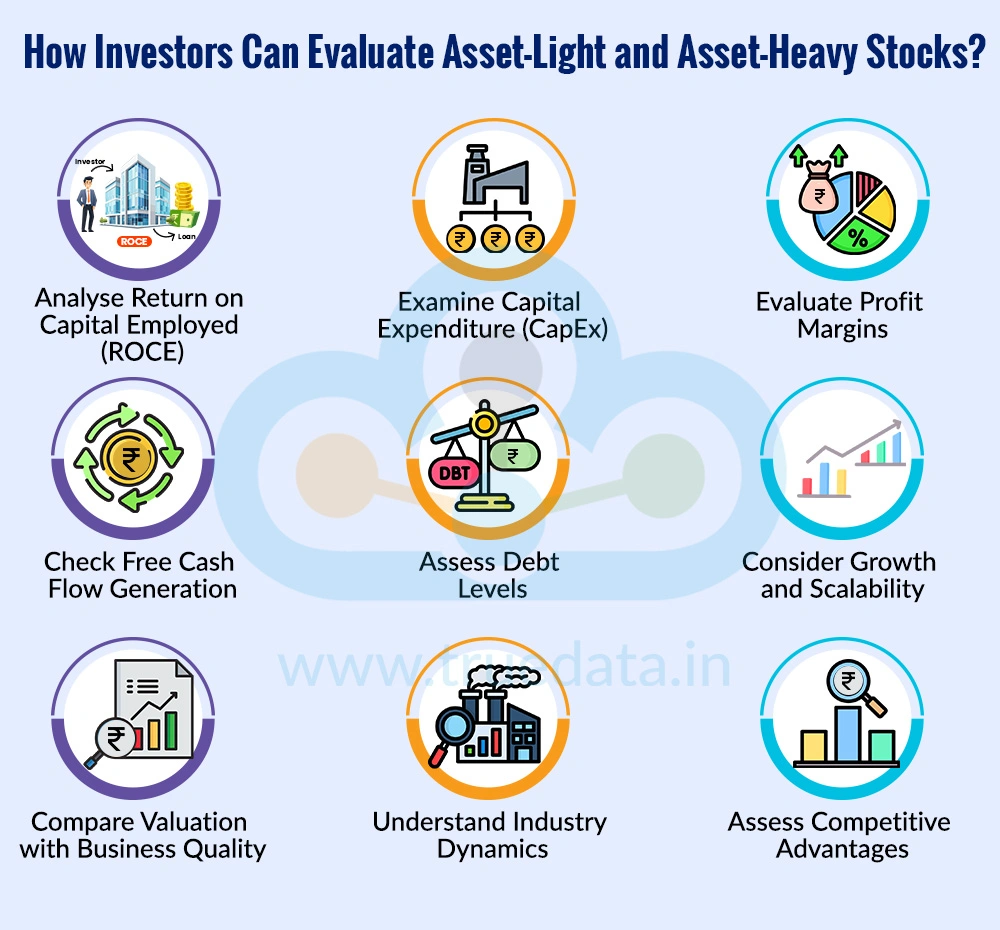
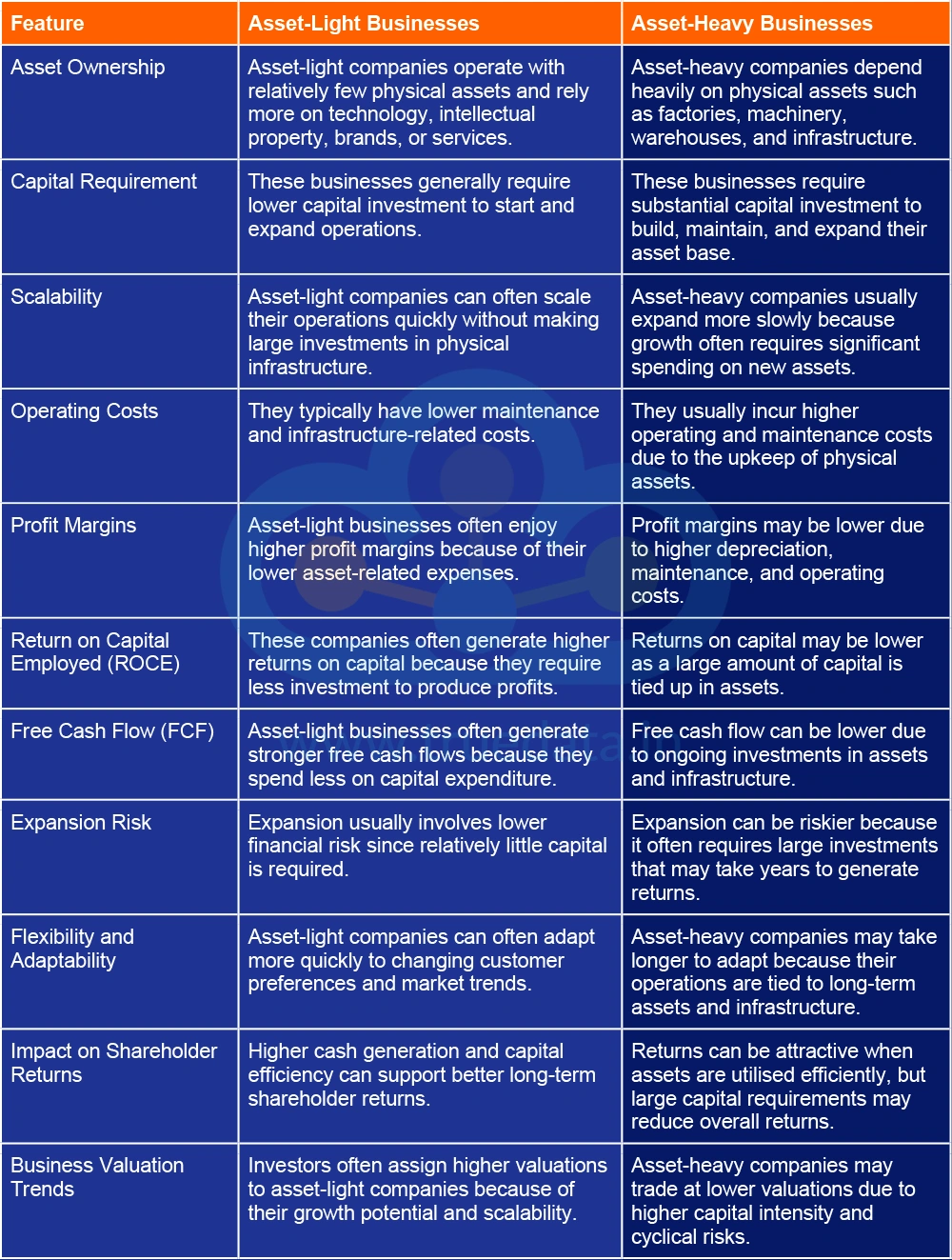
Choosing between asset-light and asset-heavy stocks is not about deciding which model is universally better. Instead, investors should understand how each business generates profits, uses capital, and creates value for shareholders. Here are some key factors to consider when evaluating these companies.
ROCE measures how efficiently a company uses its capital to generate profits. This ratio is particularly useful when comparing companies from the same industry. Asset-light businesses often have higher ROCE because they require less investment in physical assets. For example, a software company may generate significant profits without owning factories or large infrastructure. Asset-heavy companies usually have lower ROCE due to their large investments in plants, machinery, and equipment. As an investor, look for companies that consistently maintain strong ROCE over several years.
Capital expenditure refers to the money a company spends on acquiring or maintaining long-term assets. Asset-heavy businesses generally require regular and substantial CapEx to expand operations and keep assets in good condition. In contrast, asset-light companies often need lower capital investments, allowing them to retain more cash. Investors should assess whether a company's spending on assets is generating adequate growth and profitability.
Profit margins indicate how much profit a company retains from its revenue after covering expenses. Asset-light businesses often enjoy higher operating margins due to lower maintenance and infrastructure costs. Asset-heavy companies may face higher operating expenses due to asset upkeep, energy costs, and depreciation. Comparing profit margins over time can help investors understand the company's operational efficiency.
Free Cash Flow represents the cash left after a company has met its operating and capital expenditure requirements. Since asset-light businesses generally spend less on physical assets, they often generate stronger free cash flows. This cash can be used for business expansion, debt reduction, dividends, or share buybacks. Asset-heavy companies can also generate healthy cash flows, but investors should ensure that large capital requirements are not putting pressure on the company's finances.
Debt is an important factor when analysing any stock, especially asset-heavy businesses. Many asset-heavy companies borrow funds to build factories, infrastructure, or production facilities. While this can support growth, excessive debt can increase financial risk during economic slowdowns. Investors should examine debt-to-equity ratios and interest coverage ratios to determine whether the company can comfortably manage its obligations.
One of the major advantages of asset-light businesses is their ability to scale quickly. They can often enter new markets and increase revenues without making massive investments in physical infrastructure. Asset-heavy companies usually expand more slowly because growth often requires significant capital investments. However, once their assets are established, they may benefit from strong market positions and stable cash flows. Investors should evaluate whether the company's growth strategy aligns with its business model.
A great business is not always a great investment if its stock is overpriced. Asset-light companies often trade at higher valuations as investors expect faster growth and stronger profitability. Asset-heavy companies may trade at lower valuations due to slower growth or cyclical risks. Investors should compare valuation metrics such as P/E ratio, P/B ratio, EV/EBITDA, and ROCE to determine whether the stock offers a reasonable balance between price and quality.
The effectiveness of a business model depends heavily on the industry in which the company operates. For example, IT services, digital platforms, and financial services are naturally suited to asset-light models. On the other hand, industries such as steel, power generation, railways, and telecom require substantial physical assets and are inherently asset-heavy. Therefore, investors should compare companies within the same sector rather than across completely different industries.
A company's competitive advantage plays a major role in its long-term success. Asset-heavy companies can create strong barriers to entry as building factories, power plants, or transportation networks requires significant capital and expertise. Asset-light businesses may rely on technology, brand value, customer loyalty, or network effects to stay ahead of competitors. Investors should evaluate whether the company has sustainable advantages that can support future growth.
While asset-light companies are generally known for higher efficiency, scalability, and capital-light growth, asset-heavy companies can create lasting competitive advantages through their infrastructure and physical assets. The key differences between the two models are explained below.
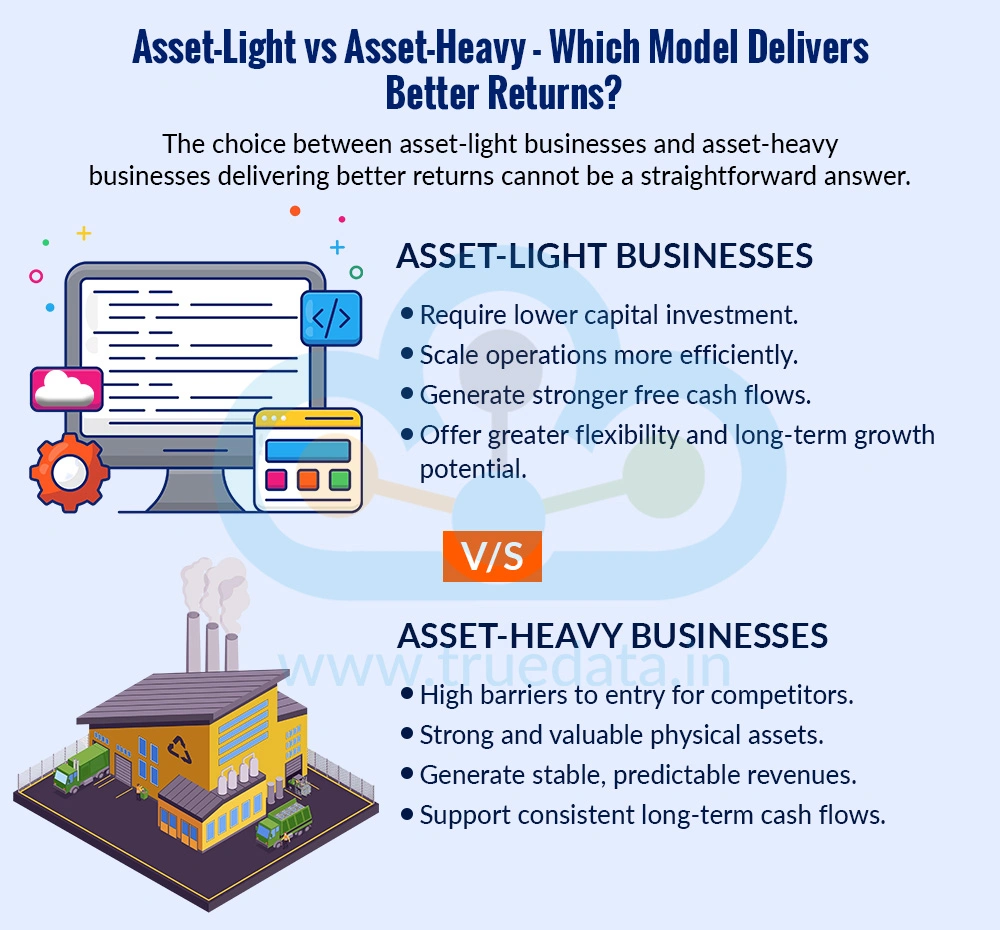
The choice between asset-light businesses and asset-heavy businesses delivering better returns cannot be a straightforward answer. The outcome in this scenario depends on factors such as industry, management quality, and market conditions.
Asset-light companies often generate higher returns on capital as they require less investment in physical assets and can scale their operations more efficiently. They also tend to have stronger free cash flows and greater flexibility to adapt to changing customer needs. As a result, many successful technology, software, and service-based companies have delivered impressive long-term returns to investors.
However, asset-heavy businesses should not be overlooked. Companies operating in sectors such as infrastructure, utilities, manufacturing, and telecom often benefit from strong barriers to entry, as competitors need significant capital to enter these industries. Once established, these businesses can generate stable revenues and long-term cash flows.
Thus, the better model is not necessarily the one with fewer or more assets, but rather the one that uses its assets efficiently, maintains strong profitability, and creates sustainable value for shareholders over time.
Both asset-light and asset-heavy business models have their own advantages and risks. Investors should focus on how effectively a company uses its resources rather than assuming one business model is always superior to the other. The key advantages and risks of each business model are explained below.
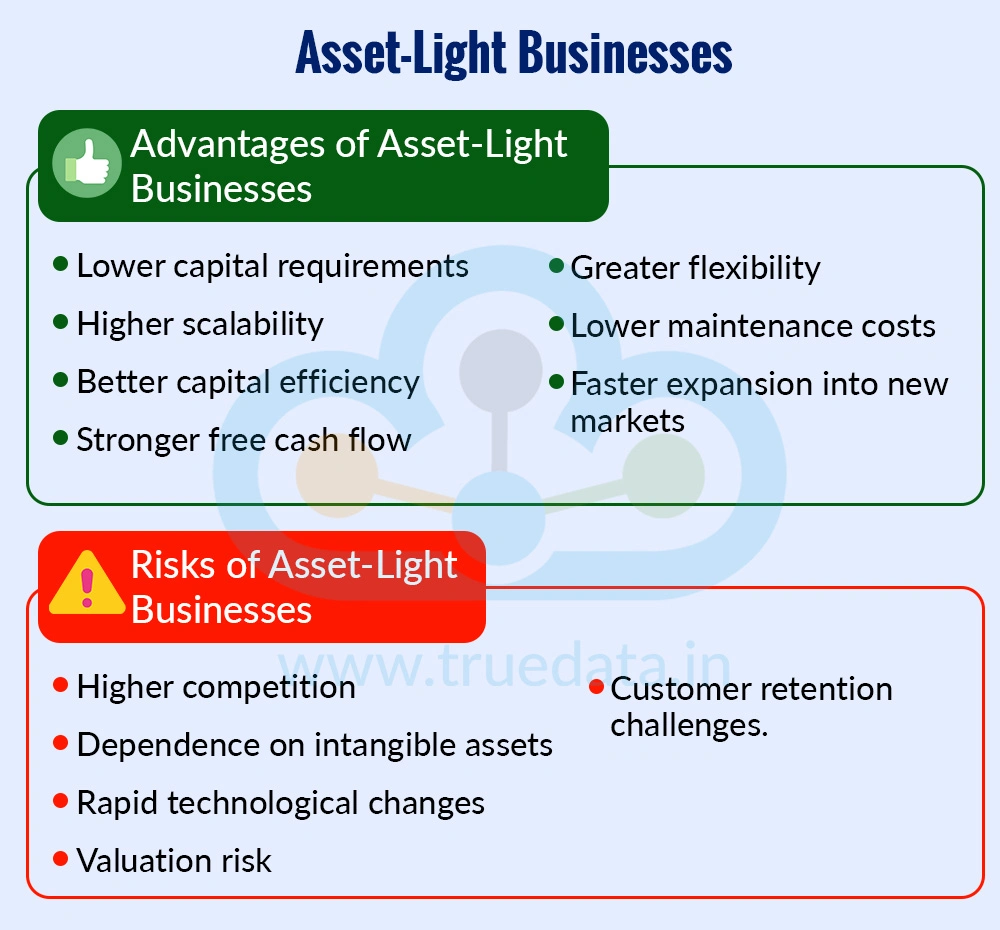
Advantages of Asset-Light Businesses
Lower capital requirements - These businesses need less money to start, operate, and expand.
Higher scalability - They can often grow quickly without investing heavily in new infrastructure.
Better capital efficiency - Less capital is tied up in physical assets, which can lead to higher returns on capital.
Stronger free cash flow - Lower spending on assets often leaves more cash available for growth, dividends, or share buybacks.
Greater flexibility - Asset-light companies can usually adapt more quickly to changing market conditions and customer preferences.
Lower maintenance costs - They spend less on maintaining factories, machinery, and other physical assets.
Faster expansion into new markets - Growth can often be achieved without building large facilities or infrastructure.
Risks of Asset-Light Businesses
Higher competition - Lower entry barriers can make it easier for new competitors to enter the market.
Dependence on intangible assets - Brand value, technology, or customer relationships can be difficult to maintain over time.
Rapid technological changes - Businesses may need to continuously innovate to stay relevant.
Valuation risk - Many asset-light companies trade at high valuations, which can increase downside risk if growth slows.
Customer retention challenges - Losing customers can have a significant impact on revenue and profitability.
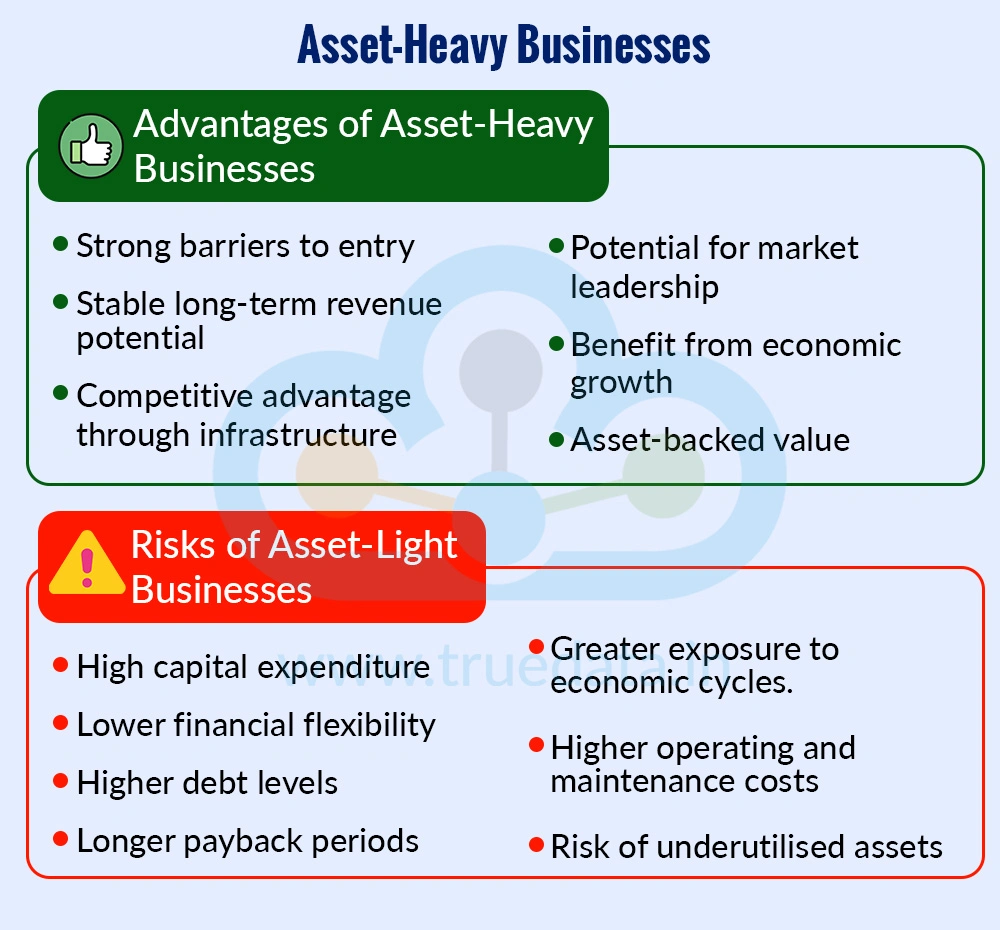
Advantages of Asset-Heavy Businesses
Strong barriers to entry - High capital requirements make it difficult for new competitors to enter the industry.
Stable long-term revenue potential - Physical assets can support revenue generation for many years.
Competitive advantage through infrastructure - Large facilities, production capacity, or networks can create lasting business strengths.
Potential for market leadership - Companies with significant assets often hold strong positions within their industries.
Benefit from economic growth - Rising demand for infrastructure, manufacturing, and industrial products can support long-term growth.
Asset-backed value - Physical assets can provide a degree of financial stability and business resilience.
Risks of Asset-Heavy Businesses
High capital expenditure - Large investments are required to build, upgrade, and maintain assets.
Lower financial flexibility - A significant portion of capital remains tied up in long-term assets.
Higher debt levels - Many asset-heavy companies rely on borrowing to fund expansion projects.
Greater exposure to economic cycles - Demand for their products and services may decline during economic slowdowns.
Higher operating and maintenance costs - Running and maintaining physical infrastructure can be expensive.
Longer payback periods - It may take years for large investments to generate meaningful returns.
Risk of underutilised assets - If demand weakens, expensive assets may not be used efficiently, reducing profitability.
Asset-light and asset-heavy businesses each have their own strengths, and neither model is inherently better than the other. While asset-light companies often benefit from higher capital efficiency, faster growth, and stronger returns on capital, asset-heavy businesses can enjoy strong competitive advantages, stable cash flows, and high barriers to entry. Thus, the key is not to focus solely on the business model but to evaluate how effectively a company uses its assets, manages its finances, and creates long-term value. By understanding these factors, investors can make more informed decisions and build a stronger portfolio for long-term wealth creation.
This article explains the two polar-opposite business approaches and their nuances. Let us know your thoughts on the topic or if you need further information on the same, and we will address it soon.
Till then, happy Reading!
Read More: Family-Owned vs Professionally Managed Firms - Does management style impact financial performance?

Marisha Bhatt is a financial content writer @TrueData.
She writes with the sole aim of simplifying complex financial concepts and jargon while attempting to clarify technical and fundamental analysis concepts of the stock markets. The ultimate goal is to spread vital knowledge and benefit the maximum audience. Her Chartered Accountant background acts as the knowledge base to help clarify crucial concepts and create a sound investment portfolio.
Thestock market never stands still, and prices swing constantly with every new h...
Corporate data is more than just the numbers of a company. They can show what is...
Investing is not just about numbers on a screen. It is about understanding the s...
