Artificial Intelligence (AI) and technology are changing the way people live, work, and do business. From AI-powered tools to digital platforms, these innovations are creating new opportunities for businesses and investors alike. But how can average investors participate in this growth? AI and Technology Mutual Funds offer one way to gain exposure to companies operating in these fast-evolving sectors. However, while the potential for growth may be exciting, these funds also come with risks that investors should understand before investing. So, are AI and Technology Mutual Funds suitable for every investor? Let us explore their key opportunities, risks, and the investors who may consider them.

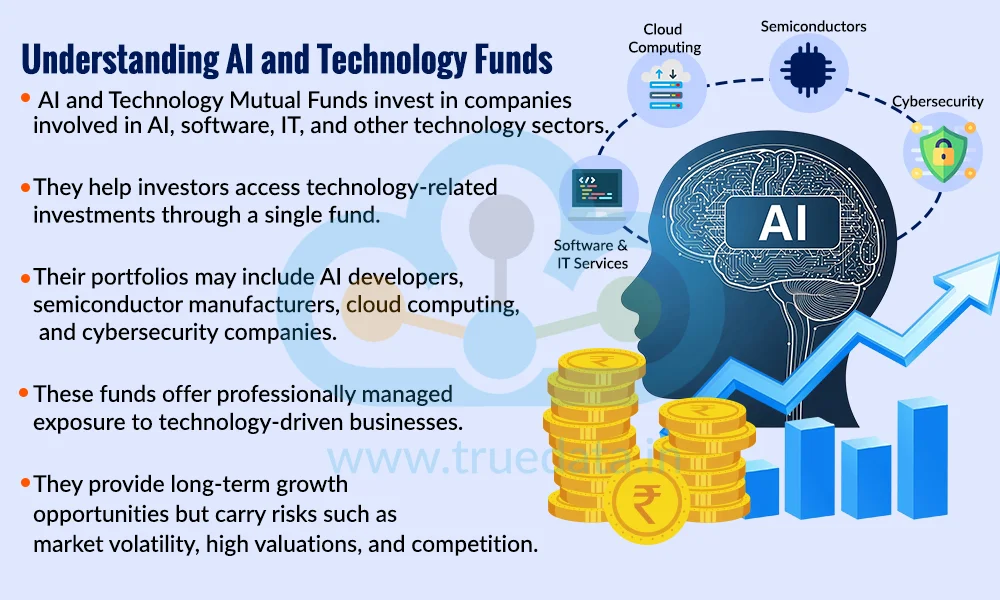
AI and Technology Mutual Funds are investment schemes that invest in companies involved in artificial intelligence (AI), software, information technology (IT), and other technology-related businesses. These funds aim to help investors participate in the growth of these sectors without having to select and buy shares of individual companies themselves. Depending on the fund's investment strategy, its portfolio may include companies that develop AI models, provide cloud computing services, manufacture semiconductors, develop enterprise software, offer cybersecurity solutions, or provide IT services. For example, a technology-focused fund may invest in software and IT service companies, while an AI-focused investment strategy may concentrate on businesses developing or supplying AI-related technologies.
Investors can gain exposure to these businesses through a professionally managed portfolio, but their returns depend on the performance of the underlying investments and market conditions. Since technology companies can experience rapid growth as well as sharp price fluctuations, these funds may offer long-term growth opportunities but also carry risks such as high valuations, intense competition, regulatory changes, and fast-changing technology. It is also important to note that AI funds and Technology Funds are not necessarily the same category. A fund investing in technology companies may have limited exposure to AI, while an AI-focused strategy may invest across several sectors that use or develop AI.
AI and Technology Mutual Funds are governed by the applicable SEBI mutual fund regulations and scheme categorisation requirements. SEBI does not have a separate mutual fund category exclusively for AI funds. Depending on their investment objectives and portfolio, these schemes may fall under the existing sectoral or thematic equity mutual fund categories.
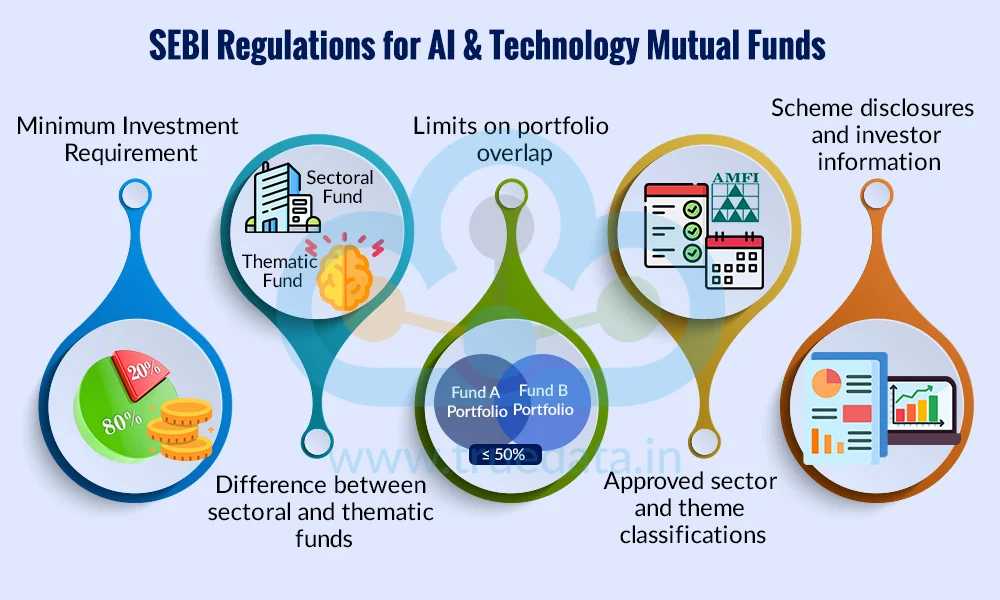
Some of the key SEBI rules in relation to AI and Technology Funds include,

Under SEBI's revised scheme categorisation framework dated February 26, 2026, sectoral and thematic equity funds must invest at least 80% of their total assets in equity and equity-related instruments of the specified sector or theme.
Technology Funds - A sectoral fund focused on technology must follow the prescribed allocation to equity and equity-related instruments of that sector.
AI-focused funds - A scheme structured as a thematic fund must follow the applicable allocation requirement for its specified theme.
This means these funds have limited flexibility to move away from their core investment focus, even when the relevant sector or theme faces market challenges.
SEBI distinguishes between sectoral funds and thematic funds based on their investment focus. Sectoral funds invest primarily in companies belonging to a specific sector, such as IT, banking or healthcare. In contrast, thematic funds invest in companies across different sectors that are connected by a common theme, such as artificial intelligence (AI). For example, an AI-themed fund may invest in technology, healthcare and other businesses adopting AI, while a technology sector fund focuses on companies within the technology sector.
SEBI's February 2026 circular introduced a portfolio-overlap limit for sectoral and thematic equity schemes. Their portfolio overlap with other equity schemes, including other sectoral and thematic schemes, must not exceed 50%, with an exception for large-cap schemes under the prescribed framework. The overlap is calculated using the securities held by the schemes and their respective portfolio weights. The limit is assessed quarterly using average daily portfolio-overlap values. Existing sectoral and thematic schemes have three years from the circular's date to comply with this requirement. The prescribed transition framework allows gradual portfolio realignment. Schemes that fail to meet the limit after the compliance period must be merged with other schemes in accordance with the applicable provisions. This rule is intended to reduce excessive duplication between funds that may otherwise hold very similar portfolios despite having different investment objectives.
Under the revised framework, mutual funds must launch sectoral and thematic schemes in line with the list of sectors and themes published and updated by the Association of Mutual Funds in India (AMFI) Association of Mutual Funds in India (AMFI), in consultation with SEBI, every six months. Therefore, an investor should not assume that every fund using terms such as ‘AI’, ‘technology’ or ‘digital innovation’ in its marketing necessarily belongs to a separate SEBI-recognised AI fund category. The scheme's official investment objective, categorisation and portfolio disclosures should be checked to understand what it actually invests in.
Mutual fund schemes must follow applicable SEBI disclosure and investor-protection requirements. These include providing information about the scheme's investment objective, asset allocation, risks and other material features in its offer documents and related disclosures. The revised framework also requires monthly disclosure of category-wise portfolio-overlap levels on asset management company websites. Investors can use these disclosures to understand the fund's holdings, assess whether it duplicates their existing investments and evaluate how closely its portfolio follows its stated investment strategy.
AI and Technology Mutual Funds can offer investors an opportunity to participate in the growth of businesses that develop, supply, or use new technologies. However, these benefits are not guaranteed, and the performance of these funds depends on the companies they invest in, their valuations, and overall market conditions.

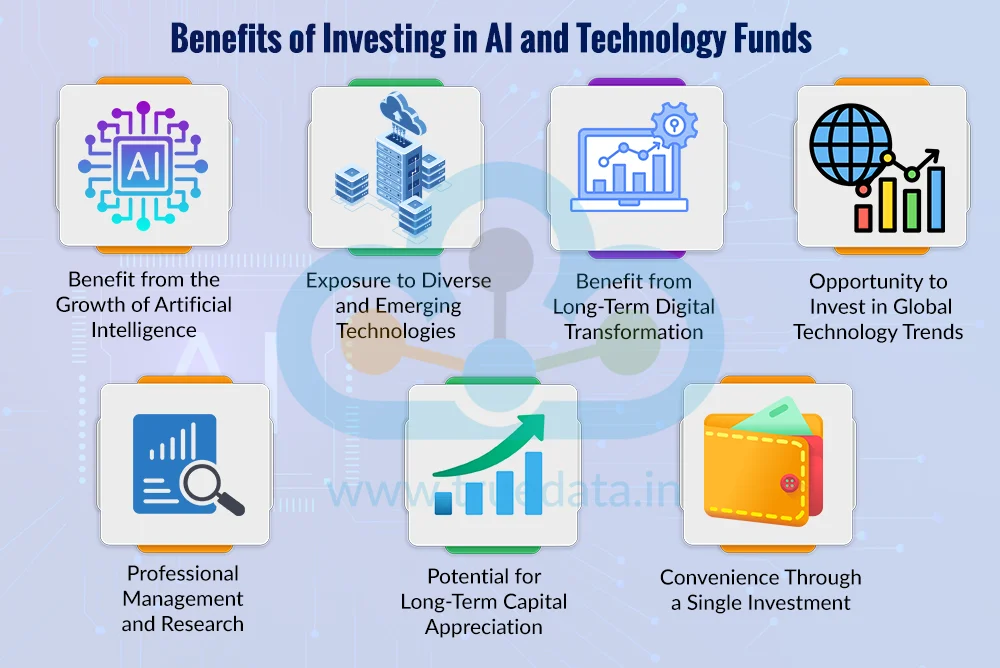
Benefit from the Growth of Artificial Intelligence - AI and Technology Funds can help investors gain exposure to companies developing AI tools, software, chips, and automation solutions. These businesses may benefit as more organisations adopt AI, although growth and returns are not guaranteed.
Exposure to Diverse and Emerging Technologies - AI and Technology Funds may invest in companies across different technology segments, such as artificial intelligence (AI), cloud computing, semiconductors, cybersecurity, enterprise software and IT services. Depending on their investment objectives, these funds may also provide exposure to emerging technologies such as generative AI, robotics, automation, edge computing and advanced data analytics. This allows investors to participate in different areas of technological growth through a single mutual fund. However, the actual exposure depends on the scheme's investment mandate and portfolio, and investing in emerging technologies involves risks such as uncertain demand, high research costs and intense competition.
Benefit from Long-Term Digital Transformation - As businesses increasingly adopt digital tools to improve efficiency and reduce costs, the demand for technology services may grow. AI and Technology Funds may benefit from this trend by investing in companies that provide digital solutions.
Opportunity to Invest in Global Technology Trends - Some funds may offer exposure to international technology companies involved in AI, cloud computing, and semiconductor development. This can help Indian investors participate in global technology trends, subject to the fund's investment strategy and applicable regulations.
Professional Management and Research - Professional fund managers research companies, assess their financial performance, and select investments based on the scheme's objectives. This allows investors to access a portfolio of technology-related companies without having to select individual stocks themselves.
Potential for Long-Term Capital Appreciation - Technology companies that develop successful products, increase their revenue, and improve profitability may experience business growth over time. Investors may benefit through their fund holdings, although high valuations and market fluctuations can affect returns.
Convenience Through a Single Investment - Instead of researching and purchasing several individual technology stocks, investors can invest in a mutual fund that holds a portfolio of eligible companies. This simplifies investing, although the fund may still carry significant sector-specific risks.
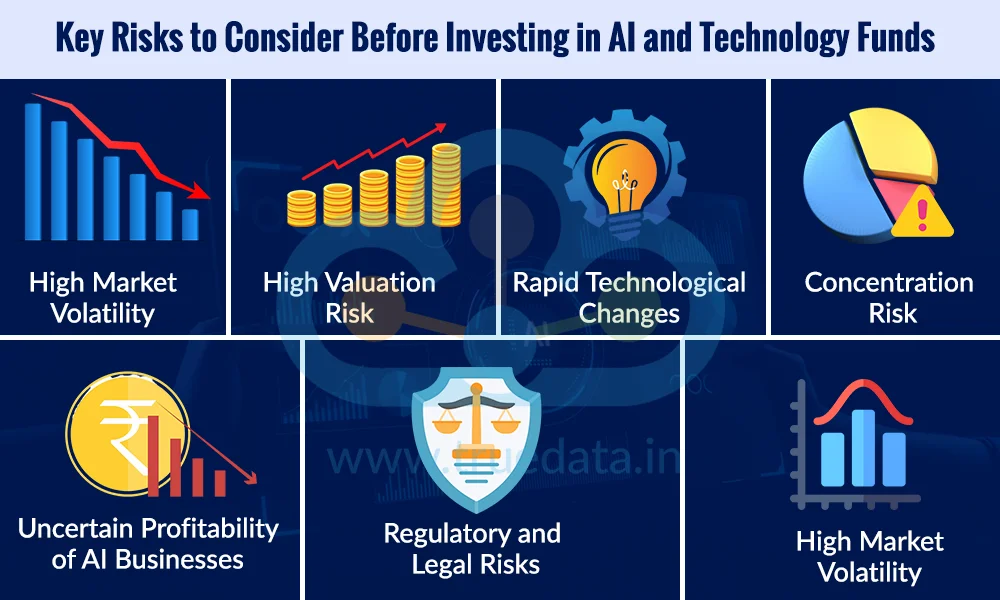
AI and Technology Mutual Funds offer investors an opportunity to participate in the growth of technology-driven businesses. However, these funds also carry risks because technology evolves rapidly, competition is intense, and stock prices can fluctuate significantly. Investors should understand the following risks before investing.

High Market Volatility - Technology stocks can experience sharp price movements due to changes in market sentiment, company earnings, economic conditions, or investor expectations. As AI and Technology Funds invest in these businesses, their Net Asset Value (NAV) may rise or fall significantly over short periods. Investors should be prepared for fluctuations and avoid assuming that strong past performance will continue.
High Valuation Risk - Companies associated with AI and new technologies may trade at high valuations because investors expect strong future growth. However, if these companies fail to meet market expectations, their share prices may fall. This can affect the returns of AI and Technology Funds, even when the underlying businesses continue to grow.
Rapid Technological Changes - Technology changes quickly, and products that are popular today may become outdated as newer solutions emerge. Companies that fail to adapt may lose customers, market share, and revenue. Funds investing in such companies may experience losses if their business prospects weaken.
Concentration Risk - AI and Technology Funds may invest a large share of their portfolios in a particular sector, theme, or group of related companies. If the technology industry faces a downturn, several holdings may decline together. This makes these funds more exposed to sector-specific risks than broadly diversified equity funds.
Uncertain Profitability of AI Businesses - Not every company developing or using AI will become profitable. Some businesses may incur high costs to develop AI models, purchase computing infrastructure, and attract customers without generating sufficient revenue. If investors' expectations are not met, the share prices of these companies may fall, affecting the funds that invest in them.
Regulatory and Legal Risks - Governments and regulators may introduce new rules related to AI, data privacy, cybersecurity, intellectual property, and the use of automated systems. Companies may need to spend more on compliance or change their business practices to meet these requirements. Such changes can affect their operating costs, profitability, and share prices.
No Guarantee of Long-Term Returns - Although AI and technology may create significant business opportunities, their growth does not guarantee investment profits. Fund returns depend on the companies selected, their valuations, market conditions, and the fund manager's investment decisions. Investors may lose part or all of the amount invested, so these funds should be chosen based on their financial goals and ability to tolerate risk.

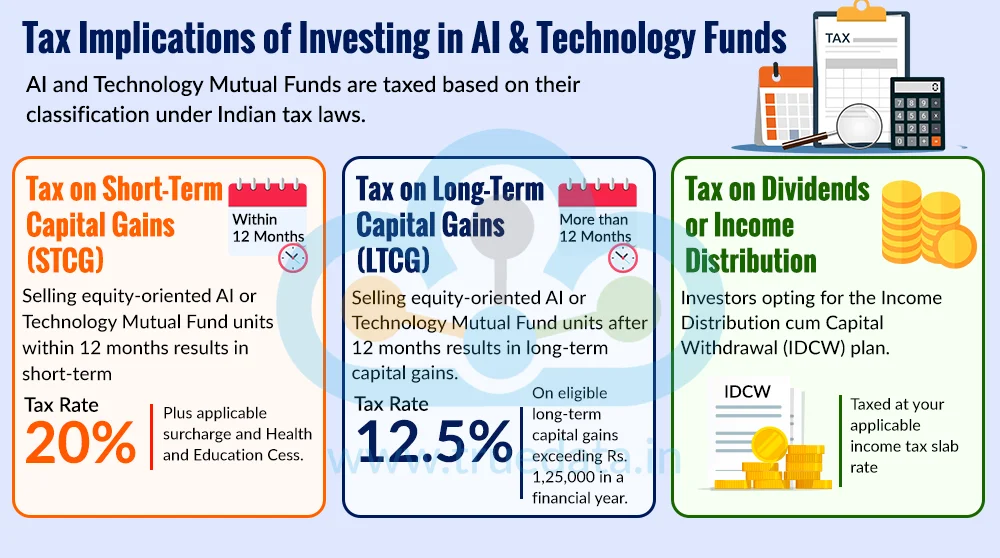
The taxation of AI and Technology Mutual Funds depends primarily on how the scheme is classified for tax purposes, rather than simply whether it invests in AI or technology companies. If a fund qualifies as an equity-oriented mutual fund under Indian tax laws, its capital gains are generally taxed at the applicable equity mutual fund rates. If it does not qualify as an equity-oriented fund, different tax rules may apply. The current capital gains tax rates for equity-oriented mutual funds are 20% for short-term capital gains and 12.5% for long-term capital gains exceeding Rs. 1,25,000 in a financial year, subject to the applicable conditions.
If an investor sells units of an equity-oriented AI or Technology Mutual Fund within 12 months of purchase, the profit is generally treated as short-term capital gains. The applicable tax rate is 20%, plus applicable surcharge and Health and Education Cess. For example, if an investor earns a short-term capital gain of Rs. 20,000, the tax on that gain would generally be Rs. 4,000 before surcharge and cess.
If an investor sells units of an equity-oriented AI or Technology Mutual Fund after holding them for more than 12 months, the profit is generally treated as long-term capital gains. The applicable tax rate is 12.5% on eligible long-term capital gains exceeding Rs. 1,25,000 in a financial year. For example, if an investor earns eligible long-term capital gains of Rs. 1,75,000 during a financial year, Rs. 50,000 would be taxable at 12.5%, resulting in tax of Rs. 6,250 before surcharge and cess. The Rs. 1,25,000 exemption is an aggregate annual limit for eligible gains covered by Section 112A, not a separate exemption for each mutual fund.
If investors choose a plan that distributes income, such as an Income Distribution cum Capital Withdrawal (IDCW) option, the distribution received is generally taxable at the investor's applicable income tax slab rate. The tax treatment is different from capital gains arising when mutual fund units are sold.
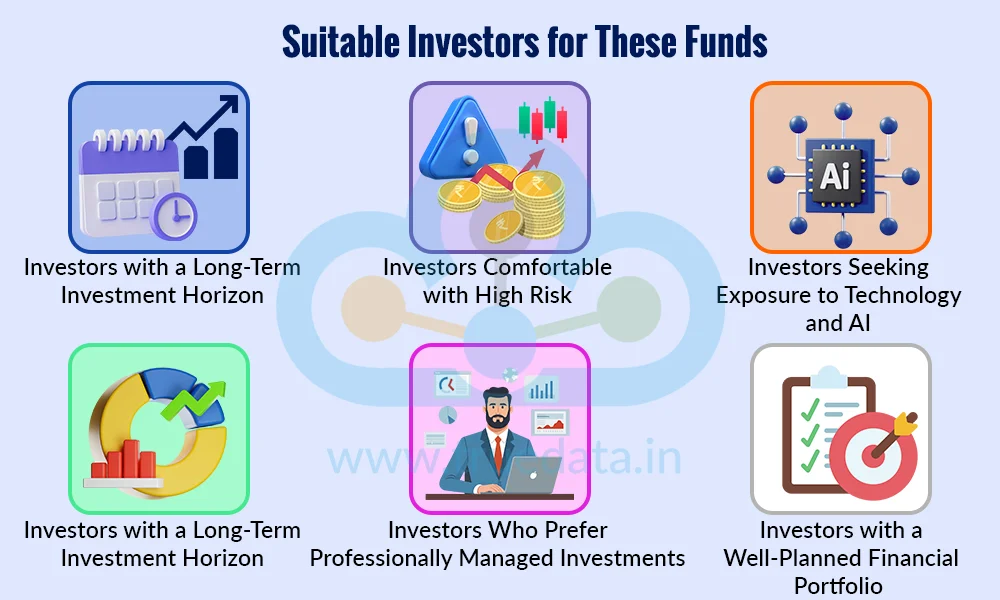
AI and Technology Mutual Funds may suit investors who want to participate in the growth of technology-driven businesses and are comfortable with the risks associated with sectoral or thematic investments. However, these funds may not be suitable for everyone. The following types of investors may consider investing in them, depending on their financial goals and risk tolerance.

Investors with a Long-Term Investment Horizon - These funds may suit investors who can remain invested for the long term and withstand short-term market fluctuations. Technology companies may need time to develop products, expand their businesses, and generate profits, although long-term investment does not guarantee positive returns.
Investors Comfortable with High Risk - AI and Technology Funds can experience sharp price fluctuations because of changing technology trends, high valuations, and intense competition. They may suit investors who can tolerate significant fluctuations in their investments without making decisions based on short-term market movements.
Investors Seeking Exposure to Technology and AI - Investors who want exposure to businesses involved in artificial intelligence, cloud computing, semiconductors, cybersecurity, and software may consider these funds. They provide an opportunity to invest in a portfolio of eligible companies rather than selecting individual technology stocks.
Investors Looking to Diversify an Existing Portfolio - Investors who already hold diversified equity mutual funds may consider AI and Technology Funds to add targeted exposure to the technology sector or AI-related themes. However, they should check for overlapping holdings because additional technology exposure may increase portfolio concentration rather than improve diversification.
Investors Who Prefer Professionally Managed Investments - Investors who want exposure to technology companies but do not have the time or expertise to research individual stocks may consider these mutual funds. Professional fund managers select and monitor investments, although their decisions do not guarantee better returns or eliminate market risks.
Investors with a Well-Planned Financial Portfolio - These funds may be more appropriate for investors who have already considered their emergency savings, short-term financial needs, and core investments. AI and Technology Funds are generally better treated as a supplementary investment rather than the only component of an investor's portfolio.
AI and Technology Mutual Funds offer investors an opportunity to participate in the growth of artificial intelligence, cloud computing, semiconductors, and other emerging technologies. However, these funds also carry risks such as market volatility, high valuations, and rapid technological changes. Before investing, investors should understand the fund's investment strategy, assess their risk tolerance, and consider their long-term financial goals. While these funds may add growth potential to a portfolio, they are best considered as part of a well-diversified investment plan rather than a guaranteed path to wealth creation.
This article is an attempt to simplify details on emerging fund categories and help investors make informed investment decisions. Let us know your thoughts on the topic or if you need further information, and we will address them soon.
Till then, Happy reading!
Read More: DIY Investing vs Advisor - Should you invest on your own or take help?
Mutual fund investments have simplified greatly with just a tap on your smartpho...
Your mutual fund has delivered impressive returns, but are those the actual retu...
Many investors think thatmutual fund investing is simply selecting a fund and wa...