Did you know that India’s mutual fund industry now has over 26.63 crore investor folios, with nearly 12 lakh new investors added in January 2026 alone? This steady rise reflects a clear shift in mindset from traditionally favouring fixed deposits to actively exploring market-linked investments for long-term wealth creation. At such a pivotal moment, the Securities and Exchange Board of India (SEBI) has introduced a revised categorisation framework for mutual funds. The aim is simple yet powerful, i.e., to make mutual funds easier to understand, compare, and choose. So what exactly has changed? And more importantly, what do these new categories mean for you as an investor? Let us break it down in simple terms.

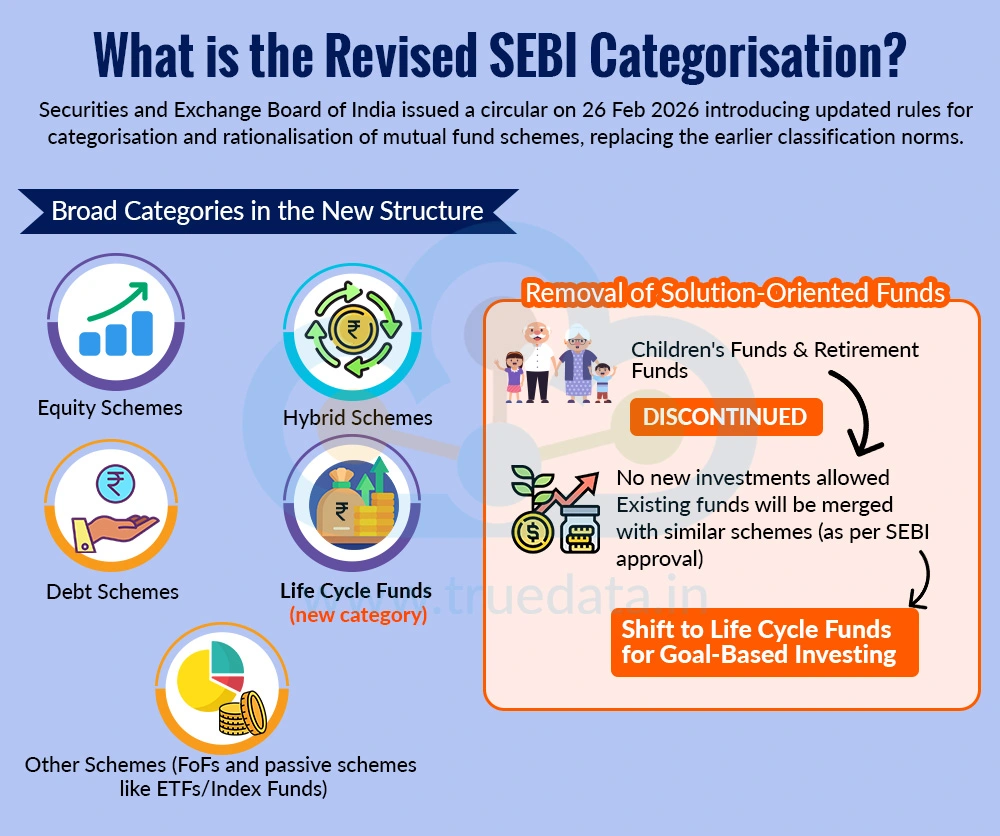
SEBI introduced a circular ‘Categorisation and Rationalisation of Mutual Fund Schemes’ dated 26 Feb 2026 that highlights key changes in the mutual fund classification and rationalisation. This circular now supercedes the earlier categorisation norms and provides entirely updated rules for scheme types and characteristics. The highlights or the broad categories of the revised structure are mentioned below.
Equity Schemes
Debt Schemes
Hybrid Schemes
Life Cycle Funds (new category)
Other Schemes (FoFs and passive schemes like ETFs/Index Funds)
One of the most notable changes introduced in the SEBI circular on categorisation and rationalisation of mutual fund schemes (26 February 2026) is the removal of the ‘Solution-Oriented Schemes’ category, which earlier included Children’s Funds and Retirement Funds. These funds were originally designed to help investors save for specific long-term goals such as retirement planning or a child’s education, often with lock-in periods and goal-based branding. However, SEBI observed that these schemes often had similar portfolios to regular equity or hybrid funds, which made the category less meaningful and sometimes confusing for investors. As a result, SEBI has decided to discontinue this category to simplify the mutual fund structure and improve clarity.
Under the new framework, existing solution-oriented schemes will not accept any new investments and will eventually be merged with other schemes that have similar asset allocation and risk profiles, subject to SEBI’s approval. Investors who currently hold these funds do not need to take immediate action, but they should watch for communication from their fund house (AMC). This move is also linked to the introduction of new Life Cycle Funds, which follow a structured asset allocation that gradually shifts from higher equity to lower risk assets over time. Overall, the change aims to reduce product complexity and ensure that fund categories are clearly differentiated and easier for investors to understand.
The Securities and Exchange Board of India (SEBI) periodically reviews mutual fund regulations to ensure that the industry remains transparent, investor-friendly, and easy to understand. Over the past few years, India’s mutual fund industry has grown rapidly, with crores of new investors entering the market, making it essential to create a more structured and transparent framework that helps investors make informed decisions.
The need for the revised categorisation is highlighted below.

Simplifying Mutual Fund Categories - Over time, some mutual fund categories became less meaningful or outdated. For example, solution-oriented schemes like children’s funds and retirement funds often had portfolios similar to regular equity or hybrid funds. By revising categories and removing certain structures, SEBI aims to simplify the mutual fund ecosystem, making it easier for investors to understand how different funds are structured and what they invest in.
Reducing Confusion Among Investors - As the mutual fund industry expanded, investors were faced with a large number of schemes across different categories. In many cases, schemes with different names had very similar investment portfolios, which made it hard for investors to understand the true difference between them. SEBI introduced revised categorisation to ensure that each category has clear investment rules and objectives. This makes it easier for investors to compare schemes and choose funds that match their risk appetite and financial goals.
Limiting Overlapping Mutual Fund Schemes - Another concern was the high overlap between schemes offered by the same fund house. For example, two funds in different categories could end up investing in many of the same stocks or bonds. Such overlap reduces the value of diversification and can make multiple schemes from the same fund house appear redundant. The revised rules introduce portfolio overlap limits [for example, a maximum of up to 50% for Sectoral and Thematic equity with other equity schemes (except Large Cap funds)] and stricter category definitions, ensuring that each scheme maintains a distinct investment strategy.
Strengthening Investor Protection - SEBI’s primary mandate is to protect the interests of investors. By rationalising mutual fund categories and tightening rules around scheme structure, SEBI reduces the possibility of misleading scheme positioning or product complexity. This ensures that investors can trust the category label of a mutual fund and understand what type of investment they are making.
Improving Transparency and Disclosure - SEBI also wants to strengthen transparency in the mutual fund industry. Clear categorisation rules ensure that fund houses follow specific investment limits and strategies within each category. This helps investors answer questions on the funds to pick or the fund risk, as well as determining if the fund’s portfolio matches its objectives. This better transparency will ultimately help investors make more informed investment decisions.

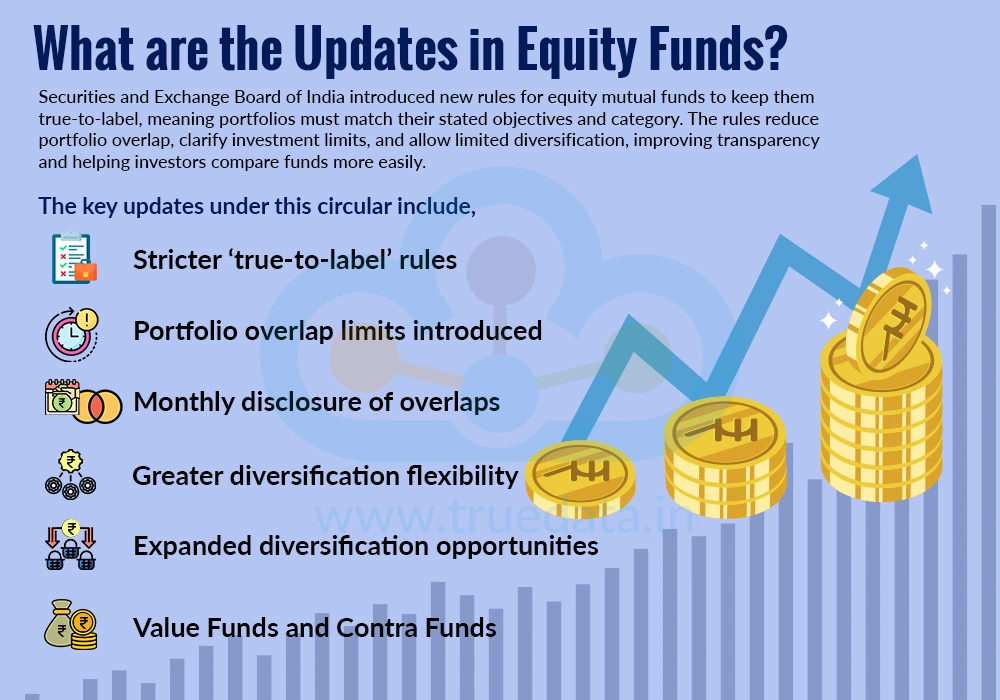
SEBI introduced new rules for equity mutual funds to ensure they remain ‘true-to-label’. This means a fund’s portfolio must clearly match its stated investment objective and category. Earlier, some equity funds had similar portfolios or flexible allocations, which made it hard for investors to understand the fund’s real strategy and risk. The new rules limit portfolio overlap, clarify investment limits, and allow limited diversification in the non-core portion of the portfolio, helping improve transparency and making it easier for investors to compare and choose the right equity funds.
The key updates under this circular include,
Stricter ‘true-to-label’ rules - Equity funds must clearly follow their category mandate so that the portfolio matches the fund’s stated objective.
Portfolio overlap limits introduced - SEBI has capped the overlap between certain equity schemes (such as value, contra, or thematic funds) at 50%, ensuring that different schemes maintain distinct investment strategies.
Time limit for compliance - Existing schemes must adjust their portfolios to meet the new rules, and most within six months, while thematic funds may get up to three years.
Monthly disclosure of overlaps - Fund houses are required to disclose portfolio overlaps every month, improving transparency for investors.
Greater diversification flexibility - Equity and hybrid funds can now invest part of their non-core allocation in assets such as gold ETFs, silver ETFs, InvITs, and debt instruments.
Expanded diversification opportunities - These changes allow fund managers to use alternative assets to manage risk and diversify portfolios while maintaining equity as the core investment.
Value Funds and Contra Funds - Under the revised SEBI rules, an Asset Management Company (AMC) can now offer both Value Funds and Contra Funds, whereas earlier it was allowed to launch only one of the two categories. However, to ensure that the schemes remain distinct, SEBI has introduced a rule that the portfolio overlap between the two funds should not exceed 50%. This change gives fund houses greater flexibility while ensuring that investors receive clearly differentiated investment strategies.
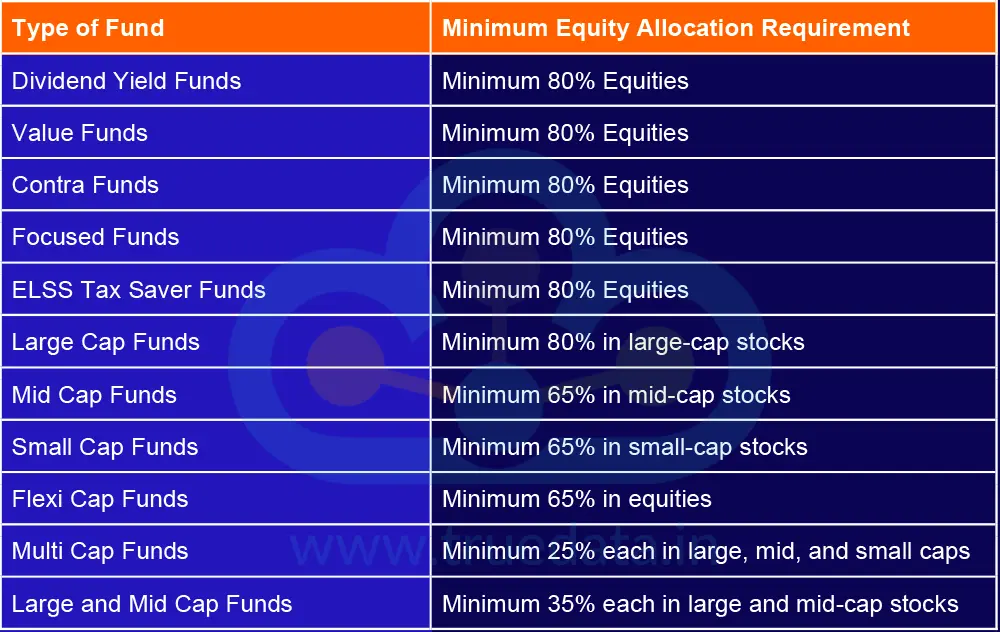
The minimum investment in equity funds as per the revised SEBI regulations is tabled below.


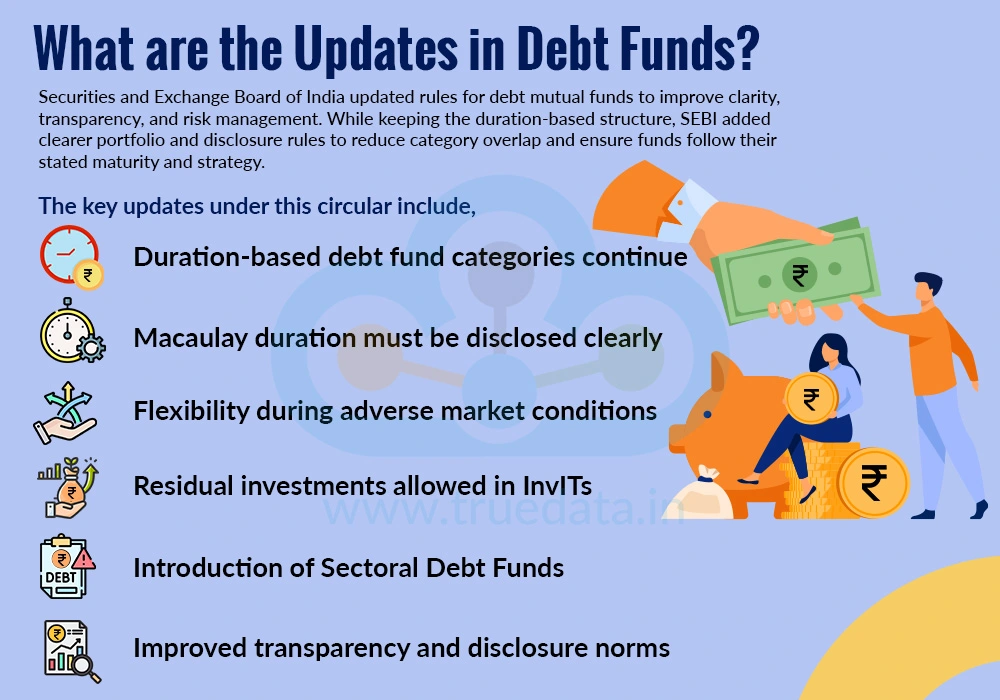
SEBI introduced updates for debt mutual funds to improve clarity, transparency, and risk management. Debt funds invest in fixed-income instruments like government securities, corporate bonds, treasury bills, and money market instruments. As the number of schemes increased, some categories began to overlap. To address this, SEBI kept the duration-based structure of debt funds but added clearer rules for portfolio management and disclosures. These changes help ensure debt funds follow their stated maturity and strategy, while still allowing fund managers some flexibility and making the category easier for investors to understand.
The key updates under this circular include,
Duration-based debt fund categories continue - Debt schemes will still be classified based on maturity or duration, such as overnight, liquid, ultra-short, short-term, medium-term, and long-term funds.
Macaulay duration must be disclosed clearly - Funds must disclose the portfolio-level Macaulay duration, which helps investors understand the interest-rate sensitivity of the debt portfolio.
Flexibility during adverse market conditions - In medium-term and medium-to-long-term debt funds, fund managers are allowed to temporarily reduce portfolio duration if market conditions become risky, but they must record the reasons and report them to trustees and SEBI.
Residual investments allowed in InvITs - Debt schemes may invest a small residual portion of their portfolio in Infrastructure Investment Trusts (InvITs), except for certain low-risk categories like overnight, liquid, and ultra-short duration funds.
Introduction of Sectoral Debt Funds - SEBI has introduced a new debt fund category called Sectoral Debt Funds. These are open-ended debt mutual funds that invest mainly in bonds issued by companies within a specific sector of the economy, such as financial services, energy, infrastructure, housing, or real estate. To maintain a clear investment focus, these funds are required to invest at least 80% of their portfolio in debt and debt-related instruments from a single sector, generally in high-quality (AA+ and above rated) securities. This new category allows investors to take targeted exposure to a particular sector through fixed-income instruments, while also expanding the range of options available in the debt mutual fund segment.
Improved transparency and disclosure norms - Fund houses must follow clearer reporting and justification requirements when making major portfolio changes, ensuring better oversight and investor protection.

SEBI updates in hybrid mutual funds are aimed at following clearer allocation guidelines while still allowing some flexibility to diversify. SEBI has also allowed a small portion of investments in assets like gold and silver ETFs, which can help improve diversification and manage market risk.
The key updates under this circular include,
Core asset allocation must remain clear - Hybrid funds must maintain their defined balance between equity and debt, ensuring the scheme remains true to its category.
Residual investment flexibility introduced - Hybrid funds can now invest part of their non-core allocation in gold and silver ETFs for diversification. SEBI has formally allowed precious metals in hybrid portfolios to help manage risk and reduce volatility during market fluctuations.

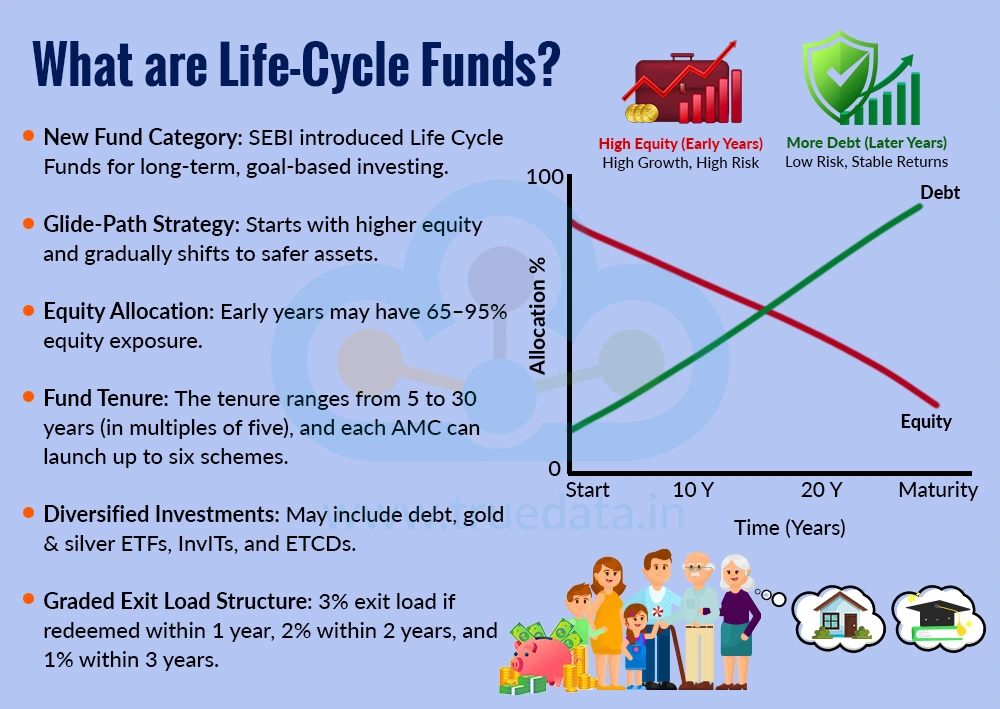
SEBI has introduced a new mutual fund category called Life Cycle Funds, which are open-ended schemes designed for long-term, goal-based investing. These funds follow a glide-path strategy, where the portfolio starts with a higher allocation to equities and gradually shifts towards safer assets such as debt as the target maturity date approaches. This means in the early years, the equity exposure may be relatively high (around 65-95% for longer-tenure funds) and is gradually reduced over time. The tenure of these funds can range from 5 to 30 years, in multiples of five, and each asset management company (AMC) can launch up to six such schemes. The funds may also invest limited portions in gold and silver ETFs, InvITs, and ETCDs within specified limits. SEBI has introduced a graded exit load structure to promote long-term investing, where investors may pay an exit load in the following structure,
3% if they redeem within the first year
2% within 2 years
1% within 3 years.
The SEBI circular on the revised categorisation and rationalisation of mutual fund schemes (February 2026) aims to make the mutual fund landscape in India simpler, clearer, and more transparent for investors. The changes introduce stricter investment rules for funds and new fund categories such as Life-Cycle Funds and Sectoral Debt Funds. Overall, these updates also reduce portfolio overlap between schemes and encourage long-term investing through clearer asset allocation and exit load structures.
This article highlights the latest updates by SEBI that have rejigged the mutual fund classifications, consolidating fund types and ensuring better investor awareness and decision-making abilities. We hope this helps you understand the updates in a better manner and create a healthy portfolio. Let us know your thoughts on the topic or if you need further information on the same, and we will address it soon.
Till Then, Happy Reading!
Read More: Understanding the Riskometer in Mutual Fund Scheme
Mutual fund investments have simplified greatly with just a tap on your smartpho...
Introduction For the longest time, investment in stock markets was thought to b...
Every investor knows that the stepping stones to a good investment in thestock m...