Your mutual fund has delivered impressive returns, but are those the actual returns you have earned? If you invest through SIPs or make investments at different points in time, the answer may surprise you. This is where XIRR comes into the picture. If you have been following our previous blogs, you know that calculating mutual fund returns is not always straightforward. In fact, no discussion on mutual fund returns is complete without XIRR. While you may have come across this term in your portfolio or investment app, how many investors truly understand what it means or how it is calculated? Not many. So dive into this blog where we explore the meaning of XIRR, its calculation and significance to make mutual fund investing simpler and more accessible for every investor.

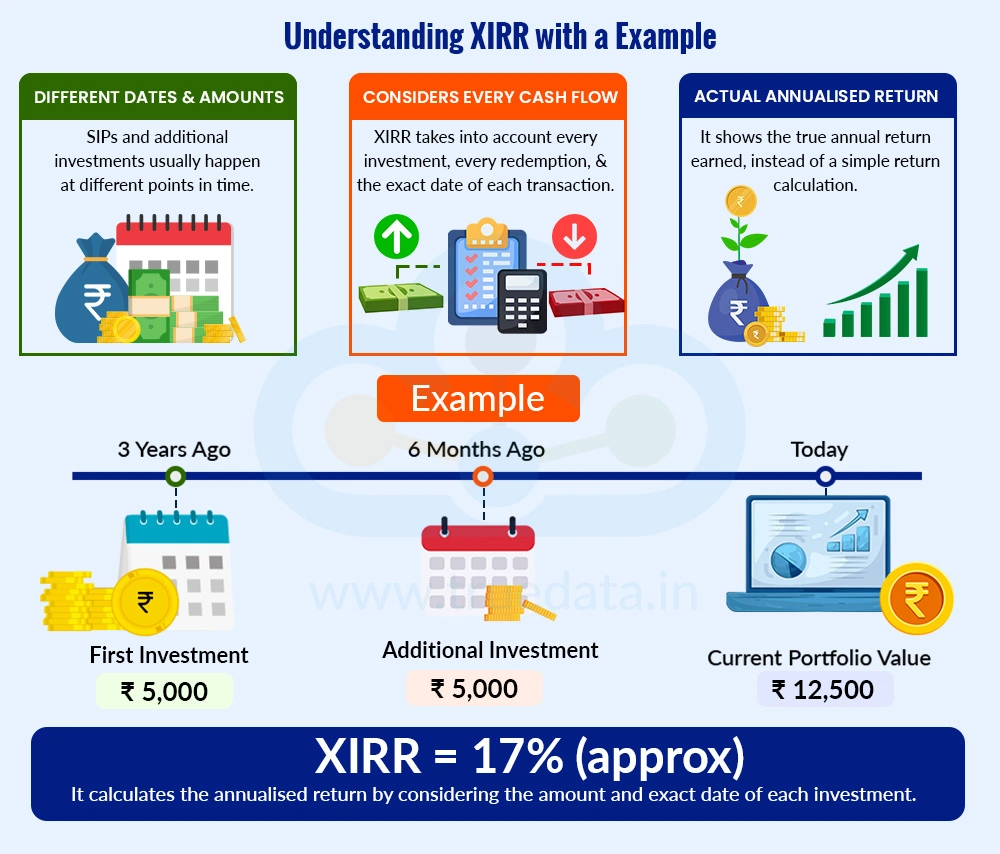
XIRR (Extended Internal Rate of Return) is a method used to calculate the actual annualised return earned on mutual fund investments when investors invest or withdraw money on different dates. Since most investors in India invest through Systematic Investment Plans (SIPs) or make additional lump sum investments over time, the amount invested and the timing of each investment are rarely the same. A simple return calculation does not consider these varying cash flows, which is why it may not reflect the true investment performance. XIRR solves this problem by taking into account every investment, every redemption, and the exact date on which each transaction occurred, giving investors a more accurate picture of the returns they have actually earned.
Think of XIRR as a report card for mutual fund investments. Instead of simply comparing the amount invested with the value of the portfolio today, it considers when each rupee was invested. For example, Rs. 5,000 invested through a SIP six months ago has had much less time to grow than Rs. 5,000 invested three years ago. XIRR factors in these differences and expresses returns as an annual percentage, making it easier to compare the performance of different mutual funds or even other investment options such as fixed deposits, stocks, or bonds. Thus, XIRR is considered one of the most reliable measures of mutual fund performance, especially for SIP investors.

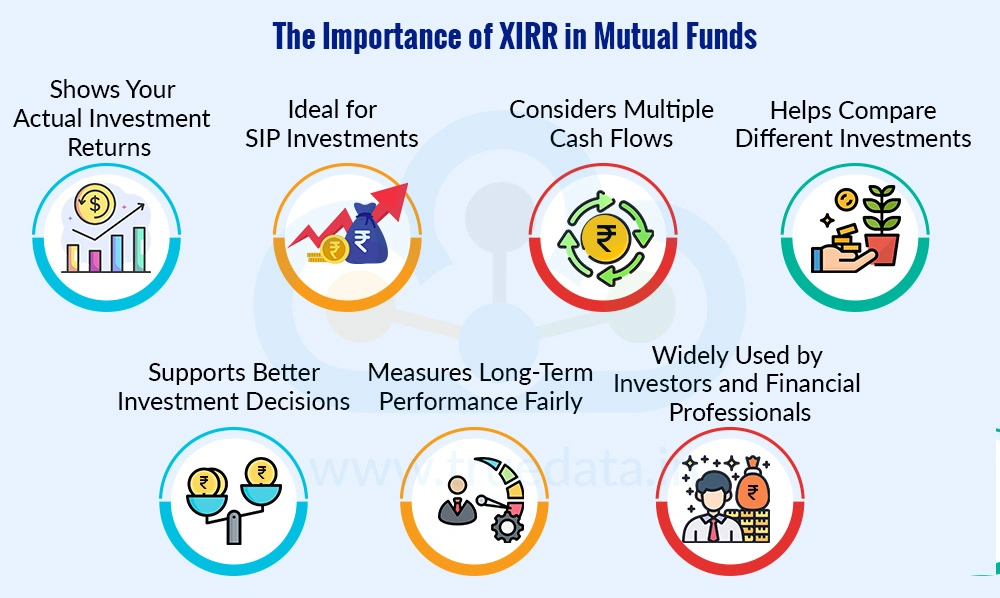
XIRR is often considered to be the best nd the most practical measure for calculating mutual fund returns. The importance of XIRR in mutual funds is explained hereunder.
Shows Your Actual Investment Returns - Unlike simple return calculations, XIRR considers the amount invested and the exact date of every investment and withdrawal. This gives investors a more accurate picture of the returns they have actually earned from their mutual fund investments.
Ideal for SIP Investments - SIPS are the most convenient and efficient way for investing in mutual funds. Since every SIP instalment gets a different amount of time to grow, XIRR is the most suitable method for measuring the overall performance of SIP investments.
Considers Multiple Cash Flows - Many investors make additional lump sum investments, partially redeem their units, or switch between mutual fund schemes. XIRR takes all these cash flows into account, making it much more reliable than simple return calculations.
Helps Compare Different Investments - XIRR expresses returns as an annual percentage, making it easier to compare the performance of different mutual funds. Investors can also use it to compare mutual fund returns with other investment options such as fixed deposits, stocks, or bonds.
Supports Better Investment Decisions - Knowing the actual return on investments helps in understanding whether the financial goals are on track. This allows in decicing whether to continue investing, increase investments, or make changes to the portfolio.
Measures Long-Term Performance Fairly - Market Conditions change over time, and investments made during market highs or lows can perform differently. XIRR adjusts for the timing of each investment, giving a fair assessment of portfolio's long-term performance.
Widely Used by Investors and Financial Professionals - XIRR is one of the most trusted methods for measuring mutual fund returns and is commonly used by investment platforms, financial advisors, and portfolio tracking applications. Understanding it enables confident interpretation of portfolio reports.

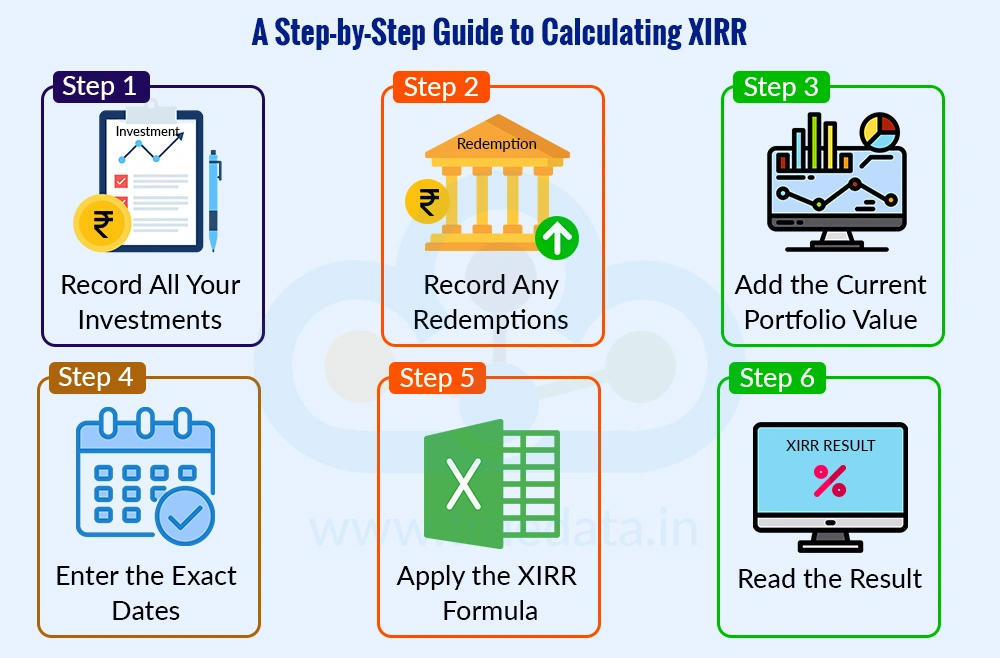
Although XIRR is based on a mathematical formula, investors do not have to calculate it manually. Most investors use Microsoft Excel or Google Sheets, which automatically calculate the XIRR once the required details are entered. The steps for calculating XIRR are,
Step 1 - Record All Your Investments
List every investment made in the mutual fund, including SIP instalments and any lump sum investments. Enter these as negative (-) values, as this is money going out of your pocket.
Step 2 - Record Any Redemptions
If any units are redeemed, enter those amounts as positive (+) values because this is money coming back to you.
Step 3 - Add the Current Portfolio Value
If you are calculating the return on an ongoing investment, enter the current value of your mutual fund holdings as the final positive (+) cash flow along with the current date. You can find the current value of the holdings from the broker platform.
Step 4 - Enter the Exact Dates
Alongside every investment, redemption, or current portfolio value, enter the exact transaction date. XIRR uses these dates to calculate the annualised return accurately.
Step 5 - Apply the XIRR Formula
In Microsoft Excel or Google Sheets, enter the following formula,
=XIRR(values, dates)
Where,
Values are the investment, redemption, and portfolio value amounts.
Dates are the corresponding transaction dates.
Step 6 - Read the Result
Press Enter, and the spreadsheet will display the annualised return on your mutual fund investment. This percentage reflects the actual return after considering both the amount invested and the timing of each cash flow.
Understanding XIRR Through an Example
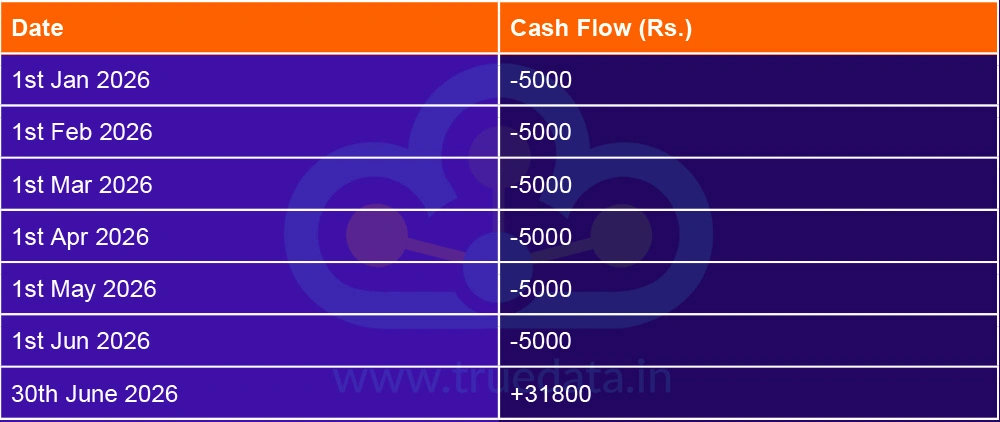
Consider Ms Puja, who invests Rs. 5000 per month through an SIP. The portfolio value at the end of six months was Rs. 31,800.

Now, enter these values and dates into Excel or Google Sheets and use:
=XIRR(B2:B8, A2:A8)
The spreadsheet will calculate the XIRR automatically. If the result is 0.2232, i.e., 22.32%, it means the mutual fund investment has earned an annualised return of 22.32%, after taking into account the amount and timing of every SIP instalment. This gives a much more accurate measure of your returns than a simple percentage gain.
This relatively high XIRR is due to the investments being made over only six months, and the portfolio value (Rs. 31,800) represents a gain of Rs. 1,800 on a total investment of Rs. 30,000 in a short period. Since XIRR annualises the return, the annual percentage appears higher than the simple gain of 6% (1800/30000*100). This makes it a good example to illustrate why XIRR and absolute returns are different.

The limitations of using XIRR include,
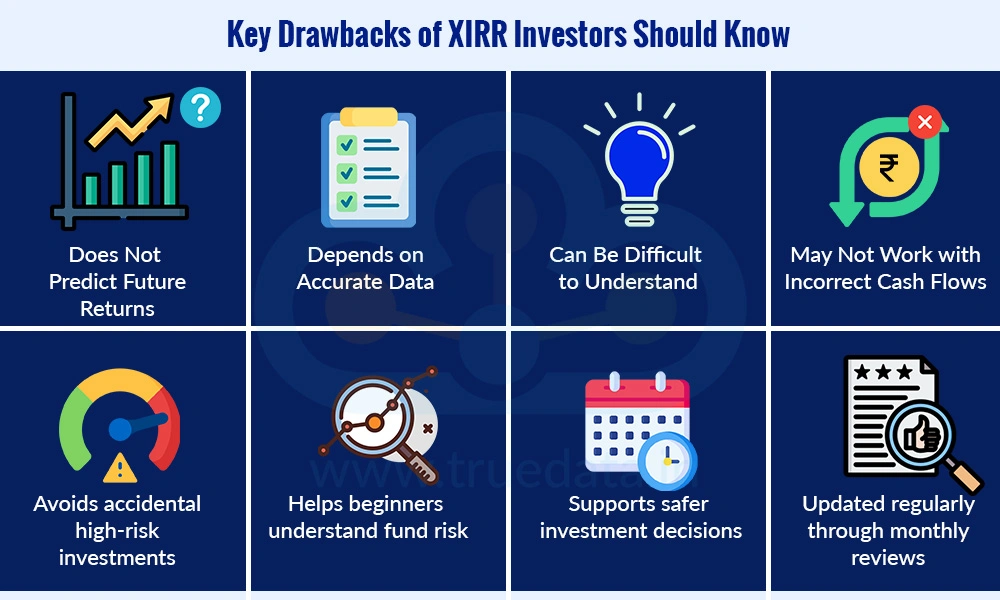
Does Not Predict Future Returns - XIRR only measures the returns you have earned based on past investments and cash flows. It cannot predict how your mutual fund will perform in the future.
Depends on Accurate Data - XIRR is only as accurate as the information you provide. If you enter incorrect investment amounts, transaction dates, or portfolio values, the calculated return will also be incorrect.
Can Be Difficult to Understand - The concept and calculation of XIRR may seem complicated for new investors. Although spreadsheet applications calculate it automatically, understanding what the result means can take some time.
May Not Work with Incorrect Cash Flows - For XIRR to calculate correctly, there must be at least one negative cash flow (investment) and one positive cash flow (redemption or current portfolio value). Otherwise, the calculation will return an error.
Does Not Consider Investment Risk - A high XIRR does not necessarily mean a mutual fund is a better investment. It does not account for the level of risk, volatility, or market fluctuations involved in generating those returns.
Cannot Explain Why Returns Changed - XIRR only tells you the annualised return on your investment. It does not explain whether the return was influenced by market conditions, your investment timing, fund manager decisions, or changes in the economy.
Sensitive to the Timing of Cash Flows - Since XIRR gives importance to the date of every investment and withdrawal, investing or redeeming money just before a sharp market rise or fall can significantly affect the final return. As a result, two investors in the same mutual fund may have different XIRR values depending on when they invested.
Should Not Be Used in Isolation - While XIRR is an excellent measure of investment performance, it should not be the only factor when evaluating a mutual fund. Investors should also consider the fund's long-term performance, risk level, investment objective, expense ratio, and portfolio quality before making investment decisions.

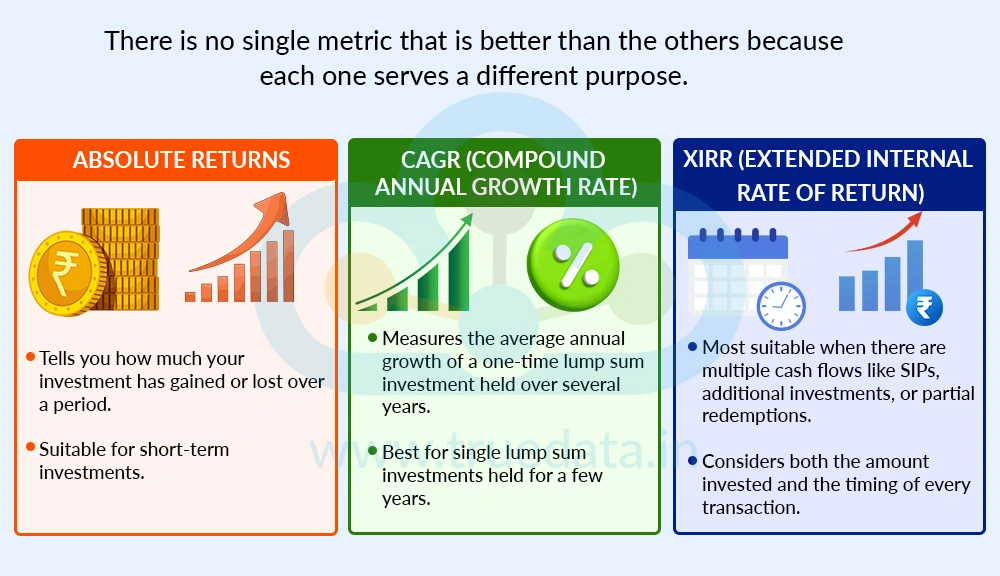
There is no single metric that is better than the others because each one serves a different purpose. Absolute return simply tells you how much your investment has gained or lost over a period, making it suitable for short-term investments. CAGR (Compound Annual Growth Rate) measures the average annual growth of a one-time lump sum investment held over several years. XIRR (Extended Internal Rate of Return), on the other hand, is the most suitable metric when there are multiple cash flows, such as SIPs, additional investments, or partial redemptions, because it considers both the amount invested and the timing of every transaction.
For most mutual fund investors who invest through SIPs, XIRR is generally the most accurate measure of returns. However, if you have made only a single lump sum investment and held it for a few years, CAGR is a better measure of annualised performance. Similarly, if you simply want to know the total gain or loss on a short-term investment, absolute return is sufficient. Therefore, the best metric depends on how you invest, rather than one measure being universally better than the others.
XIRR is one of the most reliable ways to measure the actual returns on mutual fund investments, especially if investments are made through SIPs or at different points in time. By considering both the amount invested and the timing of every transaction, it provides a more accurate picture of your portfolio's performance than simple return calculations. While understanding XIRR can help investors evaluate their investments better, it should always be used along with other factors such as financial goals, risk appetite, and the overall quality of the mutual fund before making investment decisions.
This article tackes the important question of understanding XIRR and its calculation for mutual fund returns. We hope this helps simplify the topic. Let us know if you have any queries and we will address it soon.
Till then, Happy Raeding!
Read More: Understanding the Riskometer in Mutual Fund Schemes
Mutual fund investments have simplified greatly with just a tap on your smartpho...
Many investors think thatmutual fund investing is simply selecting a fund and wa...
Every investor knows that the stepping stones to a good investment in thestock m...