Mutual Funds are subject to market risks’. Almost every investor has heard this line before investing in mutual funds. But somewhere along the way, this cautionary statement has also created several myths and misunderstandings about mutual fund investing. So let us take on some popular myths about mutual funds in this blog and debunk them for our new investors starting their investment journey.

Mutual funds have become one of the fastest-growing investment options in India. However, despite their growing popularity, several myths and misunderstandings still exist around mutual fund investing. These myths often create unnecessary fear, confusion, or unrealistic expectations among investors. Some people avoid mutual funds completely because they think they are too risky, while others enter the market expecting guaranteed profits in a short time. The truth usually lies somewhere in between.

One of the most common myths among beginners is that mutual funds are complicated products meant only for finance professionals, stock market traders, or people with deep investment knowledge. Many people feel they must understand company balance sheets, technical charts, or market movements before investing in mutual funds. In reality, mutual funds are specifically designed to make investing easier for ordinary investors. When investors invest in a mutual fund, their money is pooled together with money from many other investors. This combined amount is then managed by professional fund managers who research companies, study market trends, and decide where to invest the money.
Thus, investors do not need to actively buy or sell shares themselves, making it one of the biggest advantages of mutual funds. A person with limited financial knowledge can still participate in equity markets without needing to become a full-time market expert. Investors can start with simple products like index funds, balanced funds, or SIPs and gradually learn more over time. In fact, many successful investors began with very little market knowledge but stayed consistent and patient.

Systematic Investment Plans (SIPs) are one of the most popular ways to invest in mutual funds in India. As SIPs are widely promoted as disciplined investing tools, some people wrongly assume they guarantee positive returns regardless of market conditions. The truth is that SIPs are simply a method of investing regularly. They do not remove market risk or guarantee profits. If markets decline sharply, the value of SIP investments can also temporarily fall. However, SIPs offer important advantages. By investing fixed amounts regularly, investors automatically buy more units when prices are low and fewer units when prices are high. This process is called rupee cost averaging. Over long periods, it may help reduce the overall impact of market volatility.
SIPs also build financial discipline. Instead of trying to time the market perfectly, investors continue investing consistently month after month. This habit can be very beneficial for long-term goals such as retirement, children’s education, or wealth creation. The key benefit of SIPs is disciplined investing and long-term participation, not guaranteed returns.

Another popular myth is that mutual fund investing is only meant for wealthy individuals who can invest large sums of money. Many beginners believe they need thousands or lakhs of rupees before they can even start. In reality, mutual funds are among the most accessible investment products available today. Many mutual fund companies allow SIP investments starting from as low as Rs. 100 or Rs. 500 per month. This means even students, young professionals, and small savers can begin their investment journey comfortably.
The important factor in investing is not starting with a huge amount but investing consistently over time. Small regular investments can grow significantly because of compounding. Compounding means investors earn returns not only on their original investment but also on the returns generated over time. For example, a person investing Rs. 2,000 monthly through SIPs for many years may eventually build a meaningful investment corpus. Starting early and remaining disciplined often matters more than investing very large amounts later.

Many people enter mutual fund investing after hearing stories about someone earning very high returns in a short period. Social media, advertisements, and market discussions often create the impression that mutual funds always generate massive profits quickly. The reality is very different. Mutual fund returns depend on several factors, such as market performance, economic conditions, interest rates, investment duration, and the type of fund chosen.
Equity Mutual Funds can deliver strong long-term returns, but they can also go through temporary periods of low or negative performance when markets fall. For example, during stock market corrections or economic slowdowns, even good mutual funds may experience short-term declines in value. This does not mean the investment has failed. Markets naturally move through cycles of growth and decline. Investors who stay invested patiently for long periods often benefit more from recovery and compounding. Mutual funds should therefore be viewed as long-term wealth creation tools rather than quick-money opportunities. Investors who expect guaranteed or instant profits often become disappointed and exit investments too early.

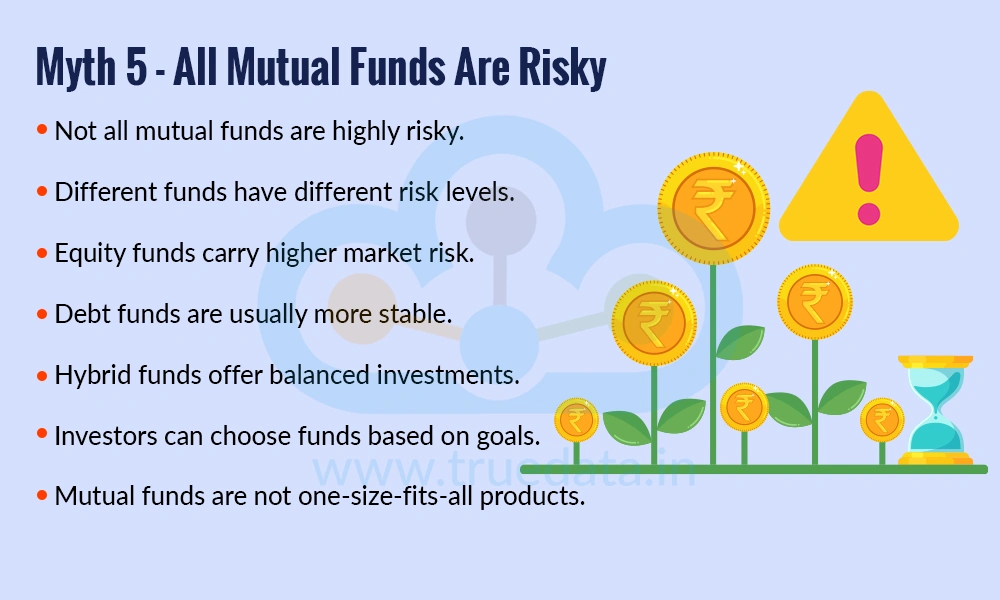
Many people avoid mutual funds entirely because they believe every mutual fund investment is highly dangerous and similar to gambling. This is far from the truth, as mutual funds come in different categories with varying levels of risk. Some funds are aggressive and market-linked, while others focus on stability and income generation. For example, equity mutual funds generally carry higher risk because they invest mainly in stocks. They may suit long-term investors willing to tolerate market fluctuations for potentially higher returns. Debt mutual funds usually invest in government securities, bonds, or fixed-income instruments and are considered relatively less volatile. Hybrid mutual funds combine equity and debt to provide balanced exposure. Investors can therefore choose funds according to their financial goals, time horizon, and comfort with risk. Mutual funds are not ‘one-size-fits-all’ products.

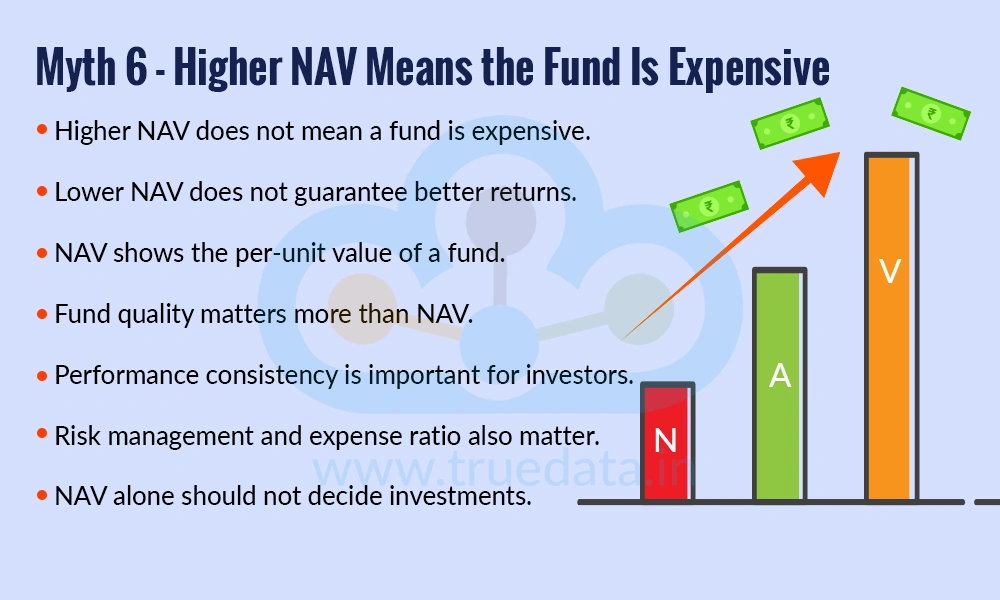
Many beginners compare mutual fund Net Asset Value (NAVs) and assume a fund with a lower NAV is cheaper or has more growth potential. Similarly, they believe a fund with a very high NAV is expensive and should be avoided.
NAV simply represents the per-unit value of a mutual fund scheme. It is calculated based on the total value of the fund’s assets divided by the number of units outstanding. A high NAV does not make a fund costly, and a low NAV does not automatically make it attractive. What matters more is the quality of the portfolio, consistency of performance, risk management, expense ratio, and how suitable the fund is for the investor’s goals. Many investors wrongly choose low-NAV funds, thinking they are getting units ‘cheaply’, but NAV alone does not determine future returns.

Market corrections often create fear among investors. When they see negative returns or falling portfolio values, many investors panic and stop their SIPs to avoid further losses. Ironically, this can hurt long-term wealth creation. Market declines allow SIP investors to purchase more mutual fund units at lower prices. When markets eventually recover, these additional units may help improve overall returns.
Stopping SIPs during downturns is similar to refusing to buy quality products during a sale. Temporary market declines are a normal part of investing. Historically, markets have recovered from corrections, recessions, and crises over long periods. Investors who continue SIPs during difficult periods often benefit from long-term compounding and rupee cost averaging. Emotional decisions based on short-term fear can disrupt financial goals and reduce the benefits of disciplined investing.

Many investors believe mutual funds are useful only for very long-term goals such as retirement or children’s education. As a result, they ignore mutual funds for short-term or medium-term financial needs. In reality, mutual funds offer a wide variety of products designed for different investment horizons. Liquid funds and ultra short-term duration funds may be suitable for temporarily parking emergency funds or short-term savings. Short-duration debt funds may help investors with medium-term goals. Equity mutual funds are generally better suited for long-term wealth creation, as stock markets need time to overcome short-term volatility. Hybrid funds can be considered for medium-term financial planning by balancing growth and stability.
The important thing is choosing the right category of mutual fund according to the investor’s timeline, financial objective, and risk tolerance. Mutual funds are flexible investment tools that can serve multiple purposes when selected wisely.

Some new investors believe all mutual fund earnings are completely tax-free. However, this is not true under the Indian Income Tax Act. In reality, taxation depends on the type of mutual fund and how long the investment is held. Equity mutual funds, debt mutual funds, hybrid funds, gold funds, and international mutual funds can all have different tax rules. Investors have to pay capital gains tax when they redeem their units at a profit. In addition, dividends received from mutual funds are also taxable in the hands of investors as per their applicable income tax slab. Mutual fund houses may also deduct TDS in certain cases if dividend income crosses the prescribed limits. A brief explanation of taxation in mutual funds in the equity and debt fund categories is tabled below.


A very common mistake among investors is choosing mutual funds only because they delivered very high returns in the past few years. Many assume that if a fund performed well earlier, it will continue generating similar returns forever. The truth is that past performance does not guarantee future results. Market conditions constantly change due to economic factors, interest rates, global events, company earnings, and investor sentiment. A fund that performed strongly during one market cycle may underperform during another.
While past performance can help investors understand how a fund behaved historically, it should never be the only factor considered. Investors should also examine the fund’s consistency, portfolio quality, risk level, expense ratio, fund manager’s experience, and whether the scheme matches their own financial goals and risk appetite.
Mutual funds are often surrounded by myths, assumptions, and half-truths that can confuse new investors and sometimes even stop them from beginning their investment journey. From believing that mutual funds guarantee huge profits to assuming that all funds are risky or only meant for experts, these misconceptions can lead to poor financial decisions. The reality is that mutual funds are flexible investment tools designed to suit different financial goals, risk levels, and investment horizons. Therefore, learning the truth behind these myths can help investors make more informed and confident decisions and use mutual funds more effectively as part of their financial planning journey.
This article targets a few misconceptions related to mutual funds and demystifies them to help investors in making informed decisions and shape a profitable portfolio. Let us know your thoughts on the topic or if you need further information on the same and we will address it soon.
Till then, Happy Reading!
Read More: How Mutual Fund Managers Use Corporate Financial Data?
Mutual fund investments have simplified greatly with just a tap on your smartpho...
Introduction For the longest time, investment in stock markets was thought to b...