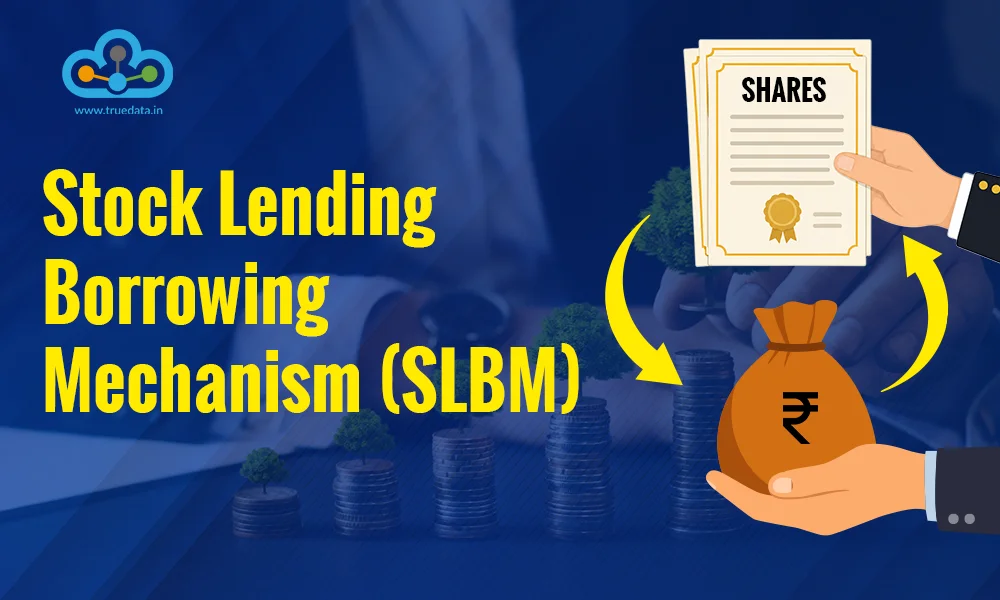
What if the shares sitting in your Demat account could earn you some additional income without having to sell them? Sounds interesting, right? While many investors associate earning from stocks with dividends or selling shares at a profit, there is another mechanism that allows you to potentially earn by lending your shares to other market participants. This is where the Stock Lending and Borrowing Mechanism (SLBM) comes in. But how does it work, who can participate, and what should investors know before lending their shares? Explore our blog to understand SLBM and discover how this mechanism works in the Indian stock market.

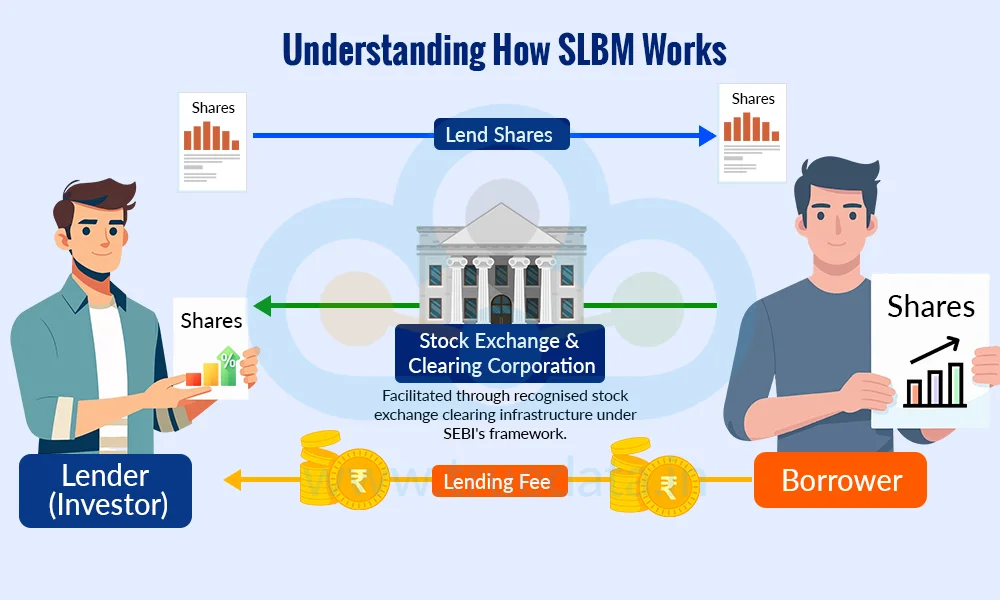
The Stock Lending and Borrowing Mechanism (SLBM) is a facility that allows investors to lend their shares to other market participants for a specified period in exchange for a lending fee. Investors holding eligible shares in their Demat account and not planning to sell them for some time can lend them through the SLBM platform and potentially earn additional income from them. The borrower, on the other hand, temporarily receives the shares and is required to return equivalent shares of the same type and quantity at the end of the agreed period. SLBM transactions are conducted through the clearing corporation of recognised stock exchanges under the framework prescribed by SEBI.

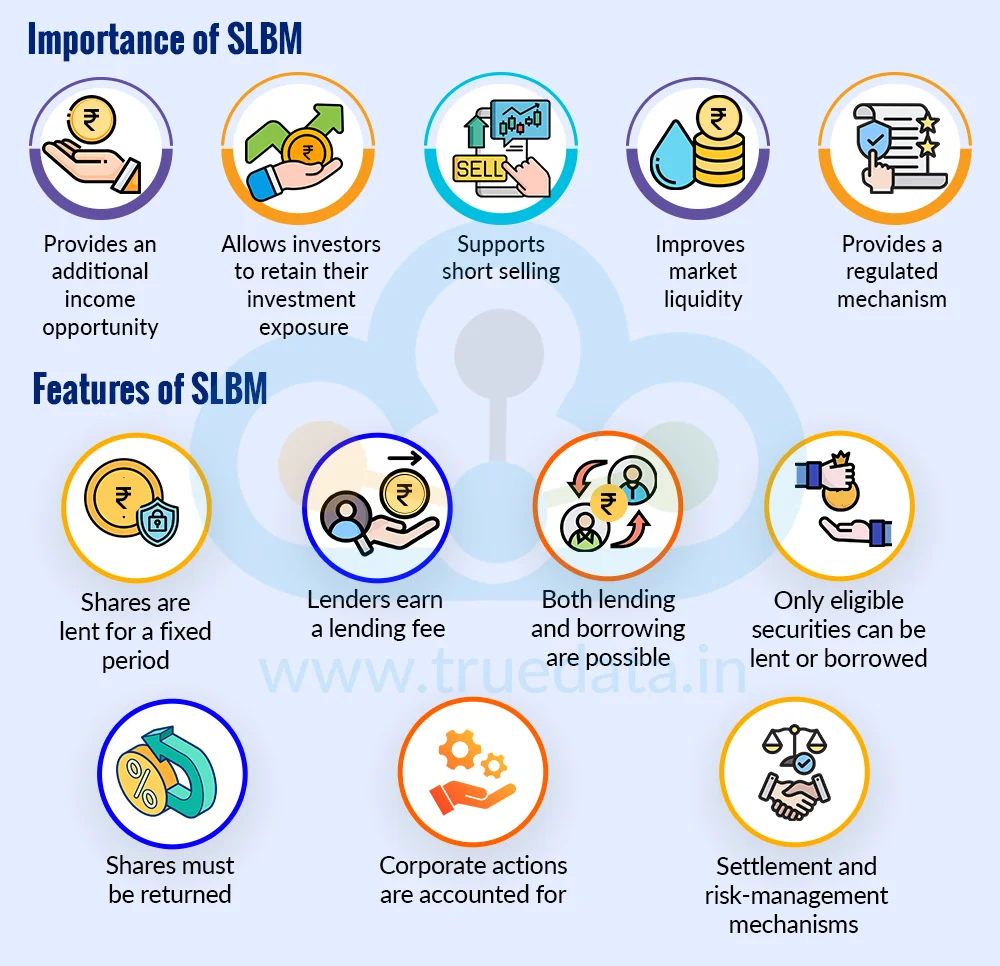
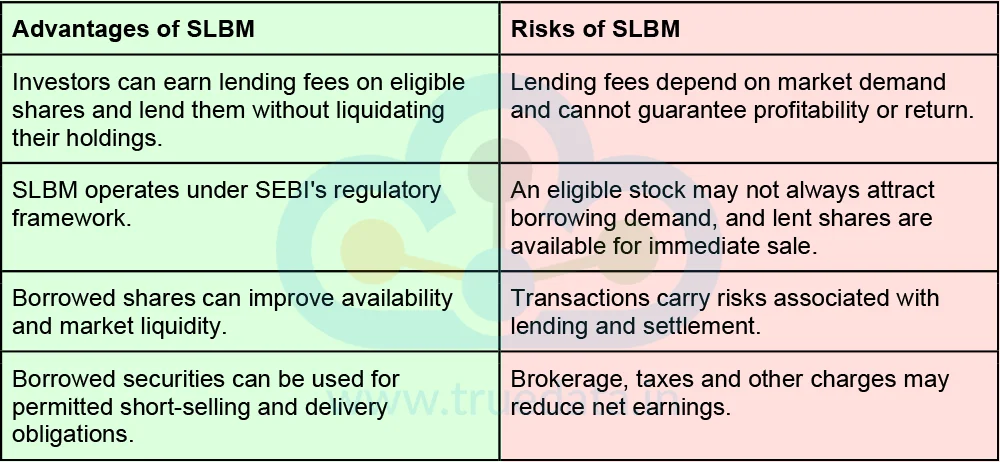
Provides an additional income opportunity - Investors can earn lending fees from shares they already hold instead of simply keeping them idle in their Demat accounts.
Allows investors to retain their investment exposure - Lending shares is different from selling them. Investors can continue to hold their investment while lending the shares for a specified period.
Supports short selling - Borrowed shares can be used by market participants who need securities to meet their delivery obligations, including for permitted short-selling transactions.
Improves market liquidity - By making securities available for borrowing, SLBM can help improve the availability and liquidity of eligible stocks in the market.
Provides a regulated mechanism - SLBM operates through the clearing infrastructure of recognised stock exchanges and is governed by SEBI's regulatory framework.
Features of SLBM
Shares are lent for a fixed period - The lender and borrower enter into an SLBM contract for a specified tenure, which can be from 3 days to 12 months, subject to the applicable framework.
Lenders earn a lending fee - The fee is quoted per share and can vary depending on the demand for a particular security.
Both lending and borrowing are possible - Investors can participate as lenders, while eligible market participants can borrow securities through the mechanism.
Only eligible securities can be lent or borrowed - Not every stock is available under SLBM. Securities must meet the applicable eligibility requirements.
Shares must be returned - At the end of the lending period, the borrower has to return equivalent securities to the lender.
Corporate actions are accounted for - Events such as dividends and stock splits are handled according to the applicable SLBM rules so that the relevant benefits are passed on or adjusted appropriately.
Settlement and risk-management mechanisms - Transactions are conducted through the authorised or designated Clearing Corporations, i.e., exchange clearing infrastructure, which is designed to manage settlement and counterparty risks.
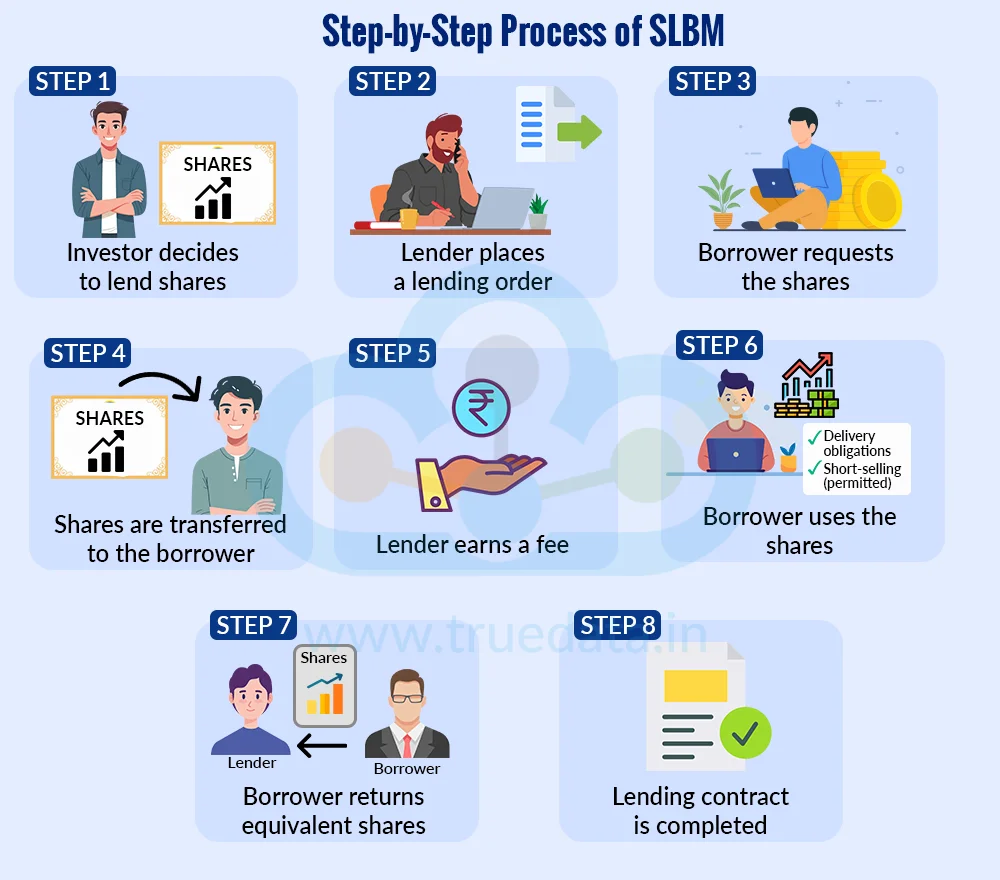
The Stock Lending and Borrowing Mechanism (SLBM) allows one market participant to lend securities to another through a regulated market framework temporarily. The process can be understood through the following steps.

Investor decides to lend shares - An investor who holds eligible shares can choose to lend them through the SLBM facility instead of selling them.
Lender places a lending order - The investor places an order with their broker, specifying the shares and quantity they want to lend.
Borrower requests the shares - Another market participant can borrow the required shares through the SLBM platform, usually by paying a lending fee.
Shares are transferred to the borrower - Once the transaction is matched and settled, the shares are transferred from the lender to the borrower for the agreed lending period.
Lender earns a fee - The lender receives the agreed lending fee for allowing the borrower to use the shares.
Borrower uses the shares - The borrower can use the borrowed shares for permitted purposes, such as meeting delivery obligations or carrying out permitted short-selling transactions.
Borrower returns equivalent shares - At the end of the lending period, the borrower must return the same quantity and type of securities to the lender.
Lending contract is completed - Once the securities are returned and the applicable settlement is completed, the SLBM transaction comes to an end.
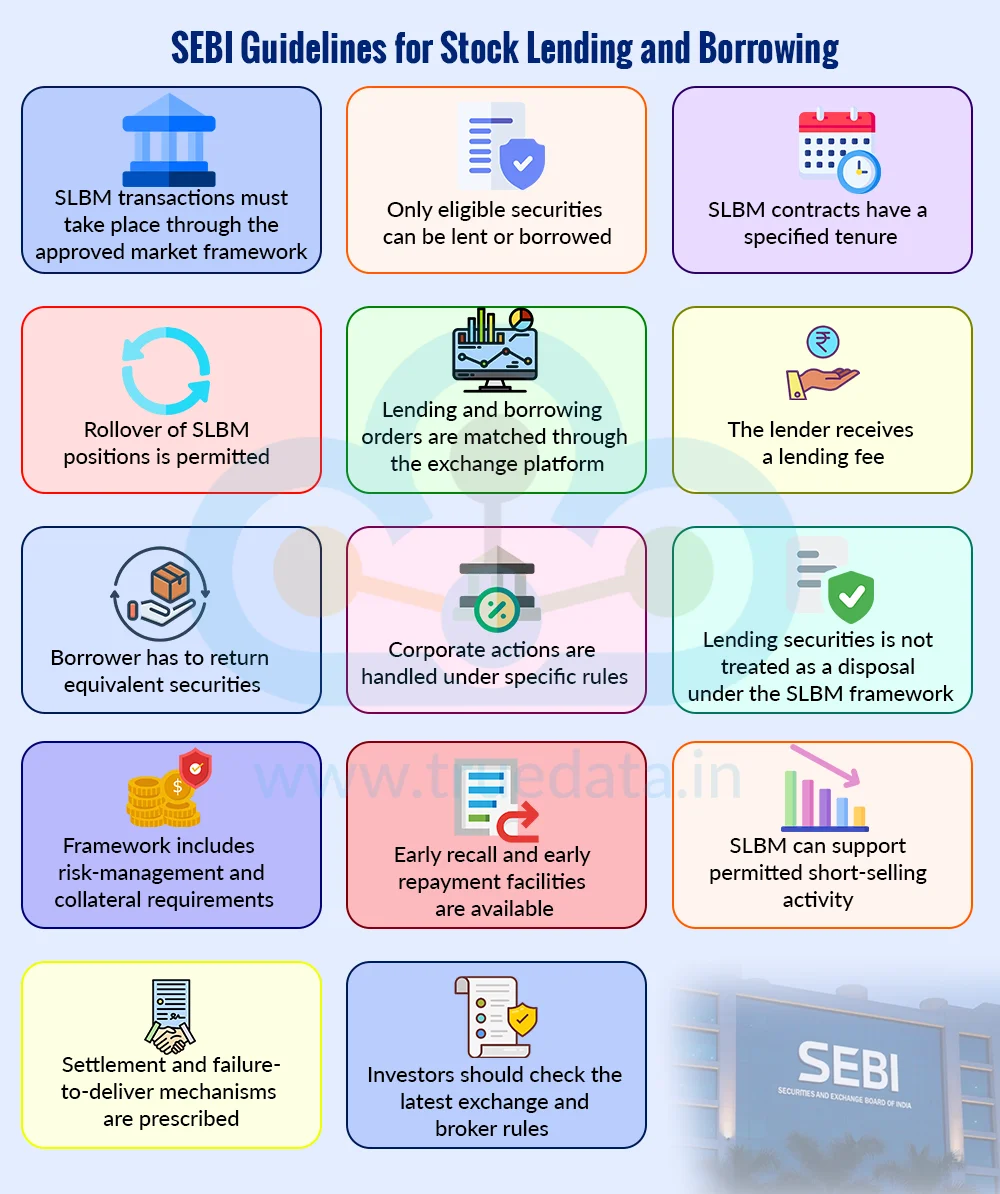
The Stock Lending and Borrowing Mechanism (SLBM) is governed by SEBI's securities-lending framework and the rules of the recognised stock exchanges and clearing corporations. The framework is intended to provide a structured way to lend and borrow securities while managing settlement, collateral and other risks. The key rules investors should understand are,

SLBM is not a private arrangement between two investors. Securities are lent and borrowed through an approved intermediary and the recognised exchange/clearing infrastructure under the applicable SEBI framework. The Securities Lending Scheme defines a lender as a person who deposits securities with an approved intermediary for lending and a borrower as a person who borrows securities through that intermediary. Thus, the lending and borrowing process follows prescribed rules rather than depending solely on an agreement between the two parties. The exchange and clearing corporation also provides the systems required for order matching, settlement and risk management.
Not every listed security is automatically available under SLBM. Securities must satisfy the applicable eligibility conditions prescribed by SEBI and the relevant exchange. For example, the framework includes qualifying securities based on factors such as their classification, Market Wide Position Limit (MWPL) and trading turnover. Certain liquid index ETFs can also be eligible. Exchanges publish the securities currently available for SLBM. Therefore, an investor should check the latest eligible-security list before placing an SLBM order rather than assuming that any listed share can be lent.
SLBM is a temporary lending arrangement. SEBI's framework permits contracts with different tenures, with the maximum contract period capped at 12 months. Exchanges can provide contracts with different periods depending on market requirements. This means an investor does not permanently give up the shares. The securities are lent for the agreed period, and equivalent securities are required to be returned at the end of the contract.
SEBI allows both lenders and borrowers to roll over an existing SLBM position if they want to extend the lending or borrowing period. A lender who is due to receive securities in the payout of an SLB session can extend the lending period. Similarly, a borrower who is due to return securities can extend the borrowing period through the same SLB session. The rollover is conducted as part of the SLB session. Importantly, multiple rollovers are permitted, but the total duration of the contract, including all rollovers, cannot exceed 12 months from the date of the original contract. Rollover also cannot be used to net a client's borrowed and lent positions against each other.
SLBM orders are placed through the exchange's SLB platform and matched according to the applicable trading mechanism. The lending fee is quoted on a per-share basis, and the SLB lot size is 1 share under the current framework described by NSE. For example, an investor holding 500 eligible shares can place a lending order for those shares at a specified lending fee. A borrower willing to accept the applicable terms can be matched through the platform.
The lender can earn a lending fee for making eligible securities available to a borrower. The fee is generally quoted on a per-share basis on the SLBM platform. The amount is not fixed for every stock. It can depend on factors such as demand for borrowing a particular security, availability of shares for lending and prevailing market conditions. Therefore, SLBM income should not be treated as a guaranteed or fixed return.
The borrower does not permanently acquire the lender's investment. Under the securities-lending framework, the borrower has to return equivalent securities of the same type or class at the end of the specified period, along with the applicable corporate benefits. This is an important distinction between SLBM and selling shares. In a sale, the investor gives up the securities in exchange for the sale proceeds. In SLBM, the securities are lent temporarily and are subsequently returned, subject to the applicable rules and settlement process.
Corporate actions occurring while securities are on loan are dealt with according to the SLBM framework. For example,
Dividend - The dividend amount is worked out and recovered from the borrower on the relevant book closure or record date and passed on to the lender.
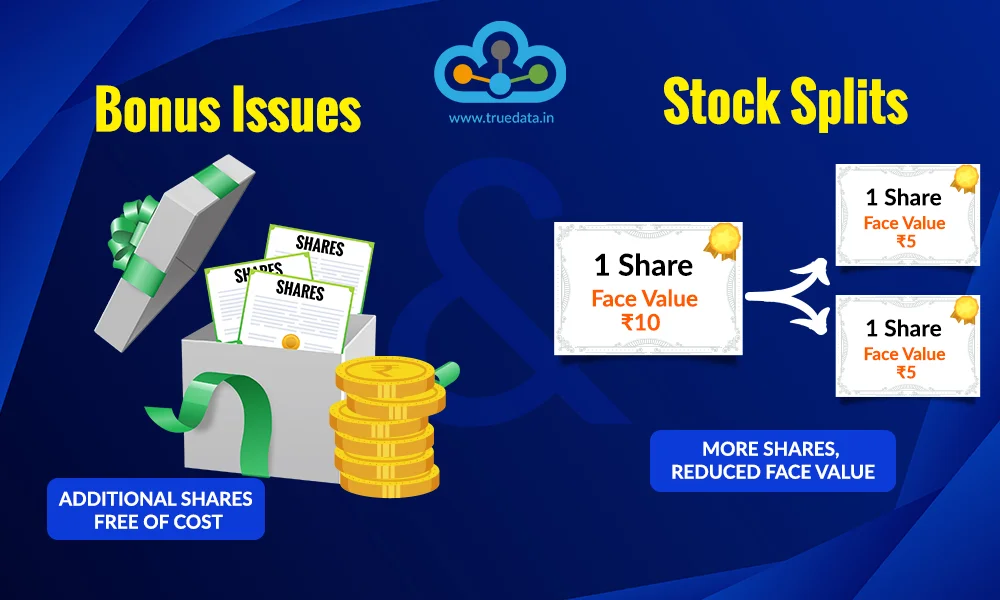
Stock split - The borrower's position is adjusted proportionately so that the lender receives the revised quantity of shares.
Bonus, mergers, amalgamations and open offer - The applicable contracts are generally foreclosed on the ex-date, with lending fees adjusted on a pro-rata basis as prescribed.
AGM/EGM - The framework provides for different types of contracts, including contracts that are mandatorily foreclosed and contracts that are not foreclosed for such events.
Therefore, investors should understand how corporate actions are treated before lending shares, particularly when an important corporate event is approaching.
SEBI's Securities Lending Scheme states that the lending of securities through the approved intermediary and the return of equivalent securities is not treated as disposal of the securities under the scheme. This is particularly relevant for investors who want to understand the difference between selling shares and lending them. However, investors should separately consider the applicable tax treatment of the lending fees and other income and consult a tax professional where necessary.
SLBM transactions involve the temporary transfer of securities, so the framework includes margin and collateral requirements to manage the risks associated with the transactions. Clearing corporations prescribe the applicable risk-management measures, and participants are required to meet their obligations. Thus, the SLBM process is supported by a formal clearing and settlement system rather than relying solely on the lender's and borrower's ability to fulfil their obligations.
The SLBM framework can provide the lender with a facility to request an early recall of securities, while the borrower can have a facility for early repayment, subject to the applicable exchange rules and contract conditions. NSE specifically provides for early recall and early repayment facilities. Therefore, investors should not assume that every SLBM contract can simply be cancelled whenever they want. The availability and process for early recall depend on the applicable contract and exchange rules.
Borrowing securities through SLBM can help market participants meet delivery requirements and participate in permitted short-selling transactions. SEBI's current framework also specifically treats short selling of a stock through SLBM as a short exposure for the relevant regulatory calculations. For a lender, this means the shares may be borrowed by another participant for purposes that are permitted under the securities-market regulations.
The clearing framework provides mechanisms to deal with situations where a participant fails to deliver or return securities. The SLB framework includes risk-management procedures and mechanisms such as auction or financial close-out in cases of failure, subject to the applicable rules. This provides an additional layer of structure to the transaction and reduces the need for the lender and borrower to resolve settlement problems directly.
SEBI's framework provides the broad regulatory structure, while stock exchanges and clearing corporations issue detailed operational rules, settlement procedures, eligible securities and contract specifications. NSE, for example, maintains a separate consolidated circular for its SLB scheme. Therefore, before participating, an investor should check the current eligible-security list, lending tenure, lending fee, margins, charges, early recall conditions and settlement dates offered by the stockbroker or exchange.
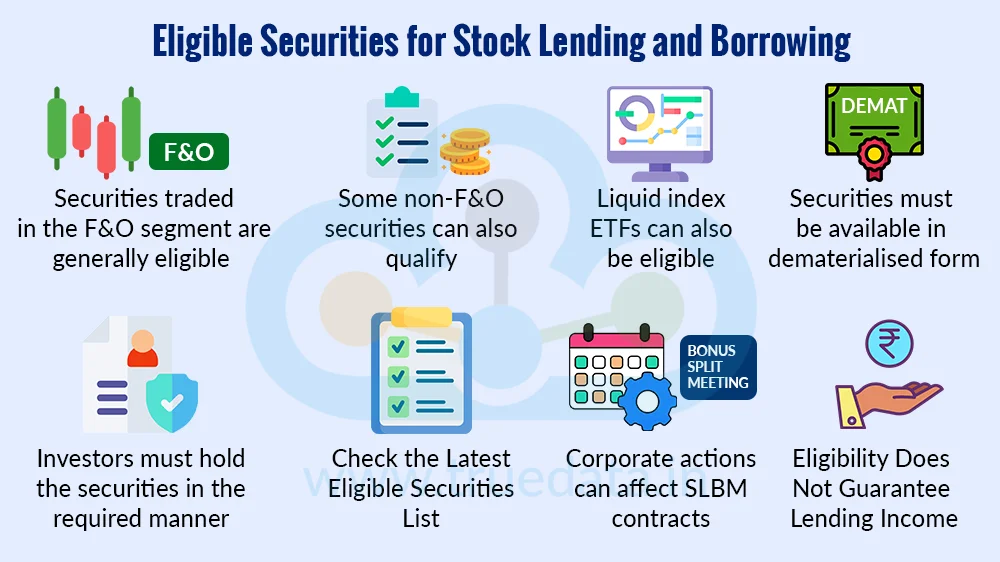
Not every stock listed on an Indian stock exchange can be lent or borrowed through the Stock Lending and Borrowing Mechanism (SLBM). SEBI has laid down eligibility criteria, while exchanges and clearing corporations maintain the operational list of securities that can currently participate in SLBM. The key points are,

Securities traded in the F&O segment are generally eligible - Under SEBI's framework, securities on which derivatives contracts are available are eligible for SLBM. On NSE, securities currently available for trading in the F&O segment are permitted for securities lending and borrowing. Thus, if a stock is part of the eligible F&O universe, it can generally be available for SLBM, subject to the current exchange list and applicable rules.
Some non-F&O securities can also qualify - SLBM eligibility is not limited only to F&O stocks. SEBI's framework also allows certain other securities to qualify if they meet specified conditions. These include,
The security must be classified as a Group I security under the applicable SEBI classification.
Its Market Wide Position Limit (MWPL) must be at least Rs. 100 crore.
Its average monthly trading turnover in the cash market must be at least Rs. 100 crore during the previous six months.
These conditions are intended to ensure that securities included in the SLBM framework have adequate market activity and liquidity.
Liquid index ETFs can also be eligible - SEBI's framework also provides for liquid index Exchange Traded Funds (ETFs) to be eligible for lending and borrowing. An index ETF is considered liquid when it has traded on at least 80% of the trading days during the previous six months and its impact cost during that period is not more than 1%. This means that certain ETFs can also participate in SLBM when they satisfy the prescribed liquidity conditions.
Securities must be available in dematerialised form - SLBM transactions are carried out in dematerialised form. NSE's current SLBM rules specifically state that securities lending and borrowing are permitted only in dematerialised form. Therefore, an investor cannot use physical share certificates for an SLBM transaction. The eligible securities must be held in the required demat form.
Investors must hold the securities in the required manner - Under SEBI's Securities Lending Scheme, the lender can deposit securities that are registered in the lender's name or in the name of a person duly authorised on the lender's behalf with the approved intermediary. For a retail investor, this essentially means that the securities intended for lending need to be available in the investor's demat holdings and meet the applicable SLBM requirements.
Check the Latest Eligible Securities List - SLBM eligibility can change as exchanges periodically review the securities available for lending and borrowing. Investors should therefore check the latest SLBM/SLB list published by the relevant stock exchange or clearing corporation before lending their shares. For instance, NSE publishes the securities currently available under its SLBM segment, helping investors confirm whether a particular security is eligible at the time of lending.
Corporate actions can affect SLBM contracts - A stock being eligible for SLBM does not mean that every contract involving that stock will continue normally when a corporate action takes place. NSE states that securities undergoing corporate actions can be subject to foreclosure or adjustment, depending on the type of corporate action. For example, events such as a bonus issue, stock split or certain shareholder meetings may require the existing SLBM contract to be adjusted or handled according to the applicable rules.
Eligibility Does Not Guarantee Lending Income - Being eligible for SLBM does not guarantee that an investor will find a borrower or earn attractive lending fees. The actual opportunity depends on the demand for borrowing a particular security and the lending fee offered in the market. Therefore, investors should consider both the stock's SLBM eligibility and the prevailing borrowing demand before deciding to lend their shares.
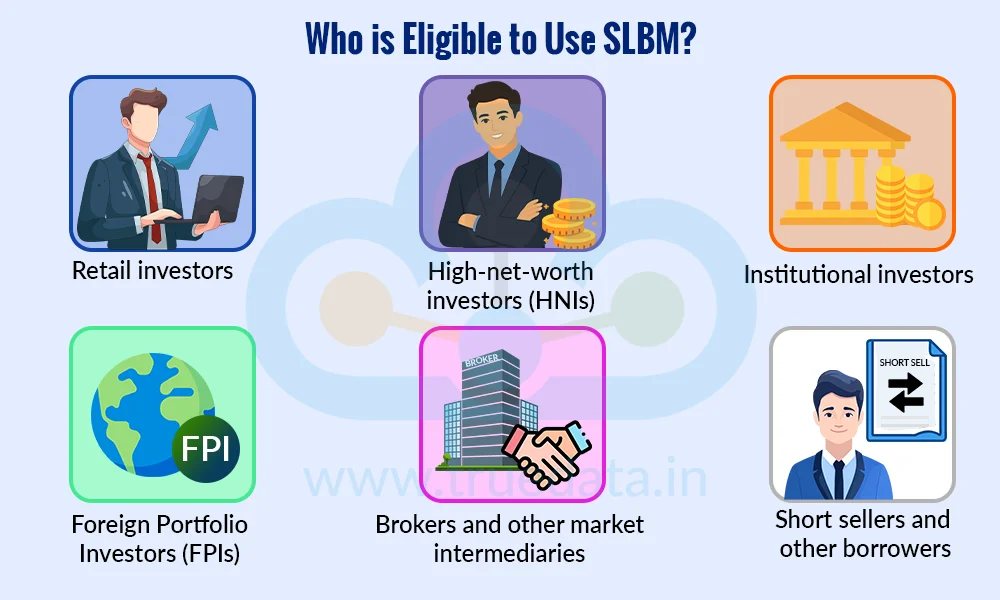
The Stock Lending and Borrowing Mechanism (SLBM) can be used by different types of market participants, subject to the applicable SEBI, exchange and intermediary requirements.

Retail investors - Individual investors who hold eligible securities in their Demat accounts can participate as lenders and, where permitted, as borrowers through an eligible broker or intermediary.
High-net-worth investors (HNIs) - HNIs can lend eligible shares they hold and potentially earn lending fees. They can also participate as borrowers, subject to the applicable requirements.
Institutional investors - Institutions such as mutual funds and other eligible institutional participants can use SLBM, subject to specific regulatory requirements and limits applicable to them.
Foreign Portfolio Investors (FPIs) - Eligible FPIs can participate in securities lending and borrowing, subject to SEBI regulations and the applicable requirements for foreign investors.
Brokers and other market intermediaries - Brokers and other authorised intermediaries facilitate SLBM transactions by providing investors with access to the lending and borrowing platform and handling the required settlement processes.
Short sellers and other borrowers - Market participants who need particular securities temporarily can borrow them through SLBM for permitted purposes, including meeting delivery obligations arising from permitted short-selling transactions.
The advantages and risks of SLBM are highlighted below.

The Stock Lending and Borrowing Mechanism (SLBM) provides investors with another way to potentially earn income from eligible shares without selling them. By lending shares for a specified period, investors can earn lending fees while the mechanism also helps improve the availability of securities in the market. However, investors should understand the applicable rules, lending demand, fees, risks and contract terms before participating in SLBM.
This article talks about the important stock lending mechanism of SEBI and how it can be used by investors. Let us know your thoughts on this topic or if you need further information, and we will address it soon.
Till then, Happy Reading!
Have you ever noticed that a company’s share price suddenly drops while th...
NSE Stock Prices in Excel in Real Time - Microsoft Excel is a super software cap...
Dividends are one of the ways companies reward shareholders by sharing a portion...