The Indian stock market is set to witness one of its biggest structural changes in recent years. SEBI has introduced the Closing Auction Session (CAS), coming into effect from 3rd August 2026, to make price discovery more transparent, efficient, and aligned with global market practices. This new mechanism is expected to play an important role in determining the closing price of stocks and could influence how traders plan and execute their strategies at the end of each trading day. But what exactly is the Closing Auction Session, how does it work, and what does it mean for traders and investors? Get answers to these questions and more in this blog where we explore this latest development by SEBI and its nuances to help you make informed trading decisions.

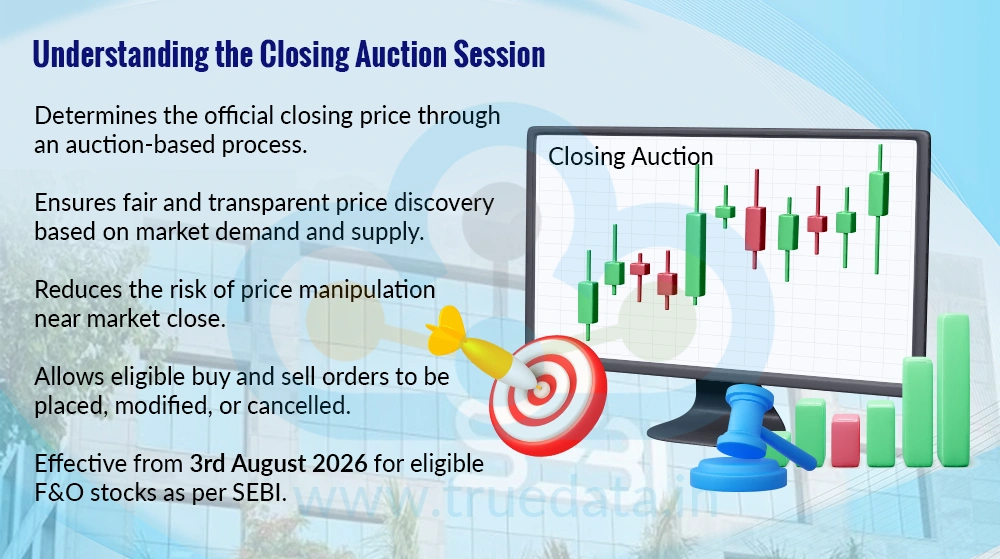
The Closing Auction Session (CAS) is a special trading session conducted at the end of the trading day to determine the official closing price of a stock through an auction-based process instead of relying only on the last traded price. During this session, traders can place, modify, or cancel eligible buy and sell orders, which are then matched based on the best available prices to arrive at a fair and transparent closing price. This method helps ensure that the closing price reflects the true demand and supply in the market, reduces the chances of price manipulation in the final minutes of trading, and provides a more reliable benchmark for investors, traders, mutual funds, and market participants. SEBI will implement this new system effective from 3rd August 2026 on eligible stocks in the F&O segment, thereby replacing the existing closing price discovery methodology for such stocks. This move by SEBI is aimed at aligning the Indian stock market with global best practices and improving the efficiency and integrity of price discovery at market close.

Before the introduction of the Closing Auction Session (CAS), the closing price of most stocks in India was determined using the Volume Weighted Average Price (VWAP) of trades executed during the last 30 minutes of the regular trading session (3:00 PM to 3:30 PM). While this method was more stable than using the last traded price alone, it still depended only on trades that had already taken place and did not consider the actual buy and sell orders waiting in the market at the close. As a result, the closing price could sometimes be influenced by large trades or unusual activity during the final minutes of trading.
To address these concerns, SEBI has introduced the Closing Auction Session (CAS), effective from 3rd August 2026. Under the new system, the closing price is determined through an auction in which eligible buy and sell orders are collected and matched to arrive at a single equilibrium price that best reflects market demand and supply. This change is expected to make the closing price more transparent, efficient, and in line with global market practices. The key reasons behind this change are explained below.
To Ensure Fairer Price Discovery - Under the earlier VWAP mechanism, the closing price depended only on trades executed during the last 30 minutes of trading. With CAS, the closing price is determined by matching buy and sell orders through an auction, allowing it to better reflect the true market value of a stock at the end of the trading day.
To Reduce the Risk of Price Manipulation - Although the VWAP method reduced the impact of a single last-minute trade, it was still possible for large or aggressive trades during the final 30 minutes to influence the closing price. The auction-based mechanism makes such manipulation much more difficult because the closing price is based on the collective demand and supply from all eligible orders.
To Better Reflect Actual Market Demand and Supply - The earlier mechanism considered only completed trades and ignored the pending buy and sell interest in the market. CAS takes into account all eligible orders placed during the auction session and determines a price at which the maximum number of shares can be traded, leading to more accurate price discovery.
To Improve Market Transparency - The auction process follows predefined and transparent rules for order matching and price determination. This gives traders greater confidence that the official closing price has been determined fairly and without undue influence.
To Align Indian Markets with Global Standards - Many leading global stock exchanges, including those in the United States, Europe, and several Asian markets, already use closing auctions to determine official closing prices. By introducing CAS, SEBI is bringing the Indian equity market in line with internationally accepted practices.
To Improve Benchmark Prices for Investors - The closing price is widely used by mutual funds, ETFs, index providers, institutional investors, portfolio managers, and benchmark indices for valuation and performance measurement, while also reducing tracking error for index funds and ETFs. A more accurate closing price results in fairer portfolio valuations and more reliable benchmark calculations.
To Improve Execution Efficiency at Market Close - Instead of matching orders one by one during continuous trading, the auction matches all eligible orders simultaneously at a single equilibrium price. This enables efficient order execution and often results in higher trading volumes being executed at the market close.
To Build Greater Confidence Among Market Participants - A transparent and auction-based closing price strengthens confidence in the fairness of the market. Traders and investors can make decisions knowing that the official closing price is determined through a robust mechanism that reflects genuine market participation rather than short-term trading activity.

SEBI has introduced several important changes to the way the Indian stock market determines the closing price of eligible stocks. Effective 3rd August 2026, the Closing Auction Session (CAS) replaces the earlier Volume Weighted Average Price (VWAP)-based closing price mechanism for stocks that are part of the Futures & Options (F&O) segment. Instead of calculating the closing price using trades executed during the last 30 minutes of trading, the new system determines it through a transparent auction where buy and sell orders are matched at a single equilibrium price. This change is aimed at improving price discovery, reducing the possibility of manipulation, and bringing Indian markets in line with global standards.
The key changes under the Closing Auction Session and their impact are explained below.
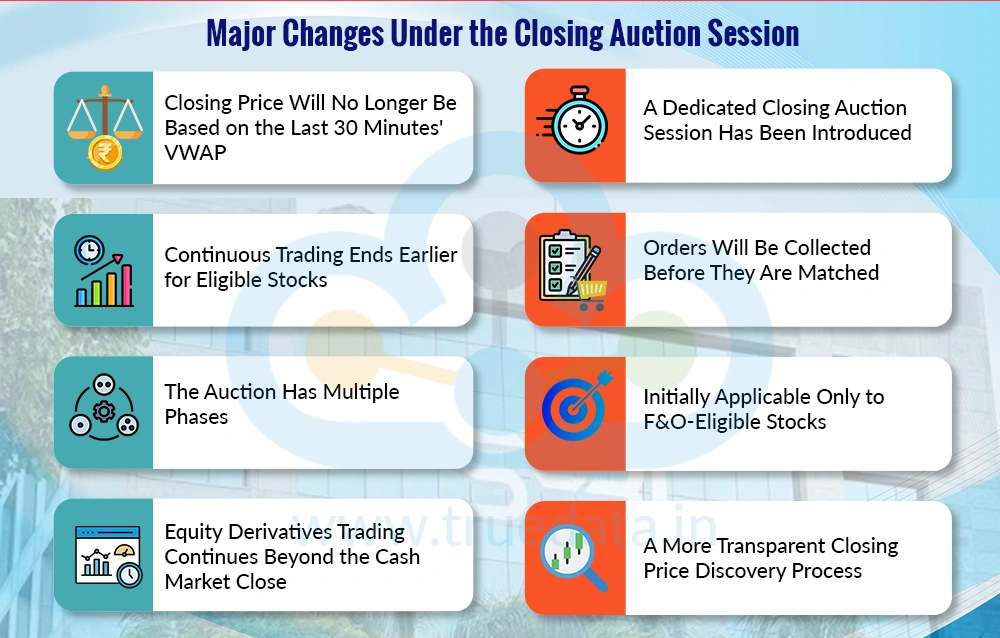
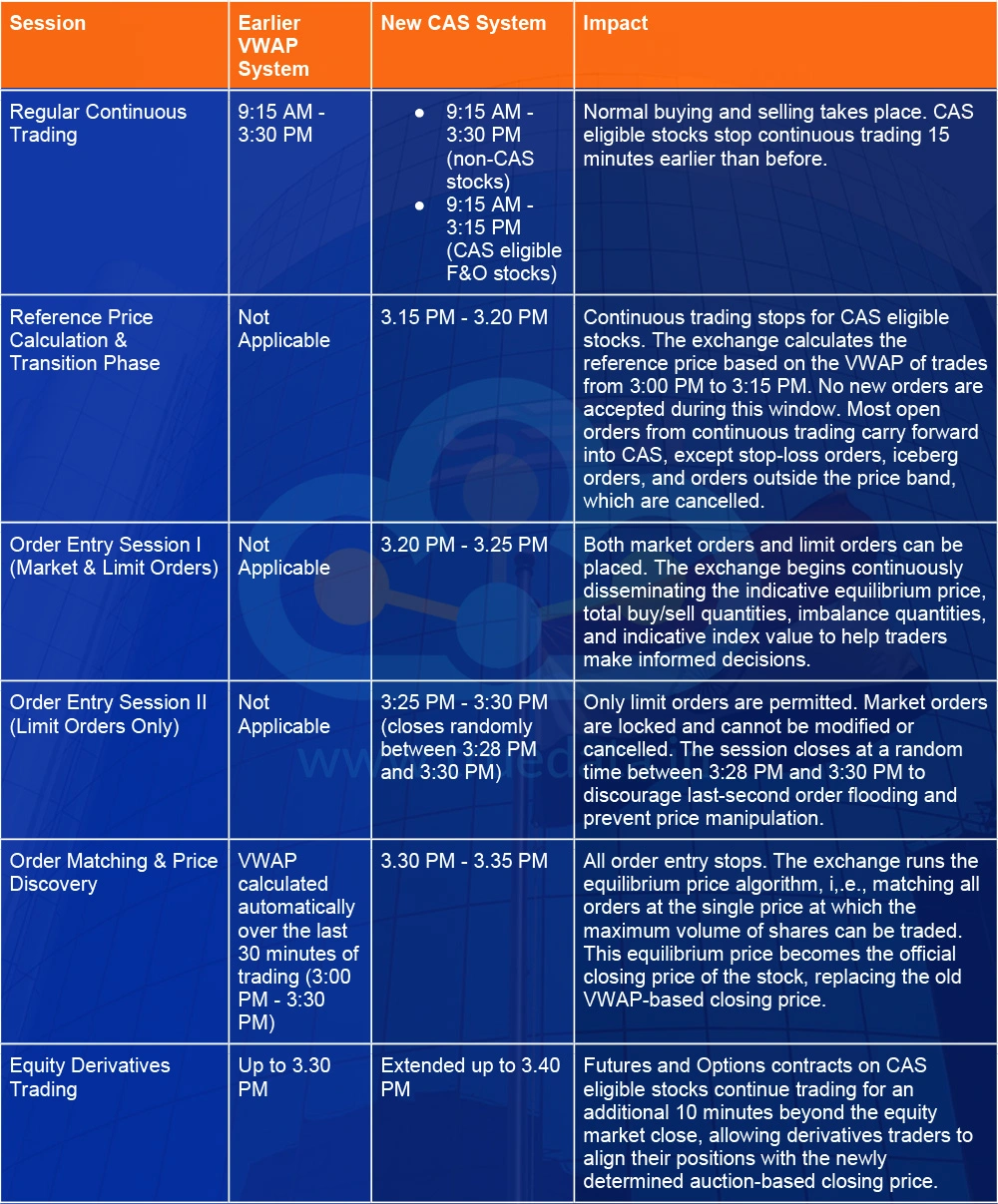
Closing Price Will No Longer Be Based on the Last 30 Minutes' VWAP - Until now, the official closing price of F&O-eligible stocks was calculated using the Volume Weighted Average Price (VWAP) of all trades executed between 3:00 PM and 3:30 PM. Under the new framework, this method has been replaced by an auction-based mechanism. The closing price will now be the equilibrium price, which is the single price at which the maximum number of buy and sell orders can be matched during the Closing Auction Session. This provides a more accurate representation of the market's actual demand and supply.
A Dedicated Closing Auction Session Has Been Introduced - SEBI has created a separate 20-minute Closing Auction Session immediately after continuous trading ends. During this period, orders are collected first and executed only after the auction concludes. Unlike continuous trading, orders are not matched instantly when they are placed. This allows the exchange to determine one fair closing price for all participants.
Continuous Trading Ends Earlier for Eligible Stocks - For stocks covered under CAS, regular continuous trading will now end at 3:15 PM instead of 3:30 PM. The period from 3:15 PM onwards is reserved for the auction process. This means traders who wish to place normal intraday orders in eligible stocks must do so before the auction begins.
Orders Will Be Collected Before They Are Matched - During the Closing Auction Session, the exchange first collects eligible buy and sell orders. Once the order collection period ends, all orders are matched simultaneously at the equilibrium price, which is the single price at which the maximum quantity of shares can be traded. This equilibrium price becomes the official closing price of the stock. This differs from continuous trading, where orders are executed immediately whenever matching prices are available. As a result, the closing price better reflects overall market participation rather than individual trades.
The Auction Has Multiple Phases - The Closing Auction Session is divided into different phases, including a transition period, order entry period, limit-order-only window, random order closure, and order matching phase. This structured approach ensures orderly price discovery while reducing the possibility of last-second order placement influencing the closing price.
Initially Applicable Only to F&O-Eligible Stocks - The new auction mechanism will initially apply only to stocks that have active Futures & Options contracts. Stocks that are not part of the F&O segment will continue to follow the existing VWAP-based closing price mechanism until SEBI decides to expand the framework further.
Equity Derivatives Trading Continues Beyond the Cash Market Close - Although regular trading in eligible cash market stocks ends at 3:15 PM, the equity derivatives segment continues to trade until approximately 3:40 PM. This allows the final auction-based closing prices to be reflected in derivatives settlement and pricing.
A More Transparent Closing Price Discovery Process - Under the earlier system, the closing price depended only on trades that had already taken place during the final 30 minutes. The new mechanism considers the entire order book during the auction and determines the price at which the maximum quantity can be traded. This makes the closing price more transparent, reliable, and resistant to manipulation.
Changes in Market Timings Under the Closing Auction Session

Important Points to Note -
Price Band in CAS - The price band during the CAS session is +/- 3% of the reference price calculated during the transition phase. Thus, orders placed outside this range will not be accepted during the auction window.
Intraday Auto Square-Off Timings (Effective August 3, 2026) - For intraday MIS positions, auto square-off timings change as follows,
Equity stocks not under CAS at 3:25 PM
Equity stocks under CAS at 3:10 PM
Equity and Index Derivatives at 3:25 PM.
Traders must factor this in to avoid unexpected square-offs.

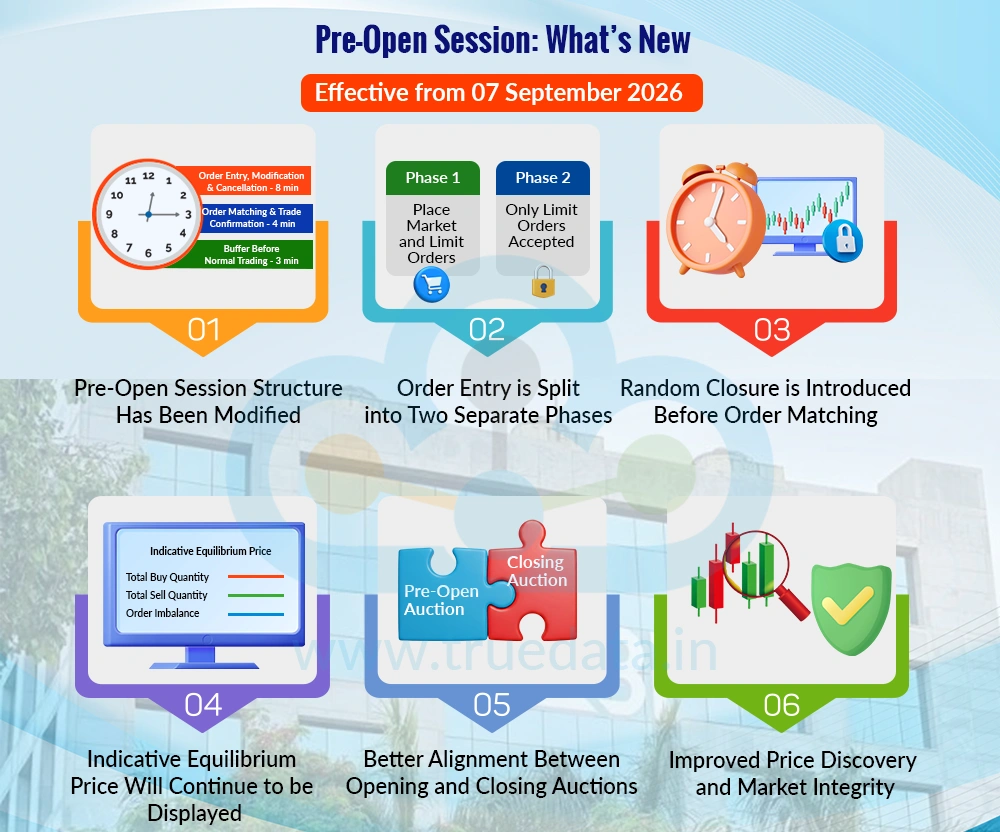
Along with introducing the Closing Auction Session (CAS), SEBI has also made a few important changes to the Pre-Open Auction Session. These changes are designed to make the opening and closing auction mechanisms more consistent, improve price discovery, and reduce the possibility of price manipulation. The pre-open session will continue to determine the opening price of stocks, but its structure and order handling will be better aligned with the newly introduced Closing Auction Session. The changes in the pre-open session will be implemented from 7th September 2026.
Pre-Open Session Structure Has Been Modified - Earlier, the pre-open session consisted of a 15-minute window, with 8 minutes for order entry, order modification and cancellation, 4 minutes for order matching and trade confirmation, and 3 minutes as a buffer before normal trading began. Under the revised framework, SEBI has restructured the pre-open session to mirror the Closing Auction Session more closely. This creates a more uniform auction process at both the beginning and the end of the trading day, making it easier for traders to understand and participate in both sessions.
Order Entry is Split into Two Separate Phases - Instead of having a single order entry period, the revised pre-open session is now divided into two order entry phases. During the first phase, traders can place both market and limit orders. During the second phase, only limit orders are accepted, while existing market orders remain in the system but cannot be modified or cancelled. This reduces uncertainty just before price discovery and makes the auction process more orderly.
Random Closure is Introduced Before Order Matching - To discourage traders from placing large orders at the very last second, SEBI has introduced a random closure mechanism during the second order entry phase. Instead of ending at a fixed time, the order entry window now closes randomly within the last few minutes. This makes it much more difficult for participants to influence the opening price through last-moment order placement.
Indicative Equilibrium Price Will Continue to be Displayed - During the order entry period, the exchanges will continue to display important auction information, including,
Indicative equilibrium price
Total buy quantity
Total sell quantity
This helps traders understand the likely opening price and adjust their orders before the auction closes.S
Better Alignment Between Opening and Closing Auctions - One of SEBI's key objectives is to make the opening auction and the closing auction follow similar operating principles. Both sessions will now have the following,
A structured order collection process.
Separate phases for different order types.
Random closure before matching.
Auction-based price discovery.
A single equilibrium price where the maximum quantity of shares can be traded.
This creates greater consistency in how prices are discovered at the beginning and end of the trading day.
Improved Price Discovery and Market Integrity - By making the pre-open auction more structured, SEBI aims to ensure that the opening price reflects genuine market demand and supply rather than a few large orders placed just before the market opens. This improves transparency, enhances market integrity, and gives traders greater confidence in the opening price.
Changes in Pre-Open Session Timings
.webp)

The introduction of the Closing Auction Session (CAS) is one of the biggest changes to the Indian equity market in recent years. While the new mechanism changes how the official closing price is determined, its impact will vary for different market participants. Active traders, long-term investors, institutional investors, and derivatives traders will all need to understand the new process and adjust their strategies accordingly.
Traders Will Need to Adapt Their Trading Strategy - For F&O-eligible stocks, regular trading will now end at 3:15 PM, after which the Closing Auction Session begins. Traders who usually place orders near market close or follow end-of-day trading strategies should understand the new timings and plan their trades accordingly.
Closing Prices Will Become More Transparent and Reliable - Instead of being based on the VWAP of the last 30 minutes of trading, the closing price will now be determined through an auction that matches the maximum number of buy and sell orders. This is expected to provide a fairer and more accurate closing price that better reflects actual market demand and supply.
Reduced Chances of Price Manipulation - The auction-based mechanism makes it more difficult for a few large trades placed towards the end of the trading session to influence the closing price. This improves market transparency and increases confidence among traders and investors.
Better Execution and Price Discovery - By collecting and matching orders through an auction, the new system can improve execution quality, especially for large orders. It also helps institutional investors, index providers, ETFs, and mutual funds use a more reliable closing price for valuation and settlement purposes.
Traders Should Be Aware of the New Market Timings - Active traders, particularly intraday and derivatives traders, should familiarise themselves with the revised trading schedule, auction phases, and their broker's auto square-off timings. Understanding these changes can help them avoid unexpected order execution issues and make better trading decisions.
The introduction of the Closing Auction Session (CAS) marks an important step taken by SEBI in the evolution of India's stock market. By replacing the earlier VWAP-based closing price mechanism with an auction-based process, SEBI aims to make price discovery more transparent, fair, and in line with global market practices. While long-term investors may not experience a significant change in their investing approach, traders should understand the revised market timings, auction process, and order execution rules to adapt their strategies effectively. Thus, staying informed about such regulatory changes can help both investors and traders make better decisions and navigate the markets with greater confidence.
This article highlights the key changes introduced by SEBI and their impact on a portfolio. Let us know your thoughts on the topic or if you need further information on the same, and we will address it soon.
Till then, Happy Reading!
Read More: What is Position Trading?
NSE Stock Prices in Excel in Real Time - Microsoft Excel is a super software cap...
Introduction For the longest time, investment in stock markets was thought to b...
When it comes to trading in thetrading in stock market, understanding key terms ...