![]()
Index funds are often seen as the easiest way to invest in the stock market due to their features, such as low costs, minimal effort, and being designed to grow in line with the market. When you invest in an index fund, you expect it to follow its benchmark index closely. But what if your fund does not move exactly like the index it tracks? That small difference, known as tracking error, can quietly affect your returns over time. Thus, understanding it is the key to picking the right fund. Dive into this blog to learn all about tracking error in index funds and how they can affect the portfolio.
![]()
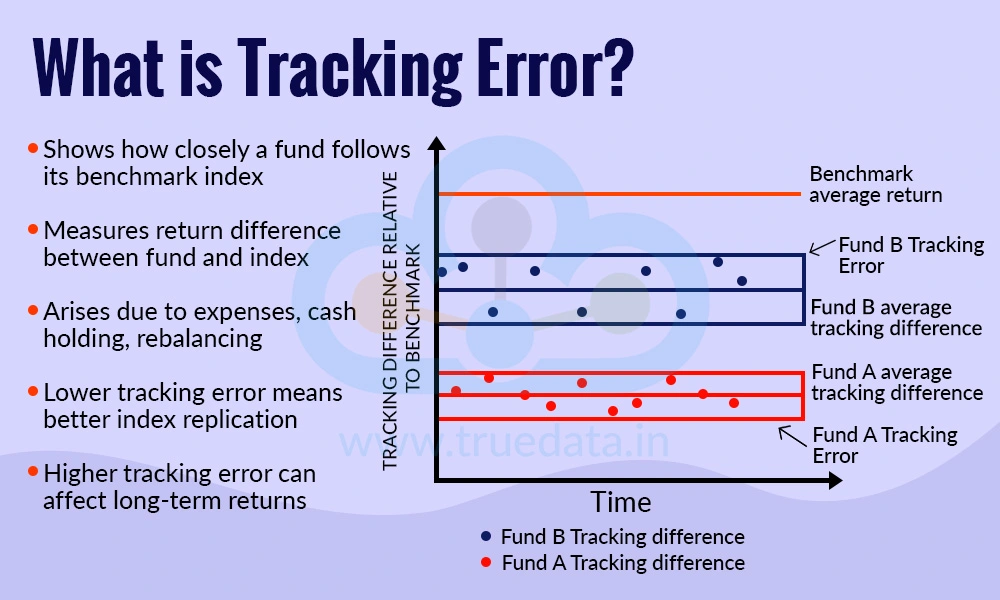
Tracking error is a measure of how closely an index fund or ETF follows the index it is supposed to track, such as the Nifty 50 or Sensex. In simple terms, it shows the difference between the returns of the fund and the returns of its benchmark index over a period of time. Ideally, an index fund should give returns very similar to the index, but in reality, small gaps always exist. These gaps arise from factors such as expense ratios, cash held by the fund, timing of stock purchases and sales, dividends, and portfolio rebalancing. Tracking error helps investors understand how efficiently a fund manager is replicating the index. A lower tracking error means the fund is doing a better job of matching the index, while a higher tracking error indicates that the fund’s performance may often deviate from the benchmark, which can impact long-term returns.
![]()
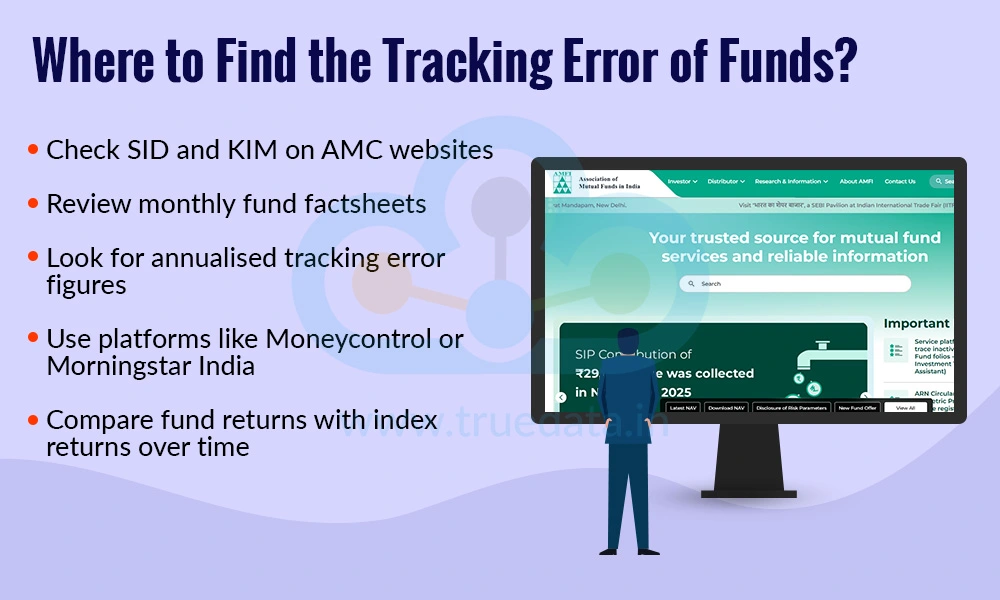
Investors can find the tracking error of index funds and ETFs from several reliable sources, though it may not always be visible at first glance. One of the most important places to check is the Scheme Information Document (SID) and Key Information Memorandum (KIM) published by the mutual fund house. As per SEBI rules, fund houses are required to disclose tracking error regularly, usually calculated over a defined period. These documents are available on the AMC’s official website and provide the most accurate and fund-specific information.
Another common source is the factsheet released by the mutual fund house, typically every month. Factsheets are designed for investors and clearly mention key details such as expense ratio, portfolio holdings, benchmark, and tracking error. Tracking error for index funds and ETFs is often shown as an annualised figure, helping investors compare how efficiently different funds track the same index. Downloading and reviewing the latest factsheet is one of the easiest ways to track this data.
Tracking error data is also available on popular financial websites and investment platforms that compile tracking error data based on publicly available disclosures and present it in a simplified format used by investors. While these platforms are convenient for quick comparisons, investors should remember that the calculation method and time period may vary slightly across platforms.
Finally, for ETFs, tracking error can sometimes be inferred by comparing the ETF’s historical returns with its benchmark index returns over time. Though this method requires a bit more effort, it helps investors understand whether the fund consistently deviates from the index. Overall, checking tracking error from official AMC documents and then cross-verifying it with trusted financial platforms can give investors a clearer and more confident view before choosing an index fund.
![]()
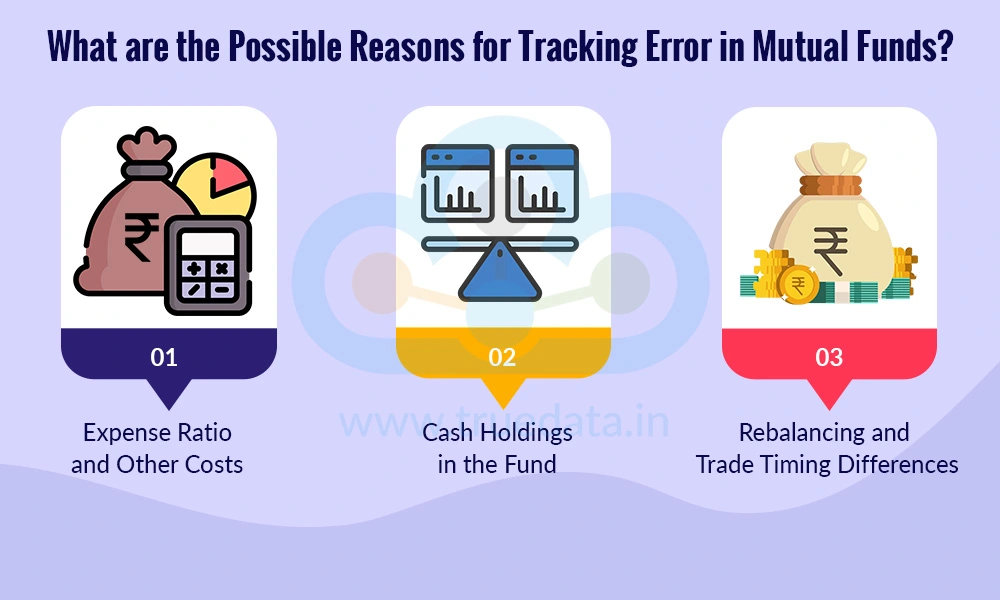
Tracking error occurs when an index fund or ETF does not perfectly match the returns of its benchmark index. This difference can happen for several practical reasons, some of which are explained hereunder.
Every mutual fund charges an expense ratio to manage the fund. Even though index funds have low costs, these expenses are still deducted from the fund’s returns, while the index itself has no such costs. Brokerage charges, transaction costs, and statutory expenses also reduce returns slightly, leading to a gap between the fund and the index.
Index funds usually keep a small portion of their money in cash to manage redemptions, dividends, or daily operations. Since this cash does not earn the same returns as the stocks in the index, it can pull down the fund’s performance, especially when markets rise sharply, causing tracking error.
When an index changes its stock weights or adds and removes companies, index funds need time to make the same changes in their portfolios. These adjustments cannot always happen instantly or at the exact prices used in the index calculation. As a result, the fund may temporarily hold stocks in slightly different proportions or buy and sell them at different prices. This gap becomes more noticeable during volatile market conditions, when prices move quickly, leading to short-term differences between the fund’s returns and the index performance and contributing to tracking error.
![]()
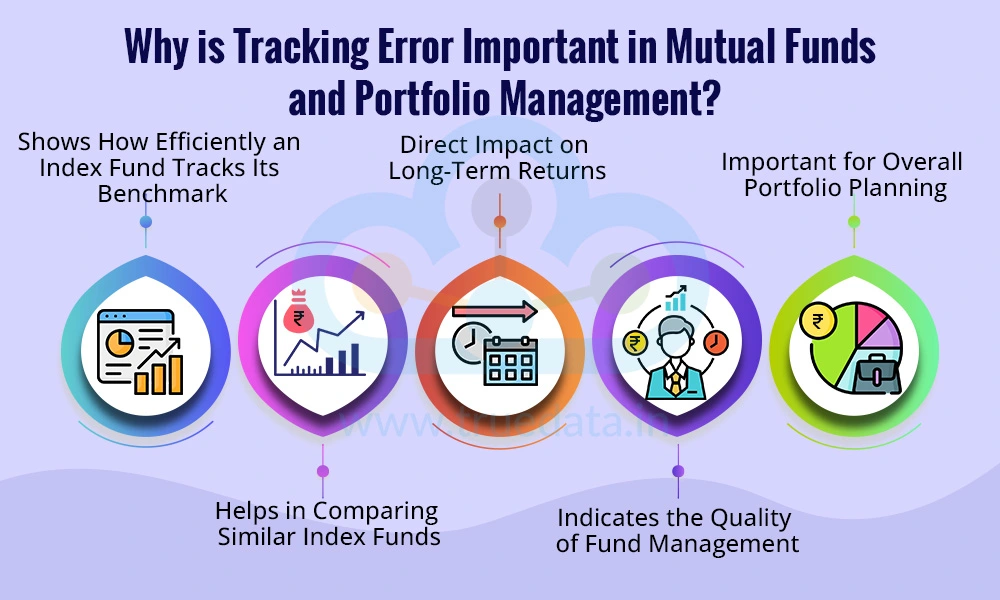
Tracking error plays a crucial role in understanding how well a mutual fund, especially an index fund or ETF, is performing its intended job. Understanding tracking errors can help in choosing better funds and managing portfolios more effectively.
The main goal of an index fund is to replicate the performance of a benchmark index like the Nifty or Sensex. Tracking error tells investors how closely the fund follows that index. A lower tracking error means the fund’s returns move very closely with the benchmark, showing efficient fund management. A consistently high tracking error suggests that the fund often deviates from the index, which may reduce the expected market-linked returns over time.
Many mutual fund houses offer index funds tracking the same benchmark. Tracking error becomes a key tool for comparison in such cases. When two funds track the same index and have similar expense ratios, the one with the lower and more stable tracking error is usually the better choice, as it delivers returns closer to the index.
Even small tracking errors may not seem important in the short term, but they can significantly affect returns over long investment periods. Since index funds are often used for long-term goals like retirement planning or wealth creation, repeated deviations from the index can result in a lower corpus value. This makes tracking error more important than one-time costs such as exit loads.
Although index funds follow a passive strategy, they still require efficient execution. Tracking error reflects how well the fund manager handles costs, cash management, rebalancing, and market liquidity. Consistently low tracking error signals strong operational efficiency and disciplined portfolio management.
In portfolio management, index funds are often used as a core holding to provide market stability and diversification. High tracking error can disturb asset allocation and risk planning because the fund may not behave as expected in line with the market. Understanding tracking error helps investors maintain better control over portfolio risk and return expectations.
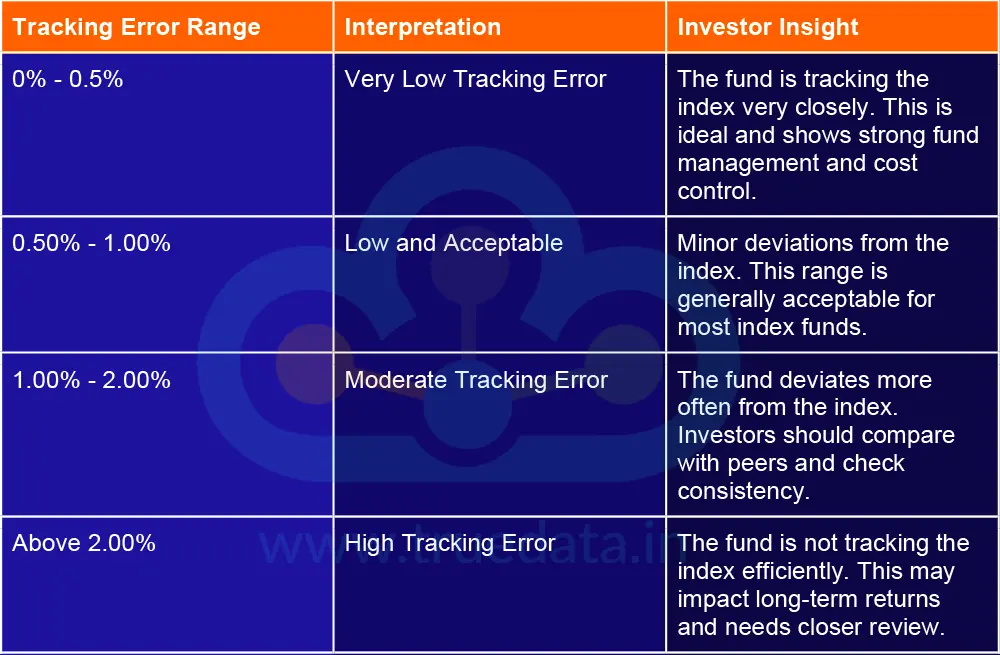
SEBI requires passive funds to disclose tracking error regularly, so investors can judge efficiency. As a thumb rule, a lower tracking error is ideal for index funds as it ensures that investors’ returns are not diluted extensively. While SEBI does not indicate or prescribe an acceptable tracking error range, investors need to understand the broad range of tracking errors and their interpretation to choose optimum index funds and ETFs.
![]()
A lower tracking error is usually better, but consistency matters more than one-time numbers. If a fund stays within a low or acceptable range year after year, it is generally doing a good job. Investors using index funds as long-term core holdings should choose funds with consistently low tracking error to ensure returns stay close to the market performance.
![]()
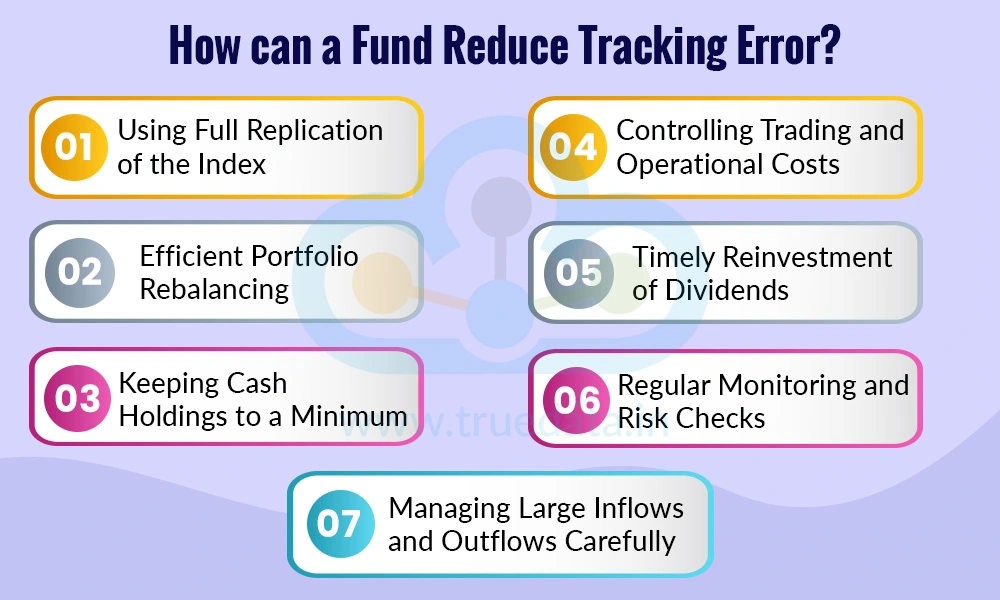
Mutual fund houses also take several internal steps to ensure that their index funds and ETFs track the benchmark as closely as possible. Here are a few key steps adopted by fund managers to ensure minimal tracking errors and thereby higher returns for investors.
Using Full Replication of the Index - Fund managers try to hold all the stocks in the index in the same weight as the benchmark. This full replication approach reduces differences between the fund and the index, especially for popular and liquid indices like the Nifty 50.
Efficient Portfolio Rebalancing - When the index changes its composition, fund managers aim to rebalance the portfolio quickly and carefully. By adjusting stock weights in a timely manner and spreading trades smartly, they reduce return differences caused by delayed or rushed transactions.
Keeping Cash Holdings to a Minimum - Holding excess cash can lower returns when markets rise. Fund managers try to maintain lower cash balances by investing inflows promptly and managing redemptions efficiently, which helps the fund stay closely aligned with the index.
Controlling Trading and Operational Costs - Lower brokerage, taxes, and transaction costs directly help reduce tracking error. Fund managers use cost-efficient trading strategies and optimise execution to minimise unnecessary expenses.
Timely Reinvestment of Dividends - Dividends received from index stocks are reinvested as quickly as possible. Faster reinvestment helps reduce the return gap caused by dividend timing differences between the fund and the index.
Managing Large Inflows and Outflows Carefully - Sudden investor inflows or withdrawals can force hurried buying or selling of stocks. Fund managers plan trades in a staggered and efficient manner to avoid price impact and reduce deviations from index performance.
Regular Monitoring and Risk Checks - Fund managers continuously monitor tracking error and portfolio alignment with the benchmark. If deviations increase, corrective actions are taken quickly to bring the fund back in line with the index.
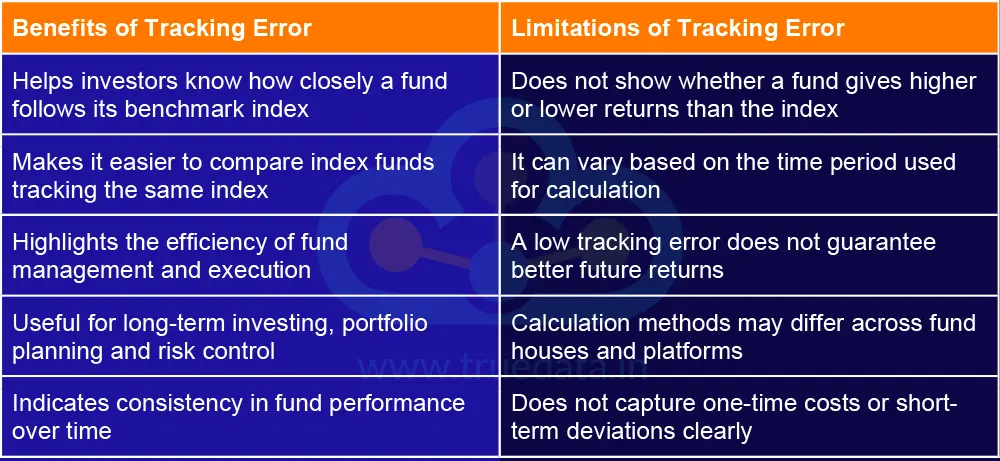
The study of tracking errors is incomplete without an understanding of its benefits and limitations. These benefits and limitations are tabled below.
![]()
Tracking error is one of the most important yet often overlooked factors when investing in index funds. While index funds are designed to mirror market indices like the Nifty or Sensex, small differences in returns are not absolutely avoidable. Over the long term, even minor tracking errors can impact wealth creation, making it essential for investors to monitor them regularly. Choosing index funds with consistently low tracking error, understanding their causes, and reviewing fund performance periodically can help ensure that returns stay as close as possible to the benchmark.
This article simplifies the concept of tracking error in index funds and its finer nuances to help understand index funds and their performance in a better light. Let us know your thoughts on the topic or if you need further information on the same and we will address it soon.
Till then, Happy Reading!
Read More: Money Market Funds and How to Invest Them
Mutual fund investments have simplified greatly with just a tap on your smartpho...
Introduction For the longest time, investment in stock markets was thought to b...
Every investor knows that the stepping stones to a good investment in thestock m...