Stock trading is a fine art that requires a deep understanding of market movements. But that means staring at the chart all day long, which can be a luxury not many traders may have. Some traders may prefer to bank on long-term trends and stay patient to let their investment grow. This is where position trading comes into the picture, where traders can make informed decisions based on market trends and economic developments. Check out this blog to understand the basics of position trading and key strategies for position traders and refine your trading journey.

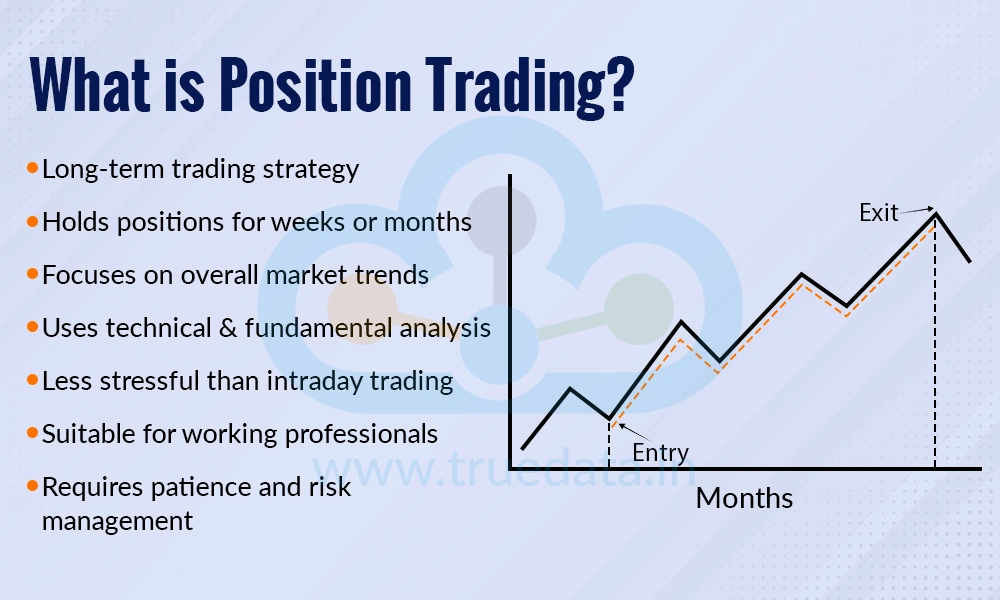
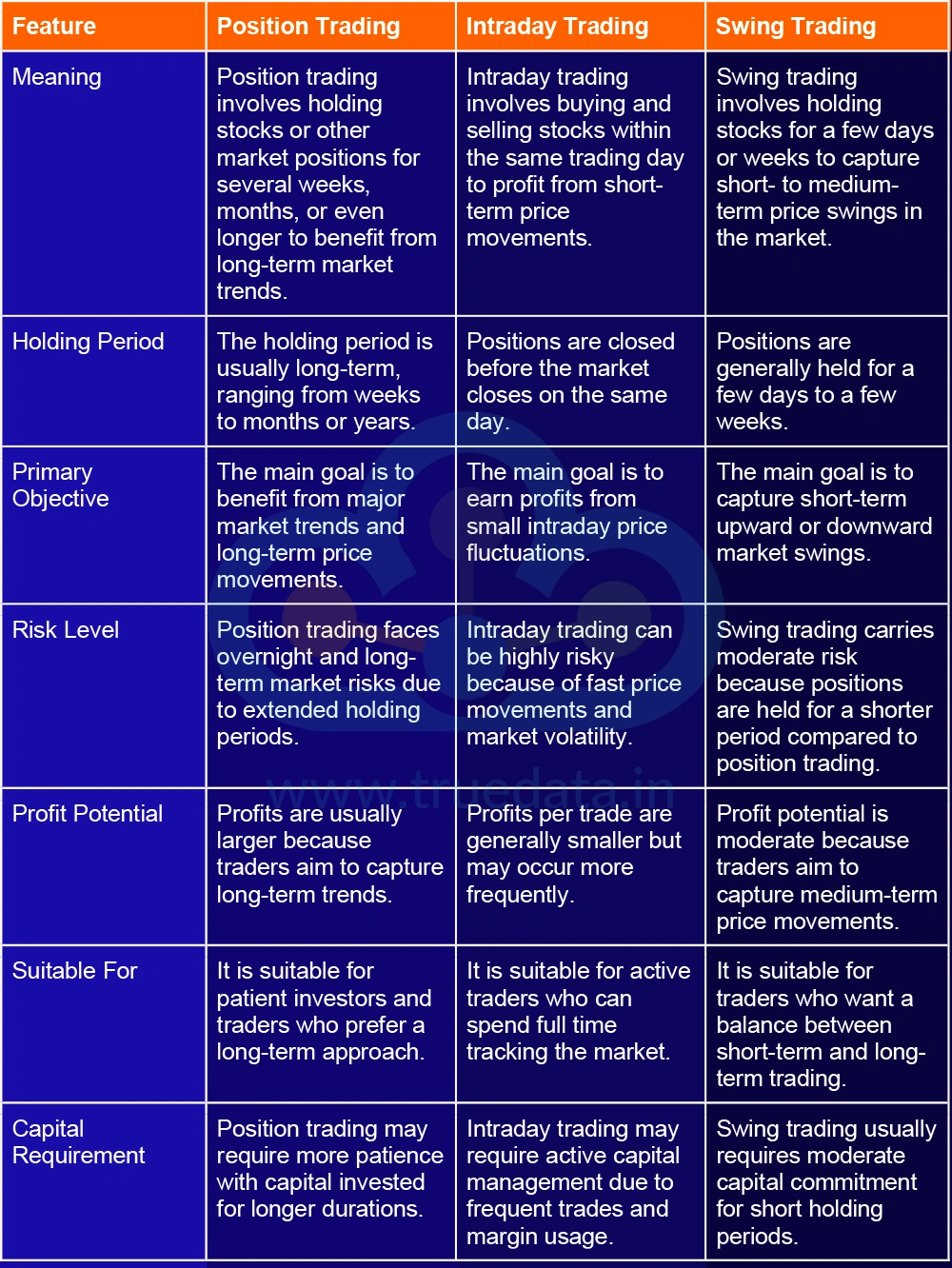
Position trading is a trading style where traders buy and hold stocks, indices, commodities, or other market instruments for a longer period, usually ranging from a few weeks to several months or even years, to benefit from larger price movements. Unlike intraday trading, where positions are opened and closed on the same day, position traders focus more on the overall market trend rather than short-term price fluctuations. They analyse factors such as company performance, industry growth, economic conditions, interest rates, government policies, and market sentiment before taking a position. Position traders generally use a mix of fundamental analysis and technical analysis to identify good entry and exit points. This trading style is suitable for people who cannot track the market throughout the day and prefer a more patient and disciplined approach to trading. However, since positions are carried for longer periods, traders must also be prepared for temporary market volatility and manage risks carefully.

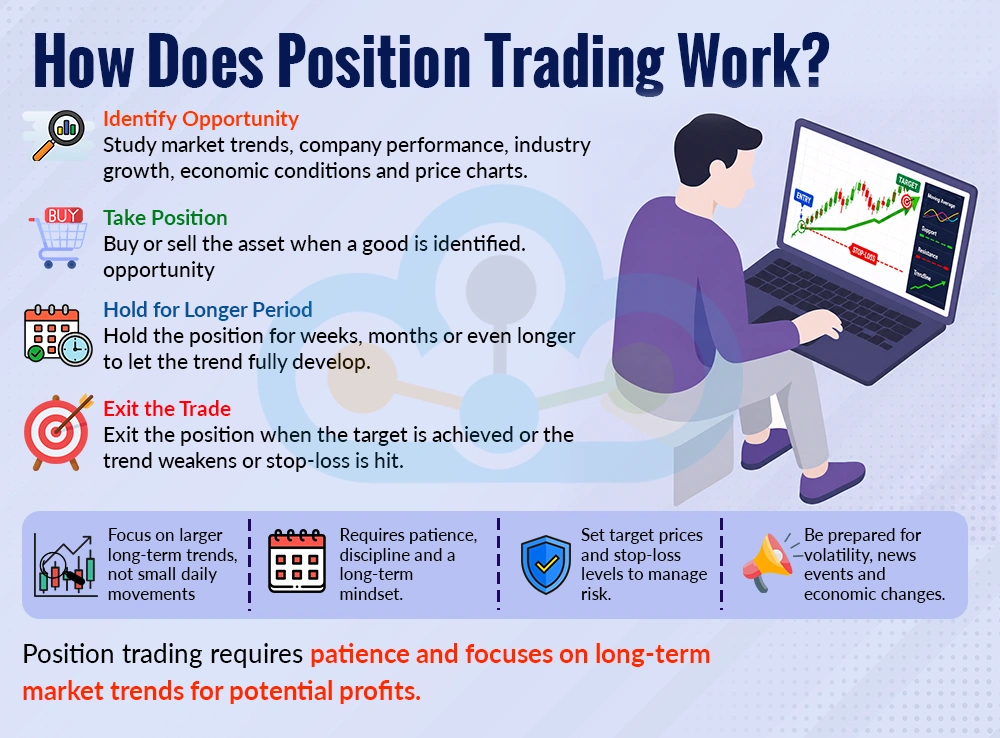
Position trading requires patience and discipline because profitable trends may take time to fully develop. Position trading starts by identifying stocks or other market instruments that are expected to move strongly in one direction over a longer period of time. Traders study market trends, company performance, industry growth, economic conditions, and price charts before taking a position. Once a good opportunity is identified, the trader buys or sells the asset and holds the position for several weeks, months, or sometimes even longer.
Technical analysis tools such as support, resistance, moving averages, and trendlines are often used to decide entry and exit points. Fundamental analysis is also important because strong company earnings, business growth, and economic developments can influence long-term price movement. Position traders do not focus on small daily price movements and instead aim to benefit from larger long-term trends in the market. Traders usually set target prices and stop-loss levels to manage profits and limit possible losses during market fluctuations. However, it is important to note that since positions are carried overnight and for longer durations, position traders must be prepared for market volatility, news events, and sudden economic changes.

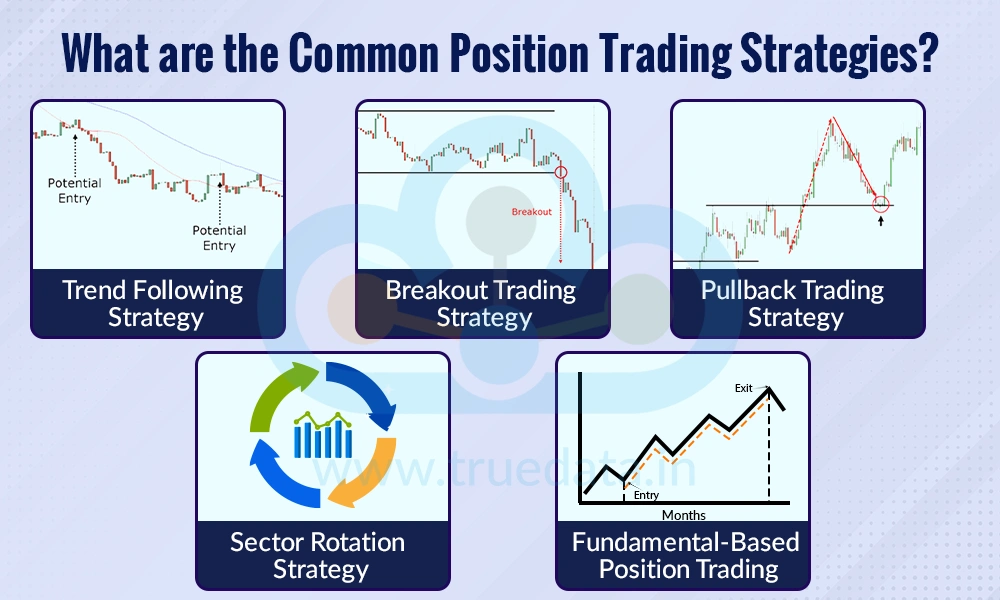
Position trading is all about having a long-term view of the market. The key position trading strategies often used by traders are explained below.
Trend following is one of the most common position trading strategies. In this approach, traders identify stocks or market sectors that are moving consistently upward or downward over a long period of time. The main idea is to trade in the direction of the existing market trend instead of going against it. Traders usually use tools such as moving averages, trendlines, and price patterns to confirm whether the trend is strong enough. For example, if a stock continues making higher highs and higher lows along with strong business performance, a position trader may hold it for several weeks or months to benefit from the long-term upward movement. This strategy works well during strong bull or bear markets but may become difficult during highly volatile or sideways markets.
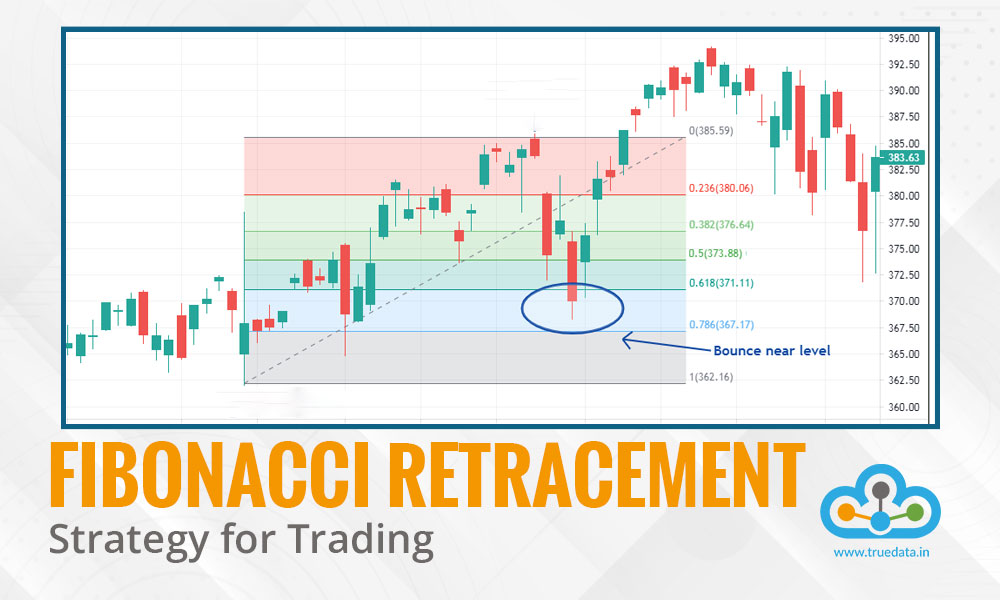
In pullback trading, traders enter a stock after a temporary price decline within an overall upward trend. Instead of buying a stock after a sharp rally, position traders wait for short-term corrections or dips to get a better entry price. The belief behind this strategy is that strong stocks often pause or decline slightly before continuing their long-term trend. Traders use support levels, moving averages, or technical indicators to identify possible pullback zones. This strategy helps traders reduce risk and avoid buying stocks at very high prices, but it requires patience and proper timing.
The breakout strategy focuses on stocks that move above an important resistance level or below a major support level. A breakout often signals the start of a strong price movement because it shows that buyers or sellers are gaining control of the market. Position traders closely watch price charts to identify such breakout points. For example, if a stock trades within a certain range for many months and then suddenly crosses its previous high with strong trading volume, traders may take a long position expecting further upside. Similarly, a breakdown below support can signal further weakness. This strategy can offer good opportunities, but false breakouts are also common, which is why stop-loss levels are important.
Sector rotation is a strategy where traders shift their investments between different sectors based on economic and market conditions. Certain sectors perform better during specific phases of the economy. For example, banking, infrastructure, and automobile stocks may perform well during economic expansion, while sectors such as FMCG or pharmaceuticals may remain stable during uncertain times. Position traders analyse interest rates, inflation, government policies, and economic growth trends to identify sectors that may outperform in the coming months. By investing in strong sectors at the right time, traders aim to benefit from broader market trends instead of depending on individual stocks alone.
Some position traders rely more on fundamental analysis rather than short-term chart patterns. In this strategy, traders select companies with strong financial performance, good management, growing profits, competitive advantages, and positive future growth potential. They hold these positions for longer periods with the expectation that the stock price will rise as the company grows. Economic trends, government policies, industry demand, and business expansion plans are also considered while making decisions. This strategy is suitable for traders who prefer a more research-based and long-term approach instead of frequent trading activity.

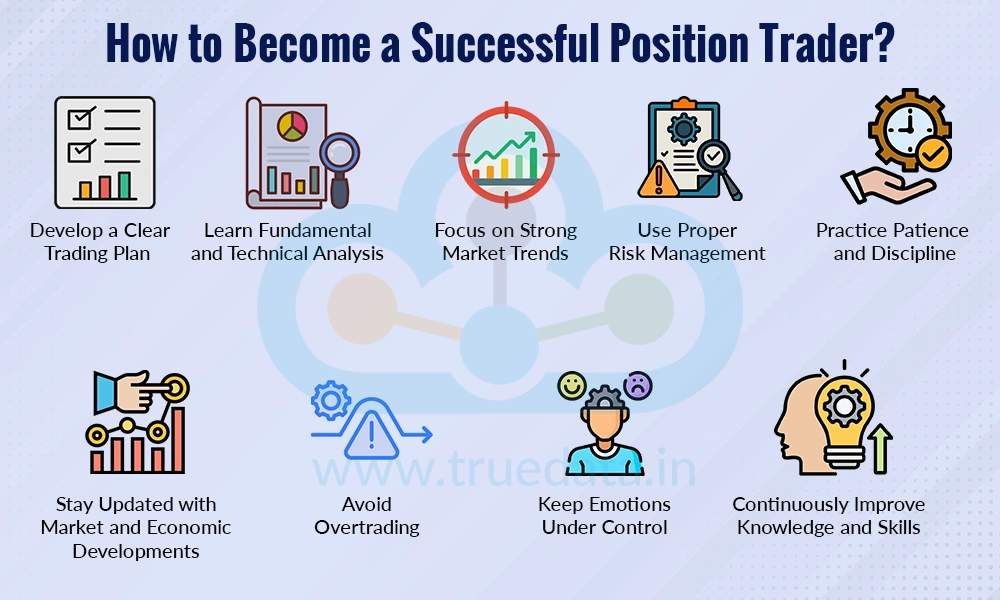
The key to successful trading is understanding the market fundamentals and having a clear strategic plan that is not triggered by emotions. These are the ground rules that work for position trading as well. A few more tips that can help position traders create a successful portfolio are highlighted below.
Develop a Clear Trading Plan - A successful position trader should always have a proper trading plan before entering the market. The plan should include investment goals, risk tolerance, entry and exit strategies, and the amount of capital to be invested. Having a clear plan helps traders avoid emotional decisions during market fluctuations and maintain discipline in the long run.
Learn Fundamental and Technical Analysis - Successful position traders usually combine both fundamental analysis and technical analysis. Fundamental analysis helps traders understand the financial health, business performance, and future growth potential of a company. Technical analysis helps identify the right entry and exit points using charts, trends, support and resistance levels, and indicators. Using both methods together can improve decision-making.
Focus on Strong Market Trends - Position trading works best when traders identify and follow strong market trends. Instead of reacting to small daily price movements, traders should focus on the broader direction of the market and select stocks that show long-term growth potential. Understanding whether the market is in a bullish, bearish, or sideways phase is very important for making better trading decisions.
Use Proper Risk Management - Risk management plays a major role in becoming a successful position trader. Traders should never invest all their capital in a single stock or sector. Setting stop-loss levels can help limit losses if the market moves in the opposite direction. Diversification across different sectors and stocks can also reduce overall portfolio risk.
Stay Updated with Market and Economic Developments - Position traders should regularly track market news, corporate announcements, interest rates, inflation trends, government policies, and global economic events. Macroeconomic and microeconomic developments can strongly affect stock prices over the long term. Staying informed helps traders make timely and well-informed decisions.
Practice Patience and Discipline - Patience is one of the most important qualities in position trading because trends take time to develop. Traders should avoid exiting positions too early due to temporary market volatility or short-term news. Discipline is equally important because traders must follow their trading strategy and avoid making impulsive decisions based on emotions such as fear or greed.
Avoid Overtrading - Successful position traders do not enter trades frequently without proper analysis. Overtrading can increase transaction costs and lead to unnecessary losses. Instead of chasing every market movement, traders should wait patiently for high-quality opportunities that match their strategy and risk profile.
Keep Emotions Under Control - Emotional decisions can negatively affect trading performance. Fear during market corrections or greed during strong rallies can lead to poor decisions. Successful traders stay calm during volatility and make decisions based on research, logic, and their trading plan rather than emotions.
Continuously Improve Knowledge and Skills - The stock market keeps changing, so continuous learning is important for long-term success. Position traders should regularly study market trends, trading strategies, company financials, and investor behaviour. Reading financial news, analysing past trades, and learning from mistakes can help traders improve their skills over time.

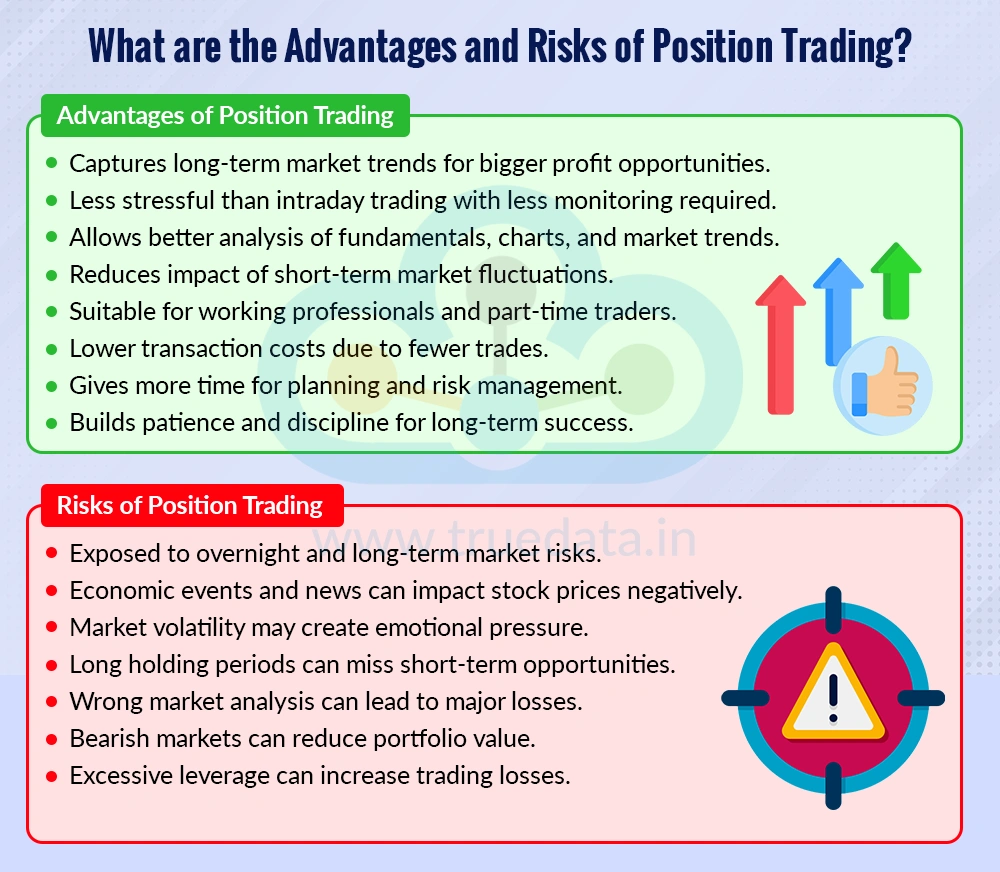
An important aspect of understanding position trading is also considering the advantages and risks of position trading. A few details of the same are given below.
Advantages of Position Trading
Position trading allows traders to benefit from larger market trends that develop over weeks, months, or even years.
It is less stressful than intraday trading because traders do not need to monitor the market constantly throughout the day.
Position traders can make more informed decisions since they get enough time to analyse company fundamentals, technical charts, and economic trends.
This trading style reduces the impact of small daily market fluctuations because the focus is on long-term price movement.
Position trading can be suitable for working professionals and part-time traders who cannot actively trade during market hours.
Transaction costs may be lower compared to frequent trading styles because position traders usually make fewer trades.
Traders get more time to plan their entry, exit, and risk management strategies carefully.
Position trading helps traders develop patience and discipline, which are important qualities for long-term market success.
Risks of Position Trading
Position traders are exposed to overnight and long-term market risks because positions are held for extended periods.
Sudden economic events, global news, government policy changes, or poor company results can negatively affect stock prices.
Temporary market volatility can create emotional pressure and may lead traders to exit positions too early.
Since capital remains invested for longer durations, traders may miss other short-term trading opportunities.
Wrong analysis of market trends or company fundamentals can result in significant losses over time.
Market corrections and bearish phases can reduce portfolio value even if the long-term outlook remains positive.
Using excessive leverage in position trading can increase losses if the market moves against the trader’s position.

Position trading can be a suitable approach for investors and traders who prefer to benefit from larger market trends instead of short-term price movements. While position trading offers the advantage of lower daily stress and the potential for larger gains, traders should also stay prepared for market volatility and economic changes. With the right knowledge and a disciplined mindset, position trading can become an effective way to build long-term trading success in the stock market.
This article sheds light on a crucial trading style and its nuances. Let us know your thoughts on the topic or if you need further information on the same and we will address it soon.
Till then, Happy Reading!
Read More: What is Market Profile?
NSE Stock Prices in Excel in Real Time - Microsoft Excel is a super software cap...
Remember the first time you tried riding a bicycle? The thrill of moving forward...
Market data is the backbone ofsuccessful trading, but not all market data is the...