Investing / Trading

What is Market Profile?

Marisha Bhatt · 02 May 2026 · 16 mins read · 0 Comments

what-is-market-profile

Have you ever wondered where most trading activity actually happens during the day? Or why prices tend to pause, reverse, or accelerate at certain levels? The answers often lie deeper than what traditional indicators can show, which often lag behind price action. This is where the market profile comes in. It offers a deeper view of price, time, and trading activity, thereby helping traders spot key levels, trends, and potential turning points with more clarity. So, what exactly is market profile, and why is it so powerful? Explore this blog to understand its meaning, how it works, and why it can be a game-changer for your trading strategy.

What is Market Profile?

What is Market Profile

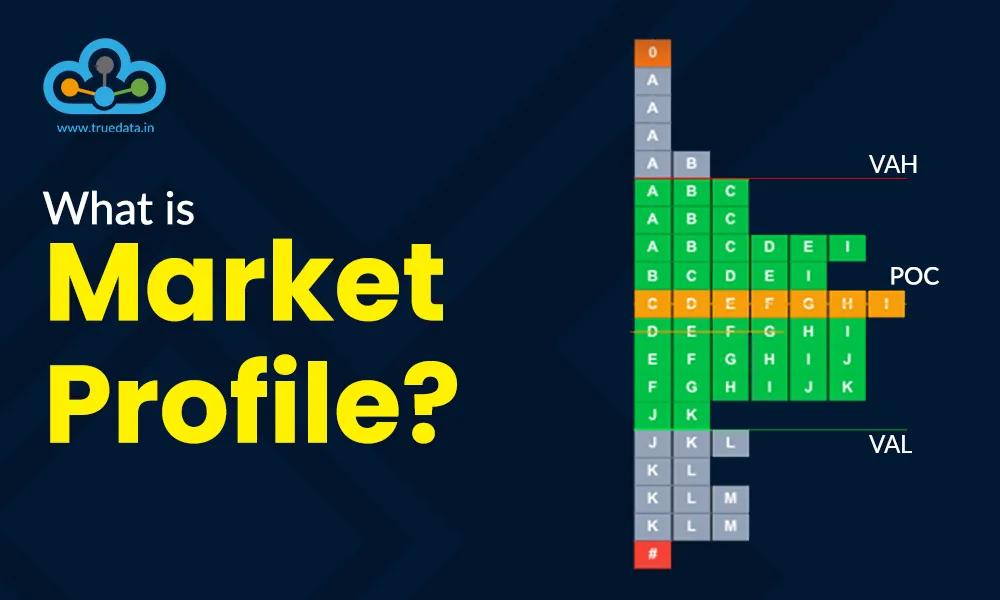
Market Profile is a trading tool that helps traders understand how the market is behaving by showing how much time the price spends at different levels. Instead of just looking at price moving up or down like in a normal chart, it organises price into a structure that highlights important areas such as where most trading happened (value area) and the most traded price (Point of Control). This helps traders identify fair price levels, support and resistance zones, and possible breakout or reversal points. Thus, market profile gives a clearer picture of where the market is comfortable and where it is not, making it easier to take better trading decisions.

The concept of Market Profile was developed in the 1980s by J. Peter Steidlmayer, a trader at the Chicago Board of Trade. He wanted to understand market behaviour beyond just price movements, focusing on how price and time interact to show value. Over time, this concept became popular among professional traders across global markets, including futures, stocks, and commodities. Today, many traders also use Market Profile to analyse indices such as Nifty and Bank Nifty, as it helps them understand market sentiment and plan trades with more confidence.

What are the Key Components of the Market Profile?

What are the Key Components of the Market Profile

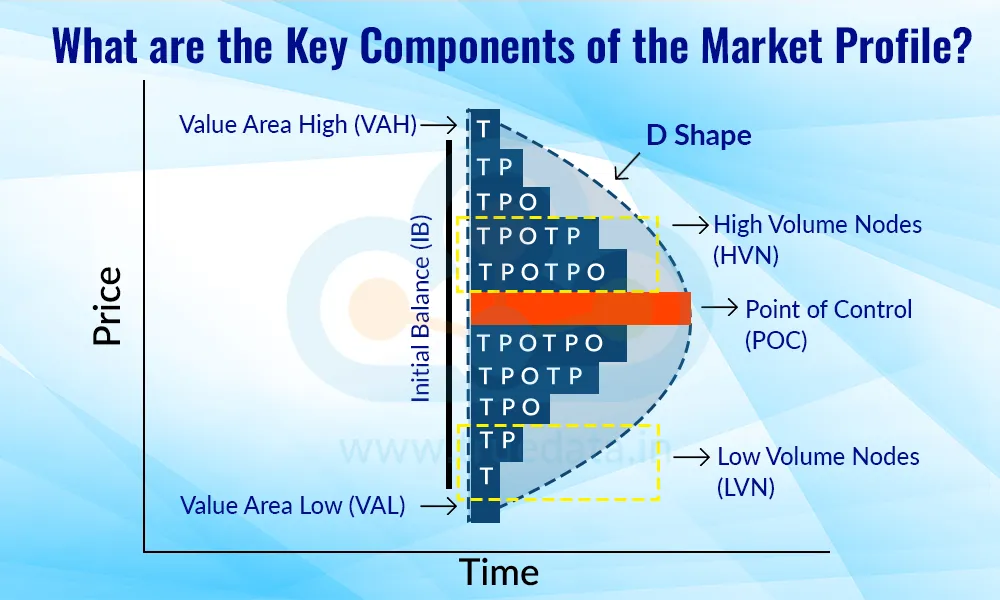
Market profile can be broken down into a few components that can help traders understand the concept in a better light and gain a deeper insight into market behaviour, rather than relying only on price charts. These components include,

Price and Time (TPO - Time Price Opportunity)

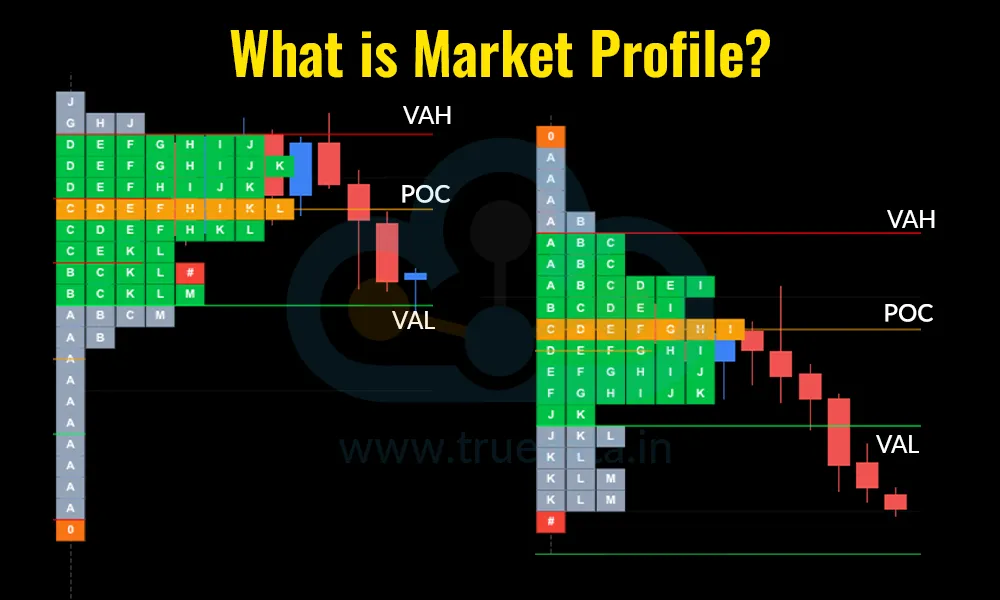
At the core of Market Profile is the concept of TPO, which stands for Time Price Opportunity. It shows how much time the market spends at different price levels during a trading session. Instead of focusing only on price movement, this component helps traders understand where the market spends more time, which often indicates acceptance of price. These are usually displayed as letters or blocks on a chart, forming a bell-shaped structure over time. This is especially useful in intraday trading of indices like Nifty or Bank Nifty, as it highlights areas where the market is stable versus where it is moving quickly. When the price spends more time at a level, it suggests that both buyers and sellers agree on that value. On the other hand, when the price moves quickly through levels, it shows an imbalance and potential trading opportunities.

Point of Control (POC)

The Point of Control (POC) is the price level where the highest trading activity has taken place during a specific period. In simple terms, it is the level where the market has spent the most time or volume. This level is considered the most important reference point in Market Profile because it represents the ‘fairest price’ for that session.  Traders often use the POC as a strong support or resistance level. If the price is above the POC, it may act as support, and if the price is below it, it may act as resistance. Traders closely watch how the price reacts around the POC during the day to make decisions about entry and exit. A shift in POC over multiple sessions can also indicate a change in market sentiment or trend direction.

Value Area (VA)

The Value Area refers to the range of prices where around 70% of the total trading activity has occurred during the session. It is made up of two important levels, i.e., Value Area High (VAH) and Value Area Low (VAL). This range shows where the market considers price to be ‘fair value’. The Value Area acts as a key zone for decision-making. When the price is within this range, the market is considered balanced, and traders may prefer range-bound strategies. However, when the price breaks above VAH or below VAL, it may signal a potential breakout or trending move. Traders often use these levels to plan intraday trades, especially during volatile sessions when breakouts from the value area can lead to strong moves.

Initial Balance (IB)

The Initial Balance is the price range formed during the first hour of the trading session. It sets the tone for the rest of the day and is considered a crucial reference point in Market Profile analysis. This range helps traders understand early market sentiment and possible volatility. If the price stays within the Initial Balance range, the market is considered stable. However, if it breaks out of this range, it may indicate the start of a strong trend. Traders often monitor the IB closely, especially in index trading, as breakouts from this range can provide good trading opportunities with defined risk levels.

Profile Shape (Market Structure)

The overall shape of the Market Profile provides valuable insights into market behaviour. Common shapes include bell-shaped (balanced market), P-shaped (short covering), and b-shaped (long liquidation). Each shape tells a different story about the market participants and their actions. For example, a bell-shaped profile indicates a balanced market where the price is trading around fair value. A P-shaped profile suggests that buyers have pushed prices higher, often after a short-covering rally. A b-shaped profile indicates selling pressure and possible long liquidation. Understanding these shapes helps traders interpret whether the market is trending, reversing, or consolidating.

Single Prints and Low Volume Areas

Single prints are the price levels where the market has spent very little time, indicating quick movement through those levels. These areas usually represent strong buying or selling pressure and often act as support or resistance in future sessions. 

The low-volume areas are similar in nature and indicate price levels with little interest from traders. These zones are important because the market tends to move quickly through them again if revisited. Identifying these areas can help traders spot breakout zones and plan trades with better risk-reward ratios.

High Volume Nodes (HVN) and Low Volume Nodes (LVN)

High Volume Nodes (HVN) are price levels where a large amount of trading activity has taken place. These levels act as strong support or resistance because the market has accepted these prices as fair value. 

Low Volume Nodes (LVN), on the other hand, are areas with very little trading activity. These levels indicate rejection of price and often lead to fast price movement when revisited. Traders use HVNs to identify consolidation zones and LVNs to identify potential breakout areas, making them essential components for effective Market Profile analysis.

Why is Market Profile Important?

Why is Market Profile Important

Market profile can help traders see the market in 3D and make sense of the chaos. It helps traders move beyond basic indicators and make decisions based on actual market behaviour. The importance of the market profile can be explained as follows.

  1. Aids in Understanding Market Structure - Market Profile helps traders see how the market is structured, not just how the price is moving. It shows where the market is balanced and where it is trending. This makes it easier for traders to understand whether the market is stable or preparing for a big move.

  2. Identifies Fair Value Zones - One of the biggest advantages of Market Profile is that it highlights where the market considers price to be ‘fair’. These value areas help traders decide whether a stock or index is overvalued or undervalued at a given time, leading to more informed trading decisions.

  3. Improves Entry and Exit Decisions - By showing key levels such as Point of Control (POC), Value Area High (VAH), and Value Area Low (VAL), Market Profile gives traders clear zones for entry and exit. This helps reduce guesswork and allows traders to plan trades with better accuracy.

  4. Highlights Support and Resistance Levels - Market Profile naturally identifies strong support and resistance levels based on actual market activity. These levels are more reliable because they are formed by real buying and selling interest, making them useful for traders.

  5. Helps Spot Breakouts and Trends Early - Market Profile helps traders identify when the market is moving out of a balanced phase into a trending phase. Breakouts from value areas or initial balance ranges can signal the start of strong moves, giving traders an early advantage.

  6. Enhances Risk Management - With clearly defined levels and zones, traders can set stop-loss and target levels more effectively. This helps in managing risk better, which is especially important in volatile markets like Nifty and Bank Nifty.

  7. Gives Insight into Market Sentiment - Market Profile reflects the behaviour of buyers and sellers. By studying how price interacts with key levels, traders can understand whether the market is dominated by buyers, sellers, or is neutral. This insight helps in making more confident trading decisions.

How to Read Market Profile Charts?

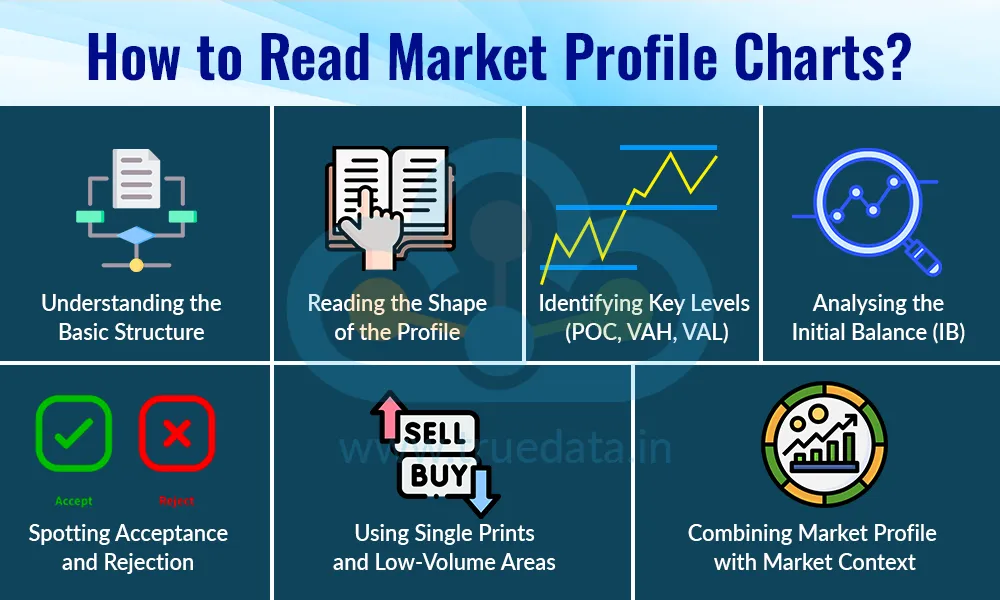
Reading trading charts is one of the primary requirements for understanding market movements. Similarly, reading a Market Profile chart helps traders gain a deeper understanding of price action and identify high-probability trading opportunities by focusing on structure, key levels, and overall market behaviour. The nuances of reading market profile charts are explained below.

How to Read Market Profile Charts

  • Understanding the Basic Structure - A Market Profile chart may look different from regular candlestick charts, but its structure is quite logical. It is made up of letters or blocks called TPOs (Time Price Opportunities), arranged along different price levels. Each letter represents a specific time period during the trading session. When more letters are seen at a particular price, it means the market spent more time there, showing acceptance. Fewer letters indicate that the price moved quickly, showing rejection. By simply observing where the market spends more or less time, a trader can understand which price levels are important. This helps traders move beyond just price movement and focus on actual market behaviour.

  • Reading the Shape of the Profile - The overall shape of the Market Profile gives a quick idea of market conditions. A bell-shaped profile usually means the market is balanced and trading within a range. In such cases, price tends to move between support and resistance levels, and range-bound strategies may work better. On the other hand, if the profile looks stretched or uneven, it suggests a trending market. This means buyers or sellers are in control, and the price is moving strongly in one direction. Recognising the shape helps traders decide whether to follow the trend or expect sideways movement.

  • Identifying Key Levels (POC, VAH, VAL) - Key levels are the most important part of reading a Market Profile chart. The Point of Control (POC) is the level where the market has spent the most time, making it a strong reference point. The Value Area includes the Value Area High (VAH) and Value Area Low (VAL), which cover the range where most trading activity has taken place. When the price stays within the value area, the market is considered balanced. If the price moves above VAH or below VAL, it may signal a breakout or change in sentiment. Traders often use these levels to plan entries, exits, and targets in a more structured way.

  • Analysing the Initial Balance (IB) - The Initial Balance is the price range formed during the first hour of the trading session. It gives an early indication of how the market might behave for the rest of the day. If the price stays within this range, the market may remain stable and range-bound. However, if the price breaks out of the Initial Balance, it often indicates strong momentum. Traders closely watch IB breakouts, especially in indices like Nifty and Bank Nifty, as they can lead to good intraday trading opportunities.

  • Spotting Acceptance and Rejection - One of the key skills in reading Market Profile is understanding whether the market is accepting or rejecting a price level. Acceptance happens when the market spends more time at a level, shown by multiple TPOs. This usually means the price is fair and stable. Rejection happens when the price moves quickly away from a level, leaving very few TPOs behind. This shows that the market does not agree with that price. Traders use this information to identify strong support and resistance levels and to anticipate possible reversals.

  • Using Single Prints and Low-Volume Areas - Single prints and low-volume areas are zones where the market has spent very little time. These areas indicate strong buying or selling pressure and are often formed during sharp moves. When price revisits these zones, it tends to move quickly again. These areas act as important signals for breakouts or continuation moves, and identifying them can help in finding trades with better speed and momentum, especially in fast-moving markets.

  • Combining Market Profile with Market Context - Reading Market Profile is not just about the chart itself. A trader also needs to consider the overall market context, such as trends, news, and global cues. For example, a breakout from the value area during a strong global market trend can be more reliable.

How to Use Market Profile in Trading?

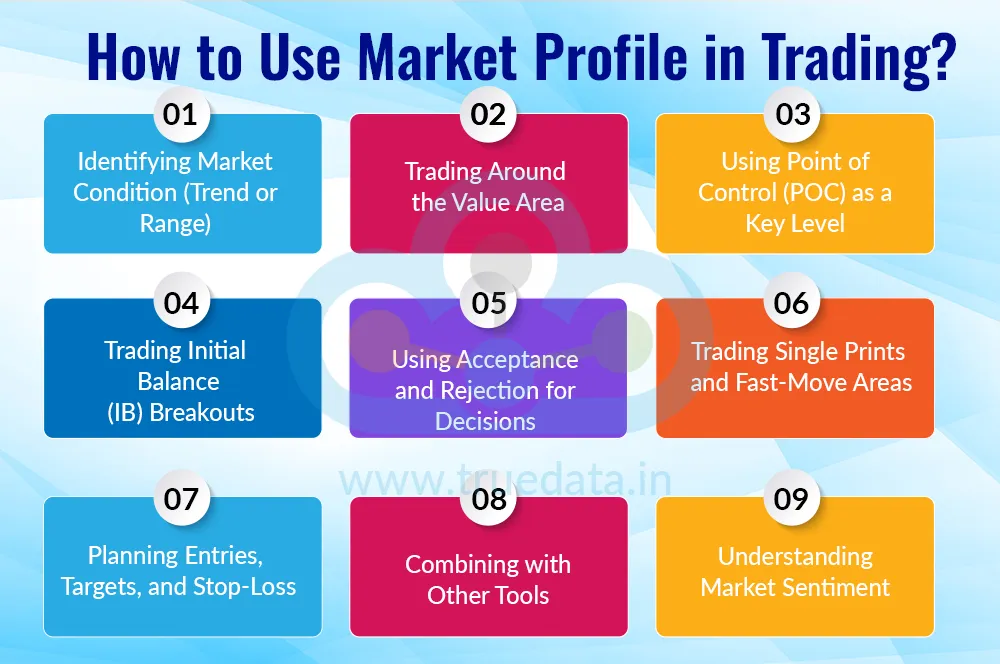
Now that we have seen the fine art of reading market charts, let us now focus on trading with the market profile. Here are the key points to consider.

How to Use Market Profile in Trading

  • Identifying Market Condition (Trend or Range) - A trader first uses Market Profile to understand whether the market is trending or moving in a range. If the profile is balanced and bell-shaped, the market is likely range-bound, and the price may move between support and resistance. If the profile is stretched in one direction, it indicates a trend. This helps the trader choose the right strategy, i.e., range trading or trend-following.

  • Trading Around the Value Area - The Value Area (VAH and VAL) shows where most trading activity has taken place. When the price is inside this range, the market is balanced, and traders may look for small buy-low, sell-high opportunities. If the price breaks above VAH or below VAL, it can signal a strong move, and the trader may look for breakout trades.

  • Using Point of Control (POC) as a Key Level - The Point of Control (POC) is the price where the market has spent the most time. Traders use this level as an important support or resistance zone. If the price approaches the POC and holds, it may reverse. If it breaks strongly, it can indicate a shift in sentiment. This helps the trader plan entries and exits more clearly.

  • Trading Initial Balance (IB) Breakouts - The Initial Balance is the range formed during the first hour of trading. Traders watch this range closely. If the price stays within it, the market may remain stable. If the price breaks above or below the IB, it can signal a strong trend for the day. Traders often use IB breakouts in Nifty and Bank Nifty for intraday trades.

  • Using Acceptance and Rejection for Decisions - Traders observe whether the market accepts or rejects certain price levels. If the price spends more time at a level (acceptance), it is considered a fair value. If the price quickly moves away (rejection), it shows strong buying or selling pressure. This helps traders identify potential reversal or breakout zones.

  • Trading Single Prints and Fast-Move Areas - Single prints and low-volume areas are zones where the market moved quickly. Traders use these areas to identify potential continuation moves. When price revisits these zones, it often moves fast again, providing good trading opportunities with momentum.

  • Planning Entries, Targets, and Stop-Loss - Market Profile gives clear levels, which help traders plan trades properly. Entries can be taken near key levels like VAH, VAL, or POC. Stop-loss can be placed just outside these levels, and targets can be set at the next important zone. This improves risk-reward and reduces guesswork.

  • Combining with Other Tools - Traders can combine Market Profile with other tools like price action, volume, or basic indicators. This adds more confirmation to trades. For example, a breakout from the value area with strong volume can increase the chances of a successful trade.

  • Understanding Market Sentiment - Market Profile helps traders understand whether buyers or sellers are in control. By observing how the price behaves around key levels, the trader can judge the strength of the market. This helps in making more confident and informed trading decisions.

What are Key Market Profile Days?

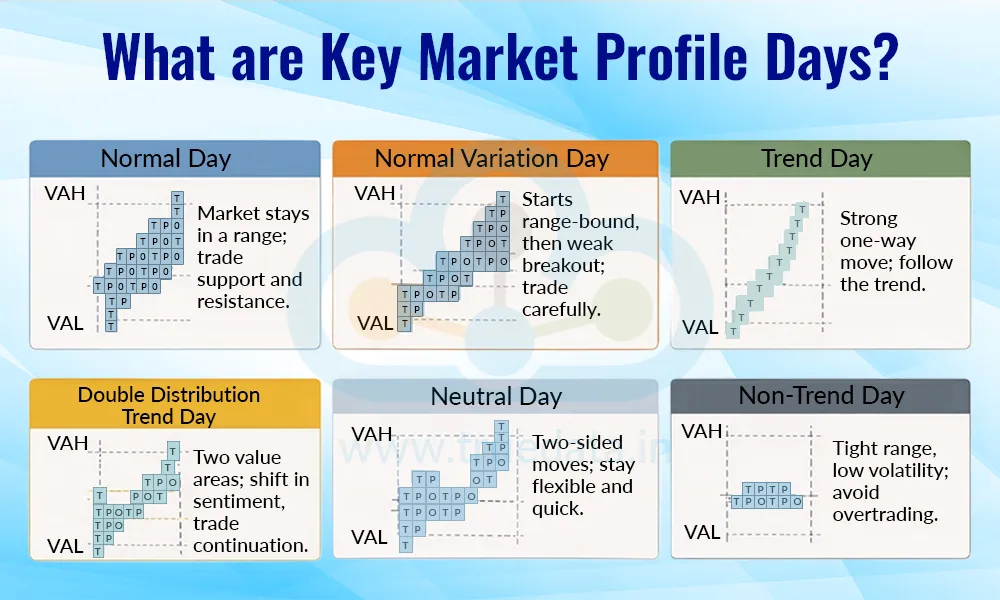
In Market Profile trading, ‘key market profile days’ refer to different types of trading days based on the price behaviour or movement and the profile formed during the session. Each day type tells a story about market sentiment, i.e., whether buyers or sellers are in control, or if the market is balanced. Understanding these day types helps a trader read the market more clearly and choose the right strategy for the day. For example, some days are suitable for trend-following trades, while others are better for range-bound strategies. Identifying the day type early can help traders improve decision-making, reduce confusion, and increase the chances of taking the right trades. 

The type of market profile days include,

What are Key Market Profile Days

  • Normal Day - A Normal Day is when the market trades within a limited range, and both buyers and sellers are balanced. The price does not move too far from the initial balance range. On such days, a trader may prefer range-bound strategies, buying near support and selling near resistance.

  • Normal Variation Day - In this type of day, the market starts with a normal range but later breaks out in one direction. However, the move is not very strong. Traders can look for breakout opportunities but should be cautious, as the trend may not be very powerful.

  • Trend Day - A Trend Day is when the market moves strongly in one direction with very little pullback. The profile is stretched, showing clear dominance of buyers or sellers. On such days, a trader may prefer trend-following strategies instead of trying to trade against the trend.

  • Double Distribution Trend Day - This day shows two separate value areas in the profile, usually caused by a strong move followed by consolidation at a new level. It indicates a shift in market sentiment during the day. Traders can look for continuation trades in the direction of the new value area.

  • Neutral Day - A Neutral Day is when both buyers and sellers are active, and the market moves above and below the initial balance. It shows uncertainty and two-sided movement. Traders may need to be flexible and quick in decision-making on such days.

  • Non-Trend Day - A Non-Trend Day has a very narrow range and low volatility. The market lacks a clear direction and mostly stays within a tight range. On such days, trading opportunities are limited, and traders may prefer to stay cautious or avoid overtrading.

What are the Differences Between Market Profile and Volume Profile?

Market profile and volume profile are important tools of market analysis. However, there are a few important differences that have to be considered. These differences are explained below. 

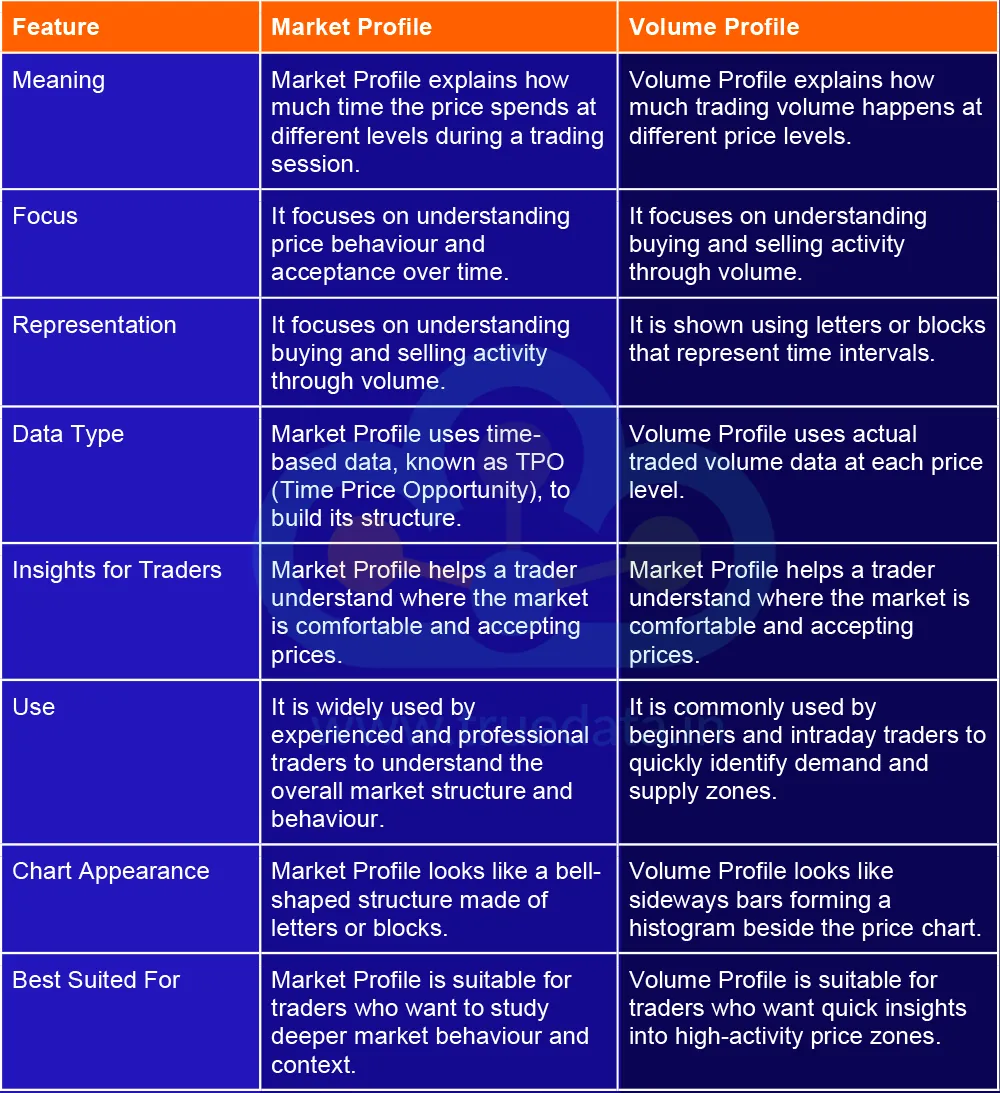
What are the Differences Between Market Profile and Volume Profile

Feature 

Market Profile 

Volume Profile 

Meaning

Market Profile explains how much time the price spends at different levels during a trading session.

Volume Profile explains how much trading volume happens at different price levels.

Focus

It focuses on understanding price behaviour and acceptance over time.

It focuses on understanding buying and selling activity through volume.

Representation

It focuses on understanding buying and selling activity through volume.

It is shown using letters or blocks that represent time intervals.

Data Type

Market Profile uses time-based data, known as TPO (Time Price Opportunity), to build its structure.

Volume Profile uses actual traded volume data at each price level.

Insights for Traders

Market Profile helps a trader understand where the market is comfortable and accepting prices.

Market Profile helps a trader understand where the market is comfortable and accepting prices.

Use

It is widely used by experienced and professional traders to understand the overall market structure and behaviour.

It is commonly used by beginners and intraday traders to quickly identify demand and supply zones.

Chart Appearance 

Market Profile looks like a bell-shaped structure made of letters or blocks.

Volume Profile looks like sideways bars forming a histogram beside the price chart.

Best Suited For

Market Profile is suitable for traders who want to study deeper market behaviour and context.

Volume Profile is suitable for traders who want quick insights into high-activity price zones.

What are the Pros and Cons of Using Market Profile in Trading?

After learning about the various aspects of market profile, it is also important to understand the pros and cons of using the tool to make informed trading choices. 

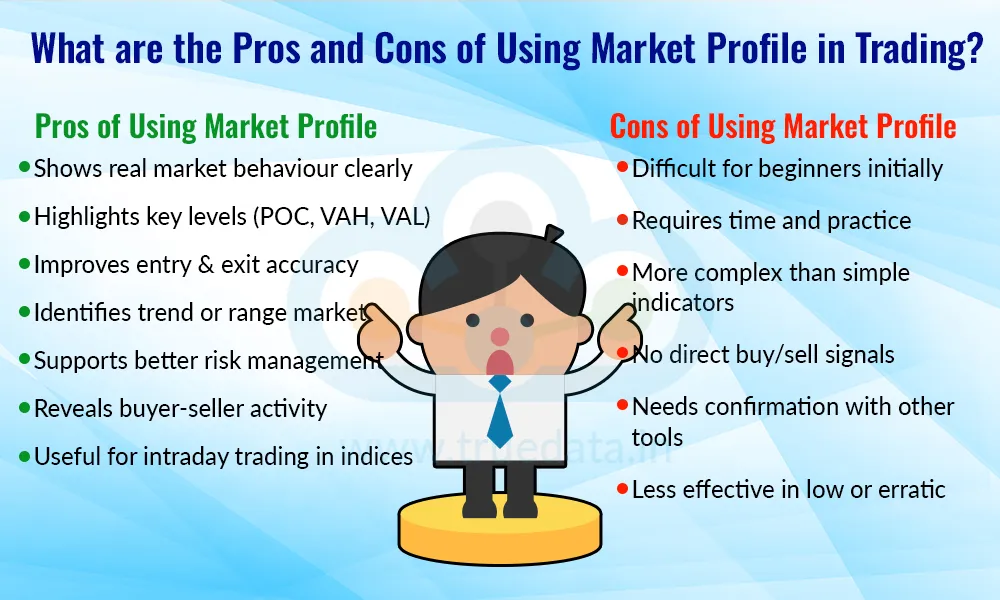
What are the Pros and Cons of Using Market Profile in Trading

Pros of Using Market Profile

  • It helps traders understand real market behaviour, not just price movement.

  • It clearly shows important levels like POC, VAH, and VAL.

  • It improves entry and exit decisions with better accuracy.

  • It helps identify whether the market is trending or range-bound.

  • It supports better risk management with clear stop-loss levels.

  • It gives insight into buyer and seller activity.

  • It works well for intraday trading in indices like Nifty and Bank Nifty.

Cons of Using Market Profile 

  • It can be difficult to understand for beginners at first.

  • It takes time and practice to read charts correctly.

  • It may feel complex compared to simple indicators.

  • It does not give direct buy or sell signals.

  • It needs to be combined with other tools for better confirmation.

  • It may not work well in very low-volume or highly erratic markets.

Conclusion

Market Profile is a powerful tool that helps traders understand how the market truly behaves by showing where price is accepted, where it is rejected, and where value is formed. Unlike traditional indicators, it focuses on price, time, and structure, helping traders identify key levels, market conditions, and high-probability trading opportunities. By learning its components, day types, and strategies, traders can improve their decision-making, manage risk better, and trade with more clarity and confidence.

This article is part of our series on understanding market terminologies and technical analysis. You can read this article in conjunction with our blog on volume profile to have a comprehensive understanding. Let us know your thoughts on the topic or if you need further information on the same, and we will address it soon. 

Till then, Happy Reading!


Read More: Three Black Crows Patterns and Trading Strategies

Frequently Asked Questions

Market Profile shows how much time the price spends at different levels and highlights key value areas, while traditional candlestick charts mainly show price movement over time. It helps traders understand market behaviour, not just price direction.

Market Profile works best on intraday and daily timeframes, especially for traders tracking Nifty, Bank Nifty, or active stocks. Intraday profiles help with entries and exits, while daily profiles give a broader market view.

Market Profile is more of a reliable analytical tool than just a visual guide, as it shows real market behaviour through price and time. However, traders usually combine it with other tools for better confirmation.

Common Market Profile strategies include trading value area breakouts, reversals near VAH/VAL, and Initial Balance breakouts. Traders also use POC levels and low-volume areas to plan entries and exits.

Charts like candlestick charts and indicators like volume, VWAP, and moving averages work well with Market Profile. They help confirm trends, strength, and better entry or exit points.
Marisha Bhatt

Marisha Bhatt is a financial content writer @TrueData.
She writes with the sole aim of simplifying complex financial concepts and jargon while attempting to clarify technical and fundamental analysis concepts of the stock markets. The ultimate goal is to spread vital knowledge and benefit the maximum audience. Her Chartered Accountant background acts as the knowledge base to help clarify crucial concepts and create a sound investment portfolio.

0 Comments

Related Articles

SEE ALL
Investing / Trading
Investing / Trading
How do I download BSE and NSE stock prices in Excel in real time?

NSE Stock Prices in Excel in Real Time - Microsoft Excel is a super software cap...

Investing / Trading
Investing / Trading
What is loss aversion? Is it bad for your portfolio?

Remember the first time you tried riding a bicycle? The thrill of moving forward...

Investing / Trading
Investing / Trading
Stocks or mutual funds? Which is better?

Introduction For the longest time, investment in stock markets was thought to b...

Relevant Tags