Investing / Trading

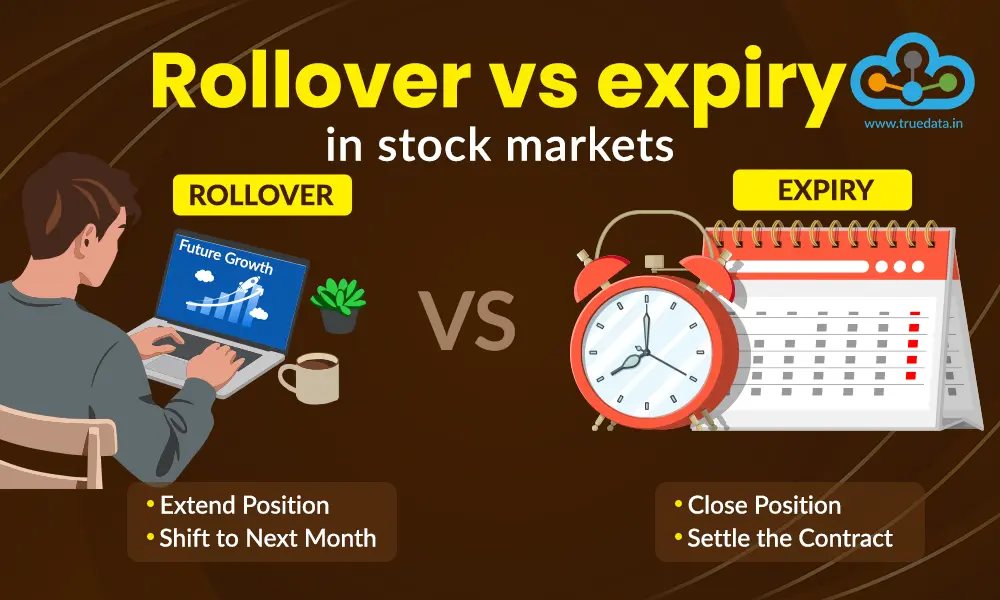
Rollover vs expiry in stock markets

Marisha Bhatt · 16 May 2026 · 9 mins read · 0 Comments

rollover-vs-expiry-in-stock-markets

When it comes to trading in the trading in stock market, understanding key terms is not just helpful, but it can directly impact your profits and risk. Two such commonly used terms are rollover and expiry, especially in the futures and options (F&O) segment. While they may sound technical, these concepts play a crucial role in how traders manage positions, control risk, and plan their next move. So, what exactly do rollover and expiry mean, and how do they affect your portfolio? Check out this blog to know their meaning and differences to shape a profitable portfolio. 

What is Rollover in Stock Markets? (Options + Futures)

What is Rollover in Stock Markets? (Options + Futures)

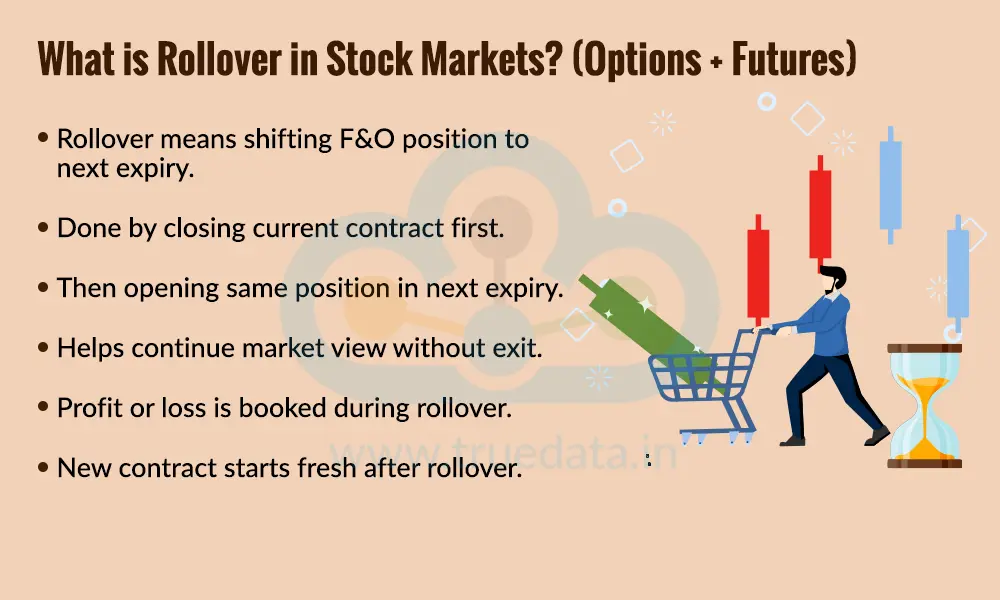
Rollover in the stock market refers to shifting an open futures or options (F&O) position from the current expiry to the next one so that the trader can continue holding their market view. This is done by first closing the existing contract and then opening a new position in the next expiry with the same buy or sell stance. Since F&O contracts in India have fixed expiry dates, rollover helps traders stay in the trade instead of being forced to exit when the contract expires.

However, rollover does not mean avoiding profit or loss. When the trader closes the current position, any difference between the buying and selling price is realised as profit or loss at that point. For example, if a trader bought a futures contract at Rs. 22,000 and closed it at Rs. 22,300 while rolling over, they would book a profit of Rs. 300 before entering the next contract. Similarly, if the price had fallen, the loss would be realised first. After this, a new position begins in the next expiry contract. Thus, rollover simply continues the trade but always locks in the existing profit or loss.

When Should Traders Use Rollovers?

When Should Traders Use Rollovers

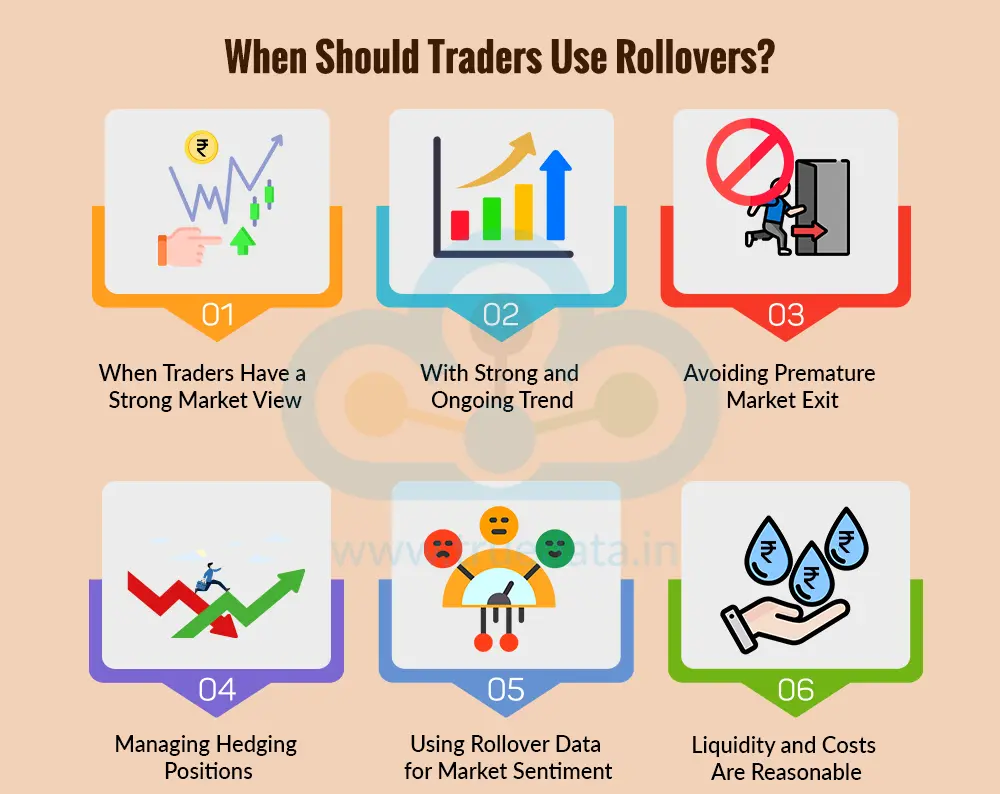
Rollover is used when traders want to continue their trade beyond expiry, especially when they believe the opportunity is still strong, the trend is intact, or their strategy requires more time. The various cases where the rollover strategy can be used are highlighted below.

When Traders Have a Strong Market View

Traders often use rollover when they still have confidence in their original market view, even as the current contract is about to expire. For example, if a trader expects the market to continue rising but their futures contract is nearing expiry, they may roll over the position to the next month instead of closing it. This allows them to stay invested in their view without interruption. Thus, rollover is used when the trade idea is still valid, but the contract is ending.

With Strong and Ongoing Trend

Rollover is commonly seen in trending markets, either strongly bullish or bearish. If prices are consistently moving in one direction, traders prefer to carry forward their positions to capture further gains. For instance, during a strong uptrend in indices like Nifty or Bank Nifty, long positions are often rolled over to benefit from continued momentum. High rollover activity in such cases can also signal that traders expect the trend to continue.

Avoiding Premature Market Exit

Sometimes, closing a position at expiry may feel too early, especially if the expected price movement has not fully played out. Instead of exiting and missing out on potential gains, traders use rollover to extend their position into the next contract. This is particularly useful in cases where the trade needs more time to deliver results.  

Managing Hedging Positions

Rollover is also used in hedging strategies. Traders and investors who have created hedged positions using futures and options may roll over both legs of the strategy to maintain protection. For example, a portfolio hedged with index futures may require rollover to continue guarding against market volatility in the next month.

Using Rollover Data for Market Sentiment

Some traders use rollover not just as a strategy but also as an indicator. High rollover of long positions can indicate bullish sentiment, while high rollover of short positions may suggest bearish expectations. By observing rollover trends, traders can align their positions with broader market sentiment.

Liquidity and Costs Are Reasonable

Traders also consider factors like liquidity and rollover cost (difference between current and next contract prices) before rolling over. If the next month's contract has good trading volume and the cost of carry is reasonable, rollover becomes a practical choice. However, if costs are too high, traders may prefer to exit instead of rolling over. 

What is Expiry in Stock Markets?

What is Expiry in Stock Markets

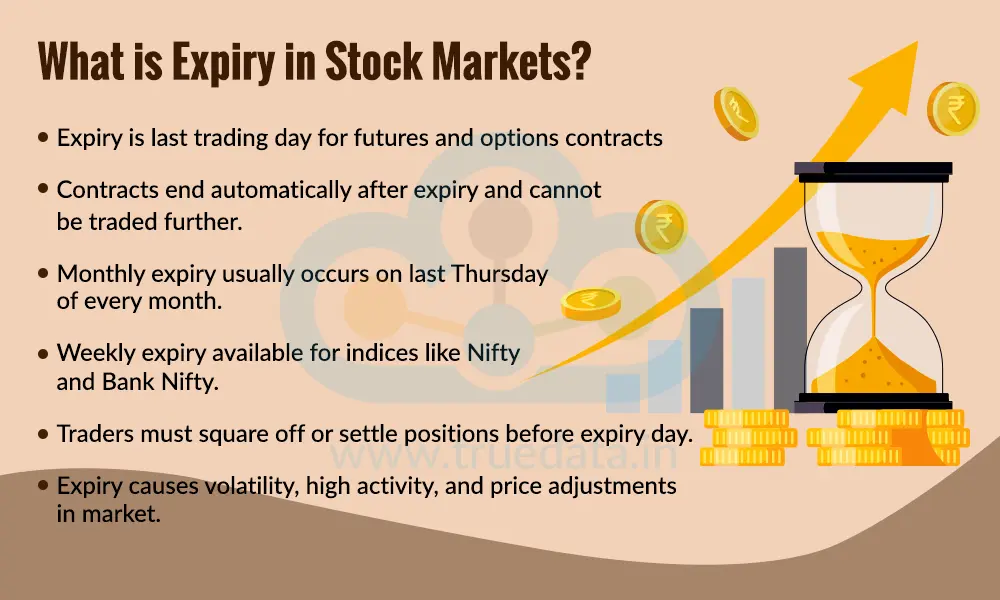
Expiry in the stock market refers to the last date on which a futures or options (F&O) contract is valid for trading. After this date, the contract automatically comes to an end and can no longer be traded. F&O contracts in India are traded on exchanges like the National Stock Exchange and Bombay Stock Exchange, and typically expire on the last Thursday of every month (for monthly contracts). However, weekly expiries are also available for certain indices like Nifty and Bank Nifty. On or before the expiry day, traders must either close (square off) their positions or let them settle, depending on the type of contract and their strategy.

On expiry, the way a contract is settled depends on whether it is a futures or an options contract. Futures contracts are usually cash-settled or physically settled (depending on the stock or index), i.e., the profit or loss is calculated based on the final settlement price. Options contracts, on the other hand, will either expire worthless (if they are out-of-the-money) or be automatically exercised (if they are in-the-money), leading to settlement. Expiry is an important event for traders as it often brings higher volatility, increased trading activity, and price adjustments, especially in the last few days. Understanding expiry helps traders plan when to exit, roll over, or adjust their positions, making it a key concept for managing risk and timing trades effectively in the stock market.

What are the Differences Between Expiry And Rollover in Stock Markets?

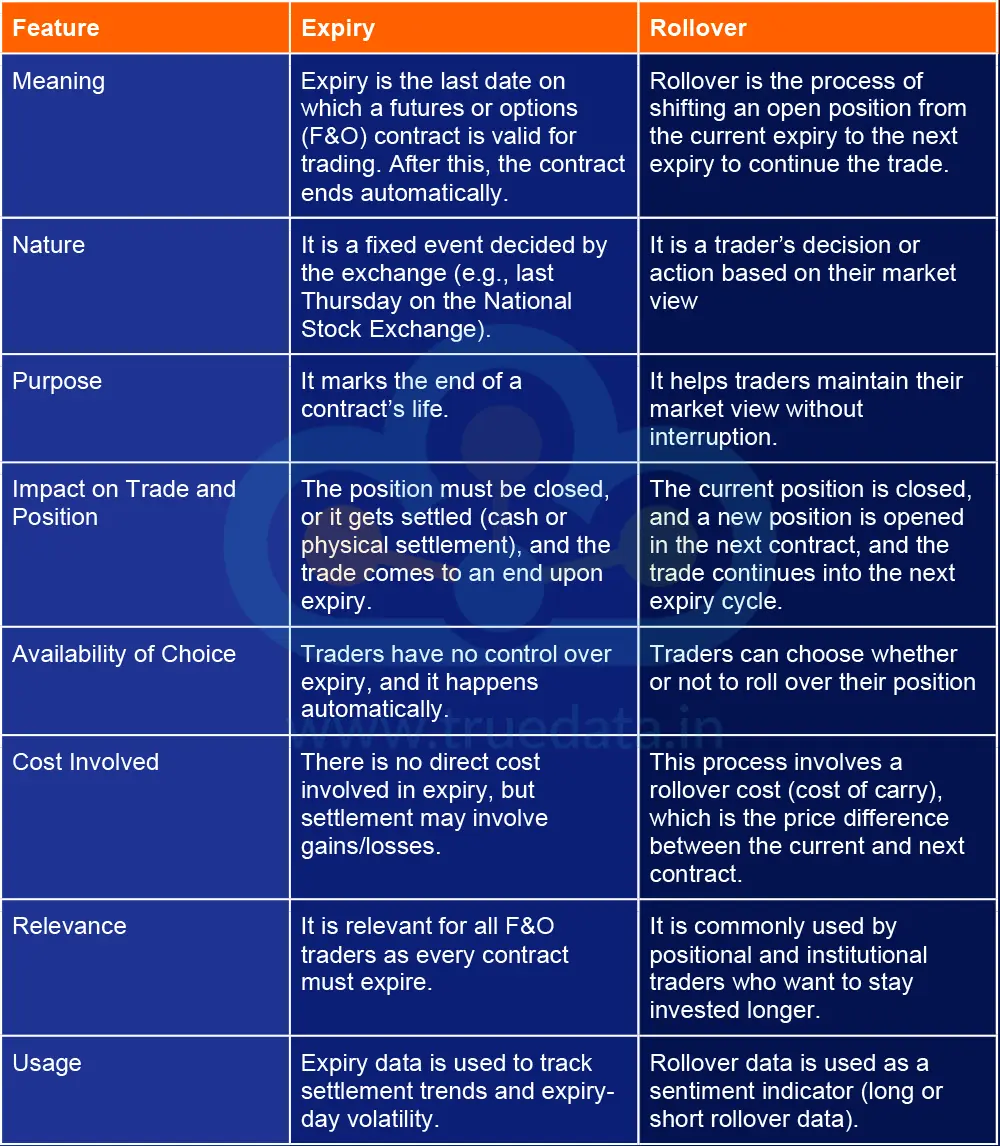
Rollover and expiry are a routine part of the F&O segment. However, they are quite different in terms of intent and market impact. The key difference between the terms is explained below. 

What are the Differences Between Expiry And Rollover in Stock Markets

Feature

Expiry

Rollover

Meaning

Expiry is the last date on which a futures or options (F&O) contract is valid for trading. After this, the contract ends automatically.

Rollover is the process of shifting an open position from the current expiry to the next expiry to continue the trade.

Nature

It is a fixed event decided by the exchange (e.g., last Thursday on the National Stock Exchange).

It is a trader’s decision or action based on their market view

Purpose

It marks the end of a contract’s life.

It helps traders maintain their market view without interruption.

Impact on Trade and Position 

The position must be closed, or it gets settled (cash or physical settlement), and the trade comes to an end upon expiry. 

The current position is closed, and a new position is opened in the next contract, and the trade continues into the next expiry cycle. 

Availability of Choice

Traders have no control over expiry, and it happens automatically.

Traders can choose whether or not to roll over their position

Cost Involved

There is no direct cost involved in expiry, but settlement may involve gains/losses.

This process involves a rollover cost (cost of carry), which is the price difference between the current and next contract.

Relevance 

It is relevant for all F&O traders as every contract must expire.

It is commonly used by positional and institutional traders who want to stay invested longer.

Usage

Expiry data is used to track settlement trends and expiry-day volatility.

Rollover data is used as a sentiment indicator (long or short rollover data).

What are the Key Considerations to Use Rollover or Expiry?

What are the Key Considerations to Use Rollover or Expiry

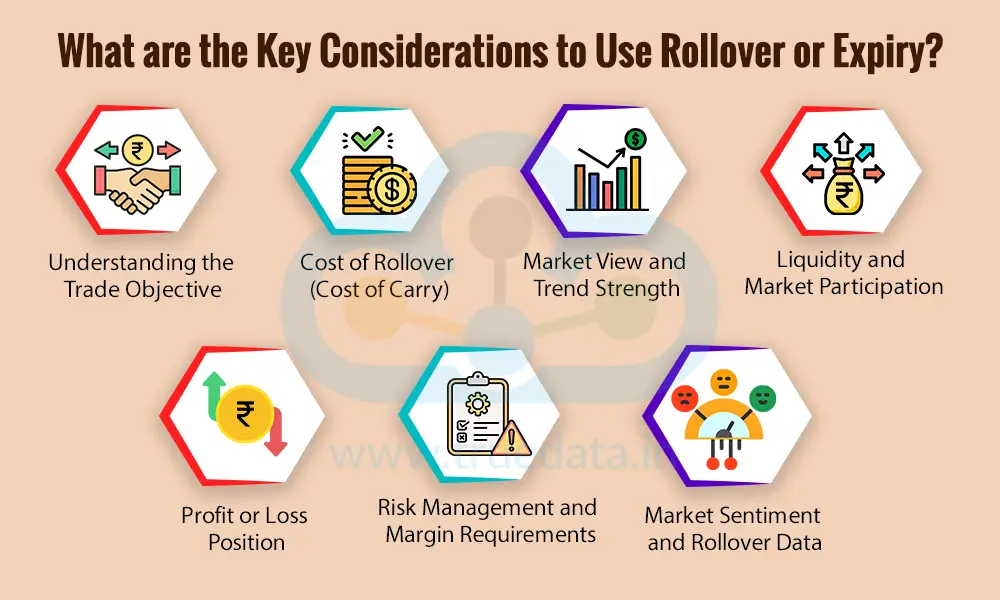
Choosing between rollover and expiry depends on market view, cost, risk, and strategy. Investors should roll over only when they have a strong conviction and the conditions support continuing the trade, while exiting at expiry can be a safer and more disciplined approach in other cases. The factors to be considered while using rollover or expiry are,

Understanding the Trade Objective

Before choosing between rollover and letting a contract expire, the investor should first be clear about the purpose of the trade. If the position was taken for a short-term opportunity, such as capturing a quick price move, then allowing the contract to expire or closing it near expiry may be more suitable. However, if the investor has a strong ongoing view about the market or a stock, rollover becomes useful to continue that position into the next contract. In simple terms, the decision depends on whether the trade idea is still valid or has already played out.

Cost of Rollover (Cost of Carry)

Rollover is not free, and it comes with a cost, known as the cost of carry, which is the difference between the current contract price and the next month’s contract price. If this cost is too high, it can reduce potential profits. Investors should compare this cost with the expected gains from continuing the trade. If the expected return does not justify the cost, it may be better to avoid a rollover and exit the position.

Market View and Trend Strength

One of the most important factors is the current market trend. If the market is showing a strong and consistent trend, either upward or downward, investors may prefer to roll over their positions to benefit from further movement. On the other hand, if the market looks uncertain, volatile, or range-bound, it may be safer to exit at expiry and avoid unnecessary risk. Rollover makes more sense when there is confidence in the direction of the market.

Liquidity and Market Participation

Liquidity plays a key role in rollover decisions. As expiry approaches, trading activity usually shifts from the current contract to the next one. Investors should ensure that the next month's contract has sufficient liquidity (good trading volume and tight bid-ask spreads). Better liquidity ensures smoother execution and lower trading costs during rollover.

Profit or Loss Position

Investors should also evaluate their current profit or loss before deciding. If the trade is already in good profit, some may prefer to book gains at expiry rather than take additional risk by rolling over. Similarly, if the trade is a loss, blindly rolling over without a clear reason can increase risk. A well-thought-out decision should be based on future expectations, not just the current profit or loss.

Risk Management and Margin Requirements

Rollover also requires maintaining a sufficient margin in the trading account. Since a new position is opened in the next contract, margin requirements continue. Investors should check whether they have enough capital to sustain the position and handle potential market fluctuations. Proper risk management is essential to avoid forced exits due to margin shortages.

Market Sentiment and Rollover Data

Rollover data itself can give useful signals about market sentiment. For example, high rollover of long positions may indicate bullish expectations, while high rollover of short positions may suggest bearishness. Investors often track such data to understand what larger market participants are doing before making their own decision.

Conclusion

Expiry and rollover are closely linked but serve very different purposes in the F&O market. Expiry marks the end of a contract, where positions must be settled, and profits or losses are realised, while rollover is a conscious decision by traders to carry forward their position into the next contract when their market view remains strong. Since rollover always involves closing the current position and booking profit or loss before starting a new one, it is not a way to avoid outcomes but a way to continue a strategy. The right choice between them depends on factors like market trend, cost of carry, risk appetite, and overall strategy, making it important to use both concepts wisely for better trading decisions.

We hope this article helped simplify rollovers and expirations, important aspects of the derivative market, and their role in creating a sound portfolio. Let us know your thoughts on the topic or if you need further information on the same, and we will address it soon. 

Till then, Happy Reading!


Read More: What is Market Profile?

Frequently Asked Questions

Traders roll over a futures position when they still believe in their market view and want to continue the trade beyond expiry. It allows them to stay invested in the trend without closing their overall strategy.

A typical rollover happens a few days before expiry, usually in the last week of the contract month. Traders shift their positions before expiry to avoid settlement and continue their trade in the next contract.

If a trader does not roll over an expiring futures contract, the position is automatically settled at expiry based on the final price. The profit or loss is realised, and the trade comes to an end.

Roll yield is the gain or loss a trader gets when shifting (rolling over) a position from one contract to the next due to the price difference between the two. If the next contract is cheaper, it can give a gain, and if it is costlier, it can reduce returns.

A front-month contract is the futures or options contract that is closest to its expiry date and is usually the most actively traded. Traders prefer it because it has higher liquidity and tighter pricing compared to longer-duration contracts.

A back-month contract is a futures or options contract with an expiry date that is further away than the current (front-month) contract. It is usually less traded but used by traders who want to hold positions for a longer time.

Options expiry and futures expiry happen on the same date, but they are settled differently. In options, contracts either expire worthless or are exercised (if in-the-money), while in futures, profit or loss is directly calculated and settled based on the final price.
Marisha Bhatt

Marisha Bhatt is a financial content writer @TrueData.

She writes with the sole aim of simplifying complex financial concepts and jargon while attempting to clarify technical and fundamental analysis concepts of the stock markets. The ultimate goal is to spread vital knowledge and benefit the maximum audience. Her Chartered Accountant background acts as the knowledge base to help clarify crucial concepts and create a sound investment portfolio.

0 Comments

Related Articles

SEE ALL
Investing / Trading
Investing / Trading
How do I download BSE and NSE stock prices in Excel in real time?

NSE Stock Prices in Excel in Real Time - Microsoft Excel is a super software cap...

Investing / Trading
Investing / Trading
What is loss aversion? Is it bad for your portfolio?

Remember the first time you tried riding a bicycle? The thrill of moving forward...

Investing / Trading
Investing / Trading
Level 1 vs Level 2 Data

Market data is the backbone ofsuccessful trading, but not all market data is the...

Relevant Tags