Investing / Trading

Level 1 vs Level 2 Data

Marisha Bhatt · 03 Mar 2026 · 6 mins read · 0 Comments

level-1-vs-level-2-data

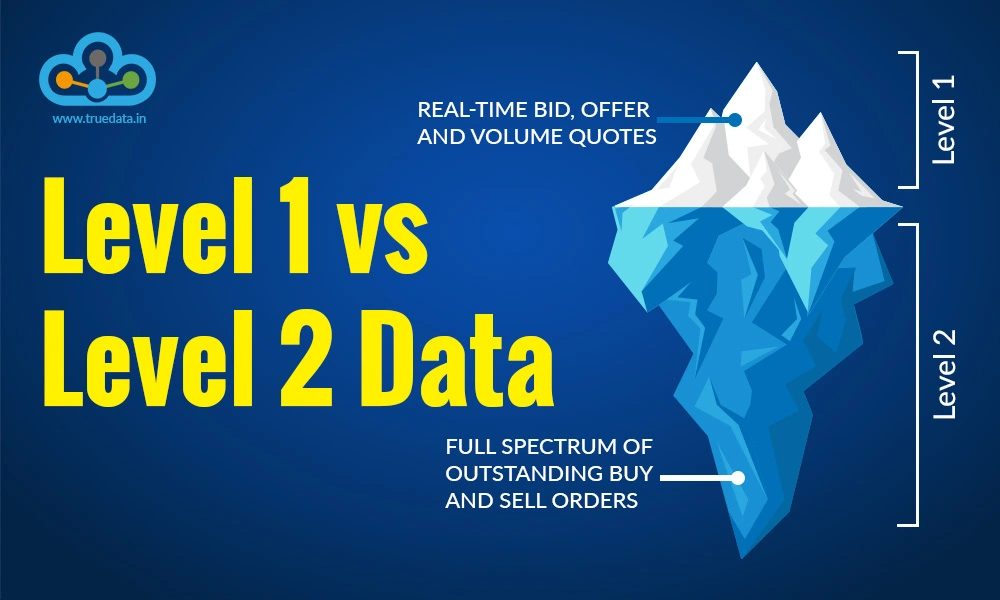
Market data is the backbone of successful trading, but not all market data is the same. Traders often hear terms like Level 1 and Level 2 data, yet the real difference between them is not always clear. While Level 1 shows you the surface, Level 2 reveals the deeper story behind every trade. In this blog, we break down what each level actually means, what data they include, and how understanding them can help you make more informed trading and portfolio decisions.

What is Level 1 Data?

What is Level 1 Data

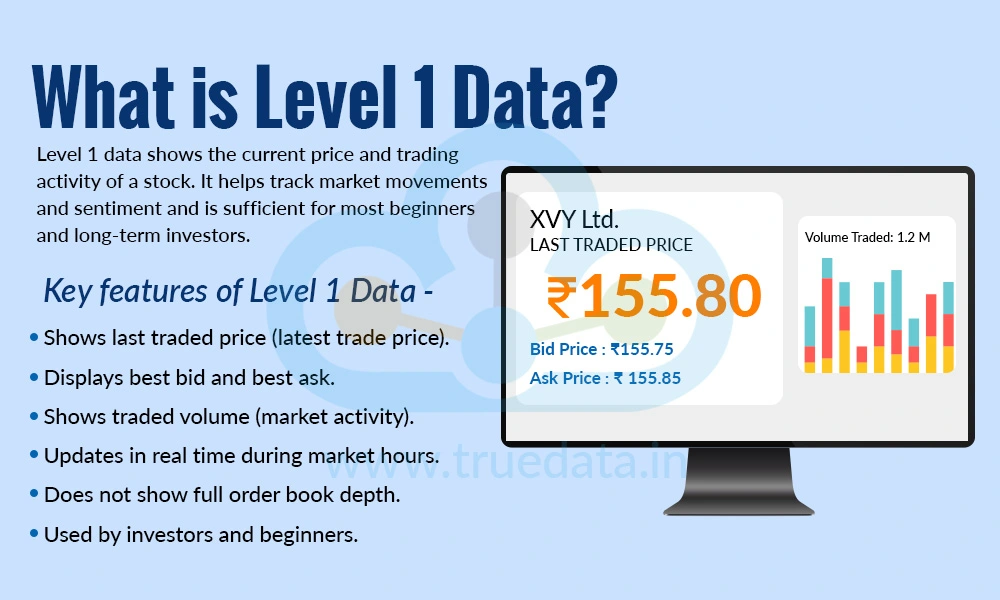
Level 1 data is the most basic form of market data that shows the current trading picture of a stock or security. It tells you where the price is right now and how actively it is being traded, without going into deeper details about who is placing orders or how many buyers and sellers are waiting at different prices. Level 1 data is enough to track market movements, check stock prices, and understand overall sentiment during the trading day and is quite useful for most long-term investors and beginner traders. 

Key features of Level 1 Data - 

  • Level 1 data shows the last traded price, which is the price at which the most recent trade happened.

  • It includes the best bid price and best ask price, meaning the highest price buyers are willing to pay and the lowest price sellers are willing to accept.

  • It displays traded volume, helping traders understand how active the stock is.

  • Level 1 data updates in real time during market hours on exchanges like NSE and BSE.

  • It does not show the full order book, so you cannot see how many buyers or sellers are waiting at different price levels.

  • This data is commonly used by long-term investors, delivery traders, and beginners who focus more on price trends than intraday order flow.

What is Level 2 Data?

What is Level 2 Data

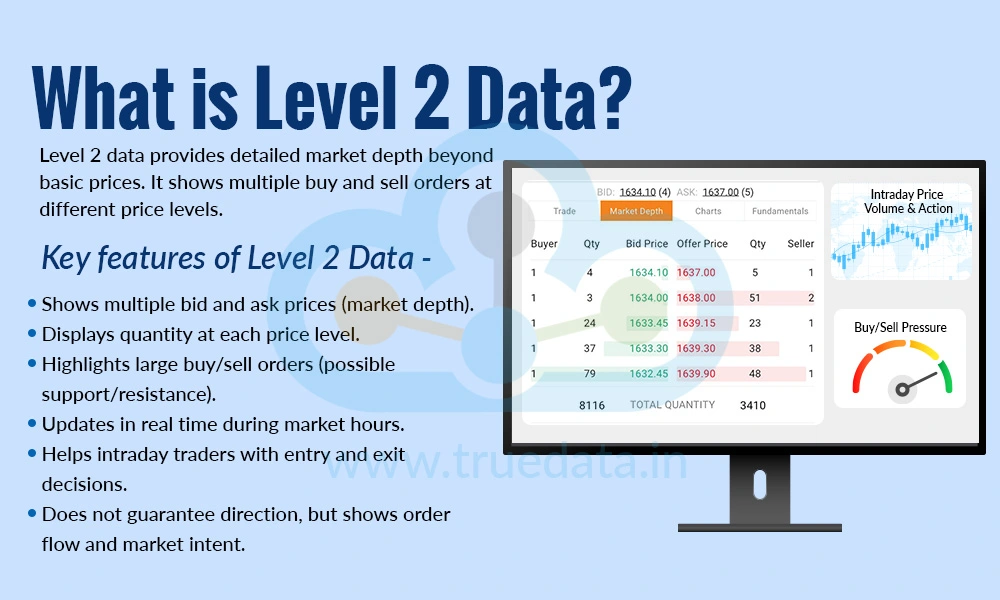
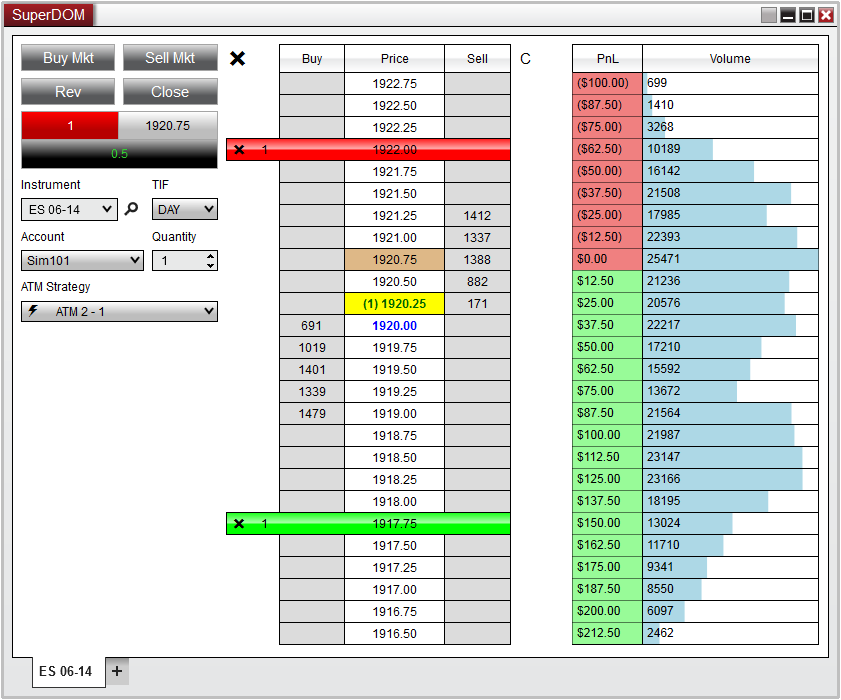
Level 2 data is a more detailed form of market data that goes beyond basic prices and shows the actual demand and supply in the market. It displays multiple buy and sell orders at different price levels, helping traders understand where buyers and sellers are positioned before a trade happens. Thus, Level 2 data offers deeper insight into market depth and price movement for active traders, especially intraday and short-term traders, by revealing how strong buying or selling pressure really is.

Key features of Level 2 Data - 

  • Level 2 data shows the market depth, which means multiple bid and ask prices instead of just the best ones.

  • It displays the quantity available at each price level, helping traders judge demand and supply.

  • Traders can see where large buy or sell orders are placed, which may act as short-term support and resistance.

  • Level 2 data updates in real time during trading hours on Indian exchanges like NSE and BSE.

  • It helps intraday and short-term traders make better entry and exit decisions.

  • Level 2 data does not guarantee price direction, but it helps traders understand market intent and order flow better.

What are the Differences Between Level 1 and Level 2 Data?

Level 1 data and level 2 data are key pillars for trading. However, they cater to different audiences and support different functions. The core differences between these market data are explained below.

What are the Differences Between Level 1 and Level 2 Data

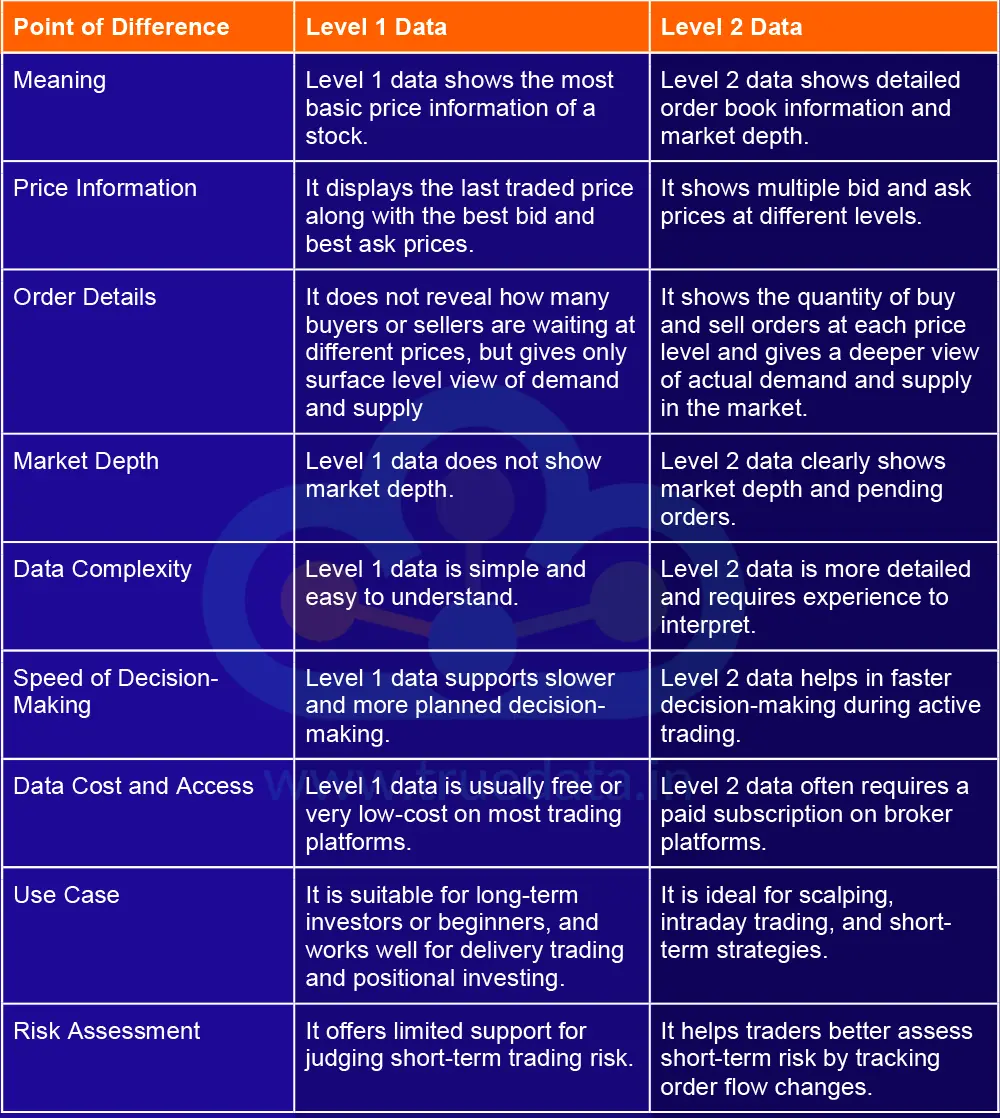
Point of Difference 

Level 1 Data

Level 2 Data

Meaning

Level 1 data shows the most basic price information of a stock.

Level 2 data shows detailed order book information and market depth.

Price Information

It displays the last traded price along with the best bid and best ask prices.

It shows multiple bid and ask prices at different levels.

Order Details

It does not reveal how many buyers or sellers are waiting at different prices, but gives only surface level view of demand and supply

It shows the quantity of buy and sell orders at each price level and gives a deeper view of actual demand and supply in the market.

Market Depth

Level 1 data does not show market depth.

Level 2 data clearly shows market depth and pending orders.

Data Complexity

Level 1 data is simple and easy to understand.

Level 2 data is more detailed and requires experience to interpret.

Speed of Decision-Making

Level 1 data supports slower and more planned decision-making.

Level 2 data helps in faster decision-making during active trading.

Data Cost and Access

Level 1 data is usually free or very low-cost on most trading platforms.

Level 2 data often requires a paid subscription on broker platforms.

Use Case

It is suitable for long-term investors or beginners, and works well for delivery trading and positional investing.

It is ideal for scalping, intraday trading, and short-term strategies. 

Risk Assessment

It offers limited support for judging short-term trading risk.

It helps traders better assess short-term risk by tracking order flow changes.

Who are the Users of the Level 1 and Level 2 Data? 

Who are the Users of the Level 1 and Level 2 Data

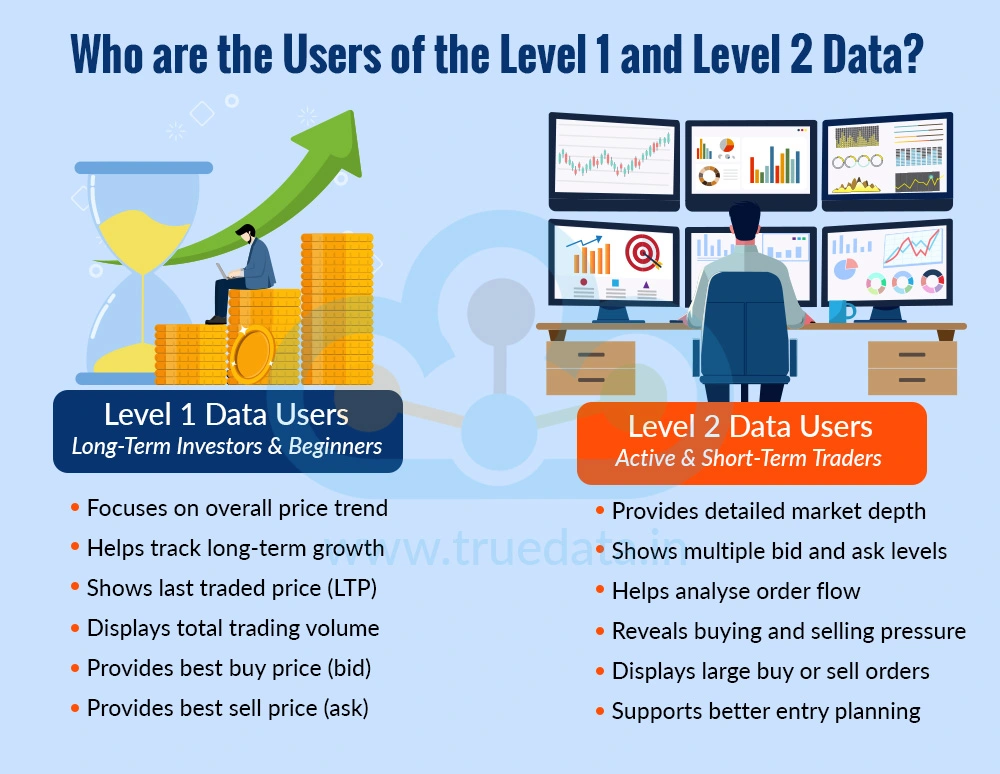
Level 1 data is mainly used by long-term investors, delivery traders, and beginners in the stock market. These users focus more on the overall price trend, company fundamentals, and long-term growth rather than short-term price movements. Level 1 data gives them the last traded price, volume, and best buy and sell prices, which is enough to track stocks, place delivery trades, and monitor their portfolios. Investors who follow a buy-and-hold approach or trade occasionally find Level 1 data simple, clear, and sufficient for their decision-making.

On the other hand, Level 2 data is mostly used by active traders, such as intraday traders, scalpers, and short-term traders. These users need deeper insight into market depth to understand where buying and selling pressure is building up during the trading session. Level 2 data helps them analyse order flow, spot large buy or sell orders, and plan better entry and exit points. Traders who depend on timing, quick decisions, and short-term price movements rely on Level 2 data to gain an edge in fast-moving markets.

Who are the Top Level 1 and Level 2 Data Providers?

who-are-the-top-level-1-and-level-2-data-providers

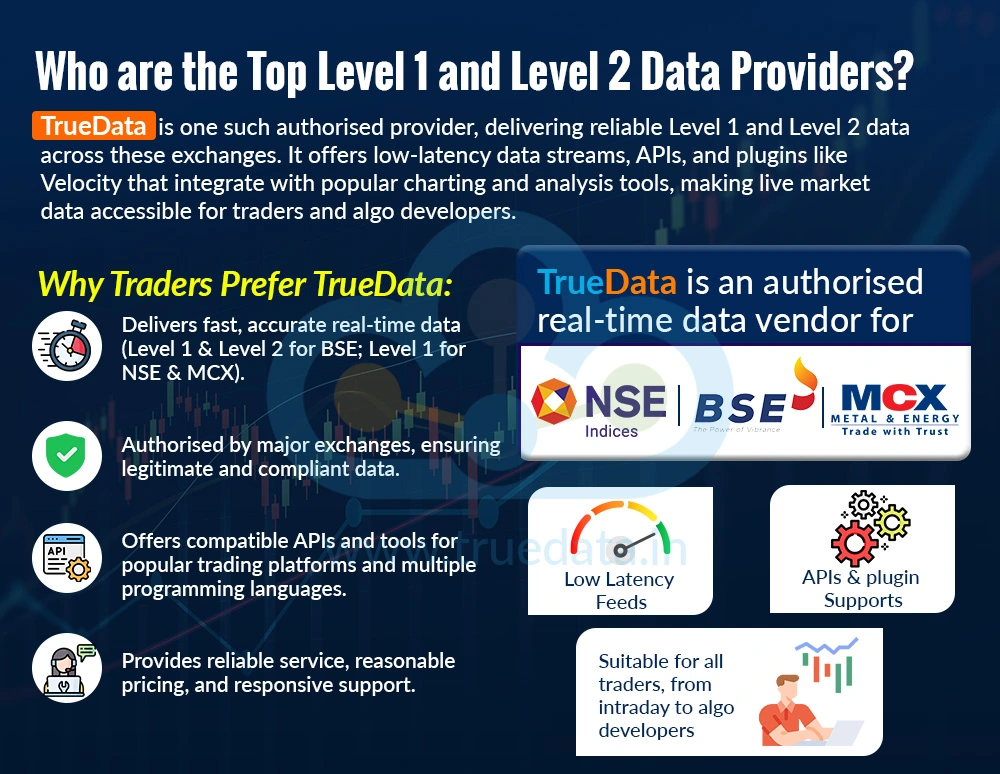
Market data comes from official exchanges like the National Stock Exchange (NSE), Bombay Stock Exchange (BSE), and Multi Commodity Exchange (MCX). These exchanges allow authorised vendors to redistribute real-time data to traders and platforms. There are several such authorised providers, but TrueData stands out in the competition due to its various unique features. TrueData is an authorised real-time data vendor for NSE (equities,  indices, futures & options), BSE (equities, indices & F&O), and MCX, and provides accurate and reliable feeds of both Level 1 (basic price and volume) and Level 2 (market depth) data to users depending on the subscription type. TrueData offers low-latency Level 1 and Level 2 data streams, APIs, and plugins (like Velocity) that work with popular charting and analysis tools, making it easier for traders of all skill levels, from intraday traders to algo developers, to access live data.

Why Traders Prefer TrueData - 

  • TrueData delivers fast and accurate real-time Level 1 and Level 2 data for BSE and Level 1 Data for NSE and MCX, helping traders act quickly.

  • Being authorised by major exchanges means the data is legitimate, with compliance and transparency.

  • Its tools and APIs are compatible with popular trading and analysis platforms, and it supports multiple formats and programming languages.

  • TrueData provides consistent service, reasonable pricing, and responsive support, which is especially useful for active traders and algorithmic strategies

Conclusion 

Level 1 and Level 2 market data both play important but different roles in trading and investing. While Level 1 data gives a simple and clear view of prices and volumes, making it ideal for long-term investors and beginners, Level 2 data goes a step deeper by showing market depth and order flow, which helps active and intraday traders make faster and more precise decisions. Thus, choosing between level 1 and level 2 data essentially depends on the trading style, goals, market knowledge and experience. However, finding reliable market data providers is the key to successful trading when using level 1 or level 2 data.

We hope this article clarifies important details of Level 1 and Level 2 data and their importance in trading. Let us know your thoughts on this topic or if you need any further information on the same, and we will address it soon. 

Till then, Happy Reading! 


Read More: Understanding Tick-by-Tick Data Benefits and Challenges

Frequently Asked Questions

Level-2 data shows real-time buy and sell orders, which can hint at short-term price moves. But it is not always reliable, so traders should use it along with charts and news for better decisions.

No, Level-2 data is not always faster than Level-1 data. Both update in real time, but Level-2 shows more detailed order information, which helps traders understand market activity better, rather than making it quicker.

Level-1 data is usually cheaper because it only shows best bid and ask prices, while Level-2 costs more since it gives full market depth and order book details. NSE and BSE, along with authorised real-time market data vendors, charge higher fees for Level-2 subscriptions compared to basic Level-1 feeds.

Yes, Level-1 data can be used for algorithmic trading, especially for simple strategies based on price, volume, or indicators. However, for faster and more order-flow-based strategies, many algo traders prefer Level-2 data.

Level 1 data is good for long-term investors or beginners who mainly track prices and trends. Level 2 data, on the other hand, is more suitable for active or intraday traders looking for deeper insight into demand and supply for better timing.

Level-2 data shows the full order book, so traders can see how much buying or selling is waiting at different prices. This helps plan order size and timing, reducing any chances of slippage in execution.
Marisha Bhatt

Marisha Bhatt is a financial content writer @TrueData.

She writes with the sole aim of simplifying complex financial concepts and jargon while attempting to clarify technical and fundamental analysis concepts of the stock markets. The ultimate goal is to spread vital knowledge and benefit the maximum audience. Her Chartered Accountant background acts as the knowledge base to help clarify crucial concepts and create a sound investment portfolio.

0 Comments

Related Articles

SEE ALL
Investing / Trading
Investing / Trading
How do I download BSE and NSE stock prices in Excel in real time?

NSE Stock Prices in Excel in Real Time - Microsoft Excel is a super software cap...

Investing / Trading
Investing / Trading
Stocks or mutual funds? Which is better?

Introduction For the longest time, investment in stock markets was thought to b...

Investing / Trading
Investing / Trading
Impact of Market Data Vendors on Algorithmic Trading

In the world of high-speed trading, success often hinges on capitalising on even...

Relevant Tags