Investing / Trading

Understanding Tick-by-Tick Data: Benefits & Challenges

Marisha Bhatt · 24 Feb 2026 · 12 mins read · 0 Comments

understanding-tick-by-tick-data-benefits-and-challenges

The world of trading is evolving rapidly, with more investors and traders stepping into the markets despite global uncertainty and constant change. In such a fast-moving environment, timely and accurate market data plays a crucial role in making informed trading decisions. Among the various types of market data, tick-by-tick data stands out for its ability to capture every price movement in real time. Curious to explore more about tick-by-tick data or tick data trading? Read on this blog where we break down what tick-by-tick data really means, and how it can support better trading decisions. 

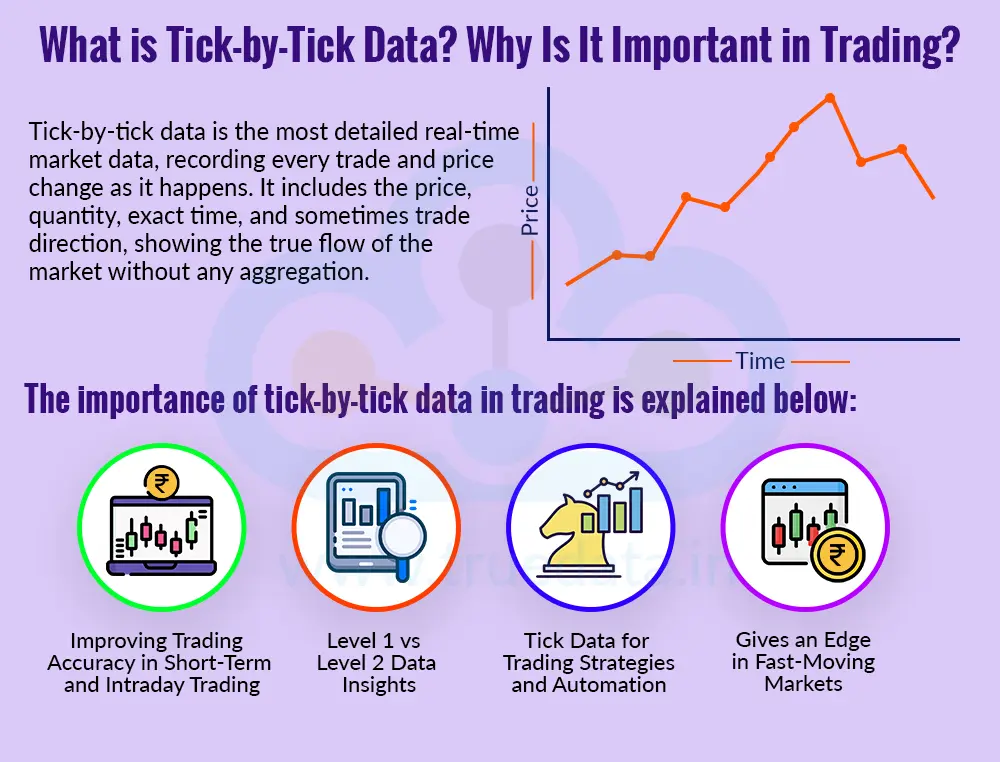
What is Tick-by-Tick Data? Why Is It Important in Trading?

What is Tick-by-Tick Data? Why Is It Important in Trading

Tick-by-tick data is the most detailed form of real-time market data, where every single trade and price change in a security is recorded exactly when it happens. Each tick usually contains the transaction price, traded quantity, precise time, and sometimes the direction of the trade. This data is often referred to as time and sales data and reflects the true flow of trades in the market. Unlike candle charts or summary data, tick-by-tick data does not aggregate information, but it shows the market tick after tick, making it a core part of intraday market data for active investors and traders.

The importance of tick-by-tick data in trading is explained below.

Understanding Order Flow and Price Movement

Tick-by-tick data plays a key role as order flow data, helping traders understand how buying and selling are actually happening in the market. Instead of just seeing price levels, traders can observe whether trades are happening aggressively or quietly. This insight supports better tick data for price discovery, especially during volatile sessions in indices like Nifty and Bank Nifty.

Improving Trading Accuracy in Short-Term and Intraday Trading

Tick-by-tick data is especially useful for intraday traders, scalpers, and those using algorithmic or quantitative trading systems because it provides real-time market data at the most detailed level. By analysing time and sales data and order-flow data, traders can spot quick price fluctuations, breakout attempts, and sudden shifts in demand or supply as they happen. Unlike aggregated charts, tick data reflects actual trades, which helps in improving trading accuracy with tick data by allowing better-timed entries and exits. This makes tick data for trading strategies highly effective, particularly in intraday market data and options trading, where even small price differences can have a big impact on profits and losses.

Level 1 vs Level 2 Data Insights

While Level 1 data shows the best bid, ask, and last traded price, Level 2 data goes deeper by showing multiple bid and ask levels. Tick-by-tick data complements both by revealing how quickly prices change and how orders get filled. Together, they help traders judge market depth, liquidity, and short-term strength or weakness more accurately.

Tick Data for Trading Strategies and Automation

Tick-by-tick data forms the backbone of algorithmic trading data and quantitative trading data. Automated systems rely on precise tick movements to trigger trades, manage risk, and optimise execution. For traders building rule-based systems, tick data for trading strategies allows realistic back-testing that includes slippage and sudden price spikes.

Gives an Edge in Fast-Moving Markets

Markets can change direction within seconds, especially during news events or high-volatility sessions. Tick-by-tick data helps traders react faster and make informed decisions based on real-time activity rather than delayed or averaged data. This edge can make a meaningful difference over the long run for serious traders.

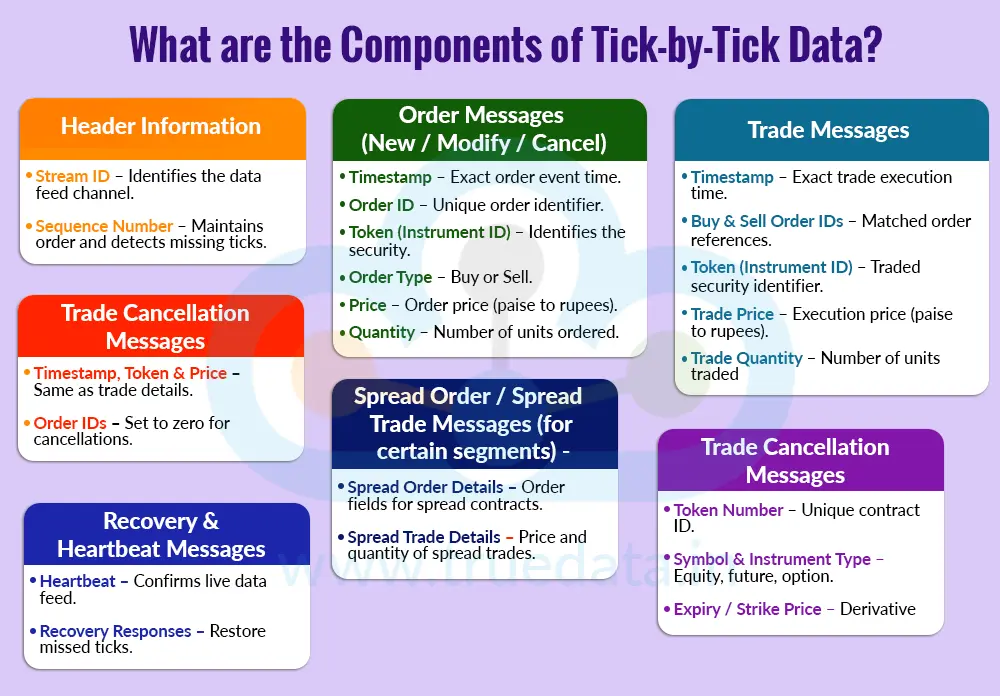
What are the Components of Tick-by-Tick Data?

What are the Components of Tick-by-Tick Data

The tick-by-tick data provides very detailed real-time market information, including both order book changes and actual executed trades. The rich structure supports algorithmic trading data and quantitative trading data models, where every event matters. They allow rigorous tick data processing, help detect anomalies, and improve execution and strategy backtesting. Thus, correctly capturing all fields helps avoid tick data quality issues, latency problems, and supports accurate market analysis. The constituents of the tick-by-tick data include,

  • Header Information - 

This helps systems synchronise and understand the structure of the incoming data. Every tick message starts with a header that includes,

  • Stream ID, which identifies which feed channel the data belongs to.

  • Sequence Number, which helps keep ticks in order and detect missing data.

  • Order Messages (New / Modify / Cancel) - 

These components form order flow data, allowing analysis of how orders enter, modify, or exit the market. These messages represent order-book actions and include,

  • Timestamp, the exact time of the order event (often in nanoseconds).

  • Order ID, i.e., unique identifier for the order.

  • Token (Instrument ID), which identifies the specific stock or derivative contract.

  • Order Type (Buy/Sell), which shows whether the order is to buy or sell.

  • Price, i.e., the order price, in paise (must be converted to rupees).

  • Quantity (number of shares or contracts in the order).

  • Trade Messages - 

This is the real tick data that shows executed trades for tick data for trading strategies and tick data for price discovery. These messages appear whenever a trade (execution) occurs and contain, 

  • Timestamp, which is the precise time when the trade happened.

  • Buy & Sell Order IDs, i.e., reference to the orders that matched.

  • Token (Instrument ID), i.e., specifies the traded security.

  • Trade Price, i.e,  execution price (in paise, needs conversion to rupees).

  • Trade Quantity, i.e., number of units traded.

  • Trade Cancellation Messages - 

Trade cancel messages are essential to maintain tick data quality because genuine executions must be adjusted in downstream analysis. These occur when previously reported trades are cancelled or invalidated,

  • Timestamp, Token, & Price, which are similar to trade messages.

  • Order IDs are set to zero since cancellation refers to the trade itself.

  • Spread Order / Spread Trade Messages (for certain segments) -

These are important for traders analysing complex instruments beyond standard equity trades. In segments like commodity derivatives (CD), specialised messages include, 

  • Spread Order Details, which are similar to normal order fields and are applied to spread contracts.

  • Spread Trade Details, which capture the price and quantity of spread executions.

  • Contract Master Data - 

Without masters, raw tick fields cannot be mapped to meaningful security names or types. To interpret tick messages correctly, applications must load Master Data Files that list details such as -

  • Token number (unique ID for each contract).

  • Symbol & Instrument Type (e.g., equity, future, option).

  • Expiry Date / Strike Price (for derivatives).

  • Recovery & Heartbeat Messages -

These are special control messages that help with tick data processing and keep feeds robust in case of latency in tick data or packet loss. This includes, 

  • Heartbeat, which confirms the feed is live.

  • Recovery Responses that help reconnect or recover missed ticks if there’s a data gap.

How to Analyse Tick-by-Tick Market Data?

How to Analyse Tick-by-Tick Market Data

Tick-by-tick data records every single trade and price change that happens in the market, including price, time, volume, and sometimes bid-ask details. Unlike 1 min 5 min charts, tick data does not group trades together. Each transaction is one ‘tick’. This makes it very powerful, but also very heavy and complex to analyse. It shows the true behaviour of buyers and sellers in real time.

The analysis of tick-by-tick market data is explained below.

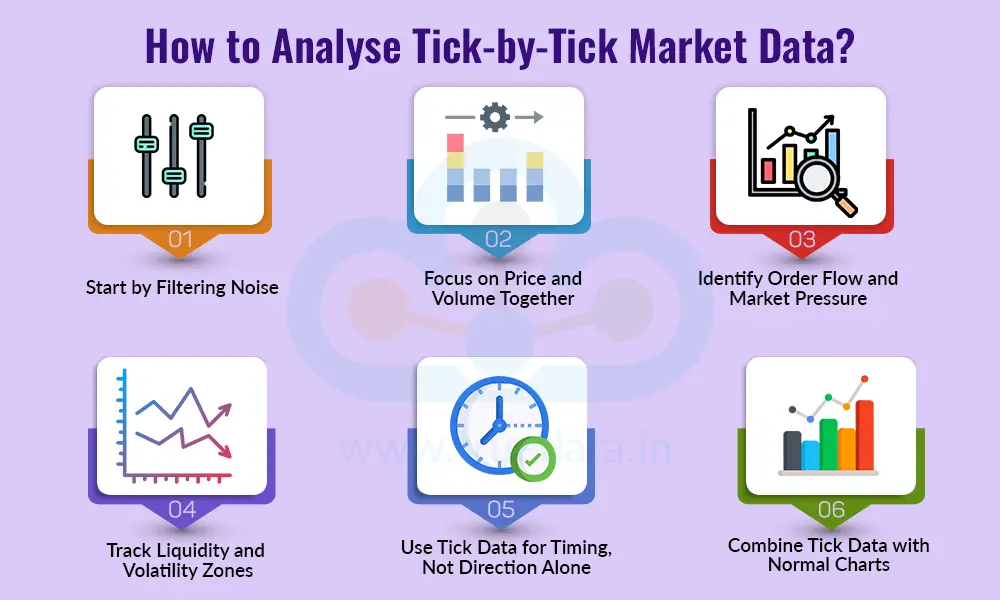
  1. Start by Filtering Noise - Raw tick data is extremely noisy. Thousands of trades can happen in seconds, especially in stocks like Reliance, Bank Nifty, or Nifty futures. If you look at raw ticks directly, it will feel chaotic and confusing. The first step is filtering, i.e., grouping ticks into small units like volume bars, time bars (1-second, 5-second), or price movement bars. This makes patterns visible and removes meaningless fluctuations that can distract decision-making.

  2. Focus on Price and Volume Together - Tick data becomes powerful only when price and volume are analysed together. A price move with low volume usually means weak interest, while a price move with heavy volume shows strong buying or selling pressure. For example, if the price is rising but the volume per tick is falling, it may signal exhaustion. If the price breaks a level with strong tick volume, it shows genuine participation and higher reliability.

  3. Identify Order Flow and Market Pressure - Tick data helps you understand who is in control, i.e, buyers or sellers. Continuous aggressive buying at the ask price shows bullish pressure, while repeated selling at the bid shows bearish pressure. This is called order flow analysis. Even for retail traders, simply observing repeated buy ticks or sell ticks near key levels gives insight into whether a breakout is real or fake.

  4. Track Liquidity and Volatility Zones - Tick data shows where the market is active and liquid. Areas with many ticks and high volume are zones of strong interest (support/resistance zones). Areas with low tick activity show a lack of interest and are prone to sudden spikes. Traders use this to avoid entries in low-liquidity zones and focus on high-participation levels where price behaviour is more reliable.

  5. Use Tick Data for Timing, Not Direction Alone - Tick-by-tick analysis is best used for entry and exit timing, not for long-term direction prediction. Direction comes from higher timeframe charts, fundamentals, or macro view. Tick data helps you refine execution by understanding better entry price, better stop placement, and better exit timing. This is especially useful for intraday traders, scalpers, and F&O traders.

  6. Combine Tick Data with Normal Charts - Tick data should never be used alone. The best approach is to combine it with 5-min, 15-min, or daily charts. Higher timeframes give structure and trend, while tick data gives precision. Think of it like a map and a microscope, where charts show the road, and tick data shows the surface details.

How is Tick-by-Tick Data Used in Different Markets?

How is Tick-by-Tick Data Used in Different Markets

Tick-by-tick data is a form of real-time market data that captures every trade, quote change, and transaction as it happens. It includes time and sales data, bid-ask updates, and volume at each price point. While the structure of tick data is similar across markets, its practical use differs because of variations in liquidity, trading hours, participant behaviour, and regulation. This is why tick data for price discovery looks very different in equities, derivatives, currencies, and crypto.

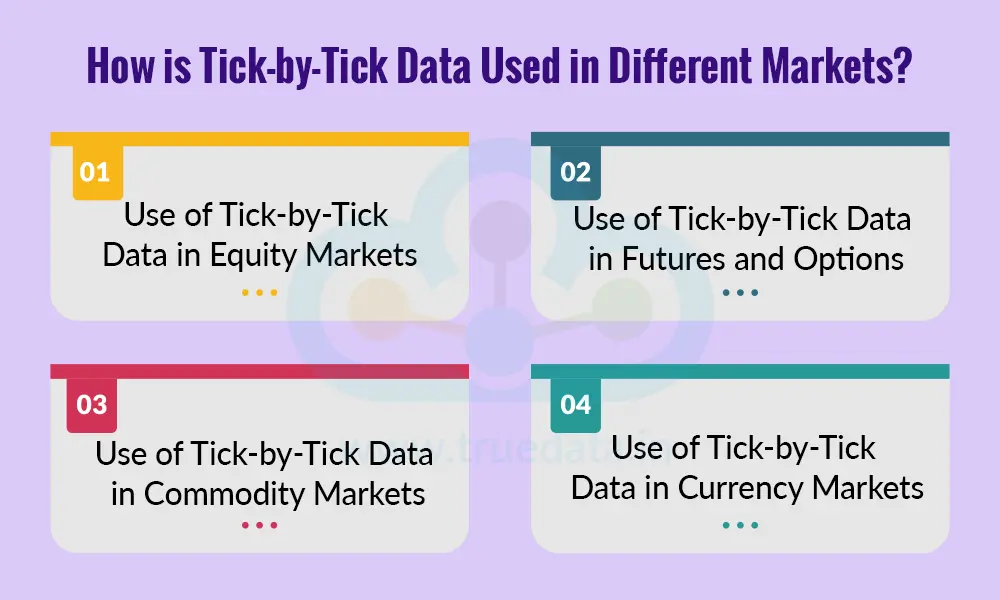
Use of Tick-by-Tick Data in Equity Markets

In equity markets, tick-by-tick data is mainly used as intraday market data to understand short-term price movements and liquidity. Traders analyse order flow data to see whether buying or selling pressure is stronger and how prices react to large trades. Comparing Level 1 vs Level 2 data helps traders see not just the last traded price, but also the depth of demand and supply. Tick data for trading strategies such as scalping and momentum trading can improve entry and exit timing. However, long-term investors usually gain limited benefits from tick data analysis and prefer daily or weekly data for decision-making.

Use of Tick-by-Tick Data in Futures and Options

In futures and options, tick-by-tick data is a core input for algorithmic trading data and quantitative trading data models. Because derivatives are leveraged instruments, even small price changes matter. Tick data helps traders track rapid changes in volume, aggressive buying or selling, and sudden shifts in sentiment. In highly active contracts like index futures and options, improving trading accuracy with tick data becomes important, especially during expiry sessions or volatile periods. Traders rely heavily on time and sales data and order flow to avoid false breakouts and manage risk better.

Use of Tick-by-Tick Data in Commodity Markets

Commodity markets react sharply to global news, weather updates, and inventory data. Tick-by-tick data allows traders to observe how prices respond second by second, offering strong benefits of tick-by-tick data during volatile sessions. Order flow and time-based analysis help traders detect unusual activity and manage risk when prices move suddenly. Tick data also improves price discovery, especially when new information enters the market.

Use of Tick-by-Tick Data in Currency Markets

Currency markets operate with tight spreads and high liquidity, making tick-by-tick data ideal for studying execution quality and latency in tick data. Traders focus less on big price moves and more on how smoothly trades are executed during fast market conditions. In Indian currency derivatives, tick data supports short-term trading strategies and helps traders avoid poor fills during news events. The advantages of tick data analysis come mainly from better timing rather than long-term trend prediction.

What are the Pros and cons of Tick-by-Tick Data? 

The pros and cons of using tick-by-tick data are highlighted below.

What are the Pros and cons of Tick-by-Tick Data

Benefits of Tick-by-Tick Data

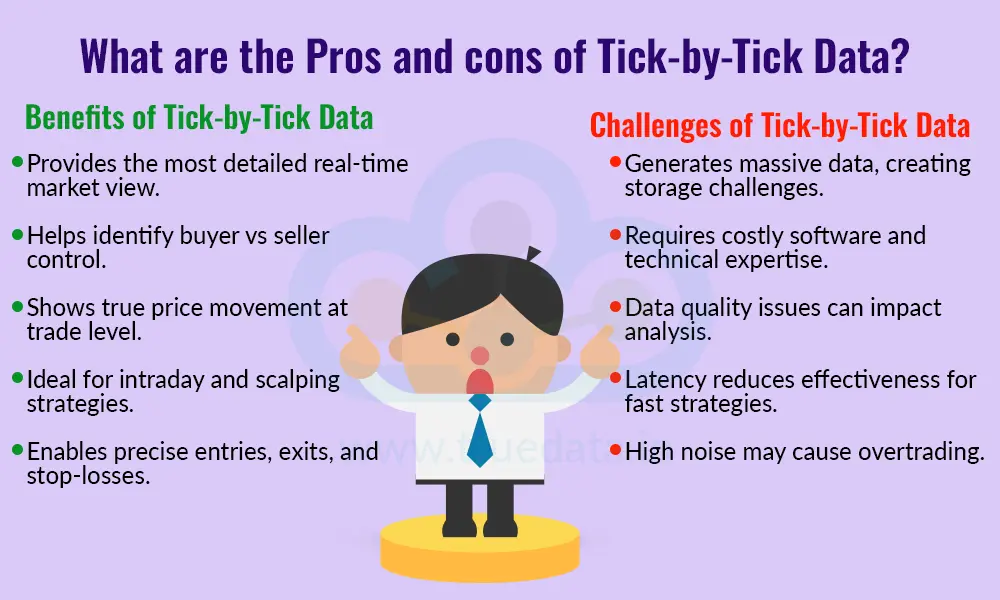
  • Tick-by-tick data provides the most detailed form of real-time market data, showing every trade and price change as it happens.

  • It helps traders understand order flow data, making it easier to see whether buyers or sellers are in control.

  • Tick data improves price discovery by revealing how prices move at the transaction level, not just at candle close.

  • It supports intraday market data analysis, which is useful for scalping and short-term trading.

  • Tick-by-tick data improves trading accuracy by allowing more precise entries, exits, and stop-loss placement.

  • It is essential for algorithmic trading data and quantitative trading data used in automated strategies.

  • Tick data helps in realistic backtesting, as it captures slippage and execution behaviour more accurately.

Challenges of Tick-by-Tick Data

  • Tick-by-tick data generates a very large volume of information, leading to tick data storage issues.

  • Tick data processing requires advanced software, fast systems, and technical knowledge, which can be costly.

  • There are common tick data quality issues, such as missing ticks or incorrect timestamps, that can affect analysis.

  • Latency in tick data can reduce its usefulness, especially for very fast trading strategies.

  • Tick data contains a lot of short-term noise, which can lead to overtrading and emotional decisions.

  • Managing and analysing tick data involves the challenge of managing large financial datasets, which is difficult for many retail traders.

  • Tick-by-tick data may distract long-term investors from focusing on fundamentals and bigger market trends.

  • The cost of reliable tick data feeds and platforms can be high for individual investors.

Conclusion

Tick-by-tick data breaks down real-time market data in the most detailed formand offers deep insight into price discovery, order flow, and short-term market behaviour. It is especially useful for intraday traders, scalpers, derivatives traders, and those using algorithmic or quantitative trading strategies, as it can improve trading accuracy and execution decisions. Tick data also comes with clear challenges, such as high noise, data quality issues, latency, and the difficulty of storing and processing large financial datasets. Hence, tick-by-tick data should be used selectively and with discipline.

This article focuses on the importance of tick-by-tick data and helping traders implement strategic trading plans through its in-depth understanding. Let us know your thoughts on the topic or if you need further information on the same, and we will address it soon. 

Till then, Happy Reading!


Read More: SEBI Norms on Sharing Real-Time Price Data

Frequently Asked Questions

Tick-by-tick data records every single trade and price change in real time, while minute or OHLC data only shows the open, high, low, and close price for a fixed time period, like 1 or 5 minutes. Tick data gives much deeper detail for intraday traders, whereas OHLC data is simpler and more suitable for most investors and long-term analysis.

Tick datasets usually include the exact time of the trade, traded price, traded quantity (volume), and buy-sell indicator for each transaction. Some datasets also include bid and ask prices, order book depth, and trade IDs, which help traders study order flow and execution.

Yes, tick-by-tick data is usually more expensive than minute or daily data because it is very detailed, high-volume, and requires fast systems to deliver and process it.

Tick-by-tick data is used in backtesting to simulate trades as they would have happened in real time, including exact prices, volumes, and order flow. This helps traders test strategies more accurately by capturing slippage, execution delays, and realistic trading conditions.

Traders can start by using tick data only for simple intraday strategies and by focusing on understanding price and volume behaviour rather than every small move. The essentials include choosing a reliable data provider, using proper tools to handle the data, and always combining tick analysis with clear rules and risk management.

Validating strategies on tick data includes backtesting them on large and clean tick datasets across different market conditions, not just one period. It is also important to include realistic costs, such as slippage and brokerage, to check whether the strategy works consistently in real trading.

Tick-by-tick data is best suited for intraday traders, scalpers, and algorithmic traders who need very detailed and real-time market information for precise entries and exits. Most long-term investors may not need tick data and are better off using higher time-frame charts and fundamentals.
Marisha Bhatt

Marisha Bhatt is a financial content writer @TrueData.

She writes with the sole aim of simplifying complex financial concepts and jargon while attempting to clarify technical and fundamental analysis concepts of the stock markets. The ultimate goal is to spread vital knowledge and benefit the maximum audience. Her Chartered Accountant background acts as the knowledge base to help clarify crucial concepts and create a sound investment portfolio.

0 Comments