Selecting stocks through fundamental analysis can be a time-consuming process, especially for beginners who may find it challenging to evaluate multiple financial factors. But what if there were a simple score that could help identify companies that combine strong business performance with attractive valuations? Enter the Magic Formula Score! This score combines two important metrics, Return on Invested Capital (ROIC) and Earnings Yield, to help investors screen and compare stocks based on profitability and valuation. But how does the Magic Formula Score work, and how can investors use it as part of their fundamental analysis? Check out our blog to understand the Magic Formula Score and explore how it can help you evaluate stocks more systematically.

The Magic Formula Score is a stock-screening approach based on the Magic Formula Investing strategy developed by Joel Greenblatt. The strategy aims to identify companies that combine strong business performance with relatively attractive valuations. It does this by considering two important factors, i.e., Earnings Yield, which helps assess how attractively a company is valued based on its operating earnings, and Return on Capital (ROC), which indicates how efficiently the company generates operating profits from the capital used in its business. Companies are ranked on these factors, and the rankings are combined to identify stocks that score well on both measures.
The concept was popularised by Joel Greenblatt in his 2005 book, The Little Book That Beats the Market. Greenblatt's approach is based on the idea of looking for ‘good companies’ available at relatively ‘bargain’ prices rather than relying on valuation or profitability alone. It is important to remember that the Magic Formula is a screening methodology, not a guarantee of investment returns. Also, the exact calculation can vary across financial platforms because they may use different definitions or adjustments for Earnings Yield and ROC.
The Magic Formula Score can serve as a starting point for screening and comparing companies. A company that ranks well under the methodology generally combines relatively strong capital efficiency with an attractive valuation.
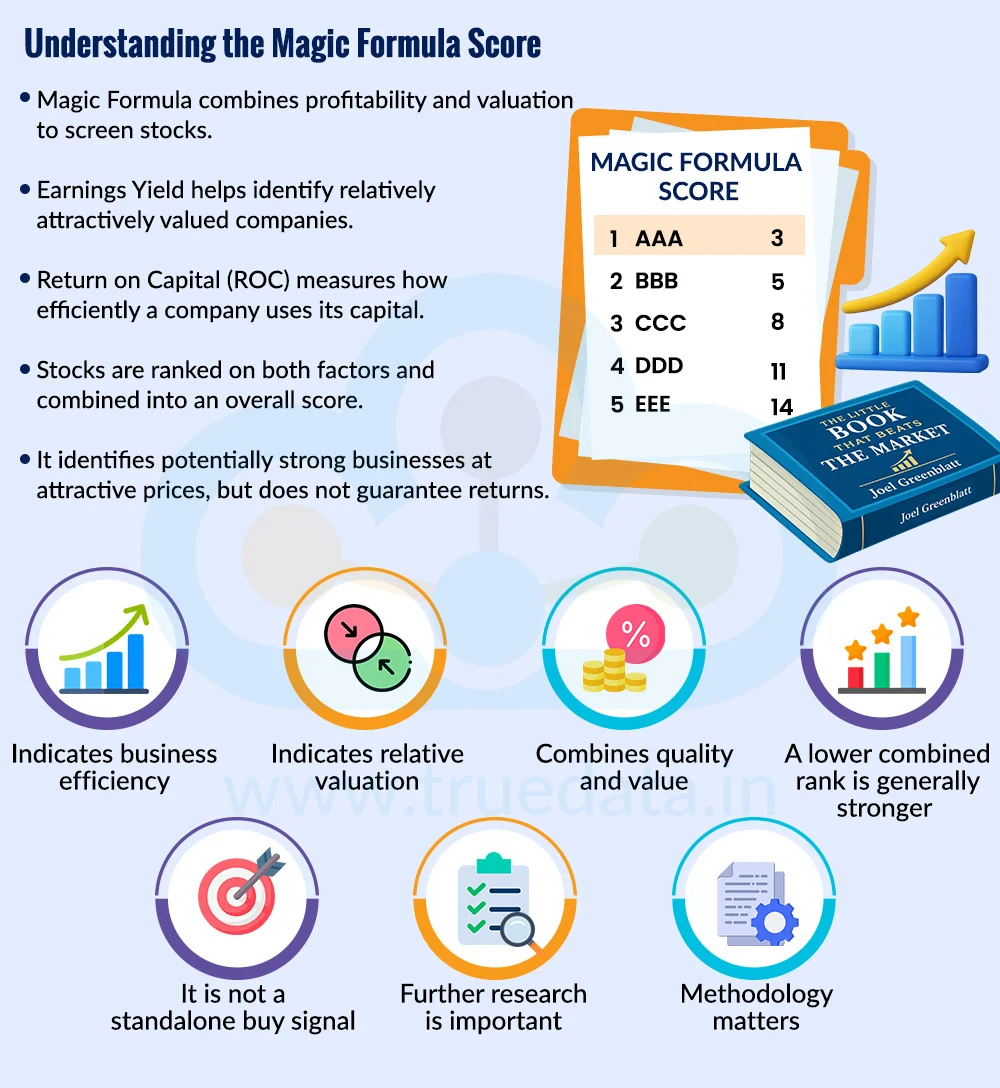
Indicates business efficiency - A strong ROC suggests that the company is generating relatively good operating returns from the capital used in its business.
Indicates relative valuation - A higher Earnings Yield generally suggests that the company's operating earnings are relatively high compared with the price or enterprise value investors are paying.
Combines quality and value - The approach considers both how good the business is and how attractively it is valued.
A lower combined rank is generally stronger - In the ranking-based approach, companies receive separate ranks for their Earnings Yield and ROC, which are combined. A lower overall rank represents a stronger position within the screened universe.
It is not a standalone buy signal - A strong Magic Formula ranking does not guarantee that a stock will generate returns or suit an individual investor's objectives.
Further research is important - Investors should also examine revenue and profit growth, debt, cash flows, competitive advantages, management quality, corporate governance and industry conditions before making an investment decision.
Methodology matters - If a stock-screening platform displays a ‘Magic Formula Score’, investors should check how that platform calculates the score, as its methodology may differ from Greenblatt's original approach.
The Magic Formula developed by Joel Greenblatt combines two factors to identify companies that are relatively profitable and attractively valued, i.e., Return on Capital (ROC) and Earnings Yield. Greenblatt's methodology ranks companies separately on these two factors and then combines the rankings. Therefore, the Magic Formula does not simply add the two percentage values together to produce a score.

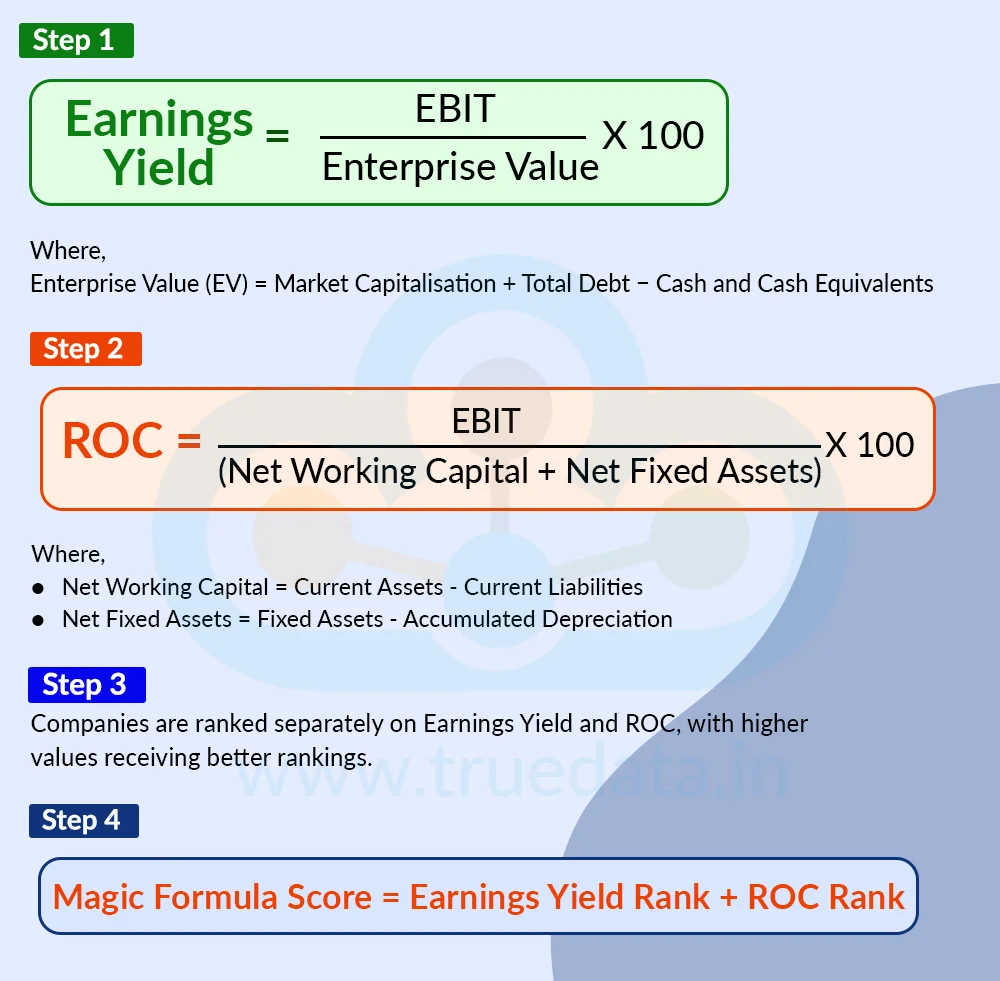
Step 1 - Calculate Earnings Yield
Earnings Yield measures how much operating earnings a company generates compared with the value investors are paying for the business.
Earnings Yield = EBIT / Enterprise Value * 100
Where,
Enterprise Value (EV) = Market Capitalisation + Total Debt - Cash and Cash Equivalents
Step 2 - Calculate Return on Capital (ROC)
ROC measures how efficiently a company uses the capital required to operate its business to generate operating profits.
ROC = EBIT ÷ (Net Working Capital + Net Fixed Assets) * 100
Where,
Net Fixed Assets = Fixed Assets - Accumulated Depreciation
Important Note -
Greenblatt's original methodology makes certain accounting adjustments to the commonly used measures so that companies can be compared more meaningfully. Therefore, the simplified formulas above are useful for explaining the concept, but the exact calculation used by a particular stock screener may differ.
Step 3 - Rank the Companies
Once Earnings Yield and ROC have been calculated for the companies in the investment universe, they are ranked separately. A company with a higher Earnings Yield receives a better ranking, while a company with a higher ROC also receives a better ranking.
Step 4 - Combine the Rankings
Magic Formula Score = Earnings Yield Rank + ROC Rank
Companies that rank well on both factors receive a stronger overall position in the Magic Formula ranking.
Understanding the Calculation of Magic Formula Score
Consider Peach Ltd. with the following details,
EBIT = Rs. 600 crore
Market Capitalisation = Rs. 5,000 crore
Total Debt = Rs. 1,000 crore
Cash and Cash Equivalents = Rs. 500 crore
Net Working Capital = Rs. 1,500 crore
Net Fixed Assets = Rs. 2,500 crore

Step 1 - Calculate Earnings Yield
EV = Rs. 5,000 crore + Rs. 1,000 crore - Rs. 500 crore = Rs. 5,500 crore
Therefore,
Earnings Yield = Rs. 600 crore / Rs. 5,500 crore * 100 = 10.91%
Step 2 - Calculate Return on Capital (ROC)
ROC = Rs. 600 crore / (Rs. 1,500 crore + Rs. 2,500 crore) * 100 = 15%
Step 3 - Rank the Companies
If an investor is comparing 100 companies,
Step 4 - Combine the Rankings
Magic Formula Score = Earnings Yield Rank + ROC Rank
Using the above example,
Company A - 15 + 10 = 25
Company B - 25 + 5 = 30
Company C - 50 + 25 = 75
Thus, Company A has the lowest combined ranking among these three companies.

The Magic Formula is more than just a way of ranking stocks. Joel Greenblatt's approach also provides a systematic way to build and manage a portfolio. The original methodology focuses on companies with high Return on Capital (ROC) and high Earnings Yield, ranks them together, and then uses a diversified portfolio and a disciplined holding period.
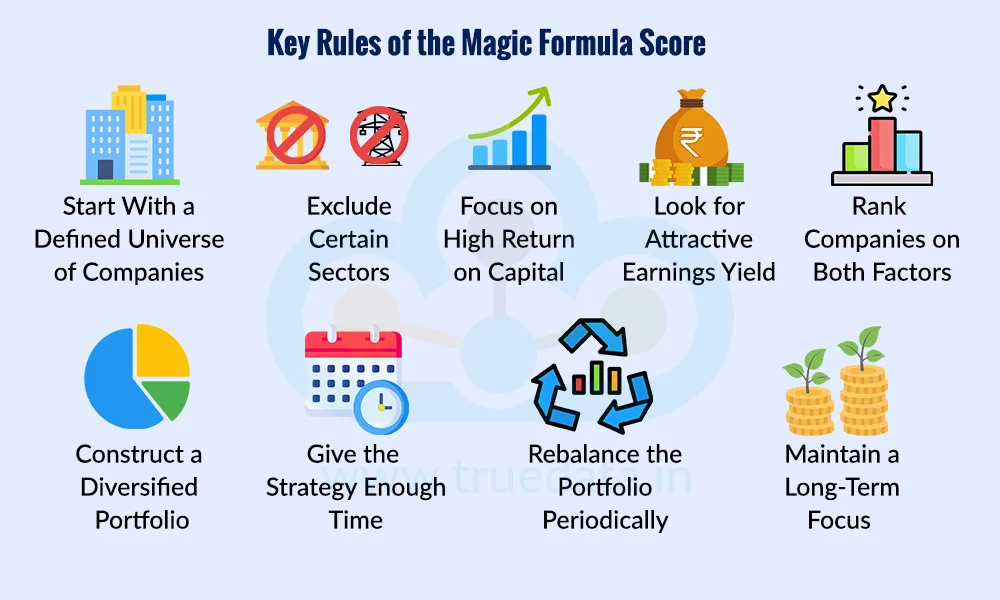
Start With a Defined Universe of Companies - Investors should include companies above a specified minimum market capitalisation, such as $50 million, $100 million or $200 million, depending on the version of the strategy being followed. The purpose is to avoid very small companies and focus on businesses with an established market presence.
Exclude Certain Sectors - Exclude financial and utility companies from the screening process. These businesses have financial structures and accounting characteristics that can make measures such as Earnings Yield and Return on Capital difficult to compare with those of typical operating companies. For example, banks and NBFCs use debt differently from manufacturing or technology companies, while utilities can have distinctive capital structures and regulatory environments.
Focus on High Return on Capital - The first major factor is Return on Capital (ROC). It is intended to identify companies that generate relatively high operating profits from the tangible capital required to run their businesses. A higher ROC generally gives a company a better ranking. In simple words, the approach looks for businesses that can generate substantial operating profits without requiring disproportionately large amounts of operating capital.
Look for Attractive Earnings Yield - The second major factor is Earnings Yield. Enterprise Value generally considers the market value of equity as well as debt and cash. A higher Earnings Yield generally means investors are paying a lower price relative to the company's operating earnings, all else being equal.
Rank Companies on Both Factors - Investors should not simply add the ROC percentage and Earnings Yield percentage. Instead, rank companies separately on each measure. The two ranks are then added to obtain a combined ranking. A lower combined rank represents a stronger position under the Magic Formula methodology.
Construct a Diversified Portfolio - The strategy is generally implemented by investing in approximately 20-30 of the highest-ranked companies, rather than putting the entire investment into one or two stocks. This helps spread company-specific risk, although the appropriate number of holdings depends on the investor's capital, risk tolerance and overall portfolio.
Give the Strategy Enough Time - The Magic Formula is designed as a long-term approach, not a short-term trading strategy. Greenblatt's official website says investors should be prepared to commit to the system for at least three years, while the book discusses continuing the process for several years. Therefore, investors should not assume that a stock with a high Magic Formula ranking will immediately outperform. The strategy can experience periods of underperformance.
Rebalance the Portfolio Periodically - The original methodology uses approximately a one-year holding period before reviewing the portfolio and replacing stocks with new Magic Formula selections. Thus, investors should periodically reassess whether the companies still qualify under the latest data rather than continuously buying and selling whenever the ranking changes slightly.
Maintain a Long-Term Focus - The Magic Formula is intended to be followed over a multi-year period, rather than being used to predict short-term price movements. A commitment of at least three to five years gives the strategy time to work through periods when highly ranked stocks may underperform the broader market. Investors should therefore avoid abandoning the approach simply because individual holdings or the overall strategy perform poorly over a short period.
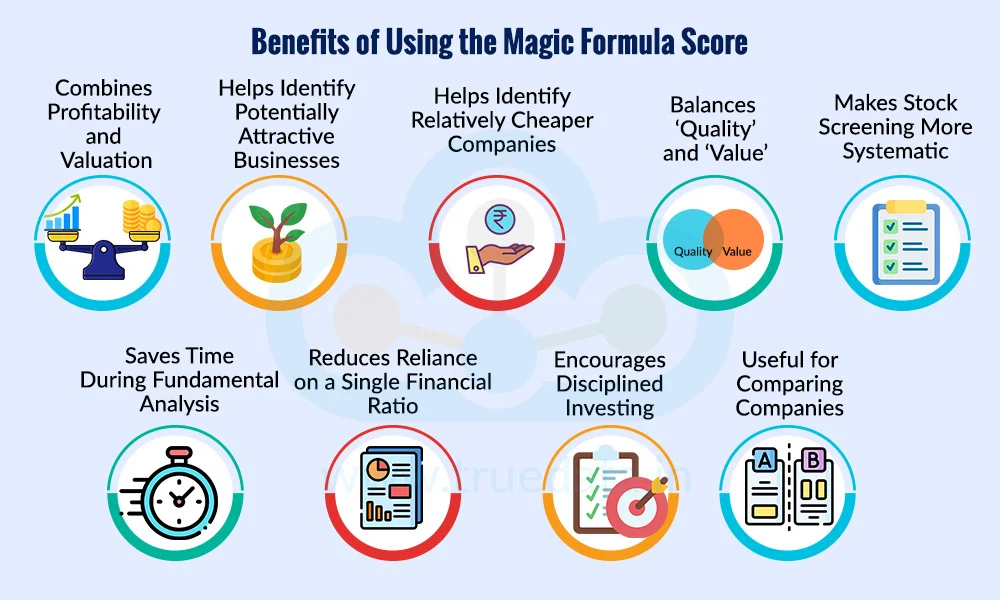
The Magic Formula Score can be useful to investors because it provides a systematic way to screen companies using two important aspects of fundamental analysis, i.e., business profitability and valuation. Instead of analysing hundreds of stocks from scratch, investors can use the approach to create a smaller list of companies that may deserve further research. Some of the key reasons for using the Magic Formula Score include,

Combines Profitability and Valuation - The Magic Formula considers Return on Capital (ROC) and Earnings Yield together. ROC focuses on how efficiently a company uses capital to generate operating profits, while Earnings Yield provides an indication of how attractively the company is valued relative to its operating earnings.
Helps Identify Potentially Attractive Businesses - A company with a relatively high ROC is generating strong operating returns compared with the capital required to run its business. This can help investors identify businesses that have demonstrated efficient use of capital.
Helps Identify Relatively Cheaper Companies - A higher Earnings Yield generally indicates that a company's operating earnings are relatively high compared with its enterprise value. This can help investors identify companies that appear relatively inexpensive based on this particular measure.
Balances ‘Quality’ and ‘Value’ - Looking only for cheap stocks can result in companies that are inexpensive because their businesses face problems. Similarly, looking only for highly profitable companies can result in paying a high price for a good business. The Magic Formula attempts to consider both factors at the same time.
Makes Stock Screening More Systematic - Investors can apply the same criteria to a large number of companies instead of selecting stocks based mainly on intuition or personal preferences. This can make the initial screening process more structured.
Saves Time During Fundamental Analysis - Analysing every financial and operational aspect of hundreds of listed companies can take considerable time. The Magic Formula can act as a first-level filter, helping investors focus their detailed research on a smaller group of companies.
Reduces Reliance on a Single Financial Ratio - No single ratio provides a complete picture of a company. By combining ROC and Earnings Yield, the Magic Formula considers both operating efficiency and valuation rather than relying on only P/E, ROE or another individual metric.
Encourages Disciplined Investing - As the methodology is based on predefined rules, it can help investors follow a consistent screening process instead of frequently changing their criteria based on short-term market movements.
Useful for Comparing Companies - Investors can rank companies based on the two factors and compare their relative positions within a selected investment universe. This can be particularly useful when an investor has a large number of potential stocks to analyse.
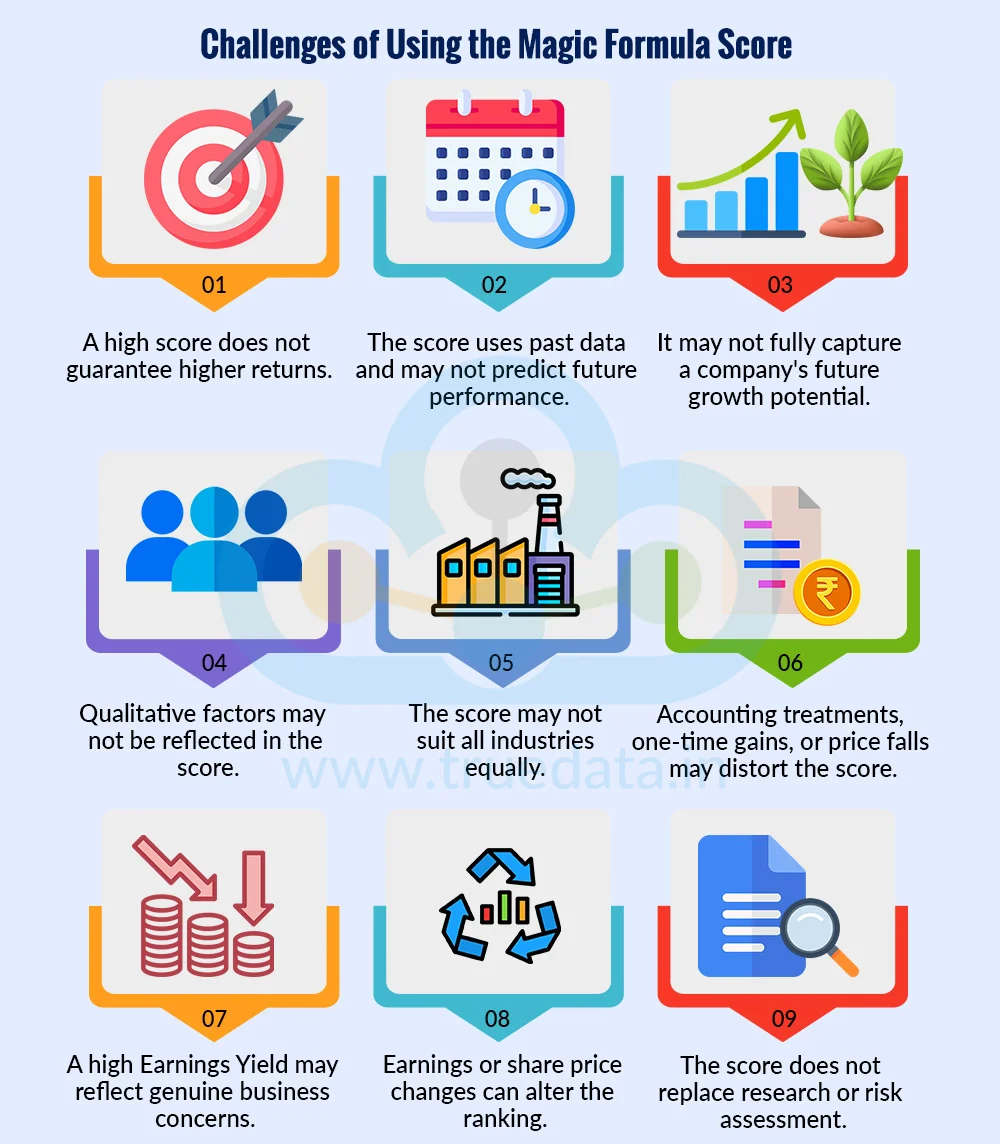
While the Magic Formula Score can be a useful stock-screening tool, it has some limitations that investors should consider. These limitations include,

A high score does not guarantee better investment returns.
The score is based on past data and may not reflect future business performance.
It may not fully capture a company's future growth potential.
Qualitative factors like management, governance, brand strength and competitive advantages may not be reflected.
The score has sector-specific limitations as it may not be equally suitable for all industries.
Different accounting treatments and one-time gains or a temporary price fall can affect the score and distort it.
Cheap does not always mean undervalued, and a high Earnings Yield may reflect genuine business concerns.
Changes in earnings or share prices can alter a company's ranking.
The score does not replace research, and investors should consider financials, valuation, risks and business quality before investing.
The Magic Formula Score offers investors a simple and systematic way to screen stocks by combining Return on Capital (ROC) and Earnings Yield. It can help narrow down the list of companies that may offer a combination of efficient business performance and attractive valuation. However, the score should be treated as a starting point rather than a final investment decision. Investors should also study a company's financial performance, growth prospects, debt, cash flows, management quality, valuation and industry outlook before investing.
This article explains yet another concept of fundamental analysis in detail and is an attempt to simplify it for our readers. Let us know your thoughts on the topic, or if you need further information, and we will address it soon.
Till then, Happy Reading!
Read More: What are the Retention Ratio and Sustainable Growth Rate?
When you invest in a company, you probably look at its profits, revenue growth, ...
Thestock market never stands still, and prices swing constantly with every new h...
Corporate data is more than just the numbers of a company. They can show what is...