15-MIN DELAYED
NIFTY 23,462.40 -172.70 (-0.73%) | BANKNIFTY 56,379.60 -397.95 (-0.70%) | SENSEX 74,895.36 -682.22 (-0.90%) | CRUDEOIL-I 9,025.00 +291.00 (+3.33%) | GOLD-I 1,53,067.00 +462.00 (+0.30%) | NIFTY 23,462.40 -172.70 (-0.73%) | BANKNIFTY 56,379.60 -397.95 (-0.70%) | SENSEX 74,895.36 -682.22 (-0.90%) | CRUDEOIL-I 9,025.00 +291.00 (+3.33%) | GOLD-I 1,53,067.00 +462.00 (+0.30%) |
TrueData
Helpline / Support +91 7304-22-44-66
Get started

WORKSPACE

Workspace overview Workspace overview Our flagship product SignalX SignalX web charting for indian market Sheets Sheets streaming spreadsheet Wealth Wealth corporate data and news


Built for India's markets.

Real-time charts, streaming spreadsheets, live corporate announcements — all in one workspace.

Get started free
Mutual Funds

Gen Z Guide to Smart Mutual Fund Investing

Marisha Bhatt · 08 Sep 2026 · 16 mins read · 0 Comments

gen-z-guide-to-smart-mutual-fund-investing

Every generation approaches money differently. While most Indians grew up believing that saving was the key to financial security, investing often took a back seat. Gen Z, however, is rewriting that story. Growing up in a digital-first world with easy access to financial information, investment apps, and market insights, this generation is more curious than ever about building wealth from an early age. If you are a Gen Z investor wondering how to make your money work harder, mutual funds can be a great place to begin. They offer a simple and disciplined way to invest, even if you are just starting your financial journey. So dive into this blog where we walk you through the basics of smart mutual fund investing, practical tips to choose the right funds, and strategies to build a portfolio that aligns with your financial goals.

How Do Gen Zs Differ in Mutual Fund Investing Than Previous Generations?

How Do Gen Zs Differ in Mutual Fund Investing Than Previous Generations

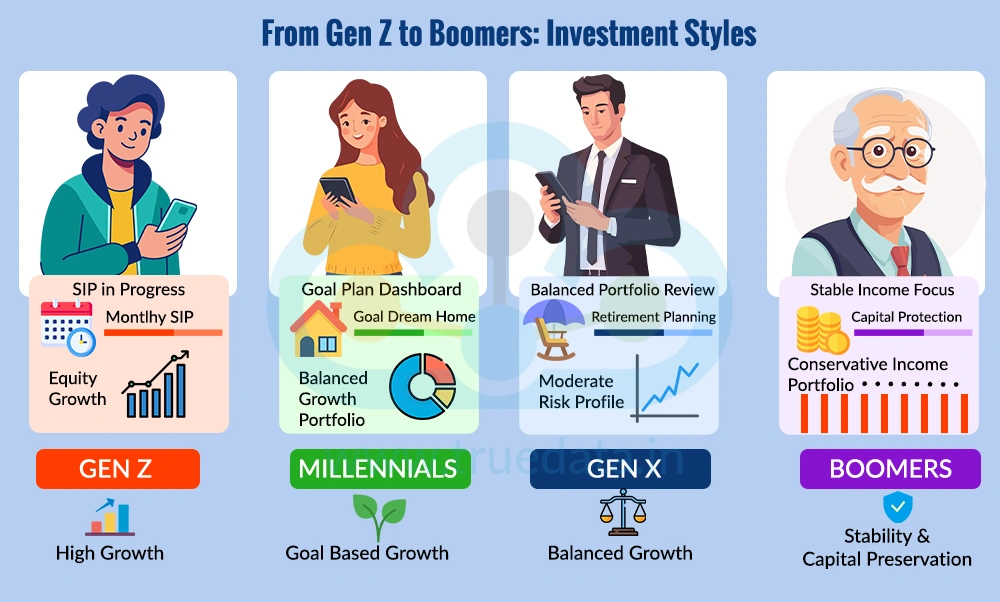
Although there is no official AMFI report that directly compares Gen Z, Millennials, Gen X, and Baby Boomers, industry data and investor behaviour clearly show that each generation approaches mutual fund investing differently. The differences are driven by age, income, financial goals, risk appetite, and familiarity with technology rather than the investment product itself.

Investment Pattern in Mutual Funds Across Generations

Investment Pattern in Mutual Funds Across Generations

Particulars

Generations 

Gen Z (Born 1997-2012)

Millennials (Born 1981-1996)

Gen X (Born 1965-1980)

Boomers (Born 1946-1964)

Age Bracket

13-28 years

29-44 years

45-60 years

60+ years

Primary Goal

Wealth building, early start

Wealth creation + family goals

Retirement planning + wealth preservation

Regular income + capital preservation

Investment Horizon

20-40 years

15-30 years

5-20 years

Usually less than 10 years

Preferred Fund Type

Equity, index, mid/small cap

Flexi-cap, large-cap, index, ELSS

Balanced, hybrid, debt

Debt, Conservative Hybrid, Income-oriented funds

Investment method

Mostly SIPs through apps

SIPs with goal-based investing

Mix of SIPs and lump sum

Often lump sum investments

Average SIP Amount

Rs. 1000

Rs. 5000-Rs. 10000

Above Rs. 10000

Varies

Risk Appetite

high

Moderate to High

Moderate

Low

Information Source

Social media, YouTube, fintech apps

Online research, advisors

Financial advisors, newspapers

Advisors, bank relationship managers

Technology adoption

Very high

High

Moderate

Comparatively lower 

Percentage of Investors that Started Investing Early

30% in college/early adulthood

15%

9%

6%

Mutual fund investing across different generations is shaped by their age, financial goals, and comfort with risk. Gen Z is entering the mutual fund space much earlier than previous generations, with many starting to invest during college or soon after beginning their careers. They are highly comfortable using digital investment platforms, prefer investing through  SIPs, and often choose equity-oriented mutual funds, including index funds, mid-cap, and small-cap funds, to benefit from long-term wealth creation. At the same time, many Gen Z investors remain cautious about financial uncertainty and therefore begin with small SIP amounts while balancing the need for growth with financial security.

Millennials, on the other hand, form the largest group of mutual fund investors in India and typically invest for long-term goals such as buying a home, funding their children's education, and retirement planning. As they move into their peak earning years, many invest larger amounts and maintain a balanced portfolio across large-cap, flexi-cap, index, and hybrid funds. Gen X investors generally focus on preserving wealth while continuing to generate reasonable returns, making hybrid and balanced funds popular choices. Baby Boomers are usually the most conservative investors, preferring debt-oriented and income-generating mutual funds to protect their capital and meet regular income needs during retirement.

What unites all four generations, however, is the growing recognition of mutual funds. Across their vast spectrum from liquid funds to small-cap equity funds, mutual funds offer something for every investor at every life stage. Thus, the instrument is the same, and what changes is the generation, the goal, the risk appetite, and the platform through which they invest.

Why are Mutual Funds a Great Investment Choice for Gen Z?

Why are Mutual Funds a Great Investment Choice for Gen Z

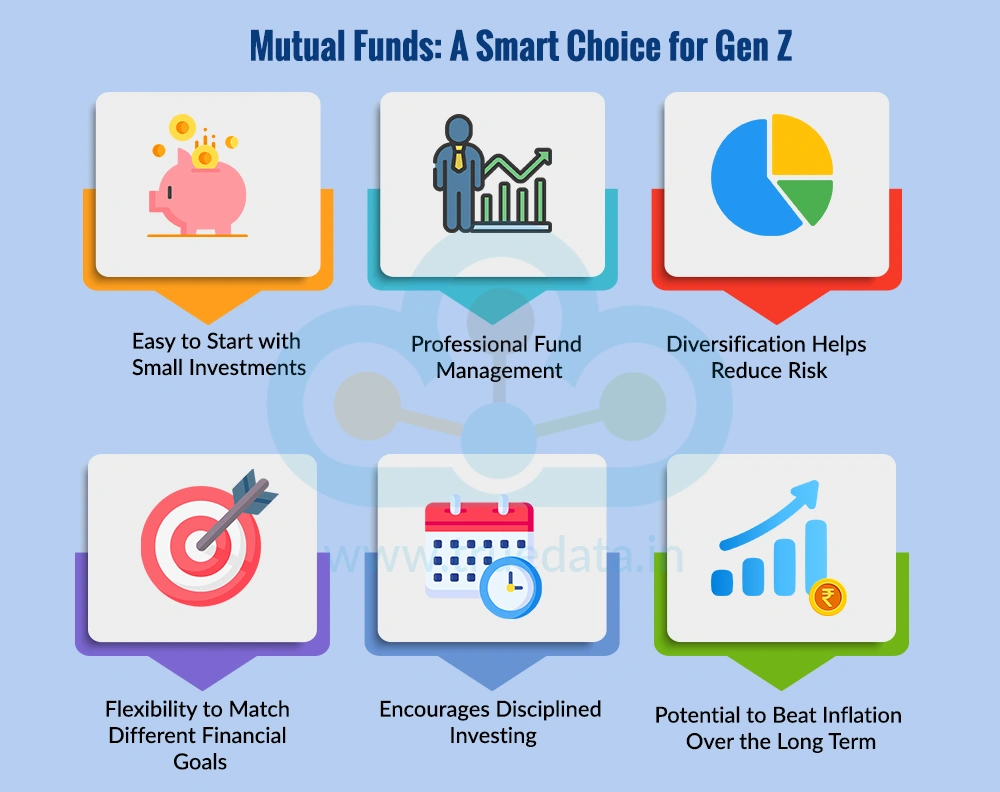
The mutual fund landscape in India is changing rapidly. The latest AMFI data shows that approximately 80% of the new mutual fund SIP accounts opened in the past two years belong to investors under the age of 35. This shows the increasing awareness among investors and their preference. The reasons that make mutual funds an attractive starting point for Gen Zs' investment journey are discussed below. 

Easy to Start with Small Investments

One of the biggest reasons mutual funds are well-suited for Gen Z is that they do not require a large amount of money to get started. Many mutual fund schemes allow investments through a Systematic Investment Plan (SIP) with relatively small monthly contributions, making them affordable for students, fresh graduates, and young professionals. This enables Gen Z investors to begin their investment journey early without waiting for a high-paying job or significant savings.

Professional Fund Management

Most first-time investors may not have the knowledge or time to research individual stocks and track market movements regularly. Mutual funds solve this problem by pooling money from many investors and investing it under the supervision of experienced fund managers. These professionals analyse companies, monitor market conditions, and make investment decisions on behalf of investors, making mutual funds a convenient option for beginners.

Diversification Helps Reduce Risk

Instead of investing in just one company or sector, mutual funds spread investments across multiple stocks, bonds, or other securities. This is known as diversification. If one investment performs poorly, the impact on the overall portfolio may be reduced because other investments can help balance the returns. Thus, for Gen Z investors who are just starting out, diversification offers a more balanced way to participate in the markets while managing risk.

Flexibility to Match Different Financial Goals

Gen Z investors often have different financial priorities, such as building an emergency fund, pursuing higher education, buying the latest gadget or a vehicle, purchasing a home, or creating long-term wealth. Mutual funds offer a wide range of schemes, including equity, debt, hybrid, and index funds, allowing investors to choose options that match their financial goals, investment horizon, and risk appetite. As financial needs change over time, the investment portfolio can also be adjusted accordingly.

Encourages Disciplined Investing

Building wealth is usually a long-term process rather than a one-time event. Investing regularly through SIPs encourages financial discipline by helping investors contribute a fixed amount every month, regardless of market conditions. This habit not only makes investing consistent but also helps reduce the temptation to time the market. Over the long term, disciplined investing can contribute significantly to wealth creation.

Potential to Beat Inflation Over the Long Term

Keeping money only in a savings account may not always be enough to preserve its purchasing power because inflation gradually increases the cost of living. While mutual fund returns are not guaranteed and depend on market performance, certain categories, especially equity mutual funds, have historically offered the potential to generate inflation-beating returns over long investment periods. For Gen Z, starting early provides more time to benefit from long-term market growth and work towards important financial milestones.

Why Should Gen Z Start Investing in Mutual Funds Early? 

Gen Z is arguably the most fascinating generation to enter India's mutual fund space. One of the biggest advantages Gen Z has is time. Starting to invest at a young age gives investments more time to grow through the power of compounding, where the returns earned are reinvested to generate additional returns over the years. As a result, even small and regular investments through a Systematic Investment Plan (SIP) can grow into a substantial corpus over the long term. This allows young investors to begin their wealth creation journey without needing a large income or a significant lump sum investment.

Mutual funds are also an ideal investment option for Gen Z because they are professionally managed, offer diversification across multiple securities, and allow investors to start with relatively small amounts. By investing early, Gen Z can develop disciplined financial habits, reduce the impact of short-term market volatility through regular investing, and work towards long-term goals such as higher education, buying a home, starting a business, or planning for retirement. Beginning the investment journey early not only provides greater financial flexibility but also increases the potential to create long-term wealth.

Explaining with Example

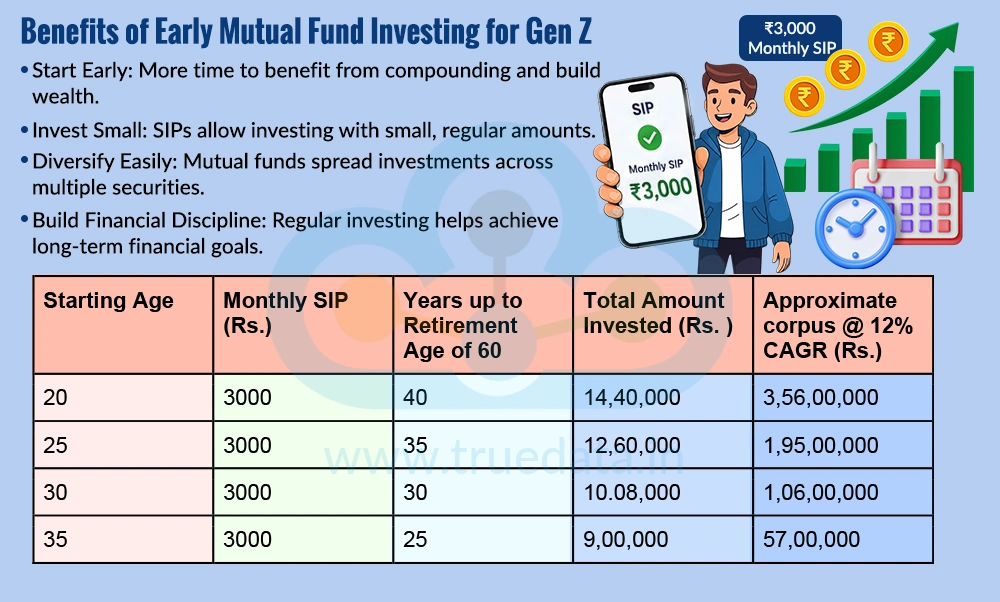
Consider the following example that shows how investing the same monthly SIP of Rs. 3,000 at an assumed 12% annual return can lead to very different outcomes simply because of when an investor starts.

Why Should Gen Z Start Investing in Mutual Funds Early

Starting Age

Monthly SIP (Rs.)

Years up to Retirement Age of 60

Total Amount Invested (Rs. )

Approximate corpus @ 12% CAGR (Rs.)

20

3000

40

14,40,000

3,56,00,000

25

3000

35

12,60,000

1,95,00,000

30

3000

30

10.08,000

1,06,00,000

35

3000

25

9,00,000

57,00,000

How Can SIPs and Step-Up SIPs Help Build Long-Term Wealth?

SIPs are the most common term associated with mutual funds and have often been used interchangeably. However, there is another beautiful version of SIPs that can make money grow faster, thereby helping investors achieve their goals earlier than planned. We are talking about Step Up SIPs. 

A Step Up SIP, also known as a Top-Up SIP, is a type of Systematic Investment Plan (SIP) where the investment amount automatically increases at regular intervals, usually every year. Instead of investing the same amount throughout the investment period, investors can choose to increase their SIP by a fixed amount or a fixed percentage annually. This helps investments grow in line with increasing income and can significantly improve long-term wealth creation.

A Step Up SIP can be particularly useful for Gen Z investors because salaries generally increase as careers progress. Rather than continuing with the same SIP amount for several years, they can gradually increase their monthly investment whenever they receive a salary hike or promotion. Since the increase happens in small steps, it is usually easier to manage financially while allowing a much larger amount to remain invested over the long term.

Regular SIP vs. Step Up SIP - Explained with Example

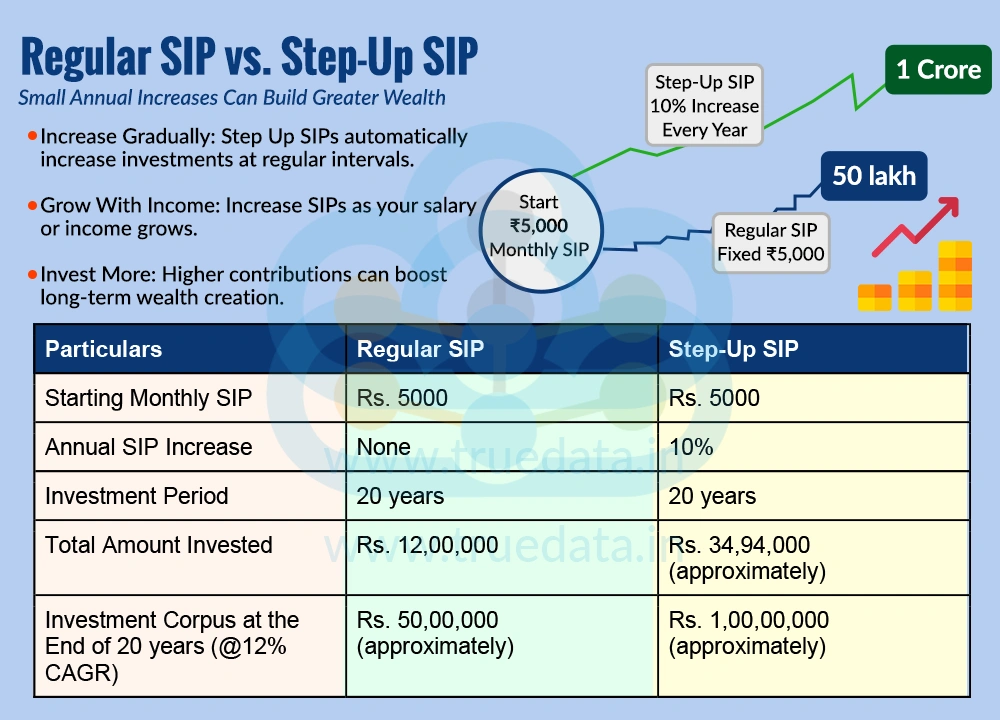
Consider Ms Aarya, a 22-year-old investor, who starts investing Rs. 5,000 per month in an equity mutual fund and remains invested for 20 years. In one scenario, the SIP amount remains fixed throughout the investment period. In the other, she increases the SIP by 10% every year through a Step Up SIP. Assuming an illustrative annual return of 12%, the investment corpus at the end of 20 years is shown below. 

How Can SIPs and Step-Up SIPs Help Build Long-Term Wealth

Particulars

Regular SIP

Step-Up SIP

Starting Monthly SIP

Rs. 5000

Rs. 5000

Annual SIP Increase

None

10%

Investment Period

20 years

20 years

Total Amount Invested

Rs. 12,00,000

Rs. 34,94,000 (approximately)

Investment Corpus at the End of 20 years (@12% CAGR)

Rs. 50,00,000 (approximately)

Rs. 1,00,00,000 (approximately)

Although the SIP increases gradually, the additional investments get more time to benefit from compounding. As a result, the investor contributes around Rs. 23 lakh (approximately) more than a regular SIP over 20 years, but the final corpus is almost double (from approximately Rs. 50 lakh to Rs. 1 crore).

This example highlights why a Step Up SIP is especially suitable for Gen Z. Young investors usually receive regular salary hikes during their careers. By increasing their SIP by a small percentage every year instead of spending the entire salary increment, they can significantly accelerate long-term wealth creation without making a drastic change to their lifestyle. Over 20-30 years, this simple strategy can make a substantial difference to achieving major financial goals such as buying a home, funding children's education, or building a retirement corpus.

How Much Should Gen Z Invest Every Month?

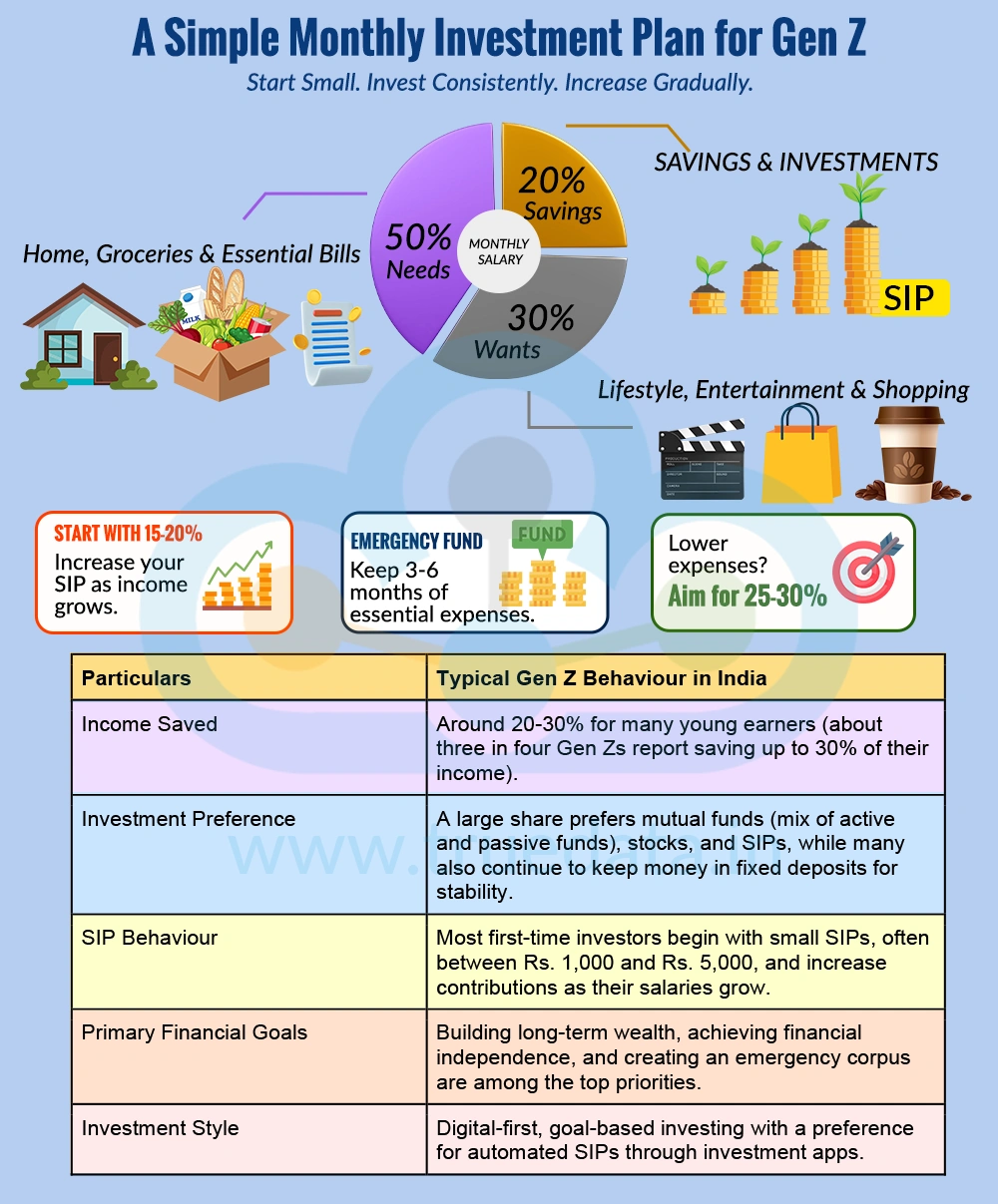
This is one of the most nagging questions and often an area where many investors get stuck. The truth is that there is no correct or wrong answer to this question, as starting the investment journey is more important than getting the amount right. That said, financial planners often recommend using the 50:30::20 rule of budgeting rule as a starting point. Under this rule, around 50% of take-home income is allocated to essential expenses, 30% to lifestyle and discretionary spending, and 20% to savings and investments. For Gen Z investors who are just beginning their careers, consistently investing even 15-20% of their monthly income can help build long-term wealth. As income increases over time, they can gradually increase this percentage through a Step Up SIP instead of allowing lifestyle expenses to rise at the same pace.

Before allocating a significant portion of income to equity mutual funds, Gen Z investors should ideally build an emergency fund that can cover around three to six months of essential expenses. Having this financial cushion helps manage unexpected situations such as job loss or medical emergencies without needing to withdraw long-term investments prematurely. 

Many young professionals in India are also fortunate to have lower financial responsibilities in the early stages of their careers, especially if they live with their parents or have fewer dependants. In such cases, investing 25-30% of monthly income may be achievable. The key is not to aim for a very high percentage from day one but to start early, invest consistently, and increase investments whenever income grows. A small SIP started today and increased every year often creates more wealth than waiting several years to invest a larger amount.

While there is no official data on the exact spending split among Indian Gen Z investors, multiple industry surveys reveal common financial behaviour. 

How Much Should Gen Z Invest Every Month

Particulars

Typical Gen Z Behaviour in India 

Income Saved

Around 20-30% for many young earners (about three in four Gen Zs report saving up to 30% of their income).

Investment Preference

A large share prefers mutual funds (mix of active and passive funds), stocks, and SIPs, while many also continue to keep money in fixed deposits for stability.

SIP Behaviour 

Most first-time investors begin with small SIPs, often between Rs. 1,000 and Rs. 5,000, and increase contributions as their salaries grow.

Primary Financial Goals

Building long-term wealth, achieving financial independence, and creating an emergency corpus are among the top priorities.

Investment Style

Digital-first, goal-based investing with a preference for automated SIPs through investment apps.

Industry data suggests that Gen Z is India's fastest-growing investor segment, with many entering the markets earlier than previous generations. While a large proportion of young investors start with small SIPs, they also show a strong preference for long-term wealth creation through equity-oriented mutual funds and increasing investments as their careers progress.

What are the Common Mistakes Gen Z Investors Should Avoid?

What are the Common Mistakes Gen Z Investors Should Avoid

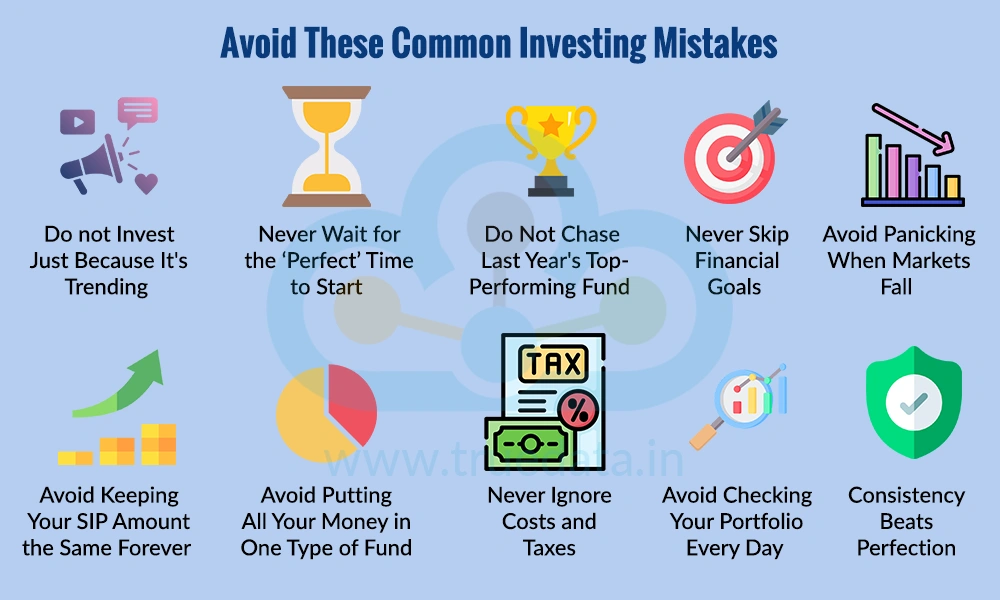
Starting to invest early is a great decision, but building wealth requires more than just opening a mutual fund account. Gen Z investors have access to more financial information than any previous generation, but they also face distractions such as social media trends, market hype, and the fear of missing out (FOMO). Avoiding these common mistakes can help them stay focused on long-term wealth creation.

  • Do not Invest Just Because It's Trending - It is easy to get influenced by social media posts, influencers, or friends talking about a particular mutual fund. However, a fund that works well for someone else may not be suitable for another investor. Instead of following trends, Gen Z investors should choose mutual funds based on their own financial goals, investment horizon, and risk appetite.

  • Never Wait for the ‘Perfect’ Time to Start - Many first-time investors postpone investing because they believe they should wait for a market correction or earn a higher salary. In reality, nobody can consistently predict market movements. Starting early with even a small SIP is often more beneficial than waiting for the perfect opportunity, as it gives investments more time to grow through compounding.

  • Do Not Chase Last Year's Top-Performing Fund - A mutual fund that delivered exceptional returns last year may not necessarily perform the same way in the future. Instead of selecting funds solely based on recent returns, investors should look at factors such as consistency, investment strategy, risk level, and how well the fund aligns with their financial goals.

  • Never Skip Financial Goals - Investing without a clear purpose can make it difficult to stay committed during market ups and downs. Every investment should be linked to a specific goal, whether it is funding higher education, buying a home, travelling, starting a business, or planning for retirement. Goal-based investing makes it easier to choose suitable mutual funds and measure progress.

  • Avoid Panicking When Markets Fall - Market volatility is a normal part of investing, especially in equity mutual funds. Many new investors stop their SIPs or redeem their investments when markets decline because they fear further losses. However, continuing SIPs during market corrections allows investors to purchase more units at lower prices, which can benefit long-term returns when markets recover.

  • Avoid Keeping Your SIP Amount the Same Forever - As careers progress, incomes usually increase. Continuing with the same SIP amount for many years may slow down wealth creation. Gen Z investors should consider increasing their SIP through a Step Up SIP whenever they receive salary hikes so that their investments grow alongside their income.

  • Avoid Putting All Your Money in One Type of Fund - Investing everything in a single mutual fund or one category, such as small-cap funds, can increase portfolio risk. A well-diversified portfolio across suitable mutual fund categories can help balance risk while supporting long-term financial goals.

  • Never Ignore Costs and Taxes - While ELSS Funds often remain among the top choices for investors when it comes to tax planning, many investors focus only on returns and overlook factors such as the expense ratio, exit load, and capital gains tax. These costs can affect the overall returns from mutual fund investments. Understanding them before investing helps avoid surprises later.

  • Avoid Checking Your Portfolio Every Day - Mutual funds are designed for long-term investing, not daily trading. Constantly tracking portfolio performance can lead to unnecessary stress and emotional decisions. Reviewing investments periodically, such as once or twice a year, is usually enough to ensure the portfolio remains aligned with financial goals.

  • Consistency Beats Perfection - Many Gen Z investors worry about choosing the ‘perfect’ mutual fund or investing at the ‘perfect’ time. In reality, long-term wealth is usually created through consistent investing, patience, and disciplined financial habits rather than trying to make flawless investment decisions. Starting early, staying invested, and increasing investments over time often matter far more than chasing short-term market trends.

Conclusion

Gen Z has one advantage that no previous generation can reclaim, time! Starting early, investing consistently, and increasing investments with every salary hike can help transform even small monthly SIPs into substantial long-term wealth. While every investment carries some level of risk, a disciplined and well-planned approach can go a long way in helping Gen Z achieve their life goals with greater financial confidence.

This article is an attempt to simplify mutual funds for Gen Zs and, at the same time, highlight how Gen Z is different from its previous generations when it comes ot mutual fund investing. Let us know your thoughts on the topic or if you need further information, and we will address it soon.

Till then, Happy Reading!


Read More: Copying a Mutual Fund Portfolio - Should You Do It? 

Frequently Asked Questions

Many mutual funds in India allow investors to start with a SIP of as little as Rs. 100 to Rs. 500 per month, although the minimum amount varies across fund houses and schemes. For lump sum investments, the minimum investment is usually Rs. 1,000 or more, depending on the mutual fund.

There is no single mutual fund that is best for every Gen Z beginner, as the right choice depends on financial goals, risk appetite, and investment horizon. For many first-time investors in India, diversified equity funds or index funds are often considered suitable options for long-term wealth creation.

A Systematic Investment Plan (SIP) allows investors to invest a fixed amount regularly, such as every month, while a one-time (lump sum) investment involves investing a larger amount in a single transaction. SIPs help build investing discipline and reduce the impact of market fluctuations, whereas lump sum investments may be suitable for those who have a sizeable amount available to invest at once.

There is no fixed amount that Gen Z should invest every month. They can start with an amount they can comfortably afford, even Rs. 100 or Rs. 500 through a SIP, and gradually increase their investment as their income grows.

Yes, most open-ended mutual funds allow investors to withdraw their money at any time. However, some funds may charge an exit load if redeemed within a specified period, and taxes may also apply on the gains.

Equity mutual funds invest mainly in stocks and have higher return potential but also higher risk, while debt mutual funds invest in fixed-income securities and generally offer more stable but lower returns. For many Gen Z investors with long-term goals and the ability to handle market fluctuations, equity mutual funds may be more suitable, while debt funds can be useful for short-term goals or lower-risk investing.

Investors should understand that profits earned from selling mutual fund units may be subject to capital gains tax (short-term or long-term capital gains), and the tax rules vary depending on the type of mutual fund and the holding period. Understanding these tax rules before investing can help avoid unexpected tax liabilities.

Some mutual funds may charge an exit load if investors redeem their units within a specified period, while many funds do not charge any exit load after that period. Investors should check the scheme's exit load rules before investing, as these charges can reduce the amount they receive on redemption.
Marisha Bhatt

Marisha Bhatt is a financial content writer @TrueData.

She writes with the sole aim of simplifying complex financial concepts and jargon while attempting to clarify technical and fundamental analysis concepts of the stock markets. The ultimate goal is to spread vital knowledge and benefit the maximum audience. Her Chartered Accountant background acts as the knowledge base to help clarify crucial concepts and create a sound investment portfolio.

0 Comments

Related Articles

SEE ALL
Mutual Funds
Mutual Funds
How to Complain About Mutual Funds?

Mutual fund investments have simplified greatly with just a tap on your smartpho...

Mutual Funds
Mutual Funds
What is XIRR in mutual funds? How is it calculated?

Your mutual fund has delivered impressive returns, but are those the actual retu...

Mutual Funds
Mutual Funds
What Happens If I Miss a SIP?

SIPs are often considered the easiest and most effective path to build long-term...