15-MIN DELAYED
NIFTY 22,231.80 -371.25 (-1.64%) | BANKNIFTY 54,515.05 -540.50 (-0.98%) | SENSEX 71,593.24 -1,045.46 (-1.44%) | CRUDEOIL-I 8,876.00 +315.00 (+3.68%) | GOLD-I 1,49,735.00 +625.00 (+0.42%) | NIFTY 22,231.80 -371.25 (-1.64%) | BANKNIFTY 54,515.05 -540.50 (-0.98%) | SENSEX 71,593.24 -1,045.46 (-1.44%) | CRUDEOIL-I 8,876.00 +315.00 (+3.68%) | GOLD-I 1,49,735.00 +625.00 (+0.42%) |
TrueData
Helpline / Support +91 7304-22-44-66
Get started

WORKSPACE

Workspace overview Workspace overview Our flagship product SignalX SignalX web charting for indian market Sheets Sheets streaming spreadsheet Wealth Wealth corporate data and news


Built for India's markets.

Real-time charts, streaming spreadsheets, live corporate announcements — all in one workspace.

Get started free

Cash Flow to Debt Ratio - What is it and How to Use it?

Marisha Bhatt · 08 Oct 2026 · 11 mins read · 0 Comments

cash-flow-to-debt-ratio-what-is-it-and-how-to-use-it

Cash flow is one of the key factors investors consider when assessing a company’s financial health. But while strong cash flow is encouraging, it does not tell the complete story. A company may generate healthy cash flows and still carry a significant debt burden. This is where the cash flow to debt ratio becomes useful. By comparing the cash a company generates with its total debt, this ratio helps investors understand how comfortably the business may be able to meet its debt obligations. So, how is the cash flow to debt ratio calculated, and what does it tell investors about a company’s financial strength? Let us explore the formula, meaning, and importance of this ratio to make your fundamental analysis more informed.

What is the Cash Flow to Debt Ratio?

What is the Cash Flow to Debt Ratio

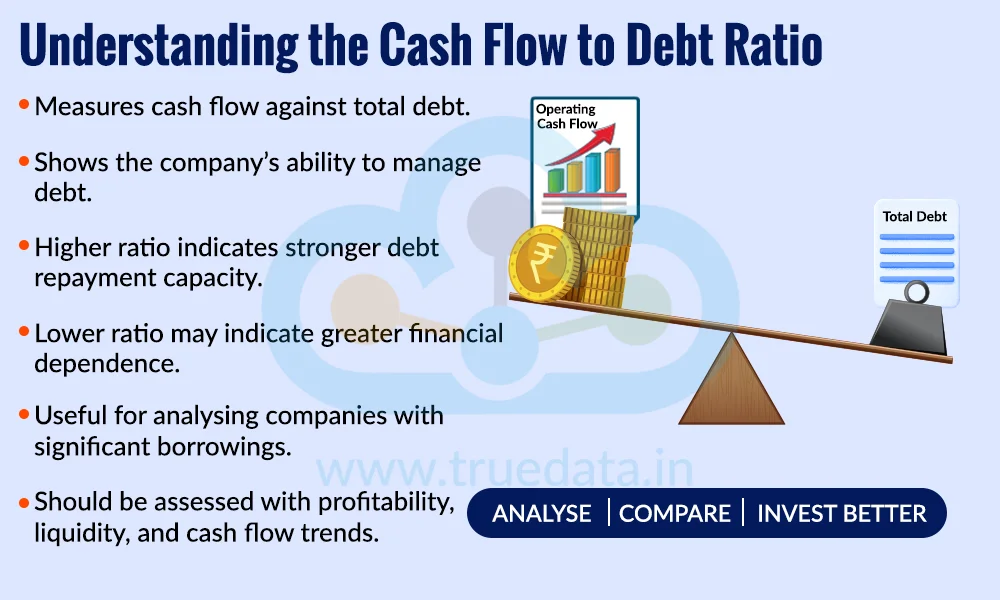
The Cash Flow to Debt Ratio is a financial ratio that helps investors understand a company’s ability to use the cash generated from its operations to meet its debt obligations. It compares the cash flow generated by the business with the total debt the company has. A higher ratio generally indicates that the company is generating enough cash to support its debt more comfortably, while a lower ratio may suggest greater dependence on other sources of funds to meet debt obligations. This ratio can be useful when analysing companies with significant borrowings, as it provides a different perspective from simply looking at the debt on the balance sheet. For example, two companies may have similar levels of debt, but the company generating stronger and more consistent operating cash flows may be in a better position to manage that debt. However, the ratio should not be viewed in isolation; investors should also consider profitability, interest costs, debt maturity, liquidity and trends in cash flow over time.

How to Calculate the Cash Flow to Debt Ratio?

The Cash Flow to Debt Ratio is calculated by comparing a company’s operating cash flow with its total debt. Operating cash flow represents the cash generated from the company’s core business activities during a particular period, while total debt represents the company’s outstanding borrowings. The ratio helps investors assess how much of its debt a company could potentially cover using the cash generated from its regular business operations.

The formula to calculate the Cash Flow to Debt Ratio is,

How to Calculate the Cash Flow to Debt Ratio

Cash Flow to Debt Ratio = Operating Cash Flow / Total Debt

Understanding the Calculation of Cash Flow to Debt Ratio Using an Example 

Consider Super Ltd. with an operating cash flow of Rs. 500 crores and total debt of Rs. 2000 crores. The cash flow to debt ratio of this company is, 

Cash Flow to Debt Ratio = Operating Cash Flow / Total Debt

Cash Flow to Debt Ratio = 500 / 2000 = 0.25 = 25%

This means the company generated operating cash flow equivalent to 25% of its total debt during the year. Thus, the company generated Rs. 25 of operating cash flow for every Rs. 100 of debt.

A higher ratio generally indicates better debt-servicing capacity, as the company is generating more cash in relation to its borrowings. Conversely, a lower ratio may indicate that the company has relatively less operating cash flow available compared with its debt. However, investors should avoid judging a company solely on one year's ratio. It is useful to compare the ratio over several years and with companies in the same industry, since debt levels and cash flow requirements can vary significantly across sectors.

How to Interpret the Cash Flow to Debt Ratio?

The Cash Flow to Debt Ratio can help investors understand how comfortably a company’s operating cash flow can support its debt. While there is no single ratio level that is ideal for every company or industry, investors can interpret it by looking at the following factors.

How to Interpret the Cash Flow to Debt Ratio

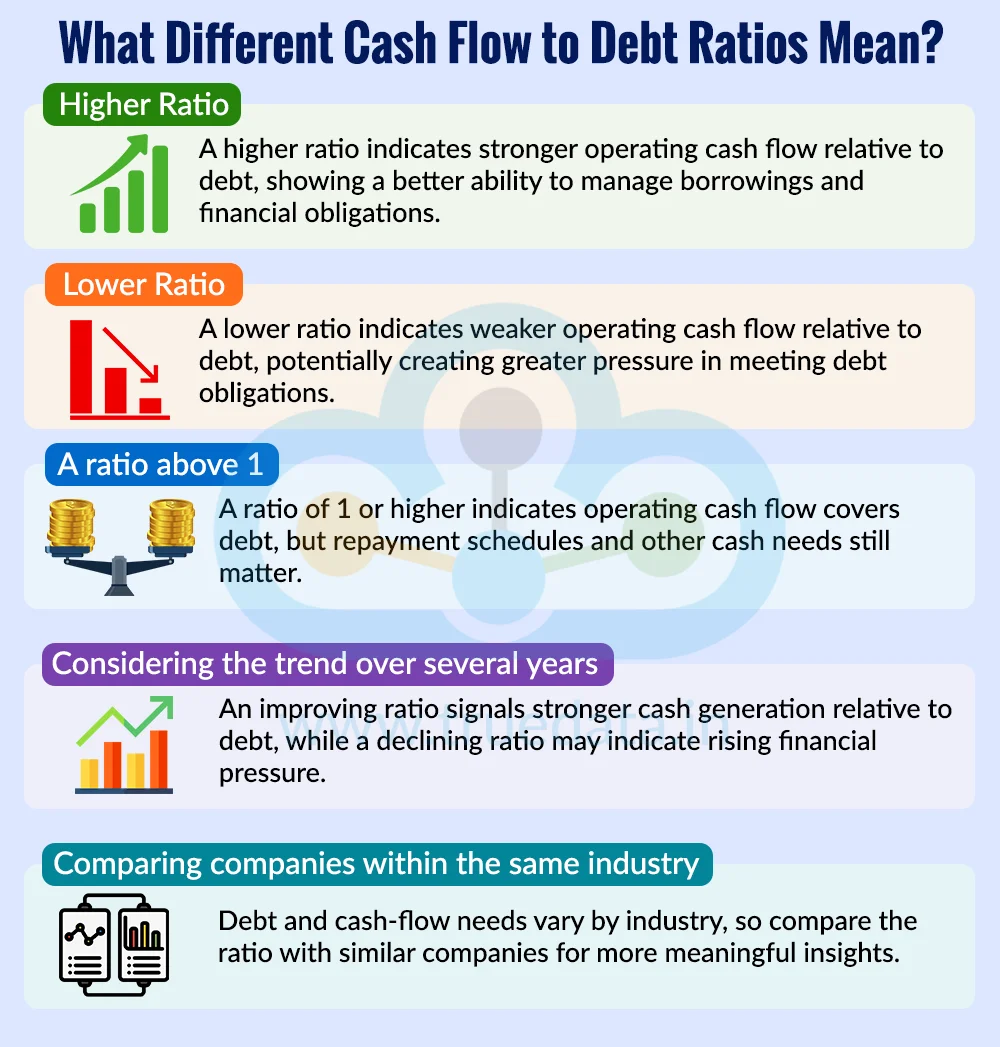
  • Higher Ratio - A higher ratio indicates the company is generating more operating cash flow compared with its total debt. This can indicate that the business is in a relatively stronger position to manage its borrowings.

  • Lower Ratio - A lower ratio means operating cash flow is relatively small compared with the company’s debt. This may indicate that the company could face greater pressure in meeting its debt obligations, particularly if cash flows weaken.

  • A ratio above 1 - If the ratio is 1 or higher, it means the company’s operating cash flow is equal to or greater than its total debt for the period. However, investors should not automatically consider this a guarantee of financial strength, as debt repayment schedules and other cash requirements also matter.

  • Considering the trend over several years -  A consistently improving ratio can indicate that the company is generating more cash relative to its debt. On the other hand, a declining ratio over several years may warrant closer attention, especially if debt is rising while operating cash flow is stagnating or falling.

  • Comparing companies within the same industry - Cash flow requirements and debt levels can vary considerably between sectors. For example, a capital-intensive infrastructure or manufacturing company may naturally carry more debt than an asset-light IT services company. Therefore, comparing the ratio with similar companies in the same industry can provide more meaningful insights.

Why is the Cash Flow to Debt Ratio Important?

The Cash Flow to Debt Ratio is an important metric for investors as it connects two key aspects of a company’s financial position, i.e., the cash it generates from its operations and the debt it has to manage. Looking at both together can provide useful insights into the company’s financial strength and ability to handle its borrowings. Some of the key reasons why investors should pay attention to this ratio include,

Why is the Cash Flow to Debt Ratio Important

  • Helps Assess Debt-Repayment Capacity - The ratio gives investors an idea of how well a company’s operating cash flow can support its debt. A company that consistently generates strong cash flows relative to its debt may be better positioned to meet its repayment obligations without relying heavily on additional borrowing or selling assets.

  • Indicates Financial Strength - A healthy and stable Cash Flow to Debt Ratio can be a positive sign of financial strength. It suggests that the company’s core business is generating sufficient cash compared with the amount it owes. This can be particularly relevant when analysing companies with substantial borrowings, such as infrastructure, manufacturing, banking-related businesses, or other capital-intensive sectors.

  • Helps Identify Potential Debt Stress - A consistently low or declining ratio can be a warning sign. It may indicate that the company’s debt is growing faster than the cash generated from its operations. Investors can use this as a starting point to investigate whether the company may face difficulties managing its debt in the future.

  • Helps Compare Debt Levels with Cash Generation - Looking at debt alone does not tell investors whether a company can comfortably manage its borrowings. For example, two companies may each have Rs. 1,000 crore of debt, but if one generates significantly more operating cash flow than the other, its ability to manage that debt may be stronger. The ratio brings debt and cash generation together, making the comparison more meaningful.

  • Useful for Tracking Financial Health Over Time - Investors can calculate the ratio for multiple financial years to identify a trend. If the ratio is steadily improving, it may indicate that operating cash flows are growing faster than debt. Conversely, a declining ratio over several years could signal increasing financial pressure and deserves further investigation.

  • Helps Investors Evaluate Borrowing Decisions - Companies often borrow money to fund expansion, purchase assets, enter new markets or meet working capital requirements. The Cash Flow to Debt Ratio can help investors assess whether the company's cash-generating ability is keeping pace with its borrowings. If debt continues to rise without a corresponding improvement in operating cash flow, investors may want to understand how effectively the borrowed funds are being used.

  • Provides a Cash-Based View of Debt Management - Profit and cash flow are not always the same. A company can report accounting profits while having weaker cash generation because of changes in working capital or other factors. Since this ratio uses operating cash flow, it gives investors a cash-based perspective when assessing the company's ability to support its debt.

  • Supports Better Fundamental Analysis - The Cash Flow to Debt Ratio should not be used as a standalone measure. Instead, it can complement other financial metrics such as the Debt-to-Equity ratio, Interest Coverage Ratio, Operating Cash Flow, Free Cash Flow and profitability ratios. Looking at these measures together can give investors a more balanced understanding of a company's financial health and debt position.

How to Use the Cash Flow to Debt Ratio?

The Cash Flow to Debt Ratio can be a useful tool for investors when assessing a company’s ability to manage its borrowings. However, rather than looking at the ratio in isolation, investors should use it along with other financial indicators and compare it over time. Here are some practical ways to use this ratio:

How to Use the Cash Flow to Debt Ratio

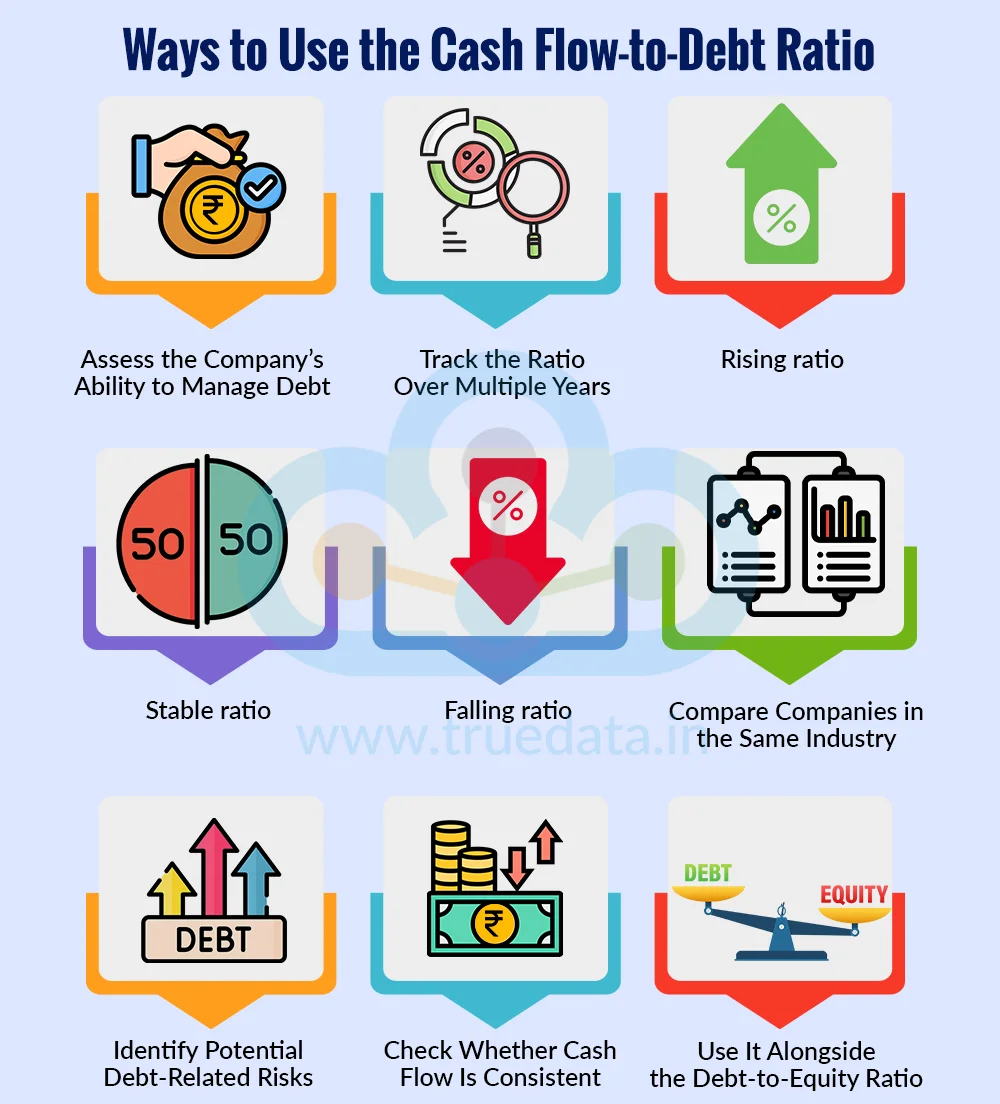
  • Assess the Company’s Ability to Manage Debt - Investors can use the ratio to get an idea of whether a company is generating enough operating cash flow in relation to its debt. A higher ratio generally suggests that the company has stronger cash generation capacity compared with its borrowings, which may make managing debt easier.

  • Track the Ratio Over Multiple Years - Looking at the ratio for just one financial year may not provide enough information. Investors should check the ratio across 3-5 years, where possible, to identify the trend.

    • Rising ratio - May indicate improving cash generation or declining debt.

    • Stable ratio - May indicate that cash generation and debt are growing at a similar pace.

    • Falling ratio - May indicate that debt is increasing faster than operating cash flow or that cash generation is weakening.

Checking annual reports and financial statements over several years can help provide this broader picture for investors.

  • Compare Companies in the Same Industry - The ratio becomes more useful when compared with peer companies operating in the same sector. Debt requirements can vary significantly between industries. For example, infrastructure and manufacturing companies may require substantial borrowings to fund large projects and assets, while an asset-light IT services company may operate with much lower debt. Therefore, investors should avoid comparing the ratios of companies with very different business models.

  • Identify Potential Debt-Related Risks - A consistently low or declining Cash Flow to Debt Ratio can prompt investors to investigate the company's debt position more closely. It may indicate that operating cash flows are not keeping pace with borrowings. Investors can then check whether the company is taking on more debt, facing weaker sales, experiencing higher working capital requirements or using borrowings to fund expansion.

  • Check Whether Cash Flow Is Consistent - Investors should examine the quality and consistency of operating cash flow rather than relying on a single year's figure. A company may report a temporarily high cash flow because of changes in working capital or other one-off factors. A ratio supported by consistent operating cash generation over several years can provide more meaningful information than a high ratio in just one year.

  • Use It Alongside the Debt-to-Equity Ratio - The Cash Flow to Debt Ratio and Debt-to-Equity Ratio provide different perspectives. The Debt-to-Equity Ratio focuses on the company's borrowings relative to shareholders’ equity, while the Cash Flow to Debt Ratio looks at debt in relation to operating cash generation. Using both can help investors understand not only how much debt a company has, but also how well its business generates cash relative to that debt.

What are the Limitations of the Cash Flow to Debt Ratio?

The limitations of the Cash Flow to Debt Ratio are,

What are the Limitations of the Cash Flow to Debt Ratio

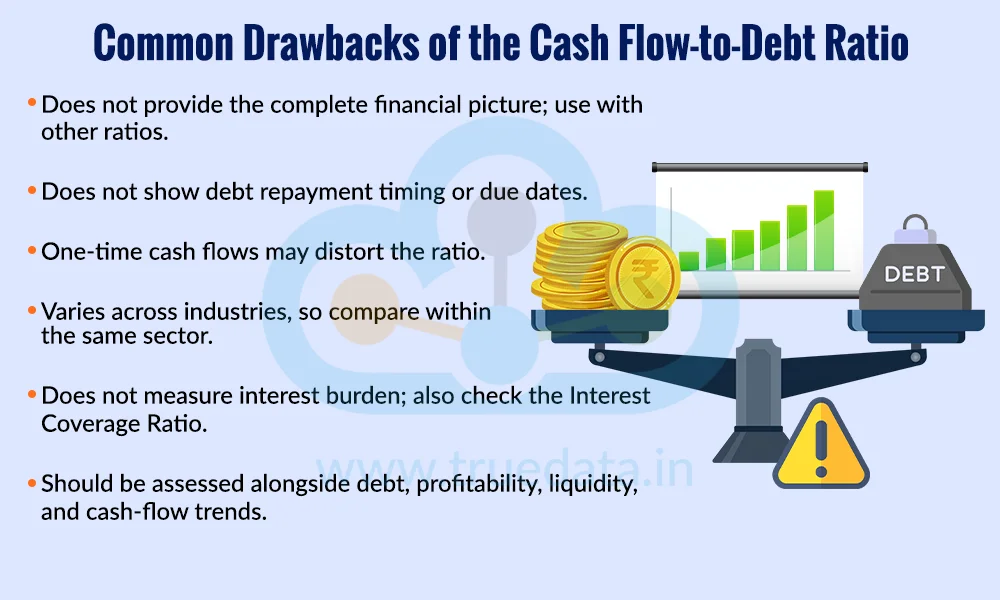
  • It does not give the full financial picture and should be used with other financial ratios.

  • It does not show repayment timing and does not indicate when the company’s debt is due.

  • This ratio can be affected by one-time cash flows, which may potentially distort the ratio.

  • This ratio can vary across industries, therefore, a good ratio for one sector may not be suitable for another.

  • It does not directly measure interest burden, and investors should also check the Interest Coverage Ratio for the same. 

  • This ratio should not be used alone, and investors should consider debt, profitability, liquidity and cash-flow trends together.

Conclusion

The Cash Flow to Debt Ratio is a useful metric for investors to understand how comfortably a company’s operating cash flow can support its debt. A higher and stable ratio can indicate stronger debt-management capacity, while a declining ratio may warrant closer attention. However, investors should not rely on this ratio alone. Comparing it over time and with industry peers, along with checking profitability, interest costs, liquidity and other debt-related ratios, can help investors make a more informed assessment of a company’s financial health.

This article explains an important financial ratio and its importance in fundamental analysis. Let us know your thoughts on the topic or if you need further information and we will address it soon. 

Till then, Happy Reading!


Read More: Debt to EBITDA Ratio - Why Do They Matter? 

Frequently Asked Questions

There is no single ‘good’ Cash Flow to Debt Ratio for every company, as it varies by industry and business model. Generally, a higher and consistently improving ratio is considered better because it indicates stronger operating cash flow relative to debt.

The Cash Flow to Debt Ratio measures a company’s operating cash flow against its total debt, while the Debt-to-Equity Ratio compares its total debt with shareholders’ equity. Thus, the first focuses on cash-generating ability to support debt, while the second shows the company’s level of financial leverage.

The Cash Flow to Debt Ratio uses total debt, which includes both short-term and long-term borrowings. This gives investors a broader view of the company’s ability to support its overall debt through operating cash flow.

Investors can use the Cash Flow to Debt Ratio to assess how well a company’s operating cash flow supports its total debt. They can compare the ratio over several years and with industry peers to identify improving or weakening debt-management capacity and use it alongside other financial ratios before making investment decisions.

The Cash Flow to Debt Ratio measures a company’s operating cash flow relative to its total debt, while the Debt Service Coverage Ratio (DSCR) measures whether the company generates enough cash to cover its current debt repayments and interest expenses. Thus, the former focuses on overall debt capacity, while DSCR focuses on the ability to meet scheduled debt payments.
Marisha Bhatt

Marisha Bhatt is a financial content writer @TrueData.

She writes with the sole aim of simplifying complex financial concepts and jargon while attempting to clarify technical and fundamental analysis concepts of the stock markets. The ultimate goal is to spread vital knowledge and benefit the maximum audience. Her Chartered Accountant background acts as the knowledge base to help clarify crucial concepts and create a sound investment portfolio.

0 Comments

Related Articles

SEE ALL
Corporate Data
Corporate Data
Investing Smarter: The Power of Corporate Data and Market Sentiment Analysis

Thestock market never stands still, and prices swing constantly with every new h...

Corporate Data
Corporate Data
Operating Profit Margin and Operating Cash Flow Ratio

Have you ever wondered why some companies report strong profits but still face c...

Corporate Data
Corporate Data
Understanding Quarterly vs Annual Corporate Data

Corporate data is more than just the numbers of a company. They can show what is...