15-MIN DELAYED
NIFTY 25,800.60 +286.30 (+1.12%) | BANKNIFTY 64,635.20 +1,572.20 (+2.49%) | SENSEX 83,919.71 +897.96 (+1.08%) | CRUDEOIL-I 7,719.00 -161.00 (-2.04%) | GOLD-I 1,21,949.00 -5,598.00 (-4.39%) | NIFTY 25,800.60 +286.30 (+1.12%) | BANKNIFTY 64,635.20 +1,572.20 (+2.49%) | SENSEX 83,919.71 +897.96 (+1.08%) | CRUDEOIL-I 7,719.00 -161.00 (-2.04%) | GOLD-I 1,21,949.00 -5,598.00 (-4.39%) |
TrueData
Helpline / Support +91 7304-22-44-66
Get started

WORKSPACE

Workspace overview Workspace overview Our flagship product SignalX SignalX web charting for indian market Sheets Sheets streaming spreadsheet Wealth Wealth corporate data and news


Built for India's markets.

Real-time charts, streaming spreadsheets, live corporate announcements — all in one workspace.

Get started free

What Are Bulk Deals and Block Deals in the Stock Market?

Marisha Bhatt · 21 Nov 2026 · 11 mins read · 0 Comments

what-are-bulk-deals-and-block-deals-in-the-stock-market-real

Big stock market news often grabs investors’ attention. Whether it is a much-awaited IPO or a major corporate announcement, such developments can keep the markets buzzing for days. But did you know that some significant market movements can also be influenced by large transactions that receive far less attention? These transactions are known as bulk deals and block deals, where substantial quantities of shares are bought or sold and can sometimes offer useful insights into the activity of large investors. Yet, many retail investors may not know how these deals work or what they signal about a stock or the broader market. So, what exactly are bulk deals and block deals and should retail investors pay attention to them? Read on this blog to explore their meaning, key differences, and potential impact on the stock market to understand what these transactions can tell us as investors.

What are Bulk Deals?

What are Bulk Deals

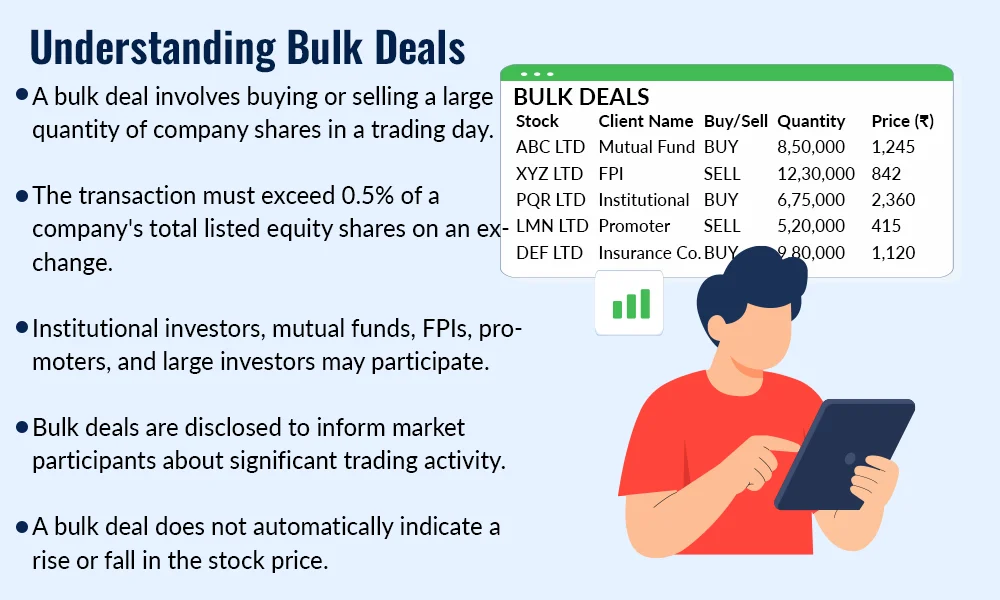
A bulk deal in the stock market occurs when a large quantity of a company's shares is bought or sold on a stock exchange during a trading day. According to the Securities and Exchange Board of India (SEBI), a transaction qualifies as a bulk deal when the total quantity of shares bought or sold in a company exceeds 0.5% of the company's total listed equity shares on a particular stock exchange. This threshold can be reached through a single transaction or multiple transactions carried out during the day in the normal market segment. For example, if a company has 10 crore listed equity shares on an exchange, buying or selling more than 5 lakh shares during the trading day would meet the bulk deal threshold. 

Such transactions may involve institutional investors, mutual funds, foreign portfolio investors (FPIs), promoters or other large investors. Bulk deals are disclosed to improve transparency and help market participants understand significant buying and selling activity. However, a bulk deal does not automatically mean that a stock's price will rise or fall, as the reason behind the transaction and the company's overall fundamentals also matter.

Key Features and Rules for Bulk Deals in India

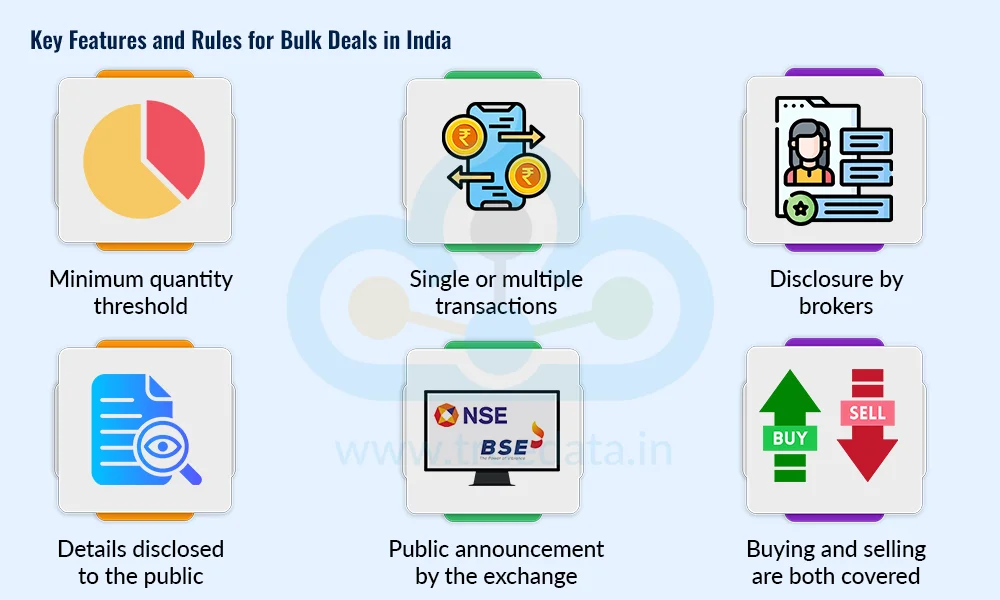
The key rules governing bulk deals under SEBI and stock exchange guidelines are as follows. 

key-features-bulk-deals

  • Minimum quantity threshold - The total quantity of shares bought or sold must be more than 0.5% of the company's listed equity shares on that exchange to qualify as a bulk deal. There is no separate minimum rupee value for a bulk deal. 

  • Single or multiple transactions - The 0.5% threshold can be crossed through one transaction or multiple transactions during the same trading day in the normal market segment. 

  • Disclosure by brokers - Brokers must report the relevant bulk deal details to the stock exchange immediately upon execution of the trade, as required by the guidelines. 

  • Details disclosed to the public - The information includes the company's name or stock symbol, the client's name, the quantity of shares bought or sold, and the traded price. 

  • Public announcement by the exchange - Stock exchanges such as the NSE and BSE publish bulk deal information for the public on the same day, after market hours. This helps investors track significant trading activity. 

  • Buying and selling are both covered - Bulk deals can involve either a large purchase or a large sale. Investors should check which side of the transaction the disclosed client was on instead of assuming every bulk deal represents buying interest.

What are Block Deals?

What are Block Deals

A block deal in the stock market is a transaction in which a large quantity of a company's shares is bought or sold through a single transaction in a separate trading window provided by a stock exchange. In India, block deals are governed by the guidelines issued by the Securities and Exchange Board of India (SEBI) and the operational rules of stock exchanges such as the NSE and BSE. These deals are generally used by large investors, such as mutual funds, foreign portfolio investors (FPIs), insurance companies and other institutional investors, to buy or sell substantial shareholdings in an organised manner. Unlike a bulk deal, which can involve one or more transactions in the regular market that collectively cross a specified quantity threshold, a block deal must be executed as a single transaction through the designated block deal window and meet the applicable minimum order value. Under the framework revised by SEBI in October 2025, the minimum order size is Rs. 25 crore. 

Block deals allow large buyers and sellers to transact without having to execute their entire orders through the regular market, where a very large order could affect the share price. However, a block deal does not necessarily indicate that a stock is a good investment or that its price will rise or fall. Investors should consider the identity of the parties, the reason for the transaction and the company's fundamentals before drawing conclusions.

Key Features and Rules for Block Deals in India

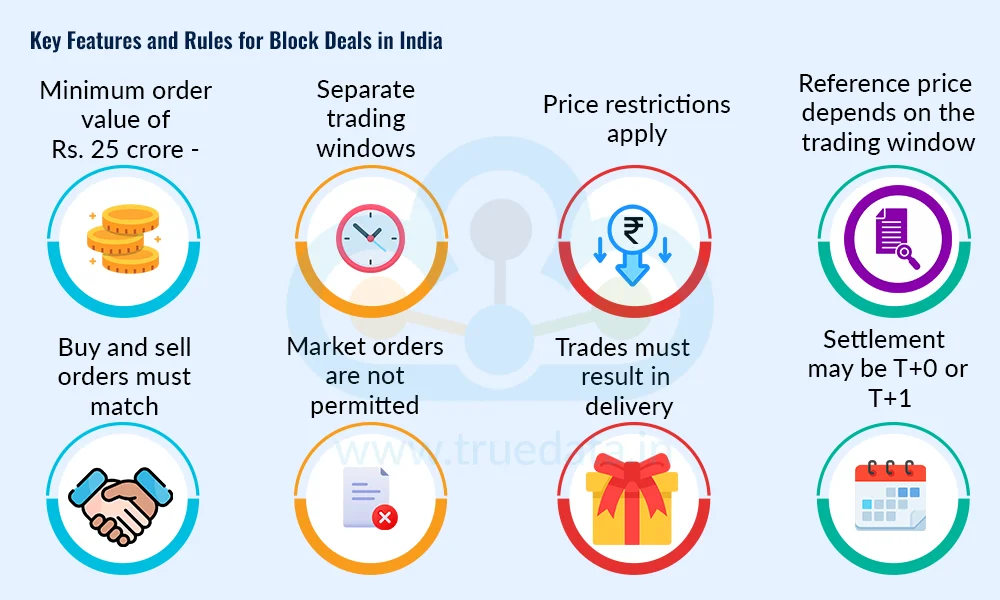
The key features and rules investors should know under the latest SEBI framework and NSE trading guidelines include,

Key Features and Rules for Block Deals in India

  • Minimum order value of Rs. 25 crore - The minimum order size for a block deal is Rs. 25 crore. This threshold applies to the order placed for execution through the block deal window. 

  • Separate trading windows - Block deals can be executed during designated time slots. 

    • Morning window - 8:45 AM to 9:00 AM IST, for securities eligible under the T+0 and T+1 settlement cycles.

    • Afternoon window - 2:05 PM to 2:20 PM IST, for securities eligible under the T+1 settlement cycle.

These timings are as per the NSE framework. 

  • Price restrictions apply - Orders can generally be placed within 3% above or below the applicable reference price. However, the permitted range cannot exceed the stock's applicable daily price band. 

  • Reference price depends on the trading window - For the morning session, the reference price is generally the previous day's closing price or applicable adjusted closing or base price. For the afternoon session, it is generally the volume weighted average price (VWAP) of trades between 1:45 PM and 2:00 PM, subject to the exchange's fallback rules. 

  • Buy and sell orders must match - A block deal is executed when the buy and sell orders match in both price and quantity. Where orders have the same price and quantity, the exchange follows time priority. 

  • Market orders are not permitted - Investors cannot place market orders in the block deal window. Orders must comply with the applicable price restrictions and trading rules. Certain special order conditions, such as stop-loss and disclosed-quantity orders, are also unavailable. 

  • Trades must result in delivery - Block deals are intended for actual share transfers. Executed trades cannot be squared off or reversed as ordinary intraday trades. 

  • Settlement may be T+0 or T+1 - Trades executed through the applicable block deal window are settled according to the relevant settlement cycle. Eligible securities may use the optional same-day T+0 cycle, while other applicable trades follow T+1 settlement.

What are the Key Differences Between Bulk Deals and Block Deals?

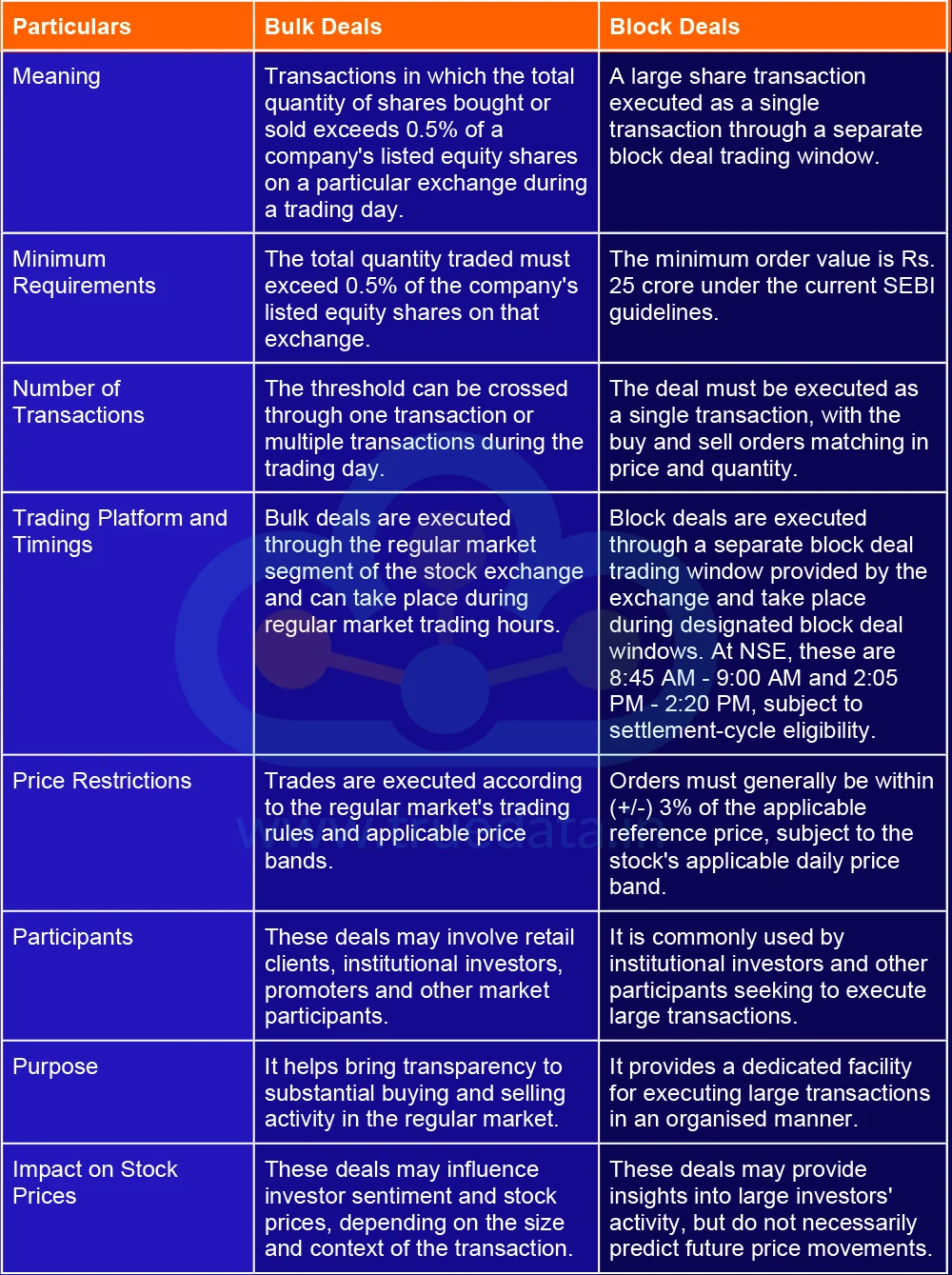
Bulk deals and block deals both involve large quantities of shares being bought or sold in the stock market. However, they differ in how the transactions are executed, the minimum requirements and the rules that apply. The primary differences between them are explained below.

What are the Key Differences Between Bulk Deals and Block Deals

Particulars 

Bulk Deals

Block Deals

Meaning

Transactions in which the total quantity of shares bought or sold exceeds 0.5% of a company's listed equity shares on a particular exchange during a trading day.

A large share transaction executed as a single transaction through a separate block deal trading window.

Minimum Requirements

The total quantity traded must exceed 0.5% of the company's listed equity shares on that exchange.

The minimum order value is Rs. 25 crore under the current SEBI guidelines.

Number of Transactions

The threshold can be crossed through one transaction or multiple transactions during the trading day.

The deal must be executed as a single transaction, with the buy and sell orders matching in price and quantity.

Trading Platform and Timings

Bulk deals are executed through the regular market segment of the stock exchange and can take place during regular market trading hours.

Block deals are executed through a separate block deal trading window provided by the exchange and take place during designated block deal windows. At NSE, these are 8:45 AM - 9:00 AM and 2:05 PM - 2:20 PM, subject to settlement-cycle eligibility.

Price Restrictions

Trades are executed according to the regular market's trading rules and applicable price bands.

Orders must generally be within (+/-) 3% of the applicable reference price, subject to the stock's applicable daily price band.

Participants

These deals may involve retail clients, institutional investors, promoters and other market participants.

It is commonly used by institutional investors and other participants seeking to execute large transactions.

Purpose

It helps bring transparency to substantial buying and selling activity in the regular market.

It provides a dedicated facility for executing large transactions in an organised manner.

Impact on Stock Prices

These deals may influence investor sentiment and stock prices, depending on the size and context of the transaction.

These deals may provide insights into large investors' activity, but do not necessarily predict future price movements.

What Do Bulk Deals and Block Deals Indicate?

Bulk deals and block deals can provide useful clues about the buying and selling activity of large investors in the stock market. Since these transactions involve substantial quantities of shares, they can influence market sentiment, affect demand and supply for a stock, and attract the attention of retail investors. However, their impact depends on factors such as the size of the transaction, the identity of the buyer or seller, the reason behind the deal and the prevailing market conditions. It is important to note that either type of deal guarantees that a stock's price will rise or fall.

Here are the key ways bulk deals and block deals can affect the market, individual stocks and investors.

  • Impact on Stock Prices

impact-stock-prices

  • Large-scale buying can create upward pressure - When a large investor buys a substantial number of shares, it may increase buying interest in the stock. If demand exceeds available supply, the share price may rise.

  • Large-scale selling can create downward pressure - When a large investor sells a significant quantity of shares, it may increase selling pressure and cause the price to fall.

  • The impact may be temporary or lasting - A deal may cause short-term price fluctuations, but its long-term impact depends on the company's performance, financial health and market conditions.

  • Impact on Overall Market Sentiment - 

Impact on Overall Market Sentiment

  • Can influence investor confidence - If a reputed institutional investor buys shares in a company, other investors may interpret it as a positive signal. However, the transaction alone does not establish whether the stock is a good investment.

  • May create uncertainty - A large sale by a promoter or major shareholder may raise questions among investors about the company's future prospects, even when the sale has a perfectly reasonable explanation.

  • Can attract market attention - Bulk and block deal disclosures often draw attention to stocks that retail investors may not have been tracking closely.

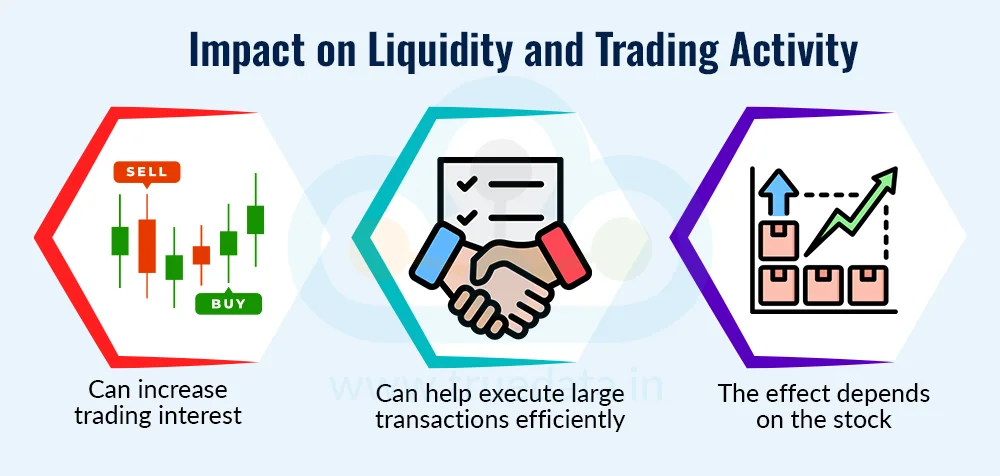
  • Impact on Liquidity and Trading Activity - 

Impact on Liquidity and Trading Activity

  • Can increase trading interest - Disclosures of large transactions may attract more buyers and sellers, increasing trading activity in the stock.

  • Can help execute large transactions efficiently - Block deals provide a separate trading window for large transactions, helping buyers and sellers execute substantial orders without relying entirely on the regular market.

  • The effect depends on the stock - The impact may be more noticeable in stocks with lower trading volumes than in highly liquid stocks.

  • Impact on Retail Investors - 

  • Offer clues about large investors' activity - Retail investors can use these disclosures to identify substantial buying or selling by institutions, promoters and other market participants.

  • Help identify stocks for further research - A large deal may encourage investors to examine a company's financial performance, valuation, business outlook and shareholding pattern more closely.

  • Can lead to impulsive decisions - Some investors may rush to buy a stock after seeing a large purchase or sell after seeing a large sale. Following such signals without proper research can lead to losses.

  • Do not reveal the complete story - The disclosures show transaction details, but they do not necessarily explain why the investor bought or sold the shares.

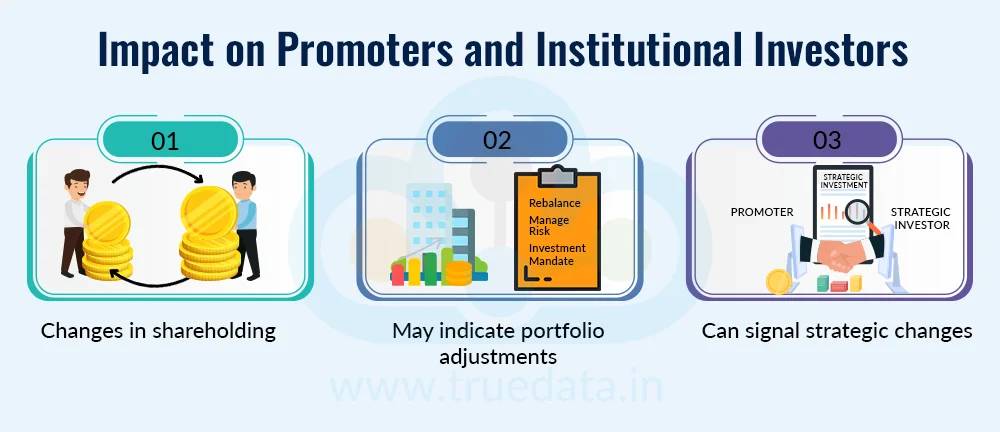
  • Impact on Promoters and Institutional Investors

Impact on Promoters and Institutional Investors

  • Changes in shareholding - Depending on the transaction, a deal can change the ownership pattern of a company, especially when a substantial holding moves from one investor to another.

  • May indicate portfolio adjustments - Mutual funds and other institutional investors may buy or sell shares to rebalance their portfolios, manage risk or respond to investment mandates.

  • Can signal strategic changes - A large transaction involving a promoter or strategic investor may be worth examining to understand whether it reflects a change in ownership or investment strategy.

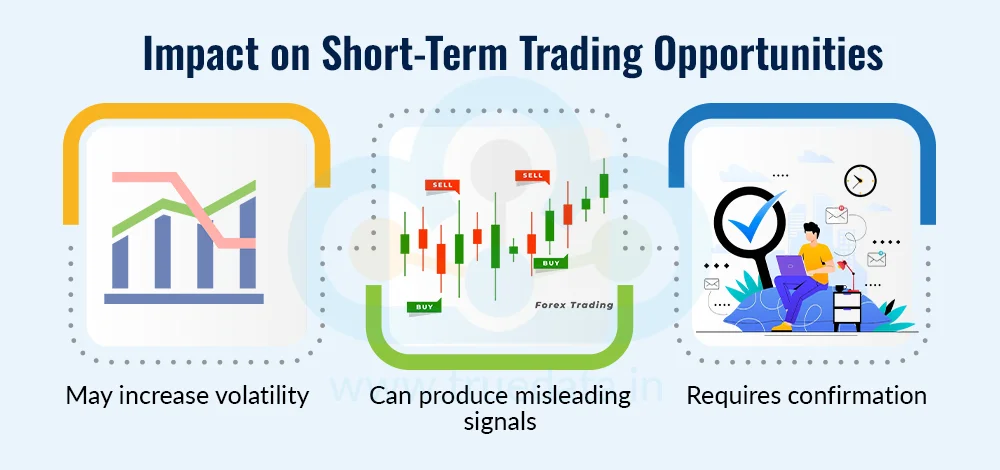
  • Impact on Short-Term Trading Opportunities

Impact on Short-Term Trading Opportunities

  • May increase volatility - Large transactions and the market's reaction to them can create short-term price movements, offering potential opportunities for traders.

  • Can produce misleading signals - A large purchase does not guarantee a breakout, and a large sale does not guarantee a decline.

  • Requires confirmation - Traders should consider price trends, trading volumes, support and resistance levels, and other relevant indicators before making decisions.

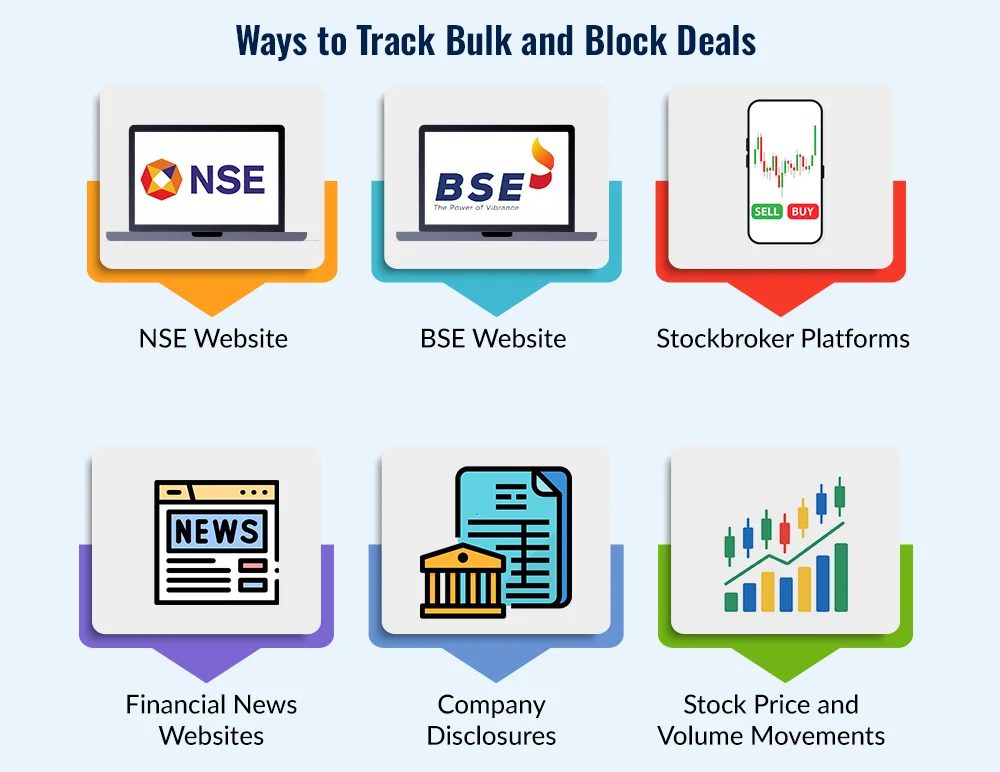
How Can Investors Track Bulk Deals and Block Deals?

Investors can track bulk deals and block deals through the following sources:

How Can Investors Track Bulk Deals and Block Deals

  • NSE Website - Investors can visit the NSE website to check bulk deal and block deal disclosures, including stock names, client names, quantities traded and transaction prices.

  • BSE Website - Investors can visit the BSE website to view the available bulk and block deal details of listed companies.

  • Stockbroker Platforms - Investors can check their broker's trading platform for large-deal data, stock-specific updates and market activity reports.

  • Financial News Websites - Investors can follow financial news portals for updates on significant transactions involving promoters, mutual funds and institutional investors.

  • Company Disclosures - Investors can review stock exchange announcements and shareholding patterns to understand changes in a company's ownership and the possible reasons behind a transaction.

  • Stock Price and Volume Movements - Investors can compare deal disclosures with changes in share prices and trading volumes to assess market reactions and identify areas for further research.

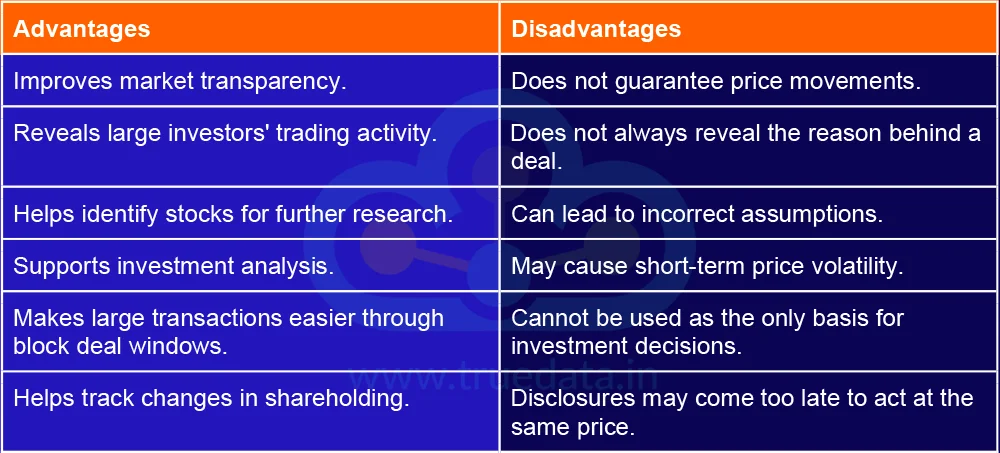
What are the Advantages and Disadvantages of Bulk and Block Deals?

Bulk deals and block deals offer useful insights into large share transactions in the stock market. However, they also have certain limitations that investors should understand before using this information to make investment decisions.

What are the Advantages and Disadvantages of Bulk and Block Deals

Advantages

Disadvantages

Improves market transparency.

Does not guarantee price movements.

Reveals large investors' trading activity.

Does not always reveal the reason behind a deal.

Helps identify stocks for further research.

Can lead to incorrect assumptions.

Supports investment analysis.

May cause short-term price volatility.

Makes large transactions easier through block deal windows.

Cannot be used as the only basis for investment decisions.

Helps track changes in shareholding.

Disclosures may come too late to act at the same price.

Conclusion

Bulk deals and block deals offer useful insights into the buying and selling activity of large investors in the stock market. By tracking these transactions, investors can better understand market trends, identify stocks for further research and monitor changes in shareholding. However, such deals do not guarantee future price movements or indicate whether a stock is worth buying or selling. Therefore, investors should consider these disclosures alongside a company's financial performance, valuation and overall market conditions before making investment decisions.

This article explains important concepts in trading and their impact for investors. Let us know your thoughts on the topic or if you need further information, and we will address it soon.

Till then, Happy Reading!


Read More: What is Pre-Market Trading and What are Pre-Market Orders?

Frequently Asked Questions

Yes, bulk deals can indicate buying or selling pressure in a stock, depending on whether large quantities of shares are being bought or sold. However, they do not guarantee future price movements, so investors should also consider market trends and the company's fundamentals.

Retail investors can track bulk deals by FIIs (Foreign Institutional Investors) and DIIs (Domestic Institutional Investors) through the official NSE and BSE websites, which publish details of large share transactions. They can check the buyer's or seller's name, quantity traded and transaction price to understand institutional activity in a stock.

Yes, bulk deal data can help investors identify stocks that may be worth researching by tracking large investors' buying and selling activity. However, investors should also check the company's financial performance, valuation and future prospects before making investment decisions.

When promoters buy shares through bulk or block deals, it may show their confidence in the company, while selling shares may indicate a need for funds or a change in ownership. However, investors should check the reason behind the transaction and the company's financial health before drawing conclusions.

Bulk deals can influence market sentiment by attracting investors' attention to a stock, especially when large institutions or company promoters are involved. They can also increase trading volume as more buyers and sellers react to the deal, although the stock's price may rise or fall depending on market conditions.

No, bulk deals are not always bullish for a stock, as they can involve either large-scale buying or selling. Investors should examine who is buying or selling and the company's financial performance before deciding whether the deal signals a positive or negative outlook.
Marisha Bhatt

Marisha Bhatt is a financial content writer @TrueData.

She writes with the sole aim of simplifying complex financial concepts and jargon while attempting to clarify technical and fundamental analysis concepts of the stock markets. The ultimate goal is to spread vital knowledge and benefit the maximum audience. Her Chartered Accountant background acts as the knowledge base to help clarify crucial concepts and create a sound investment portfolio.

0 Comments

Related Articles

SEE ALL
Investing / Trading
Investing / Trading
What is Pre-Market Trading and What are Pre-Market Orders?

If you are an avid market trader, you would have often noticed how events of the...

Investing / Trading
Investing / Trading
How do I download BSE and NSE stock prices in Excel in real time?

NSE Stock Prices in Excel in Real Time - Microsoft Excel is a super software cap...

Investing / Trading
Investing / Trading
High-Frequency Trading vs Algorithmic Trading

Financial markets are becoming faster and more technology-driven, but what reall...