15-MIN DELAYED
NIFTY 23,329.00 -85.30 (-0.36%) | BANKNIFTY 56,215.55 -255.10 (-0.45%) | SENSEX 74,529.08 -329.91 (-0.44%) | CRUDEOIL-I 8,585.00 -575.00 (-6.28%) | GOLD-I 1,52,850.00 -219.00 (-0.14%) | NIFTY 23,329.00 -85.30 (-0.36%) | BANKNIFTY 56,215.55 -255.10 (-0.45%) | SENSEX 74,529.08 -329.91 (-0.44%) | CRUDEOIL-I 8,585.00 -575.00 (-6.28%) | GOLD-I 1,52,850.00 -219.00 (-0.14%) |
TrueData
Helpline / Support +91 7304-22-44-66
Get started

WORKSPACE

Workspace overview Workspace overview Our flagship product SignalX SignalX web charting for indian market Sheets Sheets streaming spreadsheet Wealth Wealth corporate data and news


Built for India's markets.

Real-time charts, streaming spreadsheets, live corporate announcements — all in one workspace.

Get started free

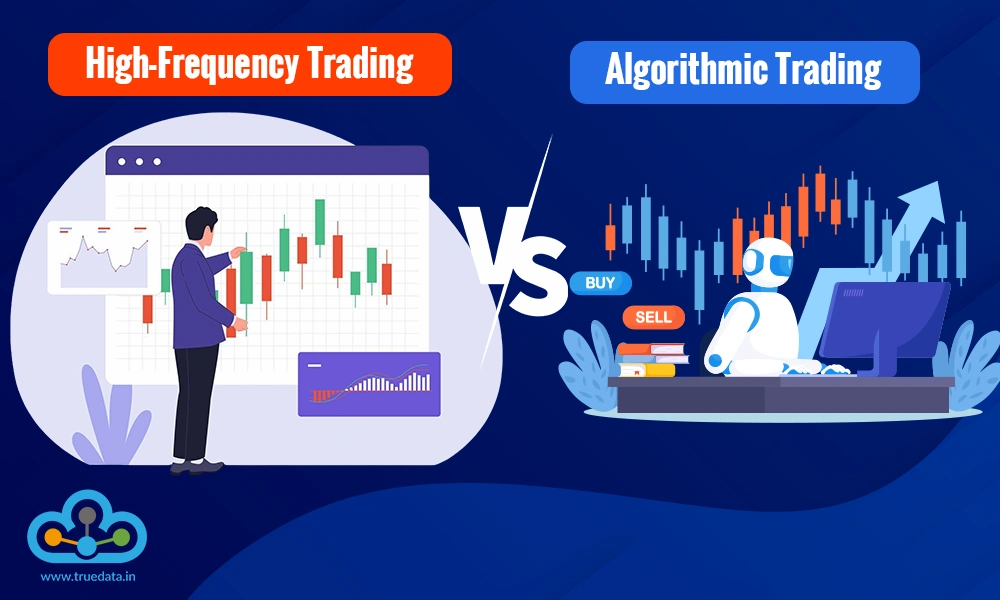
High-Frequency Trading vs Algorithmic Trading

Marisha Bhatt · 22 Sep 2026 · 7 mins read · 0 Comments

High-Frequency Trading vs Algorithmic Trading

Financial markets are becoming faster and more technology-driven, but what really happens behind the rapid-fire trades you see in today’s markets? From algorithms that automate trading decisions to high-frequency systems that execute orders in fractions of a second, technology now plays a major role in how trades are placed and managed. But are high-frequency trading (HFT) and algorithmic trading actually the same thing? Not really! Understanding the differences can help make sense of modern markets and why speed, automation, and technology matter. So let us explore what sets HFT apart from algorithmic trading, and how these strategies can influence market liquidity, volatility, and trading opportunities. 

What is High-Frequency Trading?

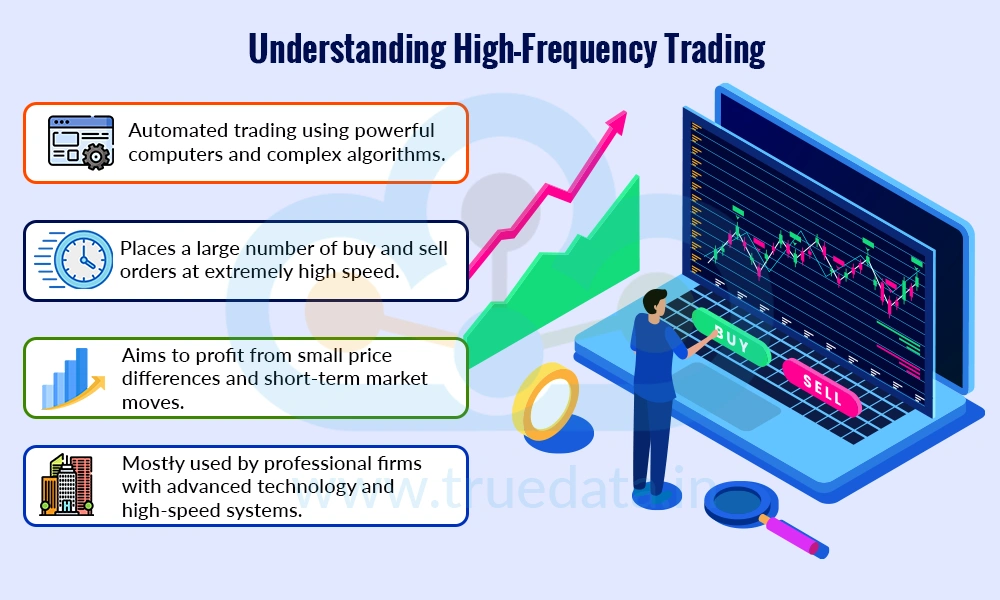
What is High-Frequency Trading

High-Frequency Trading (HFT) is a type of automated trading where powerful computer systems use complex algorithms to analyse market data and place a very large number of buy and sell orders at extremely high speeds, often within fractions of a second. HFT firms typically try to benefit from very small price differences, short-term market movements, or changes in supply and demand. Unlike regular traders who may hold stocks for minutes, days, or even years, HFT strategies can enter and exit positions within milliseconds. HFT is mainly used by professional trading firms and institutions with access to advanced technology, high-speed connections, and sophisticated trading systems. While HFT can improve market liquidity and make trading more efficient, it also involves significant technology, infrastructure, and risk-management requirements.

What is Algo Trading?

What is Algo Trading

Algorithmic Trading (Algo Trading) is a method of trading where computer programs follow a set of predefined rules to automatically analyse market data and place buy or sell orders. These rules can be based on factors such as price, trading volume, market trends, technical indicators, or specific conditions set by the trader. For example, an investor may create an algorithm that buys a stock when it crosses a certain price and sells it when it reaches a predefined target. Algo trading can help execute trades faster, reduce manual effort, and bring more discipline to a trading strategy. It is used by institutional investors, professional traders, and increasingly by retail traders through platforms that support automated strategies. However, an algorithm only follows the rules it is given, so a poorly designed strategy can also lead to losses.

What are the Key Differences Between High-Frequency Trading and Algo Trading?

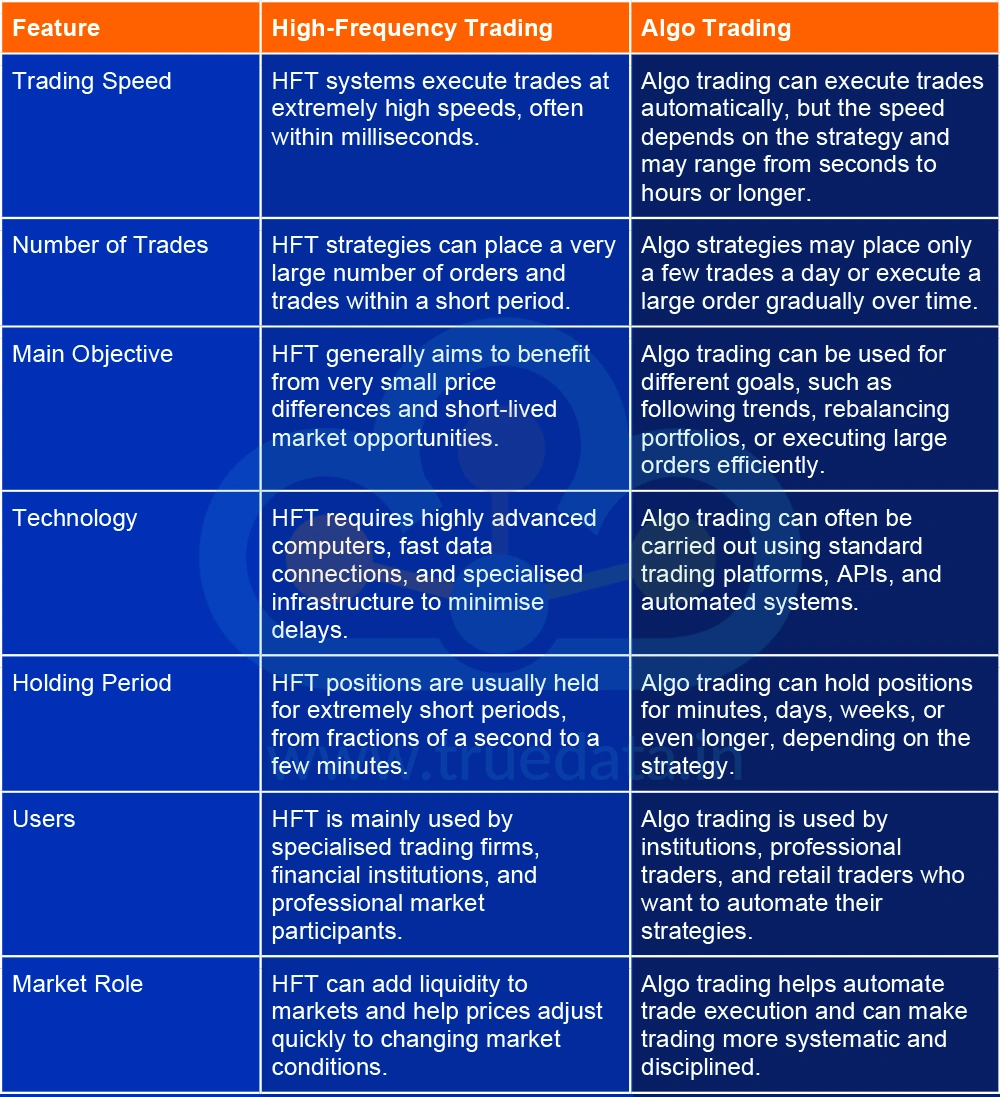
Although High-Frequency Trading (HFT) is a type of algorithmic trading, not all algo trading is high-frequency. Here are the key differences between the two.

What are the Key Differences Between High-Frequency Trading and Algo Trading

Feature

High-Frequency Trading

Algo Trading

Trading Speed

HFT systems execute trades at extremely high speeds, often within milliseconds.

Algo trading can execute trades automatically, but the speed depends on the strategy and may range from seconds to hours or longer.

Number of Trades

HFT strategies can place a very large number of orders and trades within a short period.

Algo strategies may place only a few trades a day or execute a large order gradually over time.

Main Objective

HFT generally aims to benefit from very small price differences and short-lived market opportunities.

Algo trading can be used for different goals, such as following trends, rebalancing portfolios, or executing large orders efficiently.

Technology

HFT requires highly advanced computers, fast data connections, and specialised infrastructure to minimise delays.

Algo trading can often be carried out using standard trading platforms, APIs, and automated systems.

Holding Period

HFT positions are usually held for extremely short periods, from fractions of a second to a few minutes.

Algo trading can hold positions for minutes, days, weeks, or even longer, depending on the strategy.

Users

HFT is mainly used by specialised trading firms, financial institutions, and professional market participants.

Algo trading is used by institutions, professional traders, and retail traders who want to automate their strategies.

Market Role

HFT can add liquidity to markets and help prices adjust quickly to changing market conditions.

Algo trading helps automate trade execution and can make trading more systematic and disciplined.

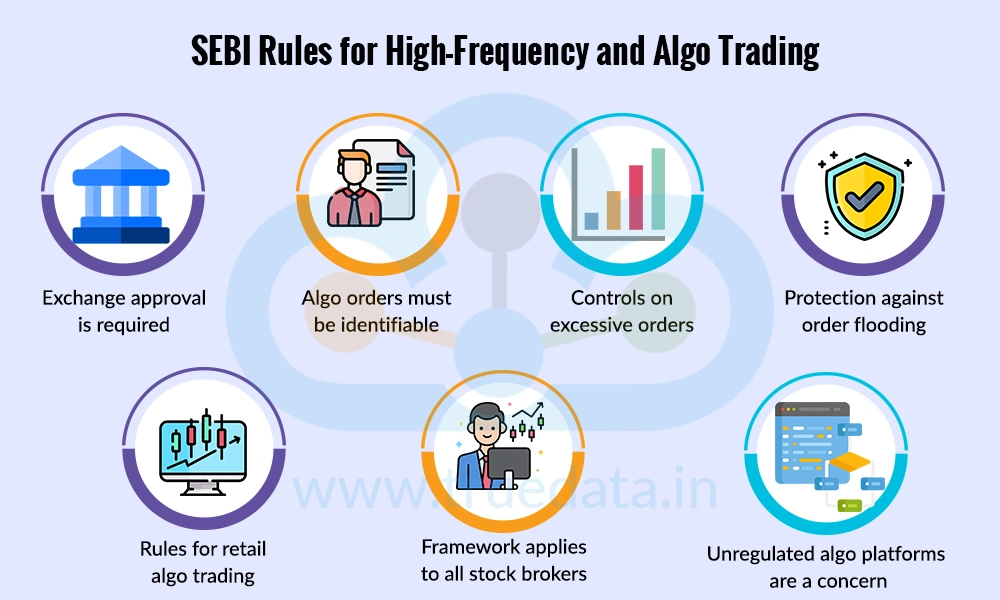
What are the SEBI Regulations for High-Frequency Trading and Algo Trading?

What are the SEBI Regulations for High-Frequency Trading and Algo Trading

SEBI has put rules in place to make algo trading more transparent, controlled, and safer for market participants. Since HFT is a form of algorithmic trading, many of the broader algo-trading rules also apply to HFT activities. Key points for investors include,

  • Exchange approval is required - Brokers offering algo trading must obtain the necessary permission from the stock exchange for each algorithm, helping ensure that the systems used for trading are properly reviewed.

  • Algo orders must be identifiable - Algorithmic orders need to carry a unique identifier so that exchanges can track them and maintain a clear audit trail.

  • Controls on excessive orders - Exchanges monitor the order-to-trade ratio (OTR) and can impose economic penalties when a trading member generates an excessively high number of orders compared with actual trades.

  • Protection against order flooding - Exchanges are required to monitor algo activity and take measures against excessive or repetitive orders that could affect orderly market functioning.

  • Rules for retail algo trading - SEBI introduced a framework in February 2025 to make retail participation in algorithmic trading safer. The framework covers brokers, algo providers, APIs, risk controls, and responsibilities of different participants.

  • Framework applies to all stock brokers - Following an implementation timeline extension, SEBI's retail algo framework became applicable to all stock brokers from April 1, 2026, along with the relevant implementation standards and operational procedures.

  • Unregulated algo platforms are a concern - SEBI has cautioned investors about unregulated platforms offering algorithmic trading strategies and making performance or return claims. Investors should therefore check whether the broker or service they use is properly regulated.

Who are the Target Users of HFT and Algo Traders?

While High-Frequency Trading (HFT) and Algorithmic Trading (Algo Trading) both use technology to automate trading, they are suitable for different types of users. HFT generally requires specialised infrastructure and very high execution speed, whereas Algo Trading can be used for a wider range of trading needs. SEBI’s framework also provides a regulated route for retail investors to participate in Algo Trading through brokers.

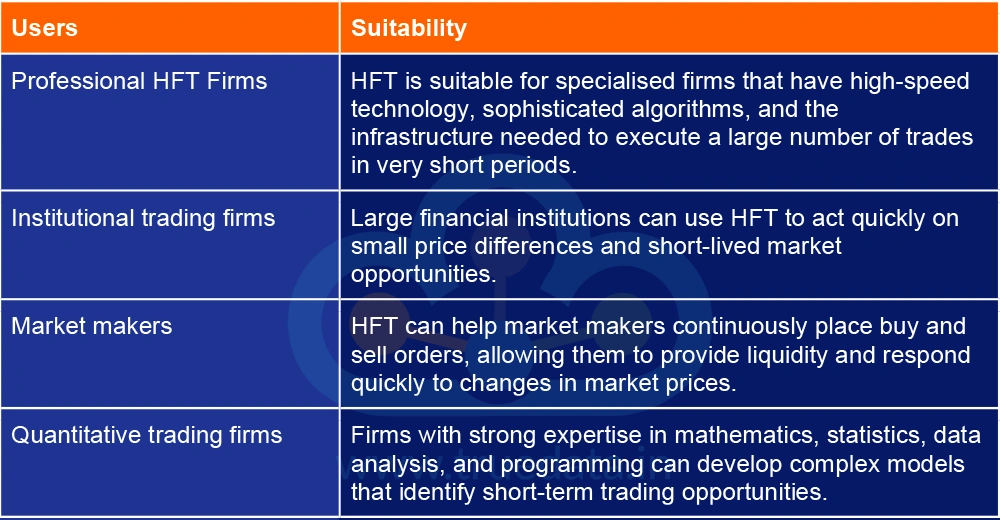
Target Users for HFT

Target Users for HFT

Users

Suitability

Professional HFT Firms

HFT is suitable for specialised firms that have high-speed technology, sophisticated algorithms, and the infrastructure needed to execute a large number of trades in very short periods.

Institutional trading firms

Large financial institutions can use HFT to act quickly on small price differences and short-lived market opportunities.

Market makers

HFT can help market makers continuously place buy and sell orders, allowing them to provide liquidity and respond quickly to changes in market prices.

Quantitative trading firms

Firms with strong expertise in mathematics, statistics, data analysis, and programming can develop complex models that identify short-term trading opportunities.

Target Users for Algo Trading

Target Users for Algo Trading

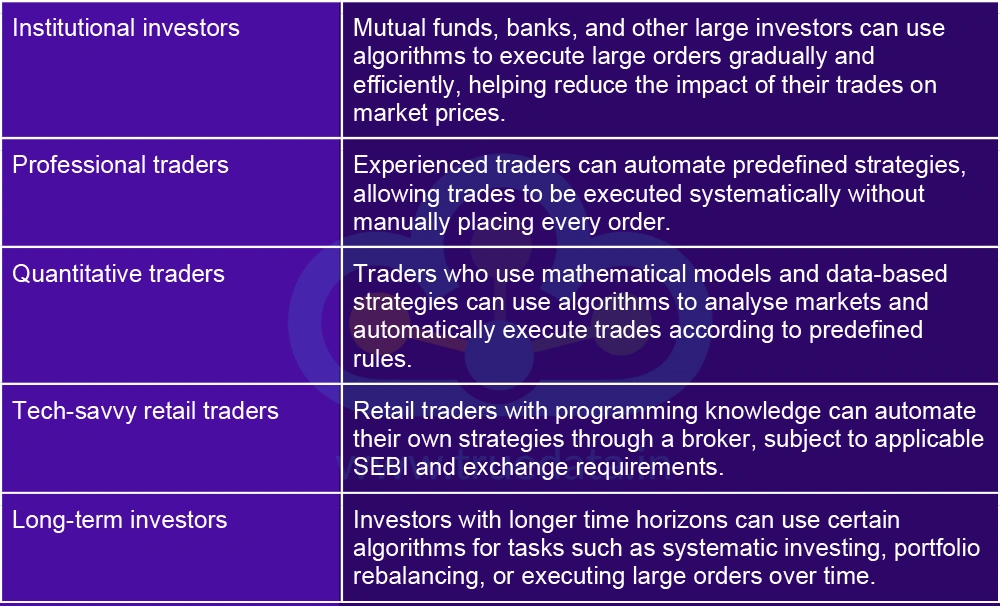
Institutional investors

Mutual funds, banks, and other large investors can use algorithms to execute large orders gradually and efficiently, helping reduce the impact of their trades on market prices.

Professional traders

Experienced traders can automate predefined strategies, allowing trades to be executed systematically without manually placing every order.

Quantitative traders

Traders who use mathematical models and data-based strategies can use algorithms to analyse markets and automatically execute trades according to predefined rules.

Tech-savvy retail traders

Retail traders with programming knowledge can automate their own strategies through a broker, subject to applicable SEBI and exchange requirements.

Long-term investors

Investors with longer time horizons can use certain algorithms for tasks such as systematic investing, portfolio rebalancing, or executing large orders over time.

Conclusion

HFT and Algo Trading have changed the way modern markets operate by making trading faster, more systematic, and technology-driven. While HFT focuses on extremely high-speed trading and short-lived opportunities, Algo Trading is a broader approach that can support a variety of trading strategies. Understanding these differences can help them choose an approach that matches their knowledge, goals, and risk appetite. Ultimately, technology can make trading more efficient, but a well-understood strategy and strong risk management remain essential.

This article explains the meaning and subtle differences between HFT and algo trading. Let us know your thoughts on the topic or if you need further information adn we will address them soon. 

Till then, Happy Reading!


Read More: Impact of Market Data Vendor on Algorithm Trading 

Frequently Asked Questions

HFT mainly aims to profit from very small price movements or short-lived opportunities by executing trades extremely quickly. Algo Trading has broader goals, such as following a strategy, executing large orders efficiently, rebalancing portfolios, or reducing manual effort.

No, HFT is not illegal in India when it follows SEBI and stock exchange rules, including required risk controls and monitoring. However, using HFT or algorithms for manipulation, unfair practices, or other prohibited activities can be illegal and unethical.

HFT requires high-speed computers, low-latency trading systems, fast market-data connections, and specialised infrastructure that can process and execute orders within milliseconds. It also needs strong risk controls and reliable technology to handle large volumes of trades quickly and safely.

Common HFT strategies include market making, arbitrage, statistical trading, and short-term momentum strategies, where algorithms try to benefit from tiny price differences or brief market movements. These strategies rely heavily on speed, large volumes of trades, and advanced technology.

HFT in India is regulated by SEBI and stock exchanges through rules on risk controls, order-to-trade ratios, system monitoring, and prevention of order flooding. HFT activity must also follow broader algorithmic trading requirements designed to support fair and orderly markets.

Retail traders can participate in Algo Trading through eligible brokers and approved systems, subject to SEBI and exchange rules. However, HFT is generally not practical for retail traders because it requires specialised technology, very low-latency infrastructure, and significant resources.
Marisha Bhatt

Marisha Bhatt is a financial content writer @TrueData.

She writes with the sole aim of simplifying complex financial concepts and jargon while attempting to clarify technical and fundamental analysis concepts of the stock markets. The ultimate goal is to spread vital knowledge and benefit the maximum audience. Her Chartered Accountant background acts as the knowledge base to help clarify crucial concepts and create a sound investment portfolio.

0 Comments

Related Articles

SEE ALL
Investing / Trading
Investing / Trading
Common Mistakes to Avoid in Algorithmic Trading - Lessons from Failed Strategies

Algorithmic trading has transformed the way people approach the markets. With AI...

Investing / Trading
Investing / Trading
Impact of Market Data Vendors on Algorithmic Trading

In the world of high-speed trading, success often hinges on capitalising on even...

Mutual Funds
Mutual Funds
Can Algorithms Beat Human Fund Managers? - Know all about Quant Based Mutual Funds

Investing in mutual funds is one of the simplest and most popular ways to grow y...