15-MIN DELAYED
NIFTY 25,334.95 +79.90 (+0.32%) | BANKNIFTY 61,150.65 +358.25 (+0.59%) | SENSEX 81,911.01 +31.61 (+0.04%) | CRUDEOIL-I 8,084.00 -99.00 (-1.21%) | GOLD-I 1,37,934.00 -1,796.00 (-1.29%) | NIFTY 25,334.95 +79.90 (+0.32%) | BANKNIFTY 61,150.65 +358.25 (+0.59%) | SENSEX 81,911.01 +31.61 (+0.04%) | CRUDEOIL-I 8,084.00 -99.00 (-1.21%) | GOLD-I 1,37,934.00 -1,796.00 (-1.29%) |
TrueData
Helpline / Support +91 7304-22-44-66
Get started

WORKSPACE

Workspace overview Workspace overview Our flagship product SignalX SignalX web charting for indian market Sheets Sheets streaming spreadsheet Wealth Wealth corporate data and news


Built for India's markets.

Real-time charts, streaming spreadsheets, live corporate announcements — all in one workspace.

Get started free

Reading Shareholding Pattern Changes - What Promoters & FIIs Signal

Marisha Bhatt · 12 Nov 2026 · 11 mins read · 0 Comments

reading-shareholding-pattern-changes-what-promoters-and-fiis-signal

Did you know FIIs have pulled nearly $30 billion from Indian equities in 2026, while DIIs have continued to support the market with strong buying? But what do these shifts really tell an investor? More importantly, what can changes in the shareholding pattern reveal about the confidence of promoters, FIIs and DIIs in a company? From rising promoter stakes to increasing or falling FII holdings, these changes can offer valuable clues about how major shareholders view a company. So, how do you read these signals without jumping to conclusions? Let us find out.

What is a Shareholding Pattern in a Company?

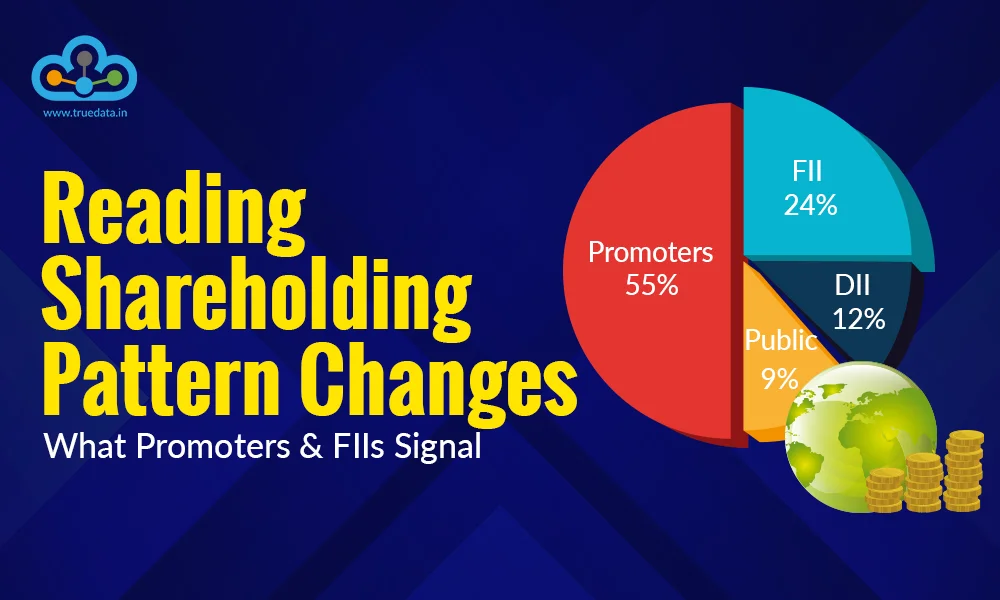
A shareholding pattern shows how the shares of a company are distributed among different groups of shareholders. It tells investors who owns how much of a company and how their ownership changes over time. The shareholding pattern generally provides details about categories such as promoters and promoter groups, Foreign Institutional Investors (FIIs), Domestic Institutional Investors (DIIs), public shareholders, and other investors. For example, if promoters own 50% of a company, FIIs hold 15%, DIIs hold 20%, and public shareholders own the remaining 15%, the shareholding pattern gives investors a clear picture of this ownership structure. It is also useful to track changes from one quarter to another. A rising promoter holding may indicate increased confidence in the company, while a fall in promoter, FII or DII holdings may warrant further investigation. However, a change in shareholding should not be treated as a standalone buy or sell signal, as investors may buy or sell shares for several reasons. Instead, the shareholding pattern should be studied along with the company’s financial performance, business outlook, valuation and other important factors.

Why is Analysing Shareholding Pattern Important?

why-is-analysing-shareholding-pattern-important

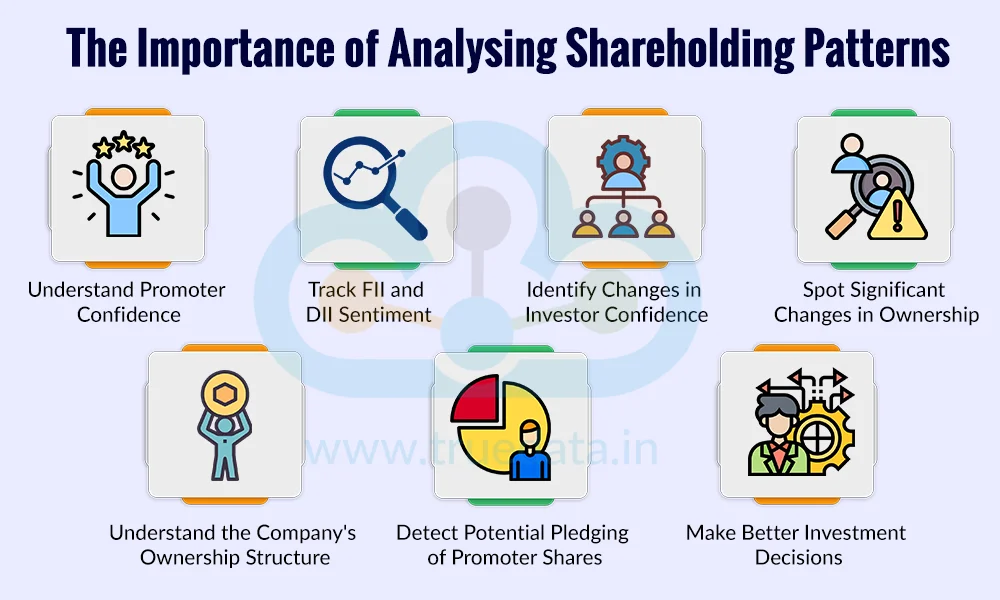
A company’s shareholding pattern gives investors a glimpse into who owns the company and how their ownership is changing over time. Simply looking at the percentage held by promoters, FIIs or DIIs may not tell the complete story. Analysing these changes can help investors understand shareholder confidence, identify important changes in ownership and spot developments that may require further investigation.

Understand Promoter Confidence

Promoters are generally closely involved in running the company and have a strong understanding of its business. Therefore, changes in their shareholding can provide useful information to investors. An increase in promoter holding may indicate that promoters are confident about the company’s future prospects, while a significant reduction may prompt investors to understand why the promoters are selling. However, investors should not automatically assume that a higher promoter holding is always positive or that a lower holding is always negative. Promoters may increase or reduce their stake for several reasons, such as raising funds, meeting personal financial requirements, restructuring their holdings or complying with regulatory requirements.

Track FII and DII Sentiment

The shareholding pattern also helps investors track the participation of Foreign Institutional Investors (FIIs) and Domestic Institutional Investors (DIIs). These institutions manage large pools of money and often conduct detailed research before investing. If FII or DII ownership in a company increases over several quarters, it may indicate growing institutional interest. On the other hand, a consistent decline may suggest that these investors are reducing their exposure. However, institutional buying or selling should be viewed as one factor among many, rather than as a direct buy or sell signal.

Identify Changes in Investor Confidence

Changes in ownership can sometimes provide clues about how different groups of investors perceive a company. For example, if promoter holding remains stable while institutional ownership steadily increases, it may indicate growing interest from professional investors. Similarly, a sharp fall in promoter or institutional holding may encourage investors to investigate whether there have been changes in the company’s business outlook, financial performance or corporate structure. The key is to look at the trend rather than a single quarter's numbers.

Spot Significant Changes in Ownership

Comparing shareholding patterns across quarters can help investors identify meaningful changes that may otherwise go unnoticed. For instance, a substantial increase in promoter holding, a sudden fall in FII ownership or a significant change in public shareholding can be a reason to look deeper into the company. Investors can compare the latest shareholding pattern with previous quarters to understand whether ownership is gradually changing or whether there has been a sudden shift.

Understand the Company's Ownership Structure

Shareholding patterns also help investors understand how ownership is distributed. A company may have a large promoter holding, significant institutional participation or a higher proportion of shares held by public investors. This is important because ownership concentration can influence how a company is controlled and how easily major shareholders can influence important decisions. Investors can therefore get a better understanding of the balance between promoters, institutions and public shareholders.

Detect Potential Pledging of Promoter Shares

The shareholding pattern can also provide information about shares pledged by promoters. When promoters pledge their shares, those shares are used as security for borrowing or other financial obligations. A high or rising level of promoter pledging may require closer attention as financial stress or a fall in the share price could create additional risks. Therefore, investors should look at both promoter ownership and the proportion of promoter shares that are pledged, rather than considering promoter holding alone.

Make Better Investment Decisions

Ultimately, analysing the shareholding pattern can help investors ask better questions about a company. If promoter holding is falling, investors can investigate the reason. If FII ownership is increasing, they can examine whether the company's financial performance and growth prospects support this interest. Similarly, a rise in DII or public ownership can be studied alongside other developments. However, the shareholding pattern should not be used in isolation. Investors should combine it with financial statements, earnings growth, debt levels, cash flows, valuation, corporate announcements and the overall business outlook before making an investment decision.

How to Check the Shareholding Pattern and Changes to it?

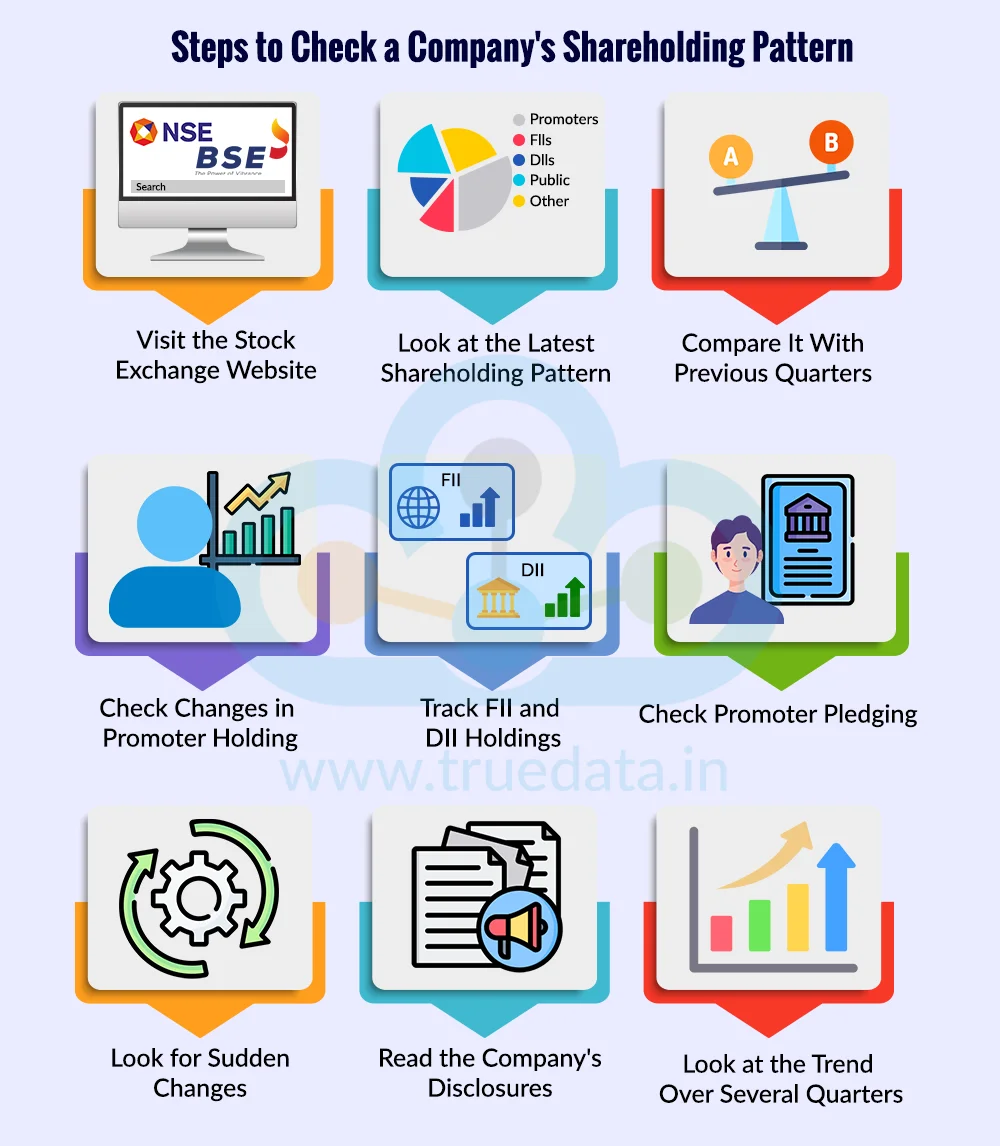
Investors can easily check a company's shareholding pattern through stock exchange websites and other reliable financial platforms. More importantly, investors should compare the current shareholding pattern with previous quarters to understand how ownership has changed. The approach to check the shareholding pattern and changes to it is explained below.

How to Check the Shareholding Pattern and Changes to it 

  • Visit the Stock Exchange Website - Investors can check a listed company's shareholding pattern on the official websites of the National Stock Exchange of India (NSE) or BSE Limited (BSE). They can search for the company and look for the section related to shareholding pattern or shareholding data. This information is regularly disclosed to the stock exchanges.

  • Look at the Latest Shareholding Pattern - Once investors find the company's shareholding pattern, first check the latest available quarter. The information is generally divided into different categories of shareholders, such as,

    • Promoters and promoter group

    • Foreign Institutional Investors (FIIs)

    • Domestic Institutional Investors (DIIs)

    • Public shareholders

    • Other shareholders

Investors can check the percentage of shares held by each category. This gives a clear snapshot of who owns the company's shares and how the ownership is distributed.

  • Compare It With Previous Quarters - Simply looking at only the latest shareholding pattern may not tell investors much. The real value comes from comparing it with previous quarters. For example, suppose the promoter holding of a company was as follows, 

    • June quarter - 52%

    • September quarter - 53%

    • December quarter - 54%

This shows that the promoters have gradually increased their stake. Similarly, investors can track whether FII, DII or public shareholding has increased or decreased over several quarters.

  • Check Changes in Promoter Holding - Investors should pay close attention to changes in promoter shareholding. A rise in promoter ownership may indicate increased confidence in the business, while a reduction may require investors to understand the reason behind the sale. However, do not immediately treat a change as positive or negative. Promoters may buy or sell shares for several reasons, including fundraising, restructuring, personal financial requirements or regulatory considerations.

  • Track FII and DII Holdings - Next, it is important to check whether FIIs and DIIs are increasing or reducing their holdings. For example, if FII ownership rises from 12% to 16% over a few quarters, it indicates greater institutional participation. Similarly, a consistent decline in FII holdings may indicate reduced exposure. However, it is important to remember that institutional investors can change their holdings due to portfolio rebalancing, market conditions, valuation or other factors. Therefore, their buying or selling should be treated as a clue to investigate further, not as an automatic investment signal.

  • Check Promoter Pledging - Investors should not look at promoter ownership alone, as it is equally crucial to check whether promoters have pledged any of their shares. For example, a promoter may own 50% of a company, but if a significant portion of those shares is pledged, the situation may carry additional risk. Investors should therefore track whether promoter pledging is increasing, decreasing or remaining stable.

  • Look for Sudden Changes - A sudden change in shareholding can be worth investigating. For example.

    • Promoters significantly reduce their stake.

    • FIIs sharply increase or reduce their holding.

    • DIIs enter the stock or substantially increase their stake.

    • Public shareholding changes significantly.

    • Promoter pledging increases.

Such changes do not necessarily mean something is wrong or that the stock will rise. Instead, they can prompt investors to look for the reason behind the change.

  • Read the Company's Disclosures - If investors notice a significant change, check the company's stock exchange filings and corporate announcements for more information. A change in shareholding may be linked to a block deal, preferential issue, acquisition, conversion of securities, promoter transaction or other corporate action. Understanding the reason behind the change is often more useful than simply looking at the percentage change.

  • Look at the Trend Over Several Quarters - Finally, investors should avoid making a decision based on just one quarter. Try to study the shareholding pattern over at least four to six quarters to identify a meaningful trend. For example, a one-quarter fall in FII holding may not mean much. However,  if FII ownership has been declining consistently for several quarters while promoter pledging is increasing, it may deserve closer attention.

What do Changes in the Shareholding Pattern Indicate?

Changes in a company's shareholding pattern can give investors useful clues about how different groups of shareholders are positioning themselves. However, these changes should not be treated as direct buy or sell signals. Investors should look at the reason for the change, the trend over several quarters and the company's financial and business performance before drawing any conclusion.

Promoters 

Promoters 

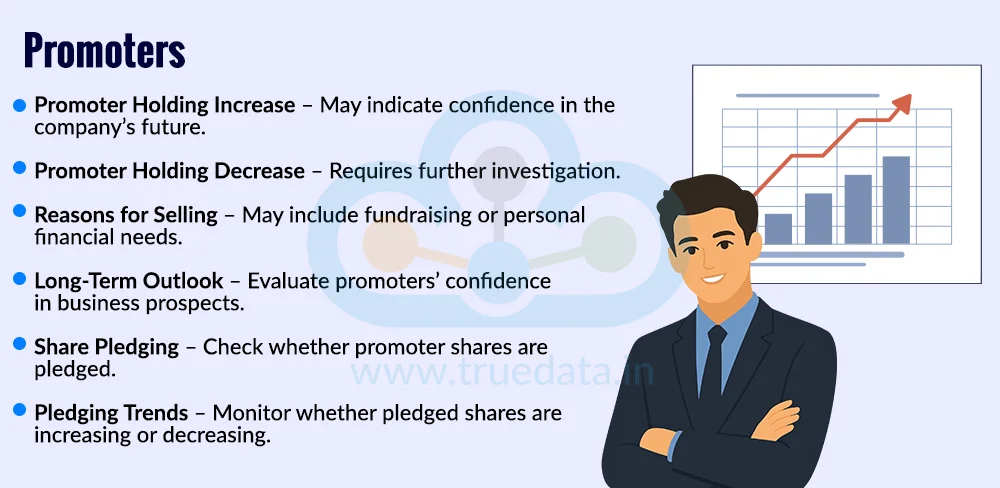
Promoters are the individuals or entities that have control or significant influence over the company. Therefore, changes in promoter shareholding can be an important factor to watch. An increase in promoter holding may indicate that promoters are confident about the company's long-term prospects and are willing to increase their investment. On the other hand, a significant or continuous reduction in promoter holding may encourage investors to investigate why the promoters are selling their shares.

However, promoter selling does not always indicate a lack of confidence. Promoters may sell shares to raise funds, meet personal financial requirements, restructure their holdings or comply with regulatory requirements. Investors should therefore look at why the promoter holding has changed, rather than judging the change in isolation. It is also important to check whether promoter shares are pledged and whether the level of pledging is increasing or decreasing.

Foreign Institutional Investors (FIIs)

Foreign Institutional Investors (FIIs)

Foreign Institutional Investors (FIIs) include overseas institutions that invest in Indian companies and markets. Changes in FII ownership can provide an indication of how foreign institutional investors are positioning themselves towards a particular company.

A rise in FII holding may indicate increasing interest in the company's growth prospects, earnings potential or valuation. Similarly, a sustained decline may suggest that FIIs are reducing their exposure. However, FII buying or selling can also be influenced by factors such as global interest rates, currency movements, emerging-market allocations, geopolitical developments and portfolio rebalancing. Therefore, investors should not assume that a fall in FII holding automatically means that a stock is likely to perform poorly.

Domestic Institutional Investors (DIIs)

Domestic Institutional Investors (DIIs)

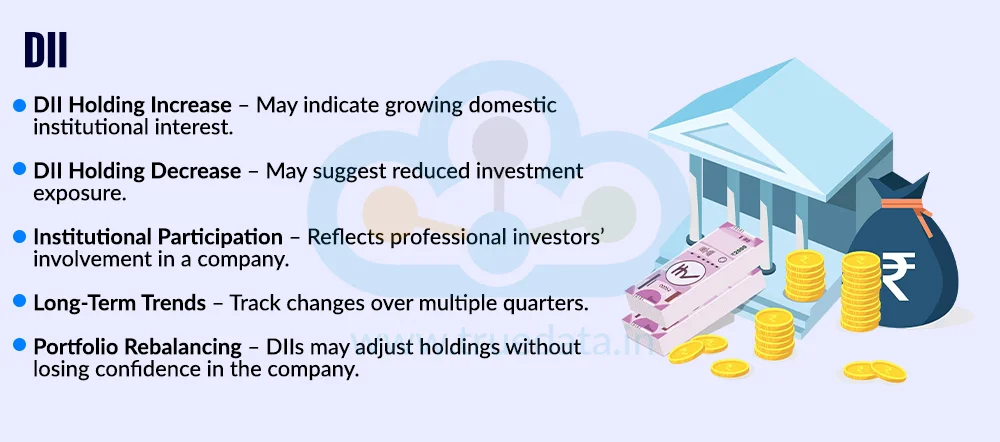
Domestic Institutional Investors (DIIs) include institutions such as mutual funds, insurance companies and other domestic investment institutions. Their shareholding can be useful for understanding the level of participation from professional investors within India.

An increase in DII holding may indicate growing institutional interest in a company, while a decline may indicate that domestic institutions have reduced their exposure. Investors should also examine whether the change is temporary or part of a longer-term trend. For example, a mutual fund may reduce its holding simply because of portfolio rebalancing, even when its view of the company's business remains positive.

Retail Investors 

Retail Investors 

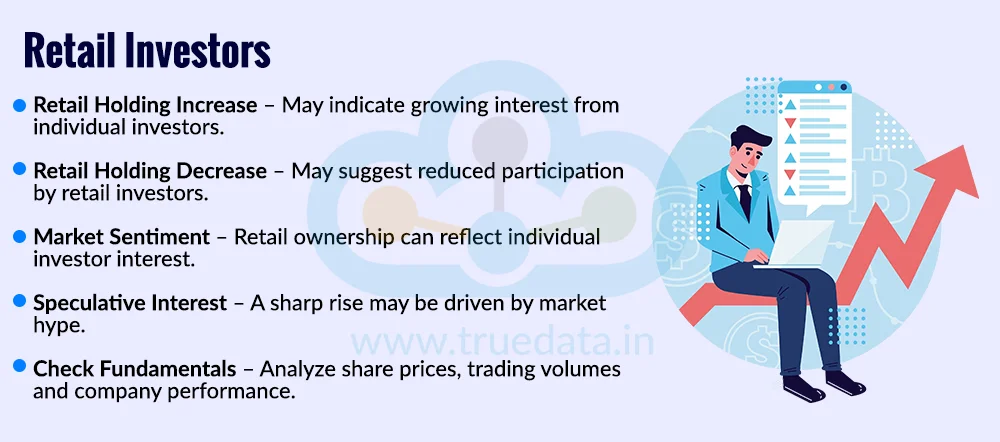
Retail investors are individual investors who generally invest smaller amounts compared with large institutional investors. Changes in public or retail shareholding can provide some insight into how individual investors are participating in a stock.

A rise in retail ownership could indicate increasing interest from individual investors, while a fall could mean that some retail shareholders have reduced their holdings. However, a sharp increase in retail participation is not necessarily a positive signal. It could sometimes happen when a stock attracts significant market attention or speculative interest. Therefore, investors should consider changes in retail ownership alongside share price movements, trading volumes and the company’s fundamentals.

Others 

Others 

The Others category can include shareholders who do not fall into the major categories such as promoters, FIIs, DIIs or public retail investors. Depending on the company and the shareholding classification, this may include certain corporate bodies, trusts, employee-related holdings or other categories of shareholders.

Changes in this category may sometimes be less straightforward to interpret as the underlying shareholders can be diverse. If there is a significant change, investors should look at the detailed shareholding information and relevant company disclosures to understand who is buying or selling and why.

What Should Investors Do?

What Should Investors Do

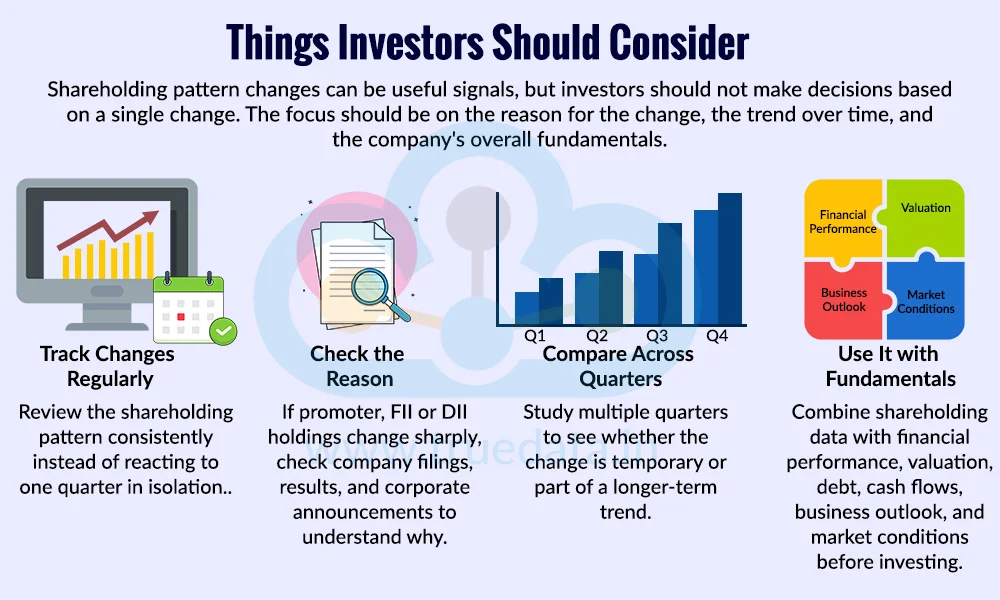
Let us now focus on the most important question for an average investor, i.e., what these changes imply for investors and what they can do about it. Investors should track changes in the shareholding pattern regularly, but avoid making investment decisions based on a single change. If promoter, FII or DII holdings rise or fall significantly, investors should first understand the reason behind the change by checking the company's filings, financial results and corporate announcements. It is also useful to compare the shareholding pattern across several quarters to identify whether the change is a one-time event or a longer-term trend.

Most importantly, investors should use shareholding changes as one piece of the investment puzzle. A rise in promoter or institutional holding may be encouraging, but it does not guarantee good returns. Similarly, a fall in FII or promoter holding does not automatically mean that a stock should be avoided. Investors should combine shareholding data with the company's financial performance, valuation, debt, cash flows, business outlook and overall market conditions before making an investment decision.

Conclusion

Reading changes in a company’s shareholding pattern can help investors understand how promoters, FIIs, DIIs and other shareholders are positioning themselves. However, these changes are best viewed as clues rather than clear buy or sell signals. By looking at the trend over time, understanding the reasons behind the changes and comparing them with the company’s financial performance and business outlook, investors can make more informed investment decisions. Ultimately, shareholding patterns can be a useful tool to understand what major investors may be signalling, but the bigger picture always matters.

This article addresses an important concept in fundamental analysis and how it can affect an investment portfolio. Let us know your thoughts on the topic or if you need further information, and we will address it soon. 

Till then, Happy Reading!


Read More: 10 Corporate Filings Every Stock Investor Should Track in India

Frequently Asked Questions

Investors can read a company’s shareholding pattern by checking the percentage of share ownership (promoters, FIIs, DIIs, retail investors and others) and how their holdings have changed over time. Comparing the latest figures with previous quarters can help the investor understand ownership trends and possible changes in investor confidence.

Promoters may buy shares of their own company when they believe in its future growth prospects or feel that the shares are undervalued. An increase in promoter holding can signal confidence, although investors should also consider the reason and overall business performance.

FII shareholding represents shares held by foreign institutional investors, while DII shareholding represents shares held by domestic institutional investors such as mutual funds and insurance companies. Investors can compare changes in both to understand how foreign and domestic institutions are positioning themselves in a company.

Promoter pledging does not change the promoter’s ownership percentage by itself, but it shows that some promoter-held shares have been used as security for a loan or other obligation. A high or rising level of pledged shares may indicate higher financial risk and therefore deserves closer attention from investors.

A company’s shareholding pattern can change whenever shareholders buy or sell shares, but listed companies generally disclose their shareholding pattern every quarter. Investors can compare these quarterly disclosures to track changes in promoter, FII, DII and other shareholder holdings

Investors should look for significant changes in promoter, FII, DII and retail holdings, along with any increase or decrease in promoter share pledging. They should also compare the changes over several quarters and understand the reasons behind them before making an investment decision.
Marisha Bhatt

Marisha Bhatt is a financial content writer @TrueData.

She writes with the sole aim of simplifying complex financial concepts and jargon while attempting to clarify technical and fundamental analysis concepts of the stock markets. The ultimate goal is to spread vital knowledge and benefit the maximum audience. Her Chartered Accountant background acts as the knowledge base to help clarify crucial concepts and create a sound investment portfolio.

0 Comments

Related Articles

SEE ALL
Corporate Data
Corporate Data
Investing Smarter: The Power of Corporate Data and Market Sentiment Analysis

Thestock market never stands still, and prices swing constantly with every new h...

Corporate Data
Corporate Data
Understanding Quarterly vs Annual Corporate Data

Corporate data is more than just the numbers of a company. They can show what is...

Corporate Data
Corporate Data
Key Corporate Data Every Investor Must Track Before Investing

Investing is not just about numbers on a screen. It is about understanding the s...