15-MIN DELAYED
NIFTY 25,514.30 +286.35 (+1.14%) | BANKNIFTY 63,063.00 +1,024.35 (+1.65%) | SENSEX 83,021.75 +989.94 (+1.21%) | CRUDEOIL-I 7,880.00 +165.00 (+2.14%) | GOLD-I 1,27,547.00 -2,333.00 (-1.80%) | NIFTY 25,514.30 +286.35 (+1.14%) | BANKNIFTY 63,063.00 +1,024.35 (+1.65%) | SENSEX 83,021.75 +989.94 (+1.21%) | CRUDEOIL-I 7,880.00 +165.00 (+2.14%) | GOLD-I 1,27,547.00 -2,333.00 (-1.80%) |
TrueData
Helpline / Support +91 7304-22-44-66
Get started

WORKSPACE

Workspace overview Workspace overview Our flagship product SignalX SignalX web charting for indian market Sheets Sheets streaming spreadsheet Wealth Wealth corporate data and news

Built for India's markets.

Real-time charts, streaming spreadsheets, live corporate announcements — all in one workspace.

Get started free

Understanding Different IPO Terms

Marisha Bhatt · 19 Nov 2026 · 19 mins read · 0 Comments

understanding-different-ipo-terms

We are entering the last quarter of 2026, and Sensex and Nifty are down almost 15% from the start of the year. While this can be a grim sign for most investors, many are still betting on the Indian growth story with major IPOs like Reliance Jio, Tata Sons, Zepto and more on the way. Therefore, before investing in such opportunities, it is important to understand key IPO terms and their relevance. So read on to learn all about the different IPO terms and their meaning to make informed investment decisions.   

What is an IPO?

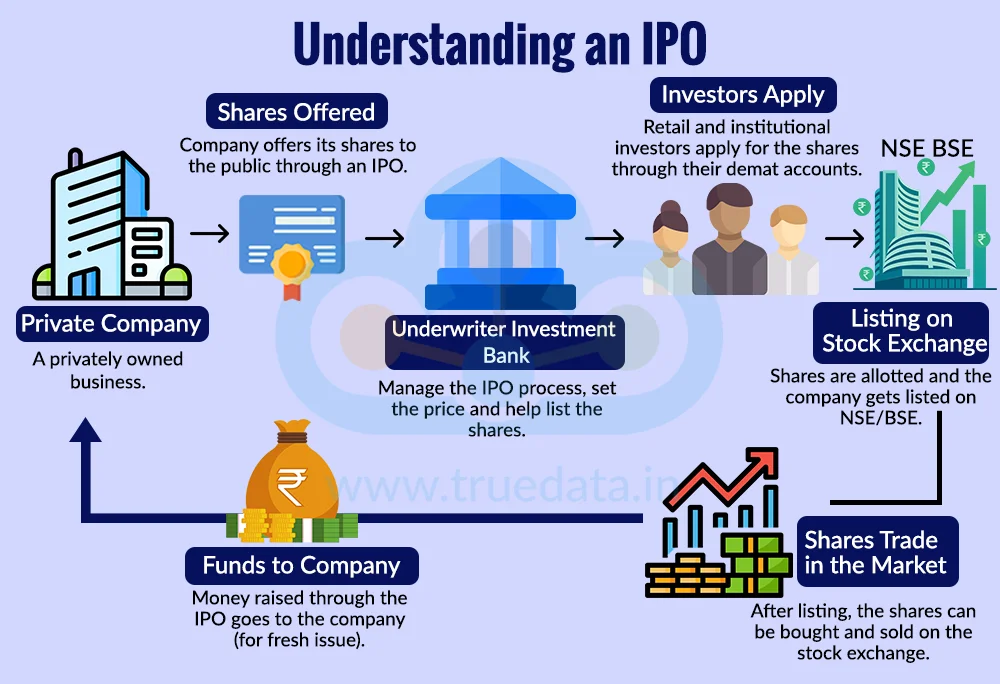
What is an IPO

An Initial Public Offering (IPO) is the process through which a private company offers its shares to the public for the first time and gets listed on a stock exchange such as the NSE or BSE. Through an IPO, a company can raise money from investors to fund business expansion, repay debt, support new projects or meet other corporate needs. Investors can apply for shares during the IPO through their demat and trading accounts, usually within a specified price range called the price band. If shares are allotted, investors become shareholders of the company, and the shares can be bought or sold on the stock exchange after listing. Thus, an IPO gives a company access to public funds while giving investors an opportunity to become part-owners of the business.

What are the Important IPO Terms Investors Should Know Before Applying?

Now that we have seen the meaning of an IPO, let us focus on a few important IPO terms and their meaning in the IPO world. 

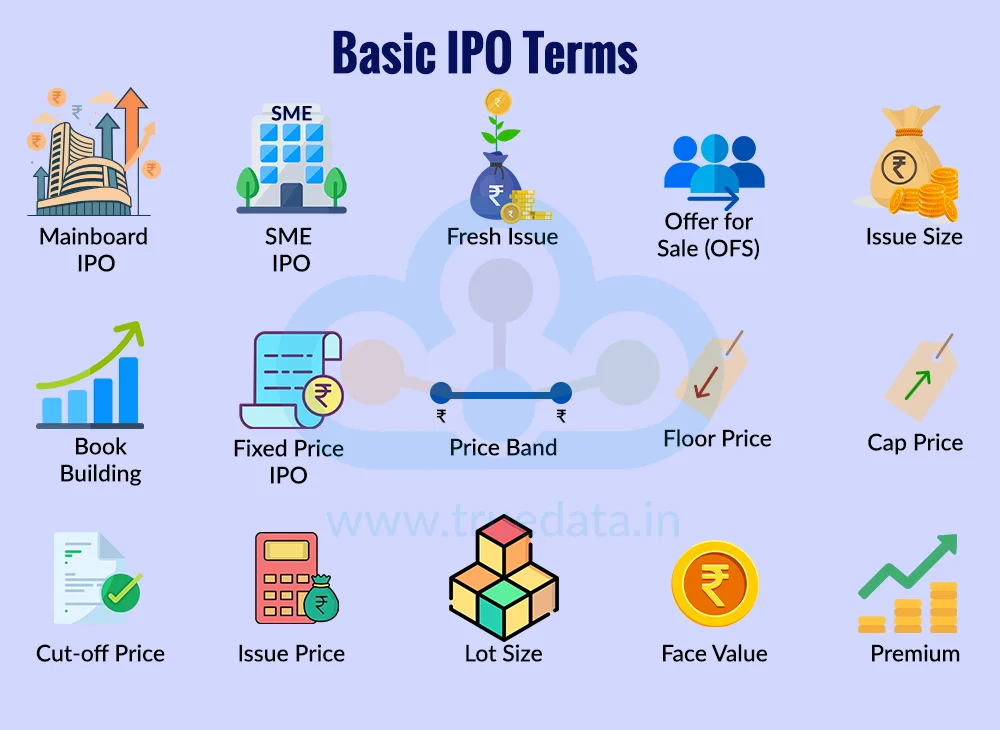
Basic IPO Terms 

Basic IPO Terms 

  • Mainboard IPO - A Mainboard IPO is an IPO of a company that seeks listing on the main platforms of stock exchanges such as the NSE and BSE. These companies are generally larger and more established than those coming through the SME platform and are subject to applicable SEBI requirements. Mainboard IPOs are generally easier to participate in for retail investors due to their minimum application amounts usually being lower than those of SME IPOs.

  • SME IPO - An SME IPO is an IPO launched by a small or medium-sized enterprise and listed on dedicated SME platforms such as NSE Emerge or BSE SME. SME IPOs can provide investors with an opportunity to invest in smaller and growing businesses, but they can also involve higher risks, larger application sizes and lower liquidity after listing. Therefore, investors should carefully study the company's financials, business model, risks and post-listing trading conditions before investing.

  • Fresh Issue - A fresh issue refers to new shares issued by the company as part of an IPO. The money raised through these shares goes directly to the company and can be used for purposes such as expansion, capital expenditure, debt repayment or working capital, as disclosed in the offer documents. For investors, the fresh issue is important because it shows how much new capital the business is actually raising and how that money is expected to be used.

  • Offer for Sale (OFS) - An Offer for Sale (OFS) is a part of an IPO in which existing shareholders, such as promoters or early investors, sell their shares to the public. Unlike a fresh issue, the money raised through an OFS goes to the selling shareholders rather than to the company. Therefore, investors should check the proportion of fresh issue and OFS to understand whether the IPO is primarily raising new funds for the business or providing an exit opportunity to existing shareholders.

  • Issue Size - The issue size refers to the total value of shares offered through the IPO. It can include both the fresh issue and the OFS component. For example, if an IPO consists of a Rs. 500 crore fresh issue and a Rs. 300 crore OFS, the total issue size would be Rs. 800 crore. Investors can use this information to understand the scale of the offering and how much capital the company is raising versus how much is being sold by existing shareholders.

  • Book Building - Book building is the process used to determine the final price of many IPOs. Instead of offering shares at one fixed price, the company announces a price band, and investors place bids within that range. Based on the demand received at different prices, the final issue price is determined. This helps in discovering a price based on investor demand rather than simply fixing one price in advance.

  • Fixed Price IPO - A fixed price IPO is an IPO in which the company announces one price at which investors can apply for the shares. Unlike a book-built IPO, there is no price range within which investors can place their bids. Investors know the offer price before applying and submit their applications at that price.

  • Price Band - The price band is the range within which investors can bid for shares in a book-built IPO. It consists of a floor price, which is the lower end, and a cap price, which is the upper end. For example, if the price band is Rs. 140 - Rs. 150, investors can bid within this range. The price band helps investors understand the valuations at which the company is seeking to raise money.

  • Floor Price - The floor price is the lowest price at which investors can place a bid in a book-built IPO. It forms the lower end of the IPO’s price band and tells investors the minimum price they can offer for the shares. For example, if an IPO has a price band of Rs. 140 - Rs. 150, the floor price is Rs. 140. An investor cannot place a bid below Rs. 140 per share. The floor price is important because it sets the minimum level within which investors can bid during the IPO. However, the final issue price may be higher than the floor price depending on the demand for the shares and the bids received from investors.

  • Cap Price - The cap price is the highest price in the price band of a book-built IPO. It represents the maximum price at which investors can place their bids. For example, if the IPO has a price band of Rs. 140 - Rs. 150, the cap price is Rs. 150. Investors cannot bid above this price during the IPO. The cap price is important because it sets the upper limit of the price range within which the final issue price is determined. Retail investors can also choose the cut-off option, which means they agree to buy the shares at the final issue price decided through the book-building process, rather than specifying a particular price within the band.

  • Cut-off Price - The cut-off price is an option available to eligible retail investors in a book-built IPO. By choosing the cut-off option, an investor agrees to buy shares at whatever final issue price is determined within the price band. This means the investor does not have to guess the final issue price while applying. 

  • Issue Price - The issue price is the final price at which shares are allotted to successful IPO applicants. In a book-built IPO, it is determined after considering the bids received during the subscription period. Investors can later compare the issue price with the listing price and the market price to understand how the stock has performed after listing.

  • Lot Size - The lot size refers to the minimum number of shares an investor must apply for in an IPO and the number of shares in subsequent multiples. For example, if the lot size is 50 shares, an investor generally needs to apply for at least 50 shares and can apply for 100, 150, 200 shares and so on, subject to applicable rules. The lot size helps investors calculate the minimum amount required to participate in an IPO. 

  • Face Value - The face value is the nominal value assigned to each share by the company, such as Rs. 2 or Rs. 10. It is different from the IPO issue price. For example, a share with a face value of Rs. 10 may be offered to investors at Rs. 150 in an IPO. Face value is relevant for understanding certain corporate actions, such as dividends, bonus issues and stock splits.

  • Premium - When an IPO share is offered at a price higher than its face value, the difference is called the premium. For example, if the face value is Rs. 10 and the IPO price is Rs. 150, the premium is Rs. 140 per share. The premium is part of the amount investors pay above the nominal face value of the share.

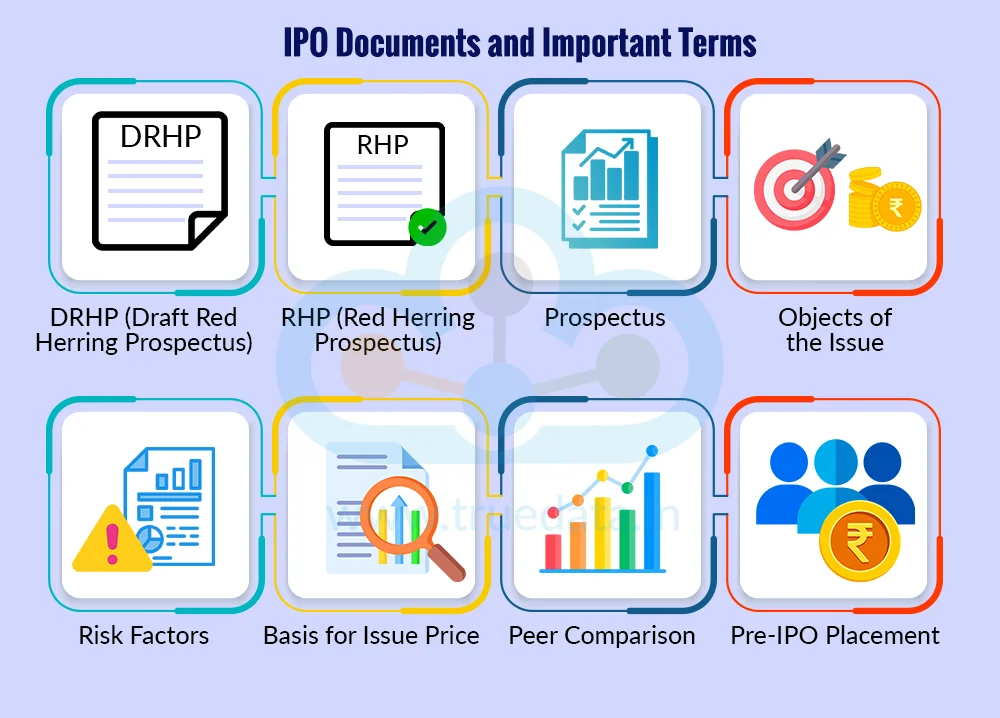
IPO Documents and Important Terms

IPO Documents and Important Terms

  • DRHP (Draft Red Herring Prospectus) - The Draft Red Herring Prospectus (DRHP) is a preliminary offer document submitted by a company to SEBI before launching its IPO. It contains detailed information about the company's business, financial performance, promoters, risks, use of funds and proposed IPO structure. Investors can use the DRHP to research the company well before the IPO opens. Since it is a draft, some details may change before the final offer document is issued

  • RHP (Red Herring Prospectus) - The Red Herring Prospectus (RHP) is the offer document issued before the IPO opens and contains important information about the company, its business, financials, risks, promoters and the IPO. It is particularly useful for investors because it contains the key details needed to evaluate the issue before applying.

  • Prospectus - The prospectus is the final offer document containing important information about the public issue, including the company's financial information, risks, issue details and the final pricing information. Investors should read the relevant offer document carefully before making an investment decision.

  • Objects of the Issue - Objects of the Issue explain how the company intends to use the money raised through the IPO, particularly the proceeds from the fresh issue. The funds may be used for purposes such as capital expenditure, debt repayment, working capital, acquisitions or general corporate purposes. Investors should check this section to understand whether the funds are being raised to support business growth or for other purposes.

  • Risk Factors - Risk Factors is a section of the IPO offer document that highlights the major risks associated with the company and its business. These may include industry risks, financial risks, regulatory issues, dependence on key customers, competition and other factors that could affect future performance. Investors should not skip this section simply because it can be lengthy, as it can reveal important challenges associated with the investment. 

  • Basis for Issue Price - The Basis for Issue Price explains why the company and its merchant bankers consider the IPO price appropriate. It may include financial measures such as EPS, P/E, RoNW and NAV, along with comparisons with listed peers. Investors can use this information to assess whether the IPO valuation appears reasonable compared with similar companies.

  • Peer Comparison - Peer Comparison compares the IPO company's financial and valuation metrics with those of similar listed companies. Investors can use various financial ratios to understand whether the IPO is being offered at a premium or discount to its peers. However, investors should also consider differences in business models, growth prospects and profitability rather than relying on one ratio alone.

  • Pre-IPO Placement - A pre-IPO placement is the sale of shares to selected investors before the IPO opens to the public. Such placements can provide the company with capital before the public issue and may influence the eventual size of the fresh issue. Investors should check the offer documents for details of any pre-IPO placement and its impact on the issue structure.

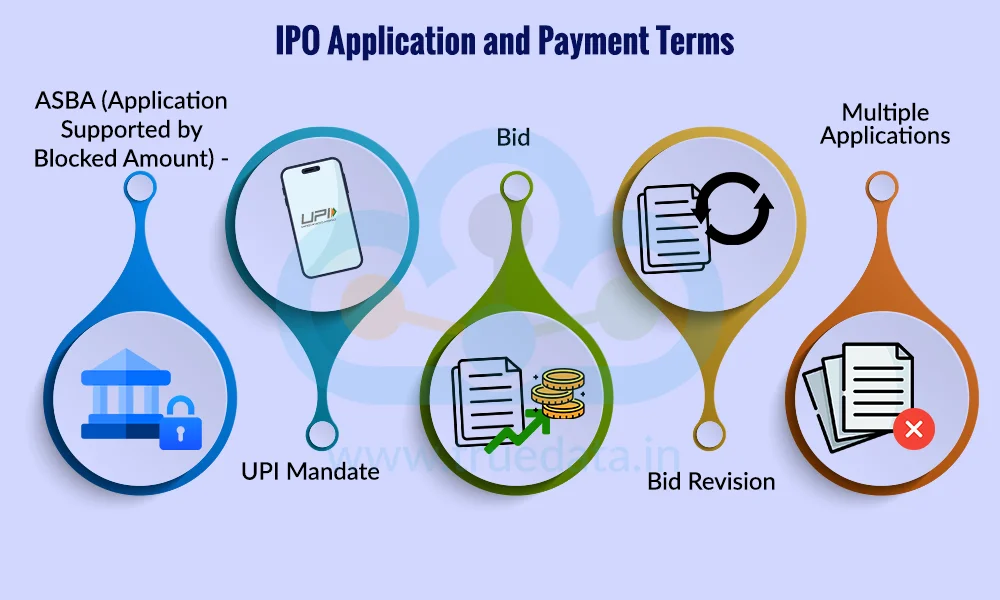
IPO Application and Payment Terms

IPO Application and Payment Terms

  • ASBA (Application Supported by Blocked Amount) - ASBA is a facility through which an investor's IPO application money is blocked in their bank account instead of being immediately transferred to the company. If shares are allotted, the required amount is debited; if shares are not allotted, the blocked amount is released. This allows investors to continue earning interest on the blocked funds, subject to the terms of their bank account. ASBA is an important part of the IPO application process in India. 

  • UPI Mandate - A UPI mandate allows eligible investors to apply for an IPO using UPI through their linked bank account. The required amount is blocked after the investor approves the mandate. Investors should carefully check the UPI mandate details and approve it within the specified deadline; merely submitting an IPO application does not necessarily complete the process if the required mandate is not approved. 

  • Bid - A bid is an investor's request to buy a specified number of shares at a particular price during an IPO. In a book-built issue, investors can generally place their bids within the price band, while eligible retail investors can also choose the cut-off option.

  • Bid Revision - Bid revision refers to changing the quantity or price of an IPO bid during the permitted bidding period. For example, an investor may increase or decrease the number of shares applied for, subject to the rules applicable to that investor category and issue. Investors should check the IPO's specific terms before making changes. 

  • Multiple Applications - A multiple application occurs when an investor submits more than one application for the same IPO in a manner that violates the applicable rules. Such applications may be rejected. Therefore, investors should follow the application requirements carefully and avoid submitting duplicate applications just to increase their chances of allotment.

Investor Categories

Investor Categories

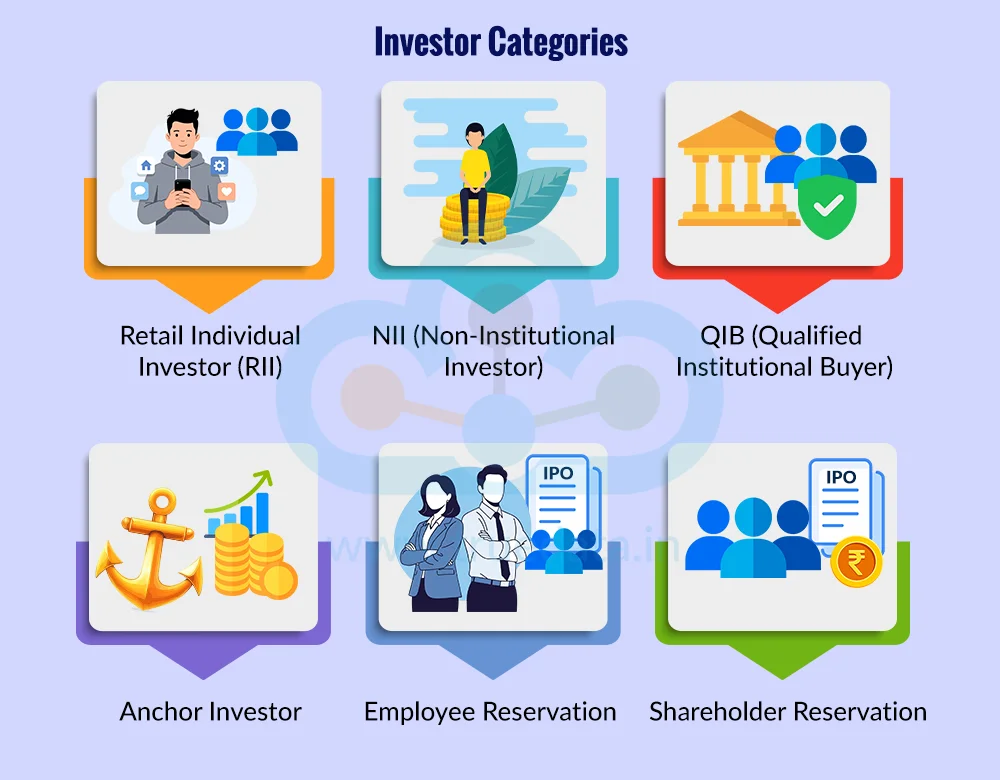
  • Retail Individual Investor (RII) - A Retail Individual Investor (RII) is an individual investor applying within the applicable retail investment limit of Rs. 2,00,000 for a public issue. The retail category is designed to provide individual investors with a separate portion of the IPO. Investors should check the current issue documents because applicable category limits and rules can change. 

  • NII (Non-Institutional Investor) - A Non-Institutional Investor (NII) is an investor who applies for more than Rs. 2,00,000 in a Mainboard IPO and does not fall under the Qualified Institutional Buyer (QIB) category. The NII category is divided into two subcategories: Small NII (sNII), for applications above Rs. 2,00,000 and up to Rs. 10,00,000, and Big NII (bNII), for applications above Rs. 10,00,000. These subcategories have separate allocation portions, so investors should understand the applicable allotment rules before deciding how much to invest. This category generally includes high-net-worth individuals and certain other eligible investors. The NII category can have different allotment rules from the retail category.

  • QIB (Qualified Institutional Buyer) - Qualified Institutional Buyers (QIBs) are eligible institutional investors that meet SEBI's prescribed criteria. They include entities such as mutual funds, insurance companies, banks and certain financial institutions. QIBs participate in the institutional portion of an IPO, which can account for up to 50% of the net offer in a standard book-built Mainboard IPO, subject to applicable regulations. Unlike retail and NII applicants, QIBs are classified by their institutional eligibility rather than by the individual application thresholds. 

  • Anchor Investor - An anchor investor is an eligible QIB that receives an allocation in a book-built IPO before the issue opens to other investors. Under the applicable SEBI framework, the minimum application size for an anchor investor is generally Rs. 10 crore. Anchor participation and allocation details are disclosed before the public bidding period and can give investors an early indication of institutional interest. However, anchor investment does not guarantee listing gains or strong future performance.

  • Employee Reservation - Some IPOs may have a portion of shares reserved for eligible employees of the company. If an employee reservation is provided, eligible employees can apply for shares under the terms specified in the offer documents. Investors should check the RHP to understand whether such a reservation exists and the applicable discount or allocation rules.

  • Shareholder Reservation - In some IPOs, shares may be reserved for eligible existing shareholders of a group or related listed company, subject to applicable regulations and the terms of the issue. Such investors must satisfy the eligibility conditions mentioned in the offer document.

Subscription and Allotment Terms

Subscription and Allotment Terms

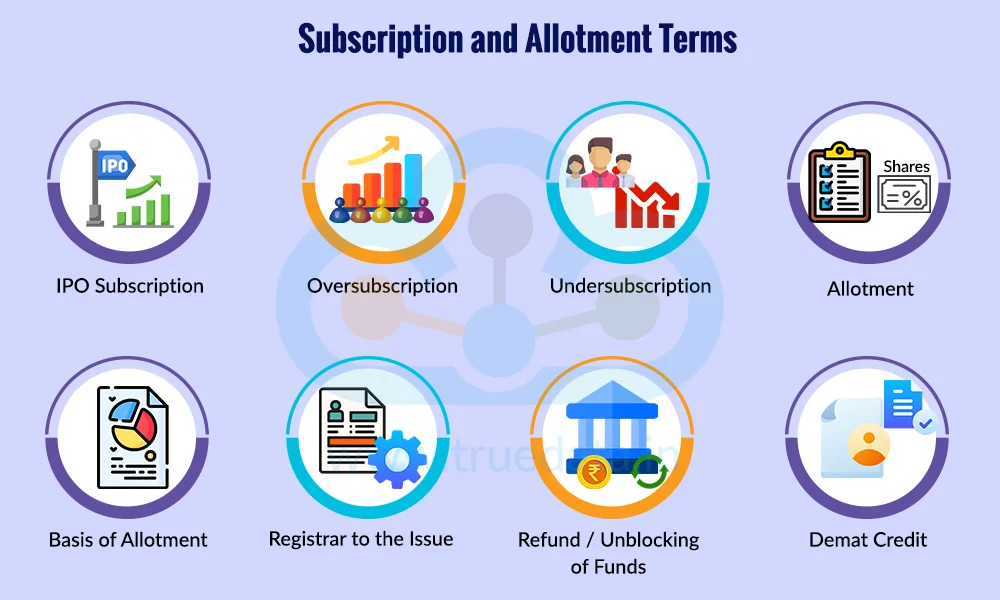
  • IPO Subscription - IPO subscription refers to the demand received from investors for the shares offered in an IPO. If an IPO offers 1 crore shares and investors bid for 5 crore shares, the issue is said to be subscribed 5 times. Subscription data can show investor demand, but high subscription alone does not mean that the company is fundamentally strong or fairly valued. 

  • Oversubscription - An IPO is oversubscribed when investors apply for more shares than the number available for a particular category. For example, if 10 lakh shares are available and investors bid for 50 lakh shares, the issue is subscribed 5 times. High oversubscription can make allotment more difficult, particularly for retail investors.

  • Undersubscription - An IPO is undersubscribed when investors apply for fewer shares than those offered. For example, if an IPO offers 1 crore shares but receives bids for only 70 lakh shares, it is undersubscribed. This may indicate weaker demand, although investors should examine the reasons behind the demand rather than drawing conclusions from subscription figures alone.

  • Allotment - Allotment is the process through which shares are distributed among investors whose IPO applications are valid. When an IPO is oversubscribed, investors may receive fewer shares than they applied for, or they may not receive any shares depending on the category and applicable allotment process. The registrar finalises the basis of allotment after the IPO closes.

  • Basis of Allotment - The basis of allotment explains how shares are distributed among successful applicants in each investor category. In a heavily oversubscribed retail portion, for example, an investor may receive only one lot or may not receive an allotment. The basis is finalised according to the applicable regulatory framework and the terms disclosed for the issue.

  • Registrar to the Issue - The Registrar to the Issue is an intermediary responsible for handling important administrative activities related to the IPO, such as processing applications, finalising the basis of allotment and coordinating the transfer of allotted shares and release of blocked funds. Investors can generally check their allotment status through the registrar's website after the basis of allotment is finalised.

  • Refund / Unblocking of Funds - If an investor does not receive an allotment, the amount blocked for the IPO is released or unblocked rather than being permanently paid to the company. For partially allotted applications, only the amount required for the allotted shares is debited, and the remaining blocked amount is released, subject to the applicable process.

  • Demat Credit - Demat credit refers to the transfer of allotted IPO shares into an investor's demat account. Once the shares are credited, investors can see them in their holdings, although they can generally start trading them only after the company's shares are officially listed on the stock exchange.

Grey Market and IPO Sentiment Terms

Grey Market and IPO Sentiment Terms

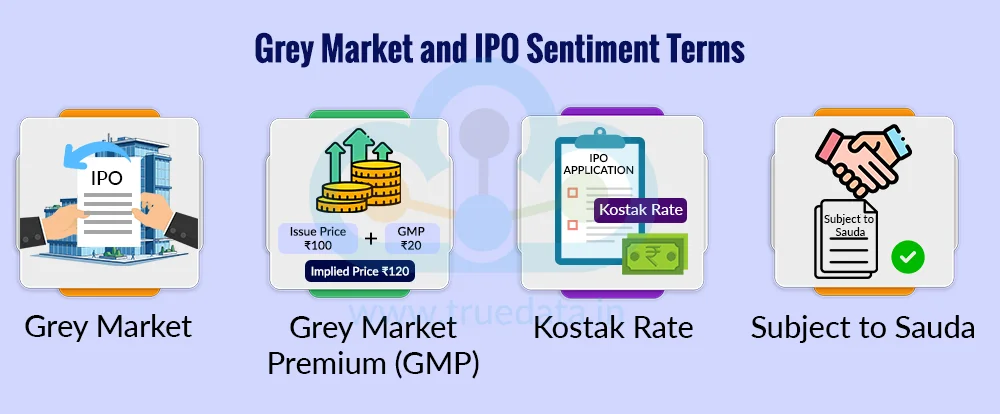
  • Grey Market - The grey market is an unofficial market where IPO shares or applications may be traded before the shares are officially listed on a stock exchange. Transactions in this market take place outside the formal stock market framework and do not have the same regulatory protections as exchange-based trading.

  • Grey Market Premium (GMP) - Grey Market Premium (GMP) refers to the unofficial premium at which an IPO share is reportedly being traded in the grey market compared with its issue price. For example, if the issue price is Rs. 100 and the reported GMP is Rs. 20, the implied grey market price would be around Rs. 120. However, GMP is unofficial, can change quickly and should not be treated as a guaranteed indicator of the listing price. 

  • Kostak Rate - The Kostak rate refers to the amount paid in the grey market for buying or selling an IPO application before allotment. It is an unofficial arrangement and is different from the actual allotment of IPO shares. Retail investors should understand that grey-market transactions carry additional risks because they take place outside the regulated exchange mechanism.

  • Subject to Sauda - Subject to Sauda is another grey-market term referring to an agreement where a buyer and seller settle an amount depending on whether shares are allotted to the IPO application. Since this is an unofficial arrangement, investors should be cautious about relying on such transactions or signals.

Listing and Post-Listing Terms

Listing and Post-Listing Terms

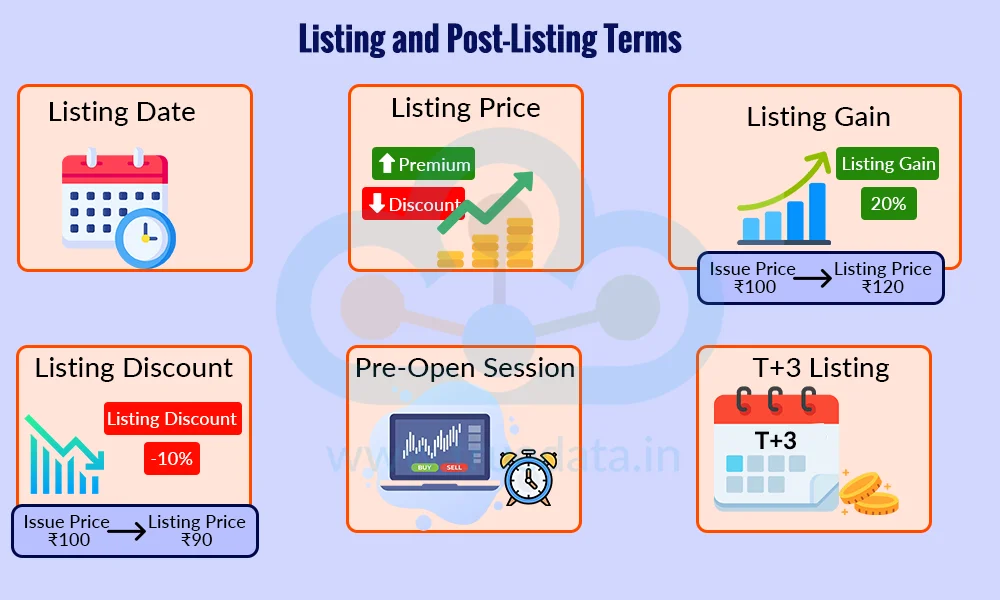
  • Listing Date - The listing date is the day on which the IPO shares begin trading on the stock exchange. The listing price may be higher or lower than the IPO issue price depending on demand, market conditions, investor sentiment and the company's perceived value. Therefore, investors should not assume that an IPO will necessarily list at a premium. 

  • Listing Price - The listing price is the price at which the shares start trading on the stock exchange. If the listing price is above the issue price, the stock has listed at a premium; if it is below the issue price, it has listed at a discount. The listing price can differ significantly from the IPO issue price.

  • Listing Gain - A listing gain occurs when an IPO share starts trading above its issue price. For example, if the issue price is Rs. 100 and the stock begins trading at Rs. 120, the listing gain is Rs. 20 per share, or 20%. Investors should remember that a listing gain is a short-term market outcome and does not necessarily indicate the company's long-term investment potential.

  • Listing Discount - A listing discount occurs when the shares begin trading below their IPO issue price. For example, if the issue price is Rs. 100 and the stock lists at Rs. 90, it has listed at a 10% discount. This can happen because of weak market sentiment, lower-than-expected demand or concerns about the company's valuation or prospects.

  • Pre-Open Session - The pre-open session is the period before normal trading begins during which buy and sell orders are collected, and an equilibrium price is determined for newly listed shares. This helps establish the initial market price at which regular trading can begin.

  • T+3 Listing - T+3 refers to the IPO listing timeline under which shares are listed on the stock exchange within three working days from the date the IPO closes, subject to completion of the required post-issue procedures. During this period, activities such as finalising the basis of allotment, unblocking funds for unsuccessful or partially successful applicants, crediting allotted shares to investors' demat accounts and completing listing formalities with the stock exchange are carried out.

Other Important IPO Terms

Other Important IPO Terms

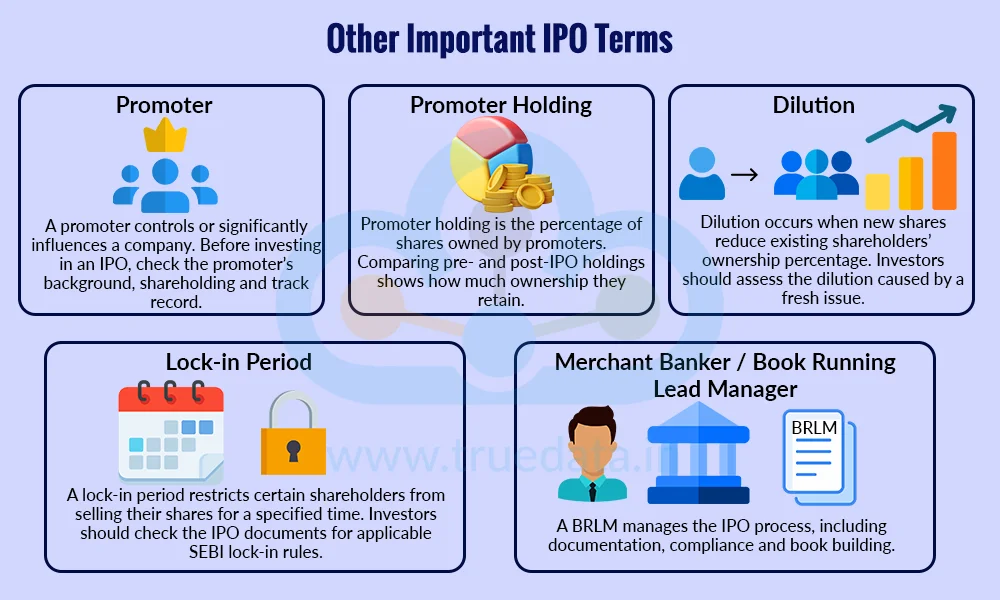
  • Promoter - A promoter is an individual, group or entity that has control or significant influence over a company and is identified as such under applicable regulations and company disclosures. Investors should examine promoter background, shareholding and the promoter's track record before investing in an IPO.

  • Promoter Holding - Promoter holding refers to the percentage of a company's shares held by its promoters. Investors can compare promoter holding before and after the IPO to understand how much ownership promoters retain after the issue.

  • Dilution - Dilution occurs when a company issues new shares and the ownership percentage of existing shareholders decreases because the total number of outstanding shares increases. A fresh issue can therefore result in dilution of existing ownership. Investors should consider the extent of dilution when assessing the IPO structure.

  • Lock-in Period - A lock-in period is the period during which certain shareholders, such as promoters or specified pre-IPO investors, may be restricted from selling their shares. The applicable lock-in depends on the investor category and prevailing SEBI rules. Investors should check the offer documents for the specific lock-in requirements applicable to the issue.

  • Merchant Banker / Book Running Lead Manager - The merchant banker or book running lead manager (BRLM) is an intermediary appointed to manage and coordinate various aspects of the IPO. This can include preparing offer documents, coordinating with regulators, managing the book-building process and assisting with the issue and listing. Investors can find the names of the lead managers in the IPO offer documents.

Conclusion

Understanding different IPO terms can help investors navigate the IPO process with greater confidence and make more informed decisions. From the price band, lot size and subscription to allotment, listing price and GMP, each term provides useful information about an IPO. However, investors should look beyond the excitement around an upcoming issue and also assess the company’s business, financial performance, valuation and associated risks before investing. A clear understanding of these terms can help investors evaluate IPO opportunities more carefully and invest with greater confidence.

This article focuses on the meaning of various IPO terms in brief. We will also have more detailed explanations of many of the terms mentioned here in our upcoming blogs on the IPO series. Stay tuned! Also, let us know your thoughts on the article or if you need further information, and we will address it soon. 

Till then, Happy Reading! 


Read More: IPOs in the market again - what should investors look for while investing in IPOs

Frequently Asked Questions

Investors can check their IPO allotment status on the website of the IPO registrar, such as KFin Technologies, using their PAN, application number or demat details. They can also check the status through the stock exchange website or their broker’s platform once the allotment is finalised.

A fixed-price IPO offers shares at one pre-decided price, while a book-built IPO provides a price band within which investors can bid. In a book-built IPO, the final issue price is determined based on investor demand during the bidding process.

After applying for an IPO, the application amount is usually blocked in the investor’s bank account until the allotment is finalised. Once the allotment is completed, the required amount is debited, and shares are credited to the investor's demat account, while the remaining blocked amount is released if they receive fewer shares or no allotment.

The price band is the range within which investors can bid for an IPO, while the cut-off price means agreeing to buy shares at the final issue price decided by the company based on demand. Retail investors can usually choose the cut-off option instead of specifying a particular bid price.

The IPO issue price is the final price at which shares are allotted to investors, while the listing price is the price at which those shares first start trading on the stock exchange. If the listing price is higher than the issue price, the stock has made a listing gain; if it is lower, it has listed at a discount.
Marisha Bhatt

Marisha Bhatt is a financial content writer @TrueData.

She writes with the sole aim of simplifying complex financial concepts and jargon while attempting to clarify technical and fundamental analysis concepts of the stock markets. The ultimate goal is to spread vital knowledge and benefit the maximum audience. Her Chartered Accountant background acts as the knowledge base to help clarify crucial concepts and create a sound investment portfolio.

0 Comments

Related Articles

SEE ALL
Corporate Data
Corporate Data
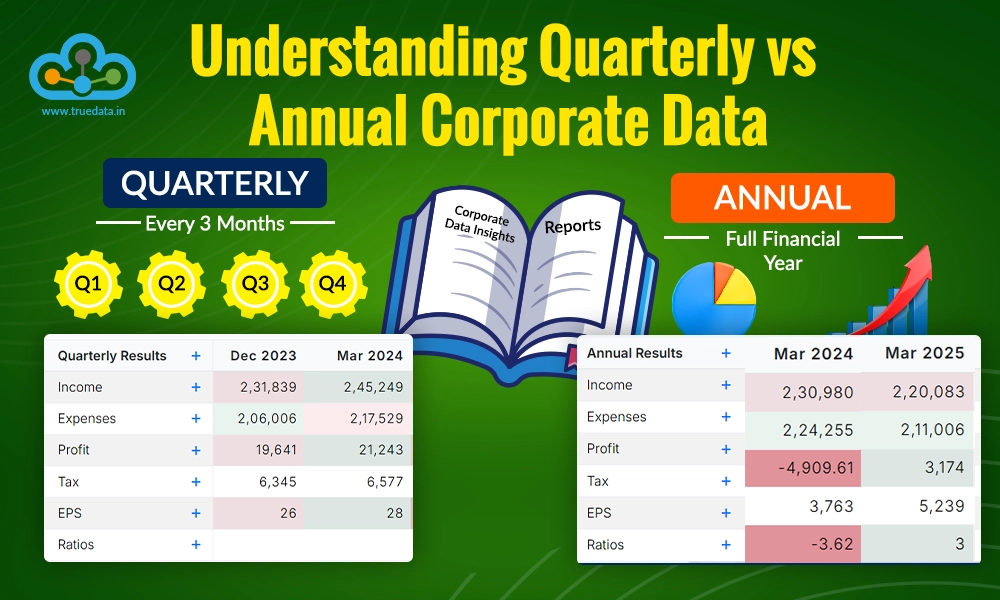
Understanding Quarterly vs Annual Corporate Data

Corporate data is more than just the numbers of a company. They can show what is...

Corporate Data
Corporate Data
Investing Smarter: The Power of Corporate Data and Market Sentiment Analysis

Thestock market never stands still, and prices swing constantly with every new h...

Corporate Data
Corporate Data
Key Corporate Data Every Investor Must Track Before Investing

Investing is not just about numbers on a screen. It is about understanding the s...