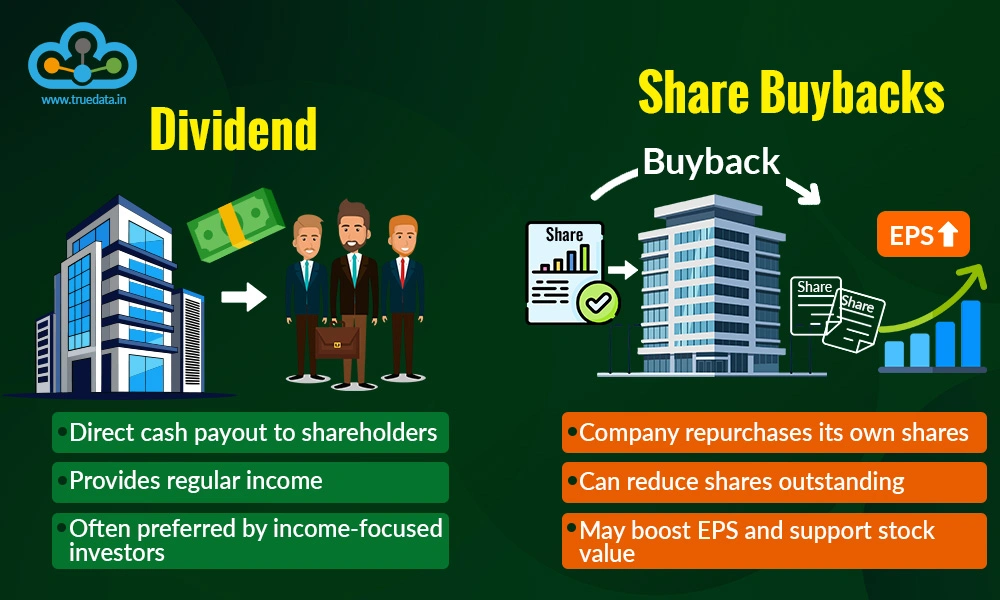
Dividends are one of the most popular ways companies reward their shareholders. But they are not the only way. Companies can also return money to shareholders through share buybacks, where they repurchase their own shares from the market. So, how do share buybacks differ from dividends, and which option may be more beneficial for investors? Get answers to these questions and more in this blog where we explore these two important corporate actions and their importance for investors.

Share buybacks and dividends are two important corporate actions that are part of the usual course of business. While they are both a way for shareholders to get returns on their investments, they are quite distinct in terms of intent and use.
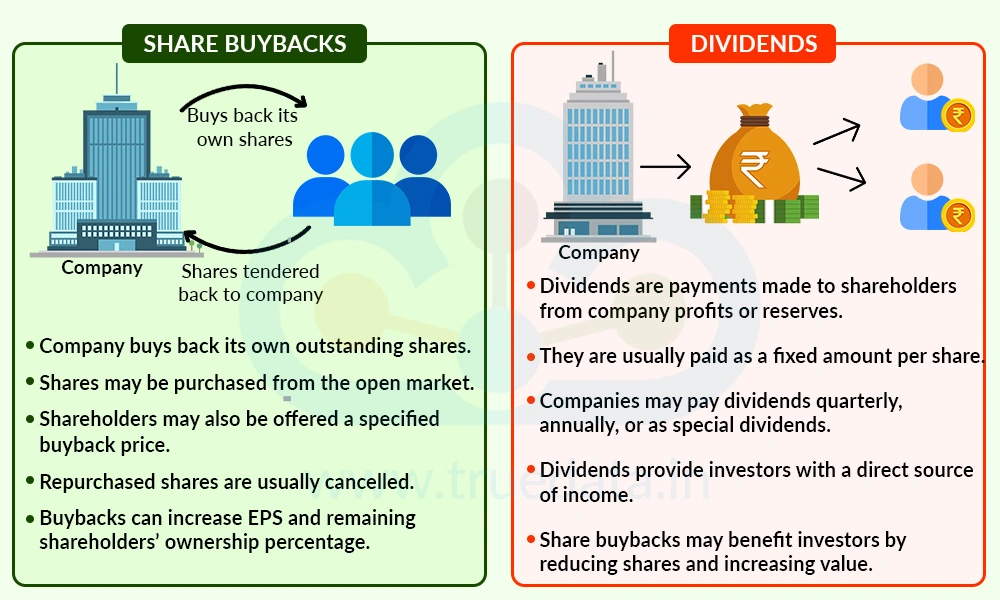
Share buybacks happen when a company uses its own money to purchase some of its outstanding shares from existing shareholders. The company may buy these shares from the open market or offer shareholders an opportunity to sell their shares back to the company at a specified price. Once the company buys back the shares, they are usually cancelled, reducing the total number of shares in circulation. This can increase the ownership percentage of shareholders who continue to hold their shares and may also improve metrics such as earnings per share (EPS), provided the company’s earnings remain stable.
Dividends, on the other hand, are payments a company makes to its shareholders from its profits or available reserves. They are generally paid as a specific amount per share, such as Rs. 5 per share, so an investor holding 100 shares would receive Rs. 500 before applicable taxes. Companies may pay dividends regularly, such as quarterly or annually, or declare special dividends when they have excess cash. Dividends can provide a direct source of income for investors, while share buybacks can potentially benefit them through a reduced share count and a possible increase in the value of the remaining shares.
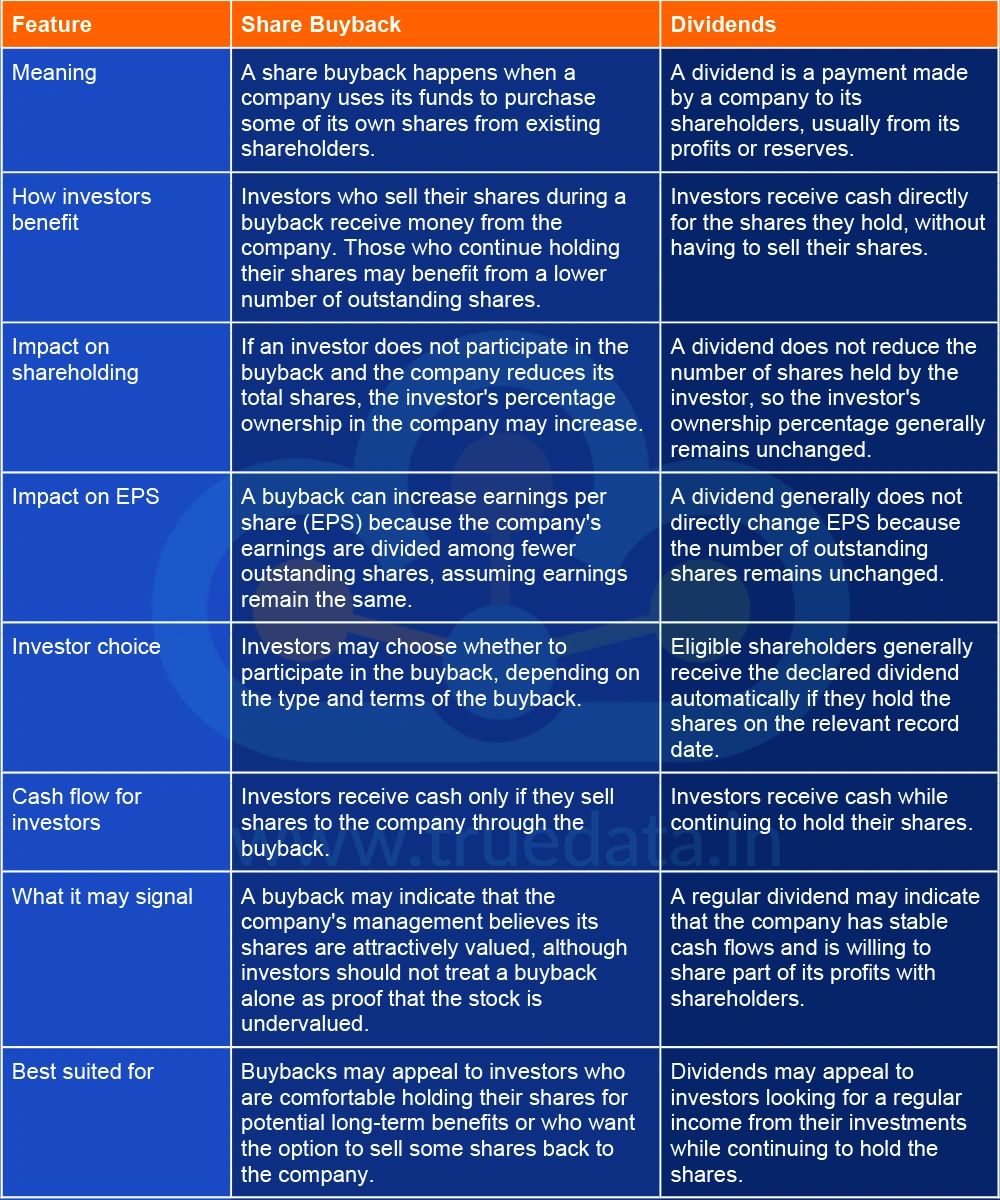
Share buybacks and dividends are both ways for companies to return money to shareholders, but they work differently. The key differences can help investors understand which corporate action may better suit their investment goals.


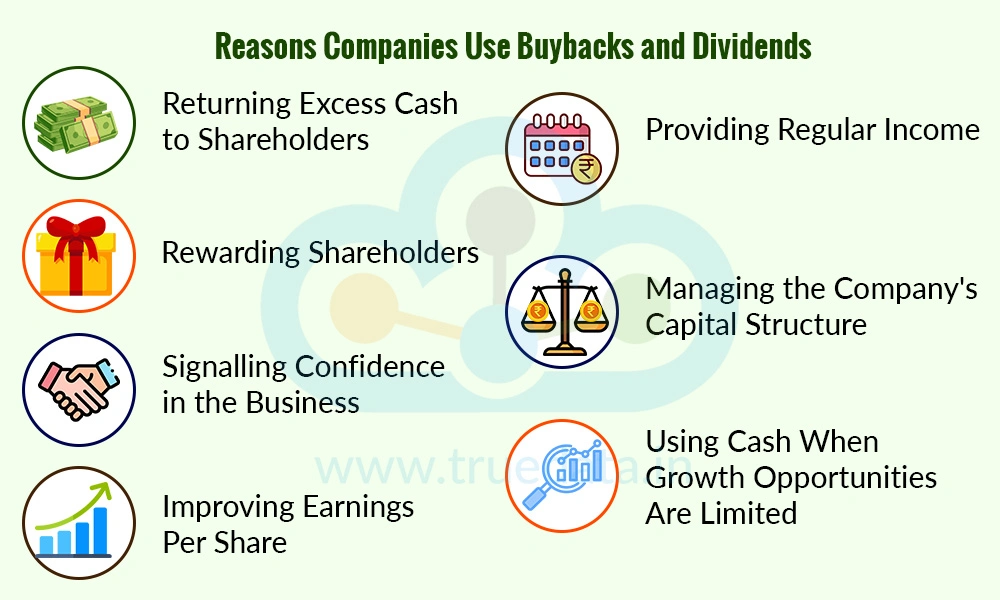
Companies may choose share buybacks, dividends, or sometimes both to return excess cash to shareholders. The choice usually depends on the company’s financial position, future plans, and management’s view of the stock’s value.
Returning Excess Cash to Shareholders - Companies with strong cash flows may have more money than they currently need for their business. Instead of keeping excess cash unused, they may return some of it to shareholders through dividends or buybacks.
Rewarding Shareholders - Dividends provide direct cash income to shareholders without requiring them to sell their shares. Buybacks allow shareholders to sell some or all of their shares back to the company, depending on the buyback method and terms.
Signalling Confidence in the Business - A company may announce a buyback when management believes its shares are attractively valued. A consistent dividend policy can also show that the company expects to generate stable cash flows in the future.
Improving Earnings Per Share - A buyback reduces the number of shares outstanding when the repurchased shares are cancelled. If the company's earnings remain stable, fewer shares can mean higher earnings per share (EPS).
Providing Regular Income - Companies with stable and predictable cash flows may prefer dividends because they can provide shareholders with a regular source of income. This can be particularly attractive to investors who depend on their investments for cash flow.
Managing the Company's Capital Structure - Buybacks can reduce the company's equity base and change the balance between debt and equity. Companies may use buybacks as part of their broader capital-allocation strategy when they have limited opportunities to invest excess cash in the business.
Using Cash When Growth Opportunities Are Limited - If a company does not have enough attractive opportunities to expand, acquire another business, or invest in new projects, it may return excess cash to shareholders. This helps the company avoid making unnecessary investments simply to use its available cash.

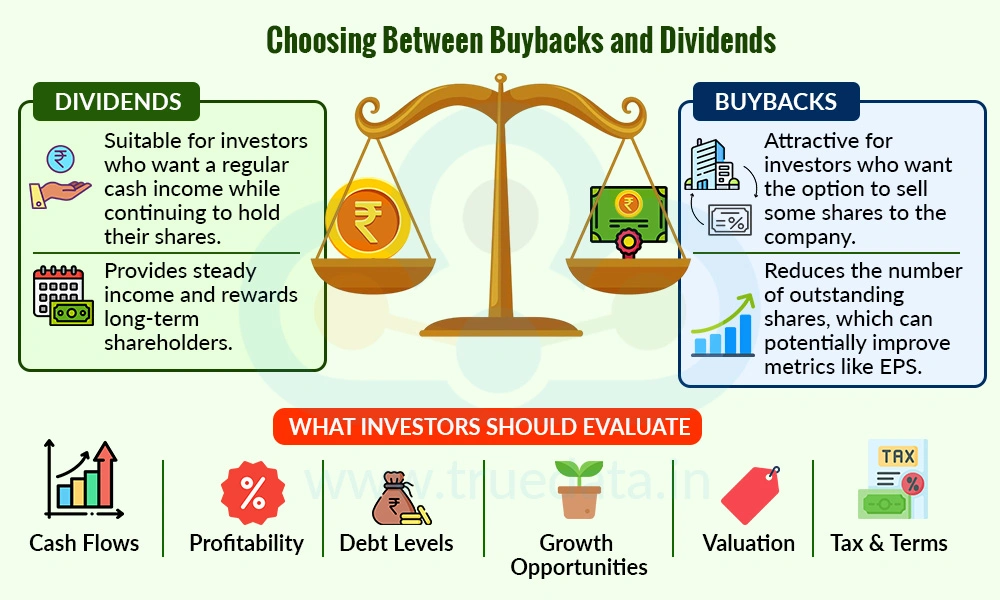
There is no single answer to whether share buybacks or dividends are better because it depends on an investor’s goals and the company’s financial position. Dividends may be more suitable for investors who want a regular cash income while continuing to hold their shares. Buybacks, on the other hand, may be attractive to investors who want the option to sell some shares to the company or benefit from a lower number of outstanding shares, which can potentially improve metrics such as EPS.
Investors should therefore look beyond the buyback or dividend announcement and assess the company’s cash flows, profitability, debt levels, growth opportunities, valuation and long-term business outlook. They should also consider the applicable tax treatment and the terms of the buyback. A company that consistently generates healthy cash flows and uses its surplus cash wisely may be more attractive than one simply offering a high dividend or announcing a large buyback.
The tax treatment of share buybacks changed from 1 April 2026, when the Income-tax Act, 2025 came into effect. Under the new regime, buyback proceeds received by shareholders are generally treated as capital gains, while dividends continue to be taxable under the head ‘Income from Other Sources’.

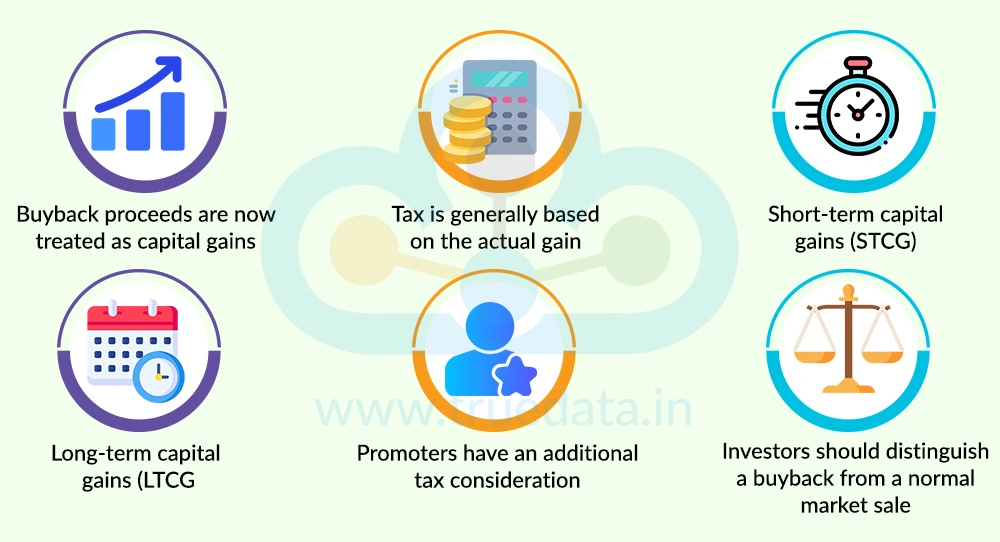
Buyback proceeds are now treated as capital gains - From 1 April 2026, the amount received by a shareholder from a company's buyback is generally taxed under the capital gains provisions rather than being treated as dividend income.
Tax is generally based on the actual gain - For a listed share, the taxable gain is broadly calculated by deducting the cost of acquisition of the shares tendered from the buyback consideration received. For example, if an investor bought shares for Rs. 80,000 and the company buys them back for Rs. 1,00,000, the broad capital gain would be Rs. 20,000.
Short-term capital gains (STCG) - If listed equity shares are held for 12 months or less, the resulting short-term capital gain is generally taxed at 20%, subject to the applicable conditions, surcharge and Health and Education Cess. Section 196 of the Income-tax Act, 2025 provides the 20% rate for specified short-term capital gains on listed equity shares where the applicable securities transaction tax conditions are met.
Long-term capital gains (LTCG) - If listed equity shares are held for more than 12 months, the gain is generally treated as long-term capital gain and taxed at 12.5% under the applicable provisions, with the Rs. 1,25,000 annual exemption for eligible Section 112A-type listed-equity LTCG applying subject to the relevant conditions.
Promoters have an additional tax consideration - Finance Act 2026 introduced an additional tax for promoters who tender shares in a buyback. The additional rate is 2% on qualifying STCG and 9.5% on qualifying LTCG for a domestic-company promoter of a listed company, while the rates are 10% and 17.5%, respectively, for other promoters. A 12% surcharge is also applicable to this additional tax.
Investors should distinguish a buyback from a normal market sale - A shareholder who sells shares on the stock exchange is carrying out a normal transfer of shares and is taxed under the applicable capital-gains rules. A buyback has its own corporate-action provisions and should therefore be considered separately when calculating the tax liability.

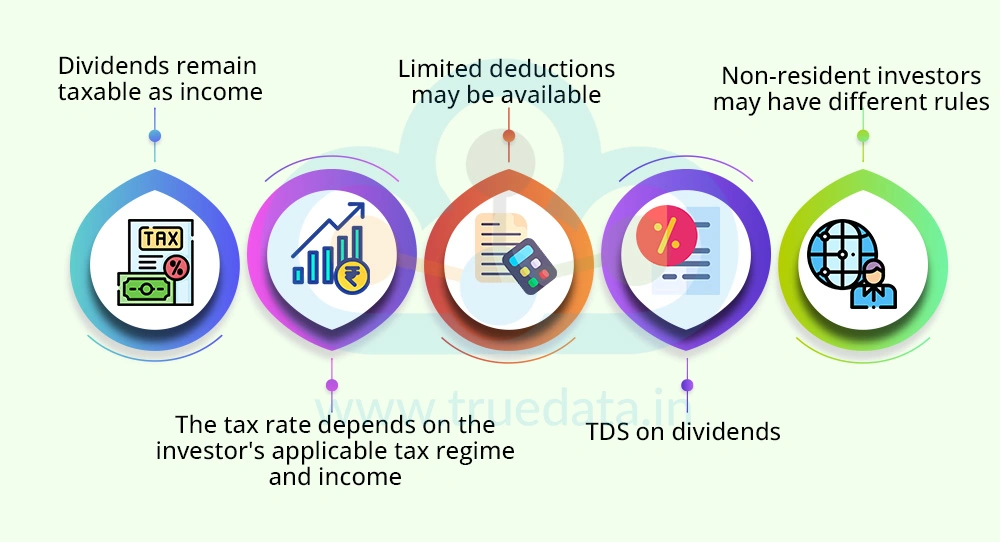
Dividends remain taxable as income - Under Section 92 of the Income-tax Act, 2025, dividend income is specifically included under the head ‘Income from Other Sources’.
The tax rate depends on the investor's applicable tax regime and income - Unlike long-term capital gains, dividends do not have a separate tax rate but are taxed at the applicable slab rate.
Limited deductions may be available - The Income-tax Act, 2025 permits certain deductions while computing income from other sources. Reasonable expenses such as commission or remuneration paid to a banker or another person for collecting the dividend may be deductible where the conditions are satisfied.
TDS on dividends - Dividend TDS is 10% for a resident individual shareholder when the aggregate dividend paid during the tax year exceeds Rs. 10,000 in a tax year, subject to the applicable provisions. It is important to note that TDS is not the final tax and is generally available as a credit against the investor's final tax liability.
Non-resident investors may have different rules - Dividends received by non-residents can be subject to special tax rates and applicable withholding provisions. A relevant Double Taxation Avoidance Agreement (DTAA) may provide a different rate if its conditions are satisfied.
Both share buybacks and dividends can be useful ways for companies to return surplus cash to shareholders, but they benefit investors differently. Dividends can provide regular income, while buybacks may offer an opportunity to realise gains and can potentially benefit continuing shareholders through a lower share count. Therefore, investors should look beyond the payout and consider the company’s financial strength, valuation, growth plans, tax implications and their own investment goals before deciding which is more suitable for them.
This article addresses two important corporate actions and their nuances. Let us know your thoughts on the topic or if you need further information on the same and we will address it soon.
Till then, Happy Reading!
Read More: Key Corporate Data Every Investor Must Track Before Investing
Have you ever noticed a company announcing a dividend and wondered whether it is...
Thestock market never stands still, and prices swing constantly with every new h...
Corporate data is more than just the numbers of a company. They can show what is...