15-MIN DELAYED
NIFTY 23,959.70 +86.25 (+0.36%) | BANKNIFTY 57,453.05 +72.45 (+0.13%) | SENSEX 76,732.80 +579.94 (+0.76%) | CRUDEOIL-I 8,672.00 +42.00 (+0.49%) | GOLD-I 1,55,194.00 -507.00 (-0.33%) | NIFTY 23,959.70 +86.25 (+0.36%) | BANKNIFTY 57,453.05 +72.45 (+0.13%) | SENSEX 76,732.80 +579.94 (+0.76%) | CRUDEOIL-I 8,672.00 +42.00 (+0.49%) | GOLD-I 1,55,194.00 -507.00 (-0.33%) |
TrueData
Helpline / Support +91 7304-22-44-66
Get started

WORKSPACE

Workspace overview Workspace overview Our flagship product SignalX SignalX web charting for indian market Sheets Sheets streaming spreadsheet Wealth Wealth corporate data and news


Built for India's markets.

Real-time charts, streaming spreadsheets, live corporate announcements — all in one workspace.

Get started free
Corporate Data

Dividend Dates - All You Need to Know

Marisha Bhatt · 03 Sep 2026 · 16 mins read · 0 Comments

dividend-dates-all-you-need-to-know

Have you ever noticed a company announcing a dividend and wondered whether it is the right time to buy or hold its shares? While dividend announcements often attract investors, understanding when you need to own the stock to actually receive the dividend can be confusing. This is where terms like the declaration date, ex-dividend date, record date, and payment date come into play. At first glance, these dates may seem like technical jargon, but each serves a specific purpose and can influence your investment decisions. So, what do these dates mean, why are they different, and which one should investors pay the closest attention to? Dive into this blog where we break down each dividend date in simple words and explain why they matter, helping you make more informed investment decisions.

What are the Different Dividend Dates?

What are the Different Dividend Dates

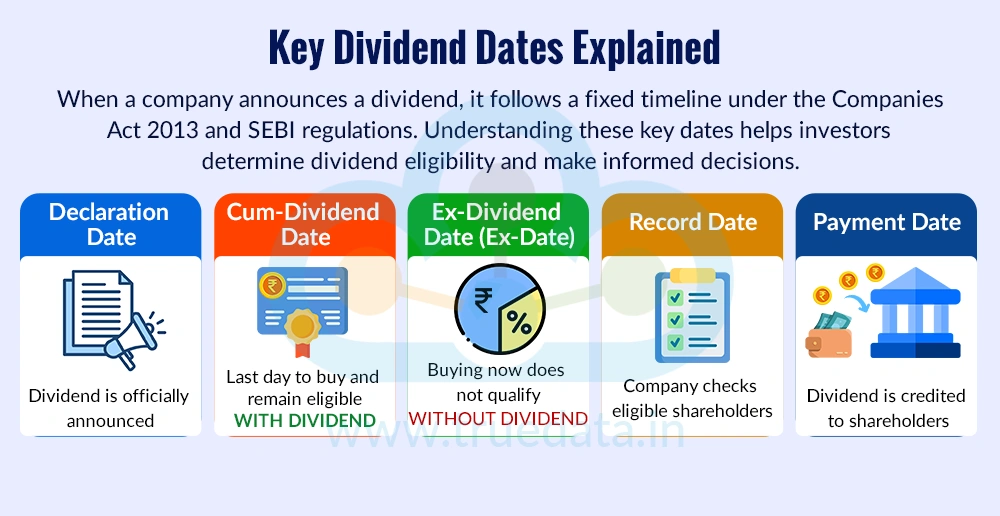
When a company decides to distribute a part of its profits to shareholders as dividends, it follows a fixed timeline as prescribed under the Companies Act 2013 and SEBI regulations. This timeline consists of four important dates, each serving a different purpose. Understanding these dates can help investors know whether they are eligible to receive the dividend and avoid making investment decisions based on incorrect assumptions.

Declaration Date

The declaration date is the day on which a company's Board of Directors officially announces that a dividend will be paid. This is the moment the dividend becomes a formal, legally binding obligation of the company. During this announcement, the company specifies the dividend amount, the record date, the ex-dividend date, and the expected payment date. This marks the beginning of the entire dividend process. The declaration date serves as an important source of information for investors rather than determining dividend eligibility. It gives shareholders clarity about how much dividend they can expect and when it will be paid. A dividend announcement may also influence investor sentiment, especially if the company declares a higher-than-expected dividend or maintains a consistent dividend despite challenging market conditions.

Cum-Dividend Date

The Cum-Dividend Date, where ‘cum’ comes from the Latin word meaning ‘with’, is the last date on which investors can buy a stock and still be eligible to receive the declared dividend. If shares are purchased on or before this date, investors will be entitled to the upcoming dividend payment. However, if shares are bought after this date, investors will not receive the dividend for that cycle. In India, the Cum-Dividend Date is essentially the trading day immediately before the Ex-Dividend Date. Since the Indian stock market operates on a T+1 Settlement Cycle (trades are settled the next business day), the Cum-Dividend Date is the day before the Ex-Dividend Date, giving the trade enough time to settle and have the investor’s name recorded as a shareholder before the record date closes.

The Cum-Dividend Date is particularly important for short-term or tactical investors who may be looking to buy a stock specifically to capture an upcoming dividend. This strategy, commonly called dividend capture, involves buying the stock before the Cum-Dividend Date, collecting the dividend, and then selling after the Ex-Dividend Date. However, for long-term investors holding quality dividend-paying stocks across multiple years, the Cum-Dividend Date is less operationally significant since they already hold the stock well before any dividend is announced. 

Ex-Dividend Date (Ex-Date)

The ex-dividend date, commonly called the ex-date, is the most important dividend date for investors. It is the first day on which a stock starts trading without the right to receive the upcoming dividend. Thus, if investors purchase the shares on or after the ex-dividend date, they will not receive that dividend. Instead, the dividend will go to the investor who owned the shares before the ex-date. The ex-dividend date exists because stock market transactions take time to settle. To ensure the correct shareholder receives the dividend, stock exchanges fix the ex-date before the record date. This is the date that investors should pay the closest attention to if they want to qualify for a dividend.

Record Date

The record date is the date on which the company checks its official list of shareholders to determine who is eligible to receive the dividend. Anyone whose name appears in the company's records on this date qualifies for the announced dividend. Although the record date is important for the company, investors usually do not need to focus on it as much as the ex-dividend date. If investors have purchased the shares before the ex-dividend date, the settlement process ensures their name appears in the company's records by the record date, making them eligible for the dividend.

Payment Date

The payment date is the day when the company actually distributes the dividend to eligible shareholders. SEBI regulations require listed companies to pay the declared dividend to shareholders within 30 days of the dividend being declared by the board. Depending on the mode of payment, the dividend amount is either credited directly to the investor's registered bank account or paid through another approved method. This is the final step in the dividend process. Once the payment date arrives, eligible shareholders receive their dividend without needing to take any additional action. The gap between the record date and the payment date may range from a few days to several weeks, depending on the company's dividend schedule.

Important To Note - 

Payment Date

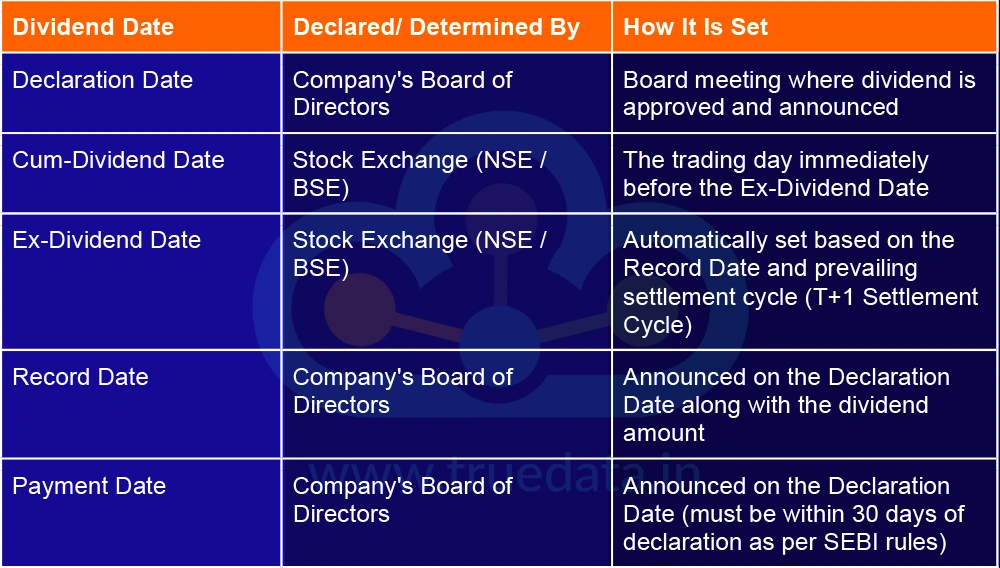
Dividend Date

Declared/ Determined By

How It Is Set

Declaration Date

Company's Board of Directors

Board meeting where dividend is approved and announced

Cum-Dividend Date

Stock Exchange (NSE / BSE)

The trading day immediately before the Ex-Dividend Date

Ex-Dividend Date

Stock Exchange (NSE / BSE)

Automatically set based on the Record Date and prevailing settlement cycle (T+1 Settlement Cycle)

Record Date

Company's Board of Directors

Announced on the Declaration Date along with the dividend amount

Payment Date

Company's Board of Directors

Announced on the Declaration Date (must be within 30 days of declaration as per SEBI rules)

Understanding Dividend Dates Using an Example

Let us understand the flow of the dividend dates and their significance using an example. 

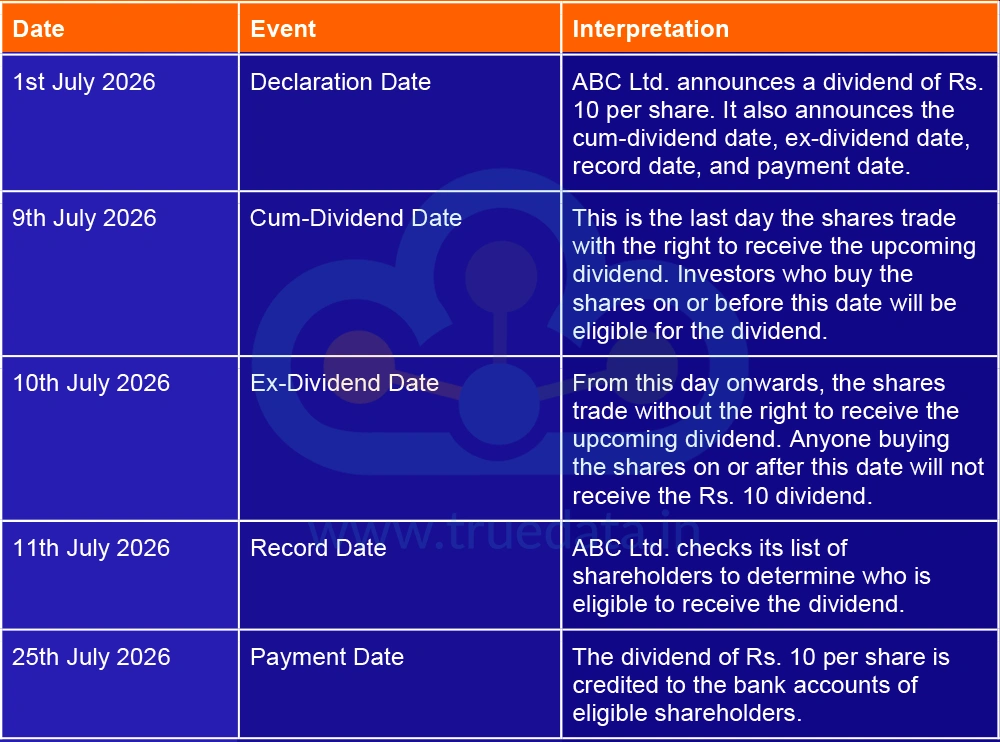
Consider Company ABC Ltd., which has declared a dividend of Rs. 10 per share on 1st July 2026 to be paid on 25th July 2026. The dividend timeline in this case is shown below

Understanding Dividend Dates Using an Example

Date

Event 

Interpretation 

1st July 2026

Declaration Date

ABC Ltd. announces a dividend of Rs. 10 per share. It also announces the cum-dividend date, ex-dividend date, record date, and payment date.

9th July 2026

Cum-Dividend Date

This is the last day the shares trade with the right to receive the upcoming dividend. Investors who buy the shares on or before this date will be eligible for the dividend.

10th July 2026

Ex-Dividend Date

From this day onwards, the shares trade without the right to receive the upcoming dividend. Anyone buying the shares on or after this date will not receive the Rs. 10 dividend.

11th July 2026

Record Date

ABC Ltd. checks its list of shareholders to determine who is eligible to receive the dividend.

25th July 2026

Payment Date

The dividend of Rs. 10 per share is credited to the bank accounts of eligible shareholders.

Suppose an investor, Mr. Rao, buys 100 shares of ABC Ltd. on 9 July 2026, which is the cum-dividend date. Since he purchased the shares before the ex-dividend date, he becomes eligible for the upcoming dividend. On the record date, his name appears in the company's list of eligible shareholders, and on the payment date, he receives Rs. 1,000 (100 * Rs. 10) as dividend.

Now consider another investor, Mr Suresh, who buys the same 100 shares on 10 July 2026, which is the ex-dividend date. Although he now owns the shares, he is not eligible for the Rs. 10 dividend because the stock is trading ex-dividend. Instead, the previous shareholder who sold the shares to Mr Suresh receives the dividend.

What are the Differences Between the Dividend Dates?

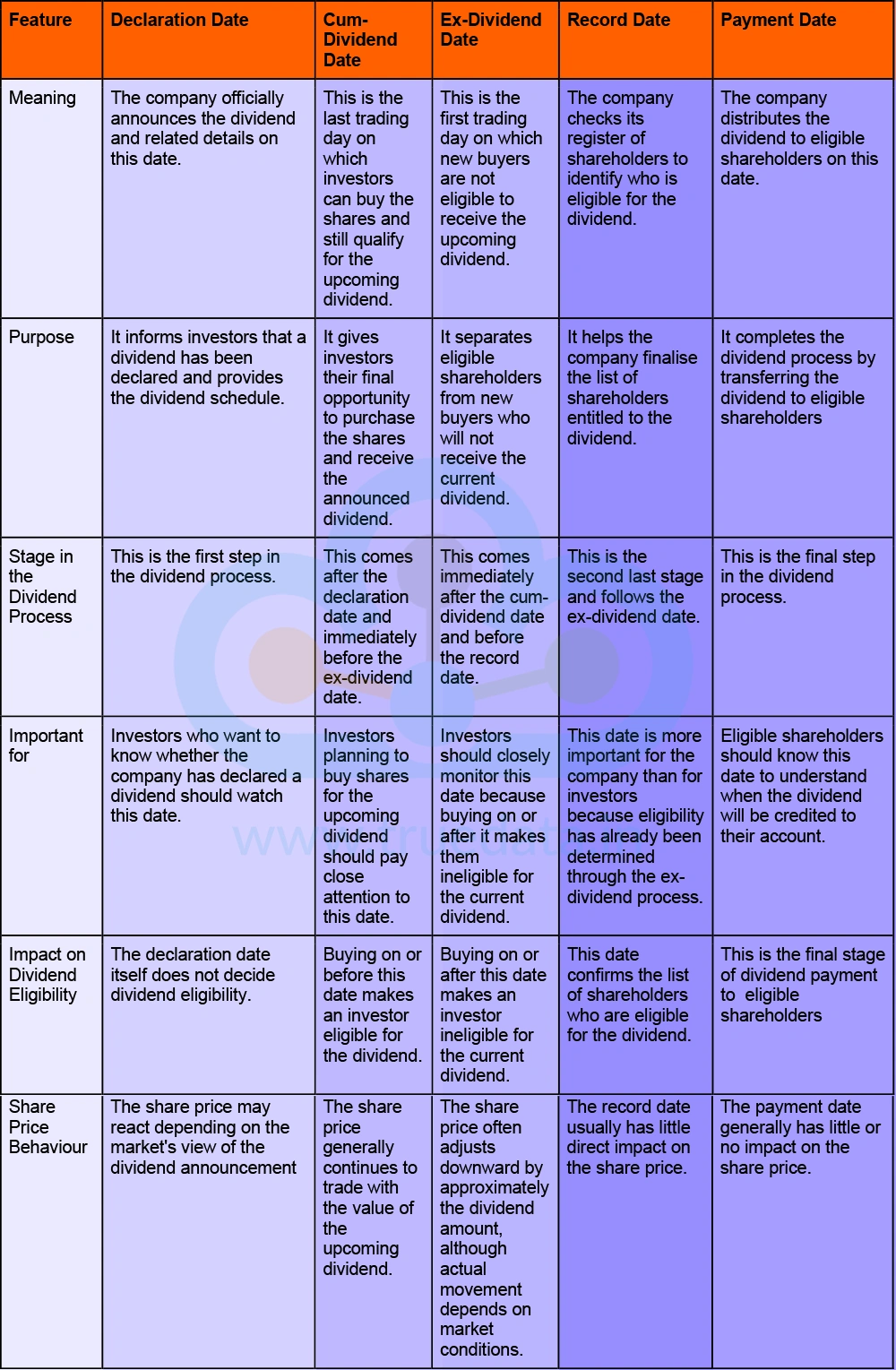
Although all dividend dates are part of the same dividend process, each one serves a unique purpose. Understanding these differences can help investors know when to buy shares, when they become eligible for dividends, and when they can expect to receive the payout.

What are the Differences Between the Dividend Dates

Feature

Declaration Date

Cum-Dividend Date

Ex-Dividend Date

Record Date

Payment Date

Meaning

The company officially announces the dividend and related details on this date.

This is the last trading day on which investors can buy the shares and still qualify for the upcoming dividend.

This is the first trading day on which new buyers are not eligible to receive the upcoming dividend.

The company checks its register of shareholders to identify who is eligible for the dividend.

The company distributes the dividend to eligible shareholders on this date.

Purpose

It informs investors that a dividend has been declared and provides the dividend schedule.

It gives investors their final opportunity to purchase the shares and receive the announced dividend.

It separates eligible shareholders from new buyers who will not receive the current dividend.

It helps the company finalise the list of shareholders entitled to the dividend.

It completes the dividend process by transferring the dividend to eligible shareholders

Stage in the Dividend Process

This is the first step in the dividend process.

This comes after the declaration date and immediately before the ex-dividend date.

This comes immediately after the cum-dividend date and before the record date.

This is the second last stage and follows the ex-dividend date.

This is the final step in the dividend process.

Important for

Investors who want to know whether the company has declared a dividend should watch this date.

Investors planning to buy shares for the upcoming dividend should pay close attention to this date.

Investors should closely monitor this date because buying on or after it makes them ineligible for the current dividend.

This date is more important for the company than for investors because eligibility has already been determined through the ex-dividend process.

Eligible shareholders should know this date to understand when the dividend will be credited to their account.

Impact on Dividend Eligibility

The declaration date itself does not decide dividend eligibility.

Buying on or before this date makes an investor eligible for the dividend.

Buying on or after this date makes an investor ineligible for the current dividend.

This date confirms the list of shareholders who are eligible for the dividend.

This is the final stage of dividend payment to  eligible shareholders

Share Price Behaviour

The share price may react depending on the market's view of the dividend announcement

The share price generally continues to trade with the value of the upcoming dividend.

The share price often adjusts downward by approximately the dividend amount, although actual movement depends on market conditions.

The record date usually has little direct impact on the share price.

The payment date generally has little or no impact on the share price.

How do These Dates Impact the Stock Prices?

How do These Dates Impact the Stock Prices

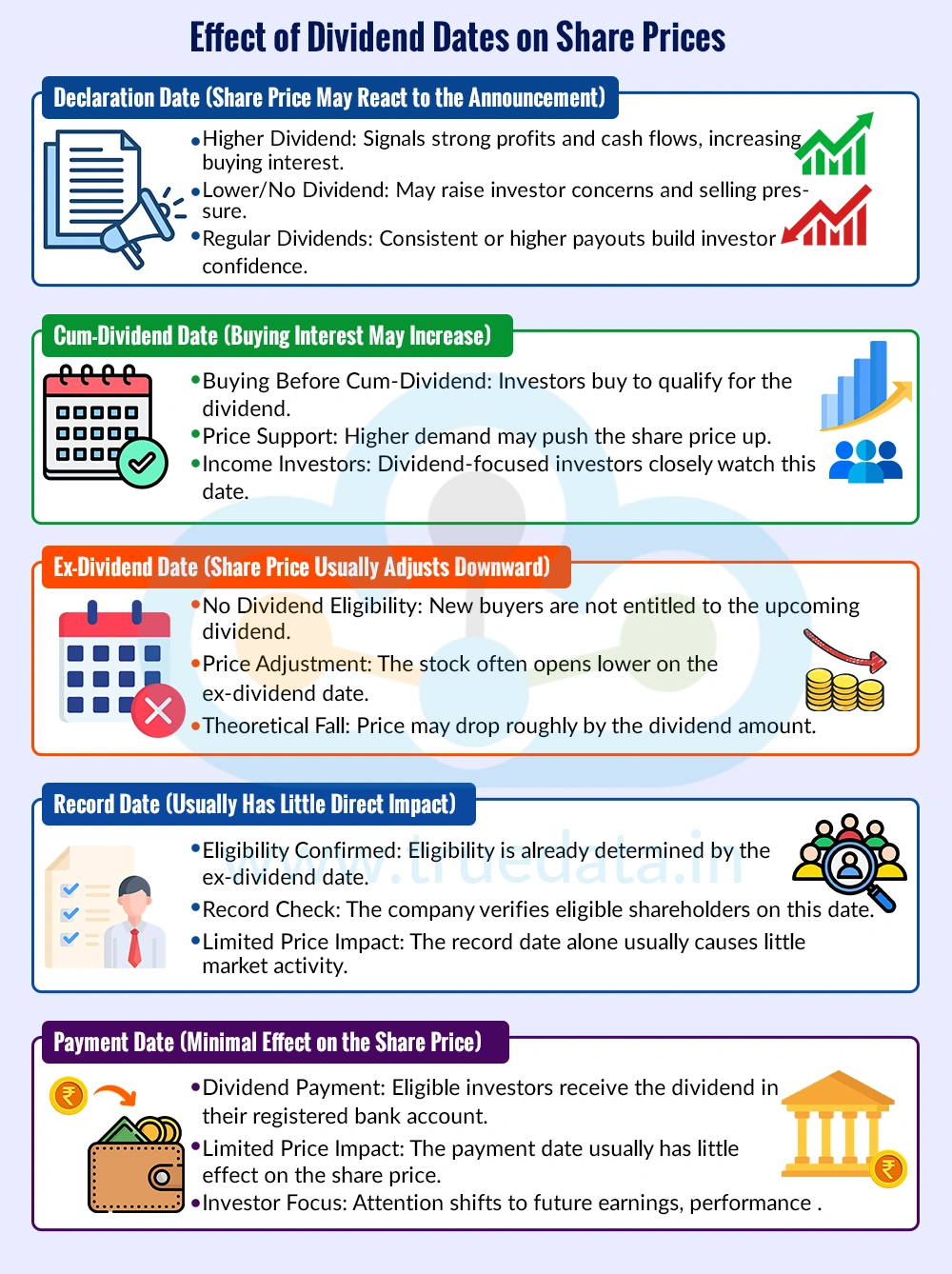
Many investors notice that a company's share price often changes around dividend dates. While dividends do influence stock prices, they are not the only factor. Overall market sentiment, company performance, economic conditions, and investor expectations also play an important role. Here is how each dividend date can affect a stock's price.

  • Declaration Date (Share Price May React to the Announcement) - When a company announces a dividend, investors interpret it as a signal about the company's financial health and future prospects.

    • If the company declares a higher-than-expected dividend, investors may view it as a sign of strong profits and healthy cash flows. This can increase buying interest and support the share price.

    • If the dividend is lower than expected or the company skips the dividend altogether, investors may become cautious, leading to selling pressure.

    • Companies with a long history of paying regular dividends often create positive investor confidence when they maintain or increase their dividend.

    • However, not every dividend announcement leads to a rise in the share price. If the dividend was already expected by the market, the share price may show little or no reaction.

  • Cum-Dividend Date (Buying Interest May Increase) - The cum-dividend date is the last trading day on which investors can buy the shares and still receive the upcoming dividend.

    • Some investors purchase the stock before the cum-dividend date to become eligible for the dividend.

    • This additional buying demand may support the share price or even push it higher in some cases.

    • Dividend-focused investors, especially those following income-investing strategies, often pay close attention to this date.

    • However, the impact is usually temporary and depends on factors such as the dividend amount, market conditions, and investor sentiment.

  • Ex-Dividend Date (Share Price Usually Adjusts Downward) - The ex-dividend date is the date that generally has the greatest impact on the share price.

    • From this date onwards, new buyers are no longer entitled to receive the upcoming dividend.

    • Since the right to receive the dividend has been removed, the stock often opens lower on the ex-dividend date.

    • In theory, the share price may fall by approximately the amount of the dividend because new buyers will not receive that payment.

    • For example, if a stock closes at Rs. 500 and announces a dividend of Rs. 10 per share, it may open around Rs. 490 on the ex-dividend date. However, this is only a theoretical adjustment.

    • The actual price movement may be higher or lower than the dividend amount because stock prices are also influenced by market sentiment, company news, demand and supply, and overall market conditions.

    • If the broader market is rising strongly, the stock may recover quickly despite the dividend adjustment. Similarly, in a weak market, it may fall by more than the dividend amount.

  • Record Date (Usually Has Little Direct Impact) - The record date itself generally does not cause significant movements in the share price.

    • By the time the record date arrives, the market has already determined who is eligible for the dividend through the ex-dividend date.

    • The company simply verifies its shareholder records on this date.

    • Since there is no change in dividend eligibility, investors usually do not see major buying or selling activity because of the record date alone.

  • Payment Date (Minimal Effect on the Share Price) - The payment date is when the company transfers the dividend to eligible shareholders.

    • Investors who have qualified for the dividend receive the payment in their registered bank account.

    • Since the market has already adjusted for the dividend earlier, the payment date usually has little or no direct effect on the share price.

    • By this stage, investors are generally focusing on the company's future earnings, business performance, and upcoming announcements rather than the dividend payment itself.

Why Does the Share Price Not Always Fall by Exactly the Dividend Amount?

Why Does the Share Price Not Always Fall by Exactly the Dividend Amount

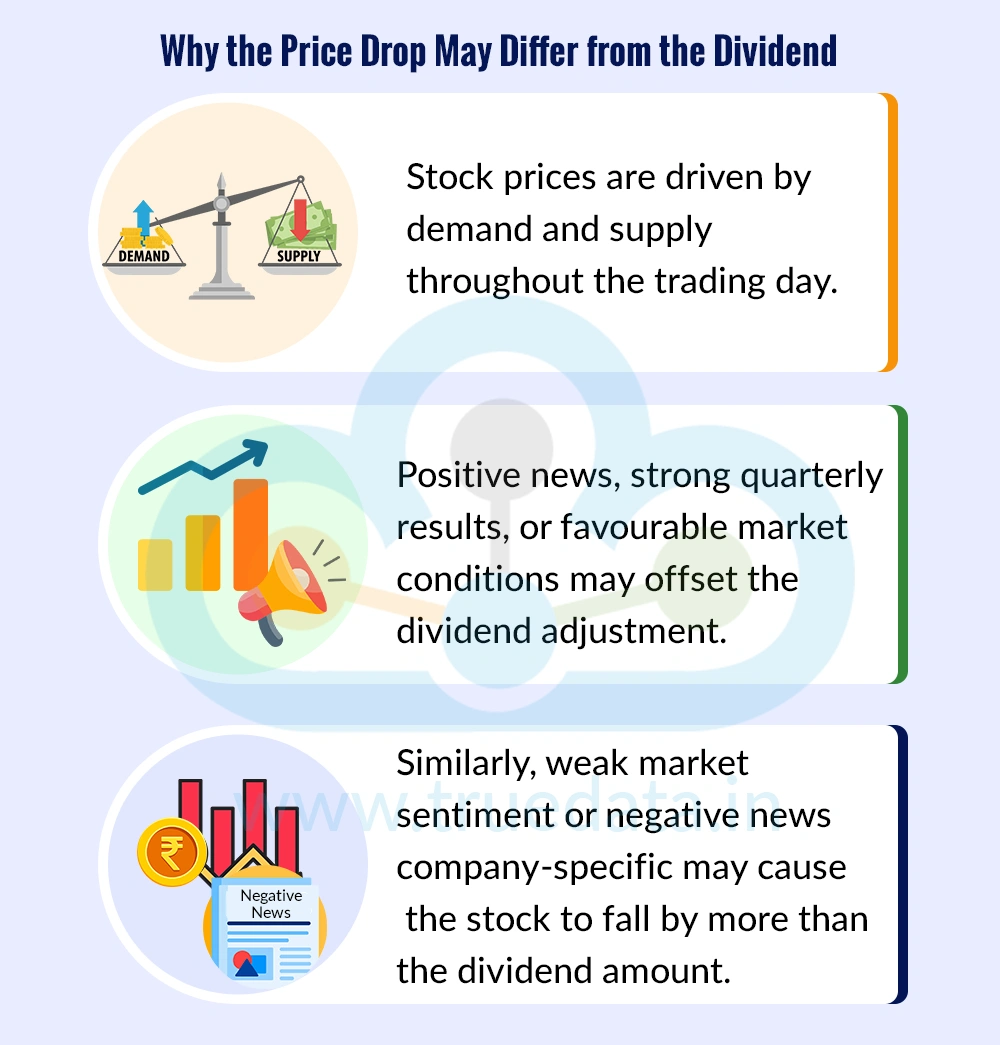
Many new investors assume that a stock will always fall by the exact dividend amount on the ex-dividend date. In reality, this is not always the case.

  • Stock prices are driven by demand and supply throughout the trading day.

  • Positive news, strong quarterly results, or favourable market conditions may offset the dividend adjustment.

  • Similarly, weak market sentiment or negative company-specific news may cause the stock to fall by more than the dividend amount.

Therefore, the dividend is only one of many factors influencing a stock's price.

What Factors To Consider While Trading Stocks Around These Dates?

What Factors To Consider While Trading Stocks Around These Dates

Trading stocks around dividend dates may seem attractive, but investors should look beyond the dividend amount before making any investment decision. Considering a few important factors can help them avoid common mistakes and make more informed choices.

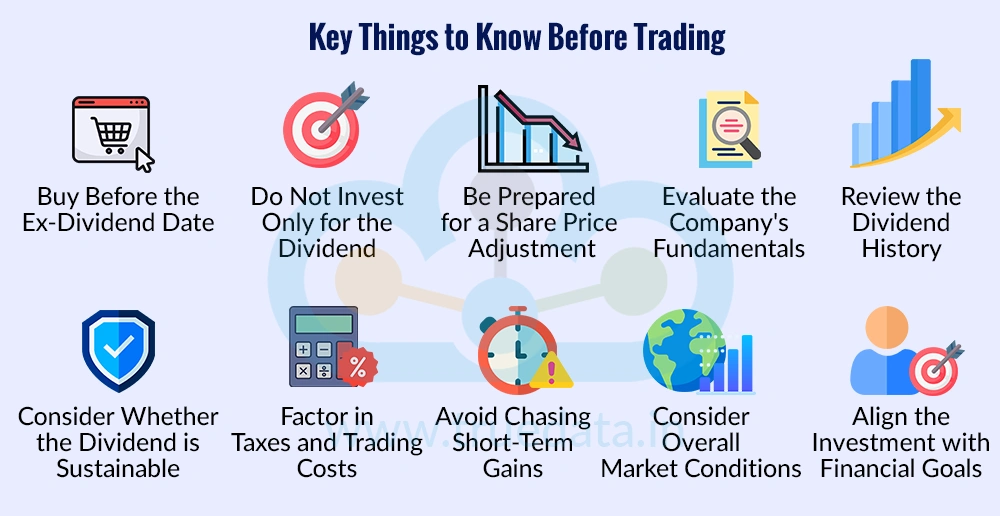
  • Buy Before the Ex-Dividend Date - Investors who wish to receive the announced dividend must purchase the shares before the ex-dividend date. Buying the stock on or after the ex-dividend date makes the investor ineligible for that dividend, even if the shares are held afterwards.

  • Do Not Invest Only for the Dividend - A dividend alone should not be the reason for buying a stock. Investors should also evaluate the company's financial health, business performance, and future growth prospects to determine whether it is a suitable long-term investment.

  • Be Prepared for a Share Price Adjustment - The share price generally falls on the ex-dividend date because new buyers are no longer entitled to receive the upcoming dividend. However, the actual price movement may differ depending on market conditions, investor sentiment, and company-specific developments.

  • Evaluate the Company's Fundamentals - Before investing, investors should review factors such as revenue growth, profitability, debt levels, and cash flows. Companies with strong fundamentals are generally better positioned to continue paying dividends consistently.

  • Review the Dividend History - A company that has maintained a consistent dividend-paying record over several years often reflects stable earnings and sound financial management. Examining the company's dividend history can help investors assess the reliability of future dividend payments.

  • Consider Whether the Dividend is Sustainable - A high dividend yield may appear attractive, but it is important to determine whether the company can continue paying such dividends in the future. Investors should review the company's earnings and dividend payout ratio to assess the sustainability of its dividend policy.

  • Factor in Taxes and Trading Costs - Dividend income is taxable according to the applicable income tax rules in India. Investors should also account for brokerage charges, Securities Transaction Tax (STT), and other transaction costs, as these can reduce their overall returns.

  • Avoid Chasing Short-Term Gains - Some investors attempt to buy shares just before the dividend and sell them shortly afterwards. However, this strategy may not always be successful because the share price can decline by more than the dividend amount or remain volatile due to changing market conditions.

  • Consider Overall Market Conditions - The broader market often has a greater influence on a stock's price than the dividend itself. Even a fundamentally strong dividend-paying company may experience price declines during periods of market weakness or high volatility.

  • Align the Investment with Financial Goals - Different investors have different objectives. Income-focused investors may prefer companies with a stable dividend history, while growth-oriented investors may favour companies that reinvest profits to expand their business. Every investment decision should align with the investor's financial goals, risk appetite, and investment horizon.

Conclusion

Dividend dates play an important role in helping investors understand when they become eligible to receive a dividend and when the payout will be credited. While knowing the declaration date, cum-dividend date, ex-dividend date, record date, and payment date can help investors plan their investments better, these dates should not be the only factor influencing an investment decision. A company's financial strength, consistent earnings, dividend history, and long-term growth potential are equally important. By understanding how dividend dates work and combining this knowledge with thorough research, investors can make more informed decisions and build a stronger investment portfolio over time.

This article explains the timeline of the dividend dates and why it is important for investors to track them. Let us know your thoughts on the topic or if you have any queries regarding the same, and we will address them soon. 

Till then, Happy Reading!


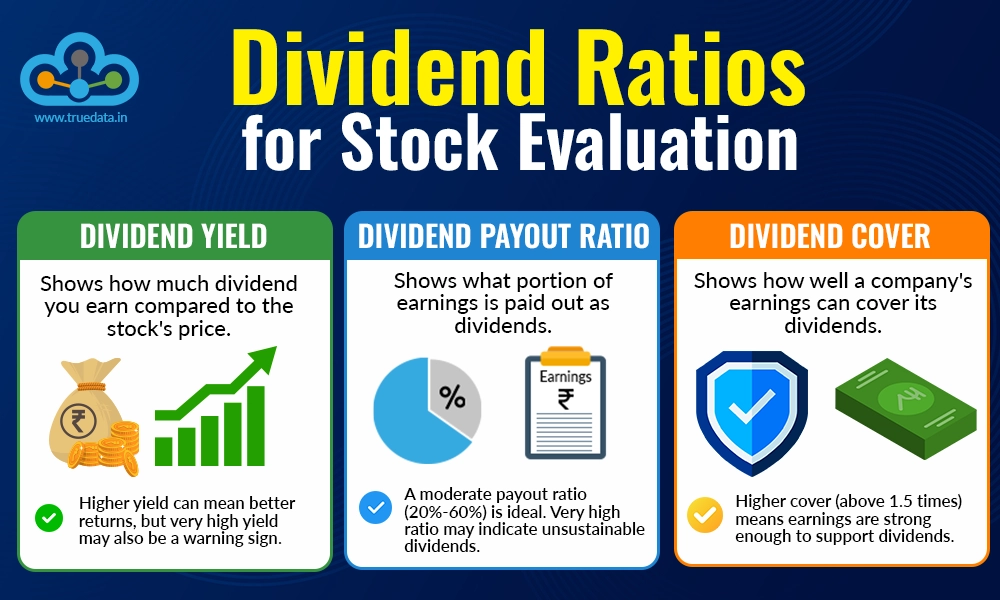
Read More: Understanding Dividend Ratios for Stock Evaluation - Dividend Yield, Dividend Payout Ratio and Dividend Cover 

Frequently Asked Questions

The ex-dividend date determines whether an investor is eligible to receive the dividend, while the record date is when the company confirms the list of eligible shareholders. The payment date is when the company finally credits the dividend to those eligible shareholders.

Yes. If an investor owned the shares before the ex-dividend date, they remain eligible to receive the dividend even if they sell the shares on the ex-dividend date.

No. If an investor buys the shares on the ex-dividend date or later, they will not receive the upcoming dividend. The dividend will instead be paid to the investor who owned the shares before the ex-dividend date.

Investors can find the ex-dividend date, record date, and payment date in the company's dividend announcement on the stock exchange websites (NSE or BSE), the company's investor relations page, or through their stockbroker's trading platform. These dates are announced well in advance, giving investors enough time to plan their investments.

No. Every company decides its own dividend schedule, so the declaration date, ex-dividend date, record date, and payment date can differ from one stock to another.

If the ex-dividend date or record date falls on a weekend or stock market holiday, it is generally shifted according to the stock exchange's trading calendar. Investors should always check the official dividend announcement or the NSE/BSE website for the confirmed dates.

Yes, the stock price usually falls on the ex-dividend date because new buyers are no longer eligible to receive the upcoming dividend. However, the actual price movement may be more or less than the dividend amount depending on market conditions and investor sentiment.

Yes, ex-date and record date are also used for corporate actions such as bonus shares and stock splits to determine which shareholders are eligible. However, there is no payment date because no cash is distributed; eligible investors receive additional shares or adjusted shares instead.
Marisha Bhatt

Marisha Bhatt is a financial content writer @TrueData.

She writes with the sole aim of simplifying complex financial concepts and jargon while attempting to clarify technical and fundamental analysis concepts of the stock markets. The ultimate goal is to spread vital knowledge and benefit the maximum audience. Her Chartered Accountant background acts as the knowledge base to help clarify crucial concepts and create a sound investment portfolio.

0 Comments

Related Articles

SEE ALL
Corporate Data
Corporate Data
Investing Smarter: The Power of Corporate Data and Market Sentiment Analysis

Thestock market never stands still, and prices swing constantly with every new h...

Corporate Data
Corporate Data
Understanding Quarterly vs Annual Corporate Data

Corporate data is more than just the numbers of a company. They can show what is...

Corporate Data
Corporate Data
Key Corporate Data Every Investor Must Track Before Investing

Investing is not just about numbers on a screen. It is about understanding the s...