Choosing the right mutual fund is one of the most important decisions an investor makes. However, with hundreds of funds available across different categories, comparing them can often feel overwhelming. While past performance is an important factor, the real challenge is understanding how a fund has performed compared to its peers over time. This is where quartile rankings become a valuable tool. They help investors identify whether a fund consistently ranks among the better performers in its category or lags behind its competitors. Want to know how quartile rankings work and why they matter when building a mutual fund portfolio? Let us break it down in this blog.

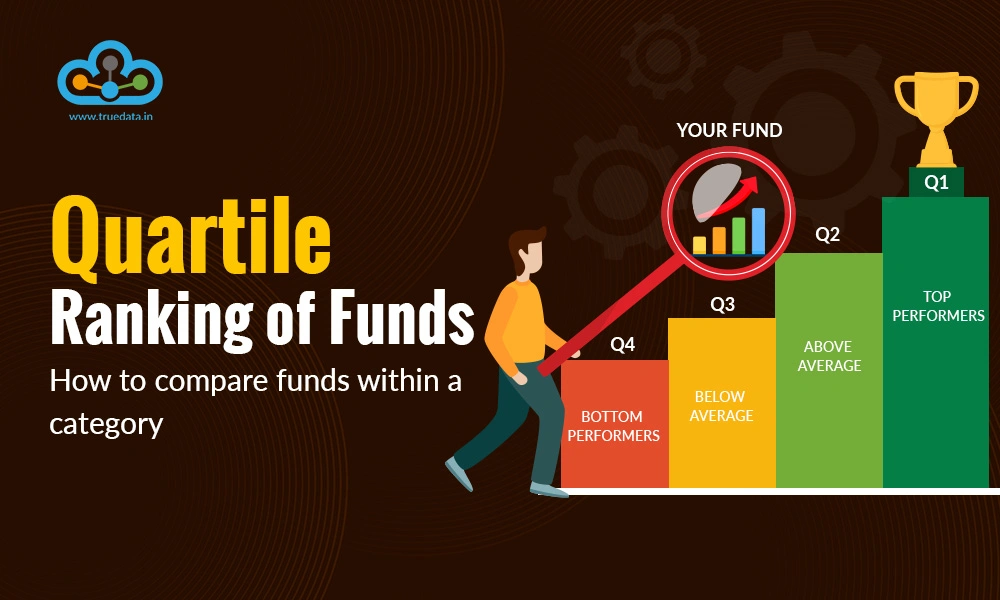
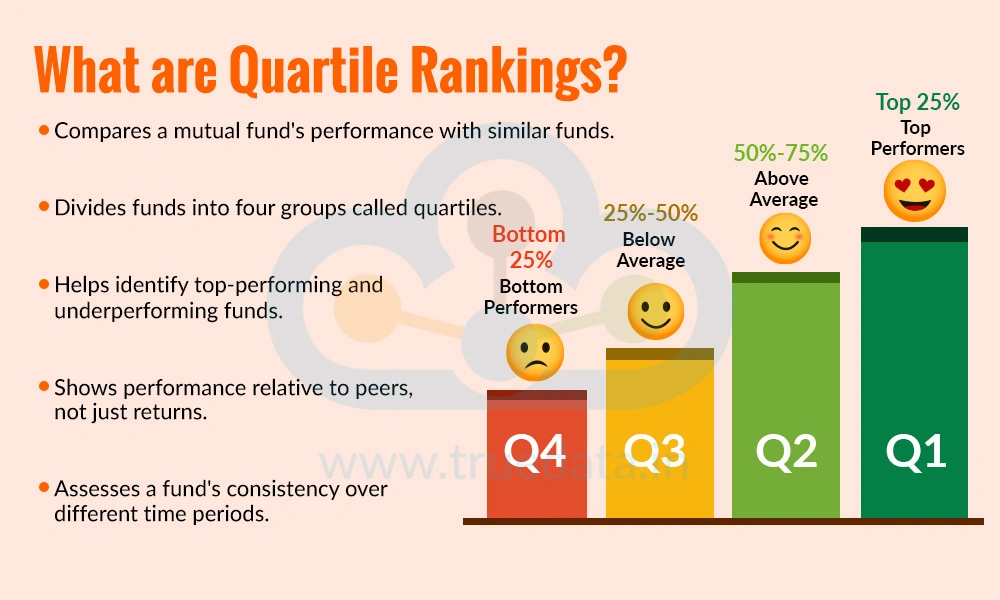
Quartile ranking is a simple way of comparing the performance of a mutual fund with other funds in the same category. This tool classifies or arranges mutual funds of the same category based on their performance and then divided into four equal groups, known as quartiles. These rankings help investors quickly understand how well a fund has performed relative to its peers rather than looking at returns in isolation. For example, a fund delivering a 12% return may seem attractive, but if most funds in the same category have generated higher returns, its quartile ranking may reveal that it is not among the stronger performers. By studying quartile rankings over different time periods, investors can assess not only a fund's performance but also its consistency in staying ahead of its competitors.

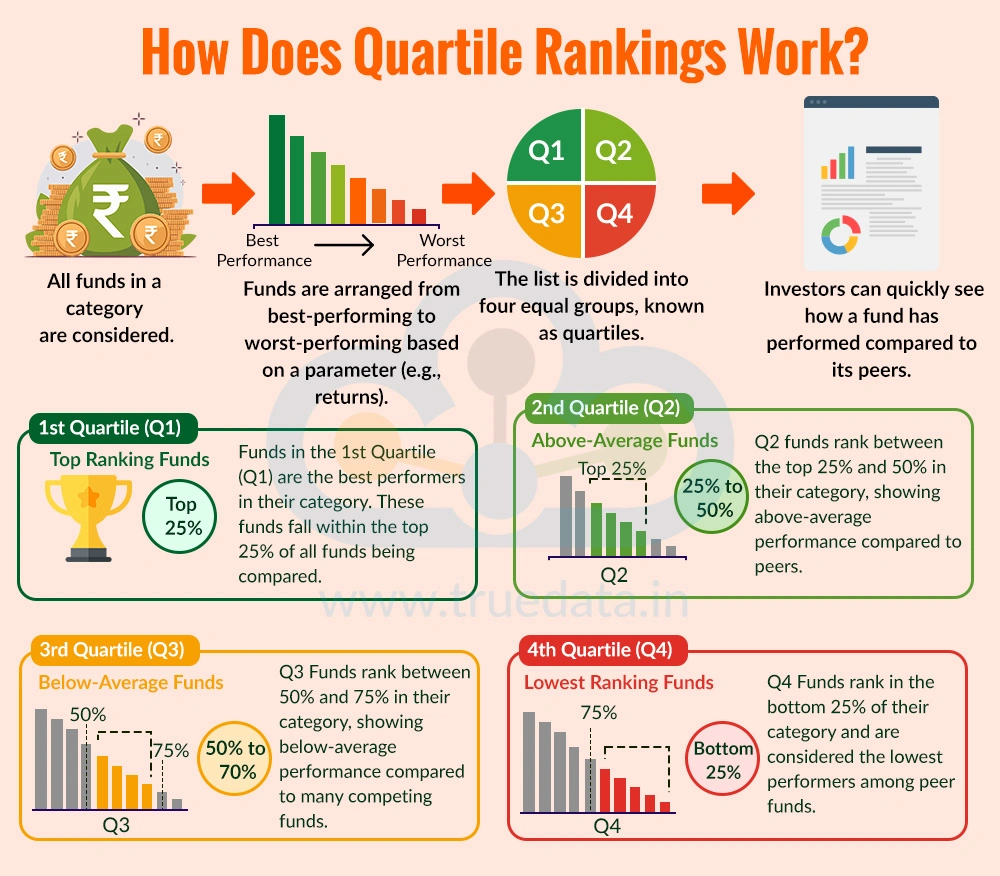
Quartile ranking requires all funds in a category to be arranged from the best-performing to the worst-performing based on a specific parameter, such as mutual fund returns. The list is then divided into four equal groups, known as quartiles. This helps investors quickly understand how a fund has performed compared to its peers.
1st Quartile (Q1), i.e., Top Ranking Funds - Funds in the 1st Quartile (Q1) are the best performers in their category. These funds fall within the top 25% of all funds being compared. A fund that consistently remains in Q1 is generally considered to have strong and reliable performance.
2nd Quartile (Q2), i.e., Above-Average Funds - Funds in the 2nd Quartile (Q2) rank between the top 25% and 50% of the category. These funds have performed better than many of their peers but are not among the very best performers.
3rd Quartile (Q3), i.e., Below-Average Funds - Funds in the 3rd Quartile (Q3) rank between 50% and 75% of the category. Their performance is below the category average, indicating that many competing funds have delivered better results.
4th Quartile (Q4), i.e., Lowest Ranking Funds - Funds in the 4th Quartile (Q4) are the lowest performers in the category and fall in the bottom 25% of the rankings. Consistent placement in Q4 may indicate weaker performance compared to peer funds.

Looking at returns alone may not give a complete picture, as a fund's performance should always be evaluated relative to its peers. Quartile rankings make this comparison simple and help investors identify funds that have consistently performed well over time. The importance of quartile rankings is explained hereunder.
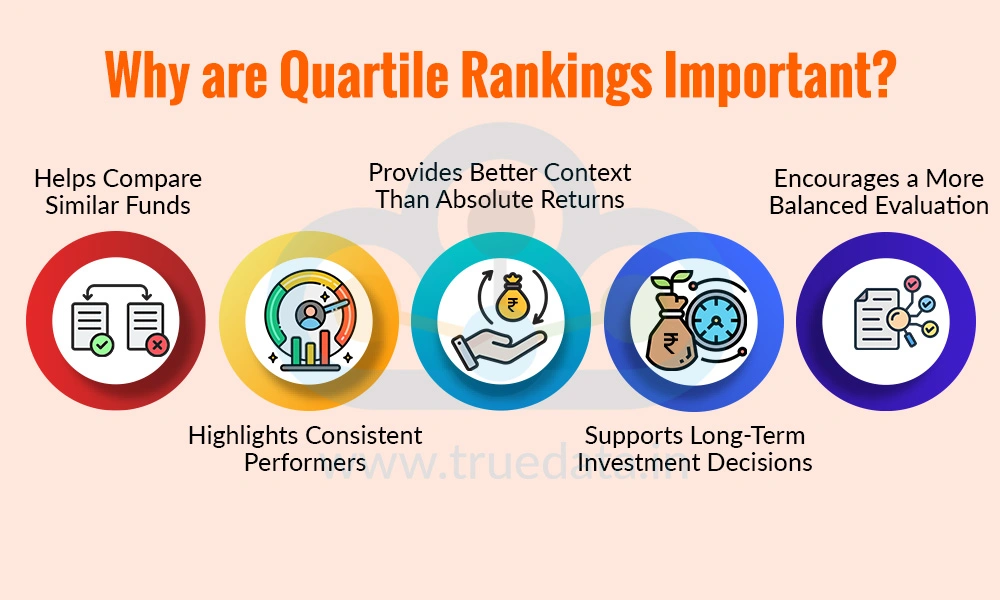
Helps Compare Similar Funds - Mutual funds should be compared only with funds that have similar investment objectives and strategies. Quartile rankings group funds within the same category and show where a fund stands among its peers. This allows investors to understand whether a fund is outperforming, matching, or lagging behind comparable funds. This can save time and make fund selection more structured.
Highlights Consistent Performers - A fund may deliver strong returns in one year due to favourable market conditions or a few successful investments. However, investors generally prefer funds that perform well consistently over longer periods. If a fund regularly remains in the top quartiles across different time frames, it indicates that the fund has been able to maintain its performance relative to competitors.
Provides Better Context Than Absolute Returns - A fund generating a 10% return may seem attractive, but the result becomes more meaningful when compared with similar funds. If most funds in the category earned 15%, the fund has actually underperformed. Quartile rankings provide this context by showing a fund's relative position within its category rather than focusing only on absolute returns.
Supports Long-Term Investment Decisions - Successful investing often requires evaluating performance over several years rather than focusing on short-term results. Quartile rankings help investors track how a fund has ranked across different market cycles. Funds that consistently remain in higher quartiles may demonstrate stronger fund management and a more effective investment strategy over the long term.
Encourages a More Balanced Evaluation - While quartile rankings are useful, they should not be the only factor in investment decisions. They work best when combined with other factors such as risk levels, expense ratio, fund manager experience, portfolio quality, and investment objectives. Together, these factors help investors make more informed and balanced mutual fund investment decisions.

Quartile rankings can be a useful tool for evaluating mutual funds, as they show how a fund has performed compared to other funds in the same category. However, investors should not simply choose a fund because it is currently ranked at the top. A better approach is to study quartile rankings over different periods and combine them with other important factors. Here are some key ways to evaluate mutual funds using quartile rankings.
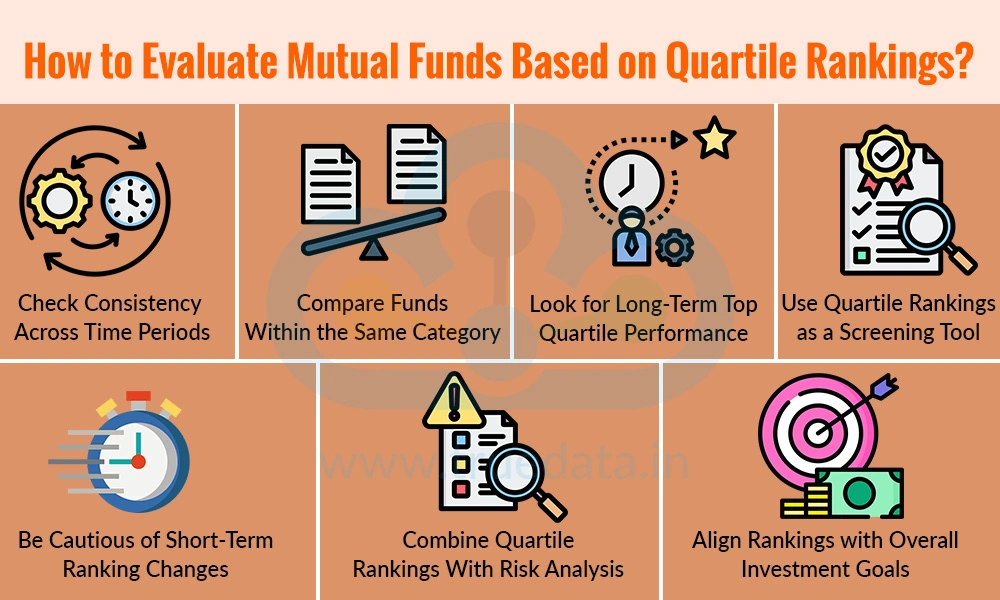
Check Consistency Across Time Periods - One of the most important things to look for is consistency. A fund that ranks in the 1st Quartile (Q1) over one year may not necessarily be a strong long-term performer. Investors should review quartile rankings over multiple periods, such as 1 year, 3 years, 5 years, and even longer. Funds that regularly remain in the top quartiles across different time frames often demonstrate more reliable performance.
Compare Funds Within the Same Category - Quartile rankings are meaningful only when comparing funds within the same category. For example, a large-cap mutual fund should be compared with other large-cap funds, while a mid-cap fund should be compared with other mid-cap funds. Comparing different categories can lead to incorrect conclusions because each category has different risk levels and return expectations.
Look for Long-Term Top Quartile Performance - A fund that consistently stays in the 1st Quartile (Q1) or 2nd Quartile (Q2) over several years may indicate strong fund management and an effective investment strategy. Such funds have been able to outperform most of their peers through different market conditions, making them potentially attractive choices for long-term investors.
Be Cautious of Short-Term Ranking Changes - Mutual fund rankings can change significantly in the short term due to market movements. A fund that jumps into the top quartile in one year may fall into a lower quartile the following year. Investors should avoid making decisions based solely on recent rankings and instead focus on performance across multiple market cycles along with other important factors.
Combine Quartile Rankings With Risk Analysis - High rankings do not always mean a fund is the best choice. Some funds may achieve higher returns by taking greater risks. Therefore, investors should evaluate risk measures along with quartile rankings. A fund that consistently ranks well while maintaining reasonable risk levels is often a more balanced investment option.
Use Quartile Rankings as a Screening Tool - Rather than making investment decisions based solely on quartile rankings, investors can use them as an initial filter. Funds that consistently rank in the top quartiles can be shortlisted for further analysis. This approach helps investors narrow down their choices while ensuring that other important factors are also considered before investing.
Align Rankings with Overall Investment Goals - Quartile rankings are useful for identifying strong-performing mutual funds, but they should not be the only factor in investment decisions. Investors should also evaluate aspects such as the fund's objective, expense ratio, fund manager experience, AUM, and long-term performance. Most importantly, the chosen fund should align with the investor's financial goals, risk appetite, and investment horizon to ensure it is the right fit for their needs.

Quartile rankings, although an important tool for fund selection, are not free from limitations. These limitations include,
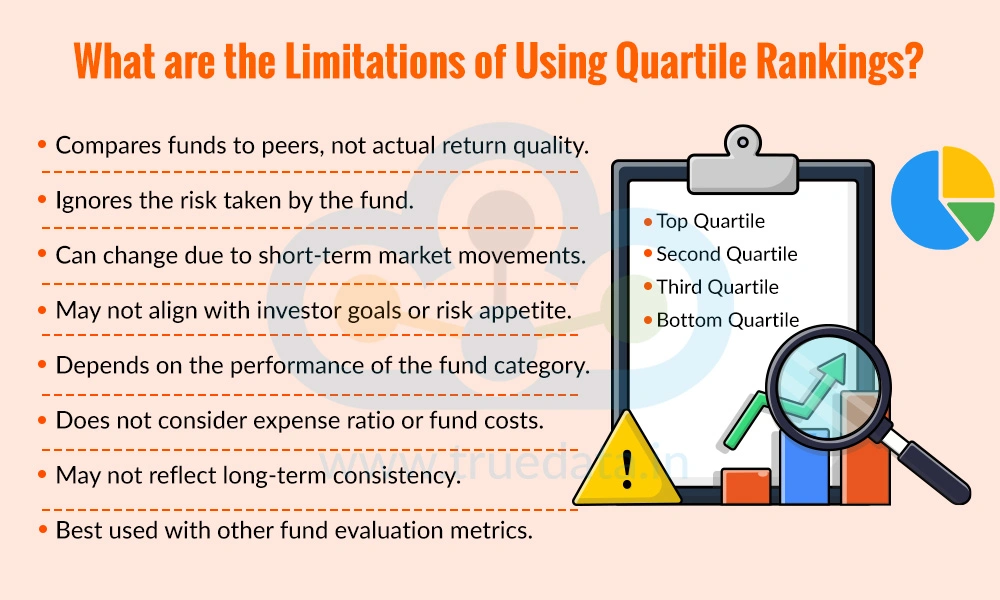
They show performance relative to peers, not actual return quality and do not explain why a fund performed well or poorly.
They do not consider the level of risk taken by the fund.
Rankings can change due to short-term market movements and may encourage investors to focus on short-term results.
Rankings may not match an investor's financial goals or risk profile.
Rankings depend on the performance of the fund category being compared.
Quartile rankings ignore factors such as expense ratio and fund costs.
A single ranking may not reflect long-term consistency.
It should be used along with other fund evaluation metrics.
Quartile rankings are a useful tool for evaluating mutual funds because they show how a fund performs compared to its peers within the same category. Quartile rankings can help identify consistent performers, compare similar funds, and simplify the fund selection process. However, they have limitations, as they do not consider factors such as risk, expenses, investment objectives, or the reasons behind a fund's performance. Therefore, investors should use quartile rankings as a starting point for evaluation and combine them with other important factors before making investment decisions.
This article talks about an important factor in evaluating mutual funds and its uses in making informed portfolio decisions. Let us know your thoughts on the topic or if you need further information on the same and we will address it soon.
Till then, Happy Reading!
Mutual fund investments have simplified greatly with just a tap on your smartpho...
Introduction For the longest time, investment in stock markets was thought to b...