
When looking at the stock price, can you decide if it is a good deal or not? The short answer is no. You need to look deeper to evaluate if it is the right time to buy or sell the stock. While there are many factors that can help make an optimum decision, one of the crucial parameters is comparing it to the book value per share. So, what is book value per share, and how to calculate it? Dive into this blog to get answers to these questions on book value per share to invest smarter and in a more efficient way.
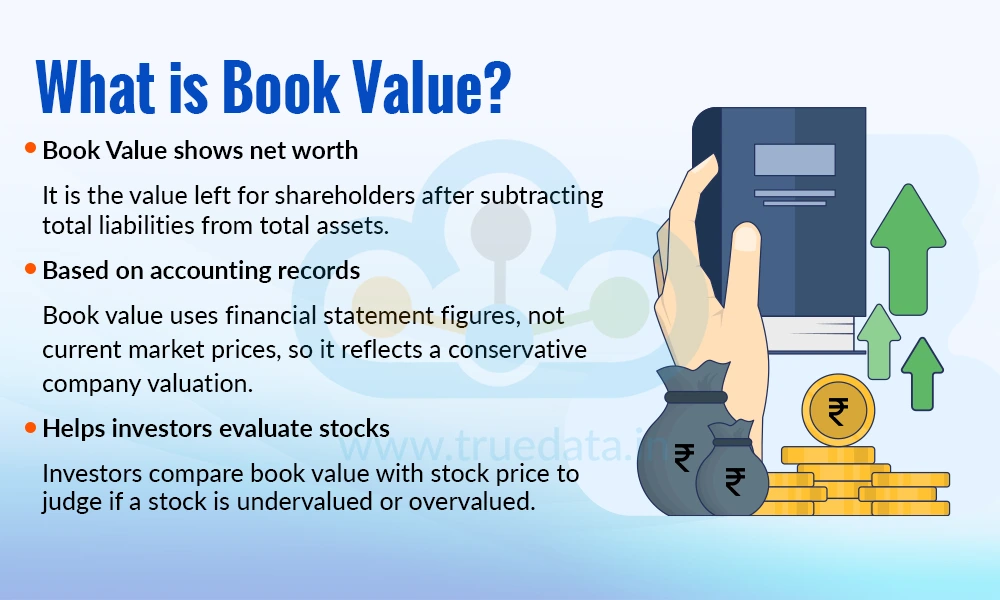
Book Value is the net worth of a company as recorded in its financial statements. It represents what would be left for shareholders if the company sold all its assets and paid off all its debts. It is based on accounting values (not market prices), so it gives a conservative estimate of a company’s value. Investors often use book value to understand how strong a company’s balance sheet is and to compare it with the stock price to judge whether a stock may be undervalued or overvalued.
The formula to calculate Boom Value is,

Book Value = Total Assets - Total Liabilities
Where,
Total Assets represents everything the company owns (cash, machinery, buildings, investments, etc.)
Total Liabilities represents everything the company owes (loans, creditors, obligations)
Understanding the Calculation of Book Value Using an Example
Consider X Ltd. with total assets of Rs. 1000 crores and total liabilities of Rs. 400 crores. The book value of X Ltd. is,
Book Value = Total Assets - Total Liabilities
Book Value = 1000 - 400 = Rs. 600 crores
Thus, the net worth of the company is Rs. 600 crores.
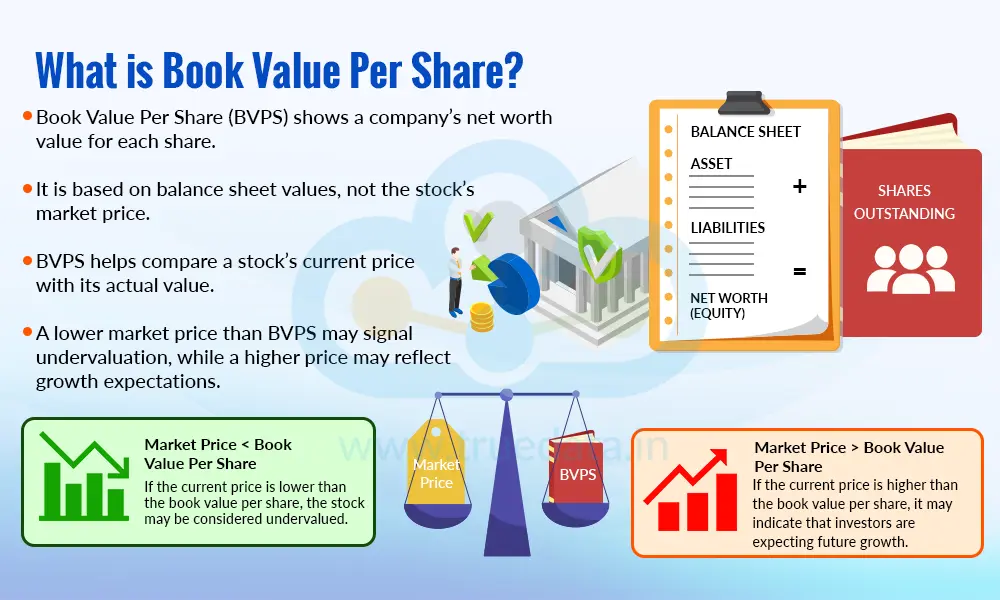
Book value per share is the value of a company’s net worth allocated to each individual share. It indicates the value received by shareholders per share after liquidating all assets and liabilities. The book value per share is based on the company's balance sheet values and hence reflects accounting values rather than the market price of the stock. Book Value Per Share (BVPS). BVPS is useful as it helps compare the stock’s current market price with its actual underlying value. If the current price is lower than the book value per share, the stock may be considered undervalued, while a higher price may indicate that investors are expecting future growth.
Book Value Per Share (BVPS) shows how much of a company’s net worth belongs to each individual share. This helps investors understand the ‘per share’ value of the company based on its financial statements and compare it with the current market price.
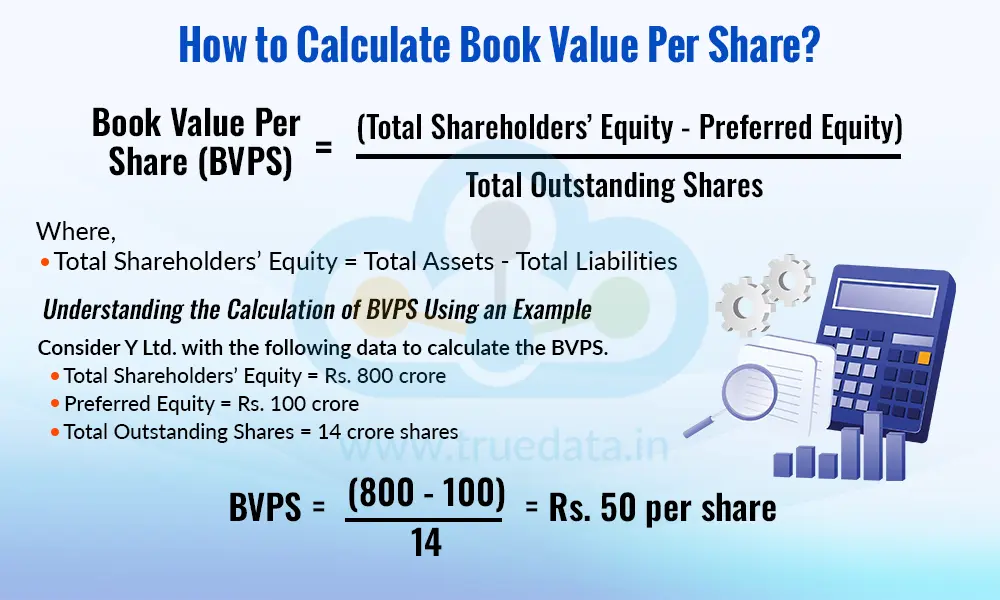
The primary formula to calculate Book Value Per Share is,
Book Value Per Share (BVPS) = (Total Shareholders’ Equity - Preferred Equity) / Total
Outstanding Shares
Preferred shareholders have a higher claim on the company’s assets than equity shareholders. So, to find the value available only for equity (common) shareholders, preferred equity is subtracted from the total equity.
Where,
Total Shareholders’ Equity = Total Assets - Total Liabilities
Understanding the Calculation of BVPS Using an Example
Consider Y Ltd. with the following data to calculate the BVPS.
Total Shareholders’ Equity = Rs. 800 crore
Preferred Equity = Rs. 100 crore
Total Outstanding Shares = 14 crore shares
The BVPS of Y Ltd. is,
Book Value Per Share (BVPS) = (Total Shareholders’ Equity - Preferred Equity) / Total
Outstanding Shares
BVPS = (800 - 100) / 14 = Rs. 50 per share.
Interpretation of BVPS
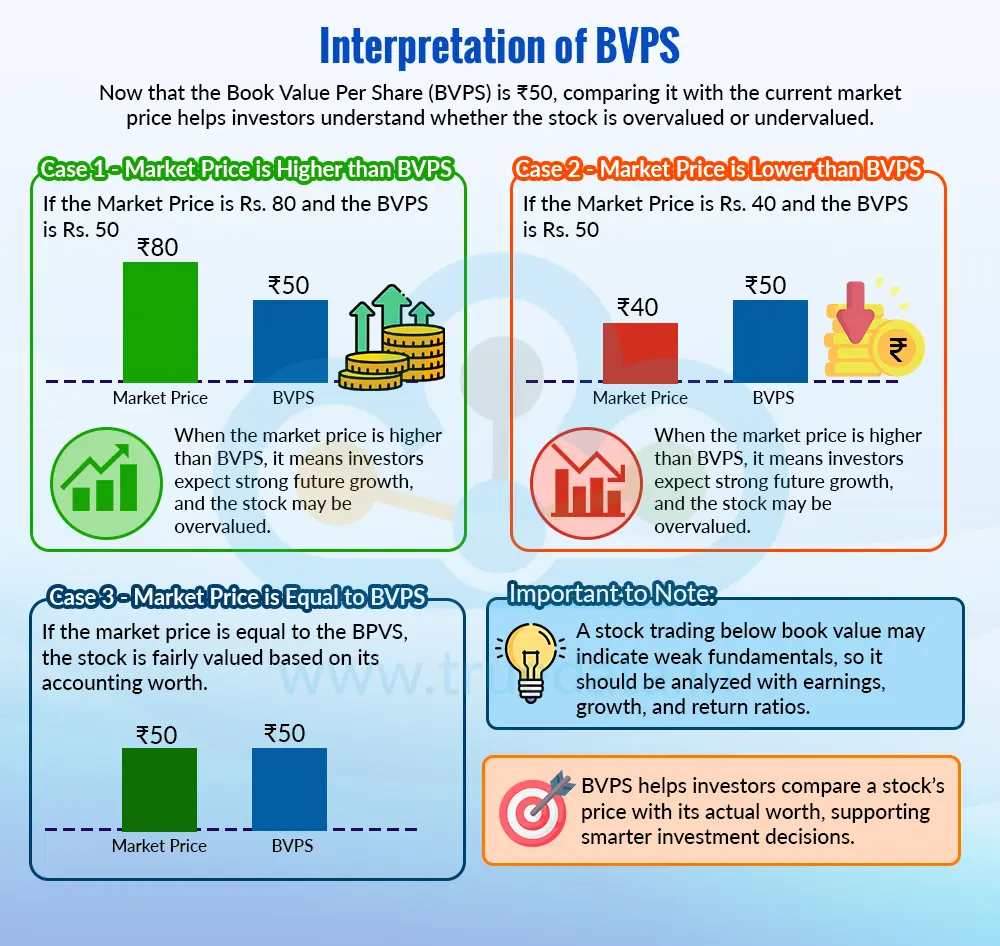
Now that we have calculated the Book Value Per Share (BVPS) = Rs. 50, the next step is to compare it with the current market price to understand what it means for investors.
Case 1 - Market Price is Higher than BVPS
(If the Market Price is Rs. 80 and the BVPS is Rs. 50)
When the market price is higher than the BVPS, it indicates that the investors are willing to pay more than the company’s book value. Thus, the stock may be overvalued, or the market expects strong future growth.
Case 2 - Market Price is Lower than BVPS
(If the Market Price is Rs. 40 and the BVPS is Rs. 50)
When the market price is lower than the BVPS, it indicates that the stock may be undervalued, or there could be concerns about the company’s future.
Case 3 - Market Price is Equal to BVPS
If the market price is equal to the BVPS, the stock is fairly valued based on its accounting worth.
It is important to note that a stock trading below book value is not always a good buy, as it could be a sign of weak business fundamentals. Thus, it is essential to always combine this with other metrics like earnings, growth, and return ratios. BVPS helps investors understand whether they are paying more or less than the company’s actual worth on paper, making it a powerful tool for smarter investment decisions.
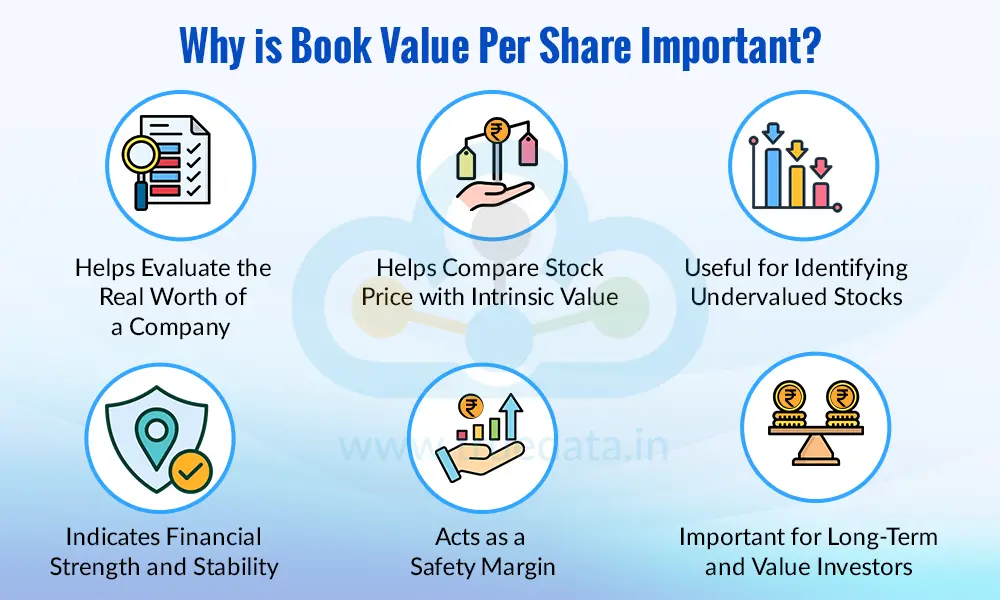
Book Value Per Share is an important tool that helps you look beyond just the stock price. It gives a deeper understanding of a company’s true worth and supports smarter, more confident investment decisions, especially when combined with other financial indicators. The importance of Book Value Per Share is explained below.
Helps Evaluate the Real Worth of a Company - Book Value Per Share gives you a clear idea of what each share is worth based on the company’s actual financial position. It shows the value of assets left for shareholders after paying all liabilities. This acts as a baseline value for investors, helping them understand whether a company has strong financial backing or not.
Helps Compare Stock Price with Intrinsic Value - BVPS allows investors to compare a stock’s market price with its actual value on paper. This comparison gives better clarity on whether you are paying a fair price. It is often used along with the Price-to-Book (P/B) Ratio to make more informed investment decisions.
Useful for Identifying Undervalued Stocks - One of the biggest advantages of BVPS is that it helps you spot potential undervalued opportunities. If a stock is trading below its book value, it may indicate that the market is undervaluing the company. This is especially useful in sectors like PSU banks, manufacturing, and infrastructure, where assets play a major role.
Indicates Financial Strength and Stability - A higher book value per share generally reflects a company with strong assets and lower liabilities. This can be a sign of financial stability for investors, especially in uncertain market conditions. Companies with consistent or growing BVPS are often seen as more reliable.
Acts as a Safety Margin - Investing in stocks with a price close to or below their book value can provide a margin of safety. This means that even if the market fluctuates, the downside risk may be relatively lower because the stock is backed by real assets.
Important for Long-Term and Value Investors - BVPS is widely used by value investors who look for stocks trading below their intrinsic value. It helps in identifying companies that may be temporarily undervalued but have solid fundamentals, making them good long-term investment opportunities.
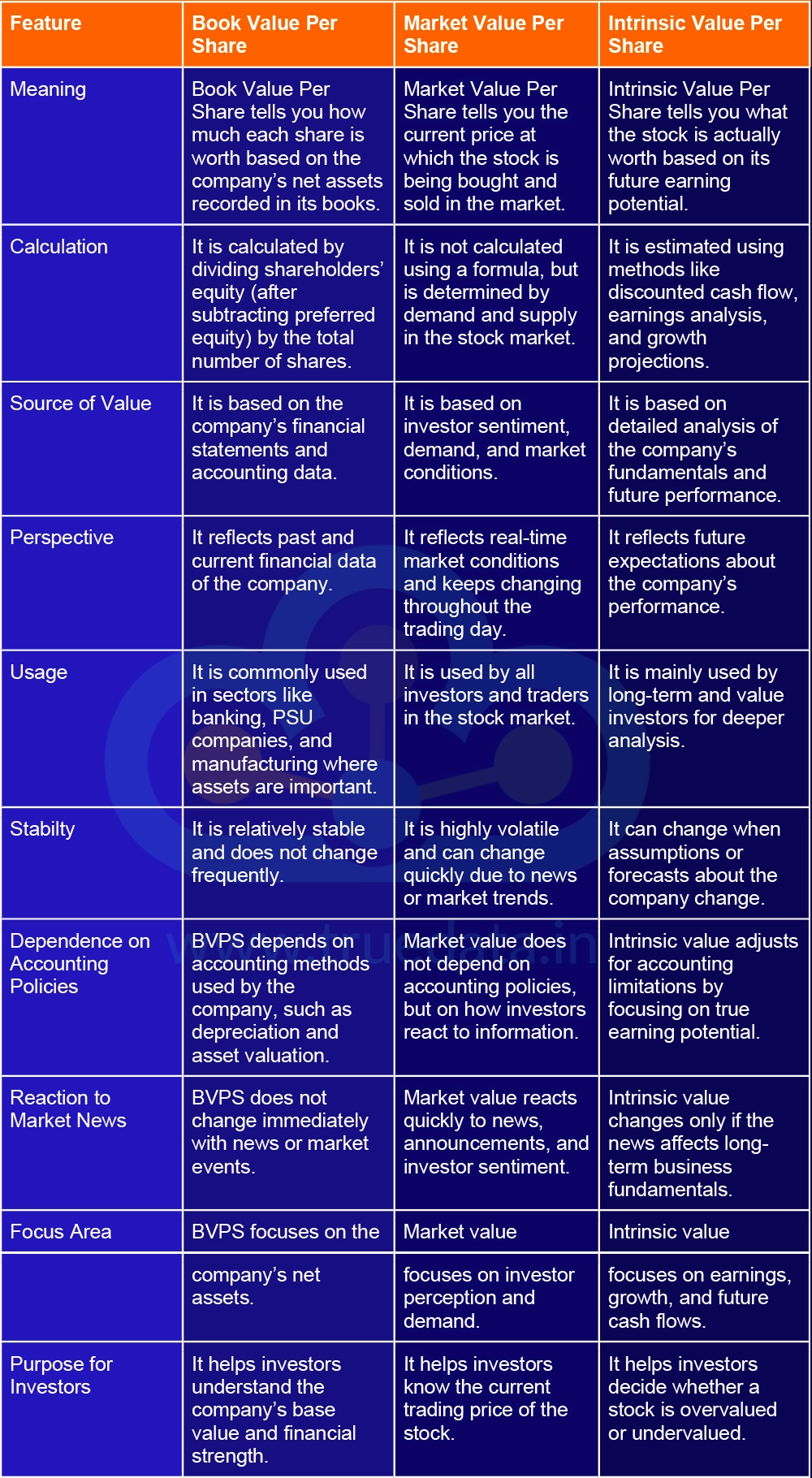
Book value per share is the accounting measure of the value assigned per share that investors are expected to receive at the time of liquidation. However, it gives an incomplete picture and does not provide any direction to buy or sell the stock. Therefore, it is important to understand the differences between three important concepts of share value, i.e, the book value per share, market value per share and intrinsic value per share. Understanding these three concepts together helps investors make better decisions, as each one shows a different perspective of a stock’s value.
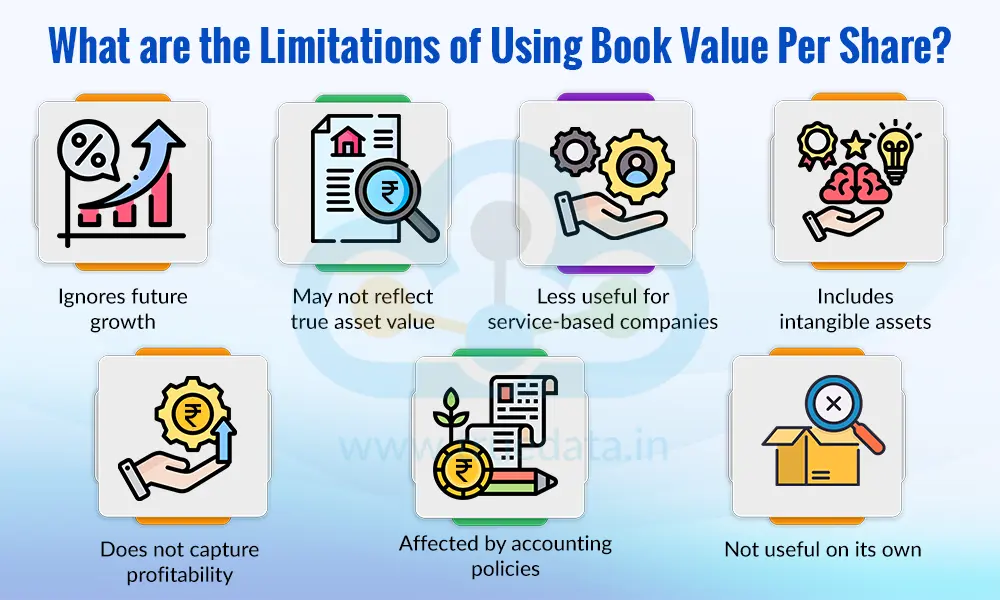
The book value per share is an important measure of valuation and is also used to calculate the price-to-book ratio, which is an important financial ratio for overall fundamental analysis. However, there are a few limitations in using the BVPS that should not be ignored. These limitations include,
Ignores future growth - BVPS is based on past data and does not consider a company’s future earnings or growth potential.
May not reflect true asset value - Assets are recorded at historical cost, which may be very different from their current market value.
Less useful for service-based companies - Companies in IT or digital sectors have fewer physical assets, so BVPS may not give a clear picture.
Includes intangible assets - Items like goodwill may inflate book value, but may not have real resale value.
Does not capture profitability - A company can have a high BVPS but still generate low profits.
Affected by accounting policies - Different accounting methods can change the book value, making comparisons tricky.
Not useful on its own - BVPS should not be used alone; it needs to be combined with other metrics like earnings and ratios.
Book Value Per Share (BVPS) is a simple yet powerful measure that helps investors in India understand the actual worth of a company based on its financial statements. Comparing BVPS with the market price can help investors get a clearer idea of whether a stock may be undervalued, fairly valued, or overvalued. However, since BVPS is based on past data and does not reflect future growth or market sentiment, it should not be used alone. Thus, combining it with other measures like market value and intrinsic value gives a more complete picture and helps investors make smarter, more balanced investment decisions.
This article focuses on a key valuation metric to help investors make informed portfolio decisions. Let us know your thoughts on the topic or if you need further information on the same, and we will address it soon.
Till then, Happy Reading!

Marisha Bhatt is a financial content writer @TrueData.
She writes with the sole aim of simplifying complex financial concepts and jargon while attempting to clarify technical and fundamental analysis concepts of the stock markets. The ultimate goal is to spread vital knowledge and benefit the maximum audience. Her Chartered Accountant background acts as the knowledge base to help clarify crucial concepts and create a sound investment portfolio.

Thestock market never stands still, and prices swing constantly with every new h...
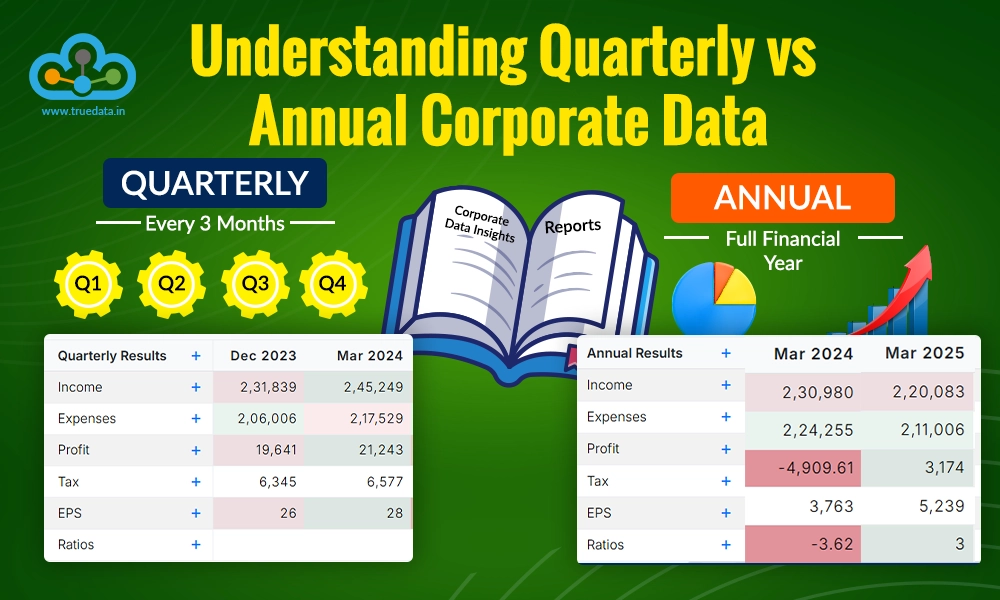
Corporate data is more than just the numbers of a company. They can show what is...

Debt and equity together form the total capital of a company. However, when anal...
