Choosing a mutual fund is not just about picking the one with the highest past returns. Behind every fund lies a detailed document that tells you how the fund works, where it invests, and what risks you are actually taking. This document is called a mutual fund factsheet. At first glance, a factsheet may look packed with numbers and jargon, but once you know what to look for, it becomes a powerful tool for smart decision-making. Check out this blog to understand what a fund factsheet is and how to read it to make informed portfolio decisions.

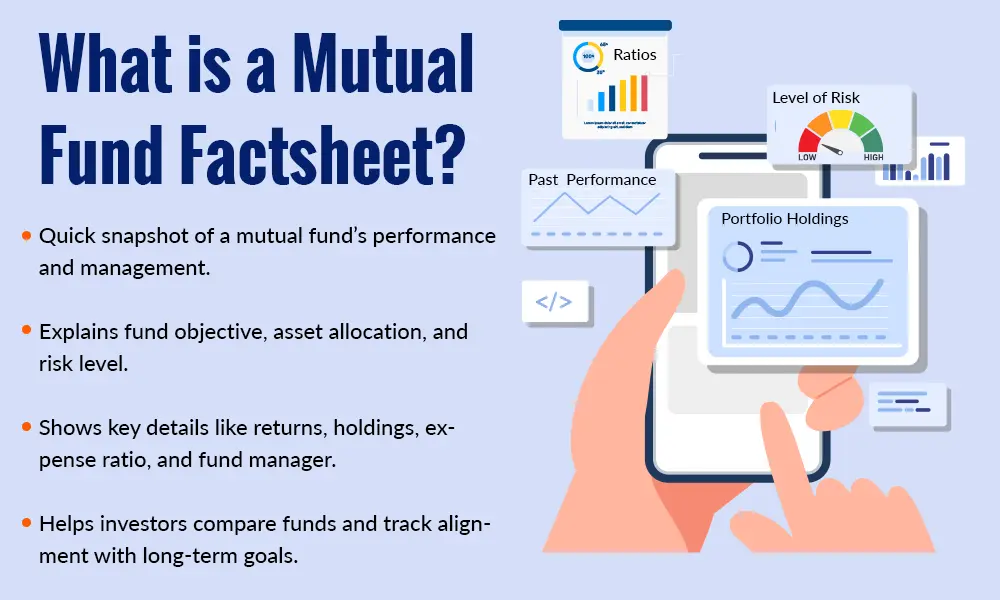
A Mutual Fund Factsheet is a simple, periodic document published by a mutual fund house that gives investors a clear snapshot of how a mutual fund is performing and how it is managed. It explains the fund’s objective, the type of assets it invests in (such as equity, debt, or hybrid instruments), and the level of risk involved, helping investors understand whether the fund suits their financial goals and risk appetite. The factsheet also shares key details like past performance, portfolio holdings, expense ratio, fund manager information, and important ratios, all in one place. A factsheet acts like a quick health check of a mutual fund, making it easier to compare similar funds and track whether the investment is still aligned with the long-term plans.

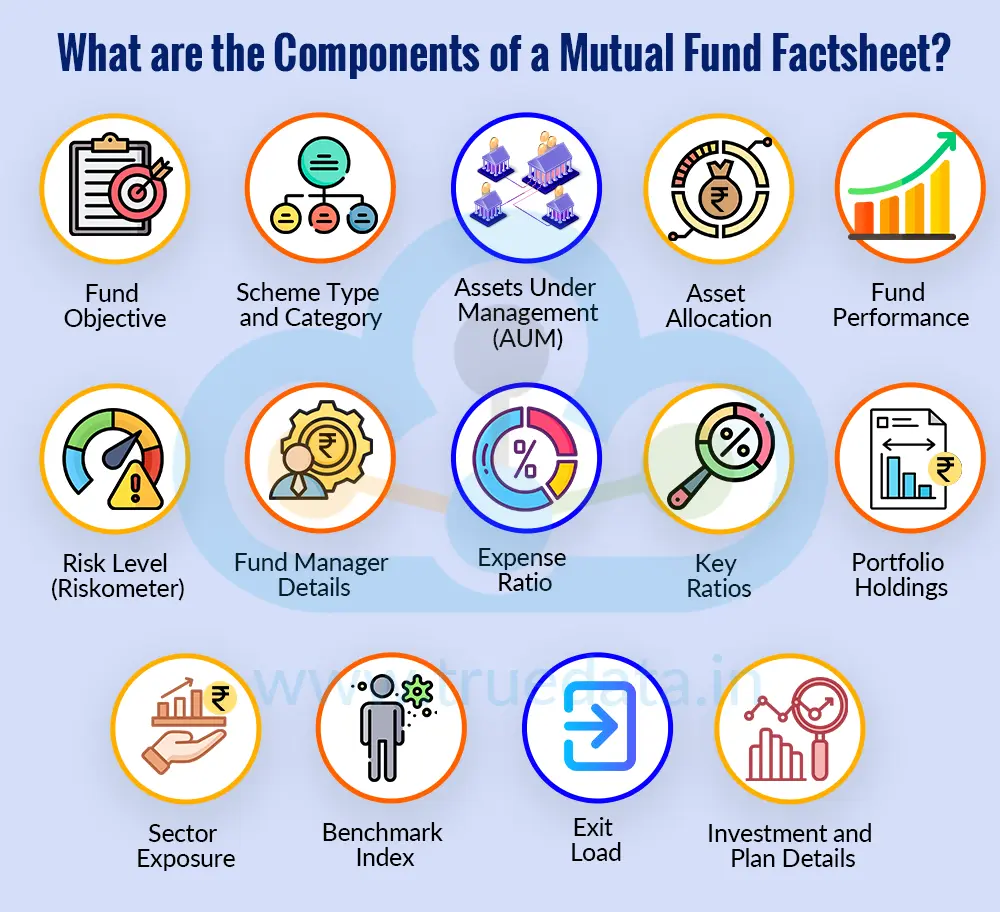
A mutual fund factsheet may look lengthy, but it is actually a well-organised document with clearly defined sections. Each component tells investors something important about how the fund works, how risky it is, and whether it suits their investment goals. The components of a mutual fund factsheet are explained below.
The fund objective explains why the mutual fund exists and what it is trying to achieve. It tells investors whether the fund aims for long-term capital growth, regular income, or a mix of both. It also mentions the type of instruments the fund will invest in, such as equity shares, debt instruments, or a combination of both. Investors should read this carefully as it sets expectations about returns and risk. If the goal is long-term wealth creation, a growth-oriented equity fund may be suitable, but if the goal is short-term stability, such a fund may not be appropriate.
This section classifies the fund into a specific category, such as equity, debt, hybrid, or life cycle fund schemes (new category) or other funds (FoFs, index funds, etc.), as per SEBI regulations. For example, equity funds may further be classified as large-cap, mid-cap or small-cap funds. This classification helps investors understand how risky the fund is likely to be and what kind of returns can be expected over time. Comparing funds within the same category is important because each category behaves differently in various market conditions.
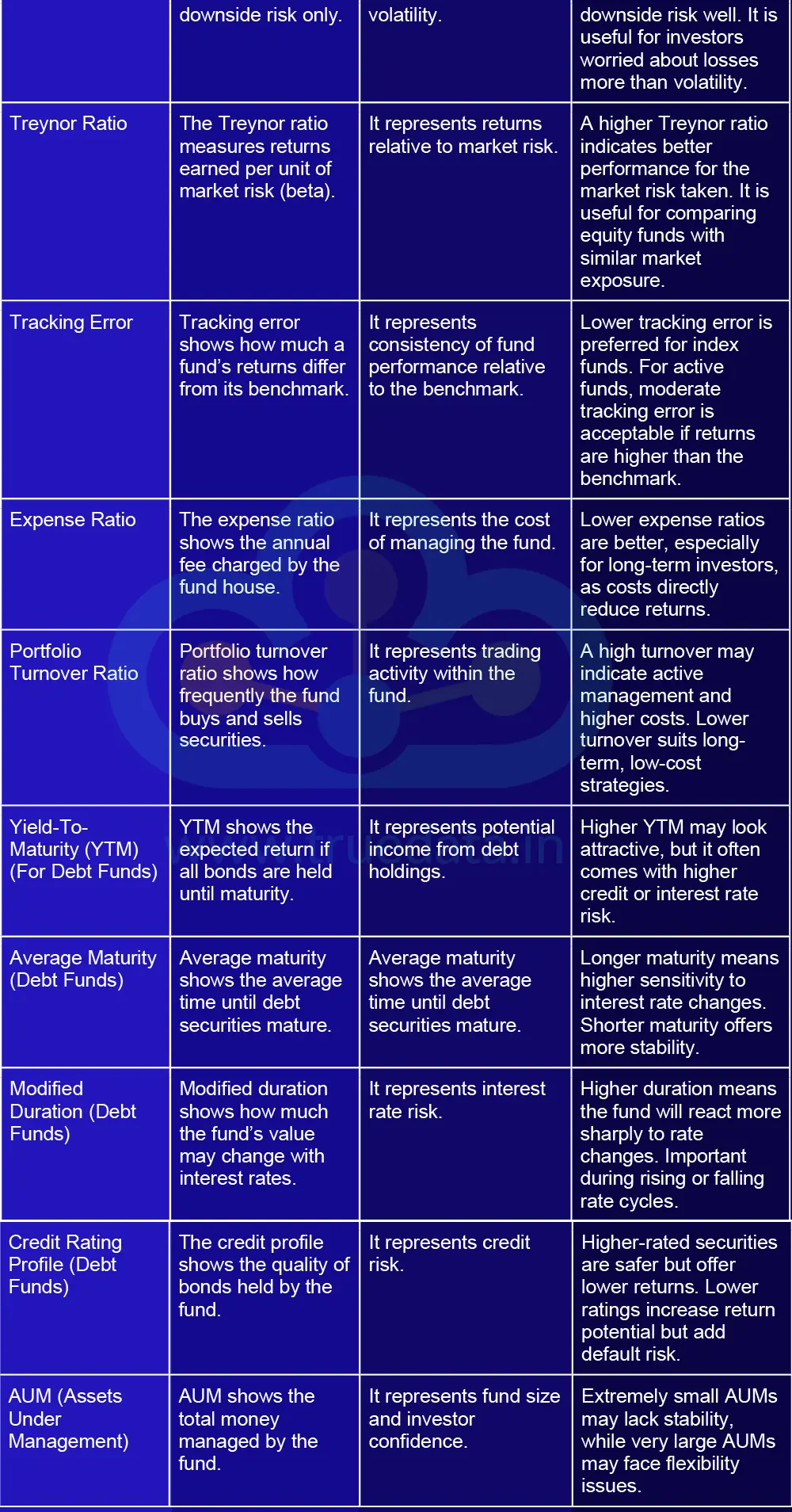
AUM in mutual funds represents the total value of assets managed by the fund. It reflects investor confidence and the fund’s scale. Very small AUMs may indicate limited investor interest, while extremely large AUMs may reduce flexibility in certain strategies. Investors should look for a comfortable balance, especially in actively managed funds.
Asset allocation shows how the fund distributes money across different asset classes, such as equity, debt, and cash. This mix plays a major role in determining the fund’s risk and return profile. Equity allocation drives growth but adds volatility, while debt allocation adds stability. A well-balanced asset allocation helps manage risk across market cycles. Investors should check whether the allocation aligns with their financial goals and risk tolerance.
Performance data shows how the fund has delivered returns over different periods, such as 1 year, 3 years, 5 years, and since inception. It helps investors judge consistency rather than short-term success. Long-term performance gives a better picture of how the fund behaves across market cycles. Investors should avoid selecting funds based only on recent high returns and focus on steady performance over time.
The risk level shows how much fluctuation investors may experience in the value of their investment. This is usually displayed through a riskometer, which ranges from low to very high risk. It helps investors assess whether they can emotionally and financially handle market ups and downs. A higher risk fund may deliver higher returns over time, but it can also fall sharply during market corrections. Choosing a risk level that matches the individual's comfort and investment horizon is crucial.
This section introduces the fund manager and provides information about their experience and tenure with the fund. The fund manager plays a key role in investment decisions, portfolio construction, and risk management. A manager with a stable track record adds confidence, but investors should remember that mutual fund performance depends on the process, not just the individual. Frequent changes in fund managers may be a red flag.
The expense ratio shows the annual fee charged by the mutual fund company to manage the fund. This cost is deducted from the fund’s returns, meaning higher expenses reduce what investors earn. Even a small difference in expense ratio can have a big impact over long periods due to compounding. Long-term investors should prefer funds with reasonable expense ratios, especially within the same category.
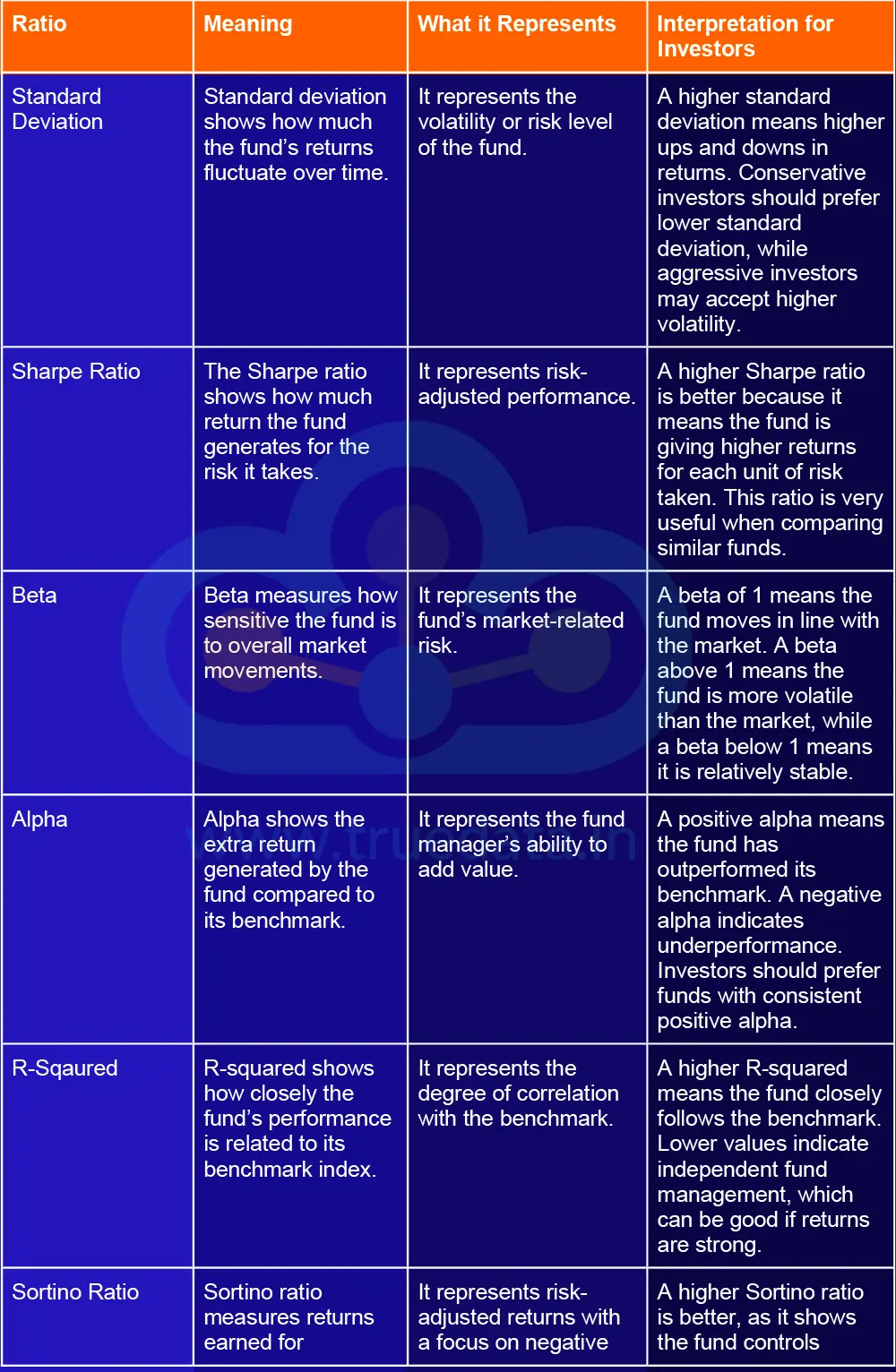
The fund factsheet also includes key ratios related to the fund. These ratios help investors understand risk-adjusted performance and not just returns. A few common ratios include standard deviation (which shows how volatile the fund is), Sharpe ratio (which indicates how well the fund generates returns for the risk taken), and beta (which shows how sensitive the fund is to market movements). These ratios are especially useful when comparing two funds in the same category. Higher risk-adjusted ratios generally indicate better-quality fund management.
This section lists the individual stocks or debt instruments that the fund has invested in, along with their weight in the portfolio. It gives investors transparency about where their money is actually invested. A diversified portfolio spread across many securities reduces risk, while a highly concentrated portfolio increases both potential return and risk. Investors should watch out for excessive exposure to a few stocks or issuers.
Sector exposure shows how much the fund is invested in different sectors such as banking, IT, pharma, or energy. This helps investors understand whether the fund is diversified or tilted towards specific sectors. Sector concentration can boost returns if that sector performs well, but it can hurt performance if the sector faces challenges. Knowing sector exposure helps investors avoid overexposure to the same sectors across multiple funds.
The benchmark is a market index against which the fund’s performance is measured. It represents the fund’s investment universe and helps investors understand whether the fund manager is adding value. If a fund consistently underperforms its benchmark over long periods, it may indicate issues in fund management. A suitable benchmark makes performance comparison meaningful and transparent.
Exit load is a fee charged if investors redeem their units within a specified period. It is designed to discourage short-term withdrawals and protect long-term investors. Understanding exit load is important for those who may need liquidity in the near future. Long-term investors are usually less affected by exit loads.
This section covers minimum investment amounts, SIP (Systematic Investment Plan) options, and plan choices such as growth or IDCW. It helps investors understand how to invest and how returns will be received. Choosing the right plan for investors depends on whether the goal is a regular income or long-term wealth creation. SIP details are especially useful for retail investors looking to invest gradually.

A mutual fund factsheet is not just an information document, but rather a practical guide that helps in making informed and confident investment decisions. It brings clarity, transparency, and structure to the fund selection and review process. The importance of the fund factsheet and its uses are explained below.
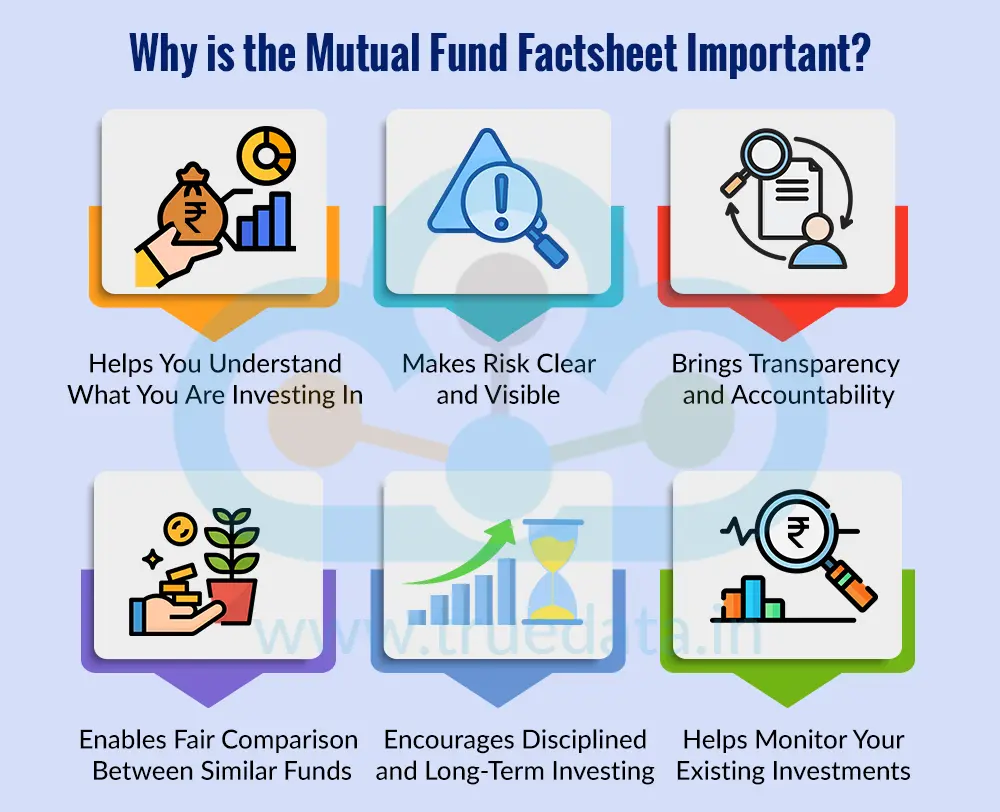
Helps You Understand What You Are Investing In - The factsheet clearly explains the fund’s objective, investment strategy, and asset allocation. This helps investors understand where their money is being invested, whether in equities, debt, or a mix of assets, and why. Understanding this reduces guesswork and ensures that the fund aligns with the financial goals and investment time horizon.
Makes Risk Clear and Visible - Every mutual fund carries some level of risk, and the factsheet helps make this risk easy to understand. Through the riskometer, portfolio details, and key risk measures, investors can judge how volatile the fund can be. This is especially important in India, where market movements can be sharp. Understanding risk in advance helps investors stay calm during market ups and downs.
Brings Transparency and Accountability - The factsheet discloses important details such as portfolio holdings, expense ratio, fund manager information, and benchmark comparison. This transparency allows investors to track whether the fund is sticking to its stated strategy. It also holds the fund house accountable for performance and investment decisions, which builds investor trust.
Enables Fair Comparison Between Similar Funds - When multiple funds have similar objectives, the factsheet helps investors compare them on meaningful parameters such as performance consistency, expense ratio, portfolio quality, and risk-adjusted returns. Instead of choosing a fund based only on recent returns or popularity, investors can make better choices based on long-term fundamentals.
Encourages Disciplined and Long-Term Investing - By focusing on data such as consistency, risk measures, and strategy rather than short-term performance, the factsheet promotes disciplined investing. It helps investors avoid emotional decisions driven by market noise and stay aligned with long-term financial goals.
Helps Monitor Your Existing Investments - Investing is not a one-time activity. By regularly checking the factsheet, investors can see if there have been changes in risk level, asset allocation, or fund management. This helps in deciding whether to continue holding the fund, rebalance the portfolio, or switch based on changing goals or market conditions.
The mutual fund factsheet also showcases key ratios/metrics of the fund that provide crucial details of risk and return parameters, as well as help in better comparison of similar funds. However, investors should understand that no single ratio can tell the full story of a mutual fund. These ratios and metrics work best when used together and compared within the same fund category. The important ratios and their interpretation are tabled below.


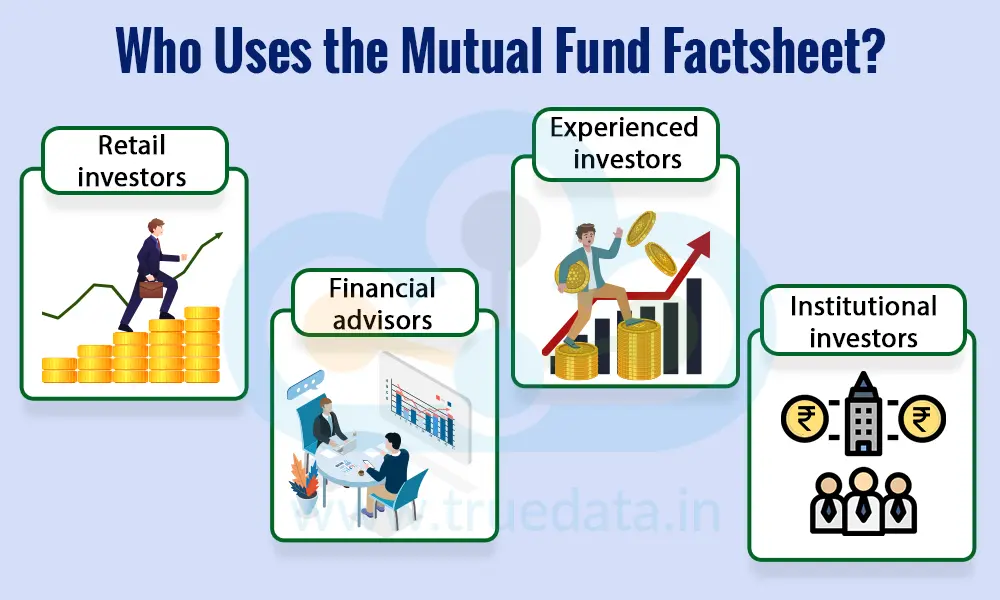
The Mutual Fund Factsheet is used by a wide range of people involved in investing, not just experts. Some of the users of the fund factsheet are,
Retail investors use it to understand where their money is invested, how risky the fund is, and whether it matches their financial goals.
Financial advisors and distributors rely on factsheets to compare funds, recommend suitable schemes to clients, and explain investment choices clearly.
Experienced investors and analysts use factsheets to assess portfolio quality, risk measures, costs, and performance consistency.
Even institutional investors and fund managers review factsheets to track strategy alignment and benchmark performance.
Thus, the fund factsheet can be used as a trusted reference by anyone who wants to make informed, transparent, and disciplined mutual fund decisions.
A mutual fund factsheet is a simple yet powerful document that brings together everything an investor needs to know about a mutual fund in one place. From the fund objective and risk level to portfolio details, it helps investors understand not just how much a fund has earned, but how and at what risk it has earned those returns. Using the factsheet to compare funds, monitor existing investments, and stay aligned with personal financial goals allows investors to move away from guesswork and short-term trends towards disciplined, informed, and confident investing.
The fund factsheet is like the bone and flesh of the fund, detailing all the crucial pointers that can help investors make an informed decision. We hope this blog was able to help you understand this document and direct it in detail. Let us know your thoughts on the topic or if you need further information on the same, and we will address it soon.
Till then, Happy Reading!
Read More: SEBI Categorisation and Rationalisation of Fund Scheme
Mutual fund investments have simplified greatly with just a tap on your smartpho...
Introduction For the longest time, investment in stock markets was thought to b...
Every investor knows that the stepping stones to a good investment in thestock m...