15-MIN DELAYED
NIFTY 23,140.50 +77.40 (+0.34%) | BANKNIFTY 55,580.40 +141.90 (+0.26%) | SENSEX 73,895.74 +315.20 (+0.43%) | CRUDEOIL-I 8,847.00 -312.00 (-3.41%) | GOLD-I 1,50,700.00 -141.00 (-0.09%) | NIFTY 23,140.50 +77.40 (+0.34%) | BANKNIFTY 55,580.40 +141.90 (+0.26%) | SENSEX 73,895.74 +315.20 (+0.43%) | CRUDEOIL-I 8,847.00 -312.00 (-3.41%) | GOLD-I 1,50,700.00 -141.00 (-0.09%) |
TrueData
Helpline / Support +91 7304-22-44-66
Get started

WORKSPACE

Workspace overview Workspace overview Our flagship product SignalX SignalX web charting for indian market Sheets Sheets streaming spreadsheet Wealth Wealth corporate data and news


Built for India's markets.

Real-time charts, streaming spreadsheets, live corporate announcements — all in one workspace.

Get started free

Understanding Fund of Funds (FoFs) - Hidden Gem or Double Expense Trap?

Marisha Bhatt · 26 Sep 2026 · 14 mins read · 10 Comments

understanding-fund-of-funds-fofs-hidden-gem-or-double-expense-trap

Mutual funds can be a good starting point for creating a successful portfolio. However, choosing a suitable fund from the abundance of options can be a daunting task. So what if you could invest in a fund that could give you access to multiple funds at the same time? Enter Fund of Funds, a unique fund that invests in funds and not individual stocks. But there is another side to consider. Are you paying an extra layer of costs for that convenience? And if so, are Fund of Funds a hidden gem for investors or a double-expense trap? Dive in to explore how they work, their benefits and limitations, taxation, costs, and what investors should consider before adding them to their portfolios. 

What are Fund of Funds?

What are Fund of Funds

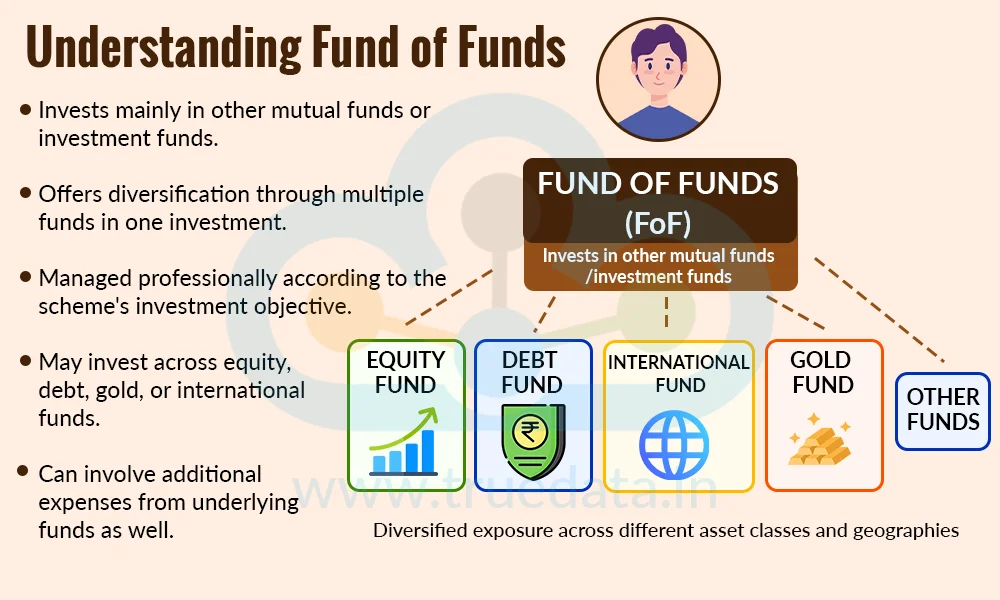
A Fund of Funds (FoF) is a type of mutual fund that invests primarily in other mutual funds or investment funds instead of directly investing in individual stocks or securities. Therefore, rather than choosing and buying shares of companies such as Reliance Industries or HDFC Bank directly, an FoF invests in other funds that already hold a collection of securities. This allows investors to gain exposure to multiple funds through a single investment. Depending on its objective, an FoF may invest in equity funds, debt funds, international funds, gold funds, or a combination of different funds. The FoF is managed by a professional fund manager who selects and manages the underlying funds based on the scheme's investment objective. This can make diversification and portfolio management more convenient for investors. However, it is important to understand that an FoF may also involve an additional layer of expenses, because investors pay the FoF's expenses while the underlying funds also have their own expenses. Therefore, investors should look beyond just the convenience of investing in multiple funds and evaluate the FoF's objective, underlying funds, costs, risk and potential returns before investing.

How do Fund of Funds (FOFs) Work?

How do Fund of Funds (FOFs) Work

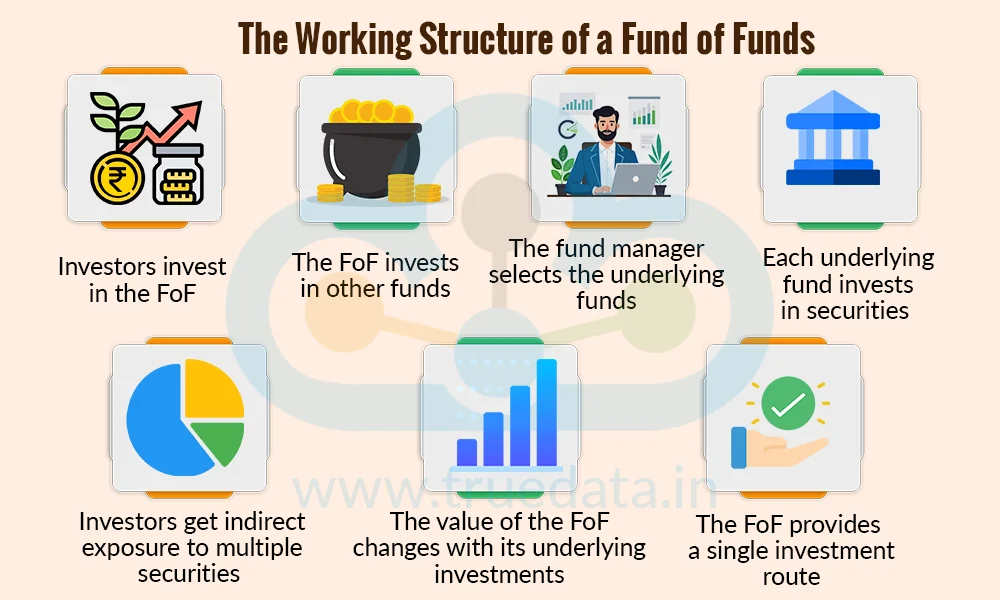
A Fund of Funds follows a simple structure where investors invest in the FoF, and the FoF invests in other mutual funds or investment funds. This creates an indirect investment route for investors to access a wider range of securities. Here is how it works.

  • Investors invest in the FoF - Investors purchase units of the FoF just as they would invest in any other mutual fund. The money collected from investors becomes part of the FoF's investment pool.

  • The FoF invests in other funds - Instead of directly purchasing individual shares or bonds, the FoF uses the collected money to invest in units of other mutual funds or eligible investment funds, depending on its investment objective.

  • The fund manager selects the underlying funds - A professional fund manager decides which underlying funds the FoF should invest in. The selection is generally based on factors such as the FoF's objective, the performance and strategy of the underlying funds, risk, and diversification.

  • Each underlying fund invests in securities - The funds selected by the FoF then invest in their respective portfolios. For example, an equity fund may invest in shares of companies across different sectors, while a debt fund may invest in bonds and other fixed-income securities.

  • Investors get indirect exposure to multiple securities - Since the FoF invests in several underlying funds, investors indirectly gain exposure to the stocks, bonds, gold or other assets held by those funds. Investors do not have to purchase these securities individually.

  • The value of the FoF changes with its underlying investments - As the value of the underlying funds rises or falls, the Net Asset Value (NAV) of the FoF also changes. Therefore, investors' returns are ultimately linked to the performance of the underlying funds, after considering the applicable expenses.

  • The FoF provides a single investment route - Instead of selecting and managing several funds themselves, investors can use an FoF to gain exposure to a portfolio of funds through a single mutual fund investment. This can make diversification more convenient, although investors should also consider the additional costs involved.

What are the Types of Fund of Funds?

What are the Types of Fund of Funds

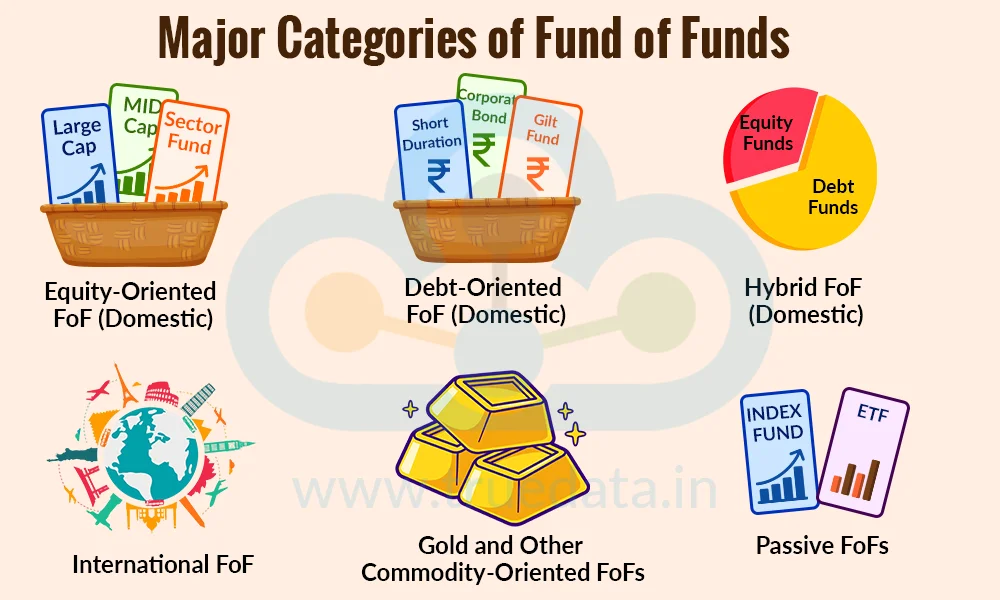
Fund of Funds (FoFs) can be broadly classified based on the type of underlying mutual fund schemes they invest in and their investment strategy. SEBI's February 2026 framework provides specific categories and sub-categories for FoFs that invest in multiple underlying funds. This standardisation is intended to make FoFs easier for investors to understand and compare

Equity-Oriented FoF (Domestic)

An Equity-Oriented FoF (Domestic) invests primarily in domestic equity-oriented mutual fund schemes. Under SEBI's framework, this category includes Diversified FoFs and Sectoral/Thematic FoFs. A Diversified FoF can invest in underlying schemes covering different market-cap segments, such as large-cap, mid-cap or broad-market strategies, provided the underlying schemes are not based on factors such as momentum or volatility. A Sectoral/Thematic FoF, on the other hand, focuses on underlying funds based on a particular sector, theme or multiple sectors. This type of FoF can therefore give investors indirect exposure to a range of Indian equity investments through the underlying schemes.

Debt-Oriented FoF (Domestic)

A Debt-Oriented FoF (Domestic) invests in domestic debt-oriented mutual fund schemes. Under SEBI's framework, these FoFs can invest in different categories of debt schemes or in schemes belonging to a single debt category. This allows investors to gain exposure to a portfolio of debt funds through one FoF rather than selecting several debt schemes themselves. However, the level of interest-rate risk, credit risk and other risks will depend on the underlying debt funds selected by the FoF.

Hybrid FoF (Domestic)

A Hybrid FoF (Domestic) invests in a combination of underlying equity-oriented and debt-oriented mutual fund schemes. SEBI's current framework includes several sub-categories within this group, such as Aggressive Hybrid FoF, Conservative Hybrid FoF, Income Plus Arbitrage FoF, Dynamic Asset Allocation FoF and Multi Asset Allocation FoF. The allocation between the underlying funds depends on the particular sub-category. For example, an Aggressive Hybrid FoF must invest 65% to 80% in underlying equity-oriented schemes and 20% to 35% in underlying debt-oriented schemes. A Conservative Hybrid FoF has a much higher allocation to underlying debt-oriented schemes.

International FoF

An International FoF provides investors with exposure to overseas markets through eligible underlying funds or schemes. Such a fund can help Indian investors diversify beyond the domestic market and gain indirect exposure to international companies or markets. However, the actual investment strategy and permitted overseas exposure depend on the scheme's structure and applicable SEBI requirements. Investors should therefore check the scheme documents to understand the countries, markets and underlying funds involved.

Gold and Other Commodity-Oriented FoFs

FoFs can also be structured to provide exposure to commodity-related investments, such as gold, through underlying schemes or eligible commodity-based investments. Under SEBI's current framework, Multi Asset Allocation FoFs can invest in underlying equity-oriented schemes, debt-oriented schemes and commodity-based schemes, subject to the prescribed framework. This can allow investors to combine different asset classes through a single FoF.

Passive FoFs

Some FoFs invest in passively managed ETFs and/or Index Funds rather than actively managed mutual funds. For example, SEBI's 2026 framework permits a passive option under the Equity-Oriented FoF (Domestic) category that can invest in passively managed factor-based ETFs and/or Index Funds. The objective is to provide exposure to a combination of passive strategies through a single FoF.

What are the Factors to Consider when Investing in FOFs?

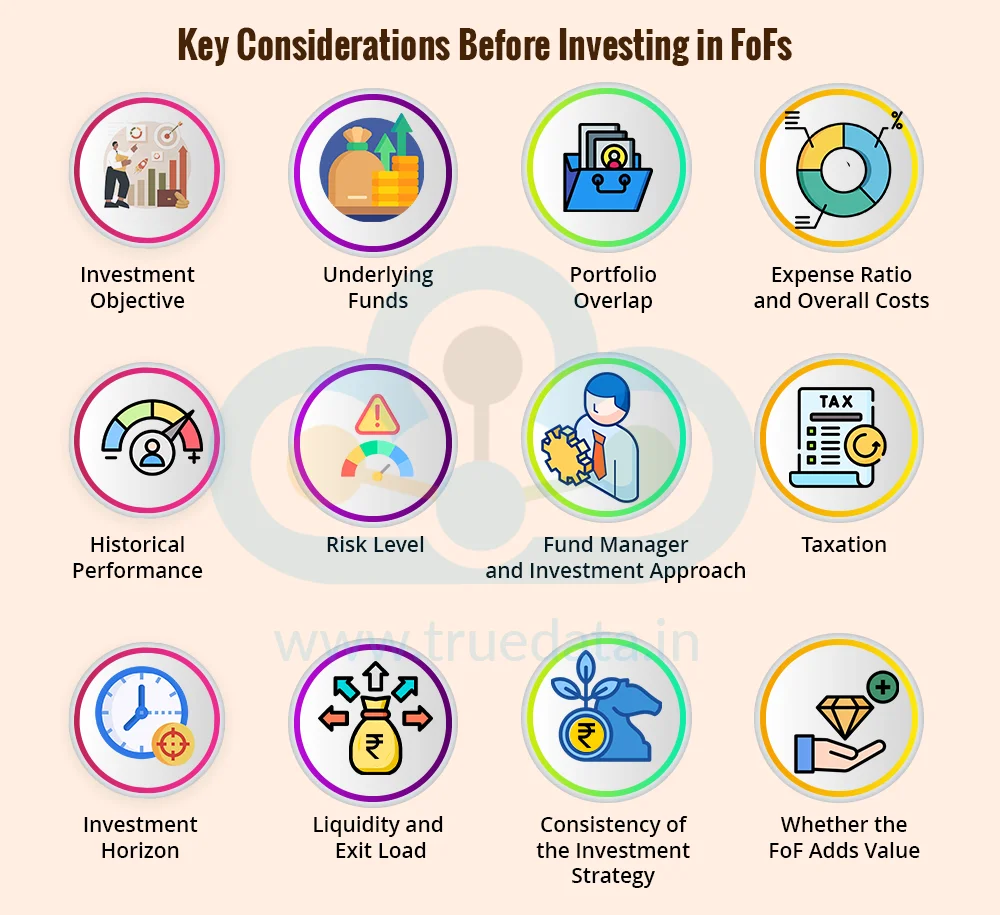
A Fund of Funds (FoF) can provide investors with exposure to multiple mutual funds through a single investment. However, the convenience of investing through an FoF should be weighed against its costs, risks and structure. Since an FoF invests in underlying funds, investors need to evaluate both the FoF and the funds within it. The following factors can help an investor make a more informed decision.

What are the Factors to Consider when Investing in FOFs

  • Investment Objective - An investor should first understand the investment objective of the FoF. Different FoFs may focus on domestic equity, debt, hybrid investments, international markets, commodities or passive strategies. The investor should check whether the FoF's objective is aligned with their financial goals, risk appetite and investment horizon.

  • Underlying Funds - The performance of an FoF depends significantly on the underlying funds in which it invests. Therefore, an investor should examine these funds instead of looking only at the FoF's past returns. Factors such as the underlying funds' investment strategy, portfolio composition, historical performance and risk level should be considered.

  • Portfolio Overlap - Investing in several funds does not automatically guarantee diversification. The underlying funds may hold many of the same stocks or securities. For example, if multiple equity funds within an FoF have significant investments in the same companies, the portfolio may be more concentrated than it appears. An investor should therefore check the extent of portfolio overlap before investing.

  • Expense Ratio and Overall Costs - Cost is an important factor when evaluating an FoF. The FoF has its own expenses, while the underlying funds may also charge expenses. This increases the expense ratio as it can create an additional layer of costs compared with investing directly in a mutual fund. An investor should therefore compare the overall cost of the FoF with the potential benefit of having the underlying funds professionally selected and managed.

  • Historical Performance - An investor can examine the FoF's performance over different periods and market conditions to understand how consistently it has performed. However, past performance should not be treated as a guarantee of future returns. It is also useful to compare the FoF's performance with an appropriate benchmark and relevant alternatives.

  • Risk Level - The risk of an FoF depends largely on the underlying funds and their investments. An equity-oriented FoF may experience greater fluctuations, while a debt-oriented FoF may be affected by interest-rate and credit risks. An international FoF may also be influenced by overseas market movements and currency fluctuations. An investor should ensure that the FoF's risk level is suitable for their ability to tolerate losses.

  • Fund Manager and Investment Approach - The fund manager is responsible for selecting and monitoring the underlying funds according to the FoF's investment strategy. An investor should understand how the underlying funds are selected, monitored and replaced. A clearly defined investment approach can help the investor understand how the FoF is expected to be managed across different market conditions.

  • Taxation - An investor should understand the tax treatment applicable to the particular FoF before investing. The tax treatment can depend on the structure and nature of the FoF and its underlying investments. Therefore, an investor should check the applicable tax rules, holding period requirements and tax rates rather than assuming that an FoF will have the same tax treatment as the underlying funds.

  • Investment Horizon - The investment horizon should match the nature of the FoF. An equity-oriented FoF may be more appropriate for a longer investment period because equity markets can be volatile in the short term. A debt-oriented FoF may have different risk and return characteristics. An investor should therefore select an FoF based on the time required to achieve the financial goal.

  • Liquidity and Exit Load - An investor should check the redemption terms and exit load before investing. Although mutual fund units are generally redeemable on business days, a scheme may charge an exit load if the investment is withdrawn within a specified period. Understanding these conditions can help an investor avoid unexpected costs when redeeming the investment.

  • Consistency of the Investment Strategy - An investor should examine whether the FoF has consistently followed its stated investment strategy. It is useful to assess how the scheme has behaved during different market cycles and whether changes in the underlying funds have been made for clear investment reasons. Consistency can provide a better understanding of the FoF's approach than simply looking at its highest return during a particular period.

  • Whether the FoF Adds Value - Finally, an investor should consider whether an FoF genuinely adds value to the portfolio. If the investor can independently select and manage suitable mutual funds, investing directly may sometimes be simpler and more cost-efficient. However, an FoF may offer value when the investor wants professional selection of underlying funds, convenient diversification or exposure to a particular investment strategy through a single fund.

What are the Benefits and Limitations of Investing in FOFs?

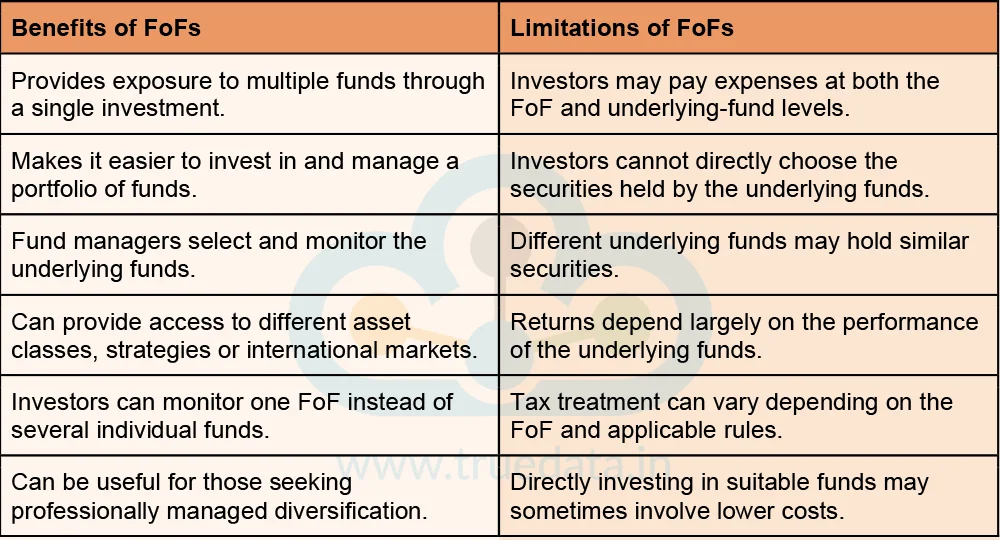
Fund of Funds (FoFs) can offer investors a convenient way to access multiple funds through a single investment. However, they also have certain limitations, particularly around costs and complexity. The key benefits and limitations include,

What are the Benefits and Limitations of Investing in FOFs

Benefits of FoFs

Limitations of FoFs

Provides exposure to multiple funds through a single investment.

Investors may pay expenses at both the FoF and underlying-fund levels.

Makes it easier to invest in and manage a portfolio of funds.

Investors cannot directly choose the securities held by the underlying funds.

Fund managers select and monitor the underlying funds.

Different underlying funds may hold similar securities.

Can provide access to different asset classes, strategies or international markets.

Returns depend largely on the performance of the underlying funds.

Investors can monitor one FoF instead of several individual funds.

Tax treatment can vary depending on the FoF and applicable rules.

Can be useful for those seeking professionally managed diversification.

Directly investing in suitable funds may sometimes involve lower costs.

Fund of Funds - Double Expense or Worth the Cost?

Fund of Funds - Double Expense or Worth the Cost

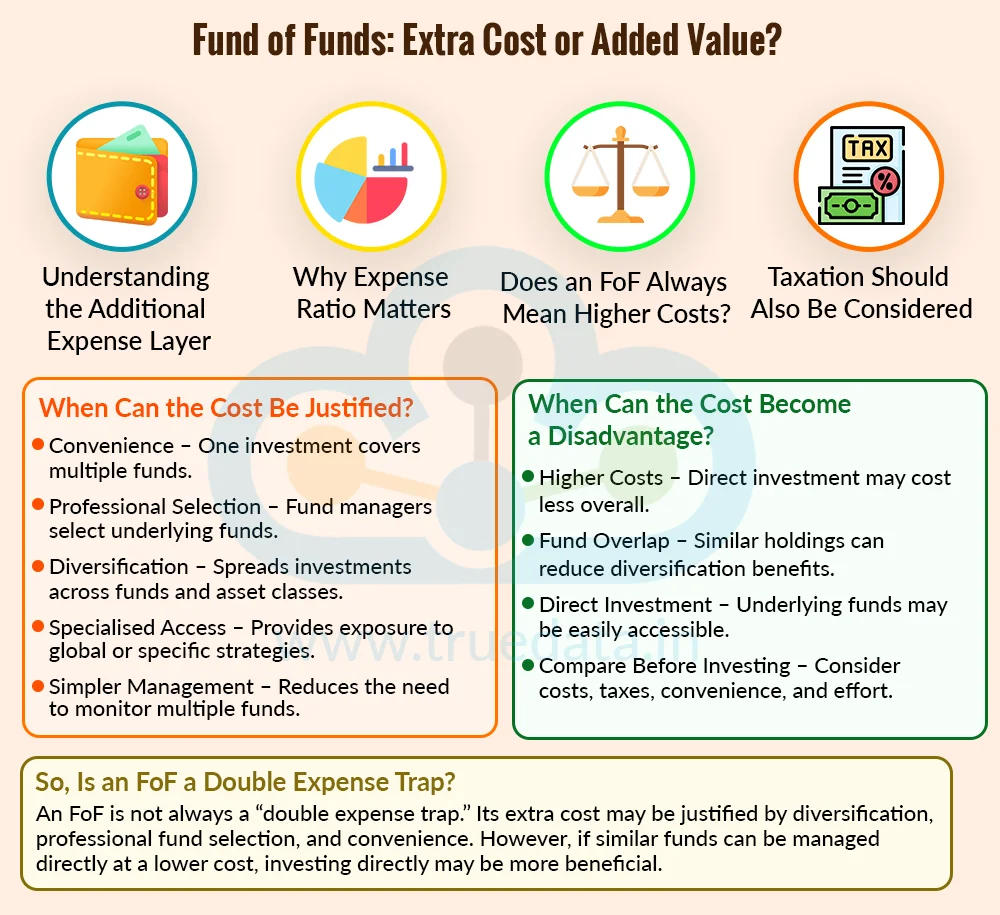
A Fund of Funds (FoF) can provide a convenient way to access multiple mutual funds through a single investment. However, this convenience comes with an important consideration: the cost of investing through two layers of funds. SEBI's investor education material also highlights that FoFs can involve slightly higher costs because of layered management fees.

Understanding the Additional Expense Layer

When an investor invests directly in a mutual fund, the investor bears the expenses charged by that fund. In an FoF, there can be two levels of expenses, i.e., the FoF charges its own expenses for managing the portfolio, while the underlying funds in which it invests also have their own expenses. Therefore, an investor should look at the overall cost of the FoF and the expenses of its underlying schemes, rather than considering only the FoF's headline expense ratio. SEBI's regulatory framework specifically considers the weighted average expenses of the underlying schemes while determining the applicable expense limits for FoFs.

Why Expense Ratio Matters

The expense ratio represents the recurring expenses charged to a mutual fund scheme and is deducted from the scheme's assets. Even a seemingly small difference in costs can affect long-term returns because the expense is incurred year after year. For example, if two investment options generate similar gross returns but one has higher overall expenses, the investor in the higher-cost option will receive lower returns after expenses. Therefore, an FoF should ideally provide enough additional value through diversification, fund selection or convenience to justify its costs.

Does an FoF Always Mean Higher Costs?

Not necessarily. An FoF does not automatically become a poor investment simply because it has an additional layer of expenses. The relevant question is whether the overall cost is reasonable for the service and diversification provided. For example, an investor may find an FoF useful when it provides access to several carefully selected funds, international exposure or a professionally managed asset-allocation strategy that would otherwise be difficult to create independently.

Taxation Should Also Be Considered

Taxation is another important factor when evaluating an FoF. The tax treatment of an FoF depends on its structure and the nature of its investments, so an investor should not assume that the FoF will necessarily receive the same tax treatment as the underlying funds. The tax rules applicable to mutual fund investments have also changed over time, making it important to check the current tax classification, holding period and applicable capital gains rules for the specific FoF before investing. Investors should refer to the scheme documents and current Income Tax rules when evaluating the post-tax return.

When Can the Cost Be Justified?

The additional cost of an FoF may be worth considering when it provides a clear benefit that an investor may find difficult to achieve independently. This could include,

  • Convenience - One investment provides exposure to several underlying funds.

  • Professional fund selection - A fund manager selects and monitors the underlying schemes.

  • Diversification - The FoF can spread investments across different funds, asset classes, strategies or markets.

  • Access to specialised strategies - Certain FoFs can provide exposure to international markets or specific investment strategies.

  • Simpler portfolio management - The investor does not have to independently monitor and rebalance several underlying funds.

When Can the Cost Become a Disadvantage?

An FoF may be less attractive when the underlying funds are readily available to investors and can be purchased directly at a lower overall cost. It may also be less compelling if the underlying funds have significant portfolio overlap, because investing in several funds may create the appearance of diversification without providing much additional diversification. An investor should therefore compare the FoF with the alternative of investing directly in the underlying funds, after considering expenses, taxation, convenience and the effort involved in managing the portfolio.

So, Is an FoF a Double Expense Trap?

Calling every FoF a ‘double expense trap’ would be too simplistic. The additional expense is real, but whether it is justified depends on the value the FoF provides in return. An FoF can be worth considering when its diversification, professional fund selection, accessibility or convenience provides meaningful value. On the other hand, if an investor can build a similar portfolio directly with suitable funds at a significantly lower overall cost, the FoF may not offer enough additional benefit to justify the extra layer of expenses.

When to Choose an FoF vs. Direct Funds?

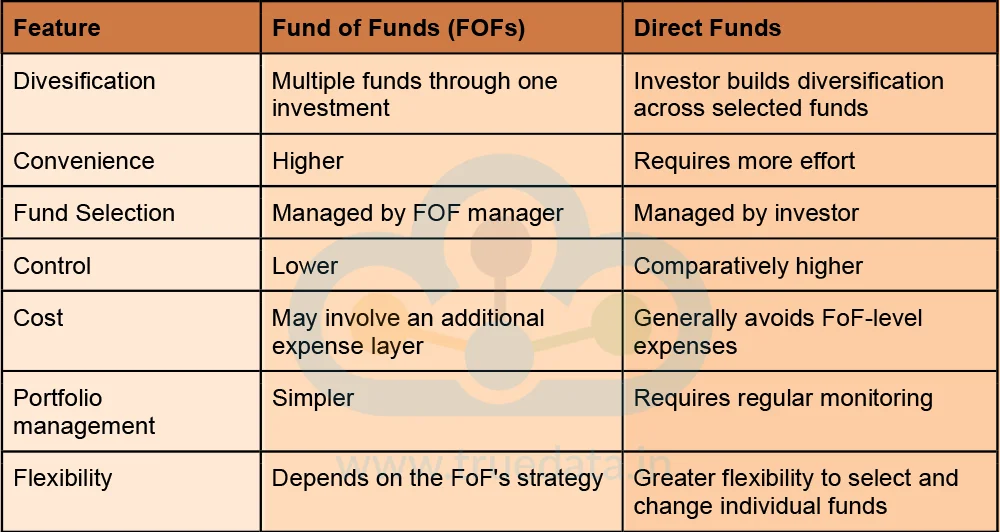
The choice between a Fund of Funds (FoF) and investing directly in mutual funds depends on the investor's goals, knowledge, time available for portfolio management and willingness to pay for convenience. The following points of comparison can help investors make the decision.

When to Choose an FoF vs. Direct Funds

Feature

Fund of Funds (FOFs)

Direct Funds

Divesification

Multiple funds through one investment

Investor builds diversification across selected funds

Convenience

Higher

Requires more effort

Fund Selection

Managed by FOF manager

Managed by investor

Control

Lower

Comparatively higher

Cost

May involve an additional expense layer

Generally avoids FoF-level expenses

Portfolio management

Simpler

Requires regular monitoring

Flexibility

Depends on the FoF's strategy

Greater flexibility to select and change individual funds

Conclusion

Fund of Funds (FoFs) can be a convenient way for investors to gain exposure to multiple mutual funds through a single investment. They can offer diversification, professional fund selection and easier portfolio management, but they may also involve an additional layer of expenses and other considerations. Therefore, investors should look beyond past returns and evaluate the underlying funds, total costs, portfolio overlap, risk, taxation and investment objective before investing. Ultimately, an FoF can be a useful addition to a portfolio when the convenience and diversification it offers justify the additional cost.

This article explains an important category of mutual funds and how they can fit in a portfolio. Let us know your thoughts on the topic or if you need further information, and we will address it soon. 

Till then, Happy Reading! 


Read More: What is Portfolio Management Services? 

Frequently Asked Questions

FoFs may be suitable for investors who want diversification and professional fund selection through a single investment and prefer a simpler way to manage their portfolio. They may also be useful for investors seeking exposure to specific asset classes, strategies or markets that may be difficult to access or manage directly.

Investors may incur expenses at both the FoF and underlying-fund levels, which can make the overall cost higher than investing directly in a mutual fund. Investors should therefore check the FoF's expense ratio, underlying fund expenses and any applicable exit load before investing.

Most Fund of Funds in India are taxed as debt fund income, i.e., both short-term and long-term capital gains are added to the total income and taxed at the applicable income tax slab rate, regardless of how much equity exposure the underlying funds may have. However, FoFs that invest predominantly in overseas funds or ETFs may have different tax treatment depending on their structure, so it is always advisable to check the specific scheme's tax classification or consult a tax advisor before investing.

An investor should evaluate the FoF by checking its investment objective, underlying funds, portfolio overlap, expense ratio, risk, past performance and tax implications. It is also important to assess whether the convenience and diversification offered by the FoF justify its overall costs.

A Fund of Funds (FoF) can invest across multiple underlying funds based on its investment strategy, while a feeder fund typically invests most or all of its assets in a single target fund. BITs (Business/Investment Trusts) are structured differently from mutual fund FoFs and should not be treated as the same type of investment product.
Marisha Bhatt

Marisha Bhatt is a financial content writer @TrueData.

She writes with the sole aim of simplifying complex financial concepts and jargon while attempting to clarify technical and fundamental analysis concepts of the stock markets. The ultimate goal is to spread vital knowledge and benefit the maximum audience. Her Chartered Accountant background acts as the knowledge base to help clarify crucial concepts and create a sound investment portfolio.

10 Comments
V
Viswanath
· September 26, 2026

The FoF vs direct mutual fund comparison is helpful, especially the points about convenience, control, diversification and overall costs.

·
K
Krishna Praba
· September 26, 2026

This article gives a clear explanation of the double expense concern in Fund of Funds.

·
S
Satish Ram
· September 26, 2026

Hello mam, Can a Fund of Funds be useful for beginners who do not have enough time to research and manage multiple mutual fund schemes?

·
A
Arpita Koel
· September 26, 2026

The taxation section is something many investors may overlook while comparing FoFs with direct mutual funds.

·
N
Nitish N
· September 26, 2026

Very useful blog for anyone trying to understand whether Fund of Funds actually provide additional value or simply add another layer of cost to a portfolio.

·
N
Nitish N
· September 26, 2026

How should investors compare the total cost of an FoF with investing directly in its underlying mutual funds?

·
A
Aarthi
· September 26, 2026

Nice Blog

·
P
Purusothaman
· September 26, 2026

Nice post

·
A
Anishma
· September 26, 2026

I have a small doubt about the expense ratio section. Does the total expense mentioned include both the FoF's own expense ratio and the expenses charged by the underlying funds?

·
R
Ranjith
· September 26, 2026

Good

·

Related Articles

SEE ALL
Mutual Funds
Mutual Funds
What is XIRR in mutual funds? How is it calculated?

Your mutual fund has delivered impressive returns, but are those the actual retu...

Mutual Funds
Mutual Funds
How to Complain About Mutual Funds?

Mutual fund investments have simplified greatly with just a tap on your smartpho...

Mutual Funds
Mutual Funds
Difference Between Active Mutual Funds and Passive Mutual Funds

Many investors think thatmutual fund investing is simply selecting a fund and wa...

Relevant Tags